

ISSN 1671-3710
CN 11-4766/R
主办:中国科学院心理研究所
出版:科学出版社
CN 11-4766/R
主办:中国科学院心理研究所
出版:科学出版社
心理科学进展 ›› 2026, Vol. 34 ›› Issue (6): 1049-1057.doi: 10.3724/SP.J.1042.2026.1049 cstr: 32111.14.2026.1049
张静1,2, 孙庆洲3( ), 朱红缨1,2, 汪群龙1,2, 陈宇航1
收稿日期:2025-09-24
出版日期:2026-06-15
发布日期:2026-04-17
通讯作者:
孙庆洲, E-mail: sunqingzhou2008@163.com基金资助:
ZHANG Jing1,2, SUN Qingzhou3(), ZHU Hongying1,2, WANG Qunlong1,2, CHEN Yuhang1
Received:2025-09-24
Online:2026-06-15
Published:2026-04-17
摘要:
孤独症儿童与典型发展儿童互惠行为存在诸多差异。以往基于他人视角的系列理论存在诸多矛盾。本文基于双加工理论, 引入自我−他人区分视角, 提出孤独症儿童的自我中心偏向和典型发展儿童的他人中心偏向共同诱发了两类儿童互惠差异, 若为前者凸显他人视角, 可能会诱发该群体的他人中心偏向, 使其互惠行为更接近后者, 进而缩小互惠差异。未来还需进一步剥离任务参数的潜在影响、深入剖析两类儿童互惠路径差异、开发科学高效的互惠行为干预模式。
中图分类号:
张静, 孙庆洲, 朱红缨, 汪群龙, 陈宇航. (2026). 孤独症儿童与典型发展儿童互惠行为差异:自我−他人区分的视角. 心理科学进展 , 34(6), 1049-1057.
ZHANG Jing, SUN Qingzhou, ZHU Hongying, WANG Qunlong, CHEN Yuhang. (2026). Differences in reciprocal behavior between children with autism spectrum disorder and typically developing children: From the perspective of self-other distinction. Advances in Psychological Science, 34(6), 1049-1057.
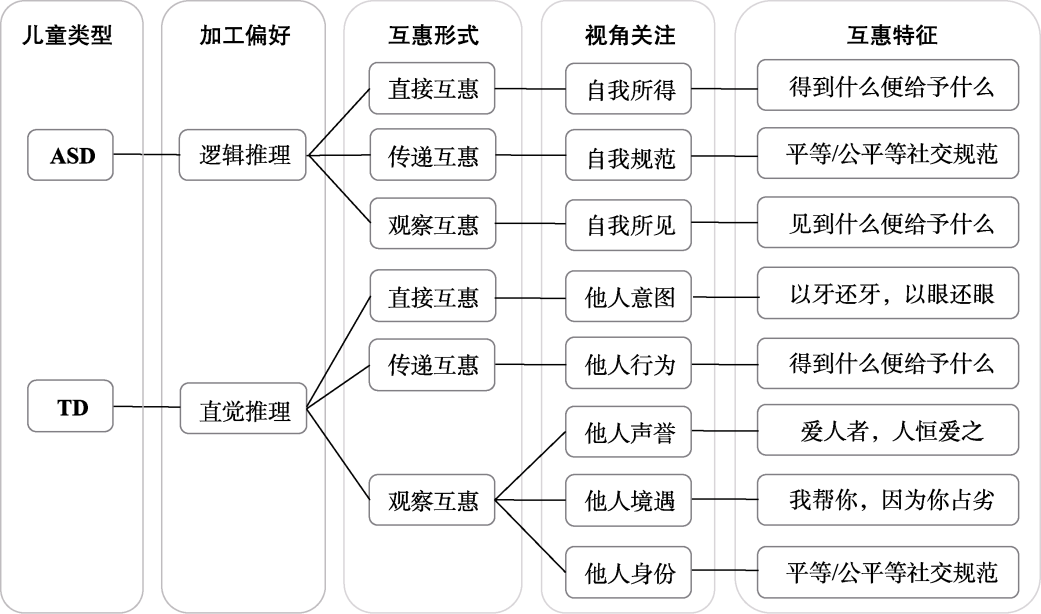
图1 ASD儿童与TD儿童互惠差异路径图
| [1] |
寇娟, 杨梦圆, 魏子杰, 雷怡. (2023). 自闭症谱系障碍社交动机理论:机制及干预探索. 心理科学进展, 31(1), 20-32.
doi: 10.3724/SP.J.1042.2023.00020 |
| [2] | 苏彦捷, 马天舒. (2014). 孤独症儿童的公平决策: 心理理论和自我/他人情绪识别的作用. 心理科学, 37(4), 985-992. |
| [3] | 魏予昕, 王志丹, 周睿, 康琴, 毕若妍. (2019). 自闭症儿童与普通儿童模仿能力的比较研究. 中国特殊教育, (10), 26-33. |
| [4] |
谢东杰, 路浩, 苏彦捷. (2018). 学龄前儿童分配模式的传递效应:心理理论和共情的作用. 心理学报, 50(9), 1018-1028.
doi: 10.3724/SP.J.1041.2018.01018 |
| [5] |
徐慧, 王滔. (2022). 自闭症谱系障碍个体的社会动机缺陷. 心理科学进展, 30(5), 1050-1061.
doi: 10.3724/SP.J.1042.2022.01050 |
| [6] | 张静, 林青, 陈立富, 孙庆洲, 杨福义. (2024). 孤独症儿童互惠行为特征: 自我-他人区分的视角. 应用心理学, 30(1), 44-55. |
| [7] | 张静, 杨福义, 孙庆洲. (2023). 双加工理论视角下孤独症儿童的分配平等性. 应用心理学, 29(1), 60-70. |
| [8] |
Akin-Bulbul, I., & Ozdemir, S. (2023). Imitation performance in children with autism and the role of visual attention in imitation. Journal of Autism and Developmental Disorders, 53(12), 4604-4617.
doi: 10.1007/s10803-022-05726-5 |
| [9] |
Alnafjan, A., Alghamdi, M., Alhakbani, N., & Al-Ohali, Y. (2025). Improving imitation skills in children with autism spectrum disorder using the NAO robot and a human action recognition. Diagnostics, 15(1), 60.
doi: 10.3390/diagnostics15010060 URL |
| [10] |
Baez, S., Rattazzi, A., Gonzalez-Gadea, M. L., Torralva, T., Vigliecca, N. S., Decety, J., ... Ibanez, A. (2012). Integrating intention and context: Assessing social cognition in adults with Asperger syndrome. Frontiers in Human Neuroscience, 6, 302.
doi: 10.3389/fnhum.2012.00302 pmid: 23162450 |
| [11] |
Baron-Cohen, S. (2002). The extreme male brain theory of autism. Trends in Cognitive Sciences, 6(6), 248-254.
doi: 10.1016/s1364-6613(02)01904-6 pmid: 12039606 |
| [12] | Baron-Cohen, S. (2009). Autism:The empathizing-systemizing (E-S) theory. Annals of the New York Academy of Sciences, 1156(1), 68-80. |
| [13] |
Brosnan, M., Ashwin, C., & Lewton, M. (2017). Brief report: Intuitive and reflective reasoning in autism spectrum disorder. Journal of Autism and Developmental Disorders, 47(8), 2595-2601.
doi: 10.1007/s10803-017-3131-3 pmid: 28474227 |
| [14] |
Caldwell, M. P., Cheung, H., Cheung, S. K., Li, J. B., & Carrey Siu, T. S. (2022). Visuospatial perspective-taking in social-emotional development: Enhancing young children’s mind and emotion understanding via block building training. BMC Psychology, 10(1), 264.
doi: 10.1186/s40359-022-00976-5 pmid: 36371295 |
| [15] |
Carter Leno, V., Naples, A., Cox, A., Rutherford, H., & McPartland, J. C. (2016). Common and distinct modulation of electrophysiological indices of feedback processing by autistic and psychopathic traits. Social Neuroscience, 11(4), 455-466.
doi: 10.1080/17470919.2015.1108223 pmid: 26471250 |
| [16] |
Chang, J. C., Lai, M. C., Chang, S. S., & Gau, S. S. F. (2024). Factors mediating pre-existing autism diagnosis and later suicidal thoughts and behaviors: A follow-up cohort study. Autism, 28(9), 2218-2231.
doi: 10.1177/13623613231223626 URL |
| [17] |
Chevallier, C., Kohls, G., Troiani, V., Brodkin, E. S., & Schultz, R. T. (2012). The social motivation theory of autism. Trends in Cognitive Sciences, 16(4), 231-239.
doi: 10.1016/j.tics.2012.02.007 pmid: 22425667 |
| [18] |
Dahary, H., Rimmer, C., Kaedbey, M., & Quintin, E. M. (2023). A systematic review of shared social activities for children on the autism spectrum and their peers. Review Journal of Autism and Developmental Disorders, 10(4), 771-792.
doi: 10.1007/s40489-022-00322-w |
| [19] |
Dawson, G., Rieder, A. D., & Johnson, M. H. (2023). A developmental social neuroscience perspective on infant autism interventions. Annual Review of Developmental Psychology, 5(1), 89-113.
doi: 10.1146/devpsych.2023.5.issue-1 URL |
| [20] |
Dodge, K. A., & Crick, N. R. (1990). Social information- processing bases of aggressive behavior in children. Personality and Social Psychology Bulletin, 16(1), 8-22.
doi: 10.1177/0146167290161002 URL |
| [21] |
Dunfield, K. A., Best, L. J., Kelley, E. A., & Kuhlmeier, V. A. (2019). Motivating moral behavior: Helping, sharing, and comforting in young children with autism spectrum disorder. Frontiers in Psychology, 10, 25.
doi: 10.3389/fpsyg.2019.00025 pmid: 30728793 |
| [22] |
Epstein, S., Pacini, R., Denes-Raj, V., & Heier, H. (1996). Individual differences in intuitive-experiential and analytical- rational thinking styles. Journal of Personality and Social Psychology, 71(2), 390-405.
doi: 10.1037//0022-3514.71.2.390 pmid: 8765488 |
| [23] |
Forbes, P. A., Chaliani, I., Schilbach, L., & Kalenscher, T. (2024). Autistic adults show enhanced generosity to socially distant others. Autism, 28(4), 999-1009.
doi: 10.1177/13623613231190674 URL |
| [24] |
Gray, K., Ward, A. F., & Norton, M. I. (2014). Paying it forward: Generalized reciprocity and the limits of generosity. Journal of Experimental Psychology: General, 143(1), 247-254.
doi: 10.1037/a0031047 URL |
| [25] |
Hansen, S. G., Frantz, R. J., Machalicek, W., & Raulston, T. J. (2017). Advanced social communication skills for young children with autism: A systematic review of single-case intervention studies. Review Journal of Autism and Developmental Disorders, 4(3), 225-242.
doi: 10.1007/s40489-017-0110-8 URL |
| [26] |
Hartley, C., & Fisher, S. (2018). Do children with autism spectrum disorder share fairly and reciprocally? Journal of Autism and Developmental Disorders, 48(8), 2714-2726.
doi: 10.1007/s10803-018-3528-7 pmid: 29512018 |
| [27] |
He, J., Bore, M. C., Jiang, H., Gan, X., Wang, J., Li, J., ... & Becker, B. (2025). Neural basis of pain empathy dysregulations in mental disorders: A preregistered neuroimaging meta- analysis. Biological Psychiatry: Cognitive Neuroscience and Neuroimaging, 10(2), 127-137.
doi: 10.1016/j.bpsc.2024.08.019 URL |
| [28] |
Hepach, R., Hedley, D., & Nuske, H. J. (2020). Prosocial attention in children with and without autism spectrum disorder: Dissociation between anticipatory gaze and internal arousal. Journal of Abnormal Child Psychology, 48(4), 589-605.
doi: 10.1007/s10802-019-00606-6 pmid: 31883039 |
| [29] |
Hill, E. L. (2004). Evaluating the theory of executive dysfunction in autism. Developmental Review, 24(2), 189-233.
doi: 10.1016/j.dr.2004.01.001 URL |
| [30] |
Horstmann, A. C., Mühl, L., Köppen, L., Lindhaus, M., Storch, D., Bühren, M., ... Krajewski, J. (2022). Important preliminary insights for designing successful communication between a robotic learning assistant and children with autism spectrum disorder in Germany. Robotics, 11(6), 141.
doi: 10.3390/robotics11060141 URL |
| [31] |
Humphrey, N., & Symes, W. (2011). Peer interaction patterns among adolescents with autistic spectrum disorders (ASDs) in mainstream school settings. Autism, 15(4), 397-419.
doi: 10.1177/1362361310387804 pmid: 21454385 |
| [32] |
Humphreys, C., Novy, L., Cergovski, N., Lai, H. C., & McVilly, K. (2023). The impact of COVID-19 lockdown on parents and young people with autism spectrum disorder (ASD). Australian Social Work, 77(2), 183-195.
doi: 10.1080/0312407X.2023.2186254 URL |
| [33] |
Jin, P., Wang, Y., Li, Y., Xiao, Y., Li, C., Qiu, N., ... Ke, X. (2020). The fair decision-making of children and adolescents with high-functioning autism spectrum disorder from the perspective of dual-process theories. BMC Psychiatry, 20(1), 1-11.
doi: 10.1186/s12888-019-2374-2 |
| [34] |
Keifer, C. M., Mikami, A. Y., Morris, J. P., Libsack, E. J., & Lerner, M. D. (2020). Prediction of social behavior in autism spectrum disorders: Explicit versus implicit social cognition. Autism, 24(7), 1758-1772.
doi: 10.1177/1362361320922058 URL |
| [35] |
Klapwijk, E. T., Aghajani, M., Lelieveld, G. J., van Lang, N. D. J., Popma, A., van der, Wee, N., J. A., Colins, O. F., & Vermeiren, R. R. J. M. (2017). Differential fairness decisions and brain responses after expressed emotions of others in boys with autism spectrum disorders. Journal of Autism and Developmental Disorders, 47(8), 2390-2400.
doi: 10.1007/s10803-017-3159-4 pmid: 28516421 |
| [36] |
Lewton, M., Ashwin, C., & Brosnan, M. (2019). Syllogistic reasoning reveals reduced bias in people with higher autistic-like traits from the general population. Autism, 23(5), 1311-1321.
doi: 10.1177/1362361318808779 pmid: 30409029 |
| [37] | Li, X. H., Lui, M., Song, X. K., Li, Y. R., Liu, X. Y., Pi, R., & So, W. C. (2025). Comparative effectiveness of human- and robot-based interventions in increasing empathy among autistic children. Journal of Autism and Developmental Disorders. https://doi.org/10.1007/s10803-025-07054-w |
| [38] |
McAuliffe, K., Raihani, N. J., & Dunham, Y. (2017). Children are sensitive to norms of giving. Cognition, 167, 151-159.
doi: S0010-0277(17)30006-9 pmid: 28129890 |
| [39] |
Ni, P., Xue, L., Cai, J., Wen, M., & He, J. (2021). Improving visual perspective-taking performance in children with autism spectrum conditions: Effects of embodied self- rotation and object based mental rotation strategies. Autism, 25(1), 125-136.
doi: 10.1177/1362361320949352 URL |
| [40] |
Nowak, M. A., & Sigmund, K. (2005). Evolution of indirect reciprocity. Nature, 437(7063), 1291-1298.
doi: 10.1038/nature04131 |
| [41] |
Olson, K. R., & Spelke, E. S. (2008). Foundations of cooperation in young children. Cognition, 108(1), 222-231.
doi: 10.1016/j.cognition.2007.12.003 pmid: 18226808 |
| [42] |
Papageorgopoulou, E., Jones, E. J., Johnson, M. H., Charman, T., Green, J., Wan, M. W., & BASIS‐STAARS, Team. (2024). Parent-infant interaction trajectories in infants with an elevated likelihood for autism in relation to 3-year clinical outcome. Autism Research, 17(10), 2018-2029.
doi: 10.1002/aur.3190 pmid: 38940216 |
| [43] |
Paulus, M., & Rosal-Grifoll, B. (2017). Helping and sharing in preschool children with autism. Experimental Brain Research, 235(7), 2081-2088.
doi: 10.1007/s00221-017-4947-y pmid: 28386711 |
| [44] |
Pelligra, V., Isoni, A., Fadda, R., & Doneddu, G. (2015). Theory of mind, perceived intentions and reciprocal behaviour: Evidence from individuals with autism spectrum disorder. Journal of Economic Psychology, 49, 95-107.
doi: 10.1016/j.joep.2015.05.001 URL |
| [45] | Peters, O., & Adamou, A. (2022). The ergodicity solution of the cooperation puzzle. Philosophical Transactions of the Royal Society A, 380(2227), 20200425. |
| [46] |
Ramirez-Duque, A. A., Bastos, T., Munera, M., Cifuentes, C. A., & Frizera-Neto, A. (2020). Robot-assisted intervention for children with special needs: A comparative assessment for autism screening. Robotics and Autonomous Systems, 127, 103484.
doi: 10.1016/j.robot.2020.103484 URL |
| [47] |
Rankin, D. J., & Taborsky, M. (2009). Assortment and the evolution of generalized reciprocity. Evolution, 63(7), 1913-1922.
doi: 10.1111/j.1558-5646.2009.00656.x pmid: 19222566 |
| [48] |
Shalev, I., Warrier, V., Greenberg, D. M., Smith, P., Allison, C., Baron-Cohen, S., ... Uzefovsky, F. (2022). Reexamining empathy in autism: Empathic disequilibrium as a novel predictor of autism diagnosis and autistic traits. Autism Research, 15(10), 1917-1928.
doi: 10.1002/aur.2794 pmid: 36053924 |
| [49] |
Silva, C., Jover, C., Da Fonseca, D., Esteves, F., & Deruelle, C. (2020). Acting on observed social exclusion and pro- social behaviour in autism spectrum disorder. Autism, 24(1), 233-245.
doi: 10.1177/1362361319857578 URL |
| [50] | Steinbeis, N. (2016). The role of self-other distinction in understanding others' mental and emotional states: Neurocognitive mechanisms in children and adults. Philosophical Transactions of the Royal Society B: Biological Sciences, 371(1686), 20150074. |
| [51] |
Townsend, L., Robeson, A., Vonk, J., & Rohrbeck, K. (2021). Autism does not dictate children’s lack of sharing in a prosocial choice test. Journal of Autism and Developmental Disorders, 51(6), 2029-2035.
doi: 10.1007/s10803-020-04691-1 |
| [52] |
Van Hoorn, J., Van Dijk, E., Crone, E. A., Stockmann, L., & Rieffe, C. (2017). Peers influence prosocial behavior in adolescent males with autism spectrum disorders. Journal of Autism and Developmental Disorders, 47(7), 2225-2237.
doi: 10.1007/s10803-017-3143-z pmid: 28484974 |
| [53] |
Wen, N. J., Clegg, J. M., & Legare, C. H. (2019). Smart conformists: Children and adolescents associate conformity with intelligence across cultures. Child Development, 90(3), 746-758.
doi: 10.1111/cdev.12935 pmid: 28836660 |
| [54] |
Woodcock, K. A., Cheung, C., Marx, D. G., & Mandy, W. (2020). Social decision making in autistic adolescents: The role of theory of mind, executive functioning and emotion regulation. Journal of Autism and Developmental Disorders, 50(7), 2501-2512.
doi: 10.1007/s10803-019-03975-5 pmid: 30879258 |
| [55] |
Wörle, M., Essler, S., & Paulus, M. (2020). Paying it back and forward: The impact of experiencing and observing others’ sharing and stinginess on preschoolers’ own sharing behavior and expectations. Journal of Experimental Child Psychology, 198, 104886.
doi: 10.1016/j.jecp.2020.104886 URL |
| [56] |
Zhang, J., Sun, Q., Liu, X., & Yang, F. (2022). Ultra-light clay intervention improves responsiveness and initiates the communication of children with ASD. Frontiers in Psychology, 13, 804488.
doi: 10.3389/fpsyg.2022.804488 URL |
| [57] |
Zhang, J., Sun, Q., Zhu, H., & Wang, Q. (2025). Same behavior, different perspectives: Direct reciprocity differences between children with autism and children with typical development. BMC Psychiatry, 25(1), 1151.
doi: 10.1186/s12888-025-07608-3 |
| [1] | 楚克群, 朱风书. 结构化身体活动改善孤独症儿童社交障碍的作用机制:基于情绪加工系统激活的视角[J]. 心理科学进展, 2026, 34(1): 134-143. |
| [2] | 王慧, 韩卓. 孤独症儿童社交沟通障碍的神经生理机制:基于亲子同步性的视角[J]. 心理科学进展, 2025, 33(9): 1483-1497. |
| [3] | 杨童舒, 黄艳利, 谢久书. 孤独症儿童跨情境词汇学习障碍的认知机制[J]. 心理科学进展, 2025, 33(8): 1367-1378. |
| [4] | 谢婷婷, 王丽娟. 动作编码促进孤独症谱系障碍学龄儿童记忆的影响因素及机制[J]. 心理科学进展, 2025, 33(6): 1067-1076. |
| [5] | 曹守静, 王馨. 以全新视角看待孤独症的社交沟通:双重共情问题[J]. 心理科学进展, 2025, 33(4): 539-547. |
| [6] | 单晓龙, 陈华富, 段旭君. 孤独症谱系障碍多模态磁共振脑影像模式识别[J]. 心理科学进展, 2025, 33(4): 548-564. |
| [7] | 涂海霞, 翁旭初, 徐波. 小脑异常发育与孤独症谱系障碍的关系[J]. 心理科学进展, 2025, 33(4): 565-573. |
| [8] | 翁玉悦, 翁旭初, 耿红岩. 孤独症中不同大脑活动相关的基因表达变化[J]. 心理科学进展, 2025, 33(4): 574-587. |
| [9] | 杨平, 方润秋, 翁旭初. 孤独症谱系障碍儿童非典型面部表情特征及其在早期筛查中的应用[J]. 心理科学进展, 2025, 33(4): 588-597. |
| [10] | 田仁霞, 杨平, 郭园园, 吴瑕. 治疗孤独症谱系障碍:重复经颅磁刺激的潜在作用[J]. 心理科学进展, 2025, 33(4): 598-610. |
| [11] | 范桂容, 翁旭初, 耿红岩. 炎症性肠病与儿童孤独症谱系障碍的关系[J]. 心理科学进展, 2025, 33(4): 611-619. |
| [12] | 周爱保, 袁月. 高功能孤独症自我加工的机制与干预[J]. 心理科学进展, 2025, 33(2): 212-222. |
| [13] | 陈丽君, 靳悦鑫, 曾涵菡, 蒋销柳. 孤独症谱系障碍儿童语音情绪识别的障碍:韵律、语义还是整合困难?——基于三水平元分析的探究[J]. 心理科学进展, 2025, 33(12): 2083-2104. |
| [14] | 付春野, 李艾馨, 吕小康, 王崇颖. 孤独症谱系障碍者的视觉感知:基于贝叶斯和预测编码视角[J]. 心理科学进展, 2024, 32(7): 1164-1178. |
| [15] | 荆伟, 陈琦, 薛云卿, 杨苗, 张婕. 孤独症者的预测编码缺陷:前馈联结异常还是反馈联结异常?[J]. 心理科学进展, 2024, 32(5): 813-833. |
| 阅读次数 | ||||||
|
全文 |
|
|||||
|
摘要 |
|
|||||
