

ISSN 1671-3710
CN 11-4766/R
主办:中国科学院心理研究所
出版:科学出版社
CN 11-4766/R
主办:中国科学院心理研究所
出版:科学出版社
心理科学进展 ›› 2026, Vol. 34 ›› Issue (5): 761-778.doi: 10.3724/SP.J.1042.2026.0761 cstr: 32111.14.2026.0761
• 研究构想 • 下一篇
赵庆柏1, 陈岩1, 周治金1, 陈石2,3( )
)
收稿日期:2025-10-20
出版日期:2026-05-15
发布日期:2026-03-20
通讯作者:
陈石, E-mail: chs22@hbucm.edu.cn基金资助:
ZHAO Qingbai1, CHEN Yan1, ZHOU Zhijin1, CHEN Shi2,3()
Received:2025-10-20
Online:2026-05-15
Published:2026-03-20
摘要:
以往研究虽然强调了无意识加工在顿悟问题解决中的关键作用, 却未直接揭示其过程与加工信息如何交互。本研究旨在探讨顿悟中关键的弱关联信息如何由无意识进入意识, 以及执行功能如何调控该过程。为此, 我们提出一个无意识信息加工过程假设模型, 强调大脑在意识状态的变化过程中完成了强弱关联信息的更迭和替换, 从而促成了问题的顿悟解决。本研究结合多种行为及神经技术对这一问题进行系统考察, 有望揭示创造性问题解决的深层机制, 并为促进创造力的干预手段提供科学依据。
中图分类号:
赵庆柏, 陈岩, 周治金, 陈石. (2026). 从无意识到意识:执行功能调控下顿悟问题解决的信息加工过程. 心理科学进展 , 34(5), 761-778.
ZHAO Qingbai, CHEN Yan, ZHOU Zhijin, CHEN Shi. (2026). From unconscious to conscious: Executive deactivation drives information replacement in insight problem-solving. Advances in Psychological Science, 34(5), 761-778.
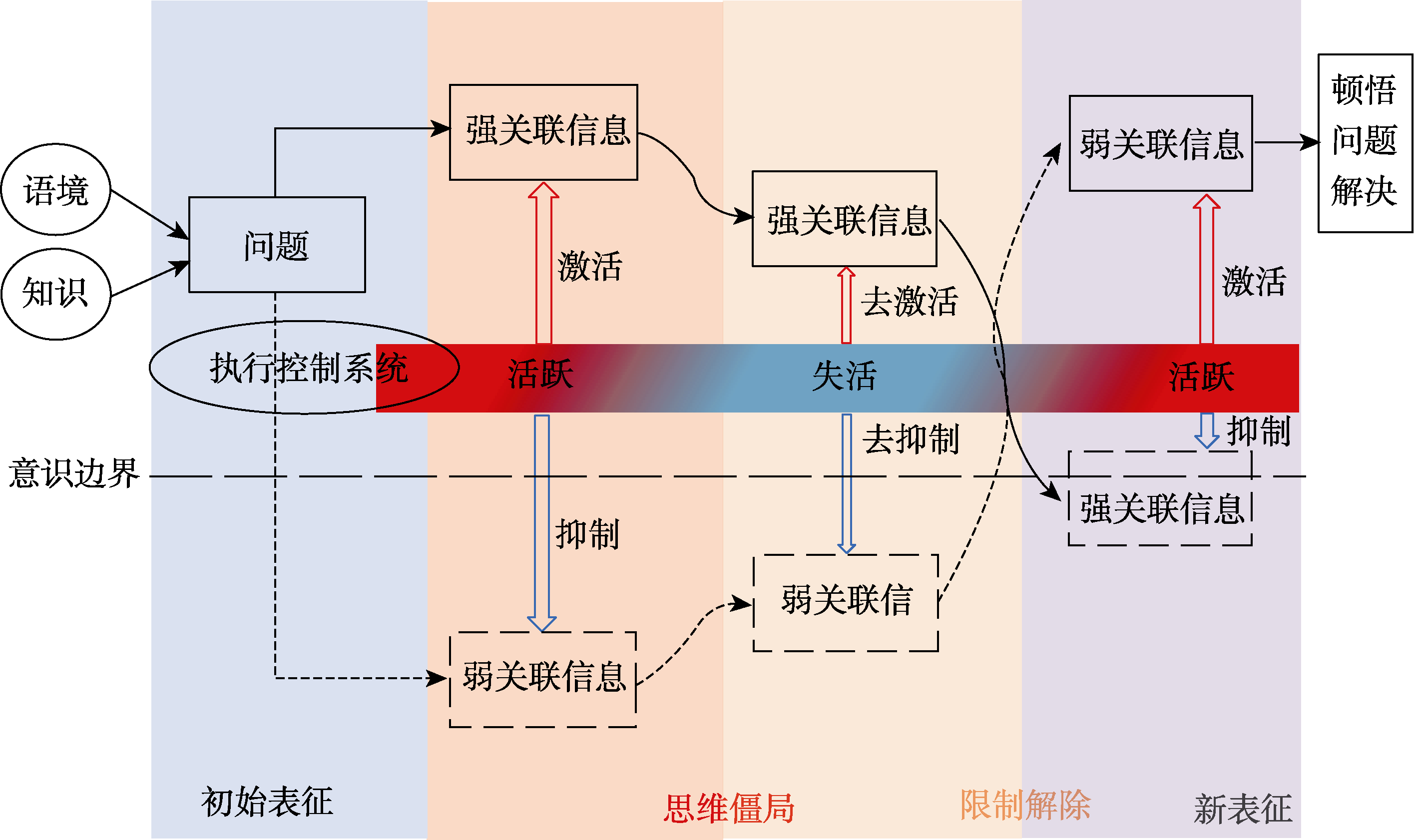
图1 顿悟问题解决的信息无意识加工过程假设模型 注:彩图见电子版, 下同
| 谜面 | 谜底 | 强关联信息 | 弱关联信息 | 无效信息 |
|---|---|---|---|---|
| 越做越快 | 积劳成疾 | 熟练 | 疾病 | 快乐 |
| 民航局开业 | 有机可乘 | 飞机 | 机会 | 天空 |
| 观光 | 一览无余 | 风景 | 剩余 | 光亮 |
表1 成语谜语任务材料举例
| 谜面 | 谜底 | 强关联信息 | 弱关联信息 | 无效信息 |
|---|---|---|---|---|
| 越做越快 | 积劳成疾 | 熟练 | 疾病 | 快乐 |
| 民航局开业 | 有机可乘 | 飞机 | 机会 | 天空 |
| 观光 | 一览无余 | 风景 | 剩余 | 光亮 |
| 问题 | 答案 | 正确组合1 | 正确组合2 | 正确组合3 |
|---|---|---|---|---|
| fish/mine/rush | gold | gold fish | gold mine | gold rush |
| basket/eight/snow | ball | basketball | eight ball | snowball |
| age/mile/sand | stone | stone age | milestone | sandstone |
表2 复合远距离联想任务材料举例
| 问题 | 答案 | 正确组合1 | 正确组合2 | 正确组合3 |
|---|---|---|---|---|
| fish/mine/rush | gold | gold fish | gold mine | gold rush |
| basket/eight/snow | ball | basketball | eight ball | snowball |
| age/mile/sand | stone | stone age | milestone | sandstone |
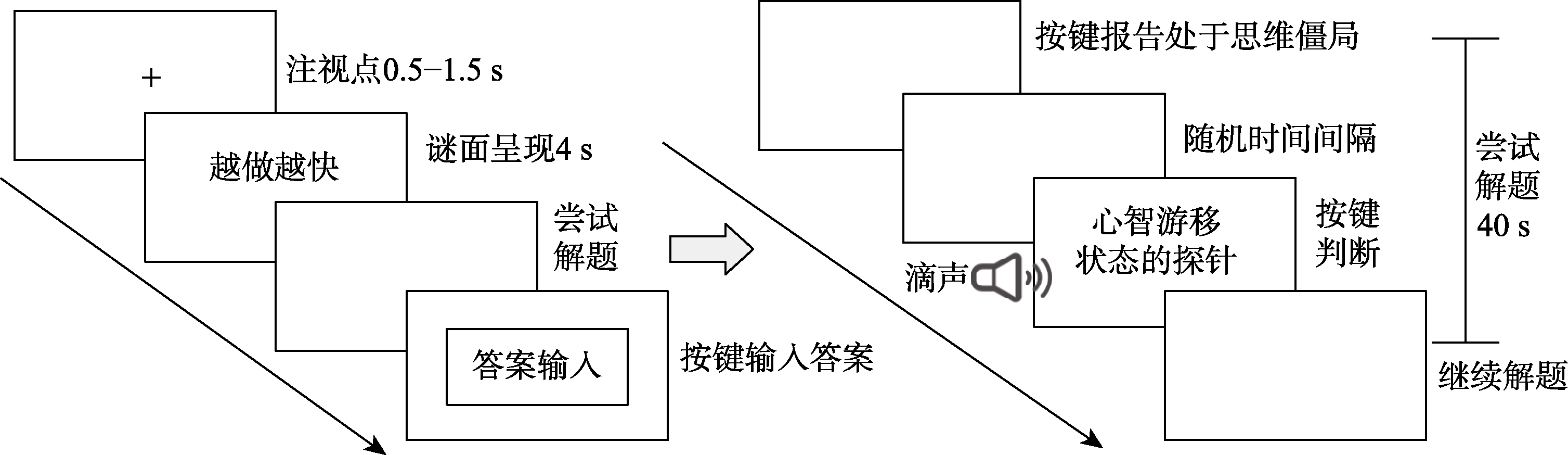
图2 实验1流程示意图
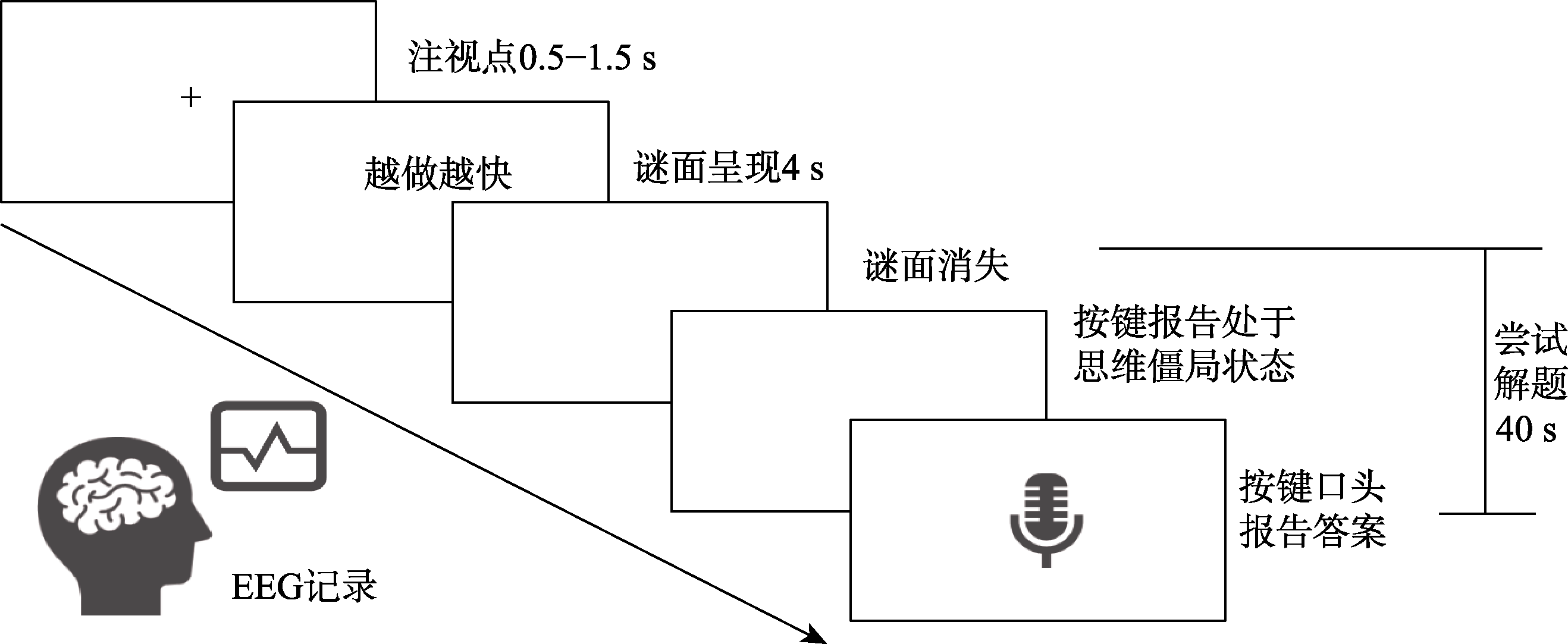
图3 实验2流程示意图
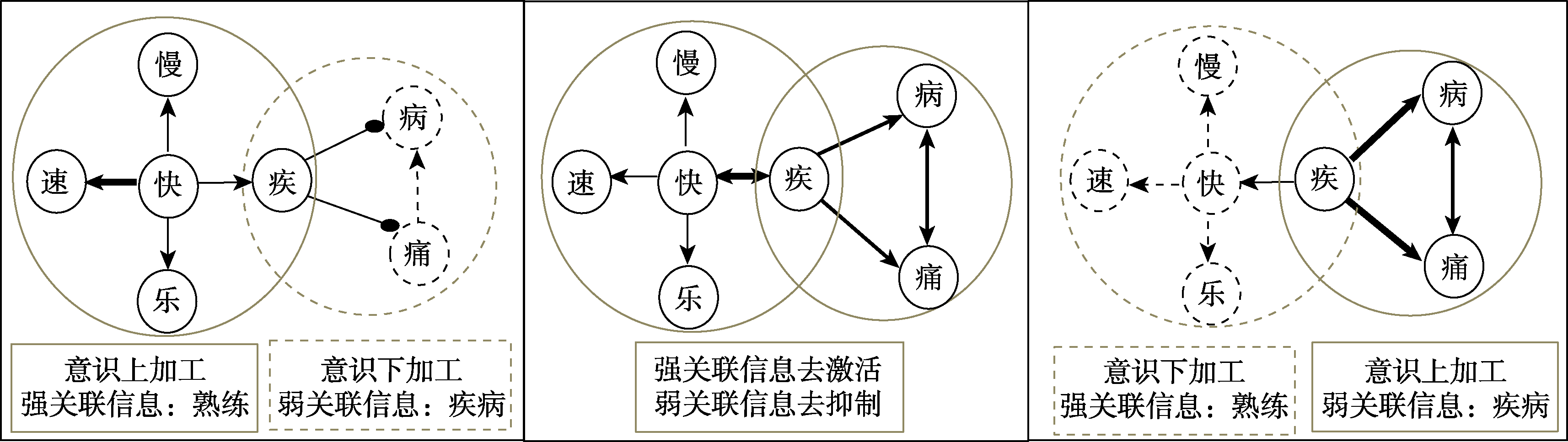
图4 成语谜语解题过程中相关语义信息加工示意图

图5 实验3流程示意图(探测词的呈现时间30 ms仅为示例)
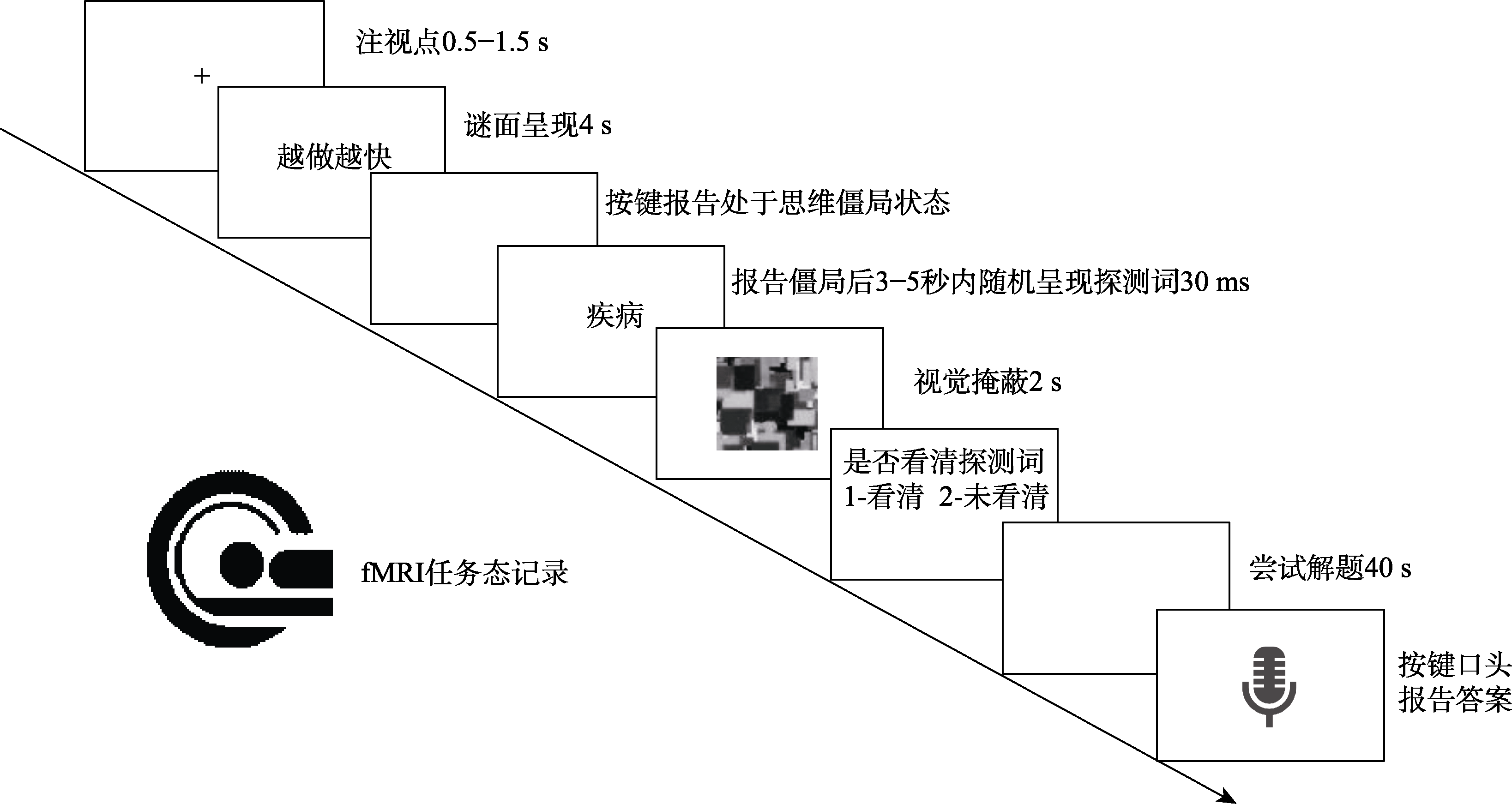
图6 实验4流程示意图 注:本图为探测词在僵局报告后呈现的条件, 且呈现时间30 ms仅为示例。

图7 表征相似性分析示意图。a) 根据刺激特征构建理论语义RDM; b) 根据神经激活模式构建神经表征RDM; c) 计算语义理论RDM和每个阶段神经RDM、以及每个阶段神经RDM之间的两两相关性
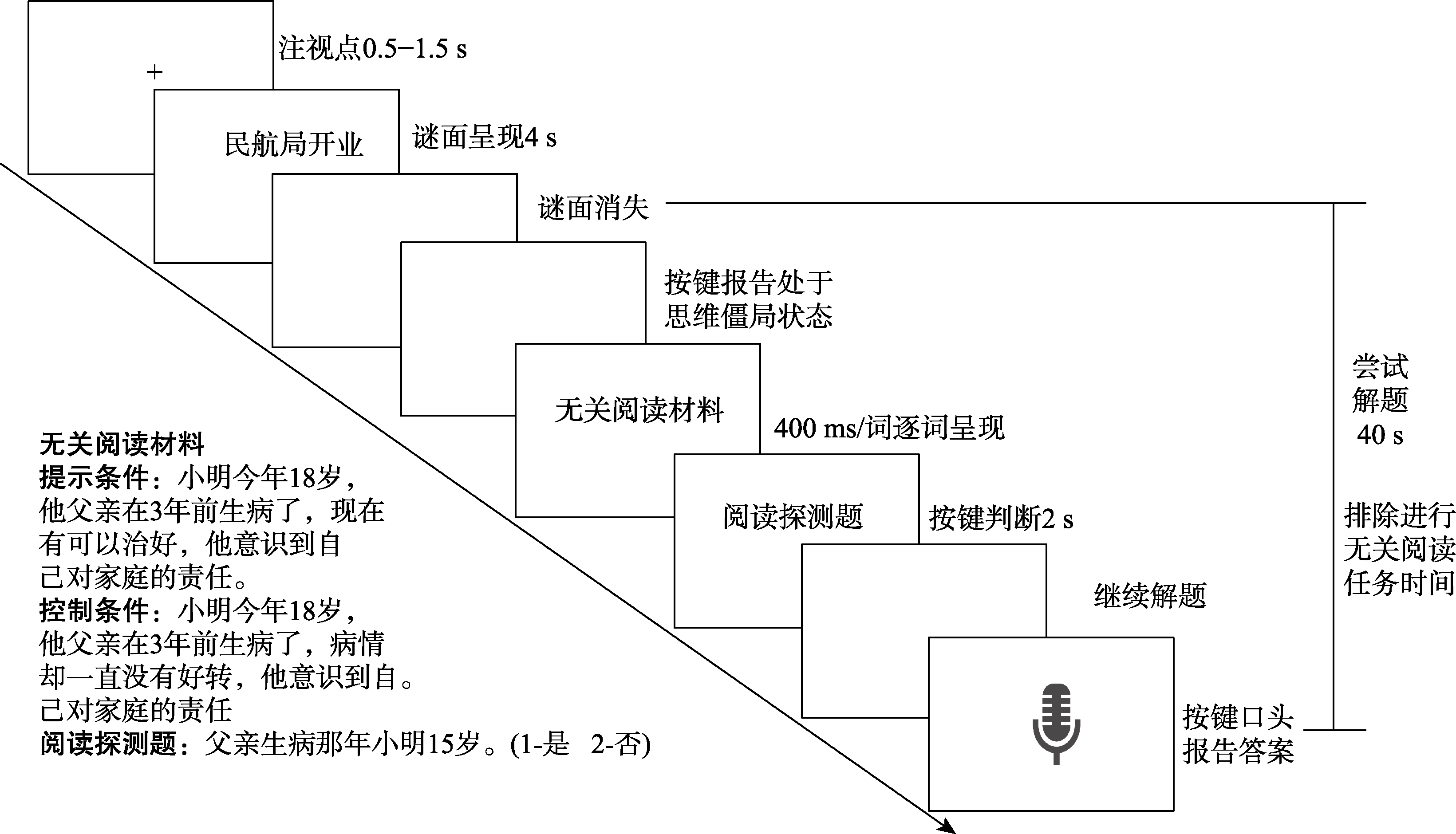
图8 实验5a流程示意图
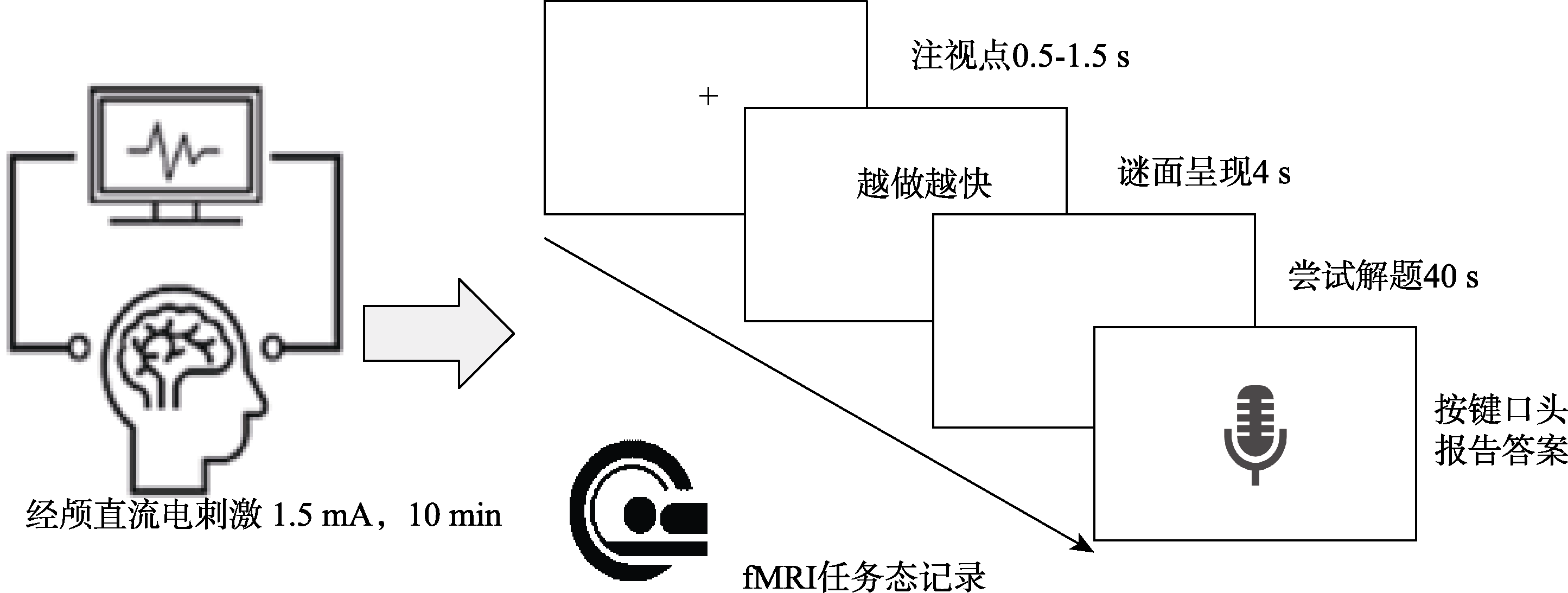
图9 实验6流程示意图
| 谜面 | 弱关联 答案 | 强关联 答案 | 无关 答案I | 无关 答案II |
|---|---|---|---|---|
| 越做越快 | 积劳成疾 | 熟能生巧 | 察言观色 | 言简意赅 |
| 民航局开业 | 有机可乘 | 开张大吉 | 刮目相看 | 急转直下 |
| 观光 | 一览无余 | 游山玩水 | 歌功颂德 | 至死不渝 |
表3 成语谜语答案选择任务材料举例
| 谜面 | 弱关联 答案 | 强关联 答案 | 无关 答案I | 无关 答案II |
|---|---|---|---|---|
| 越做越快 | 积劳成疾 | 熟能生巧 | 察言观色 | 言简意赅 |
| 民航局开业 | 有机可乘 | 开张大吉 | 刮目相看 | 急转直下 |
| 观光 | 一览无余 | 游山玩水 | 歌功颂德 | 至死不渝 |
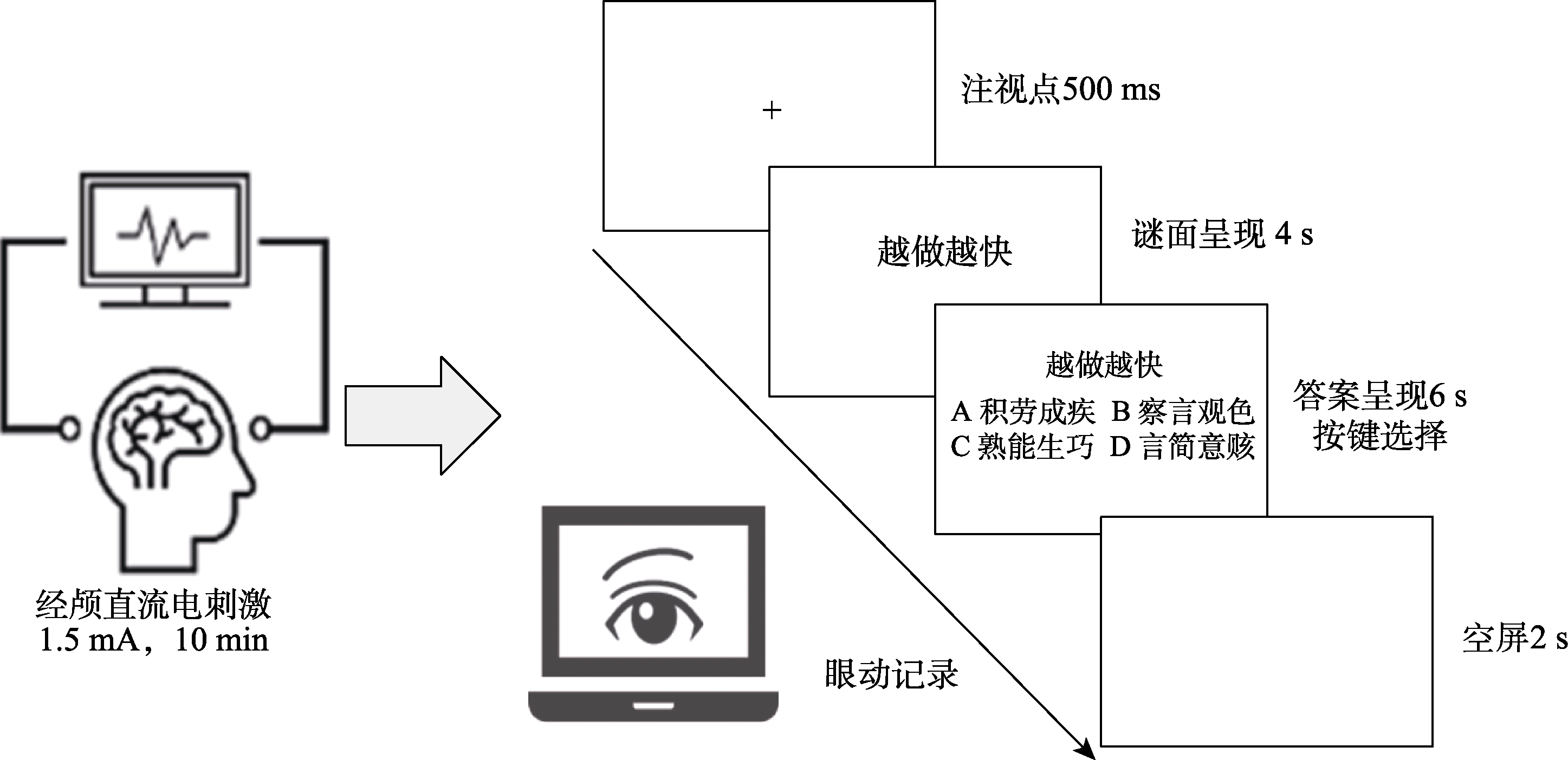
图10 实验8流程示意图
| [1] |
陈岩, 李瑛, 刘冠雄, 于全磊, 梁正, 陈石, 赵庆柏. (2026). 探索顿悟问题解决的微观动态神经加工模式. 心理学报, 58(4), 634-650.
doi: 10.3724/SP.J.1041.2026.0634 |
| [2] | 郭芳, 赵庆柏, 胡丽霞, 费昕媛, 陈石, 周治金. (2019). 执行功能子成分对创造性思维不同认知加工阶段的影响. 心理科学, 42(4), 790-797. |
| [3] | 黄福荣, 周治金, 赵庆柏. (2013). 汉语成语谜语问题解决中思路竞争的眼动研究. 心理学报, 45(1), 35-46. |
| [4] |
李子逸, 张泽, 张莹, 罗劲. (2022). 创造性思维的酝酿效应. 心理科学进展, 30(2), 291-307.
doi: 10.3724/SP.J.1042.2022.00291 |
| [5] | 邢强, 孙海龙, 占丹玲, 胡婧, 刘凯. (2017). 执行功能对言语顿悟问题解决的影响: 基于行为与ERPs的研究. 心理学报, 49(7), 909-919. |
| [6] | 邢强, 张忠炉, 孙海龙, 张金莲, 王菁. (2013). 字谜顿悟任务中限制解除和组块分解的机制及其原型启发效应. 心理学报, 45(10), 1061-1071. |
| [7] | 张庆林, 肖崇好. (1996). 顿悟与问题表征的转变. 心理学报, 28(1), 30-37. |
| [8] |
赵庆柏, 李松清, 陈石, 周治金, 成良. (2015). 创造性问题解决的动态神经加工模式. 心理科学进展, 23(3), 375-384.
doi: 10.3724/SP.J.1042.2015.00375 |
| [9] | 赵庆柏, 魏琳琳, 李瑛, 周治金, 赵黎莉, 唐磊. (2017). 新颖语义联结形成的右半球优势效应. 心理学报, 49(11), 1370-1382. |
| [10] | 朱新秤, 李瑞菊, 周治金. (2009). 谜语问题解决中线索的作用. 心理学报, 41(5), 397-405. |
| [11] | Beaty R. E., Benedek M., Barry Kaufman S., & Silvia P. J. (2015). Default and executive network coupling supports creative idea production. Scientific Reports, 5(1), 10964. |
| [12] | Bieth T., Ovando-Tellez M., Lopez-Persem A., Garcin B., Hugueville L., Lehongre K., … Volle E. (2024). Time course of EEG power during creative problem-solving with insight or remote thinking. Human Brain Mapping, 45(1), e26547. |
| [13] | Bilalić M., Graf M., Vaci N., & Danek A. H. (2019). The temporal dynamics of insight problem solving - restructuring might not always be sudden. Thinking & Reasoning, 27(1), 1-37. |
| [14] |
Bowden E. M., & Jung-Beeman M. (2007). Methods for investigating the neural components of insight. Methods, 42(1), 87-99.
pmid: 17434419 |
| [15] |
Bradley M. M., Miccoli L., Escrig M. A., & Lang P. J. (2008). The pupil as a measure of emotional arousal and autonomic activation. Psychophysiology, 45(4), 602-607.
doi: 10.1111/j.1469-8986.2008.00654.x pmid: 18282202 |
| [16] |
Brunoni A. R., Amadera J., Berbel B., Volz M. S., Rizzerio B. G., & Fregni F. (2011). A systematic review on reporting and assessment of adverse effects associated with transcranial direct current stimulation. International Journal of Neuropsychopharmacology, 14(8), 1133-1145.
doi: 10.1017/S1461145710001690 URL |
| [17] |
Christoff K., Gordon A. M., Smallwood J., Smith R., & Schooler J. W. (2009). Experience sampling during fMRI reveals default network and executive system contributions to mind wandering. Proceedings of the National Academy of Sciences of the United States of America, 106(21), 8719-8724.
doi: 10.1073/pnas.0900234106 pmid: 19433790 |
| [18] |
Dijksterhuis A., & Nordgren L. F. (2006). A theory of unconscious thought. Perspectives on Psychological Science, 1(2), 95-109.
doi: 10.1111/j.1745-6916.2006.00007.x pmid: 26151465 |
| [19] |
Fleming C. B., Stevens A. L., Vivero M., Patwardhan I., Nelson T. D., Nelson J. M., … Mason W. A. (2020). Executive control in early childhood as an antecedent of adolescent problem behaviors: A longitudinal study with performance-based measures of early childhood cognitive processes. Journal of Youth and Adolescence, 49(12), 2429-2440.
doi: 10.1007/s10964-020-01316-9 |
| [20] | Graesser A. C., & D'Mello S. (2012). Emotions during the learning of difficult material. In B. H. Ross (Ed.), The psychology of learning and motivation (pp. 183-225). Elsevier Academic Press. |
| [21] |
Haavold P. Ø., & Sriraman B. (2022). Creativity in problem solving: Integrating two different views of insight. ZDM-Mathematics Education, 54(1), 83-96.
doi: 10.1007/s11858-021-01304-8 |
| [22] |
Henok N., Vallée-Tourangeau F., & Vallée-Tourangeau G. (2020). Incubation and interactivity in insight problem solving. Psychological Research, 84(1), 128-139.
doi: 10.1007/s00426-018-0992-9 pmid: 29480412 |
| [23] |
Huang F., Zhao Q., Zhou Z., & Luo J. (2019). People got lost in solving a set of similar problems. NeuroImage, 186, 192-199.
doi: S1053-8119(18)32035-4 pmid: 30449716 |
| [24] | Jung-Beeman M., Bowden E. M., Haberman J., Frymiare J. L., Arambel-Liu S., Greenblatt R., Reber P. J., & Kounios J. (2004). Neural activity when people solve verbal problems with insight. PLoS Biology, 2(4), E97. |
| [25] |
Kizilirmak J. M., Thuerich H., Folta-Schoofs K., Schott B. H., & Richardson-Klavehn A. (2016). Neural correlates of learning from induced insight: A case for reward-based episodic encoding. Frontiers in Psychology, 7, 1693.
pmid: 27847490 |
| [26] |
Knoblich G., Ohlsson S., & Raney G. E. (2001). An eye movement study of insight problem solving. Memory & Cognition, 29(7), 1000-1009.
doi: 10.3758/BF03195762 URL |
| [27] | Leszczynski M., Chaieb L., Reber T. P., Derner M., Axmacher N., & Fell J. (2017). Mind wandering simultaneously prolongs reactions and promotes creative incubation. Scientific Reports, 7(1), 10197. |
| [28] | Liu D., Hao L., Han L., Zhou Y., Qin S., Niki K., Shen W., Shi B., & Luo J. (2023). The optimal balance of controlled and spontaneous processing in insight problem solving: FMRI evidence from Chinese idiom guessing. Psychophysiology, 60(7), e14240. |
| [29] | Liu G., Ga R., Wang C., Hu H., Liang Z., Yu Q., … Zhao Q. (2025). Cathodal Stimulation on Left Dorsolateral Prefrontal Cortex Facilitates Restructuring Process Underlying Insight Problem Solving. Creativity Research Journal, https://doi.org/10.1080/10400419.2025.2564066 |
| [30] |
Lopez K. L., Monachino A. D., Morales S., Leach S. C., Bowers M. E., & Gabard-Durnam L. J. (2022). HAPPILEE: Happe in low electrode electroencephalography, a standardized pre-processing software for lower density recordings. NeuroImage, 260, 119390.
doi: 10.1016/j.neuroimage.2022.119390 URL |
| [31] | Luft C. D. B., Zioga I., Banissy M. J., & Bhattacharya J. (2017). Relaxing learned constraints through cathodal tDCS on the left dorsolateral prefrontal cortex. Scientific Reports, 7(1), 2916. |
| [32] | Markina P. N., & Vladimirov I. (2019). Executive function role on a stage of impasse in insight problem solving. Psychology. Journal of Higher School of Economics, 16(3), 562-570. |
| [33] |
Meiron O., & Lavidor M. (2013). Unilateral prefrontal direct current stimulation effects are modulated by working memory load and gender. Brain Stimulation, 6(3), 440-447.
doi: 10.1016/j.brs.2012.05.014 pmid: 22743075 |
| [34] |
Michel C. M., Bréchet L., Schiller B., & Koenig T. (2024). Current state of EEG/ERP microstate research. Brain Topography, 37(2), 169-180.
doi: 10.1007/s10548-024-01037-3 pmid: 38349451 |
| [35] |
Michel C. M., & Koenig T. (2018). EEG microstates as a tool for studying the temporal dynamics of whole-brain neuronal networks: A review. NeuroImage, 180(Pt B), 577-593.
doi: S1053-8119(17)31008-X pmid: 29196270 |
| [36] | Murray M. A., & Byrne R. M. (2005). Attention and working memory in insight problem solving. Proceedings of the Annual Meeting of the Cognitive Science Society, 27, 1571-1575. |
| [37] |
Ohkuma R., Kurihara Y., Takahashi T., & Osu R. (2025). Neural dynamics of constraint relaxation and problem representation changes in single-trial insight problem solving: An fNIRS study. Behavioural Brain Research, 495, 115813.
doi: 10.1016/j.bbr.2025.115813 URL |
| [38] | Oostenveld R., Fries P., Maris E., & Schoffelen J. M. (2011). Fieldtrip: Open source software for advanced analysis of MEG, EEG, and invasive electrophysiological data. Computational Intelligence and Neuroscience, 2011, 156869. |
| [39] | Ovando-Tellez M., Kenett Y. N., Benedek M., Bernard M., Belo J., Beranger B., Bieth T., & Volle E. (2022). Brain connectivity-based prediction of real-life creativity is mediated by semantic memory structure. Science Advances, 8(5), eabl4294. |
| [40] | Poulsen A. T., Pedroni A., Langer N., & Hansen L. K. (2018). Microstate EEGlab toolbox: An introductory guide. Biorxiv, 289850. |
| [41] | Salvi C., Beeman M., Bikson M., McKinley R., & Grafman J. (2020). TDCS to the right anterior temporal lobe facilitates insight problem-solving. Scientific Reports, 10(1), 946. |
| [42] |
Sanghavi H., Zhang Y., & Jeon M. (2023). Exploring the influence of driver affective state and auditory display urgency on takeover performance in semi-automated vehicles: Experiment and modelling. International Journal of Human-Computer Studies, 171, 102979.
doi: 10.1016/j.ijhcs.2022.102979 URL |
| [43] |
Seitzman B. A., Abell M., Bartley S. C., Erickson M. A., Bolbecker A. R., & Hetrick W. P. (2017). Cognitive manipulation of brain electric microstates. NeuroImage, 146, 533-543.
doi: S1053-8119(16)30549-3 pmid: 27742598 |
| [44] |
Shen W., Tong Y., Li F., Yuan Y., Hommel B., Liu C., & Luo J. (2018). Tracking the neurodynamics of insight: A meta-analysis of neuroimaging studies. Biological Psychology, 138, 189-198.
doi: S0301-0511(18)30035-8 pmid: 30165082 |
| [45] |
Siegler R. S. (2000). Unconscious insights. Current Directions in Psychological Science, 9(3), 79-83.
doi: 10.1111/1467-8721.00065 URL |
| [46] |
Sio U. N., & Ormerod T. C. (2009). Does incubation enhance problem solving? A meta-analytic review. Psychological Bulletin, 135(1), 94-120.
doi: 10.1037/a0014212 pmid: 19210055 |
| [47] |
Smeekens B. A. (2013). The role of working memory capacity and mind wandering in creativity and insight. Journal of Cognitive Neuroscience, 33(1), 28-45.
doi: 10.1162/jocn_a_01636 URL |
| [48] | Tal A., Schechtman E., Caughran B., Paller K. A., & Davachi L. (2024). The reach of reactivation: Effects of consciously triggered versus unconsciously triggered reactivation of associative memory. Proceedings of the National Academy of Sciences of the United States of America, 121(10), e2313604121. |
| [49] |
Tan T., Zou H., Chen C., & Luo J. (2015). Mind wandering and the incubation effect in insight problem solving. Creativity Research Journal, 27(4), 375-382.
doi: 10.1080/10400419.2015.1088290 URL |
| [50] |
Tarailis P., Koenig T., Michel C. M., & Griškova-Bulanova I. (2024). The functional aspects of resting EEG microstates: A systematic review. Brain Topography, 37(2), 181-217.
doi: 10.1007/s10548-023-00958-9 |
| [51] |
Thomas L. E., & Lleras A. (2009). Swinging into thought: directed movement guides insight in problem solving. Psychonomic Bulletin & Review, 16(4), 719-723.
doi: 10.3758/PBR.16.4.719 URL |
| [52] | Valba O., Gorsky A., Nechaev S., & Tamm M. (2021). Analysis of English free association network reveals mechanisms of efficient solution of remote association tests. PloS One, 16(4), e0248986. |
| [53] | Wallas G. (1926). The art of thought. New York, NY: Harcourt Brace. |
| [54] |
Wang X., Wu W., Ling Z., Xu Y., Fang Y., Wang X., … Bi Y. (2018). Organizational principles of abstract words in the human brain. Cerebral Cortex, 28(12), 4305-4318.
doi: 10.1093/cercor/bhx283 URL |
| [55] |
Wiley J., & Danek A. H. (2024). Restructuring processes and Aha! experiences in insight problem solving. Nature Reviews Psychology, 3(1), 42-55.
doi: 10.1038/s44159-023-00257-x |
| [56] |
Yu Y., Oh Y., Kounios J., & Beeman M. (2022). Dynamics of hidden brain states when people solve verbal puzzles. NeuroImage, 255, 119202.
doi: 10.1016/j.neuroimage.2022.119202 URL |
| [57] |
Zanesco A. P., Denkova E., & Jha A. P. (2021). Self- reported mind wandering and response time variability differentiate prestimulus electroencephalogram microstate dynamics during a sustained attention task. Journal of Cognitive Neuroscience, 33(1), 28-45.
doi: 10.1162/jocn_a_01636 URL |
| [58] |
Zhang Y., Paquette L., & Bosch N. (2024). Conditional and marginal strengths of affect transitions during computer- based learning. International Journal of Artificial Intelligence in Education, 35(3), 1317-1345.
doi: 10.1007/s40593-024-00430-0 |
| [59] |
Zhao Q., Guo F., Chen X., Chen Y., Liang Z., Yu Q., & Zhou Z. (2025). The advantage of novel solutions on subsequent memory in insight problems. Psychology of Aesthetics, Creativity, and the Arts, 19(5), 1111-1123.
doi: 10.1037/aca0000662 URL |
| [60] | Zhao Q., Zhou Z., Xu H., Chen S., Xu F., Fan W., & Han L. (2013). Dynamic neural network of insight: A functional magnetic resonance imaging study on solving Chinese ‘chengyu’ riddles. PLoS One, 8(3), e59351. |
| [61] |
Zhao Q., Zhou Z., Xu H., Fan W., & Han L. (2014). Neural pathway in the right hemisphere underlies verbal insight problem solving. Neuroscience, 256, 334-341.
doi: 10.1016/j.neuroscience.2013.10.019 pmid: 24161281 |
| [1] | 许洁, 黄英航, 盖笑松. 家庭因素与儿童执行功能的关系: 系列元分析[J]. 心理科学进展, 2026, 34(7): 1170-1188. |
| [2] | 刘涵慧, 吴际, 葛雪景, 李会杰. 体感游戏对儿童青少年执行功能的干预效果及机制[J]. 心理科学进展, 2026, 34(11): 2049-2065. |
| [3] | 张满豪, 周炜, 陈朝阳, 朱怡, 程亚华. 汉语声调意识与儿童阅读能力的关系[J]. 心理科学进展, 2025, 33(9): 1604-1616. |
| [4] | 余凌峰, 张婕, 明先超, 雷怡. 无意识恐惧及其神经机制[J]. 心理科学进展, 2025, 33(7): 1234-1245. |
| [5] | 刘海宁, 董现玲, 刘海虹, 刘艳丽, 李现文. 老年遗忘型轻度认知障碍执行功能的神经机制及数字干预[J]. 心理科学进展, 2024, 32(6): 873-885. |
| [6] | 蒋莹, 胡佳, 冯靓瑜, 任启丹. 贫困经历下稀缺心态对儿童执行功能的影响及其机制[J]. 心理科学进展, 2024, 32(5): 728-737. |
| [7] | 雷贺雅, 黄文欣, 陈为聪, 洪金珠, 郑岩, 黄亮. 眼睛效应不稳定性的原因阐释: 基于主客观因素与心理机制视角[J]. 心理科学进展, 2024, 32(3): 486-498. |
| [8] | 刘一鸣, 罗浩诚, 傅世敏. 视觉意识是离散还是连续模式?基于注意瞬脱的整合性视角[J]. 心理科学进展, 2024, 32(2): 264-275. |
| [9] | 葛乙平, 袁甜, 黄欣怡, 王莉, 蒋毅. 眼睛注视线索介导的社会性恐惧学习[J]. 心理科学进展, 2023, 31(suppl.): 53-53. |
| [10] | 王仪瑾, 邓芷晴, 朱福英, 李自娜, 陈娟. 使用DCNN研究有意识和无意识的工具的工具性和狭长形状的表征[J]. 心理科学进展, 2023, 31(suppl.): 59-59. |
| [11] | 赵佳旭, 鲍敏. 基于伪装原理研究无意识视觉运动加工的方法[J]. 心理科学进展, 2023, 31(suppl.): 64-64. |
| [12] | 吴禧芊, 张西磊, 蒋毅, 王亮. 注意是无意识恐惧表达的必要条件:一项视觉ERP研究[J]. 心理科学进展, 2023, 31(suppl.): 79-79. |
| [13] | 姜雯, 孟明. 注意基于双眼间交互作用的瞬脱效应[J]. 心理科学进展, 2023, 31(suppl.): 93-93. |
| [14] | 张西磊, 郭志浩, 吴禧芊, 张弨, 蒋毅, 张凯, 王亮. 视觉意识在人脑新皮层中的注意整合机制[J]. 心理科学进展, 2023, 31(suppl.): 171-171. |
| [15] | 曹晋菁, 仇式明, 定险峰, 程晓荣, 范炤. 意识的层级性和丰富性:解读意识的两条路径[J]. 心理科学进展, 2023, 31(7): 1172-1185. |
| 阅读次数 | ||||||
|
全文 |
|
|||||
|
摘要 |
|
|||||
