

ISSN 1671-3710
CN 11-4766/R
主办:中国科学院心理研究所
出版:科学出版社
CN 11-4766/R
主办:中国科学院心理研究所
出版:科学出版社
心理科学进展 ›› 2026, Vol. 34 ›› Issue (4): 742-760.doi: 10.3724/SP.J.1042.2026.0742 cstr: 32111.14.2026.0742
• 研究前沿 • 上一篇
赵红丹, 马允硕( )
)
收稿日期:2025-07-29
出版日期:2026-04-15
发布日期:2026-03-02
通讯作者:
马允硕, E-mail: mys913@163.com基金资助:
ZHAO Hongdan, MA Yunshuo()
Received:2025-07-29
Online:2026-04-15
Published:2026-03-02
摘要:
面对老龄化给工作场所带来的深刻影响, 如何充分开发和利用年长劳动力资源成为组织的当务之急。年长员工向年轻同事寻求知识(简称年长员工知识寻求), 作为年长员工实现工作中成功老龄化的重要方式, 逐渐受到了学界和业界的关注, 但是对于年长员工知识寻求的前因及其驱动机制尚缺乏系统性的探讨。鉴于此, 本文首先明确年长员工作为知识寻求者的行为主体角色, 并在梳理总结年长员工知识寻求前因的基础上, 结合计划行为理论, 尝试构建年长员工知识寻求前因及驱动机制的理论框架:分别提出以寻求态度、主观规范与行为控制为核心的驱动机制, 以及员工个体因素和组织情境因素的约束条件。未来研究需立足于年长员工的行为主体角色, 结合先进研究方法深化驱动机制探索, 进而拓展组织中代际知识转移的研究视角和理论成果。
中图分类号:
赵红丹, 马允硕. (2026). 年长员工向年轻同事知识寻求的驱动机制. 心理科学进展 , 34(4), 742-760.
ZHAO Hongdan, MA Yunshuo. (2026). The driving mechanisms of older workers’ knowledge seeking from younger coworkers. Advances in Psychological Science, 34(4), 742-760.
| 概念 | 代表性学者 | 定义 | 行为目标 | 行为方向 | 主体 关系 | 行为 性质 | 知识类型 | 结果导向 | 与年长员工知识寻求的 本质差异 |
|---|---|---|---|---|---|---|---|---|---|
| 年长员工知识寻求 (Older workers’ knowledge seeking) | Fasbender & Gerpott ( | 年长员工观察并主动向年轻同事寻求知识 | 获取更新知识 | 单向 | 无层级差异 | 主动 | 技能性、经验性、隐性知识 | 提升学习力与适应性 | 行为主体为年长员工, 动机是适应与保持竞争力, 伴随身份威胁和刻板印象压力 |
| 年轻员工知识寻求(Younger workers’ knowledge seeking from older coworkers) | Burmeister et al., ( | 年轻员工观察并主动向年长同事寻求知识 | 获取经验知识 | 单向 | 无层级差异 | 主动 | 经验性、隐性知识 | 职业发展与传承 | 行为主体为年轻员工, 动机是能力提升和经验学习, 通常被组织视为自然合理行为 |
| 反向指导 (Reverse mentoring) | Chaudhuri & Ghosh ( | 年轻的初级员工作为导师, 向年长的高级传授专业知识 | 知识共享与关系建构 | 多为双向 | 有层级差异 | 正式或强制 | 技术性、新兴知识 | 双赢、代际关系改善 | 行为主体是年轻人, 强调年轻员工主导性和领导力培养 |
| 代际知识转移 (Intergenerational knowledge transfer) | Burmeister et al., ( | 不同代际之间的知识交流 | 知识获取与传递 | 双向 | 无层级差异 | 主动 | 技能性、经验性 | 知识积累与组织学习 | 包含多向互动, 涵盖分享与寻求, 范围更广 |
| 代际学习 (Intergenerational learning) | Gerpott et al., ( | 年长与年轻员工相互学习 | 知识共建 | 双向 | 可有层级差异 | 主动 | 知识、态度、价值观 | 知识共建、批判反思 | 涉及情感、态度和价值观的多维度学习, 不仅限于知识获取 |
| 反馈寻求 (Feedback seeking) | Ashford ( | 个体主动获取他人对自身行为的评价 | 获得评价性信息 | 单向 | 可有层级差异 | 主动 | 评价性信息 | 行为改进、减少不确定性 | 关注绩效与行为评价, 而非知识性内容 |
| 帮助寻求 (Help seeking) | Bamberger ( | 个体为解决问题请求他人帮助 | 完成任务 | 单向 | 可有层级差异 | 主动/被动 | 具体性、操作性知识 | 短期问题解决 | 注重问题解决, 而非系统性知识获取 |
| 信息寻求 (Information seeking) | Morrison ( | 个体主动搜集环境或任务相关信息 | 获得情境或任务信息 | 单向 | 组织内外 | 主动 | 明确性、表层信息 | 环境适应、快速理解 | 范围更宽泛, 可能不涉及学习或知识深化 |
表1 年长员工知识寻求及其相关概念
| 概念 | 代表性学者 | 定义 | 行为目标 | 行为方向 | 主体 关系 | 行为 性质 | 知识类型 | 结果导向 | 与年长员工知识寻求的 本质差异 |
|---|---|---|---|---|---|---|---|---|---|
| 年长员工知识寻求 (Older workers’ knowledge seeking) | Fasbender & Gerpott ( | 年长员工观察并主动向年轻同事寻求知识 | 获取更新知识 | 单向 | 无层级差异 | 主动 | 技能性、经验性、隐性知识 | 提升学习力与适应性 | 行为主体为年长员工, 动机是适应与保持竞争力, 伴随身份威胁和刻板印象压力 |
| 年轻员工知识寻求(Younger workers’ knowledge seeking from older coworkers) | Burmeister et al., ( | 年轻员工观察并主动向年长同事寻求知识 | 获取经验知识 | 单向 | 无层级差异 | 主动 | 经验性、隐性知识 | 职业发展与传承 | 行为主体为年轻员工, 动机是能力提升和经验学习, 通常被组织视为自然合理行为 |
| 反向指导 (Reverse mentoring) | Chaudhuri & Ghosh ( | 年轻的初级员工作为导师, 向年长的高级传授专业知识 | 知识共享与关系建构 | 多为双向 | 有层级差异 | 正式或强制 | 技术性、新兴知识 | 双赢、代际关系改善 | 行为主体是年轻人, 强调年轻员工主导性和领导力培养 |
| 代际知识转移 (Intergenerational knowledge transfer) | Burmeister et al., ( | 不同代际之间的知识交流 | 知识获取与传递 | 双向 | 无层级差异 | 主动 | 技能性、经验性 | 知识积累与组织学习 | 包含多向互动, 涵盖分享与寻求, 范围更广 |
| 代际学习 (Intergenerational learning) | Gerpott et al., ( | 年长与年轻员工相互学习 | 知识共建 | 双向 | 可有层级差异 | 主动 | 知识、态度、价值观 | 知识共建、批判反思 | 涉及情感、态度和价值观的多维度学习, 不仅限于知识获取 |
| 反馈寻求 (Feedback seeking) | Ashford ( | 个体主动获取他人对自身行为的评价 | 获得评价性信息 | 单向 | 可有层级差异 | 主动 | 评价性信息 | 行为改进、减少不确定性 | 关注绩效与行为评价, 而非知识性内容 |
| 帮助寻求 (Help seeking) | Bamberger ( | 个体为解决问题请求他人帮助 | 完成任务 | 单向 | 可有层级差异 | 主动/被动 | 具体性、操作性知识 | 短期问题解决 | 注重问题解决, 而非系统性知识获取 |
| 信息寻求 (Information seeking) | Morrison ( | 个体主动搜集环境或任务相关信息 | 获得情境或任务信息 | 单向 | 组织内外 | 主动 | 明确性、表层信息 | 环境适应、快速理解 | 范围更宽泛, 可能不涉及学习或知识深化 |
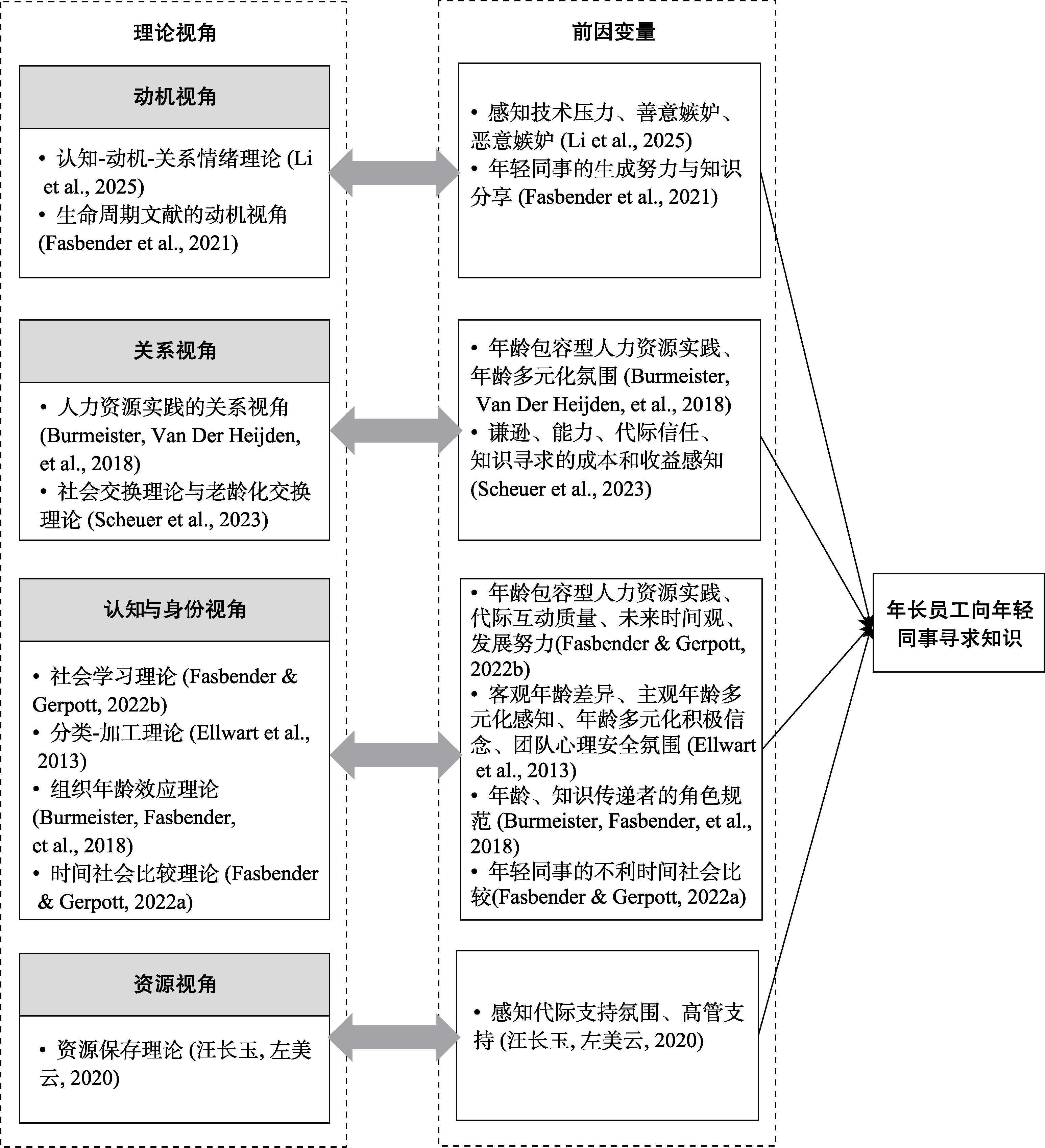
图1 年长员工知识寻求行为前因研究脉络梳理
| 维度 | 维度内涵 | 对应要素 | 影响因素 |
|---|---|---|---|
| 寻求态度 | 反映年长员工对向年轻同事知识寻求这一特定行为的积极或消极态度 | 内生态度 | 老龄化非本质主义信念 |
| 未来时间观 | |||
| 外生态度 | 预期收益 | ||
| 感知有用性 | |||
| 主观规范 | 年长员工在决定是否向年轻同事知识寻求时感受到的组织、社会规范压力 | 指令性规范 | 年龄包容型HRM |
| 针对年长员工的HRM | |||
| 示范性规范 | 年龄包容型领导 | ||
| 年龄多元化氛围 | |||
| 行为控制 | 年长员工感知到向年轻同事知识寻求的难易程度 | 能力控制 | 职业晚期管理自我效能感 |
| 职业晚期发展努力 | |||
| 人际控制 | 代际信任 | ||
| 代际互动质量 |
表2 年长员工知识寻求的驱动因素框架
| 维度 | 维度内涵 | 对应要素 | 影响因素 |
|---|---|---|---|
| 寻求态度 | 反映年长员工对向年轻同事知识寻求这一特定行为的积极或消极态度 | 内生态度 | 老龄化非本质主义信念 |
| 未来时间观 | |||
| 外生态度 | 预期收益 | ||
| 感知有用性 | |||
| 主观规范 | 年长员工在决定是否向年轻同事知识寻求时感受到的组织、社会规范压力 | 指令性规范 | 年龄包容型HRM |
| 针对年长员工的HRM | |||
| 示范性规范 | 年龄包容型领导 | ||
| 年龄多元化氛围 | |||
| 行为控制 | 年长员工感知到向年轻同事知识寻求的难易程度 | 能力控制 | 职业晚期管理自我效能感 |
| 职业晚期发展努力 | |||
| 人际控制 | 代际信任 | ||
| 代际互动质量 |
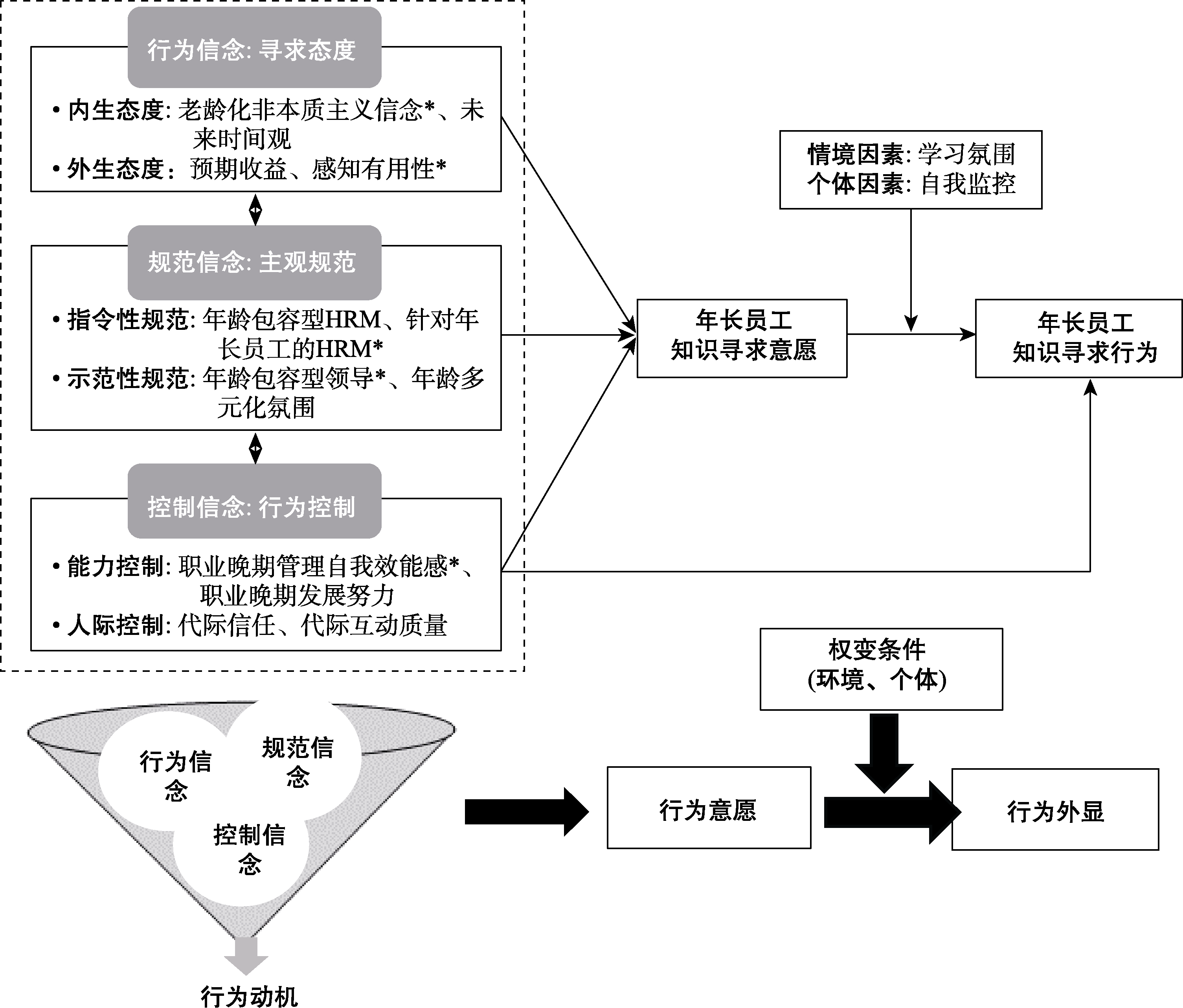
图2 年长员工知识寻求的前因与驱动机制 注:* 表示现有研究未探讨但未来可继续验证的驱动因素
| [1] |
陈文平, 段锦云, 田晓明. (2013). 员工为什么不建言: 基于中国文化视角的解析. 心理科学进展, 21(5), 905-913.
doi: 10.3724/SP.J.1042.2013.00905 |
| [2] | 陈耘, 陈祝慧, 赵富强, 刘晰. (2023). 身未老, 心先衰? 老龄化本质主义信念影响工作倦怠的作用机制研究. 中国人力资源开发, 40(3), 24-36. |
| [3] | 崔国东, 程延园, 李柱, 唐贵瑶. (2023). 年长员工何以“老当益壮”? 工作内、外控人格对职场成功老龄化的影响研究. 中国人力资源开发, 40(3), 51-64. |
| [4] | 段文婷, 江光荣. (2008). 计划行为理论述评. 心理科学进展, 16(2), 315-320. |
| [5] | 李锐, 凌文辁, 柳士顺. (2012). 传统价值观、上下属关系与员工沉默行为——一项本土文化情境下的实证探索. 管理世界, 3, 127-140+150. |
| [6] | 卢艳秋, 孙丹丹. (2021). 基于MOA模型的代际知识转移绩效影响因素研究. 社会科学战线, 2, 241-245. |
| [7] | 孙丹丹. (2022). 学习意愿、代际知识转移与年轻员工创造力关系研究 [博士学位论文]. 吉林大学. |
| [8] | 唐春勇, 李亚莉, 赵曙明. (2021). 发展型人力资源管理实践研究: 概念内涵、量表开发及检验. 南开管理评论, 24(4), 85-95. |
| [9] | 汪长玉, 左美云. (2020). 感知组织因素与工作意义对年长员工线下代际知识转移的影响研究. 管理学报, 17(8), 1228-1237. |
| [10] | 王东阳, 赵洁, 郭家琛, 李莉, 高晓彩. (2025). 真心换真知: 代际接触质量影响相互知识共享的跨层共同命运模型. 心理科学, 48(1), 199-209. |
| [11] | 王舜淋, 代毓芳, 郑文智, 张向前. (2022). 员工知识求取: 概念、测量、前因与后效. 中国人力资源开发, 39(3), 55-68. |
| [12] |
吴一丹, 李斌. (2025). 员工网络知识寻求:概念、前因及形成机制. 心理科学进展, 33(8), 1395-1407.
doi: 10.3724/SP.J.1042.2025.1395 |
| [13] |
张银普, 石伟, 骆南峰, 邢璐, 徐渊. (2017). 经验取样法在组织行为学中的应用. 心理科学进展, 25(6), 943-954.
doi: 10.3724/SP.J.1042.2017.00943 |
| [14] | 周恋, 盘兰兰, 苏涛, 陈薇茵, 战宇杰. (2025). 年长员工人力资源实践研究述评与展望. 中国人力资源开发, 42(9), 82-99. |
| [15] |
Ackerman, P. L., & Kanfer, R. (2020). Work in the 21st century: New directions for aging and adult development. American Psychologist, 75(4), 486-498.
doi: 10.1037/amp0000615 pmid: 32378944 |
| [16] |
Ajzen, I. (1991). The theory of planned behavior. Organizational Behavior and Human Decision Processes, 50(2), 179-211.
doi: 10.1016/0749-5978(91)90020-T URL |
| [17] |
Ajzen, I., Timko, C., & White, J. B. (1982). Self-monitoring and the attitude-behavior relation. Journal of Personality and Social Psychology, 42(3), 426-435.
doi: 10.1037/0022-3514.42.3.426 URL |
| [18] |
Allen, D. G., Weeks, K. P., & Moffitt, K. R. (2005). Turnover intentions and voluntary turnover: The moderating roles of self-monitoring, locus of control, proactive personality, and risk aversion. Journal of Applied Psychology, 90(5), 980-990.
pmid: 16162070 |
| [19] |
Ashford, S. J. (1986). Feedback-seeking in individual adaptation: A resource perspective. Academy of Management Journal, 29(3), 465-487.
doi: 10.2307/256219 URL |
| [20] | Baltes, P., B., & Baltes, M. M. (1990). Psychological perspectives on successful aging:The model of selective optimization with compensation. In P. B. Baltes & M. M. Baltes (Eds.), Successful aging: Perspectives from the behavioral sciences (pp. 1-34). Cambridge University Press. |
| [21] | Bamberger,, P. (2009). Employee help-seeking: Antecedents, consequences and new insights for future research. In J. J. Martocchio & H. Liao (Eds.), Research in personnel and human resources management (pp. 49-98). Emerald Group Publishing Limited. |
| [22] |
Banerjee, P., Gupta, R., & Bates, R. (2017). Influence of organizational learning culture on knowledge worker’s motivation to transfer training: Testing moderating effects of learning transfer climate. Current Psychology, 36(3), 606-617.
doi: 10.1007/s12144-016-9449-8 URL |
| [23] |
Bayl-Smith, P. H., & Griffin, B. (2014). Age discrimination in the workplace: Identifying as a late-career worker and its relationship with engagement and intended retirement age. Journal of Applied Social Psychology, 44(9), 588-599.
doi: 10.1111/jasp.2014.44.issue-9 URL |
| [24] |
Boehm, S. A., Kunze, F., & Bruch, H. (2014). Spotlight on age-diversity climate: The impact of age-inclusive HR practices on firm-level outcomes. Personnel Psychology, 67(3), 667-704.
doi: 10.1111/peps.2014.67.issue-3 URL |
| [25] |
Burmeister, A., Alterman, V., Fasbender, U., & Wang, M. (2022). Too much to know? The cognitive demands of daily knowledge seeking and the buffering role of coworker contact quality. Journal of Applied Psychology, 107(8), 1303-1322.
doi: 10.1037/apl0000925 URL |
| [26] |
Burmeister, A., & Deller, J. (2016). Knowledge retention from older and retiring workers: What do we know, and where do we go from here? Work, Aging and Retirement, 2(2), 87-104.
doi: 10.1093/workar/waw002 URL |
| [27] | Burmeister, A., & Deller, J. (2017). Intergenerational knowledge transfer: Antecedents of a dyadic process. Innovation in Aging, 1, 839-839. |
| [28] |
Burmeister, A., Fasbender, U., & Deller, J. (2018). Being perceived as a knowledge sender or knowledge receiver: A multistudy investigation of the effect of age on knowledge transfer. Journal of Occupational and Organizational Psychology, 91(3), 518-545.
doi: 10.1111/joop.2018.91.issue-3 URL |
| [29] |
Burmeister, A., Van Der Heijden, B., Yang, J., & Deller, J. (2018). Knowledge transfer in age-diverse coworker dyads in China and Germany: How and when do age-inclusive human resource practices have an effect? Human Resource Management Journal, 28(4), 605-620.
doi: 10.1111/hrmj.v28.4 URL |
| [30] |
Burmeister, A., Wang, M., & Hirschi, A. (2020). Understanding the motivational benefits of knowledge transfer for older and younger workers in age-diverse coworker dyads: An actor-partner interdependence model. Journal of Applied Psychology, 105(7), 748-759.
doi: 10.1037/apl0000466 pmid: 31697117 |
| [31] |
Carmeli, A., Reiter-Palmon, R., & Ziv, E. (2010). Inclusive leadership and employee involvement in creative tasks in the workplace: The mediating role of psychological safety. Creativity Research Journal, 22(3), 250-260.
doi: 10.1080/10400419.2010.504654 URL |
| [32] |
Carstensen, L. L., Isaacowitz, D. M., & Charles, S. T. (1999). Taking time seriously: A theory of socioemotional selectivity. American Psychologist, 54(3), 165-181.
doi: 10.1037//0003-066x.54.3.165 pmid: 10199217 |
| [33] |
Chaudhuri, S., & Ghosh, R. (2012). Reverse mentoring: A social exchange tool for keeping the boomers engaged and millennials committed. Human Resource Development Review, 11(1), 55-76.
doi: 10.1177/1534484311417562 URL |
| [34] |
Chia-An Tsai, J., & Kang, T. -C. (2019). Reciprocal intention in knowledge seeking: Examining social exchange theory in an online professional community. International Journal of Information Management, 48, 161-174.
doi: 10.1016/j.ijinfomgt.2019.02.008 URL |
| [35] |
Cui, G., Kooij, D. D. T. A. M., Zhang, Y., Liu, D., & Pan, J. (2025). Building an age-inclusive workplace for older workers: A dual pathway of age-inclusive HR practices to facilitate successful aging at work. Journal of Vocational Behavior, 161, 104148.
doi: 10.1016/j.jvb.2025.104148 URL |
| [36] | Davenport, T. H., & Prusak, L. (1998). Working knowledge: How organizations manage what they know. Harvard Business Press. |
| [37] |
De Boom, L., & De Meulenaere, K. (2025). Age-inclusive leadership and intrinsic work motivation: The moderating role of the leader-member age difference. Work, Aging and Retirement, 11(3), 230-248
doi: 10.1093/workar/waae016 URL |
| [38] |
Duan, Y., Yang, M., Huang, L., Chin, T., Fiano, F., De Nuccio, E., & Zhou, L. (2022). Unveiling the impacts of explicit vs. tacit knowledge hiding on innovation quality: The moderating role of knowledge flow within a firm. Journal of Business Research, 139, 1489-1500.
doi: 10.1016/j.jbusres.2021.10.068 URL |
| [39] |
Ellwart, T., Bündgens, S., & Rack, O. (2013). Managing knowledge exchange and identification in age diverse teams. Journal of Managerial Psychology, 28(7/8), 950-972.
doi: 10.1108/JMP-06-2013-0181 URL |
| [40] | Fan, P., Song, Y., Fang, M., & Chen, X. (2023). Creating an age-inclusive workplace: The impact of HR practices on employee work engagement. Journal of Management & Organization, 29(6), 1179-1197. |
| [41] |
Fasbender, U., & Gerpott, F. H. (2022a). Knowledge transfer between younger and older employees: A temporal social comparison model. Work, Aging and Retirement, 8(2), 146-162.
doi: 10.1093/workar/waab017 URL |
| [42] |
Fasbender, U., & Gerpott, F. H. (2022b). Why do or don’t older employees seek knowledge from younger colleagues? A relation-opportunity model to explain how age-inclusive human resources practices foster older employees’ knowledge seeking from younger colleagues. Applied Psychology, 71(4), 1385-1406.
doi: 10.1111/apps.v71.4 URL |
| [43] |
Fasbender, U., Gerpott, F. H., & Unger, D. (2021). Give and take? Knowledge exchange between older and younger employees as a function of generativity and development striving. Journal of Knowledge Management, 25(10), 2420-2443.
doi: 10.1108/JKM-11-2020-0856 URL |
| [44] |
Gadomska-Lila, K. (2020). Effectiveness of reverse mentoring in creating intergenerational relationships. Journal of Organizational Change Management, 33(7), 1313-1328.
doi: 10.1108/JOCM URL |
| [45] | Gerpott, F. H., Lehmann-Willenbrock, N., & Voelpel, S. C. (2017). A phase model of intergenerational learning in organizations. Academy of Management Learning & Education, 16(2), 193-216. |
| [46] |
Harvey, J. (2012). Managing organizational memory with intergenerational knowledge transfer. Journal of Knowledge Management, 16(3), 400-417.
doi: 10.1108/13673271211238733 URL |
| [47] | Irving, P. (2014). The upside of aging: How long life is changing the world of health, work, innovation, policy, and purpose. John Wiley & Sons. |
| [48] |
Kanfer, R., & Ackerman, P. L. (2004). Aging, adult development, and work motivation. Academy of Management Review, 29(3), 440-458.
doi: 10.2307/20159053 URL |
| [49] |
Kang, J., Rhee, M., & Kang, K. H. (2010). Revisiting knowledge transfer: Effects of knowledge characteristics on organizational effort for knowledge transfer. Expert Systems with Applications, 37(12), 8155-8160.
doi: 10.1016/j.eswa.2010.05.072 URL |
| [50] |
Kochoian, N., Raemdonck, I., Frenay, M., & Zacher, H. (2017). The role of age and occupational future time perspective in workers’ motivation to learn. Vocations and Learning, 10(1), 27-45.
doi: 10.1007/s12186-016-9160-9 URL |
| [51] |
Kooij, D. T. A. M., De Lange, A. H., Jansen, P. G. W., Kanfer, R., & Dikkers, J. S. E. (2011). Age and work-related motives: Results of a meta-analysis. Journal of Organizational Behavior, 32(2), 197-225.
doi: 10.1002/job.v32.2 URL |
| [52] |
Kulik, C. T., Perera, S., & Cregan, C. (2016). Engage me: The mature-age worker and stereotype threat. Academy of Management Journal, 59(6), 2132-2156.
doi: 10.5465/amj.2015.0564 URL |
| [53] | Kuo, T. (2013). How expected benefit and trust influence knowledge sharing. Industrial Management & Data Systems, 113(4), 506-522. |
| [54] |
Kuvaas, B. (2008). An exploration of how the employee- organization relationship affects the linkage between perception of developmental human resource practices and employee outcomes. Journal of Management Studies, 45(1), 1-25.
doi: 10.1111/joms.2008.45.issue-1 URL |
| [55] | Lai, H. -M., Chen, C. -P., & Chang, Y. -F. (2014). Determinants of knowledge seeking in professional virtual communities. Behaviour & Information Technology, 33(5), 522-535. |
| [56] |
Lee, F. (1997). When the going gets tough, do the tough ask for help? Help seeking and power motivation in organizations. Organizational Behavior and Human Decision Processes, 72(3), 336-363.
pmid: 9606170 |
| [57] |
Leroy, H., Segers, J., van Dierendonck, D., & den Hartog, D. (2018). Managing people in organizations: Integrating the study of HRM and leadership. Human Resource Management Review, 28(3), 249-257.
doi: 10.1016/j.hrmr.2018.02.002 URL |
| [58] | Li, J., Li, H., & Fu, B. (2025). The impact of technostress on older workers seeking knowledge from younger colleagues: An emotional perspective. Internet Research. https://doi.org/10.1108/INTR-06-2024-0913 |
| [59] |
Li, Y., Gong, Y., Burmeister, A., Wang, M., Alterman, V., Alonso, A., & Robinson, S. (2021). Leveraging age diversity for organizational performance: An intellectual capital perspective. Journal of Applied Psychology, 106(1), 71-91.
doi: 10.1037/apl0000497 URL |
| [60] |
Liang, X., Guo, G., Shu, L., Gong, Q., & Luo, P. (2022). Investigating the double-edged sword effect of AI awareness on employee’s service innovative behavior. Tourism Management, 92, 104564.
doi: 10.1016/j.tourman.2022.104564 URL |
| [61] |
McEvily, S. K., & Chakravarthy, B. (2002). The persistence of knowledge-based advantage: An empirical test for product performance and technological knowledge. Strategic Management Journal, 23(4), 285-305.
doi: 10.1002/smj.v23:4 URL |
| [62] |
Morrison, E. W. (1993). Newcomer information seeking: Exploring types, modes, sources, and outcomes. Academy of Management Journal, 36(3), 557-589.
doi: 10.2307/256592 URL |
| [63] |
Murphy, W. M. (2012). Reverse mentoring at work: Fostering cross-generational learning and developing millennial leaders. Human Resource Management, 51(4), 549-573.
doi: 10.1002/hrm.v51.4 URL |
| [64] |
Oliveira, E. (2021). Age-inclusive HR practices and the thriving of older workers: The mediating role of occupational future time perspective. Career Development International, 26(3), 348-362.
doi: 10.1108/CDI-01-2021-0026 URL |
| [65] | Pak, K., Renkema, M., & Van Der Kruijssen, D. T. F. (2023). A conceptual review of the love-hate relationship between technology and successful aging at work: Identifying fits and misfits through job design. Human Resource Management Review, 33(2), 100955. |
| [66] |
Parker, S. K., & Grote, G. (2022). Automation, algorithms, and beyond: Why work design matters more than ever in a digital world. Applied Psychology: An International Review, 71(4), 1171-1204.
doi: 10.1111/apps.v71.4 URL |
| [67] |
Pfrombeck, J., Burmeister, A., & Grote, G. (2024). Older workers’ knowledge seeking from younger coworkers: Disentangling countervailing pathways to successful aging at work. Journal of Organizational Behavior, 45(1), 1-20.
doi: 10.1002/job.v45.1 URL |
| [68] |
Podsakoff, P. M., Podsakoff, N. P., Williams, L. J., Huang, C., & Yang, J. (2024). Common method bias: It’s bad, it’s complex, it’s widespread, and it’s not easy to fix. Annual Review of Organizational Psychology and Organizational Behavior, 11(1), 17-61.
doi: 10.1146/orgpsych.2024.11.issue-1 URL |
| [69] | Polanyi,, M. (2009). The tacit dimension. In L. Prusak (Eds.), Knowledge in organisations (pp. 135-146). Routledge. |
| [70] |
Randel, A. E., Galvin, B. M., Shore, L. M., Ehrhart, K. H., Chung, B. G., Dean, M. A., & Kedharnath, U. (2018). Inclusive leadership: Realizing positive outcomes through belongingness and being valued for uniqueness. Human Resource Management Review, 28(2), 190-203.
doi: 10.1016/j.hrmr.2017.07.002 URL |
| [71] |
Rudolph, C. W., Kooij, D. T. A. M., Rauvola, R. S., & Zacher, H. (2018). Occupational future time perspective: A meta- analysis of antecedents and outcomes. Journal of Organizational Behavior, 39(2), 229-248.
doi: 10.1002/job.v39.2 URL |
| [72] |
Rui, H., & Ju, H. (2022). How does rapport impact knowledge transfer from older to younger employees? The moderating role of supportive climate. Frontiers in Psychology, 13, 1032143.
doi: 10.3389/fpsyg.2022.1032143 URL |
| [73] |
Rupčić, N. (2018). Intergenerational learning and knowledge transfer-challenges and opportunities. The Learning Organization, 25(2), 135-142.
doi: 10.1108/TLO-11-2017-0117 URL |
| [74] |
Scheuer, C. -L., Loughlin, C., Ford, D., & Edwards, D. (2023). Is competence without humility wasted in building the trust necessary for knowledge transfer in younger/ older worker dyads? Journal of Knowledge Management, 27(11), 231-252.
doi: 10.1108/JKM-01-2023-0013 URL |
| [75] | Schmidt, X., & Muehlfeld, K. (2017). What’s so special about intergenerational knowledge transfer? Identifying challenges of intergenerational knowledge transfer. Management Revu, 28(4), 375-411. |
| [76] |
Singh, J. B., Chandwani, R., & Kumar, M. (2018). Factors affecting Web 2.0 adoption: Exploring the knowledge sharing and knowledge seeking aspects in health care professionals. Journal of Knowledge Management, 22(1), 21-43.
doi: 10.1108/JKM-08-2016-0320 URL |
| [77] |
Singh, S., & Chitre, C. (2025). Enhancing motivation to learn through age diversity climate: A mediated moderation perspective. Journal of Workplace Learning, 37(2), 135-152.
doi: 10.1108/JWL-05-2024-0103 URL |
| [78] |
Singh, S., Thomas, N., & Numbudiri, R. (2021). Knowledge sharing in times of a pandemic: An intergenerational learning approach. Knowledge and Process Management, 28(2), 153-164.
doi: 10.1002/kpm.v28.2 URL |
| [79] |
Smith, E. A. (2001). The role of tacit and explicit knowledge in the workplace. Journal of Knowledge Management, 5(4), 311-321.
doi: 10.1108/13673270110411733 URL |
| [80] |
Snyder, M. (1974). Self-monitoring of expressive behavior. Journal of Personality and Social Psychology, 30(4), 526-537.
doi: 10.1037/h0037039 URL |
| [81] |
Super, D. E. (1980). A life-span, life-space approach to career development. Journal of Vocational Behavior, 16(3), 282-298.
doi: 10.1016/0001-8791(80)90056-1 URL |
| [82] |
Truxillo, D. M., Cadiz, D. M., & Hammer, L. B. (2015). Supporting the aging workforce: A review and recommendations for workplace intervention research. Annual Review of Organizational Psychology and Organizational Behavior, 2(1), 351-381.
doi: 10.1146/orgpsych.2015.2.issue-1 URL |
| [83] |
Veeravalli, S., Venkatraman, V., & Hariharan, M. (2019). Why do people seek knowledge? Tracing factors that affect knowledge seeking intention. VINE Journal of Information and Knowledge Management Systems, 50(2), 271-290.
doi: 10.1108/VJIKMS-04-2019-0059 URL |
| [84] |
Vuori, J., Törnroos, K., Ruokolainen, M., & Wallin, M. (2019). Enhancing late-career management among aging employees - A randomized controlled trial. Journal of Vocational Behavior, 115, 103327.
doi: 10.1016/j.jvb.2019.103327 URL |
| [85] |
Wang, C., Dong, Y., Ye, Z., & Feng, J. (2023). Linking online and offline intergenerational knowledge transfer to younger employees’ innovative work behaviors: Evidence from Chinese hospitals. Journal of Knowledge Management, 27(3), 762-784.
doi: 10.1108/JKM-11-2021-0839 URL |
| [86] |
Wang, C., Zuo, M., & An, X. (2017). Differential influences of perceived organizational factors on younger employees’ participation in offline and online intergenerational knowledge transfer. International Journal of Information Management, 37(6), 650-663.
doi: 10.1016/j.ijinfomgt.2017.06.003 URL |
| [87] | Wang, L., Jiang, W., Zhang, H., & Lin, H. (2020). Leader information seeking, team performance and team innovation: Examining the roles of team reflexivity and cooperative outcome interdependence. Information Processing & Management, 57(6), 102343. |
| [88] |
Weiss, M., Weiss, D., & Zacher, H. (2022). All set in stone? How essentialist beliefs about aging affect older workers’ motivation to continue working beyond retirement age. Journal of Organizational Behavior, 43(8), 1446-1461.
doi: 10.1002/job.v43.8 URL |
| [89] |
Wilkesmann, U., Wilkesmann, M., & Virgillito, A. (2009). The absence of cooperation is not necessarily defection: Structural and motivational constraints of knowledge transfer in a social dilemma situation. Organization Studies, 30(10), 1141-1164.
doi: 10.1177/0170840609344385 URL |
| [90] |
Yan, Y., Tang, Y., Ma, Y., Jiang, F., Liu, S., & Zhu, X. (2025). Push back to move forward: How knowledge counterflow boosts creativity in older employees. The International Journal of Human Resource Management, 36(8), 1283-1308.
doi: 10.1080/09585192.2025.2500512 URL |
| [91] |
Zacher, H., & Frese, M. (2009). Remaining time and opportunities at work: Relationships between age, work characteristics, and occupational future time perspective. Psychology and Aging, 24(2), 487-493.
doi: 10.1037/a0015425 pmid: 19485664 |
| [92] | Zeng, H., Zhao, L., & Zhao, Y. (2020). Inclusive leadership and taking-charge behavior: Roles of psychological safety and thriving at work. Frontiers in Psychology, 11. 62. |
| [93] |
Zhang, X., Cao, Q., & Grigoriou, N. (2011). Consciousness of social face: The development and validation of a scale measuring desire to gain face versus fear of losing face. The Journal of Social Psychology, 151(2), 129-149.
doi: 10.1080/00224540903366669 URL |
| [94] |
Zhang, Y., Wang, C., & Yan, J. (2025). For whom and why mature-age human resource practices are linked to in-role and extra-role performance? A study from a person-job fit perspective in China. Work, Aging and Retirement, 11(3), 282-293.
doi: 10.1093/workar/waaf008 URL |
| [95] |
Zhao, H., Ma, Y., & Chen, Y. (2025). Facing or avoiding? How dependence on artificial intelligence influences hotel employees’ job crafting. International Journal of Contemporary Hospitality Management, 37(6), 1884-1902.
doi: 10.1108/IJCHM-06-2024-0939 URL |
| [96] |
Zhou, J., Liao, R., & Kishore, R. (2023). Aging differently: How socioemotional reactions to perceived remaining time in life influence older adults’ satisfaction in virtual communities. New Media & Society, 26(11), 6325-6346.
doi: 10.1177/14614448221149906 URL |
| [97] |
Zhou, L., Zhan, Y., Peng, J., & Chen, J. (2024). Engaging mature-age workers through mature-age practices: Examining the roles of focus on opportunities and work centrality. Work, Aging and Retirement, 10(4), 386-400.
doi: 10.1093/workar/waad021 URL |
| [1] | 王海江, 邹浩云, 何宇恒. 薪酬倒挂与组织社会化:一个多视角整合的框架[J]. 心理科学进展, 2026, 34(4): 608-625. |
| [2] | 韩翼, 马朝翊, 宗树伟. 领导对员工−生成式人工智能建议的反应机制:基于社会比较视角多层次研究[J]. 心理科学进展, 2026, 34(4): 626-646. |
| [3] | 张剑, 彭帅, 付瑞冰. 组织情绪能力对工作不安全感驱动后效的影响机制[J]. 心理科学进展, 2026, 34(3): 381-403. |
| [4] | 宋一晓, 曾铭灼, 苏涛. 机会抑或威胁? 人与AI协作系统对员工工作效能影响的元分析[J]. 心理科学进展, 2026, 34(3): 461-486. |
| [5] | 冯娇娇, 刘轶, 刘军. 知识颠覆的概念内涵、形成与影响机制[J]. 心理科学进展, 2026, 34(2): 210-226. |
| [6] | 聂琦, 张捷. 工间微休息的双刃剑效应及其调节机制[J]. 心理科学进展, 2026, 34(1): 29-43. |
| [7] | 孙芳, 李绍龙, 龙立荣, 雷宣, 曾祥麟, 黄夏虹. 人工智能反馈寻求行为的驱动机制及其影响效应[J]. 心理科学进展, 2025, 33(10): 1647-1662. |
| [8] | 侯楠, 高中华, 杨皎平, 李豪. 年长员工数字技术工作不安全感的来源与影响后效[J]. 心理科学进展, 2025, 33(9): 1514-1525. |
| [9] | 张莹, 张剑. 挑战性和阻碍性评价的职业冲击对可持续职业生涯的影响及其诱发机制[J]. 心理科学进展, 2025, 33(9): 1526-1540. |
| [10] | 钟杰, 郑晓明. 数智化背景下的谦逊型领导对职业可持续性的影响[J]. 心理科学进展, 2025, 33(8): 1292-1305. |
| [11] | 岳思怡, 孙宇, 战祥平, 马红宇, 王怀勇. 权力的动态化体验:权力波动的影响效应及理论解释[J]. 心理科学进展, 2025, 33(8): 1379-1394. |
| [12] | 吴一丹, 李斌. 员工网络知识寻求:概念、前因及形成机制[J]. 心理科学进展, 2025, 33(8): 1395-1407. |
| [13] | 姜平, 宗宽道, 赵琛徽, 龙立荣. 化阻力为助力:企业数字化转型中反向师徒制的有效性及作用机制[J]. 心理科学进展, 2025, 33(7): 1120-1139. |
| [14] | 席猛, 刘玥玥, 李鑫, 李佳鑫, 史家臻. 算法人力资源管理下的员工算法应对行为与工作绩效[J]. 心理科学进展, 2025, 33(6): 948-964. |
| [15] | 宗树伟, 杨付, 龙立荣, 韩翼. 促进还是抑制?生成式人工智能建议采纳对创造力的双刃剑效应[J]. 心理科学进展, 2025, 33(6): 905-915. |
| 阅读次数 | ||||||
|
全文 |
|
|||||
|
摘要 |
|
|||||
