

ISSN 1671-3710
CN 11-4766/R
主办:中国科学院心理研究所
出版:科学出版社
CN 11-4766/R
主办:中国科学院心理研究所
出版:科学出版社
心理科学进展 ›› 2025, Vol. 33 ›› Issue (11): 1891-1911.doi: 10.3724/SP.J.1042.2025.1891 cstr: 32111.14.2025.1891
王桢( ), 季小童, 全程
收稿日期:2025-04-23
出版日期:2025-11-15
发布日期:2025-09-19
通讯作者:
王桢, E-mail: wangz@ruc.edu.cn基金资助:
WANG Zhen(), JI Xiaotong, QUAN Cheng
Received:2025-04-23
Online:2025-11-15
Published:2025-09-19
摘要:
社会的快速变革和职业生涯模式的转变, 使得个体在职业生涯发展中主动性的重要性日益凸显。职业主动行为研究虽已取得一些研究进展, 但其概念内涵尚未形成统一的界定, 其前因和后果仍未充分探索, 限制了该领域的深入发展。本研究将对职业主动行为的概念内涵、形成机制和影响机制进行全面探讨。首先, 本研究基于自我调节理论, 提出职业主动行为的概念框架, 并进一步开发相应的测验量表。其次, 基于主动性动机模型, 探究个体特征、职业特征、组织特征通过“有能力做”、“有原因做”、“有能量做”三个动机状态对职业主动行为产生影响, 对其前因机制形成多层次系统的认知。最后, 从职业资源的角度出发, 考察职业主动行为对个体人力资源、社会资源、心理资源和认同资源的积累, 进而促进可持续职业生涯发展的影响机制。本研究将丰富和拓展职业主动行为的研究, 为其理论发展提供新的视角和实证支持, 也为职业咨询和管理实践提供启示。
中图分类号:
王桢, 季小童, 全程. (2025). 职业主动行为的内涵、形成与作用机制. 心理科学进展 , 33(11), 1891-1911.
WANG Zhen, JI Xiaotong, QUAN Cheng. (2025). The conceptualization, antecedents, and effects of proactive career behavior. Advances in Psychological Science, 33(11), 1891-1911.
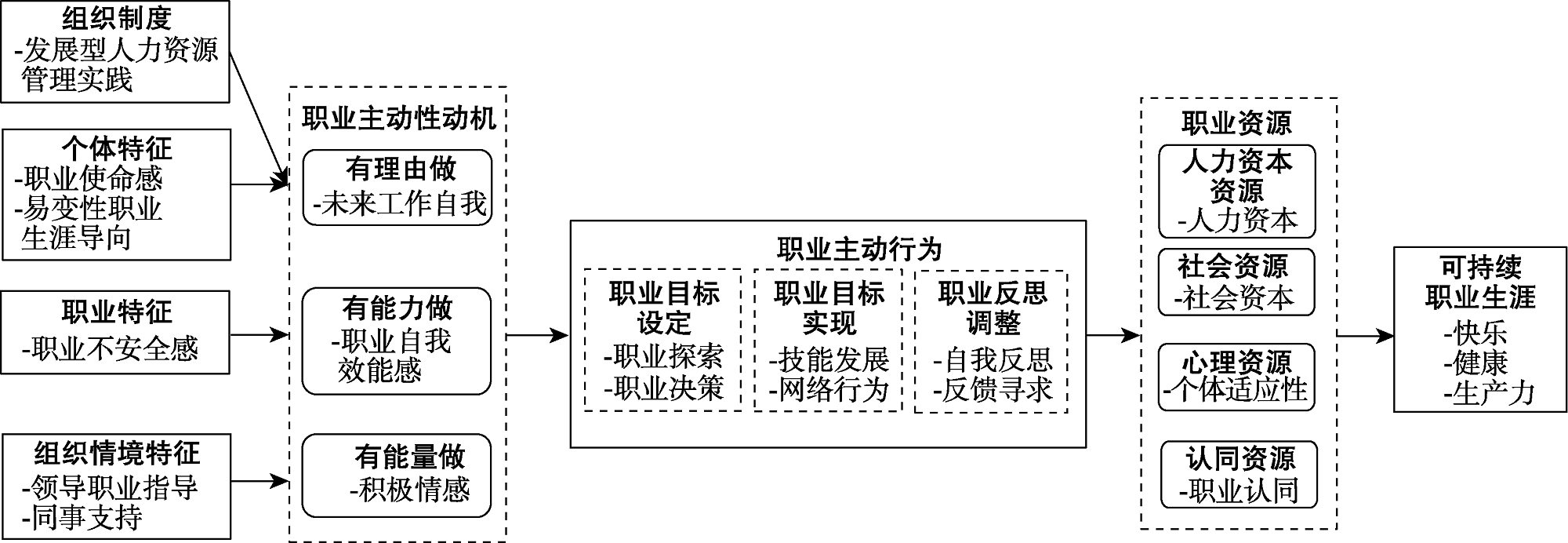
图1 研究框架图
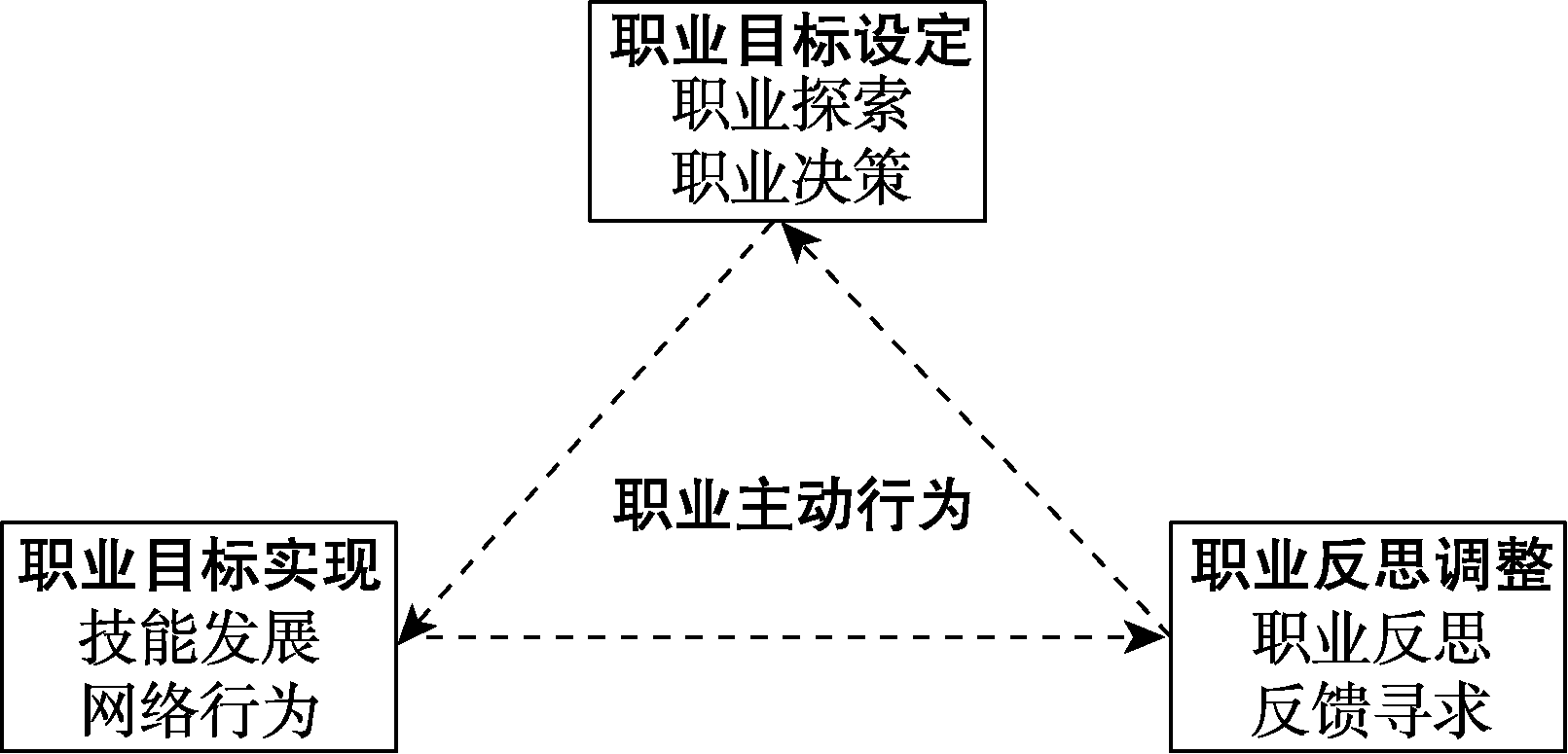
图2 职业主动行为的内容与维度
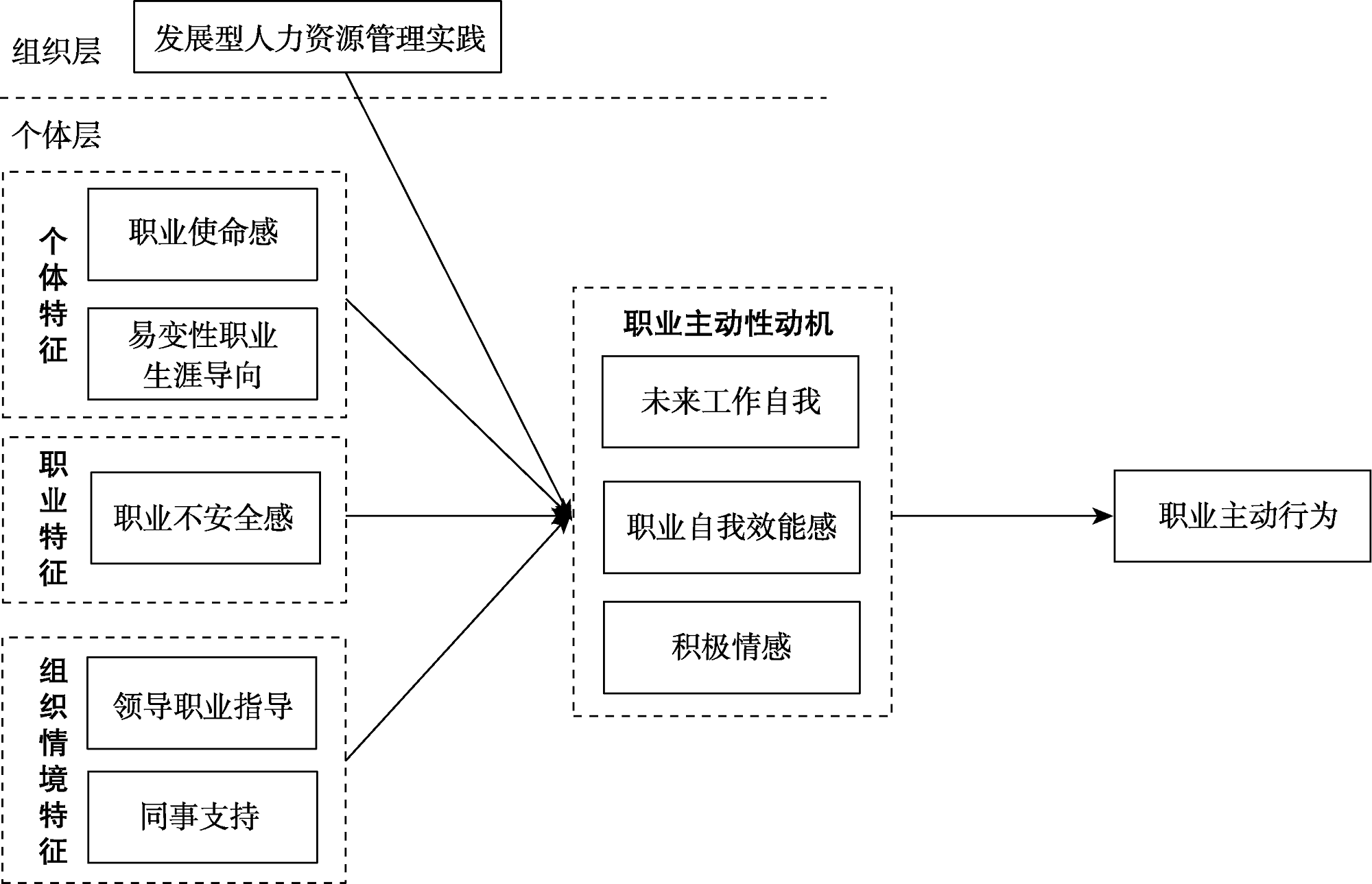
图3 研究2: 职业主动行为的前因和形成机制模型
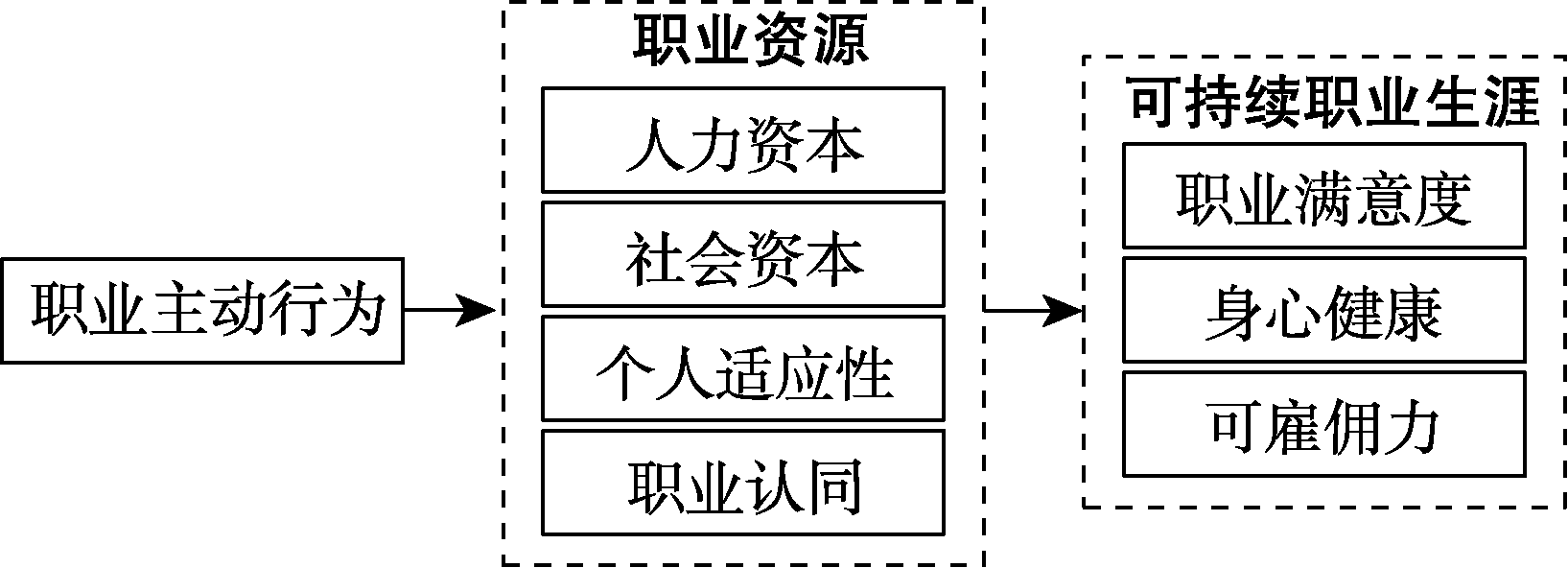
图4 研究3: 职业主动行为对个体可持续职业生涯的作用机制模型
| [1] | 樊子立, 马君. (2022). 情感事件理论视角下个性化工作协议对员工主动化职业行为的影响. 软科学, 36(6), 85-92. |
| [2] | 高洁, 林燕滢, 崔佳, 温忠麟. (2018). 未来工作自我清晰度对主动职业行为的影响——一个有调节的中介模型. 心理学探新, 38(5), 475-480. |
| [3] | 刘晋, 黄波, 盛小丰, 王颖, 于晓彤. (2018). 跨越职业边界的新途径: 员工的主动职业行为. 中国人力资源开发, 35(2), 129-140. |
| [4] |
罗萍, 施俊琦, 朱燕妮, 房俨然. (2020). 个性化工作协议对员工主动性职业行为和创造力的影响. 心理学报, 52(1), 81-92.
doi: 10.3724/SP.J.1041.2020.00081 |
| [5] | 唐春勇, 李亚莉, 赵曙明. (2021). 发展型人力资源管理实践研究: 概念内涵、量表开发及检验. 南开管理评论, 24(4), 85-95. |
| [6] | 涂艳, 蒿坡, 龙立荣. (2022). 工作替代还是工作转型?技术型工作不安全感的内涵、影响后果及来源. 心理科学进展, 31(8), 1359-1373. |
| [7] | 王忠军, 温琳, 龙立荣. (2015). 无边界职业生涯研究: 二十年回顾与展望. 心理科学, 38(1), 243-248. |
| [8] | 翁清雄, 席酉民. (2010). 职业成长与离职倾向: 职业承诺与感知机会的调节作用. 南开管理评论, 13(2), 119-131. |
| [9] | 吴仲达, 梁婧涵, 陆昌勤. (2023). 可持续职业生涯: 概念、管理策略与研究展望. 外国经济与管理, 45(6), 68-83. |
| [10] | 薛晓州, 张敏, 侯楠, 周文霞. (2017). 导师指导关系类型及其在未来工作自我与主动职业行为间的调节作用:一个潜在剖面分析. 中国人力资源开发, (3), 81-89. |
| [11] | 张志学, 赵曙明, 连汇文, 谢小云. (2021). 数智时代的自我管理和自我领导: 现状与未来. 外国经济与管理, 43(11), 3-14. |
| [12] | 周文霞, 李硕钰, 李梦宜, 冯晋, 徐颖. (2020). 中国职业生涯管理研究回顾与展望——一项基于文献(1978-2018)的研究. 南开管理评论, 23(4), 213-224. |
| [13] | 周文霞, 潘真, 魏仕龙, 于坤, 高雪原, 冯悦. (2022). 常怀感恩, 持续发展: 感恩对人力资源从业者可持续职业生涯的积极作用. 中国人力资源开发, (10), 64-75. |
| [14] | Adler, P. S., & Kwon, S. (2002). Social capital: Prospects for a new concept. The Academy of Management Review, 27(1), 17-40. |
| [15] | Akkermans, J., & Hirschi, A. (2023). Career proactivity: Conceptual and theoretical reflections. Applied Psychology, 72(1), 199-204. |
| [16] | Akkermans, J., Seibert, S. E., & Mol, S. T. (2018). Tales of the unexpected: Integrating career shocks in the contemporary careers literature. SA Journal of Industrial Psychology, 44, a1503. |
| [17] | Akmal, S. Z., Hood, M., Duffy, A. L., & Creed, P. A. (2025). Antecedents and outcomes of positive career goal progress discrepancy appraisal in young adults. Journal of Career Assessment, 33(1), 132-148. |
| [18] | Ali, Z., & Mehreen, A. (2022). Can you manage shocks? An investigation of career shocks on proactive career behavior: A COR theory perspective. Journal of Managerial Psychology, 37(4), 346-360. |
| [19] | Alisic, A., & Wiese, B. S. (2020). Keeping an insecure career under control: The longitudinal interplay of career insecurity, self-management, and self-efficacy. Journal of Vocational Behavior, 120, 103431. |
| [20] |
Allen, T. D., Eby, L. T., Chao, G. T., & Bauer, T. N. (2017). Taking stock of two relational aspects of organizational life: Tracing the history and shaping the future of socialization and mentoring research. Journal of Applied Psychology, 102(3), 324-337.
doi: 10.1037/apl0000086 pmid: 28125264 |
| [21] | Allen, T. D., Eby, L. T., Poteet, M. L., Lentz, E., & Lima, L. (2004). Career benefits associated with mentoring for protégés: A meta-analysis. Journal of Applied Psychology, 89(1), 127-136. |
| [22] | Andresen, M., Apospori, E., Gunz, H., Suzanne, P. A., Taniguchi, M., Lysova, E. I., … Dysvik, A. (2019). Careers in context: An international study of career goals as mesostructure between societies’ career-related human potential and proactive career behaviour. Human Resource Management Journal, 30(3), 365-391. |
| [23] |
Bandura, A. (1977). Self-efficacy: Toward a unifying theory of behavioral change. Psychological Review, 84(2), 191-215.
doi: 10.1037//0033-295x.84.2.191 pmid: 847061 |
| [24] | Bandura, A. (1991). Social Cognitive Theory of self-regulation. Organizational Behavior and Human Decision Processes, 50(2), 248-287. |
| [25] | Becker, G. (1993). Human capital: A theoretical and empirical analysis with special reference to education. New York: The University of Chicago Press. |
| [26] |
Bindl, U. K., Parker, S. K., Totterdell, P., & Hagger-Johnson, G. (2012). Fuel of the self-starter: How mood relates to proactive goal regulation. Journal of Applied Psychology, 97(1), 134-150.
doi: 10.1037/a0024368 pmid: 21744938 |
| [27] | Briscoe, J. P., & Hall, D. T. (2006). Special section on boundaryless and protean careers: Next steps in conceptualizing and measuring boundaryless and protean careers. Journal of Vocational Behavior, 69(1), 1-3. |
| [28] | Briscoe, J. P., Henagan, S. C., Burton, J. P., & Murphy, W. M. (2012). Coping with an insecure employment environment: The differing roles of protean and boundaryless career orientations. Journal of Vocational Behavior, 80(2), 308-316. |
| [29] | Buunk, A. P., Peiró, J. M., & Griffioen, C. (2007). A positive role model may stimulate career-oriented behavior. Journal of Applied Social Psychology, 37(7), 1489-1500. |
| [30] | Cai, Z., Ji, X., & Wang, Z. (2025). Career insecurity scale short form (CI-S): Construction and validation. Journal of Career Assessment, 33(3), 470-488. |
| [31] | Carver, C. S., & Scheier, M. F. (1981). Attention and self-regulation: A control-theory approach to human behavior. Springer Science & Business Media. |
| [32] | Chan, D. (2000). Understanding adaptation to changes in the work environment:Integrating individual difference and learning perspectives. In G. R. Ferris (Ed.), Research in personnel and human resources management (Vol. 18, pp. 1-42). JAI Press. |
| [33] | Chan, S. H. J., Mai, X., Kuok, O. M. K., & Kong, S. H. (2016). The influence of satisfaction and promotability on the relation between career adaptability and turnover intentions. Journal of Vocational Behavior, 92, 167-175. |
| [34] | Chen, H., Liu, J., Wang, Y., Yang, N., & Wang, X. (2023). The impacts of role commitment and pay-for-performance on proactive career behavior: An interactionist perspective. Career Development International, 28(6/7), 721-738. |
| [35] |
Chiaburu, D. S., & Harrison, D. A. (2008). Do peers make the place? Conceptual synthesis and meta-analysis of coworker effects on perceptions, attitudes, OCBs, and performance. Journal of Applied Psychology, 93(5), 1082-1103.
doi: 10.1037/0021-9010.93.5.1082 pmid: 18808227 |
| [36] | Chong, J. X. Y., Andrei, D. M., Tian, A., & Parker, S. K. (2025). Include, individualize, and integrate HRM practices for successful aging at work: Scale development and test of a model. Human Resource Management, 64(5), 1187-1206. https://doi.org/10.1002/hrm.22301 |
| [37] | Chughtai, A. A. (2019). Servant leadership and perceived employability: Proactive career behaviours as mediators. Leadership & Organization Development Journal, 40(2), 213-229. |
| [38] | Chui, H., Li, H., & Ngo, H. (2022). Linking protean career orientation with career optimism: Career adaptability and career decision self-efficacy as mediators. Journal of Career Development, 49(1), 161-173. |
| [39] | Claes, R., & Ruiz-Quintanilla, S. A. (1998). Influences of early career experiences, occupational group, and national culture on proactive career behavior. Journal of Vocational Behavior, 52(3), 357-378. |
| [40] | Colakoglu, S. N. (2011). The impact of career boundarylessness on subjective career success: The role of career competencies, career autonomy, and career insecurity. Journal of Vocational Behavior, 79(1), 47-59. |
| [41] | Crant, J. (2000). Proactive behavior in organizations. Journal of Management, 26(3), 435-462. |
| [42] | De Vos, A., Dewilde, T., & De Clippeleer, I. (2009). Proactive career behaviours and career success during the early career. Journal of Occupational and Organizational Psychology, 82(4), 761-777. |
| [43] | De Vos, A., & Soens, N. (2008). Protean attitude and career success: The mediating role of self-management. Journal of Vocational Behavior, 73(3), 449-456. |
| [44] | De Vos, A., Van der Heijden, B. I. J. M., & Akkermans, J. (2020). Sustainable careers: Towards a conceptual model. Journal of Vocational Behavior, 117, 103196. |
| [45] | Deng, T., Tang, C., & Lai, Y. (2024). Exploring the role of organizational developmental HR practices in enhancing employees’ commitment to organizational career: A multilevel investigation. Journal of Organizational Change Management, 37(2), 340-355. |
| [46] | Dess, G. G., & Shaw, J. D. (2001). Voluntary turnover, social capital, and organizational performance. The Academy of Management Review, 26(3), 446-456. |
| [47] | Dobrow, S. R., & Tosti-Kharas, J. (2011). Calling: The development of a scale measure. Personnel Psychology, 64(4), 1001-1049. |
| [48] | Duffy, R. D., Dik, B. J., & Steger, M. F. (2011). Calling and work-related outcomes: Career commitment as a mediator. Journal of Vocational Behavior, 78(2), 210-218. |
| [49] | Fredrickson, B. L. (2004). The broaden-and-build theory of positive emotions. Philosophical Transactions of the Royal Society of London. Series B: Biological Sciences, 359(1449), 1367-1378. |
| [50] | Frese, M., & Fay, D. (2001). Personal initiative: An active performance concept for work in the 21st century. Research in Organizational Behavior, 23(1), 133-187. |
| [51] | Frese, M., & Zapf, D. (1994). Action as the core of work psychology:A German approach. In H. C. Triandis, M. D. Dunnette, & L. M. Hough (Eds.), Handbook of industrial and organizational psychology (2nd ed., Vol. 4, pp271-340). Consulting Psychologists Press. |
| [52] | Fugate, M., Kinicki, A. J., & Ashforth, B. E. (2004). Employability: A psycho-social construct, its dimensions, and applications. Journal of Vocational Behavior, 65(1), 14-38. |
| [53] | Gazica, M. W., & Spector, P. E. (2015). A comparison of individuals with unanswered callings to those with no calling at all. Journal of Vocational Behavior, 91, 1-10. |
| [54] | Grant, A. M., & Ashford, S. J. (2008). The dynamics of proactivity at work. Research in Organizational Behavior, 28, 3-34. |
| [55] | Grant, A. M., & Parker, S. K. (2009). Redesigning work design theories: The rise of relational and proactive perspectives. The Academy of Management Annals, 3(1), 317-375. |
| [56] | Guan, Y., Arthur, M. B., Khapova, S. N., Hall, R. J., & Lord, R. G. (2019). Career boundarylessness and career success: A review, integration and guide to future research. Journal of Vocational Behavior, 110(Part B), 390-402. |
| [57] | Guan, Y., Zhuang, M., Cai, Z., Ding, Y., Wang, Y., Huang, Z., & Lai, X. (2017). Modeling dynamics in career construction: Reciprocal relationship between future work self and career exploration. Journal of Vocational Behavior, 101, 21-31. |
| [58] | Haenggli, M., Hirschi, A., Rudolph, C. W., & Peiró, J. M. (2021). Exploring the dynamics of protean career orientation, career management behaviors, and subjective career success: An action regulation theory approach. Journal of Vocational Behavior, 131, 103650. |
| [59] | Hall, D. T., & Chandler, D. E. (2005). Psychological success: When the career is a calling. Journal of Organizational Behavior, 26(2), 155-176. |
| [60] | Hall, D. T., Yip, J., & Doiron, K. (2018). Protean careers at work: Self-direction and values orientation in psychological success. Annual Review of Organizational Psychology and Organizational Behavior, 5(1), 129-156. |
| [61] | Harrison, J. A., Halinski, M., & Manroop, L. (2024). Happy, and they know it? The roles of positive affectivity, intrinsic motivation and network building on LinkedIn on employment predictions. Career Development International, 29(6), 656-673. |
| [62] | Herrmann, A., Hirschi, A., & Baruch, Y. (2015). The protean career orientation as predictor of career outcomes: Evaluation of incremental validity and mediation effects. Journal of Vocational Behavior, 88, 205-214. |
| [63] | Hirschi, A. (2011). Vocational identity as a mediator of the relationship between core self-evaluations and life and job satisfaction. Applied Psychology: An International Review, 60(4), 622-644. |
| [64] | Hirschi, A. (2012). The career resources model: An integrative framework for career counsellors. British Journal of Guidance & Counselling, 40(4), 369-383. |
| [65] | Hirschi, A. (2014). Hope as a resource for self-directed career management: Investigating mediating effects on proactive career behaviors and life and job satisfaction. Journal of Happiness Studies, 15(6), 1495-1512. |
| [66] | Hirschi, A., Freund, P. A., & Herrmann, A. (2014). The career engagement scale: Development and validation of a measure of proactive career behaviors. Journal of Career Assessment, 22(4), 575-594. |
| [67] | Hirschi, A., & Herrmann, A. (2013). Calling and career preparation: Investigating developmental patterns and temporal precedence. Journal of Vocational Behavior, 83(1), 51-60. |
| [68] | Hirschi, A., & Koen, J. (2021). Contemporary career orientations and career self-management: A review and integration. Journal of Vocational Behavior, 126(1), 103505. |
| [69] | Hirschi, A., Lee, B., Porfeli, E. J., & Vondracek, F. W. (2013). Proactive motivation and engagement in career behaviors: Investigating direct, mediated, and moderated effects. Journal of Vocational Behavior, 83(1), 31-40. |
| [70] |
Hobfoll, S. E. (1989). Conservation of resources: A new attempt at conceptualizing stress. American Psychologist, 44(3), 513-524.
doi: 10.1037//0003-066x.44.3.513 pmid: 2648906 |
| [71] | Hobfoll, S. E., Halbesleben, J., Neveu, J.-P., & Westman, M. (2018). Conservation of resources in the organizational context: The reality of resources and their consequences. Annual Review of Organizational Psychology and Organizational Behavior, 5(1), 103-128. |
| [72] | Hu, S., Jiang, L., Zou, Q., & Liu, M. (2024). Does proactive career behaviour matter with respect to job insecurity? The mediating role of work-related basic needs satisfaction and the moderating role of contract type. Career Development International, 30(1), 43-59. |
| [73] | Huang, J. T., & Hsieh, H. H. (2015). Supervisors as good coaches: Influences of coaching on employees’ in-role behaviors and proactive career behaviors. The International Journal of Human Resource Management, 26(1), 42-58. |
| [74] | Huang, Y. (2020). The relationship between networking behavior and promotability: The moderating effect of political skill. Journal of Management & Organization, 26(2), 185-200. |
| [75] | Jian, H., He, B., & Sun, X. (2024). The impact of developmental human resource practices on employee workplace procrastination: The moderating role of exploitative leadership and self-leadership. Leadership & Organization Development Journal, 45(8), 1548-1567. |
| [76] | Jiang, X., Qu, J., Meng, L., & Zhou, W. (2024). How do proactive career behaviors translate into subjective career success and perceived employability? The role of thriving at work and humble leadership. Journal of Management & Organization, 30(6), 2088-2104. |
| [77] | Jiang, Z., Wang, Y., Li, W., Peng, K. Z., & Wu, C.-H. (2023). Career proactivity: A bibliometric literature review and a future research agenda. Applied Psychology: An International Review, 72(1), 144-184. |
| [78] | Johnston, C. S., Maggiori, C., & Rossier, J. (2015). Professional trajectories, individual characteristics, and staying satisfied and healthy. Journal of Career Development, 43(1), 81-98. |
| [79] | Jung, Y., & Takeuchi, N. (2018). A lifespan perspective for understanding career self-management and satisfaction: The role of developmental human resource practices and organizational support. Human Relations, 71(1), 73-102. |
| [80] | Kao, K.-Y., Hsu, H.-H., Lee, H.-T., Cheng, Y.-C., Dax, I., & Hsieh, M.-W. (2020). Career mentoring and job content plateaus: The roles of perceived organizational support and emotional exhaustion. Journal of Career Development, 49(2), 457-470. |
| [81] | Karatepe, O. M., & Olugbade, O. A. (2017). The effects of work social support and career adaptability on career satisfaction and turnover intentions. Journal of Management & Organization, 23(3), 337-355. |
| [82] |
Kim, S. L., & Yun, S. (2015). The effect of coworker knowledge sharing on performance and its boundary conditions: An interactional perspective. Journal of Applied Psychology, 100(2), 575-582.
doi: 10.1037/a0037834 pmid: 25198095 |
| [83] | Klehe, U. C., Fasbender, U., & van der Horst, A. (2021). Going full circle: Integrating research on career adaptation and proactivity. Journal of Vocational Behavior, 126, 103526. |
| [84] | Koen, J., & Parker, S. K. (2020). In the eye of the beholder: How proactive coping alters perceptions of insecurity. Journal of Occupational Health Psychology, 25(6), 385-400. |
| [85] | Korkmaz, O., Doğanülkü, H. A., Bakioğlu, F., & Yalçın, S. B. (2025). Development and validation of the online proactive career behavior scale. Journal of Career Assessment, 33(2), 364-382. |
| [86] | Kuvaas, B. (2008). An exploration of how the employee- organization relationship affects the linkage between perception of developmental human resource practices and employee outcomes. Journal of Management Studies, 45(1), 1-25. |
| [87] | Lam, L. W., Peng, K. Z., Wong, C.-S., & Lau, D. C. (2015). Is more feedback seeking always better? Leader-member exchange moderates the relationship between feedback- seeking behavior and performance. Journal of Management, 43(7), 2195-2217. |
| [88] | Le, H., Lee, J., Gopalan, N., & Van der Heijden, B. (2024). Proactive behaviors matter for my job! The roles of career decidedness and career stress in face of VUCA. Career Development International, 29(2), 251-266. |
| [89] | Lee, Y., & Eissenstat, S. J. (2018). An application of work engagement in the job demands-resources model to career development: Assessing gender differences. Human Resource Development Quarterly, 29(2), 143-161. |
| [90] | Lent, R. W., & Brown, S. (2008). Social cognitive career theory and subjective well-being in the context of work. Journal of Career Assessment, 16(1), 6-21. |
| [91] | Lent, R. W., Brown, S. D., & Hackett, G. (1994). Toward a unifying social cognitive theory of career and academic interest, choice, and performance. Journal of Vocational Behavior, 45(1), 79-122. |
| [92] | Lent, R. W., Brown, S. D., Wang, R. J., Cygrymus, E. R., & Moturu, B. P. (2023). Looking ahead, looking around, and looking to others: Identifying core proactive behaviors in the quest for career sustainability. Journal of Career Assessmen, 32(3), 539-559. |
| [93] | Lent, R. W., Morris, T. R., Wang, R. J., Moturu, B. P., Cygrymus, E. R., & Yeung, J. G. (2022). Test of a social cognitive model of proactive career behavior. Journal of Career Assessment, 30(4), 756-775. |
| [94] | Leong, A. M. W., Bai, J. Y., Luo, J. M., & Fan, D. X. F. (2024). Why do negative career shocks foster perceived employability and career performance: A career crafting explanation. International Journal of Hospitality Management, 119, 103724. |
| [95] | Li, H., Ngo, H., & Cheung, F. (2019). Linking protean career orientation and career decidedness: The mediating role of career decision self-efficacy. Journal of Vocational Behavior, 115, 103322. |
| [96] | Liaw, Y.-J., Chi, N.-W., & Chuang, A. (2010). Examining the mechanisms linking transformational leadership, employee customer orientation, and service performance: The mediating roles of perceived supervisor and coworker support. Journal of Business and Psychology, 25(3), 477-492. |
| [97] | Locke, E. A., & Latham, G. P. (1990). A theory of goal setting and task performance. Prentice-Hall. |
| [98] | Meijers, F. (1998). The development of a career identity. International Journal for the Advancement of Counselling, 20(3), 191-207. |
| [99] | Methot, J. R., & Seibert, S. E. (2021). Chapter 9:The role of social networks in contemporary careers. In W. Murphy, & J. Tosti-Kharas (Eds.), Handbook of research methods in careers (pp. 191-209). Edward Elgar Publishing. |
| [100] | Ng, J. W. X., Song, Z., & Lievens, F. (2023). Human capital effects in the job search process for new labor market entrants: A double-edged sword? Journal of Vocational Behavior, 144, 103894. |
| [101] | Parker, S. K., Bindl, U. K., & Strauss, K. (2010). Making things happen: A model of proactive motivation. Journal of Management, 36(4), 827-856. |
| [102] | Parker, S. K., & Collins, C. G. (2010). Taking stock: Integrating and differentiating multiple proactive behaviors. Journal of Management, 36(3), 633-662. |
| [103] | Parker, S. K., Wang, Y., & Liao, J. (2019). When is proactivity wise? A review of factors that influence the individual outcomes of proactive behavior. Annual Review of Organizational Psychology and Organizational Behavior, 6(1), 221-248. |
| [104] | Pohl, S., Vonthron, A.-M., & Closon, C. (2019). Human resources practices as predictors of organizational citizenship behaviour: The role of job breadth and organizational support. Journal of Management & Organization, 25(2), 224-238. |
| [105] | Praskova, A., Creed, P. A., & Hood, M. (2015). Career identity and the complex mediating relationships between career preparatory actions and career progress markers. Journal of Vocational Behavior, 87, 145-153. |
| [106] | Praskova, A., & Johnston, L. (2020). The role of future orientation and negative career feedback in career agency and career success in Australian adults. Journal of Career Assessment, 29(3), 463-485. |
| [107] | Ran, G., & Cinamon, R. G. (2022). Career self-efficacy, future perceptions, and life satisfaction: Investigating two adolescent career development models. Journal of Career Development, 50(4), 764-784. |
| [108] | Rao, L., Xu, J., & Zhou, M. (2024). Work-family conflict and proactive career behaviors: The roles of career resilience and conscientiousness. Journal of Career Development, 52(1), 41-56. |
| [109] | Rothwell, A., & Arnold, J. (2007). Self-perceived employability: Development and validation of a scale. Personnel Review, 36(1), 23-41. |
| [110] | Rudolph, C. W., Lavigne, K. N., & Zacher, H. (2017). Career adaptability: A meta-analysis of relationships with measures of adaptivity, adapting responses, and adaptation results. Journal of Vocational Behavior, 98, 17-34. |
| [111] | Santos, A., Wang, W., & Lewis, J. (2018). Emotional intelligence and career decision-making difficulties: The mediating role of career decision self-efficacy. Journal of Vocational Behavior, 107, 295-309. |
| [112] | Savickas, M. L. (2013). Career construction theory and practice. In R. W. Lent, & S. D. Brown (Eds.). Career development and counselling: Putting theory and research into work (pp. 539-564). (2nd ed.). Wiley. |
| [113] | Savickas, M. L., & Porfeli, E. J. (2012). Career adapt-abilities scale: Construction, reliability, and measurement equivalence across 13 countries. Journal of Vocational Behavior, 80(3), 661-673. |
| [114] | Seibert, S. E., Akkermans, J., & Liu, C. (2024). Understanding contemporary career success: A critical review. Annual Review of Organizational Psychology and Organizational Behavior, 11, 509-534. |
| [115] |
Seibert, S. E., Crant, J. M., & Kraimer, M. L. (1999). Proactive personality and career success. Journal of Applied Psychology, 84(3), 416-427.
doi: 10.1037/0021-9010.84.3.416 pmid: 10380421 |
| [116] | Seibert, S. E., Kraimer, M. L., & Crant, J. M. (2001). What do proactive people do? A longitudinal model linking proactive personality and career success. Personnel Psychology, 54(4), 845-874. |
| [117] | Singh, B., Selvarajan, T. T., & Solansky, S. T. (2019). Coworker influence on employee performance: A conservation of resources perspective. Journal of Managerial Psychology, 34(8), 587-600. |
| [118] | Singh, R., Ragins, B. R., & Tharenou, P. (2009). Who gets a mentor? A longitudinal assessment of the rising star hypothesis. Journal of Vocational Behavior, 74(1), 11-17. |
| [119] |
Smale, A., Bagdadli, S., Cotton, R., Russo, S. D., Dickmann, M., Dysvik, A., … Verbruggen, M. (2019). Proactive career behaviors and subjective career success: The moderating role of national culture. Journal of Organizational Behavior, 40(1), 105-122.
doi: 10.1002/job.2316 |
| [120] |
Song, L., & Lin, N. (2009). Social capital and health inequality: Evidence from Taiwan. Journal of Health and Social Behavior, 50(2), 149-163.
pmid: 19537457 |
| [121] | Sou, E. K., Yuen, M., & Chen, G. (2022). Career adaptability as a mediator between social capital and career engagement. The Career Development Quarterly, 70(1), 2-15. |
| [122] | Spurk, D., Hofer, A., Hirschi, A., De Cuyper, N., & De Witte, H. (2022). Conceptualizing career insecurity: Toward a better understanding and measurement of a multidimensional construct. Personnel Psychology, 75(2), 253-294. |
| [123] | Spurk, D., Volmer, J., Orth, M., & Göritz, A. S. (2020). How do career adaptability and proactive career behaviours interrelate over time? An inter- and intraindividual investigation. Journal of Occupational and Organizational Psychology, 93(1), 158-186. |
| [124] | Steindórsdóttir, B. D., Sanders, K., Nordmo, M., & Dysvik, A. (2023). A cross-lagged study investigating the relationship between burnout and subjective career success from a lifespan developmental perspective. Journal of Occupational and Organizational Psychology, 97(1), 273-300. |
| [125] |
Strauss, K., Griffin, M. A., & Parker, S. K. (2012). Future work selves: How salient hoped-for identities motivate proactive career behaviors. Journal of Applied Psychology, 97(3), 580-598.
doi: 10.1037/a0026423 pmid: 22122111 |
| [126] | Strauss, K., Parker, S. K., & O’Shea, D. (2017). When does proactivity have a cost? Motivation at work moderates the effects of proactive work behavior on employee job strain. Journal of Vocational Behavior, 100, 15-26. |
| [127] |
Sylva, H., Mol, S. T., Den Hartog, D. N., & Dorenbosch, L. (2019). Person-job fit and proactive career behaviour: A dynamic approach. European Journal of Work and Organizational Psychology, 28(5), 631-645.
doi: 10.1080/1359432X.2019.1580309 |
| [128] | Taber, B. J., & Blankemeyer, M. (2015). Future work self and career adaptability in the prediction of proactive career behaviors. Journal of Vocational Behavior, 86, 20-27. |
| [129] | Talluri, S. B., Schreurs, B., & Uppal, N. (2022). How do individual factors affect career sustainability? An investigation of cascading effects through the career construction model of adaptation. Career Development International, 27(6/7), 584-600. |
| [130] | Tams, S., & Arthur, M. B. (2010). New directions for boundaryless careers: Agency and interdependence in a changing world. Journal of Organizational Behavior, 31(5), 629-646. |
| [131] |
Tang, P. M., Koopman, J., Mai, K. M., De Cremer, D., Zhang, J. H, Reynders, P., Ng, S., & Chen, I-H. (2023). No person is an island: Unpacking the work and after-work consequences of interacting with artificial intelligence. Journal of Applied Psychology, 108(11), 1766-1789.
doi: 10.1037/apl0001103 pmid: 37307359 |
| [132] | Tharenou, P., & Terry, D. J. (1998). Reliability and validity of scores on scales to measure managerial aspirations. Educational and Psychological Measurement, 58(3), 475-492. |
| [133] |
Thompson, J. A. (2005). Proactive personality and job performance: A social capital perspective. Journal of Applied Psychology, 90(5), 1011-1017.
pmid: 16162073 |
| [134] | Tims, M., & Akkermans, J. (2020). Job and career crafting to fulfill individual career pathways. In G. Carter, & J. Hedge (Eds.), Career pathways: From School to retiremen (pp. 165-190). Oxford University Press. |
| [135] |
Urbanaviciute, I., Udayar, S., & Rossier, J. (2019). Career adaptability and employee well-being over a two-year period: Investigating cross-lagged effects and their boundary conditions. Journal of Vocational Behavior, 111, 74-90.
doi: 10.1016/j.jvb.2018.10.013 |
| [136] | Van Vianen, A. E. M., Rosenauer, D., Homan, A. C., Horstmeier, C. A. L., & Voelpel, S. C. (2018). Career mentoring in context: A multilevel study on differentiated career mentoring and career mentoring climate. Human Resource Management, 57(2), 583-599. |
| [137] | Wang, E., Li, S., Jiang, Y., & Zhang, J. (2024). Longitudinal effect of career-related parental support on vocational college students’ proactive career behavior: A moderated mediation model. Current Psychology, 43(13), 11422-11434. |
| [138] | Whitely, W. T., & Coetsier, P. (1993). The relationship of career mentoring to early career outcomes. Organization Studies, 14(3), 419-441. |
| [139] | Yang, C., Luo, Z., Xu, N., & Tang, C. (2024). Fostering career crafting by developmental HR practices: The mediating role of future work self and moderating role of AI awareness. Career Development International, 29(6), 641-655. |
| [140] | Zacher, H., & Frese, M. (2011). Maintaining a focus on opportunities at work: The interplay between age, job complexity, and the use of selection, optimization, and compensation strategies. Journal of Organizational Behavior, 32(2), 291-318. |
| [141] | Zettna, N., Yam, C., Kunzelmann, A., Forner, V. W., Dey, S., Askovic, M., … Parker, S. K. (2025). Crystal clear: How leaders and coworkers together shape role clarity and well-being for employees in social care. Human Resource Management, 64(1), 5-20. |
| [1] | 张莹, 张剑. 挑战性和阻碍性评价的职业冲击对可持续职业生涯的影响及其诱发机制[J]. 心理科学进展, 2025, 33(9): 1526-1540. |
| [2] | 林新月, 孟亮. 嵌入于社会情境的工作重塑[J]. 心理科学进展, 2022, 30(4): 888-905. |
| [3] | 于坤, 王哲源, 彭雄良, 王佩, 赵泽珺, 严一丹, 曹培悦. 组织中利他行为的可持续性及其前因机制:基于主动性动机视角[J]. 心理科学进展, 2022, 30(10): 2164-2176. |
| [4] | 王桢. 团队工作重塑的形成与影响机制[J]. 心理科学进展, 2020, 28(3): 390-404. |
| 阅读次数 | ||||||
|
全文 |
|
|||||
|
摘要 |
|
|||||
