

ISSN 1671-3710
CN 11-4766/R
主办:中国科学院心理研究所
出版:科学出版社
CN 11-4766/R
主办:中国科学院心理研究所
出版:科学出版社
心理科学进展 ›› 2025, Vol. 33 ›› Issue (9): 1617-1629.doi: 10.3724/SP.J.1042.2025.1617 cstr: 32111.14.2025.1617
王慧, 董妍( )
)
收稿日期:2024-10-15
出版日期:2025-09-15
发布日期:2025-06-26
通讯作者:
董妍, E-mail: dong8958@126.com
WANG Hui, DONG Yan()
Received:2024-10-15
Online:2025-09-15
Published:2025-06-26
摘要:
个体的记忆会被他人输出的错误信息所扭曲, 从而形成虚假记忆, 这一现象被称为记忆的社会感染。现有研究多关注人际因素对记忆的社会感染效应的影响, 但往往将信息发送者和接收者视为独立单元, 而忽略了二者之间的互动机制。鉴于此, 本研究从互动动力学的视角深入探究记忆的社会感染的内在过程。互动模式作为一种基本的互动动力, 可能会影响社会感染效应的强度, 并且其影响途径可能与互动中的“去个性化”反应有关。未来研究可以验证“去个性化”反应发挥的作用并且进一步探究其作用机制。
中图分类号:
王慧, 董妍. (2025). 人际互动情境中虚假记忆的主动构建——“去个性化”在社会感染效应中的作用. 心理科学进展 , 33(9), 1617-1629.
WANG Hui, DONG Yan. (2025). Active construction of false memory in interpersonal interactions: The role of “deindividuation” in social contagion effect. Advances in Psychological Science, 33(9), 1617-1629.
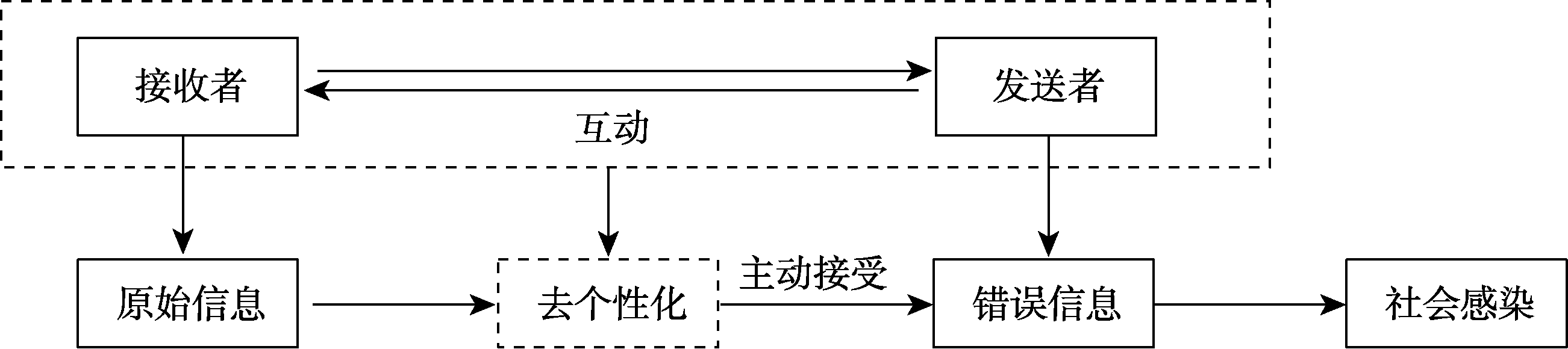
图1 社会互动通过“去个性化”产生记忆的社会感染效应的过程
| [1] |
陈文平, 段锦云, 田晓明. (2013). 员工为什么不建言:基于中国文化视角的解析. 心理科学进展, 21(5), 905-913. https://doi.org/10.3724/SP.J.1042.2013.00905
doi: 10.3724/SP.J.1042.2013.00905 URL |
| [2] |
郭滢, 龚先旻, 王大华. (2021). 错误记忆产生的认知与神经机制:信息加工视角. 心理科学进展, 29(1), 79-92. https://doi.org/10.3724/SP.J.1042.2021.00079
doi: 10.3724/SP.J.1042.2021.00079 URL |
| [3] |
孙亚茹, 刘泽军, 段亚杰, 陈宁, 刘伟. (2023). 协作如何减少记忆错误:一项元分析研究. 心理学报, 55(11), 1780-1795. https://doi.org/10.3724/SP.J.1041.2023.01780
doi: 10.3724/SP.J.1041.2023.01780 URL |
| [4] | 闫阅, 徐建平, 彭宇. (2015). 重复测量和具体警示对错误信息效应的影响. 心理与行为研究, 13(4), 485-489. |
| [5] | Abadie, M., & Camos, V. (2019). False memory at short and long term. Journal of Experimental Psychology: General, 148(8), 1312-1334. https://doi.org/10.1037/xge0000526 |
| [6] | Abel, M., & Bäuml, K.-H. T. (2020). Social interactions can simultaneously enhance and distort memories: Evidence from a collaborative recognition task. Cognition, 200, 104254. https://doi.org/10.1016/j.cognition.2020.104254 |
| [7] | Abel, M., & Bäuml, K.-H. T. (2023). Joint contributions of collaborative facilitation and social contagion to the development of shared memories in social groups. Cognition, 238, 105453. https://doi.org/10.1016/j.cognition.2023.105453 |
| [8] | Allan, K., & Gabbert, F. (2008). I still think it was a banana: Memorable ‘lies’ and forgettable ‘truths’. Acta Psychologica, 127(2), 299-308. https://doi.org/10.1016/j.actpsy.2007.06.001 |
| [9] | Andrews, J. J., & Rapp, D. N. (2014). Partner characteristics and social contagion: Does group composition matter? Applied Cognitive Psychology, 28(4), 505-517. https://doi.org/10.1002/acp.3024 |
| [10] | Andrews-Todd, J., Salovich, N. A., & Rapp, D. N. (2021). Differential effects of pressure on social contagion of memory. Journal of Experimental Psychology: Applied, 27(2), 258-275. https://doi.org/10.1037/xap0000346 |
| [11] | Asch, S. E. (1955). Opinions and social pressure. Scientific American, 193(5), 31-35. |
| [12] | Battista, F., Mangiulli, I., Riesthuis, P., Curci, A., & Otgaar, H. (2021). Do liars really remember what they lied upon? The impact of fabrication on memory. Memory, 29(8), 1076-1090. https://doi.org/10.1080/09658211.2021.1960380 |
| [13] | Betz, A. L., Skowronski, J. J., & Ostrom, T. M. (1996). Shared realities: Social influence and stimulus memory. Social Cognition, 14(2), 113-140. https://doi.org/10.1521/soco.1996.14.2.113 |
| [14] |
Blank, H. (1998). Memory states and memory tasks: An integrative framework for eyewitness memory and suggestibility. Memory, 6(5), 481-529. https://doi.org/10.1080/741943086
URL pmid: 10197161 |
| [15] |
Blank, H. (2005). Another look at retroactive and proactive interference: A quantitative analysis of conversion processes. Memory, 13(2), 200-224. https://doi.org/10.1080/09608210344000698
URL pmid: 15847231 |
| [16] | Bodner, G. E., Musch, E., & Azad, T. (2009). Reevaluating the potency of the memory conformity effect. Memory & Cognition, 37(8), 1069-1076. https://doi.org/10.3758/MC.37.8.1069 |
| [17] | Boorom, O., & Liu, T. (2024). A scoping review of interaction dynamics in minimally verbal autistic individuals. Frontiers in Psychology, 15, 1497800. https://doi.org/10.3389/fpsyg.2024.1497800 |
| [18] | Brainerd, C. J., & Reyna, V. F. (2019). Fuzzy-trace theory, false memory, and the law. Policy Insights from the Behavioral and Brain Sciences, 6(1), 79-86. https://doi.org/10.1177/2372732218797143 |
| [19] | Carneiro, P., Lapa, A., & Finn, B. (2021). Memory updating after retrieval: When new information is false or correct. Memory, 29(9), 1156-1175. https://doi.org/10.1080/09658211.2021.1968438 |
| [20] | Chan, J. C. K., & LaPaglia, J. A. (2013). Impairing existing declarative memory in humans by disrupting reconsolidation. Proceedings of the National Academy of Sciences, 110(23), 9309-9313. https://doi.org/10.1073/pnas.1218472110 |
| [21] | Chan, T. K. H., Cheung, C. M. K., Benbasat, I., Xiao, B., & Lee, Z. W. Y. (2023). Bystanders join in cyberbullying on social networking sites: The deindividuation and moral disengagement perspectives. Information Systems Research, 34(3), 828-846. https://doi.org/10.1287/isre.2022.1161 |
| [22] |
Conway, M. A., & Howe, M. L. (2022). Memory construction: A brief and selective history. Memory, 30(1), 2-4. https://doi.org/10.1080/09658211.2021.1964795
doi: 10.1080/09658211.2021.1964795 URL pmid: 35331087 |
| [23] | Cordonnier, A., Rosoux, V., Gijs, A.-S., & Luminet, O. (2022). Collective memory: An hourglass between the collective and the individual. Memory, Mind & Media, 1, e8. https://doi.org/10.1017/mem.2022.1 |
| [24] | Davis, S. D., & Meade, M. L. (2013). Both young and older adults discount suggestions from older adults on a social memory test. Psychonomic Bulletin & Review, 20(4), 760-765. https://doi.org/10.3758/s13423-013-0392-5 |
| [25] | De Jaegher, H. (2013). Embodiment and sense-making in autism. Frontiers in Integrative Neuroscience, 7, 15. https://doi.org/10.3389/fnint.2013.00015 |
| [26] |
DePaulo, B. M., Lindsay, J. J., Malone, B. E., Muhlenbruck, L., Charlton, K., & Cooper, H. (2003). Cues to deception. Psychological Bulletin, 129(1), 74-118. https://doi.org/10.1037/0033-2909.129.1.74
URL pmid: 12555795 |
| [27] | Dianiska, R. E., & Meissner, C. A. (2023). The effect of lying on memory and metamemory when deception is repeated and volitional. Journal of Applied Research in Memory and Cognition, 12(1), 128-140. https://doi.org/10.1037/mac0000036 |
| [28] | Diener, E. (1979). Deindividuation, self-awareness, and disinhibition. Journal of Personality and Social Psychology, 37(7), 1160-1171. https://doi.org/10.1037/0022-3514.37.7.1160 |
| [29] | Doughty, N., Paterson, H. M., MacCann, C., & Monds, L. A. (2017). Personality and memory conformity. Journal of Individual Differences, 38(1), 12-20. https://doi.org/10.1027/1614-0001/a000217 |
| [30] | Echterhoff, G., Hirst, W., & Hussy, W. (2005). How eyewitnesses resist misinformation: Social postwarnings and the monitoring of memory characteristics. Memory & Cognition, 33(5), 770-782. https://doi.org/10.3758/BF03193073 |
| [31] | Ecker, U. K. H., Lewandowsky, S., Chang, E. P., & Pillai, R. (2014). The effects of subtle misinformation in news headlines. Journal of Experimental Psychology: Applied, 20(4), 323-335. https://doi.org/10.1037/xap0000028 |
| [32] |
Ekeocha, J. O., & Brennan, S. E. (2008). Collaborative recall in face-to-face and electronic groups. Memory, 16(3), 245-261. https://doi.org/10.1080/09658210701807480
doi: 10.1080/09658210701807480 URL pmid: 18324550 |
| [33] |
Fehr, E., & Schurtenberger, I. (2018). Normative foundations of human cooperation. Nature Human Behaviour, 2(7), 458-468. https://doi.org/10.1038/s41562-018-0385-5
doi: 10.1038/s41562-018-0385-5 URL pmid: 31097815 |
| [34] | Festinger, L., Pepitone, A., & Newcomb, T. (1952). Some consequences of de-individuation in a group. The Journal of Abnormal and Social Psychology, 47(Suppl. 2), 382-389. https://doi.org/10.1037/h0057906 |
| [35] | French, L., Garry, M., & Mori, K. (2011). Relative--not absolute--judgments of credibility affect susceptibility to misinformation conveyed during discussion. Acta Psychologica, 136(1), 119-128. https://doi.org/10.1016/j.actpsy.2010.10.009 |
| [36] |
Gabbert, F., Memon, A., & Wright, D. (2007). I saw it for longer than you: The relationship between perceived encoding duration and memory conformity. Acta Psychologica, 124(3), 319-331. https://doi.org/10.1016/j.actpsy.2006.03.009
URL pmid: 16764812 |
| [37] | Garvin, C. D., Gutiérrez, L. M., & Galinsky, M. J. (2017). Handbook of social work with groups. Guilford Publications. |
| [38] | Goodwin, K. A., Hannah, P. J., Nicholl, M. C., & Ferri, J. M. (2017). The confident co-witness: The effects of misinformation on memory after collaborative discussion. Applied Cognitive Psychology, 31(2), 225-235. https://doi.org/10.1002/acp.3320 |
| [39] | Grice, H. P. (1975). Logic and conversation. In P. Cole, & J. L. Morgan (Eds.), Syntax and semantics (pp. 41-58). New York: Academic Press. |
| [40] | Gronchi, G., Righi, S., Gavazzi, G., Giganti, F., & Viggiano, M. P. (2023). Intuitive thinking predicts false memory formation due to a decrease in inhibitory efficiency. Frontiers in Psychology, 14, 1195668. https://doi.org/10.3389/fpsyg.2023.1195668 |
| [41] | Harris, C. B., Barnier, A. J., & Sutton, J. (2012). Consensus collaboration enhances group and individual recall accuracy. Quarterly Journal of Experimental Psychology, 65(1), 179-194. https://doi.org/10.1080/17470218.2011.608590 |
| [42] | Hart, K. M., & Meade, M. L. (2021). Social contagion of memory and the role of self-initiated relative judgments. Acta Psychologica, 212, 103189. https://doi.org/10.1016/j.actpsy.2020.103189 |
| [43] | Hirst, W., & Echterhoff, G. (2012). Remembering in conversations: The social sharing and reshaping of memories. Annual Review of Psychology, 63(1), 55-79. https://doi.org/10.1146/annurev-psych-120710-100340 |
| [44] | Horry, R., Palmer, M. A., Sexton, M. L., & Brewer, N. (2012). Memory conformity for confidently recognized items: The power of social influence on memory reports. Journal of Experimental Social Psychology, 48(3), 783-786. https://doi.org/10.1016/j.jesp.2011.12.010 |
| [45] | Huang, M. (2024). Confucian culture and democratic values: An empirical comparative study in east Asia. Journal of East Asian Studies, 24(1), 71-101. https://doi.org/10.1017/jea.2023.23 |
| [46] | Huang, T.-R., Cheng, Y.-L., & Rajaram, S. (2024). Unavoidable social contagion of false memory from robots to humans. American Psychologist, 79(2), 285-298. https://doi.org/10.1037/amp0001230 |
| [47] | Huff, M. J., Davis, S. D., & Meade, M. L. (2013). The effects of initial testing on false recall and false recognition in the social contagion of memory paradigm. Memory & Cognition, 41(6), 820-831. https://doi.org/10.3758/s13421-013-0299-4 |
| [48] | Ito, H., Barzykowski, K., Grzesik, M., Gülgöz, S., Gürdere, C., Janssen, S. M. J., … Mori, K. (2019). Eyewitness memory distortion following co-witness discussion: A replication of Garry, French, Kinzett, and Mori (2008) in ten countries. Journal of Applied Research in Memory and Cognition, 8(1), 68-77. https://doi.org/10.1016/j.jarmac.2018.09.004 |
| [49] | Kękuś, M., Dziubańska, R., Michalak, K., Polczyk, R., Szpitalak, M., & Barzykowski, K. (2024). Protecting against misinformation: Evaluating the effectiveness of three techniques to reduce memory conformity. British Journal of Psychology, 115(4), 880-906. https://doi.org/10.1111/bjop.12712 |
| [50] | Kękuś, M., Polczyk, R., Ito, H., Mori, K., & Barzykowski, K. (2021). Is your memory better than mine? Investigating the mechanisms and determinants of the memory conformity effect using a modified MORI technique. Applied Cognitive Psychology, 35(6), 1621-1630. https://doi.org/10.1002/acp.3879 |
| [51] | Kensinger, E. A., Choi, H.-Y., Murray, B. D., & Rajaram, S. (2016). How social interactions affect emotional memory accuracy: Evidence from collaborative retrieval and social contagion paradigms. Memory & Cognition, 44(5), 706-716. https://doi.org/10.3758/s13421-016-0597-8 |
| [52] |
Koike, T., Tanabe, H. C., Okazaki, S., Nakagawa, E., Sasaki, A. T., Shimada, K., … Sadato, N. (2016). Neural substrates of shared attention as social memory: A hyperscanning functional magnetic resonance imaging study. NeuroImage, 125, 401-412. https://doi.org/10.1016/j.neuroimage.2015.09.076
doi: S1053-8119(15)00982-9 URL pmid: 26514295 |
| [53] |
Lehman, M., & Malmberg, K. J. (2013). A buffer model of memory encoding and temporal correlations in retrieval. Psychological Review, 120(1), 155-189. https://doi.org/10.1037/a0030851
doi: 10.1037/a0030851 URL pmid: 23230891 |
| [54] |
Li, Y., Liu, Z., & Liu, X. (2022). Who did I lie to that day? Deception impairs memory in daily life. Psychological Research, 86(6), 1763-1773. https://doi.org/10.1007/s00426-021-01619-x
doi: 10.1007/s00426-021-01619-x URL pmid: 34988638 |
| [55] |
Loftus, E. F. (1993). The reality of repressed memories. American Psychologist, 48(5), 518-537. https://doi.org/10.1037/0003-066X.48.5.518
URL pmid: 8507050 |
| [56] | Loftus, E. F. (2005). Planting misinformation in the human mind: A 30-year investigation of the malleability of memory. Learning & Memory, 12(4), 361-366. https://doi.org/10.1101/lm.94705 |
| [57] |
Luhmann, C. C., & Rajaram, S. (2015). Memory transmission in small groups and large networks: An agent-based model. Psychological Science, 26(12), 1909-1917. https://doi.org/10.1177/0956797615605798
doi: 10.1177/0956797615605798 URL pmid: 26553014 |
| [58] | Luo, H., Cai, M., & Cui, Y. (2021). Spread of misinformation in social networks: Analysis based on Weibo Tweets. Security and Communication Networks, 2021, 1-23. https://doi.org/10.1155/2021/7999760 |
| [59] |
Mangiulli, I., Otgaar, H., Curci, A., & Jelicic, M. (2020). An experimental investigation of the misinformation effect in crime-related amnesia claims. Applied Cognitive Psychology, 34(5), 1092-1100. https://doi.org/10.1002/acp.3697
doi: 10.1002/acp.3697 URL |
| [60] |
Marion, S. B., & Thorley, C. (2016). A meta-analytic review of collaborative inhibition and postcollaborative memory: Testing the predictions of the retrieval strategy disruption hypothesis. Psychological Bulletin, 142(11), 1141-1164. https://doi.org/10.1037/bul0000071
URL pmid: 27618544 |
| [61] | Maswood, R., Luhmann, C. C., & Rajaram, S. (2022). Persistence of false memories and emergence of collective false memory: Collaborative recall of DRM word lists. Memory, 30(4), 465-479. https://doi.org/10.1080/09658211.2021.1928222 |
| [62] |
Maswood, R., & Rajaram, S. (2019). Social transmission of false memory in small groups and large networks. Topics in Cognitive Science, 11(4), 687-709. https://doi.org/10.1111/tops.12348
doi: 10.1111/tops.12348 URL pmid: 29785724 |
| [63] | McCloskey, M., & Zaragoza, M. (1985). Misleading postevent information and memory for events: Arguments and evidence against memory impairment hypotheses. Journal of Experimental Psychology: General, 114(1), 1-16. https://doi.org/10.1037/0096-3445.114.1.1 |
| [64] |
Meade, M. L., McNabb, J. C., Lindeman, M. I. H., & Smith, J. L. (2017). Discounting input from older adults: The role of age salience on partner age effects in the social contagion of memory. Memory, 25(5), 704-716. https://doi.org/10.1080/09658211.2016.1207783
doi: 10.1080/09658211.2016.1207783 URL pmid: 27424720 |
| [65] | Meade, M. L., & Roediger, H. L. (2002). Explorations in the social contagion of memory. Memory & Cognition, 30(7), 995-1009. https://doi.org/10.3758/BF03194318 |
| [66] | Mojtahedi, D., Ioannou, M., & Hammond, L. (2018). The dangers of co-witness familiarity: Investigating the effects of co-witness relationships on blame conformity. Journal of Police and Criminal Psychology, 33(4), 316-326. https://doi.org/10.1007/s11896-018-9254-4 |
| [67] | Mojtahedi, D., Ioannou, M., & Hammond, L. (2020). Intelligence, authority and blame conformity: Co-witness influence is moderated by the perceived competence of the information source. Journal of Police and Criminal Psychology, 35(4), 422-431. https://doi.org/10.1007/s11896-019-09361-2 |
| [68] |
Monds, L. A., Howard, M., Paterson, H. M., & Kemp, R. I. (2019). The effects of perceived memory ability on memory conformity for an event. Psychiatry, Psychology and Law, 26(4), 580-592. https://doi.org/10.1080/13218719.2018.1556130
doi: 10.1080/13218719.2018.1556130 URL pmid: 31984098 |
| [69] |
Multhaup, K. S. (1995). Aging, source, and decision criteria: When false fame errors do and do not occur. Psychology and Aging, 10(3), 492-497. https://doi.org/10.1037/0882-7974.10.3.492
URL pmid: 8527069 |
| [70] | Newcomb, T. M., Turner, R. H., & Converse, P. E. (2015). Social psychology: The study of human interaction. London: Psychology Press. https://doi.org/10.4324/9781315720708 |
| [71] | Numata, T., Sato, H., Asa, Y., Koike, T., Miyata, K., Nakagawa, E., Sumiya, M., & Sadato, N. (2020). Achieving affective human-virtual agent communication by enabling virtual agents to imitate positive expressions. Scientific Reports, 10(1), 5977. https://doi.org/10.1038/s41598-020-62870-7 |
| [72] | Oeberst, A., Wachendörfer, M. M., Imhoff, R., & Blank, H. (2021). Rich false memories of autobiographical events can be reversed. Proceedings of the National Academy of Sciences, 118(13), e2026447118. https://doi.org/10.1073/pnas.2026447118 |
| [73] | Osorio-Gómez, D., Miranda, M. I., Guzmán-Ramos, K., & Bermúdez-Rattoni, F. (2023). Transforming experiences: Neurobiology of memory updating/editing. Frontiers in Systems Neuroscience, 17, 1103770. https://doi.org/10.3389/fnsys.2023.1103770 |
| [74] |
Otgaar, H., & Baker, A. (2018). When lying changes memory for the truth. Memory, 26(1), 2-14. https://doi.org/10.1080/09658211.2017.1340286
doi: 10.1080/09658211.2017.1340286 URL pmid: 28661223 |
| [75] | Otgaar, H., Howe, M. L., Smeets, T., & Wang, J. (2016). Denial-induced forgetting: False denials undermine memory, but external denials undermine belief. Journal of Applied Research in Memory and Cognition, 5(2), 168-175. https://doi.org/10.1016/j.jarmac.2016.04.002 |
| [76] | Pena, M. M., Klemfuss, J. Z., Loftus, E. F., & Mindthoff, A. (2017). The effects of exposure to differing amounts of misinformation and source credibility perception on source monitoring and memory accuracy. Psychology of Consciousness: Theory, Research, and Practice, 4(4), 337-347. https://doi.org/10.1037/cns0000137 |
| [77] |
Pezdek, K., Sperry, K., & Owens, S. M. (2007). Interviewing witnesses: The effect of forced confabulation on event memory. Law and Human Behavior, 31(5), 463-478. https://doi.org/10.1007/s10979-006-9081-5
URL pmid: 17245633 |
| [78] |
Pfister, R., Wirth, R., Schwarz, K. A., Steinhauser, M., & Kunde, W. (2016). Burdens of non-conformity: Motor execution reveals cognitive conflict during deliberate rule violations. Cognition, 147, 93-99. https://doi.org/10.1016/j.cognition.2015.11.009
doi: 10.1016/j.cognition.2015.11.009 URL pmid: 26638051 |
| [79] |
Polage, D. C. (2019). Liar, liar: Consistent lying decreases belief in the truth. Applied Cognitive Psychology, 33(4), 527-536. https://doi.org/10.1002/acp.3489
doi: 10.1002/acp.3489 URL |
| [80] | Polczyk, R. (2017). The ‘memory’ misinformation effect may not be caused by memory failures: Exploring memory states of misinformed subjects. Polish Psychological Bulletin, 48(3), 388-400. https://doi.org/10.1515/ppb-2017-0045 |
| [81] | Provenzi, L., Scotto Di Minico, G., Giusti, L., Guida, E., & Müller, M. (2018). Disentangling the dyadic dance: Theoretical, methodological and outcomes systematic review of mother-infant dyadic processes. Frontiers in Psychology, 9, 348. https://doi.org/10.3389/fpsyg.2018.00348 |
| [82] | Raposo, N. G. (2023). Memory distortions: An interdisciplinary framework for cognitive-affective bias. In P. Fossa & C. Cortés-Rivera (Eds.), Affectivity and learning: Bridging the gap between neurosciences, cultural and cognitive psychology (pp. 517-537). Springer Nature Switzerland. https://doi.org/10.1007/978-3-031-31709-5_27 |
| [83] | Ribino, P. (2023). The role of politeness in human-machine interactions: A systematic literature review and future perspectives. Artificial Intelligence Review, 56(1), 445-482. https://doi.org/10.1007/s10462-023-10540-1 |
| [84] | Riesthuis, P., Otgaar, H., De Cort, A., Bogaard, G., & Mangiulli, I. (2022). Creating a false alibi leads to errors of commission and omission. Applied Cognitive Psychology, 36(4), 936-945. https://doi.org/10.1002/acp.3982 |
| [85] | Riesthuis, P., Otgaar, H., Hope, L., & Mangiulli, I. (2022). Registered report: The effects of incentivized lies on memory. Applied Cognitive Psychology, 36(5), 1150-1161. https://doi.org/10.1002/acp.3986 |
| [86] |
Rodriguez, D. N., & Strange, D. (2015). False memories for dissonance inducing events. Memory, 23(2), 203-212. https://doi.org/10.1080/09658211.2014.881501
doi: 10.1080/09658211.2014.881501 URL pmid: 25625288 |
| [87] | Roediger, H. L., Meade, M. L., & Bergman, E. T. (2001). Social contagion of memory. Psychonomic Bulletin & Review, 8(2), 365-371. https://doi.org/10.3758/BF03196174 |
| [88] | Romeo, T., Otgaar, H., Smeets, T., Landstrom, S., & Boerboom, D. (2019). The impact of lying about a traumatic virtual reality experience on memory. Memory & Cognition, 47(3), 485-495. https://doi.org/10.3758/s13421-018-0885-6 |
| [89] | Sanderson, J. A., & Ecker, U. K. H. (2020). The Challenge of misinformation and ways to reduce its impact. In P. Van Meter, A. List, D. Lombardi, & P. Kendeou (Eds.), Handbook of learning from multiple representations and perspectives (pp. 461-476). Routledge. |
| [90] | Saraiva, M., Albuquerque, P. B., & Arantes, J. (2017). Production of false memories in collaborative memory tasks using the DRM paradigm. Psicológica, 38(2), 209-229. |
| [91] | Saraiva, M., & Garrido, M. V. (2024). Misinformation in social interaction: Examining the role of discussion. Memory, 32(2), 156-165. https://doi.org/10.1080/09658211.2023.2300671 |
| [92] |
Schacter, D. L., Guerin, S. A., & St. Jacques, P. L. (2011). Memory distortion: An adaptive perspective. Trends in Cognitive Sciences, 15(10), 467-474. https://doi.org/10.1016/j.tics.2011.08.004
doi: 10.1016/j.tics.2011.08.004 URL pmid: 21908231 |
| [93] | Seamon, J. G., Luo, C. R., Kopecky, J. J., Price, C. A., Rothschild, L., Fung, N. S., & Schwartz, M. A. (2002). Are false memories more difficult to forget than accurate memories? The effect of retention interval on recall and recognition. Memory & Cognition, 30(7), 1054-1064. https://doi.org/10.3758/BF03194323 |
| [94] | Smith, L. G. E., & Postmes, T. (2011). The power of talk: Developing discriminatory group norms through discussion. British Journal of Social Psychology, 50(2), 193-215. https://doi.org/10.1348/014466610X504805 |
| [95] | Steinmetz, J., Sezer, O., & Sedikides, C. (2017). Impression mismanagement: People as inept self-presenters. Social and Personality Psychology Compass, 11(6), e12321. https://doi.org/10.1111/spc3.12321 |
| [96] | Szpitalak, M., & Polczyk, R. (2019). How to induce resistance to the misinformation effect? Characteristics of positive feedback in the reinforced self-affirmation procedure. Psychology, Crime & Law, 25(7), 771-791. https://doi.org/10.1080/1068316X.2019.1574791 |
| [97] | Thorley, C., & Dewhurst, S. A. (2007). Collaborative false recall in the DRM procedure: Effects of group size and group pressure. European Journal of Cognitive Psychology, 19(6), 867-881. https://doi.org/10.1080/09541440600872068 |
| [98] | Thorley, C., & Kumar, D. (2017). Eyewitness susceptibility to co-witness misinformation is influenced by co-witness confidence and own self-confidence. Psychology, Crime & Law, 23(4), 342-360. https://doi.org/10.1080/1068316X.2016.1258471 |
| [99] | Verovšek, P. J. (2016). Collective memory, politics, and the influence of the past: The politics of memory as a research paradigm. Politics, Groups, and Identities, 4(3), 529-543. https://doi.org/10.1080/21565503.2016.1167094 |
| [100] | Vieira, K. M., & Lane, S. M. (2013). How you lie affects what you remember. Journal of Applied Research in Memory and Cognition, 2(3), 173-178. https://doi.org/10.1016/j.jarmac.2013.05.005 |
| [101] | Vilanova, F., Beria, F. M., Costa, Â. B., & Koller, S. H. (2017). Deindividuation: From Le Bon to the social identity model of deindividuation effects. Cogent Psychology, 4(1), 1308104. https://doi.org/10.1080/23311908.2017.1308104 |
| [102] |
Vosoughi, S., Roy, D., & Aral, S. (2018). The spread of true and false news online. Science, 359(6380), 1146-1151. https://doi.org/10.1126/science.aap9559
doi: 10.1126/science.aap9559 URL pmid: 29590045 |
| [103] | Vredeveldt, A., Groen, R. N., Ampt, J. E., & van Koppen, P. J. (2017). When discussion between eyewitnesses helps memory. Legal and Criminological Psychology, 22(2), 242-259. https://doi.org/10.1111/lcrp.12097 |
| [104] | Walczyk, J. J., Harris, L. L., Duck, T. K., & Mulay, D. (2014). A social-cognitive framework for understanding serious lies: Activation-decision-construction-action theory. New Ideas in Psychology, 34, 22-36. https://doi.org/10.1016/j.newideapsych.2014.03.001 |
| [105] | Williamson, P., Weber, N., & Robertson, M. (2013). The effect of expertise on memory conformity: A test of informational influence. Behavioral Sciences & the Law, 31(5), 607-623. https://doi.org/10.1002/bsl.2094 |
| [106] |
Wright, D. B., Gabbert, F., Memon, A., & London, K. (2008). Changing the criterion for memory conformity in free recall and recognition. Memory, 16(2), 137-148. https://doi.org/10.1080/09658210701836174
doi: 10.1080/09658210701836174 URL pmid: 18286418 |
| [107] | Wright, D. B., London, K., & Waechter, M. (2010). Social anxiety moderates memory conformity in adolescents. Applied Cognitive Psychology, 24(7), 1034-1045. https://doi.org/10.1002/acp.1604 |
| [108] | Zacks, J. M., Bezdek, M. A., & Cunningham, G. E. (2022). Knowledge and the reliability of constructive memory. Memory, 30(1), 22-25. https://doi.org/10.1080/09658211.2020.1871022 |
| [109] | Zhan, B., Chen, Y., Wang, R., & Jiang, Y. (2025). Prolonged visual perceptual changes induced by short-term dyadic training: The roles of confidence and autistic traits in social learning. iScience, 28(2), 111716. https://doi.org/10.1016/j.isci.2024.111716 |
| [110] | Zimbardo, P. G. (1969). The human choice:Individuation, reason, and order versus deindividuation, impulse, and chaos. Nebraska Symposium on Motivation, 17, 237-307. |
| [1] | 弯美娜;刘力;邱佳;杨晓莉. 集群行为:界定、心理机制与行为测量[J]. 心理科学进展, 2011, 19(5): 723-730. |
| [2] | 兰玉娟;佐斌. 去个性化效应的社会认同模型[J]. 心理科学进展, 2009, 17(2): 467-472. |
| [3] | 董昌锋,张积家. 复习对正确记忆和虚假记忆的影响[J]. 心理科学进展, 2003, 11(5): 500-504. |
| [4] | 何海瑛;张剑;朱滢. DRM范式的关联性记忆错觉的研究综述[J]. 心理科学进展, 2000, 8(3): 6-11. |
| 阅读次数 | ||||||
|
全文 |
|
|||||
|
摘要 |
|
|||||
