

ISSN 1671-3710
CN 11-4766/R
主办:中国科学院心理研究所
出版:科学出版社
CN 11-4766/R
主办:中国科学院心理研究所
出版:科学出版社
心理科学进展 ›› 2026, Vol. 34 ›› Issue (1): 1-17.doi: 10.3724/SP.J.1042.2026.0001 cstr: 32111.14.2026.0001
• 研究构想 • 下一篇
罗霄骁1( ), 周晓林2,3
收稿日期:2025-01-27
出版日期:2026-01-15
发布日期:2025-11-10
通讯作者:
罗霄骁, E-mail: luoxiaoxiao@ynnu.edu.cn基金资助:
LUO Xiaoxiao1(), ZHOU Xiaolin2,3
Received:2025-01-27
Online:2026-01-15
Published:2025-11-10
摘要:
意志是自主控制自身的能力, 是人类区分于动物和机器的核心特征, 是身心健康和社会秩序的基石。其外在表现是主动动作, 内在表征是控制信念。前者指基于自身意愿产生的动作; 后者指相信主动动作的实施能对外界事物产生影响的信念。前人研究大多基于主动动作研究意志, 而个体实施主动动作的同时会持有控制信念。因此, 相关研究混淆了意志的外在表现和内在表征。本研究拟基于意志促进表现(volition-motivated performance, VMP)范式, 通过分离主动动作和控制信念, 结合计算建模、多模态神经影像技术(肌电图/脑电图/功能磁共振成像), 系统揭示二者的共享与特异性认知神经机制。据此提出“人类意志过程的双路径假设”:一是主动动作相关路径, 体现意志的动作属性; 二是控制信念相关路径, 体现意志的动机属性。
中图分类号:
罗霄骁, 周晓林. (2026). 意志的外在表现和内在表征的分离. 心理科学进展 , 34(1), 1-17.
LUO Xiaoxiao, ZHOU Xiaolin. (2026). Dissociating the external manifestation and internal representation of volition. Advances in Psychological Science, 34(1), 1-17.

图1 以往研究中探究意志的范式总结。无论是关注主动动作还是控制信念, 这些范式都离不开即时实施的主动动作, 而个体实施主动动作往往同时持有控制信念, 故以往研究未能区分主动动作和控制信念分别的作用。彩图见电子版, 下同。

图2 意志促进表现(volition-motivated performance, VMP)范式的典型试次流程。线索阶段:不同颜色圆提示当前试次的选择类型(自主选择vs.强制选择)。选择阶段:从两张图片中自主/强制按键选择一张。任务阶段:以选中的图片为背景完成一项认知任务(此处为视觉搜索任务)。注意:在不同阶段(线索、选择、任务阶段)之间均有0.5~0.8 s的注视点。出于简化流程图的考虑, 这些注视点的示意图没有呈现在此图中。资料来源:Luo, Wang, Gu等人(2024)中的Fig. 1。
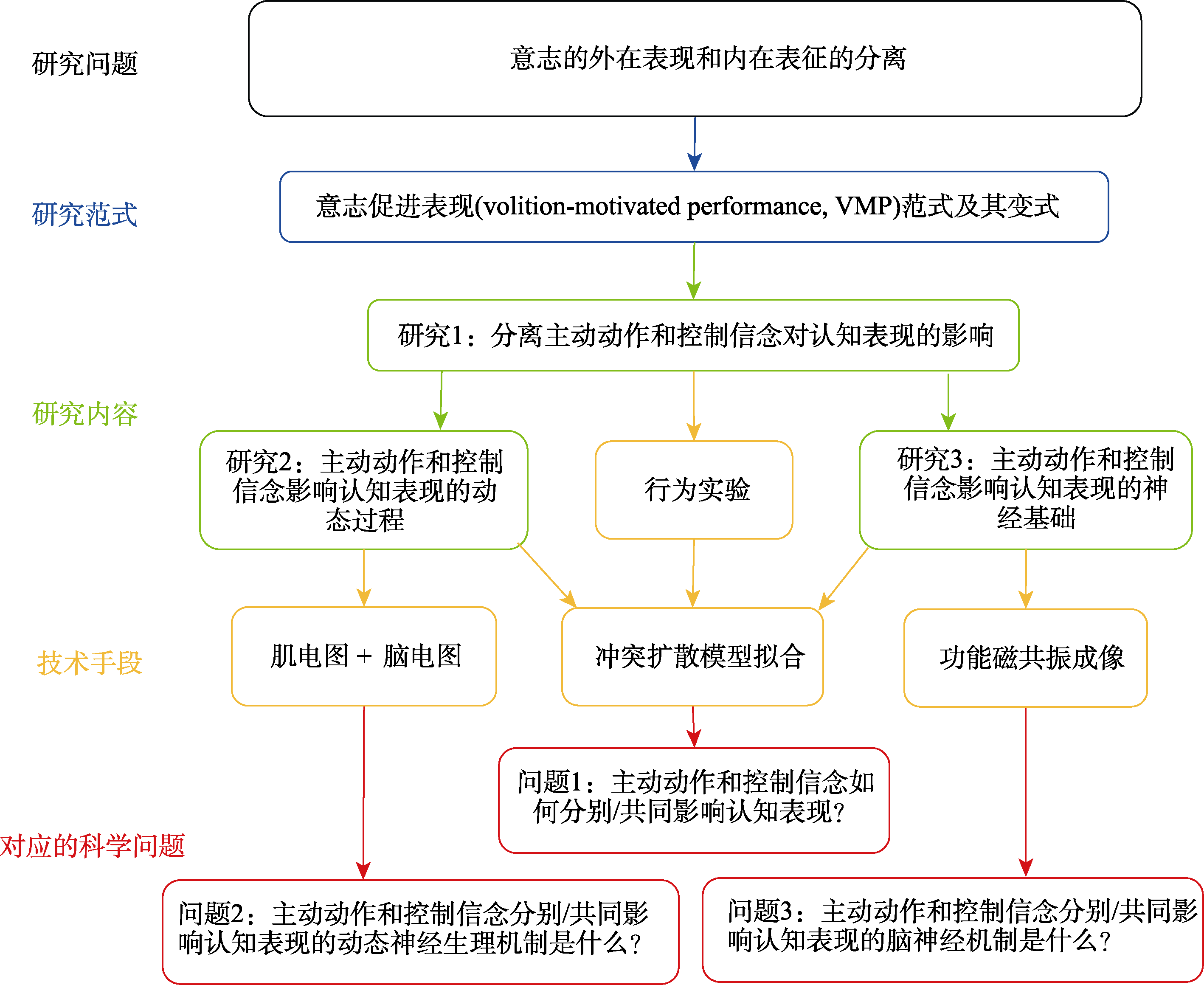
图3 研究框架与技术路线。黑色框代表研究问题, 蓝色框代表研究范式, 绿色框代表研究内容, 黄色框代表技术手段, 红色框代表对应的科学问题。本研究中意志对认知表现的影响主要通过自主选择对Simon任务表现的影响来评价。

图4 意志促进表现(volition-motivated performance, VMP)范式及其变式。(A)一般VMP范式。线索阶段:不同颜色提示接下来的选择类型(自主选择vs.强制选择)。选择阶段:从两张图片中自主/强制按键选择一张。任务阶段:以选中的图片为背景完成Simon任务。在一般VMP范式中, 意志对认知表现的影响同时包含了主动动作的作用和控制信念的作用(共同效应)。(B)VMP变式①。与一般VMP范式相比, 任务阶段的背景图片总是固定不变的一张, 与选择阶段中的选择无关。该变式旨在剔除控制信念, 只保留主动动作的作用。(C)VMP变式②。与一般VMP范式相比, 没有选择阶段。线索阶段:不同颜色提示接下来呈现的图片类型(昨天自主选择的图片vs.昨天强制选择的图片)。任务阶段:呈现相应图片背景进行Simon任务。该变式旨在剔除主动动作, 只保留控制信念的作用。注意:在不同阶段(线索、选择、任务阶段)之间均有0.5~0.8 s的注视点。出于简化流程图的考虑, 这些注视点的示意图没有呈现在此图中。
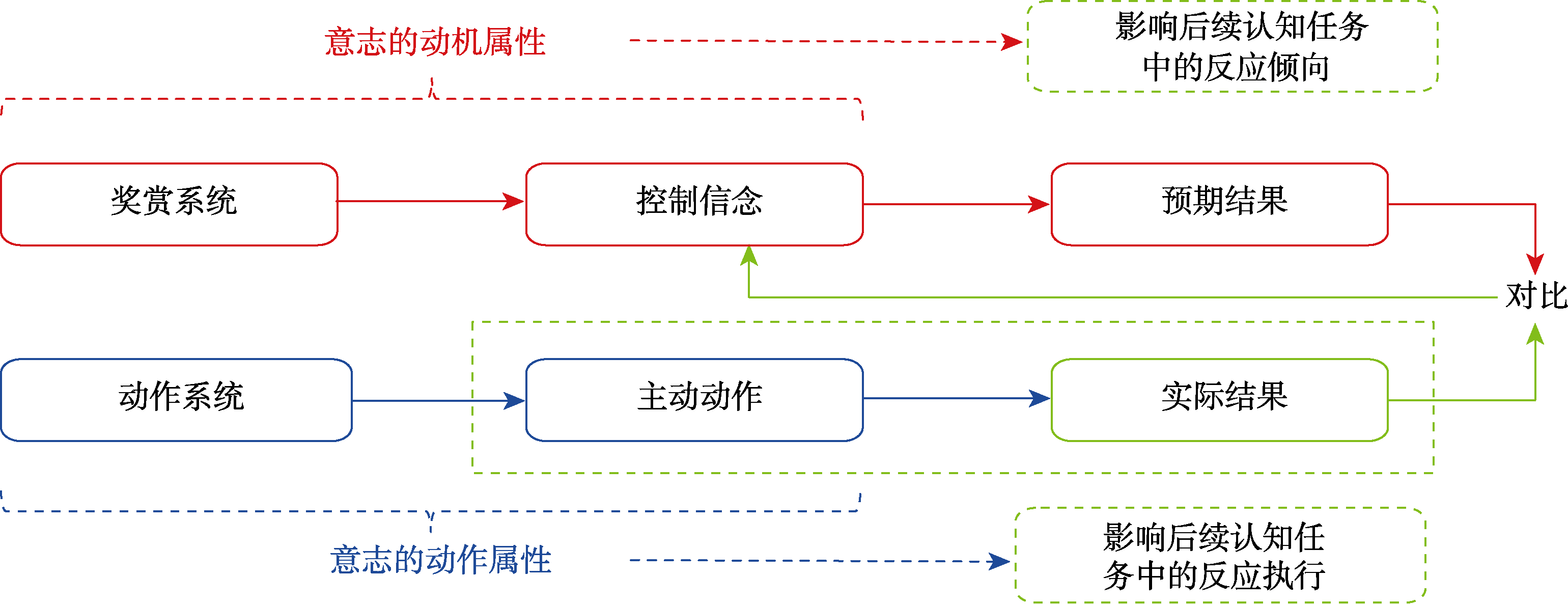
图5 人类意志过程的双路径假设。红色内容是控制信念相关路径, 可能与大脑奖赏系统有关, 体现了意志的动机属性, 可能影响后续认知任务中的反应倾向; 蓝色内容是主动动作相关路径, 可能与大脑动作系统有关, 体现了意志的动作属性, 可能影响后续认知任务中的反应执行; 绿色内容是外部世界可观测到的结果或效应。控制信念是产生主动动作的基础, 而主动动作所造成的实际结果与控制信念中的预期结果的一致性会反过来调节控制信念的强弱。
| [1] | 陈煦海, 吴茜. (2019). 自主选择偏好:表现、机制与应用. 心理科学进展, 27(8), 1460-1467. |
| [2] | 陈雪玲, 徐富明, 刘腾飞, 蒋多, 张军伟. (2010). 控制幻觉的研究方法、形成机制和影响因素. 心理科学进展, 18(5), 800-809. |
| [3] | 田昊月, 李力红, 徐喆, 李飞, 金丹, 安灿翎. (2018). 最小自我中的施动感. 心理科学进展, 26(5), 872-885. |
| [4] | 吴迪, 顾晶金, 李明, 张淼, 张明, 赵科, 傅小兰. (2019). 动作的主动控制感与因果关系的主动控制感:主动动作时间压缩效应的产生机制. 心理科学进展, 27(5), 804-810. |
| [5] | 张淼, 吴迪, 李明, 凌懿白, 张明, 赵科. (2018). 主动控制感的测量及认知神经机制. 心理科学进展, 26(10), 1787-1793. |
| [6] | Applebaum A., Netzer O., Stern Y., Zvilichovsky Y., Mashiah O., & Salomon R. (2025). The body knows better: Sensorimotor signals reveal the interplay between implicit and explicit sense of agency in the human mind. Cognition, 254, 105992. https://doi.org/10.1016/j.cognition.2024.105992 |
| [7] | Arikan B. E., Voudouris D., Voudouri-Gertz H., Sommer J., & Fiehler K. (2021). Reach-relevant somatosensory signals modulate activity in the tactile suppression network. NeuroImage, 236, 118000. https://doi.org/10.1016/j.neuroimage.2021.118000 |
| [8] | Barlas Z., Hockley W. E., & Obhi S. S. (2018). Effects of free choice and outcome valence on the sense of agency: Evidence from measures of intentional binding and feelings of control. Experimental Brain Research, 236, 129-139. https://doi.org/10.1007/s00221-017-5112-3 |
| [9] | Bertoni T., Noel, J-P., Bockbrader M., Foglia C., Colachis S., Orset B., …, Serino A. (2025). Pre-movement sensorimotor oscillations shape the sense of agency by gating cortical connectivity. Nature Communications, 16, 3594. https://doi.org/10.1038/s41467-025-58683-9 |
| [10] | Blakemore S. J., Wolpert D. M., & Frith C. D. (1998). Central cancellation of self-produced tickle sensation. Nature Neuroscience, 1(7), 635-640. https://doi.org/10.1038/2870 |
| [11] | Blakemore S. J., Wolpert D. M., & Frith C. D. (2000). Why can't you tickle yourself? Neuroreport, 11(11), R11- R16. http://doi.org/10.1097/00001756-200012180-00006 |
| [12] | Borhani K., Beck B., & Haggard P. (2017). Choosing, doing, and controlling: Implicit sense of agency over somatosensory events. Psychological Science, 28(7), 882-893. https://doi.org/10.1177/0956797617697693 |
| [13] | Bowen H. J., Marchesi M. L., & Kensinger E. A. (2020). Reward motivation influences response bias on a recognition memory task. Cognition, 203, 104337. http://doi.org/10.1016/j.cognition.2020.104337 |
| [14] | Caspar E. A., Christensen J. F., Cleeremans A., & Haggard P. (2016). Coercion changes the sense of agency in the human brain. Current Biology, 26, 585-592. https://doi.org/10.1016/j.cub.2015.12.067 |
| [15] | Cavazzana A., Penolazzi B., Begliomini C., & Bisiacchi P. S. (2015). Neural underpinnings of the 'agent brain': New evidence from transcranial direct current stimulation. European Journal of Neuroscience, 42(3), 1889-1894. http://doi.org/10.1111/ejn.12937 |
| [16] | Chambon V., Théro H., Vidal M., Vandendriessche H., Haggard P., & Palminteri S. (2020). Information about action outcomes differentially affects learning from self- determined versus imposed choices. Nature Human Behaviour, 4, 1067-1079. https://doi.org/10.1038/s41562-020-0919-5 |
| [17] | Christensen J. F., Rödiger C., Claydon L., & Haggard P. (2024). Volition and control in law and in brain science: Neurolegal translation of a foundational concept. Frontiers in Human Neuroscience, 18, 1401895. https://doi.org/10.3389/fnhum.2024.1401895 |
| [18] | Cunnington R., Windischberger C., Deecke L., & Moser E. (2002). The preparation and execution of self-initiated and externally-triggered movement: A study of event-related fMRI. NeuroImage, 15(2), 373-385. http://doi.org/10.1006/nimg.2001.0976 |
| [19] | Daprati E., Franck N., Georgieff N., Proust J., Pacherie E., Dalery J., & Jeannerod M. (1997). Looking for the agent: An investigation into consciousness of action and self-consciousness in schizophrenic patients. Cognition, 65(1), 71-86. http://doi.org/10.1016/s0010-0277(97)00039-5 |
| [20] | Deiber M., Honda M., Ibañez V., Sadato N., & Hallett M. (1999). Mesial motor areas in self-initiated versus externally triggered movements examined with fMRI: Effect of movement type and rate. Journal of Neurophysiology, 81(6), 3065-3077. http://doi.org/10.1152/jn.1999.81.6.3065 |
| [21] | Desantis A., Roussel C., & Waszak F. (2011). On the influence of causal beliefs on the feeling of agency. Consciousness and Cognition, 20, 1211-1220. http://doi.org/10.1016/j.concog.2011.02.012 |
| [22] | Desmurget M., Reilly K. T, Richard N., Szathmari A., Mottolese C., & Sirigu A. (2009). Movement intention after parietal cortex stimulation in humans. Science, 324(5928), 811-813. http://doi.org/10.1126/science.1169896 |
| [23] | Dogge M., Schaap M., Custers R., Wegner D. M., & Aarts H. (2012). When moving without volition: Implied self- causation enhances binding strength between involuntary actions and effects. Consciousness and Cognition, 21(1), 501-506. http://doi.org/10.1016/j.concog.2011.10.014 |
| [24] | Egner T. (2008). Multiple conflict-driven control mechanisms in the human brain. Trends in Cognitive Sciences, 12(10), 374-380. http://doi.org/10.1016/j.tics.2008.07.001 |
| [25] | Eitam B., Kennedy P. M., & Higgins E. T. (2013). Motivation from control. Experimental Brain Research, 229(3), 475-484. http://doi.org/10.1007/s00221-012-3370-7 |
| [26] | Fried I., Katz A., McCarthy G., Sass K. J., Williamson P., Spencer S. S., & Spencer D. D. (1991). Functional organization of human supplementary motor cortex studied by electrical stimulation. Journal of Neuroscience, 11(11), 3656-3666. http://doi.org/10.1523/JNEUROSCI.11-11-03656.1991 |
| [27] | Frith C. (2013). The psychology of volition. Experimental Brain Research, 229, 289-299. https://doi.org/10.1007/s00221-013-3407-6 |
| [28] | Georgieff N., & Jeannerod M. (1998). Beyond consciousness of external reality: A "who" system for consciousness of action and self-consciousness. Consciousness and Cognition, 7(3), 465-477. http://doi.org/10.1006/ccog.1998.0367 |
| [29] | Haggard P. (2008). Human volition: Towards a neuroscience of will. Nature Reviews Neuroscience, 9(12), 934-946. http://doi.org/10.1038/nrn2497 |
| [30] | Haggard P. (2017). Sense of agency in the human brain. Nature Reviews Neuroscience, 18(4), 196-207. http://doi.org/10.1038/nrn.2017.14 |
| [31] | Haggard P. (2019). The neurocognitive bases of human volition. Annual Review of Psychology, 70, 9-28. http://doi.org/10.1146/annurev-psych-010418-103348 |
| [32] | Haggard P., Clark S., & Kalogeras J. (2002). Voluntary action and conscious awareness. Nature Neuroscience, 5(4), 382-385. http://doi.org/10.1038/nn827 |
| [33] | Hemed E., Bakbani-Elkayam S., Teodorescu A. R., Yona L., & Eitam B. (2020). Evaluation of an action’s effectiveness by the motor system in a dynamic environment. Journal of Experimental Psychology: General, 149(5), 935-948. https://doi.org/10.1037/xge0000692 |
| [34] | Henriques J. B., & Glowacki J. M. (1994). Reward fails to alter response bias in depression. Journal of Abnormal Psychology, 103(3), 460-466. http://doi.org/10.1037/0021-843X.103.3.460 |
| [35] | Hommel B. (2011). The Simon effect as tool and heuristic. Acta Psychologica, 136(2), 189-202. http://doi.org/10.1016/j.actpsy.2010.04.011 |
| [36] | Huys Q. J. M., & Dayan P. (2009). A Bayesian formulation of behavioral control. Cognition, 113(3), 314-328. http://doi.org/10.1016/j.cognition.2009.01.008 |
| [37] | Kane R. (1996). The significance of free will. Oxford University Press |
| [38] | Karsh N., Eitam B., Mark I., & Higgins E. T. (2016). Bootstrapping agency: How control-relevant information affects motivation. Journal of Experimental Psychology: General, 145(4), 1333-1350. http://doi.org/10.1037/xge0000212 |
| [39] | Khalighinejad N., Schurger A., Desantis A., Zmigrod L., & Haggard P. (2018). Precursor processes of human self- initiated action. NeuroImage, 165, 35-47. http://doi.org/10.1016/j.neuroimage.2017.09.057 |
| [40] | Kringelbach, M. L., & Berridge K. C. (2016). Neuroscience of reward, motivation, and drive. In S.Kim, J.Reeve, & M.Bong (Eds.), Recent developments in neuroscience research on human motivation (Advances in motivation and achievement), Vol. 19 (pp. 23-35). Emerald Group Publishing Limited, Leeds. https://doi.org/10.1108/S0749-742320160000019020 |
| [41] | Kuhl J. (1984). Volitional aspects of achievement motivation and learned helplessness: Toward a comprehensive theory of action control. In B.A, Maher(Ed.), Progress in experimental personality research (Vol. 13, pp. 99-171). Academic Press. https://doi.org/10.1016/B978-0-12-541413-5.50007-3 |
| [42] | Kühn S., Brass M., & Haggard P. (2013). Feeling in control: Neural correlates of experience of agency. Cortex, 49(7), 1935-1942. http://doi.org/10.1016/j.cortex.2012.09.002 |
| [43] | Langer E. J. (1975). The illusion of control. Journal of Personality & Social Psychology, 32(2), 311-328. http://doi.org/10.1037/0022-3514.32.2.311 |
| [44] | Lawlor V. M., Webb C. A., Wiecki T. V., Frank M. J., Trivedi M., Pizzagalli D. A., & Dillon D.G. (2020). Dissecting the impact of depression on decision-making. Psychological Medicine, 50(10), 1613-1622. http://doi.org/10.1017/S0033291719001570 |
| [45] | Leotti L. A., Iyengar S. S., & Ochsner K. N. (2010). Born to choose: The origins and value of the need for control. Trends in Cognitive Sciences, 14(10), 457-463. http://doi.org/10.1016/j.tics.2010.08.001 |
| [46] | Leotti L. A., & Delgado M. R. (2011). The inherent reward of choice. Psychological Science, 22(10), 1310-1318. http://doi.org/10.1177/0956797611417005 |
| [47] | Legault L., & Inzlicht M. (2013). Self-determination, self- regulation, and the brain: Autonomy improves performance by enhancing neuroaffective responsiveness to self- regulation failure. Journal of Personality & Social Psychology, 105(1), 123-138. https://doi.org/10.1037/a0030426 |
| [48] | Libet B., Gleason C. A., Wright E. W., & Pearl D. K. (1983). Time of conscious intention to act in relation to onset of cerebral activity (readiness-potential): The unconscious initiation of a freely voluntary act. Brain, 106(3), 623-642. http://doi.org/10.1093/brain/106.3.623 |
| [49] | Lindner E., Schöberl T., Desantis A., & Gail A. (2025). Temporal action-effect prediction does not affect perceived loudness, but the sense of agency. Consciousness and Cognition, 130, 103837. https://doi.org/10.1016/j.concog.2025.103837 |
| [50] | Luo X., Kang G., Guo Y., Yu X., & Zhou X. (2020). A value-driven McGurk effect: Value-associated faces enhance the influence of visual information on audiovisual speech perception and its eye movement pattern. Attention, Perception, & Psychophysics, 82, 1928-1941. http://doi.org/10.3758/s13414-019-01918-x |
| [51] | Luo X., Wang L., Gu J., Zhang Q., Ma H., & Zhou X. (2024). The benefit of making voluntary choices generalizes across multiple effectors. Psychonomic Bulletin & Review, 31, 340-352. http://doi.org/10.3758/s13423-023-02350-x |
| [52] | Luo X., Wang L., & Zhou X. (2022). Belief in control: Voluntary choice enhances subsequent task performance under undefeated choice-outcome causation. Cognition, 255, 105108. http://doi.org/10.1016/j.cognition.2022.105108 |
| [53] | Luo X., Wang L., & Zhou X. (2024). Volition motivates cognitive performance at the response-execution level by attenuating task-irrelevant motor activations. Cognition, 245, 105738. http://doi.org/10.1016/j.cognition.2024.105738 |
| [54] | Maier S. F., & Seligman M. E. (1976). Learned helplessness: Theory and evidence. Journal of Experimental Psychology: General, 105(1), 3-46. http://doi.org/10.1037/0096-3445.105.1.3 |
| [55] | Matute H., & Blanco F. (2014). Reducing the illusion of control when an action is followed by an undesired outcome. Psychonomic Bulletin & Review, 21(4), 1087-1093. http://doi.org/10.3758/s13423-014-0584-7 |
| [56] | Mifsud N. G., Beesley T., Watson T. L., Elijah R. B., Sharp T. S., & Whitford T. J. (2018). Attenuation of visual evoked responses to hand and saccade-initiated flashes. Cognition, 179, 14-22. https://doi.org/10.1016/j.cognition.2018.06.005 |
| [57] | Mittelstädt V., Miller J., Leuthold H., Mackenzie I. G., & Ulrich R. (2022). The time-course of distractor-based activation modulates effects of speed-accuracy tradeoffs in conflict tasks. Psychonomic Bulletin & Review, 29, 837-854. http://doi.org/10.3758/s13423-021-02003-x |
| [58] | Moore J. W., Lagnado D., Deal D. C., & Haggard P. (2009). Feelings of control: Contingency determines experience of action. Cognition, 110(2), 279-283. http://doi.org/10.1016/j.cognition.2008.11.006 |
| [59] | Moore J. W., Ruge D., Wenke D., Rothwell J., & Haggard P. (2010). Disrupting the experience of control in the human brain: Pre-supplementary motor area contributes to the sense of agency. Proceedings of the Royal Society B: Biological Sciences, 277(1693), 2503-2509. http://doi.org/10.1098/rspb.2010.0404 |
| [60] | Murayama K., Matsumoto M., Izuma K., Sugiura A., Ryan R. M., Deci E. L., & Matsumoto K.. (2015). How self-determined choice facilitates performance: A key role of the ventromedial prefrontal cortex. Cerebral Cortex, 25(5), 1241-1251. http://doi.org/10.1093/cercor/bht317 |
| [61] | Murty V. P., DuBrow S., & Davachi L. (2015). The simple act of choosing influences declarative memory. Journal of Neuroscience, 35(16), 6255-6264. http://doi.org/10.1523/JNEUROSCI.4181-14.2015 |
| [62] | Noel, J-P., Bockbrader, M. Bertoni, T. Colachis, S. Solca, M. Orepic, P., … Serino, A. (2025). Neuronal responses in the human primary motor cortex coincide with the subjective onset of movement intention in brain-machine interface-mediated actions. PLoS Biology, 23(4), e3003118. https://doi.org/10.1371/journal.pbio.3003118 |
| [63] | Obhi S. S., & Hall P. (2011). Sense of agency and intentional binding in joint action. Experimental Brain Research, 211(3-4), 655-662. http://doi.org/10.1007/s00221-011-2675-2 |
| [64] | Ota K., Charles L., & Haggard P. (2024). Autonomous behaviour and the limits of human volition. Cognition, 244, 105684. https://doi.org/10.1016/j.cognition.2023.105684 |
| [65] | Passingham R. E. (1987). Two cortical systems for directing movement. Ciba Foundation Symposium, 132, 151-164. http://doi.org/10.1002/9780470513545.ch10 |
| [66] | Penfield W. (1954). Mechanisms of voluntary movement. Brain, 77(1), 1-17. http://doi.org/10.1093/brain/77.1.1 |
| [67] | Ratcliff R., & McKoon G. (2008). The diffusion decision model: Theory and data for two-choice decision tasks. Neural Computation, 20, 873-922. http://doi.org/10.1162/neco.2008.12-06-420 |
| [68] | Reznik D., Henkin Y., Schadel N., & Mukamel R. (2014). Lateralized enhancement of auditory cortex activity and increased sensitivity to self-generated sounds. Nature Communications, 5, 4059. https://doi.org/10.1038/ncomms5059 |
| [69] | Ricciardi L., Haggard P., de Boer L., Sorbera C., Stenner M., Morgante F. & Edwards M. J. (2017). Acting without being in control: Exploring volition in Parkinson's disease with impulsive compulsive behaviours. Parkinsonism & Related Disorders, 40, 51-57. http://doi.org/10.1016/j.parkreldis.2017.04.011 |
| [70] | Rizzolatti, G., & Kalaska J. F. (2013). Voluntary movement:The parietal and premotor cortex. In E. R. Kandel, T. M. JessellS. A. &Eds.), Principles of neural science (5th ed., pp. 865-893). McGraw Hill. |
| [71] | Rolls E. T., Wan Z., Cheng W., & Feng J. (2022). Risk-taking in humans and the medial orbitofrontal cortex reward system. NeuroImage, 249, 118893. https://doi.org/10.1016/j.neuroimage.2022.118893 |
| [72] | Rugg M. D., & Curran T. (2007). Event-related potentials and recognition memory. Trends in Cognitive Sciences, 11(6), 251-257. http://doi.org/10.1016/j.tics.2007.04.004 |
| [73] | Ruiz N. A., DuBrow S., & Murty V. P. (2023). Agency as a bridge to form associative memories. Journal of Experimental Psychology: General, 152(6), 1797-1813. https://doi.org/10.1037/xge0001356 |
| [74] | Schafer E. W. P., & Marcus M. M. (1973). Self-stimulation alters human sensory brain responses. Science, 181(4095), 175-177. https://doi.org/10.1126/science.181.4095.175 |
| [75] | Schwarz K. A., Weller L., Klaffehn A. L., & Pfister R. (2019). The effects of action choice on temporal binding, agency ratings, and their correlation. Consciousness and Cognition, 75, 102807. http://doi.org/10.1016/j.concog.2019.102807 |
| [76] | Shibasaki H., & Hallett M. (2006). What is the bereitschaftspotential? Clinical Neurophysiology, 117(11), 2341-2356. http://doi.org/10.1016/j.clinph.2006.04.025 |
| [77] | Simon J. R., & Rudell A. P. (1967). Auditory S-R compatibility: The effect of an irrelevant cue on information processing. Journal of Applied Psychology, 51(3), 300-304. http://doi.org/10.1037/h0020586 |
| [78] | Sirigu A., Daprati E., Pradat-Diehl P., Franck N., & Jeannerod M. (1999). Perception of self-generated movement following left parietal lesion. Brain, 122(10), 1867-1874. https://doi.org/10.1093/brain/122.10.1867 |
| [79] | Thompson S. C., Armstrong W., & Thomas C. (1998). Illusions of control, underestimations, and accuracy: A control heuristic explanation. Psychological Bulletin, 123(2), 143-161. http://doi.org/10.1037/0033-2909.123.2.143 |
| [80] | Tsakiris M., Haggard P., Franck N., Mainy N., & Sirigu A. (2005). A specific role for efferent information in self- recognition. Cognition, 96(3), 215-231. http://doi.org/10.1016/j.cognition.2004.08.002 |
| [81] | Ulrich R., Schröter H., Leuthold H., & Birngruber T. (2015). Automatic and controlled stimulus processing in conflict tasks: Superimposed diffusion processes and delta functions. Cognitive Psychology, 78, 148-174. http://doi.org/10.1016/j.cogpsych.2015.02.005 |
| [82] | Wagenmakers E. J., van der Maas, H. L. J., & Grasman R. P. P. P. (2007). An EZ-diffusion model for response time and accuracy. Psychonomic Bulletin & Review, 14(1), 3-22. http://doi.org/10.3758/BF03194023 |
| [83] | Wang L., Chang W., Krebs R. M., Boehler C. N., Theeuwes J., & Zhou X. (2019). Neural dynamics of reward-induced response activation and inhibition. Cerebral Cortex, 29(9), 3961-3976. http://doi.org/10.1093/cercor/bhy275 |
| [84] | Wang L., Luo X., Yuan T., & Zhou X. (2021). Reward facilitates response conflict resolution via global motor inhibition: Electromyography evidence. Psychophysiology, 58(10), e13896. http://doi.org/10.1111/psyp.13896 |
| [85] | Weiss C., Herwig A., & Schütz-Bosbach S. (2011). The self in action effects: Selective attenuation of self- generated sounds. Cognition, 121(2), 207-218. https://doi.org/10.1016/j.cognition.2011.06.011 |
| [86] | Wen W., Charles L., & Haggard P. (2023). Metacognition and sense of agency. Cognition, 241, 105622. https://doi.org/10.1016/j.cognition.2023.105622 |
| [87] | Wen W., & Haggard P. (2020). Prediction error and regularity detection underlie two dissociable mechanisms for computing the sense of agency. Cognition, 195, 104074. https://doi.org/10.1016/j.cognition.2019.104074 |
| [88] | Wen W., & Imamizu H. (2022). The sense of agency in perception, behaviour and human-machine interactions. Nature Reviews Psychology, 1, 211-222. https://doi.org/10.1038/s44159-022-00030-6 |
| [89] | Wegner D. M., & Wheatley T. (1999). Apparent mental causation. American Psychologist, 54(7), 480-492. http://doi.org/10.1037/0003-066X.54.7.480 |
| [90] | Wood W. & Rünger D. (2016). Psychology of habit. Annual Review of Psychology, 67, 289-314. https://doi.org/10.1146/annurev-psych-122414-033417 |
| [91] | Yarritu I., Matute H., & Vadillo M. A. (2014). Illusion of control: The role of personal involvement. Experimental Psychology, 61(1), 38-47. http://doi.org/10.1027/1618-3169/a000225 |
| [92] | Yavuz M., Bonicalzi S., Schmitz L., Battich L., Esmaily J., & Deroy O. (2025). Rational choices elicit stronger sense of agency in brain and behavior. Cognition, 257, 106062. https://doi.org/10.1016/j.cognition.2025.106062 |
| [1] | 陈煦海, 吴茜. 自主选择偏好:表现、机制与应用[J]. 心理科学进展, 2019, 27(8): 1460-1467. |
| [2] | 吴迪, 顾晶金, 李明, 张淼, 张明, 赵科, 傅小兰. 动作的主动控制感与因果关系的主动控制感:主动动作时间压缩效应的产生机制[J]. 心理科学进展, 2019, 27(5): 804-810. |
| [3] | 吕小康;汪新建;付晓婷. 为什么贫困会削弱决策能力?三种心理学解释[J]. 心理科学进展, 2014, 22(11): 1823-1828. |
| [4] | 董蕊;彭凯平;喻丰;郑若乔. 自由意志:实证心理学的视角[J]. 心理科学进展, 2012, 20(11): 1869-1878. |
| 阅读次数 | ||||||
|
全文 |
|
|||||
|
摘要 |
|
|||||
