

ISSN 1671-3710
CN 11-4766/R
主办:中国科学院心理研究所
出版:科学出版社
CN 11-4766/R
主办:中国科学院心理研究所
出版:科学出版社
心理科学进展 ›› 2025, Vol. 33 ›› Issue (6): 948-964.doi: 10.3724/SP.J.1042.2025.0948 cstr: 32111.14.2025.0948
席猛1, 刘玥玥2( ), 李鑫1, 李佳鑫1, 史家臻1
收稿日期:2024-07-09
出版日期:2025-06-15
发布日期:2025-04-09
通讯作者:
刘玥玥, E-mail: jasminelyy0108@163.com基金资助:
XI Meng1, LIU Yue-Yue2(), LI Xin1, LI Jia-Xin1, SHI Jia-Zhen1
Received:2024-07-09
Online:2025-06-15
Published:2025-04-09
摘要:
算法人力资源管理是人工智能技术与人力资源管理相结合的新兴研究领域。尽管人工智能技术已广泛应用于人力资源管理各职能领域, 但学界对算法人力资源管理的研究仍处起步阶段, 存在大量问题值得理论与实证研究。依据结构化理论, 本研究旨在提示数智时代算法人力资源管理对员工认知与情感反应、算法应对行为及其工作绩效的影响。具体包括: 探索算法人力资源管理对员工认知与情感反应的影响及边界条件; 提炼员工对算法人力资源管理的应对行为及检验员工认知与情感反应如何影响其算法应对行为的选择; 分析算法人力资源管理对员工工作绩效的影响效应及作用机制。本研究将丰富和拓展算法人力资源管理知识体系, 为战略人力资源管理领域提供新见解, 并为组织全面采用算法人力资源管理或开展数字化人力资源管理实践奠定微观理论基础。
中图分类号:
席猛, 刘玥玥, 李鑫, 李佳鑫, 史家臻. (2025). 算法人力资源管理下的员工算法应对行为与工作绩效. 心理科学进展 , 33(6), 948-964.
XI Meng, LIU Yue-Yue, LI Xin, LI Jia-Xin, SHI Jia-Zhen. (2025). The influence of algorithmic human resource management on employee algorithmic coping behavior and job performance. Advances in Psychological Science, 33(6), 948-964.
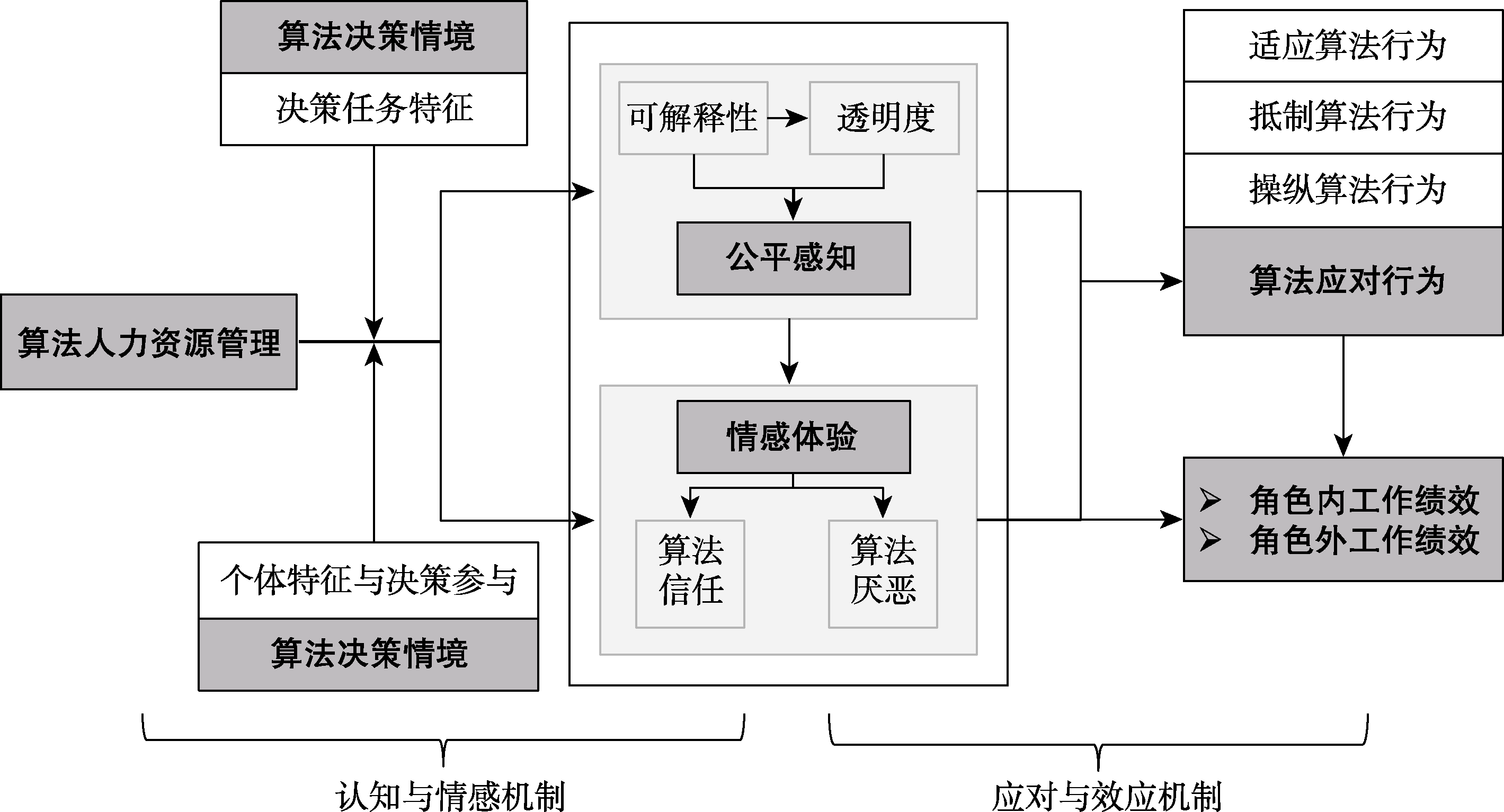
图1 本研究的理论框架图
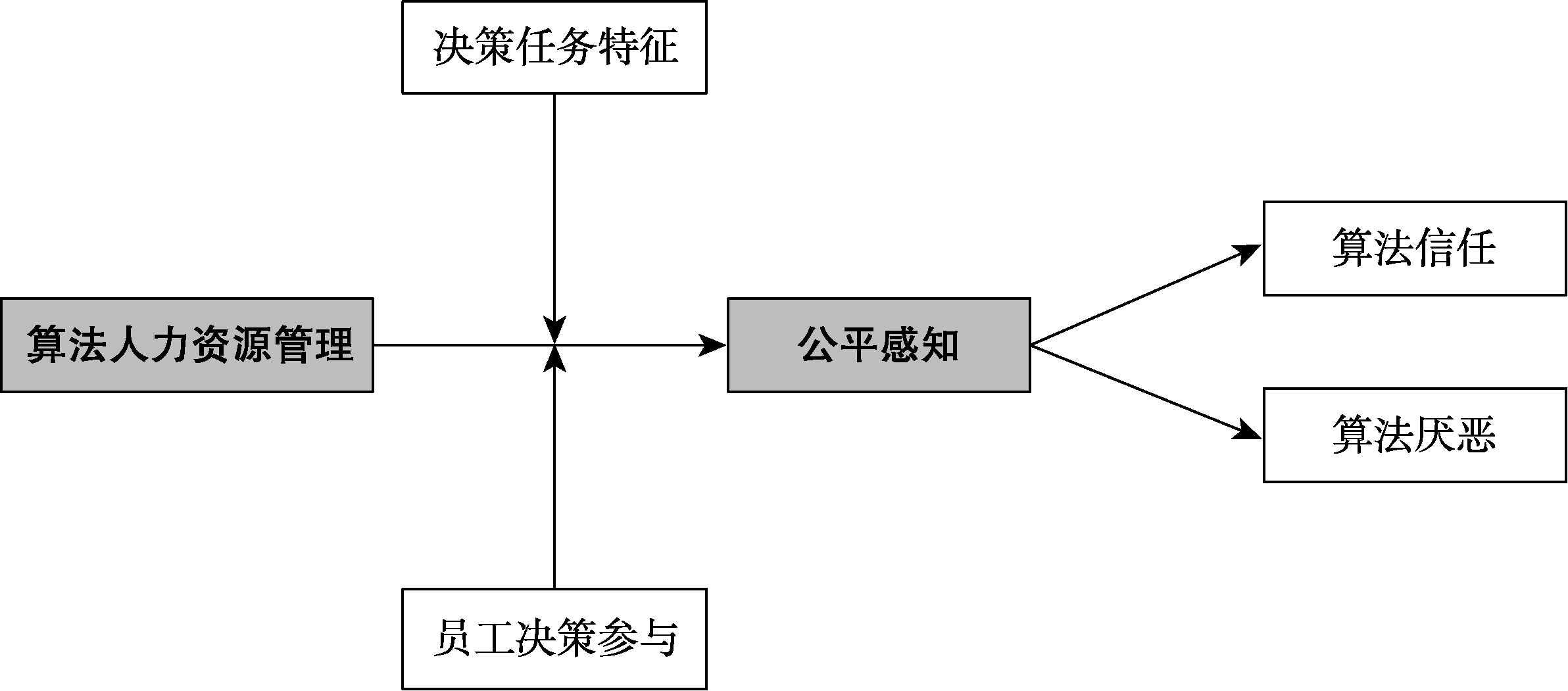
图2 研究1的理论模型
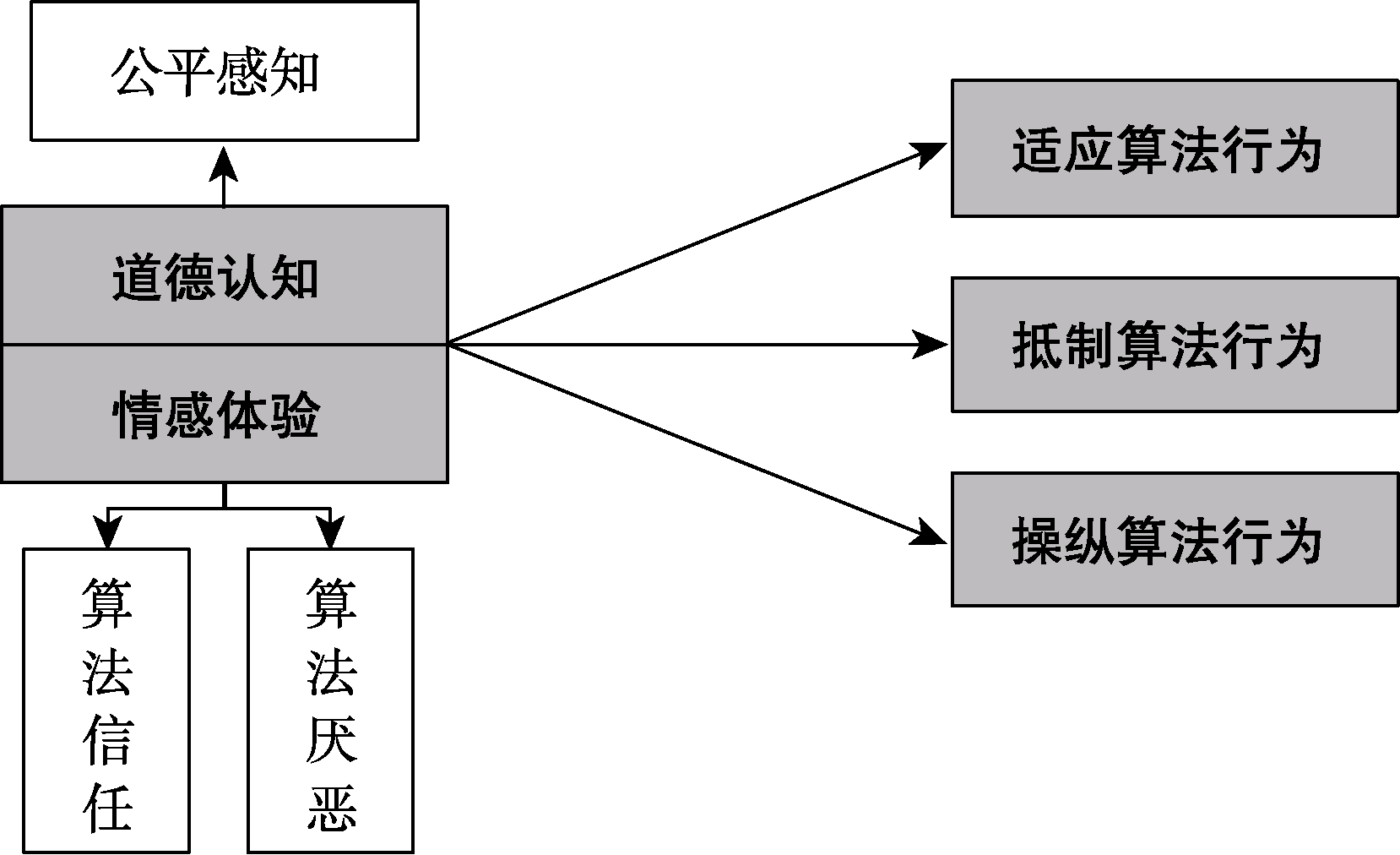
图3 研究2的理论模型
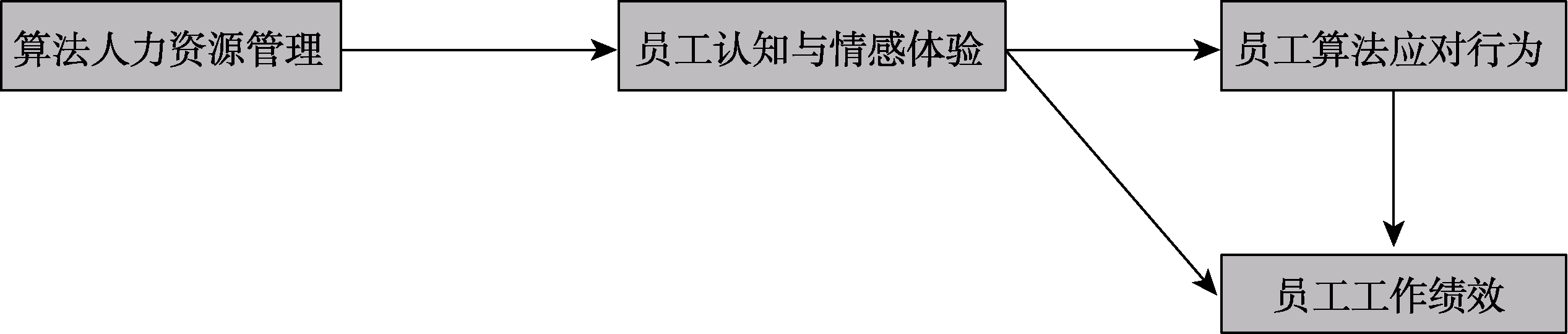
图4 研究3的理论模型
| [1] | 杜严勇. (2022). 厌恶算法还是欣赏算法?——人工智能时代的算法认知差异与算法信任建构. 哲学分析, 13(3), 151-165. |
| [2] |
蒋路远, 曹李梅, 秦昕, 谭玲, 陈晨, 彭小斐. (2022). 人工智能决策的公平感知. 心理科学进展, 30(5), 1078-1092.
doi: 10.3724/SP.J.1042.2022.01078 |
| [3] | 李燕萍, 李乐, 胡翔. (2021). 数字化人力资源管理: 整合框架与研究展望. 科技进步与对策, 38(23), 151-160. |
| [4] | 李游, 梁哲浩, 常亚平. (2022). 用户对人工智能产品的算法厌恶研究述评及展望. 管理学报, 19(11), 1725-1732. |
| [5] | 刘善仕, 裴嘉良, 葛淳棉, 刘小浪, 谌一璠. (2022). 在线劳动平台算法管理: 理论探索与研究展望. 管理世界, 38(2), 225-239+14-16. |
| [6] | 罗文豪, 霍伟伟, 赵宜萱, 王震. (2022). 人工智能驱动的组织与人力资源管理变革: 实践洞察与研究方向. 中国人力资源开发, 39(1), 4-16. |
| [7] | 裴嘉良, 刘善仕, 钟楚燕, 谌一璠. (2021). AI 算法决策能提高员工的程序公平感知吗?. 外国经济与管理, 43(11), 41-55. |
| [8] | 魏昕, 黄鸣鹏, 李欣悦. (2021). 算法决策、员工公平感与偏差行为: 决策有利性的调节作用. 外国经济与管理, 43(11), 56-69. |
| [9] | 席猛, 邓文明. (2021). 零工经济下基于算法监视的自我实现循环文献述评与研究展望. 人力资源管理评论, (1), 142-154. |
| [10] | 谢小云, 左玉涵, 胡琼晶. (2021). 数字化时代的人力资源管理: 基于人与技术交互的视角. 管理世界, 37(1), 200-216. |
| [11] | 张建民, 顾春节, 杨红英. (2022). 人工智能技术与人力资源管理实践: 影响逻辑与模式演变. 中国人力资源开发, 39(1), 17-34. |
| [12] | 张志学, 赵曙明, 施俊琦, 秦昕, 贺伟, 赵新元, 吴刚. (2021). 数字经济下组织管理研究的关键科学问题——第254期“双清论坛”学术综述. 中国科学基金, (05), 774-781. |
| [13] | 赵宜萱, 赵曙明, 栾佳锐. (2020). 基于人工智能的人力资源管理: 理论模型与研究展望. 南京社会科学, 31(2), 36-43. |
| [14] | 周恋, 雷雪, 后锐, 陈越. (2022). 在线用工平台算法管理的消极影响和控制策略研究: 算法技术属性视角. 中国人力资源开发, 39(6), 8-22. |
| [15] | Acikgoz Y., Davison K. H., Compagnone M., & Laske M. (2020). Justice perceptions of artificial intelligence in selection. International Journal of Selection and Assessment, 28(4), 399-416. |
| [16] | Alexander V., Blinder C., & Zak P. J. (2018). Why trust an algorithm? Performance, cognition, and neurophysiology. Computers in Human Behavior, 89, 279-288. |
| [17] | Bellamy R. K., Dey K., Hind M., Hoffman S. C., Houde S., Kannan K.,... Zhang Y. (2019). AI fairness 360: An extensible toolkit for detecting and mitigating algorithmic bias. IBM Journal of Research and Development, 63(4/5), 4-1. |
| [18] | Berger B., Adam M., Rühr A., & Benlian A. (2021). Watch me improve—Algorithm aversion and demonstrating the ability to learn. Business & Information Systems Engineering, 63(1), 55-68. |
| [19] |
Bhave D. P., Teo L. H., & Dalal R. S. (2020). Privacy at work: A review and a research agenda for a contested terrain. Journal of Management, 46(1), 127-164.
doi: 10.1177/0149206319878254 |
| [20] | Buhmann A., Paßmann J., & Fieseler C. (2020). Managing algorithmic accountability: Balancing reputational concerns, engagement strategies, and the potential of rational discourse. Journal of Business Ethics, 163(2), 265-280. |
| [21] |
Castelo N., Bos M. W., & Lehmann D. R. (2019). Task- dependent algorithm aversion. Journal of Marketing Research, 56(5), 809-825.
doi: 10.1177/0022243719851788 |
| [22] | Cheng M., & Foley C. (2019). Algorithmic management: The case of Airbnb. International Journal of Hospitality Management, 83, 33-36. |
| [23] | Cheng M. M., & Hackett R. D. (2021). A critical review of algorithms in HRM: Definition, theory, and practice. Human Resource Management Review, 31(1), 100698. |
| [24] | Chowdhury S., Joel-Edgar S., Dey P. K., Bhattacharya S., & Kharlamov A. (2023). Embedding transparency in artificial intelligence machine learning models: Managerial implications on predicting and explaining employee turnover. The International Journal of Human Resource Management, 34(14), 2732-2764. |
| [25] | Colbert A., Yee N., & George G. (2016). The digital workforce and the workplace of the future. Academy of Management Journal, 59(3), 731-739. |
| [26] | Corbett-Davies S., Gaebler J. D., Nilforoshan H., Shroff R., & Goel S. (2023). The measure and mismeasure of fairness. The Journal of Machine Learning Research, 24(1), 14730-14846. |
| [27] | Deci E. L., & Ryan R. M. (2012). Self-determination theory. Handbook of Theories of Social Psychology, 1(20), 416-436. |
| [28] | Dery K., Hall R., Wailes N., & Wiblen S. (2013). Lost in translation? An actor-network approach to HRIS implementation. The Journal of Strategic Information Systems, 22(3), 225-237. |
| [29] | Dietvorst B. J., Simmons J. P., & Massey C. (2015). Algorithm aversion: People erroneously avoid algorithms after seeing them err. Journal of Experimental Psychology: General, 144(1), 114-126. |
| [30] | Dietvorst B. J., Simmons J. P., & Massey C. (2018). Overcoming algorithm aversion: People will use imperfect algorithms if they can (even slightly) modify them. Management Science, 64(3), 1155-1170. |
| [31] |
Duggan J., Sherman U., Carbery R., & McDonnell A. (2020). Algorithmic management and app‐work in the gig economy: A research agenda for employment relations and HRM. Human Resource Management Journal, 30(1), 114-132.
doi: 10.1111/1748-8583.12258 |
| [32] |
Dzindolet M. T., Pierce L. G., Beck H. P., & Dawe L. A. (2002). The perceived utility of human and automated aids in a visual detection task. Human Factors, 44(1), 79-94.
pmid: 12118875 |
| [33] | Edwards J. S., Duan Y., & Robins P. C. (2000). An analysis of expert systems for business decision making at different levels and in different roles. European Journal of Information Systems, 9(1), 36-46. |
| [34] | Fügener A., Grahl J., Gupta A., & Ketter W. (2022). Cognitive challenges in human-artificial intelligence collaboration: Investigating the path toward productive delegation. Information Systems Research, 33(2): 678-696. |
| [35] | Helberger N., Araujo T., & de Vreese C. H. (2020). Who is the fairest of them all? Public attitudes and expectations regarding automated decision-making. Computer Law & Security Review, 39, 105456. https://doi.org/10.1016/j.clsr.2020.105456 |
| [36] | Highhouse S. (2008). Stubborn reliance on intuition and subjectivity in employee selection. Industrial and Organizational Psychology, 1(3), 333-342. |
| [37] |
Hoff K. A., & Bashir M. (2015). Trust in automation: Integrating empirical evidence on factors that influence trust. Human Factors, 57(3), 407-434.
doi: 10.1177/0018720814547570 pmid: 25875432 |
| [38] | Huselid M. A. (2018). The science and practice of workforce analytics: Introduction to the HRM special issue. Human Resource Management, 57(3), 679-684. |
| [39] | Jarrahi M. H., & Sutherland W. (2019, March 31-April 3).Algorithmic management and algorithmic competencies: Understanding and appropriating algorithms in gig work.In Information in Contemporary Society: 14th International Conference [Proceedings]Springer International Publishing, Washington, DC, USA. |
| [40] | Kawaguchi K. (2021). When will workers follow an algorithm? A field experiment with a retail business. Management Science, 67(3), 1670-1695. |
| [41] | Kellogg K. C., Valentine M. A., & Christin A. (2020). Algorithms at work: The new contested terrain of control. Academy of Management Annals, 14(1), 366-410. |
| [42] | Kim S., Wang Y., & Boon C. (2021). Sixty years of research on technology and human resource management: Looking back and looking forward. Human Resource Management, 60(1), 229-247. |
| [43] | Kryscynski D., Reeves C., Stice-Lusvardi R., Ulrich M., & Russell G. (2018). Analytical abilities and the performance of HR professionals. Human Resource Management, 57(3), 715-738. |
| [44] |
Lambrecht A., & Tucker C. (2019). Algorithmic bias? An empirical study of apparent gender-based discrimination in the display of STEM career ads. Management Science, 65(7), 2966-2981.
doi: 10.1287/mnsc.2018.3093 |
| [45] | Langer M., & König C. J. (2023). Introducing a multi- stakeholder perspective on opacity, transparency and strategies to reduce opacity in algorithm-based human resource management. Human Resource Management Review, 33(1), 100881. https://doi.org/10.1016/j.hrmr.2021.100881 |
| [46] |
Lazarus R. S. (1991). Progress on a cognitive-motivational- relational theory of emotion. American Psychologist, 46(8), 819-834.
doi: 10.1037//0003-066x.46.8.819 pmid: 1928936 |
| [47] | Lee M. K. (2018). Understanding perception of algorithmic decisions: Fairness, trust, and emotion in response to algorithmic management. Big Data & Society, 5(1). https://doi.org/10.1177/2053951718756684 |
| [48] | Leonardi P. M. (2011). When flexible routines meet flexible technologies: Affordance, constraint, and the imbrication of human and material agencies. MIS Quarterly, 35(1), 147-167. |
| [49] |
Logg J. M., Minson J. A., & Moore D. A. (2019). Algorithm appreciation: People prefer algorithmic to human judgment. Organizational Behavior and Human Decision Processes, 151, 90-103.
doi: 10.1016/j.obhdp.2018.12.005 |
| [50] |
Longoni C., Bonezzi A., & Morewedge C. K. (2019). Resistance to medical artificial intelligence. Journal of Consumer Research, 46(4), 629-650.
doi: 10.1093/jcr/ucz013 |
| [51] | Longoni C., & Cian L. (2022). Artificial intelligence in utilitarian vs. hedonic contexts: The “word-of-machine” effect. Journal of Marketing, 86(1), 91-108. |
| [52] | Luo X., Qin M. S., Fang Z., & Qu Z. (2021). Artificial intelligence coaches for sales agents: Caveats and solutions. Journal of Marketing, 85(2), 14-32. |
| [53] | Meijerink J., Boons M., Keegan A., & Marler J. (2021). Algorithmic human resource management: Synthesizing developments and cross-disciplinary insights on digital HRM. The International Journal of Human Resource Management, 32(12), 2545-2562. |
| [54] | Meijerink J., & Bondarouk T. (2023). The duality of algorithmic management: Toward a research agenda on HRM algorithms, autonomy and value creation. Human Resource Management Review, 33(1). https://doi.org/10.1016/j.hrmr.2021.100876 |
| [55] | Miller S. M., & Keiser L. R. (2021). Representative bureaucracy and attitudes toward automated decision making. Journal of Public Administration Research and Theory, 31(1), 150-165. |
| [56] | Newman D. T., Fast N. J., & Harmon D. J. (2020). When eliminating bias isn't fair: Algorithmic reductionism and procedural justice in human resource decisions. Organizational Behavior and Human Decision Processes, 160, 149-167. |
| [57] | Parent-Rocheleau X., & Parker S. K. (2022). Algorithms as work designers: How algorithmic management influences the design of jobs. Human Resource Management Review, 32(3), 100838. |
| [58] | Prahl A., & Van Swol L. (2017). Understanding algorithm aversion: When is advice from automation discounted?. Journal of Forecasting, 36(6), 691-702. |
| [59] | Roy D. K., Barzegar R., Quilty J., & Adamowski J. (2020). Using ensembles of adaptive neuro-fuzzy inference system and optimization algorithms to predict reference evapotranspiration in subtropical climatic zones. Journal of Hydrology, 591. https://doi.org/10.1016/j.jhydrol.2020.125509 |
| [60] | Ruel H. J., Bondarouk T. V., & Van der Velde M. (2007). The contribution of e-HRM to HRM effectiveness: Results from a quantitative study in a Dutch Ministry. Employee Relations, 29(3), 280-291. |
| [61] | Schildt H. (2017). Big data and organizational design-the brave new world of algorithmic management and computer augmented transparency. Innovation, 19(1), 23-30. |
| [62] | Shin D. (2020). How do users interact with algorithm recommender systems? The interaction of users, algorithms, and performance. Computers in Human Behavior, 109. https://doi.org/10.1016/j.chb.2020.106344 |
| [63] | Sienkiewicz Ł. (2021). Algorithmic human resources management-perspectives and challenges. Annales Universitatis Mariae Curie-Skłodowska, Sectio H Oeconomia, 55(2), 95-105. |
| [64] | Silverman R. E., & Waller N. (2015). The algorithm that tells the boss who might quit. Wall Street Journal. Retrieved from https://www.wsj.com/articles/the-algorithm-thattells-the-boss-who-might-quit-1426287935 |
| [65] | Stieglitz S., Mirbabaie M., Möllmann N. R., & Rzyski J. (2022). Collaborating with virtual assistants in organizations: Analyzing social loafing tendencies and responsibility attribution. Information Systems Frontiers, 24(3), 745-770. |
| [66] | Stone D. L., Deadrick D. L., Lukaszewski K. M., & Johnson R. (2015). The influence of technology on the future of human resource management. Human Resource Management Review, 25(2), 216-231. |
| [67] | Strohmeier S. (2020). Smart HRM-a Delphi study on the application and consequences of the Internet of Things in Human Resource Management. The International Journal of Human Resource Management, 31(18), 2289-2318. |
| [68] | Sundar S. S., & Nass C. (2001). Conceptualizing sources in online news. Journal of Communication, 51(1), 52-72. |
| [69] | Tambe P., Cappelli P., & Yakubovich V. (2019). Artificial intelligence in human resources management: Challenges and a path forward. California Management Review, 61(4), 15-42. |
| [70] | Tang P. M., Koopman J., McClean S. T., Zhang J. H., Li C. H., De Cremer D.,... Ng C. T. S. (2022). When conscientious employees meet intelligent machines: An integrative approach inspired by complementarity theory and role theory. Academy of Management Journal, 65(3), 1019-1054. |
| [71] | Wesche J. S., Hennig F., Kollhed C. S., Quade J., Kluge S., & Sonderegger A. (2024). People's reactions to decisions by human vs. algorithmic decision-makers: The role of explanations and type of selection tests. European Journal of Work and Organizational Psychology, 33(2), 1469-157. |
| [72] | Wilson H. J., & Daugherty P. R. (2018). Collaborative intelligence: Humans and AI are joining forces. Harvard Business Review, 96(4), 1149-123. |
| [73] |
Yeomans M., Shah A., Mullainathan S., & Kleinberg J. (2019). Making sense of recommendations. Journal of Behavioral Decision Making, 32(4), 403-414.
doi: 10.1002/bdm.2118 |
| [1] | 刘庚, 韩翼, 卢俊阳. 领导倾听内涵及其多层次效应[J]. 心理科学进展, 2025, 33(1): 25-41. |
| [2] | 刘燕, 刘晴晴, 任磊. 道德无涉领导的产生原因及其双刃剑效应[J]. 心理科学进展, 2024, 32(3): 421-432. |
| [3] | 史燕伟, 谢菊兰, 王雅妮, 张南. 数字化工作重塑及其对工作绩效的促进作用:基于人-任务-技术匹配视角[J]. 心理科学进展, 2023, 31(7): 1133-1145. |
| [4] | 盛小添, 刘耔含, 张西超, 郭恒, 笪姝, 周诗怡. 睡眠与工作:相互作用机制[J]. 心理科学进展, 2018, 26(10): 1844-1856. |
| [5] | 李英武;于宙;韩笑;刘婷安胥. 一般心理能力(GMA)预测绩效:现状、机制及趋势[J]. 心理科学进展, 2015, 23(3): 448-459. |
| [6] | 李超平. 和谐领导的结构、测量及其作用机制[J]. 心理科学进展, 2013, 21(12): 2103-2109. |
| [7] | 张春雨;韦嘉;陈谢平;张进辅. 工作设计的新视角:员工的工作重塑[J]. 心理科学进展, 2012, 20(8): 1305-1313. |
| [8] | 洪雁;王端旭. 组织内领导越轨行为研究:概念、诱因与结果[J]. 心理科学进展, 2012, 20(3): 424-432. |
| [9] | 陈猛;卞冉;王丽娜;车宏生;林绚晖. 情绪智力与工作绩效的关系[J]. 心理科学进展, 2012, 20(3): 412-423. |
| [10] | 王孟成;楚艳民;戴晓阳. 严谨性的结构及其应用研究述评[J]. 心理科学进展, 2011, 19(3): 440-448. |
| [11] | 胡青;王胜男;张兴伟;程斌;孙宏伟. 工作中的主动性行为的回顾与展望[J]. 心理科学进展, 2011, 19(10): 1534-1543. |
| [12] | 吴新辉; 袁登华. 适应性绩效:一个尚需深入研究的领域[J]. 心理科学进展, 2010, 18(2): 339-347. |
| [13] | 霍娜;李超平. 工作价值观的研究进展与展望[J]. 心理科学进展, 2009, 17(4): 795-801. |
| [14] | 田建全. Project A对我军士兵心理选拔研究的启示[J]. 心理科学进展, 2006, 14(2): 164-. |
| [15] | 罗正学;苗丹民. 工作绩效预测研究述评[J]. 心理科学进展, 2005, 13(6): 798-805. |
| 阅读次数 | ||||||
|
全文 |
|
|||||
|
摘要 |
|
|||||
