ISSN 0439-755X
CN 11-1911/B

Acta Psychologica Sinica ›› 2026, Vol. 58 ›› Issue (5): 995-1014.doi: 10.3724/SP.J.1041.2026.0995

• Reports of Empirical Studies • Previous Articles    

Development of main effect DIF and interactive DIF detection method in cognitive diagnosis assessments: A recursive partitioning-based perspective

LIU Kai1,2, GUO Zhichen1, WANG Qin1, WANG Daxun1, CAI Yan1, TU Dongbo1,3,4   

  1. 1School of Psychology, Jiangxi Normal University, Nanchang 330022, China;
    2College of Psychology, Liaoning Normal University, Dalian 116029, China;
    3Jiangxi Provincial Philosophy and Social Sciences Laboratory for Data Science and Intelligent Psychological Assessment and Services, Nanchang 330022, China;
    4Jiangxi Provincial Key Laboratory of Intelligent Information Processing and Affective Computing, Nanchang 330022, China
  • Received:2024-04-26 Published:2026-05-25 Online:2026-03-05

Abstract: With the growing recognition of the advantages of cognitive diagnosis (CD) in psychological and educational measurement, applying the CD framework to test development has become an important research direction in the field of psychology. In the development of cognitive diagnostic assessments, detecting differential item functioning (DIF) remains a crucial quality control procedure to ensure test fairness and validity. However, existing CD-based DIF detection methods typically focus on a single covariate at a time. While these approaches are effective for identifying main effect DIF induced by a single covariate, they are limited in detecting interactive DIF caused by the interaction among multiple covariates. Such limitations may compromise the fairness and interpretability of assessment outcomes. To address this issue, the present study integrates CD modeling with recursive partitioning techniques by proposing a novel DIF detection method, namely the Item-based Sequential Recursive Partitioning Method (ISRPM). Building on the core principles of recursive partitioning, the ISRPM allows the simultaneous consideration of multiple covariates within a single DIF detection procedure and facilitates the identification of both main effect DIF and interactive DIF in cognitive diagnostic assessments.
To evaluate the performance of the proposed method, a series of Monte Carlo simulation studies were conducted focusing on two key objectives: (1) examining how factors such as sample size per group, DIF magnitude, DIF type, item quality, correlations among attributes, and the influence of demographic covariates on attribute mastery distribution affect the performance of ISRPM; and (2) comparing ISRPM with several existing DIF detection methods across varied experimental conditions. In addition, to illustrate its practical utility, ISRPM was applied to a cognitive diagnostic version of the Schizotypal Personality Questionnaire (DC-SPQ) and compared with five established DIF detection methods.
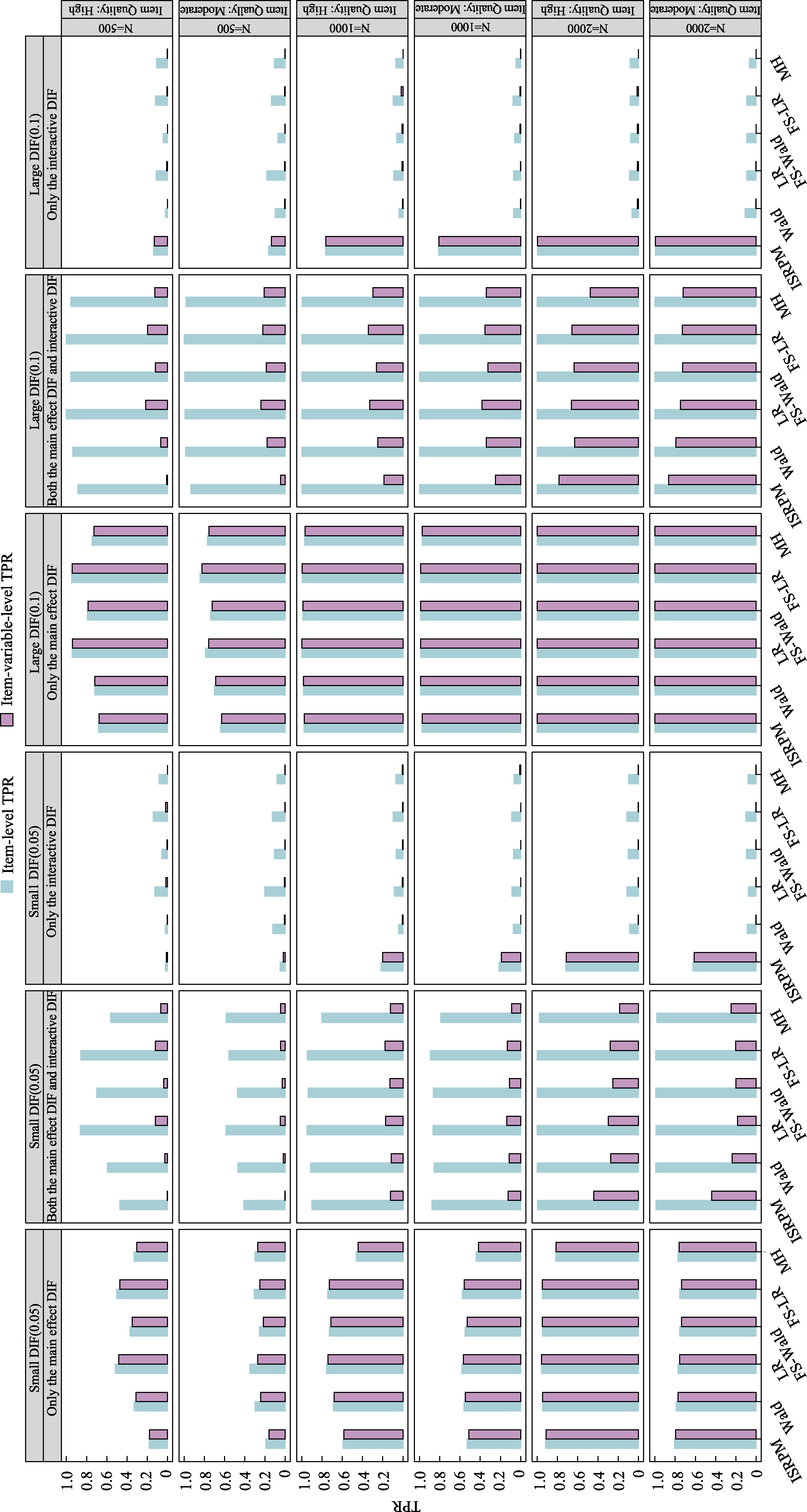
The results showed that (1) sample size, DIF magnitude, and item quality substantially influenced the performance of all methods; and (2) when items exhibited interactive DIF, ISRPM achieved higher detection accuracy than the Wald, LR, FS-Wald, FS-LR, and Mantel-Haenszel (MH) approaches. When only the main effect DIF was present, the overall performance of ISRPM was comparable to that of the existing methods.
These findings suggest that ISRPM provides a flexible and effective framework for identifying both main effect DIF and interactive DIF in cognitive diagnostic assessments, thereby contributing to methodological advancements in fairness evaluation and the broader application of CD-based measurement in psychological and educational measurement.

Key words: cognitive diagnosis assessments, differential item functioning, main effect DIF, interactive DIF, recursive partitioning