

ISSN 0439-755X
CN 11-1911/B
CN 11-1911/B
Acta Psychologica Sinica ›› 2026, Vol. 58 ›› Issue (3): 467-479.doi: 10.3724/SP.J.1041.2026.0467
• Reports of Empirical Studies • Previous Articles Next Articles
XU Honghui1,2,3, XU Yiran4, YANG Guochun5, NAN Weizhi6, LIU Xun1,2( )
)
Published:2026-03-25
Online:2025-12-26
Contact:
LIU Xun
E-mail:liux@psych.ac.cn
XU Honghui, XU Yiran, YANG Guochun, NAN Weizhi, LIU Xun. (2026). Behavioral Theta Oscillations in Cross-modal Stimulus Conflict and Response Conflict Processing. Acta Psychologica Sinica, 58(3), 467-479.
Add to citation manager EndNote|Ris|BibTeX
URL: https://journal.psych.ac.cn/acps/EN/10.3724/SP.J.1041.2026.0467
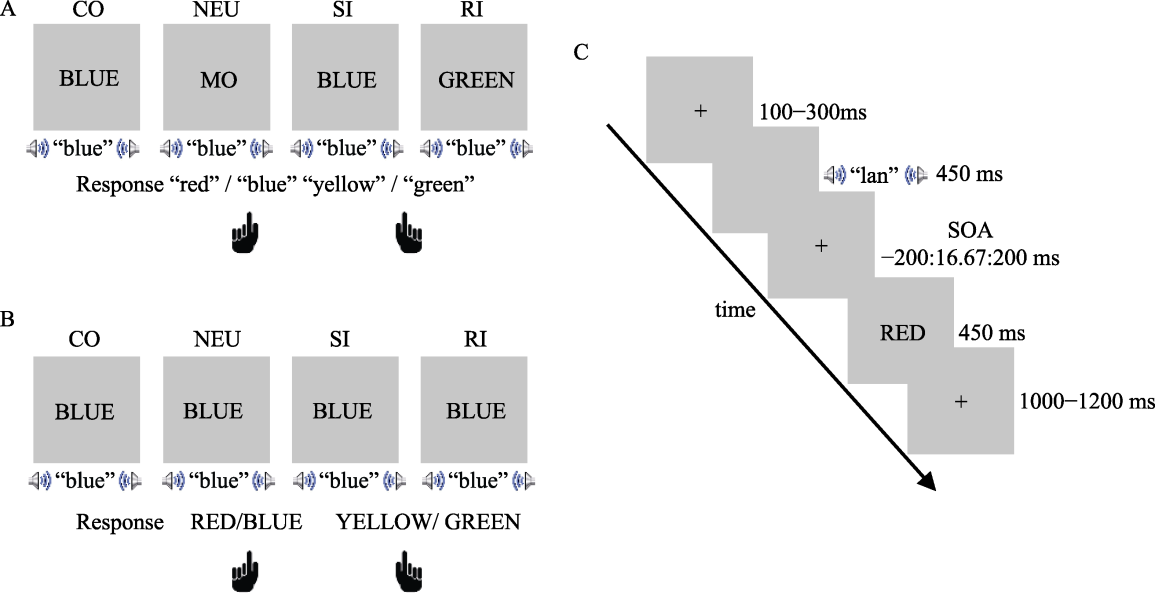
Figure 1 Experimental design for (A) Experiment 1 and (B) Experiment 2. (C) Illustration of the trial procedure. Negative and positive SOA values indicate that the task-irrelevant or task-relevant stimulus was presented first, respectively. Stimuli are shown in English for illustration; all actual stimuli were in Chinese.
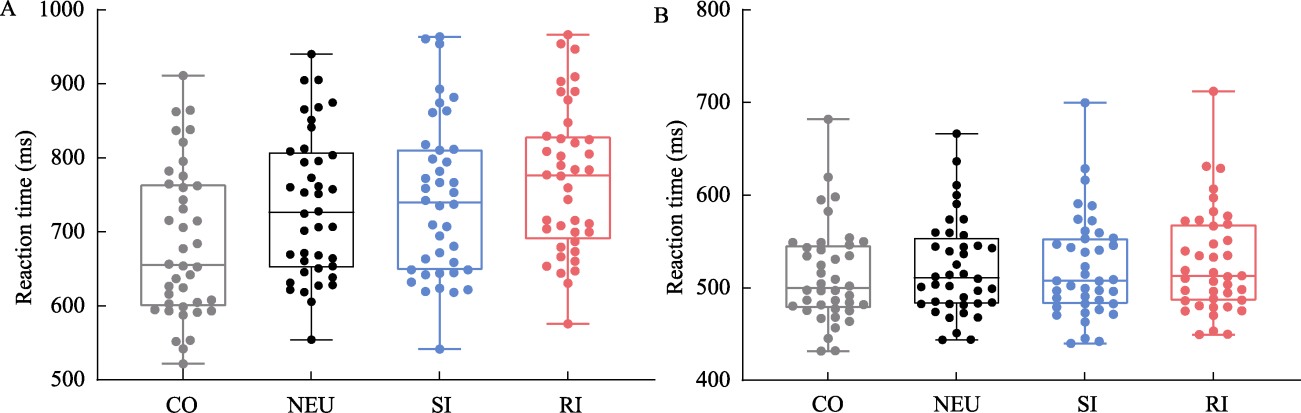
Figure 2 Mean RTs averaged across SOAs for Experiment 1 (A) and Experiment 2 (B).
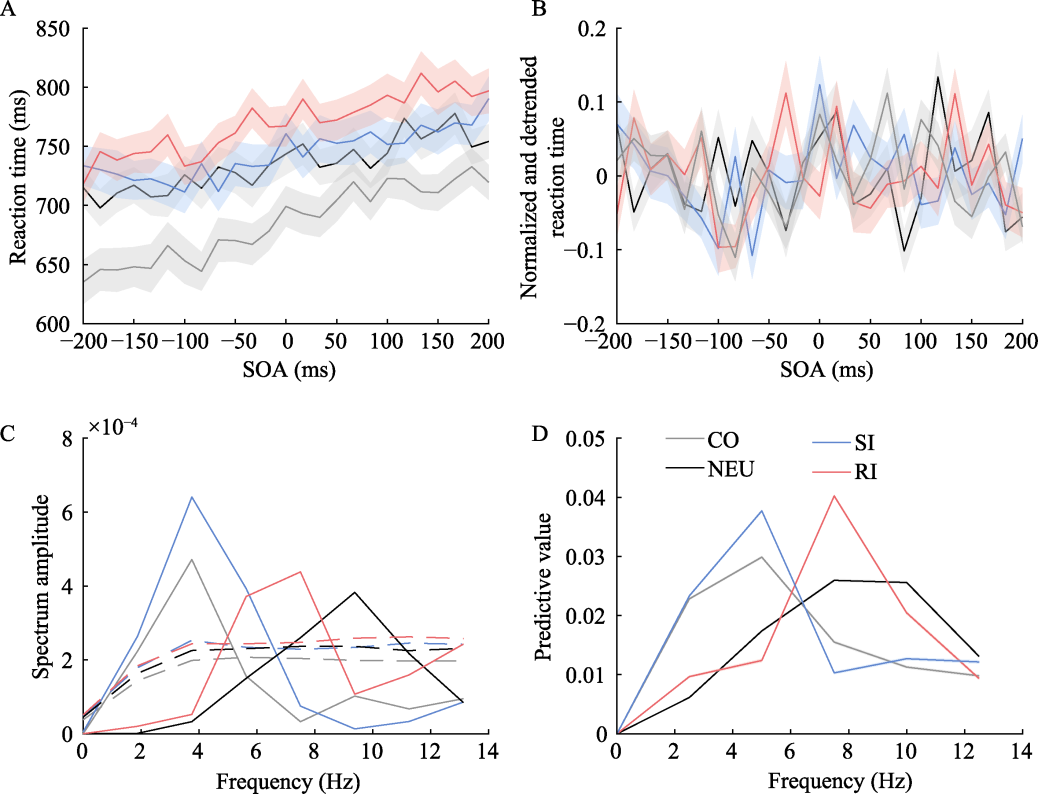
Figure 3 Results of Experiment 1. (A) Raw RT curves for each trial type as a function of SOA. (B) Standardized and detrended RT values. (C) Spectral analysis results derived from the aggregate subject data analysis method; the dashed line indicates the significance threshold (p < 0.05, FDR-corrected). (D) Spectral analysis based on the single-trial linear model approach. Negative and positive SOA values correspond to the visual or auditory stimulus being presented first, respectively.
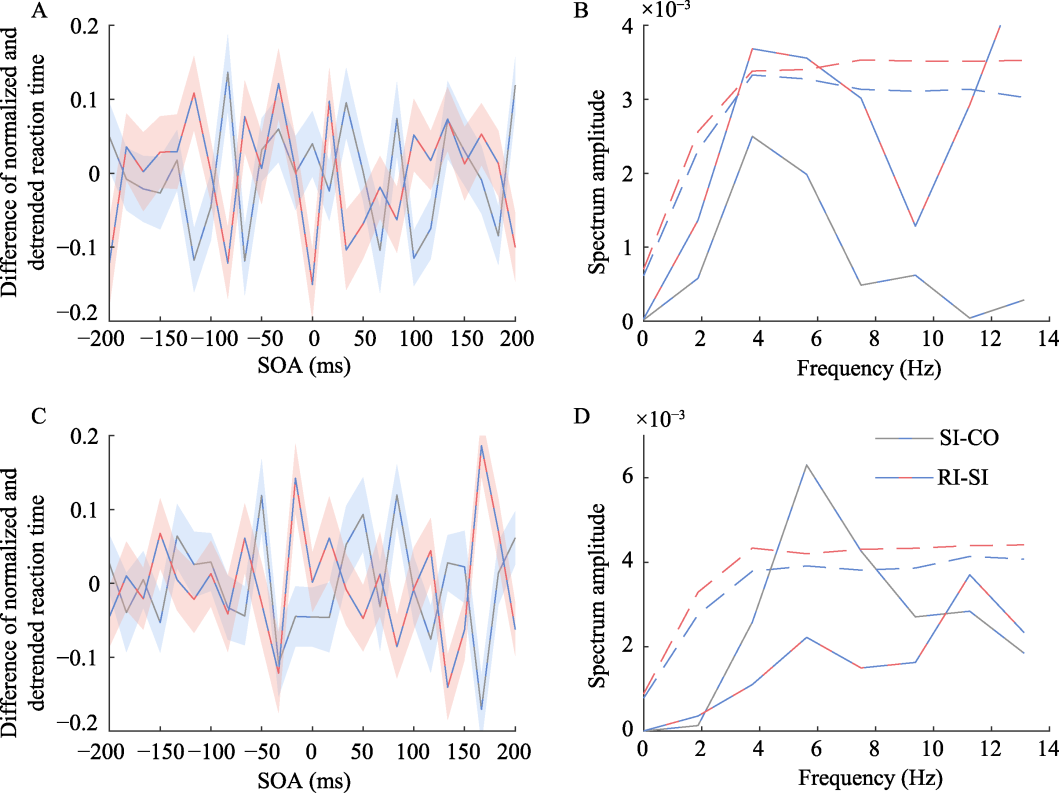
Figure 4 Conflict time courses and spectral analysis. (A, C) Standardized and detrended RT differences representing stimulus conflict (SI?CO) and response conflict (RI?SI) over SOA. (B, D) Corresponding power spectra from spectral analysis. Panels A and B showed results from Experiment 1 (Auditory task), while panels C and D showed results from Experiment 2 (Visual task). In spectra panels (B, D), the dashed horizontal line indicated the FDR-corrected significance threshold (p < 0.05).
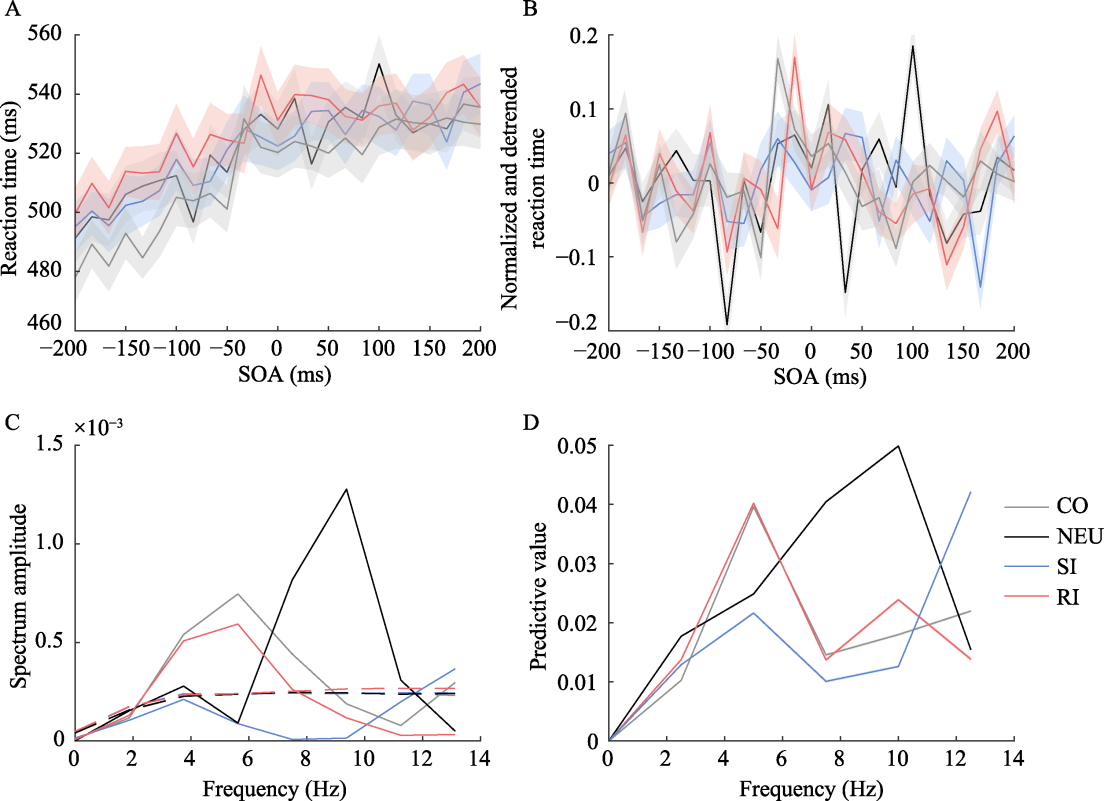
Figure 5 Results from Experiment 2 (Visual task). (A) Raw and (B) detrended RT time courses across SOA for each trial type. Spectral power derived from the (C) aggregate subject data analysis and (D) single-trial linear model approach. The dashed line in (C) marks the FDR-corrected significance threshold (p <.05). SOA: negative (auditory first), positive (visual first).
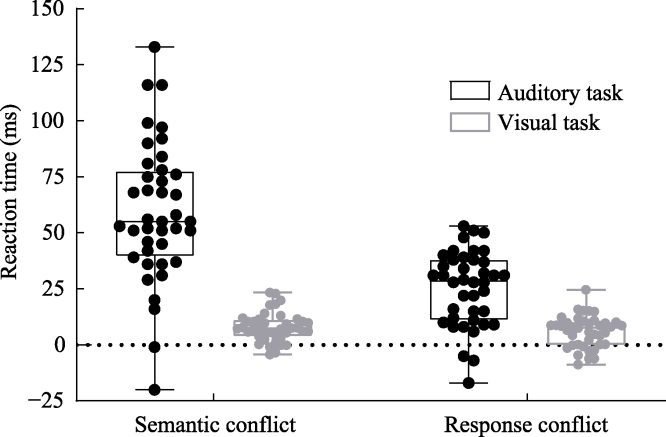
Figure A1 Comparison of cross-modal stimulus conflict and response conflict magnitudes between Experiment 1 (auditory task) and Experiment 2 (visual task).
| [1] |
Appelbaum L. G., Boehler C. N., Davis L. A., Won R. J., & Woldorff M. G. (2014). The Dynamics of proactive and reactive cognitive control processes in the human Brain. Journal of Cognitive Neuroscience, 26(5), 1021-1038.
doi: 10.1162/jocn_a_00542 pmid: 24345171 |
| [2] |
Augustinova M., Silvert L., Spatola N., & Ferrand L. (2018). Further investigation of distinct components of Stroop interference and of their reduction by short response-stimulus intervals. Acta Psychologica, 189, 54-62.
doi: S0001-6918(17)30160-9 pmid: 28407872 |
| [3] | Burca M., Beaucousin V., Chausse P., Ferrand L., Parris B. A., & Augustinova M. (2021). Is there semantic conflict in the Stroop task? Experimental Psychology, 68(5), 274-283. |
| [4] |
Chen Q., & Zhou X. L. (2013). Vision dominates at the preresponse level and audition dominates at the response level in cross-modal interaction: Behavioral and neural evidence. The Journal of Neuroscience, 33(17), 7109-7121.
doi: 10.1523/JNEUROSCI.1985-12.2013 URL |
| [5] |
Cohen M. X., & Cavanagh J. F. (2011). Single-trial regression elucidates the role of prefrontal theta oscillations in response conflict. Frontiers in Psychology, 2, 30.
doi: 10.3389/fpsyg.2011.00030 pmid: 21713190 |
| [6] |
Cohen M. X., & Donner T. H. (2013). Midfrontal conflict-related theta-band power reflects neural oscillations that predict behavior. Journal of Neurophysiology, 110(12), 2752-2763.
doi: 10.1152/jn.00479.2013 pmid: 24068756 |
| [7] |
De Cheveigné A., & Arzounian D. (2018). Robust detrending, rereferencing, outlier detection, and inpainting for multichannel data. NeuroImage, 172, 903-912.
doi: S1053-8119(18)30035-1 pmid: 29448077 |
| [8] |
De Houwer J. (2003). On the role of stimulus-response and stimulus-stimulus compatibility in the Stroop effect. Memory & Cognition, 31(3), 353-359.
doi: 10.3758/BF03194393 URL |
| [9] | Donohue S. E., Appelbaum L. G., Park C. J., Roberts K. C., & Woldorff M. G. (2013). Cross-modal stimulus conflict: The behavioral effects of stimulus input timing in a visual-auditory Stroop task. PloS One, 8(4), e62802. |
| [10] |
Dugué L., & VanRullen R. (2017). Transcranial magnetic stimulation reveals intrinsic perceptual and attentional rhythms. Frontiers in Neuroscience, 11, 154.
doi: 10.3389/fnins.2017.00154 pmid: 28396622 |
| [11] | Efron B., & Gong G. (1983). A leisurely look at the bootstrap, the jackknife, and cross-validation. The American Statistician, 37(1), 36-48. |
| [12] |
Egner T. (2008). Multiple conflict-driven control mechanisms in the human brain. Trends in Cognitive Sciences, 12(10), 374-380.
doi: 10.1016/j.tics.2008.07.001 pmid: 18760657 |
| [13] |
Fiebelkorn I. C., & Kastner S. (2019). A rhythmic theory of attention. Trends in Cognitive Sciences, 23(2), 87-101.
doi: S1364-6613(18)30281-X pmid: 30591373 |
| [14] |
Fiebelkorn I. C., Saalmann Y. B., & Kastner S. (2013). Rhythmic sampling within and between objects despite sustained attention at a cued location. Current Biology, 23(24), 2553-2558.
doi: 10.1016/j.cub.2013.10.063 pmid: 24316204 |
| [15] | Haciahmet C. C., Frings C., Beste C., Münchau A., & Pastötter B. (2023). Posterior delta/theta EEG activity as an early signal of Stroop conflict detection. Psychophysiology, 60(3), e14195. |
| [16] | Haciahmet C. C., Frings C., & Pastötter B. (2021). Target amplification and distractor inhibition: Theta oscillatory dynamics of selective attention in a flanker task. Cognitive, Affective, & Behavioral Neuroscience, 21(2), 355-371. |
| [17] |
Helfrich R. F., Fiebelkorn I. C., Szczepanski S. M., Lin J. J., Parvizi J., Knight R. T., & Kastner S. (2018). Neural mechanisms of sustained attention are rhythmic. Neuron, 99(4), 854-865.
doi: S0896-6273(18)30630-5 pmid: 30138591 |
| [18] |
Ho H. T., Burr D. C., Alais D., & Morrone M. C. (2019). Auditory perceptual history is propagated through alpha oscillations. Current Biology, 29(24), 4208-4217.
doi: S0960-9822(19)31381-8 pmid: 31761705 |
| [19] |
Hommel B. (2019). Theory of Event Coding (TEC) V2. 0: Representing and controlling perception and action. Attention, Perception, & Psychophysics, 81(7), 2139-2154.
doi: 10.3758/s13414-019-01779-4 |
| [20] |
Huang Y., Chen L., & Luo H. (2015). Behavioral oscillation in priming: Competing perceptual predictions conveyed in alternating theta-band rhythms. Journal of Neuroscience, 35(6), 2830-2837.
doi: 10.1523/JNEUROSCI.4294-14.2015 pmid: 25673869 |
| [21] |
Jia J. R., Fan Y., & Luo H. (2022). Alpha-band phase modulates bottom-up feature processing. Cerebral Cortex, 32(6), 1260-1268.
doi: 10.1093/cercor/bhab291 URL |
| [22] | Jia J. R., Liu L., Fang F., & Luo H. (2017). Sequential sampling of visual objects during sustained attention. PloS Biology, 15(6), e2001903. |
| [23] | Jiang J., Zhang Q. L., & Van Gaal S. (2015). EEG neural oscillatory dynamics reveal semantic and response conflict at difference levels of conflict awareness. Scientific Reports, 5(1), 12008. |
| [24] |
Kienitz R., Schmid M. C., & Dugué L. (2022). Rhythmic sampling revisited: Experimental paradigms and neural mechanisms. European Journal of Neuroscience, 55(11-12), 3010-3024.
doi: 10.1111/ejn.v55.11-12 URL |
| [25] |
Landau A. N., & Fries P. (2012). Attention samples stimuli rhythmically. Current Biology, 22(11), 1000-1004.
doi: 10.1016/j.cub.2012.03.054 pmid: 22633805 |
| [26] | Liu L., & Luo H. (2019). Behavioral oscillation in global/local processing: Global alpha oscillations mediate global precedence effect. Journal of Vision, 19(5), 12. |
| [27] |
Michel R., Dugué L., & Busch N. A. (2022). Distinct contributions of alpha and theta rhythms to perceptual and attentional sampling. European Journal of Neuroscience, 55(11-12), 3025-3039.
doi: 10.1111/ejn.v55.11-12 URL |
| [28] |
Miller E. K., & Cohen J. D. (2001). An integrative theory of prefrontal cortex function. Annual Review of Neuroscience, 24(1), 167-202.
doi: 10.1146/neuro.2001.24.issue-1 URL |
| [29] | Mo C., Lu J. S., Wu B. C., Jia J. R., Luo H., & Fang F. (2019). Competing rhythmic neural representations of orientations during concurrent attention to multiple orientation features. Nature Communications, 10(1), 5264. |
| [30] |
Nieuwenhuis S., & Yeung N. (2005). Neural mechanisms of attention and control: Losing our inhibitions? Nature Neuroscience, 8(12), 1631-1633.
pmid: 16306886 |
| [31] |
Nigbur R., Cohen M. X., Ridderinkhof K. R., & Stürmer B. (2012). Theta dynamics reveal domain-specific control over stimulus and response conflict. Journal of Cognitive Neuroscience, 24(5), 1264-1274.
doi: 10.1162/jocn_a_00128 pmid: 21861681 |
| [32] |
Nigbur R., Ivanova G., & Stürmer B. (2011). Theta power as a marker for cognitive interference. Clinical Neurophysiology, 122(11), 2185-2194.
doi: 10.1016/j.clinph.2011.03.030 pmid: 21550845 |
| [33] |
Plöchl M., Fiebelkorn I., Kastner S., & Obleser J. (2022). Attentional sampling of visual and auditory objects is captured by theta‐modulated neural activity. European Journal of Neuroscience, 55(11-12), 3067-3082.
doi: 10.1111/ejn.v55.11-12 URL |
| [34] |
Pomper U., & Ansorge U. (2021). Theta-rhythmic oscillation of working memory performance. Psychological Science, 32(11), 1801-1810.
doi: 10.1177/09567976211013045 URL |
| [35] |
Re D., Inbar M., Richter C. G., & Landau A. N. (2019). Feature-based attention samples stimuli rhythmically. Current Biology, 29(4), 693-699.
doi: S0960-9822(19)30012-0 pmid: 30744973 |
| [36] | Senoussi M., Moreland J. C., Busch N. A., & Dugué L. (2019). Attention explores space periodically at the theta frequency. Journal of Vision, 19(5), 22. |
| [37] |
Senoussi M., Verbeke P., Desender K., De Loof E., Talsma D., & Verguts T. (2022). Theta oscillations shift towards optimal frequency for cognitive control. Nature Human Behaviour, 6(7), 1000-1013.
doi: 10.1038/s41562-022-01335-5 pmid: 35449299 |
| [38] |
Song K., Meng M., Chen L., Zhou K., & Luo H. (2014). Behavioral oscillations in attention: Rhythmic α pulses mediated through θ band. Journal of Neuroscience, 34(14), 4837-4844.
doi: 10.1523/JNEUROSCI.4856-13.2014 pmid: 24695703 |
| [39] |
Stroop J. R. (1935). Studies of interference in serial verbal reactions. Journal of Experimental Psychology, 18(6), 643-662.
doi: 10.1037/h0054651 URL |
| [40] | Tomassini A., Ambrogioni L., Medendorp W. P., & Maris E. (2017). Theta oscillations locked to intended actions rhythmically modulate perception. Elife, 6, e25618. |
| [41] |
van Veen V., & Carter C. S. (2005). Separating semantic conflict and response conflict in the Stroop task: A functional MRI study. NeuroImage, 27(3), 497-504.
pmid: 15964208 |
| [42] |
Wang C., Li H., Jia L., Li F., & Wang J. (2020). Theta band behavioral fluctuations synchronized interpersonally during cooperation. Psychonomic Bulletin & Review, 27(3), 563-570.
doi: 10.3758/s13423-020-01711-0 |
| [43] | Xu H. H., Yang G. C., Göschl F., Nolte G., Ren Q. Y., Li Z. H.,... & Liu X. (2024). Distinct and common mechanisms of cross-model semantic conflict and response conflict in an auditory relevant task. Cerebral Cortex, 34(3), bhae105. |
| [44] | Xu H. H., Yang G. C., Wu H. Y., Xiao J., Li Q., & Liu X. (2024). Distinct mechanisms underlying cross-modal semantic conflict and response conflict processing. Cerebral Cortex, 34(2), bhad539. |
| [45] | Yang Y., Qi Z. Y., Zhang K. H., & Luo W. B. (2019). Behavioral oscillations and their performance in attention and perception. Chinese Science Bulletin, 64(5), 546-554. |
| [46] |
Zhang H., & Kornblum S. (1998). The effects of stimulus-response mapping and irrelevant stimulus-response and stimulus-stimulus overlap in four-choice Stroop tasks with single-carrier stimuli. Journal of Experimental Psychology: Human Perception and Performance, 24(1), 3-19.
doi: 10.1037/0096-1523.24.1.3 URL |
| [47] |
Zhang X. D., Zhang L. J., Ding Y. L., & Qu Z. (2021). Behavioral oscillations in attentional processing. Advances in Psychological Science, 29(3), 460-471.
doi: 10.3724/SP.J.1042.2021.00460 |
| [1] | WANG Aijun, HUANG Jie, ZHAO Danna, LI Xin, ZHANG Ming. Stimulus similarity modulates sensory dominance effects in cross-modal conflicts [J]. Acta Psychologica Sinica, 2026, 58(4): 571-589. |
| [2] | TANG Yi, ZHAO Yajun, ZENG Qingzhang, ZHANG Zhijun, WU Shengnan. Cross-modal transfer of statistical learning under unimodal and multimodal learning conditions [J]. Acta Psychologica Sinica, 2026, 58(4): 590-602. |
| [3] | ZU Guangyao, LI Shuqi, ZHANG Tianyang, WANG Aijun, ZHANG Ming. Effect of inhibition of return on audiovisual cross-modal correspondence [J]. Acta Psychologica Sinica, 2023, 55(8): 1220-1233. |
| [4] | SUN Chu, GENG Haiyan. Dynamic information processing under self and another’s perspectives: A behavioral oscillation study [J]. Acta Psychologica Sinica, 2023, 55(2): 224-236. |
| [5] | JIA Shiwei, QI Congcong, CHEN Lele, REN Yanju. The effect of working memory load on feedback processing: Evidence from an event-related potentials (ERP) study [J]. Acta Psychologica Sinica, 2022, 54(3): 248-258. |
| [6] | ZHANG Ming, SANG Hanbin, LU Ke, WANG Aijun. Effects of trial history on cross-modal non-spatial inhibition of return [J]. Acta Psychologica Sinica, 2021, 53(7): 681-693. |
| [7] | HOU Lulu, CHEN Lirong, ZHOU Renlai. Altered reward processing in women with premenstrual syndrome: Evidence from ERPs and time-frequency analysis [J]. Acta Psychologica Sinica, 2020, 52(6): 742-757. |
| [8] | JIANG Yuchen, CAI Xiao, ZHANG Qingfang. Theta band (4-8 Hz) oscillations reflect syllables processing in Chinese spoken word production [J]. Acta Psychologica Sinica, 2020, 52(10): 1199-1211. |
| [9] | ZHOU Aibao;LI Shifeng;SHI Zhan;LIU Peiru;XIA Ruixue;XU Kepeng;ZHU Jing;REN Deyun. Searching the Self: Encoding Self-relevant Possessive Pronoun and Theta Activity [J]. Acta Psychologica Sinica, 2013, 45(7): 790-796. |
| [10] | XIN Yong,LI Hong,YUAN Jia-Jin. Negative Emotion Interferes with Behavioral Inhibitory Control: An ERP Study [J]. , 2010, 42(03): 334-341. |
| [11] | Soledad Ballesteros and Julia Mayas. Preserved Cross-modal Priming and Aging: A Summary of Current Thoughts [J]. , 2009, 41(11): 1063-1074. |
| [12] | Wang Yonghui,Zhou Xiaolin,Wang Yufeng,Zhang Yaxu. RESPONSE INHIBITION IN TWO SUBTYPES OF CHILDREN WITH ADHD [J]. , 2005, 37(02): 178-188. |
| [13] | Zhou Xiaolin, Qu Yanxuan, Shu Hua, Gareth Gaskell, William Marslen-Wilson. Constraints of Lexical Tone on Semantic Activation in Chinese Spoken Word Recognition [J]. , 2004, 36(04): 379-392. |
| [14] | Yang Lixia, Fu Xiaolan (Institute of Psychology, Chinese Academy of Sciences, Beijing 100101). THE INHIBITORY MECHANISM IN PROCESSING VISUAL-AUDITORY CROSS-MODEL CHINESE WORDS [J]. , 2002, 34(01): 11-16. |
| [15] | Shu Hua, Tang Yinghong(Department of Psychology, Beijing Normal University, Beijing 100875)Zhang Yaxu(Department of Psychology, Beijing University, Beijing 100871). A STUDY ON THE RESOLUTION OF LEXICAL AMBIGUITY OF TWO-SYLLABLE HOMOPHONES IN CHINESE [J]. , 2000, 32(03): 247-252. |
| Viewed | ||||||
|
Full text |
|
|||||
|
Abstract |
|
|||||
