
ISSN 0439-755X
CN 11-1911/B
CN 11-1911/B
Acta Psychologica Sinica ›› 2025, Vol. 57 ›› Issue (9): 1649-1660.doi: 10.3724/SP.J.1041.2025.1649
• Reports of Empirical Studies • Previous Articles Next Articles
YANG Can1, LI Zixuan2, BI Chongzeng1( )
)
Published:2025-09-25
Online:2025-06-26
Contact:
BI Chongzeng
E-mail:beech@swu.edu.cn
YANG Can, LI Zixuan, BI Chongzeng. (2025). The Effect of Interaction Partners' Zhongyong and Social Mindfulness on Cooperation. Acta Psychologica Sinica, 57(9), 1649-1660.
Add to citation manager EndNote|Ris|BibTeX
URL: https://journal.psych.ac.cn/acps/EN/10.3724/SP.J.1041.2025.1649
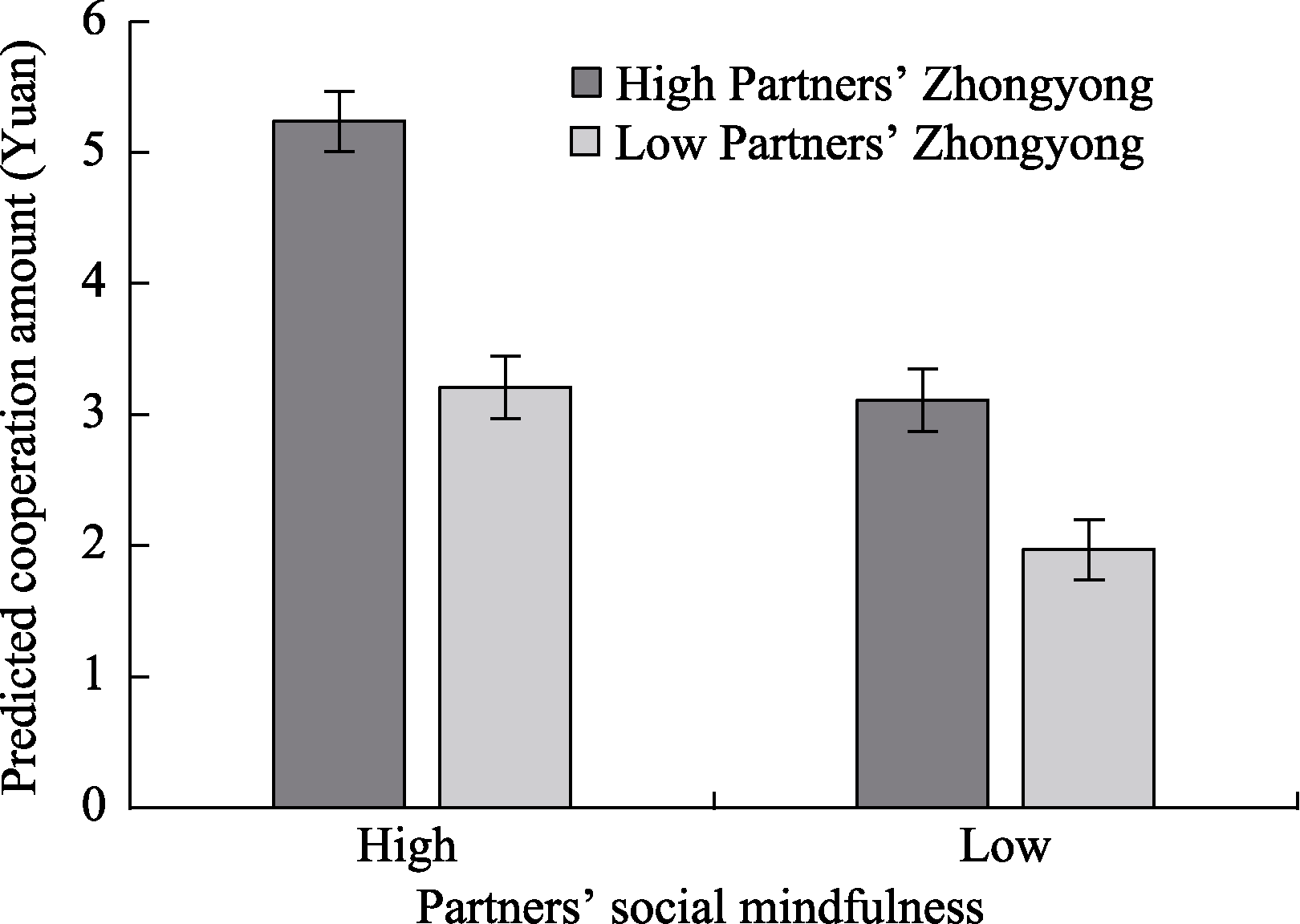
Figure 1. The Effect of The Partners’ Zhongyong and Social Mindfulness on Trust (Predicted Cooperation Amount) in Experiment 1. Note. Error bars represent standard error.
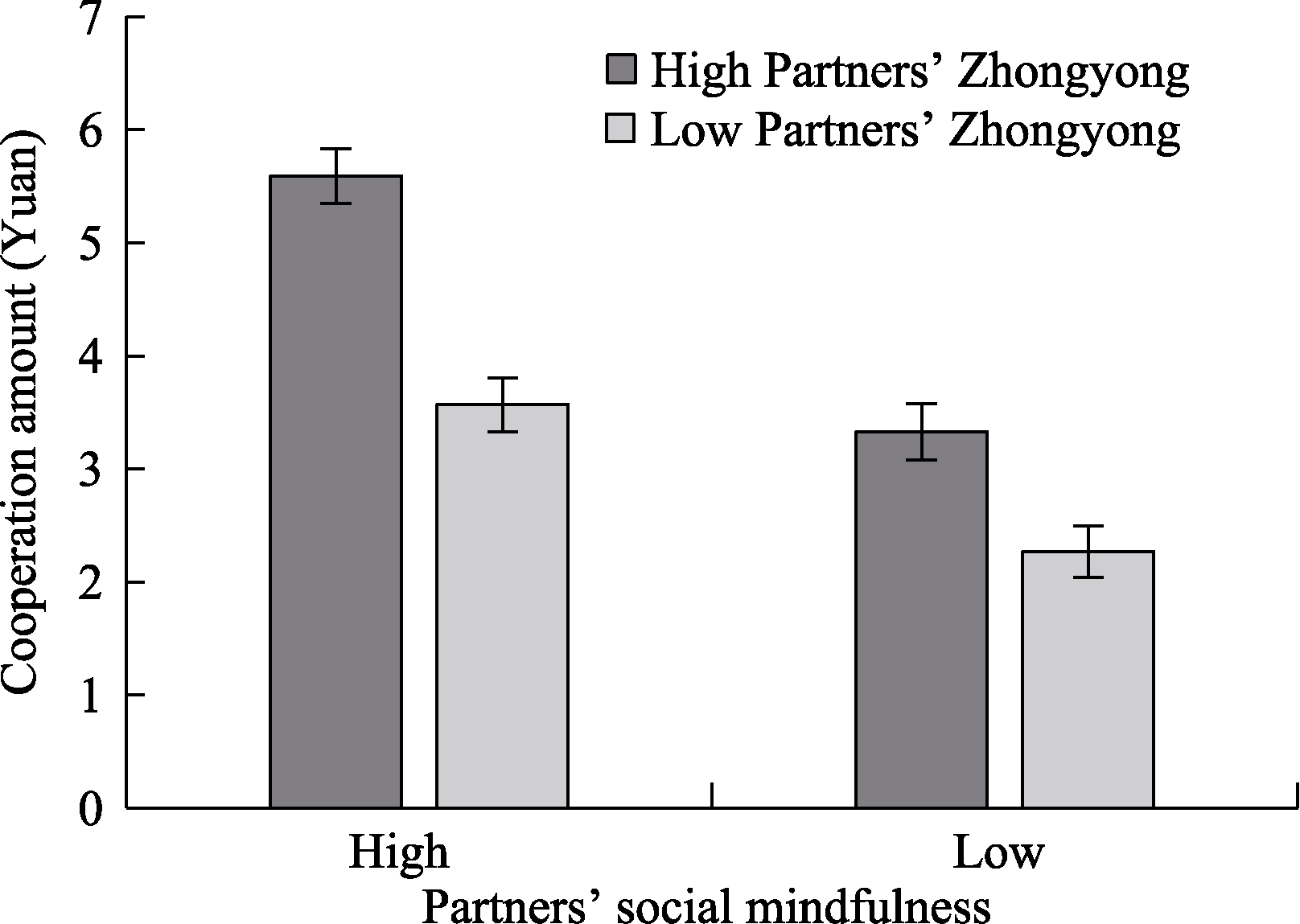
Figure 2. The Effect of The Partners’ Zhongyong and Social mindfulness on Cooperation in Experiment 1. Note. Error bars represent standard error.
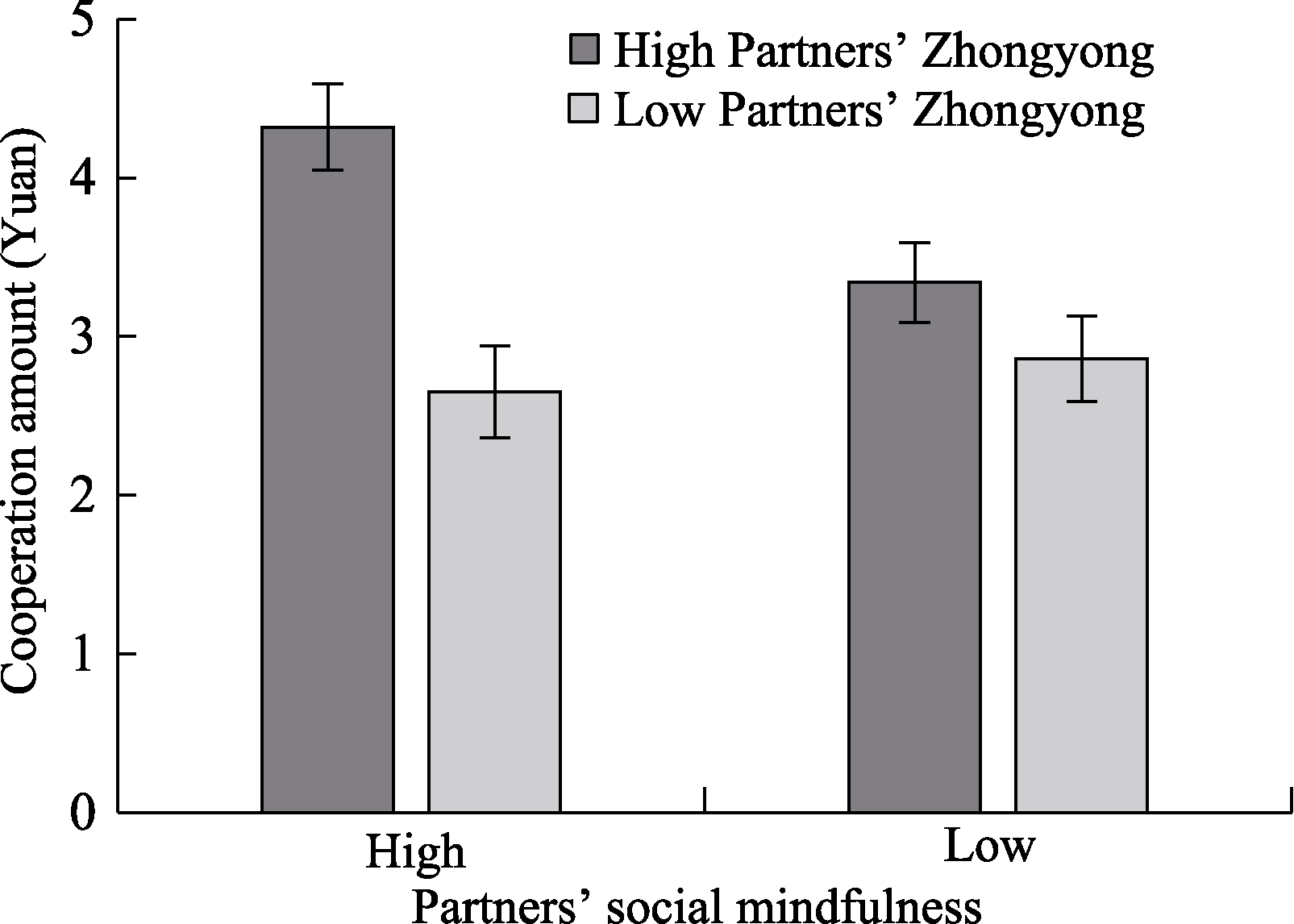
Figure 3. The Effect of Partners’ Zhongyong and Social Mindfulness on Cooperation in Experiment 2 Note. Error bars represent standard errors.
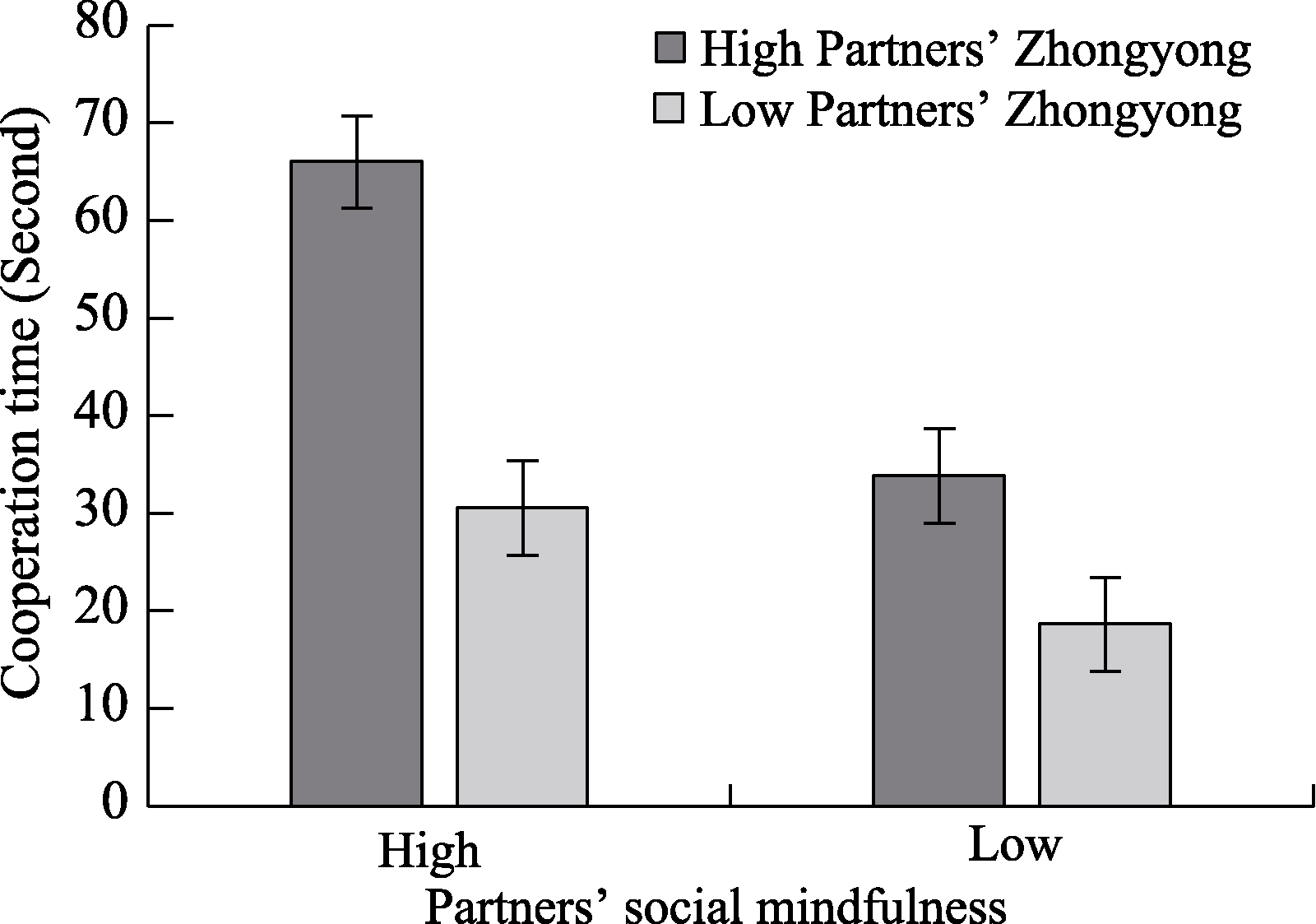
Figure 4. The Impact of Partners’ Zhongyong and Social Mindfulness on Cooperation in Experiment 3 Note. Error bars represent standard errors.
| [1] |
Balliet, D., & Lindström, B. (2023). Inferences about interdependence shape cooperation. Trends in Cognitive Sciences, 27(6), 583-595.
doi: 10.1016/j.tics.2023.03.003 pmid: 37055313 |
| [2] |
Balliet, D., & van Lange, P. A. M. (2013). Trust, conflict, and cooperation: A meta-analysis. Psychological Bulletin, 139(5), 1090-1112.
doi: 10.1037/a0030939 pmid: 23231532 |
| [3] | Boyd, R., & Richerson, P. J. (2006). Culture and the evolution of the human social instincts. In N. J. Enfield & S. C. Berg (Eds.), Roots of human sociality: Culture, cognition and interaction (pp. 453- 477). Routledge. |
| [4] |
Chen, X., Zhao, G. X., & Ye, H. S. (2014). The forms and functions of punishment in public-goods dilemmas. Advances in Psychological Science, 22, 160-170.
doi: 10.3724/SP.J.1042.2014.00160 |
| [5] | Chiu, C. Y. (2010). The morality, practicality, cultural specificity, and social adaptability of the practical thinking of the golden mean. Indigenous Psychological Research in Chinese Societies, (34), 137-144. |
| [6] | Ding, Q., Zhang, Y. X., Wei, H., & Hu, W. (2019). Effect of social support and loneliness zhongyong thinking style and internet addiction of college students: Serial mediating. Studies of Psychology and Behavior, 17(4), 553-560. |
| [7] | Dou, K., Liu, Y.Z., Wang, Y.J., & Nie, Y.G. (2018). Willingness to cooperate: Emotion enhancement mechanism of perceived social mindfulness on cooperative behaviour. Acta Psychologica Sinica, 50(1), 101-114. |
| [8] | Dou, K., Nie, Y. G., Wang, Y. J., & Liu, Y. Z. (2018). Trust or defence? The enhancing effect of perceived social mindfulness on cooperative behavior during interactive game. Journal of Psychological Science, 41(2), 390-396. |
| [9] | Dou, K., Wang, Y. J, Li, J. B., Li, J. J., & Nie, Y. G. (2018). Perceiving high social mindfulness during interpersonal interaction promotes cooperative behaviours. Asian Journal of Social Psychology, 21, 97-106. |
| [10] | Du, J., & Yao, J. H. (2015). Zhongyong: The connotation and its relationship with collectivism. Chinese Journal of Management, 12(5), 638-646. |
| [11] | Geertz, C. (1983). Local knowledge. New York: Basic Books. |
| [12] | Henrich, J., Boyd, R., Bowles, S., Camerer, C., Fehr, E., Gintis, H., & McElreath, R. (2001). In search of homo economicus: Behavioral experiments in 15 small-scale societies. American Economic Review, 91(2), 73-78. |
| [13] | Huang, C. L., Lin, Y. C., & Yang, C. F. (2012). Revision of the Yang & Zhao’s Zhongyong belief-Value Scale. Indigenous Psychological Research in Chinese Societies, 38, 3-14. |
| [14] | Kelley, H. H., Holmes, J. G., Kerr, N. L., Reis, H. T., Rusbult, C. E., & van Lange, P. A. M. (2003). An Atlas of Interpersonal Situations. New York, NY: Cambridge |
| [15] | Kelley, H. H., & Thibaut, J. W. (1978). Interpersonal relations: A Theory of Interdependence. New York: Wiley. |
| [16] |
Kittler, J. E., Menard, W., & Phillips, K. A. (2007). Weight concerns in individuals with body dysmorphic disorder. Eating Behaviors, 8(1), 115-120.
pmid: 17174859 |
| [17] | Li, Z. X., Wang, X. G., & Bi, C. Z. (2019). What kind of person prefers Zhongyong Thinking? —A preliminary description in the fundamental dimensions of social cognition. Psychology: Techniques and Applications, 7(1), 17-22 |
| [18] | Lu, J., Huang, X., Liao, C., Guan, Q., Qi, X. R., & Cui, F. (2020). Social mindfulness shown by individuals with higher status is more pronounced in our brain: Erp evidence. Frontiers in Neuroscience, 13, 1-10. |
| [19] | Lv, M. Z., Pan, J. Q., Zheng, Q., Xue, H., & Deng, Z. (2015). The impact of compromising thinking on forgiveness and self-forgiveness in college students. China Journal of Health Psychology, 23(1), 71-74. |
| [20] | Moore, A. K., Lewis, J., Levine, E. E., & Schweitzer, M. E. (2023). Benevolent friends and high integrity leaders: How preferences for benevolence and integrity change across relationships. Organizational Behavior and Human Decision Processes, 177, 104-252. |
| [21] | Pletzer, J. L., Balliet, D., Joireman, J., Kuhlman, D. M., Voelpel, S. C., & van Lange, P. A. M. (2018). Social value orientation, expectations, and cooperation in social dilemmas: A meta-analysis. European Journal of Personality, 32(1), 62-83. |
| [22] |
Rand, D. G. (2016). Cooperation, fast and slow: Meta-analytic evidence for a theory of social heuristics and self-interested deliberation. Psychological Science, 27(9), 1192-1206.
doi: 10.1177/0956797616654455 pmid: 27422875 |
| [23] |
Rand, D. G., & Nowak, M. A. (2013). Human cooperation. Trends in Cognitive Sciences, 17(8), 413-425.
doi: 10.1016/j.tics.2013.06.003 pmid: 23856025 |
| [24] | Rao, L. L., Han, R., Ren, X. P., Bai, X. W., Zheng, R., & Liu, H. (2011). Disadvantage and prosocial behavior: The effects of the Wenchuan earthquake. Evolution and Human Behavior, 32(1), 63-69. |
| [25] | Rodriguez, L. M., Neighbors, C., & Knee, C. R. (2014). Problematic alcohol use and marital distress: An interdependence theory perspective. Addiction Research and Theory, 22(4), 294-312. |
| [26] | Rusbult, C. E., & van Lange, P. A. M. (2003). Interdependence, interaction, and relationships. Annual Review of Psychology, 54(1), 351-375. |
| [27] | Simpson, J. A. (2007). Psychological foundations of trust. Current Directions in Psychological Science, 16, 264-268. |
| [28] |
Tian, Y., Wang, L., Xu, Y., & Jiao, L. Y. (2021). Psychological structure of social mindfulness in Chinese culture. Acta Psychologica Sinica, 53(9), 1003-1017.
doi: 10.3724/SP.J.1041.2021.01003 |
| [29] |
van Dijk, E., & De Dreu, C. K. W. (2021). Experimental games and social decision making. Annual Review of Psychology, 72, 415-438.
doi: 10.1146/annurev-psych-081420-110718 pmid: 33006926 |
| [30] |
van Doesum, N. J., van Lange, D. A. W., & van Lange, P. A. M. (2013). Social mindfulness: Skill and will to navigate the social world. Journal of Personality and Social Psychology, 105, 86-103.
doi: 10.1037/a0032540 pmid: 23647176 |
| [31] | van Doesum, N. J., van Lange, P. A. M., Mischkowski, D., & van Dijk, E. (2025). Social mindfulness and the SoMi Paradigm: A decade of research on low-cost prosociality. European Review of Social Psychology, 1-51. |
| [32] | van Lange, P. A. M., & Rand, D. G. (2022). Human cooperation and the crises of climate change, COVID-19, and misinformation. Annual Review of Psychology, 73, 370-402. |
| [33] | van Lange, P. A. M., & Rusbult, C. E. (2012). Interdependence theory. In P. A. M. Van Lange, A. W. Kruglanski, & E. T. Higgins. (Eds.), Handbook of theories of social psychology (Vol. 2, pp. 251-272). Thousand Oaks, CA: Sage. |
| [34] | Wang, H., & Zhang, L. C. (2018, January). Need for Zhongyong balance and its influence on dormitory interpersonal relationship. Paper presented at the 5th Zhongyong Psychology Conference, Xiamen, China. |
| [35] | Wang, P., & Chen, L. (2011). The effects of sanction and social value orientation on trust and cooperation in public goods dilemmas. Acta Psychologica Sinica, 43(1), 52-64. |
| [36] | Wang, X. H., Zhang, L. B., & Peng, M. (2021). How peer characteristics affect people's cooperation and conflict behavior? Journal of Psychological Science, 44(1), 148-154. |
| [37] |
Wang, Y. M., Zhang, J. M., Wang, F. Y., Xu, W. T., & Liu, W. T. (2023). Do not think any virtue trivial, and thus neglect it: Serial mediating role of social mindfulness and perspective taking. Acta Psychologica Sinica, 55(4), 626-641.
doi: 10.3724/SP.J.1041.2023.00626 |
| [38] | Wu, C. H. (2006). Zhongyong make my life better: The effect of Zhongyong thinking on life satisfaction. Journal of Psychology in Chinese Societies, 7, 163-176. |
| [39] | Wu, C. H., & Lin, Y. C. (2005). Development of a Zhong-yong thinking style scale. Indigenous Psychological Research in Chinese Societies, 24, 247-299. |
| [40] | Xiong, C. Q., Xu, J. Y., Ma, D. Y., & Liu, Y. F. (2021). The effect of opponent’s emotional facial expressions on individuals’ cooperation and underlying mechanism in prisoner’s dilemma game. Acta Psychologica Sinica, 53(8), 919-933. |
| [41] | Yamagishi, T. (2011). Trust: The evolutionary game of mind and society. New York, NY: Springer. |
| [42] |
Yamagishi, T., Hashimoto, H., & Schug, J. (2008). Preferences versus strategies as explanations for culture-specific behavior. Psychological Science, 19(6), 579-584.
doi: 10.1111/j.1467-9280.2008.02126.x pmid: 18578848 |
| [43] | Yang, C. F. (2009). A case of attempt to combine the Chinese traditional culture with the social science: the social psychological research of “Zhongyong”. Journal of Renmin University of China, (3), 53-60. |
| [44] | Yang, C. F. (2022). Zhongyong psychology:Past, present and future. In C. F. Yang & J. H. Chang (Eds.), Chinese indigenous psychology, 30 years after (Vol. I, Chapter 5). Taipei: Wu-Nan Publishing Co. |
| [45] |
Yang, C. F. (2023). Zhong-yong action self as a contributing factor to COVID-19 crisis management. Acta Psychologica Sinica, 55(3), 355-373.
doi: 10.3724/SP.J.1041.2023.00355 |
| [46] | Yang, C. F., & Chiu, C. Y. (1997, May). A preliminary study of Zhongyong. Paper presented at the Fourth Symposium on “The Psychology and Behavior of the Chinese”, Taipei, China. |
| [47] | Yang, C. F., & Lin, S. D. (2014). What does Huang, Lin & Yang’s Zhongyong Belief/Value Scale really measure? Chinese Social Psychological Review, 7, 159-77. |
| [48] | Yao, X., Yang, Q., Dong, N., & Wang, L. (2010). Moderating effect of Zhong Yong on the relationship between creativity and innovation behaviour. Asian Journal of Social Psychology, 13(1), 53-57. |
| [49] | Ye, X. L., & Zhang, L. C. (2014). The effects of Zhongyong thinking mode on decision-making in different situations. Chinese Social Psychological Review, 8, 77-87. |
| [50] | Yuan, B., Liu, Y. C., & Ku, T. T. (2024). The impact of perceived social mindfulness on adolescents’ prosocial behavior. Journal of Psychological Science, 47(5), 1153-1162. |
| [51] | Zhang, T. S., Jin, Y. J., Chen, H. W., Chen, J. M., Yang, C. F., Chiu, C. Y., & Yi, S. B. (2001). On Zhongyong rationality: Beyond instrumental, value, and communicative rationality. Sociological Studies, (2), 33-48. |
| [52] | Zhao, X., Li, D. D., & Yang, X. D. (2022). The relationship between preschoolers’ understanding of considerate socially-mindful actions and theory of mind. Acta Psychologica Sinica, 54(8), 892-904. |
| [53] | Zhou, Z., Zhang, H., Li, M., Sun, C., & Luo, H. (2021). The effects of Zhongyong thinking priming on creative problem‐solving. The Journal of Creative Behavior, 55(1), 145-153. |
| [54] |
Zou, X., Tam, K.-P., Morris, M. W., Lee, S., Lau, I. Y.-M., & Chiu, C. Y. (2009). Culture as common sense: Perceived consensus versus personal beliefs as mechanisms of cultural influence. Journal of Personality and Social Psychology, 97(4), 579-597.
doi: 10.1037/a0016399 pmid: 19785480 |
| [1] | GENG Xiaowei, LIU Chao, SU Li, HAN Bingxue, ZHANG Qiaoming, WU Mingzheng. Human-AI cooperation makes individuals more risk seeking: The mediating role of perceived agentic responsibility [J]. Acta Psychologica Sinica, 2025, 57(11): 1885-1900. |
| [2] | ZHANG Xuan, LIU Ping-Ping. Familiarity promotes resident cooperation with volunteers in waste separation [J]. Acta Psychologica Sinica, 2023, 55(8): 1358-1371. |
| [3] | WANG Yimeng, ZHANG Jingmin, WANG Fengyan, XU Wentao, LIU Weiting. Do not think any virtue trivial, and thus neglect it: Mindfulness and wisdom − Serial mediating role of social mindfulness and perspective taking [J]. Acta Psychologica Sinica, 2023, 55(4): 626-641. |
| [4] | ZHAO Xin, LI Dandan, YANG Xiangdong. The relationship between preschoolers’ understanding of considerate socially-mindful actions and theory of mind [J]. Acta Psychologica Sinica, 2022, 54(8): 892-904. |
| [5] | TIAN Yi, WANG Li, XU Yan, JIAO Liying. Psychological structure of social mindfulness in Chinese culture [J]. Acta Psychologica Sinica, 2021, 53(9): 1003-1017. |
| [6] | XIONG Chengqing, XU Jiaying, MA Danyang, LIU Yongfang. The effect of opponent’s emotional facial expressions on individuals’ cooperation and underlying mechanism in prisoner’s dilemma game [J]. Acta Psychologica Sinica, 2021, 53(8): 919-932. |
| [7] | CHEN Sijing, XING Yilin, WENG Yijing, LI Chang. Spillover effects of third-party punishment on cooperation: A norm-based explanation [J]. Acta Psychologica Sinica, 2021, 53(7): 758-772. |
| [8] | MIAO Xiaoyan, SUN Xin, KUANG Yi, WANG Zuojun. Co-experiencing the same negative emotional events promotes cooperation [J]. Acta Psychologica Sinica, 2021, 53(1): 81-94. |
| [9] | ZHANG Dandan, WANG Ju, ZHAO Jun, CHEN Shumei, Huang Yanlin, GAO Qiufeng. Impact of depression on cooperation: An fNIRS hyperscanning study [J]. Acta Psychologica Sinica, 2020, 52(5): 609-622. |
| [10] | WANG Jianfeng, DAI Bing. The pursuit of fame at the expense of profit: The influence of power motive and social presence on prosocial behavior [J]. Acta Psychologica Sinica, 2020, 52(1): 55-65. |
| [11] | JIN Xinyi, ZHOU Bingxin, MENG Fei. Level 2 visual perspective-taking at age 3 and the corresponding effect of cooperation [J]. Acta Psychologica Sinica, 2019, 51(9): 1028-1039. |
| [12] | SHEN Yimo,MA Chenlu,BAI Xinwen,ZHU Yanhan,LU Yunlin,ZHANG Qinglin,LIU Jun. Linking abusive supervision with employee creativity: The roles of psychological contract breach and Zhongyong thinking style [J]. Acta Psychologica Sinica, 2019, 51(2): 238-247. |
| [13] | DOU Kai, LIU Yaozhong, WANG Yujie, NIE Yangang. Willingness to cooperate: Emotion enhancement mechanism of perceived social mindfulness on cooperative behaviour [J]. Acta Psychologica Sinica, 2018, 50(1): 101-114. |
| [14] | CUI Liying, HE Xing, LUO Junlong, HUANG Xiaojiao, CAO Weijia, CHEN Xiaomei. The effects of moral punishment and relationship punishment on junior middle school students’ cooperation behaviors in public goods dilemma [J]. Acta Psychologica Sinica, 2017, 49(10): 1322-1333. |
| [15] | ZHANG Mei; XIN Ziqiang; LIN Chongde. Routines in Three-Person Problem Solving: Measurement and the Effect of Different Collaborative Level [J]. Acta Psychologica Sinica, 2015, 47(6): 814-825. |
| Viewed | ||||||
|
Full text |
|
|||||
|
Abstract |
|
|||||
