

ISSN 0439-755X
CN 11-1911/B
CN 11-1911/B
Acta Psychologica Sinica ›› 2025, Vol. 57 ›› Issue (7): 1281-1294.doi: 10.3724/SP.J.1041.2025.1281
• Reports of Empirical Studies • Previous Articles Next Articles
LIU Xiaomin1, WANG Xue1, XIANG Hongyu1( ), CHEN Zengxiang2(), SU Song1()
Published:2025-07-25
Online:2025-04-24
Contact:
XIANG Hongyu, E-mail: LIU Xiaomin, WANG Xue, XIANG Hongyu, CHEN Zengxiang, SU Song. (2025). The Shared Consumption Paradox: Financial Scarcity Hinders Shared Consumption. Acta Psychologica Sinica, 57(7), 1281-1294.
Add to citation manager EndNote|Ris|BibTeX
URL: https://journal.psych.ac.cn/acps/EN/10.3724/SP.J.1041.2025.1281
| Study | Independent Variable | Dependent Variable | Main Purpose |
|---|---|---|---|
| S1 | Annual household income | Housing rental status | Test H1: Financial scarcity inhibits shared consumption |
| S2 | Financial scarcity | Willingness to rent badminton rackets | |
| S3 | Financial scarcity | Rent vs. purchase decisions for camping equipment | Test H2: Mediating effect of psychological ownership |
| S4 | Financial scarcity | Willingness to rent camping equipment | Test H2: Testing mediation through moderation |
| S5 | Financial scarcity | Rent vs. purchase decisions for camping equipment | Test H3: Moderating role of price advantage salience |
| S6 | Financial scarcity | Willingness to rent out idle vehicles | Test H4: Moderating role of role switching |
Table 1 Research Summary
| Study | Independent Variable | Dependent Variable | Main Purpose |
|---|---|---|---|
| S1 | Annual household income | Housing rental status | Test H1: Financial scarcity inhibits shared consumption |
| S2 | Financial scarcity | Willingness to rent badminton rackets | |
| S3 | Financial scarcity | Rent vs. purchase decisions for camping equipment | Test H2: Mediating effect of psychological ownership |
| S4 | Financial scarcity | Willingness to rent camping equipment | Test H2: Testing mediation through moderation |
| S5 | Financial scarcity | Rent vs. purchase decisions for camping equipment | Test H3: Moderating role of price advantage salience |
| S6 | Financial scarcity | Willingness to rent out idle vehicles | Test H4: Moderating role of role switching |
| Variables | (1) Whole Sample | (2) High-Income | (3) Low-Income | (4) Difference in means |
|---|---|---|---|---|
| Rental housing percentage (%) | 5.79(23.36) | 8.46(27.83) | 3.77(19.04) | ?4.69***[0.01] |
| Urban percentage (%) | 53.15(49.91) | 74.45(43.62) | 36.95(48.28) | ?37.50***[0.01] |
| Household net assets (ln-transformed) | 12.55(1.43) | 13.59(1.09) | 11.77 (1.12) | ?1.82***[0.03] |
| Number of household properties | 0.28(0.61) | 0.53(0.78) | 0.10(0.33) | ?0.43***[0.02] |
| Family size | 3.44 (1.78) | 3.83(1.76) | 3.16(1.74) | ?0.67***[0.05] |
| Childhood economic status | 3.28(1.15) | 3.19(1.06) | 3.34(1.21) | 0.15***[0.03] |
| Age (years) | 51.41(14.28) | 47.23(13.79) | 54.58(13.83) | 7.35***[0.38] |
| Male percentage (%) | 72.25 (44.78) | 75.15(43.22) | 70.04(45.81) | ?0.05***[0.01] |
Table 2 Descriptive Statistical Analysis of Annual Household Income
| Variables | (1) Whole Sample | (2) High-Income | (3) Low-Income | (4) Difference in means |
|---|---|---|---|---|
| Rental housing percentage (%) | 5.79(23.36) | 8.46(27.83) | 3.77(19.04) | ?4.69***[0.01] |
| Urban percentage (%) | 53.15(49.91) | 74.45(43.62) | 36.95(48.28) | ?37.50***[0.01] |
| Household net assets (ln-transformed) | 12.55(1.43) | 13.59(1.09) | 11.77 (1.12) | ?1.82***[0.03] |
| Number of household properties | 0.28(0.61) | 0.53(0.78) | 0.10(0.33) | ?0.43***[0.02] |
| Family size | 3.44 (1.78) | 3.83(1.76) | 3.16(1.74) | ?0.67***[0.05] |
| Childhood economic status | 3.28(1.15) | 3.19(1.06) | 3.34(1.21) | 0.15***[0.03] |
| Age (years) | 51.41(14.28) | 47.23(13.79) | 54.58(13.83) | 7.35***[0.38] |
| Male percentage (%) | 72.25 (44.78) | 75.15(43.22) | 70.04(45.81) | ?0.05***[0.01] |
| Variables | Model 1 (Unmatched sample) | Model 2 (Matched sample) | ||
|---|---|---|---|---|
| Coef. | Robust SE | Coef. | Robust SE | |
| Annual household income (ln-transformed) | 0.68*** | 0.09 | 1.52*** | 0.22 |
| Region type (urban = 1) | 1.13*** | 0.15 | 1.16*** | 0.19 |
| Household net assets (ln-transformed) | ?0.87*** | 0.06 | ?0.96*** | 0.08 |
| Number of household properties | 0.74*** | 0.11 | 1.15*** | 0.16 |
| Family size | ?0.30*** | 0.04 | ?0.24*** | 0.06 |
| Childhood economic status | 0.09 | 0.06 | 0.06 | 0.07 |
| Age (years) | ?0.05*** | 0.06 | ?0.06*** | 0.01 |
| Gender (male = 1) | 0.41** | 0.13 | 0.45* | 0.18 |
| Constant | 3.28** | 0.97 | 11.42*** | 0.98 |
| Province fixed effects | Yes | Yes | ||
| Observations | 7,537 | 4,648 | ||
| Model fit (Wald χ2) | 869.11 | 520.82 | ||
| Pseudo R2 | 0.36 | 0.40 | ||
| Log likelihood | ?1125.90 | ?649.60 | ||
Table 3 Regression Analysis Results of Annual Household Income Predicting Housing Status (Dependent Variable: Housing Status)
| Variables | Model 1 (Unmatched sample) | Model 2 (Matched sample) | ||
|---|---|---|---|---|
| Coef. | Robust SE | Coef. | Robust SE | |
| Annual household income (ln-transformed) | 0.68*** | 0.09 | 1.52*** | 0.22 |
| Region type (urban = 1) | 1.13*** | 0.15 | 1.16*** | 0.19 |
| Household net assets (ln-transformed) | ?0.87*** | 0.06 | ?0.96*** | 0.08 |
| Number of household properties | 0.74*** | 0.11 | 1.15*** | 0.16 |
| Family size | ?0.30*** | 0.04 | ?0.24*** | 0.06 |
| Childhood economic status | 0.09 | 0.06 | 0.06 | 0.07 |
| Age (years) | ?0.05*** | 0.06 | ?0.06*** | 0.01 |
| Gender (male = 1) | 0.41** | 0.13 | 0.45* | 0.18 |
| Constant | 3.28** | 0.97 | 11.42*** | 0.98 |
| Province fixed effects | Yes | Yes | ||
| Observations | 7,537 | 4,648 | ||
| Model fit (Wald χ2) | 869.11 | 520.82 | ||
| Pseudo R2 | 0.36 | 0.40 | ||
| Log likelihood | ?1125.90 | ?649.60 | ||
| Variables | Urban/Rural Subsamples | Alternative Financial Scarcity Indicators | Additional Control Variables | |||||||
|---|---|---|---|---|---|---|---|---|---|---|
| (1) Urban | (2) Rural | (3) Individual Annual Income | (4) Household Head Education | (5) Household Head Employment Status | ||||||
| Before PSM | After PSM | Before PSM | After PSM | Before PSM | After PSM | Before PSM | After PSM | Before PSM | After PSM | |
| Financial scarcity | 0.67*** (0.11) | 1.52*** (0.26) | 0.77*** (0.18) | 1.26** (0.43) | 0.49*** (0.06) | 1.05*** (0.14) | 0.13** (0.05) | 0.39+ (0.21) | 0.62*** (0.09) | 1.51*** (0.29) |
| Province fixed effects | Yes | Yes | Yes | Yes | Yes | Yes | Yes | Yes | Yes | Yes |
| Control variables | Control | Control | Control | Control | Control | Control | Control | Control | Control | Control |
| Observations | 4, 068 | 2, 424 | 3, 142 | 1, 242 | 18, 206 | 12, 322 | 7, 716 | 4, 964 | 7, 517 | 3, 419 |
Table 4 Robustness Checks (Dependent Variable: Housing Status)
| Variables | Urban/Rural Subsamples | Alternative Financial Scarcity Indicators | Additional Control Variables | |||||||
|---|---|---|---|---|---|---|---|---|---|---|
| (1) Urban | (2) Rural | (3) Individual Annual Income | (4) Household Head Education | (5) Household Head Employment Status | ||||||
| Before PSM | After PSM | Before PSM | After PSM | Before PSM | After PSM | Before PSM | After PSM | Before PSM | After PSM | |
| Financial scarcity | 0.67*** (0.11) | 1.52*** (0.26) | 0.77*** (0.18) | 1.26** (0.43) | 0.49*** (0.06) | 1.05*** (0.14) | 0.13** (0.05) | 0.39+ (0.21) | 0.62*** (0.09) | 1.51*** (0.29) |
| Province fixed effects | Yes | Yes | Yes | Yes | Yes | Yes | Yes | Yes | Yes | Yes |
| Control variables | Control | Control | Control | Control | Control | Control | Control | Control | Control | Control |
| Observations | 4, 068 | 2, 424 | 3, 142 | 1, 242 | 18, 206 | 12, 322 | 7, 716 | 4, 964 | 7, 517 | 3, 419 |
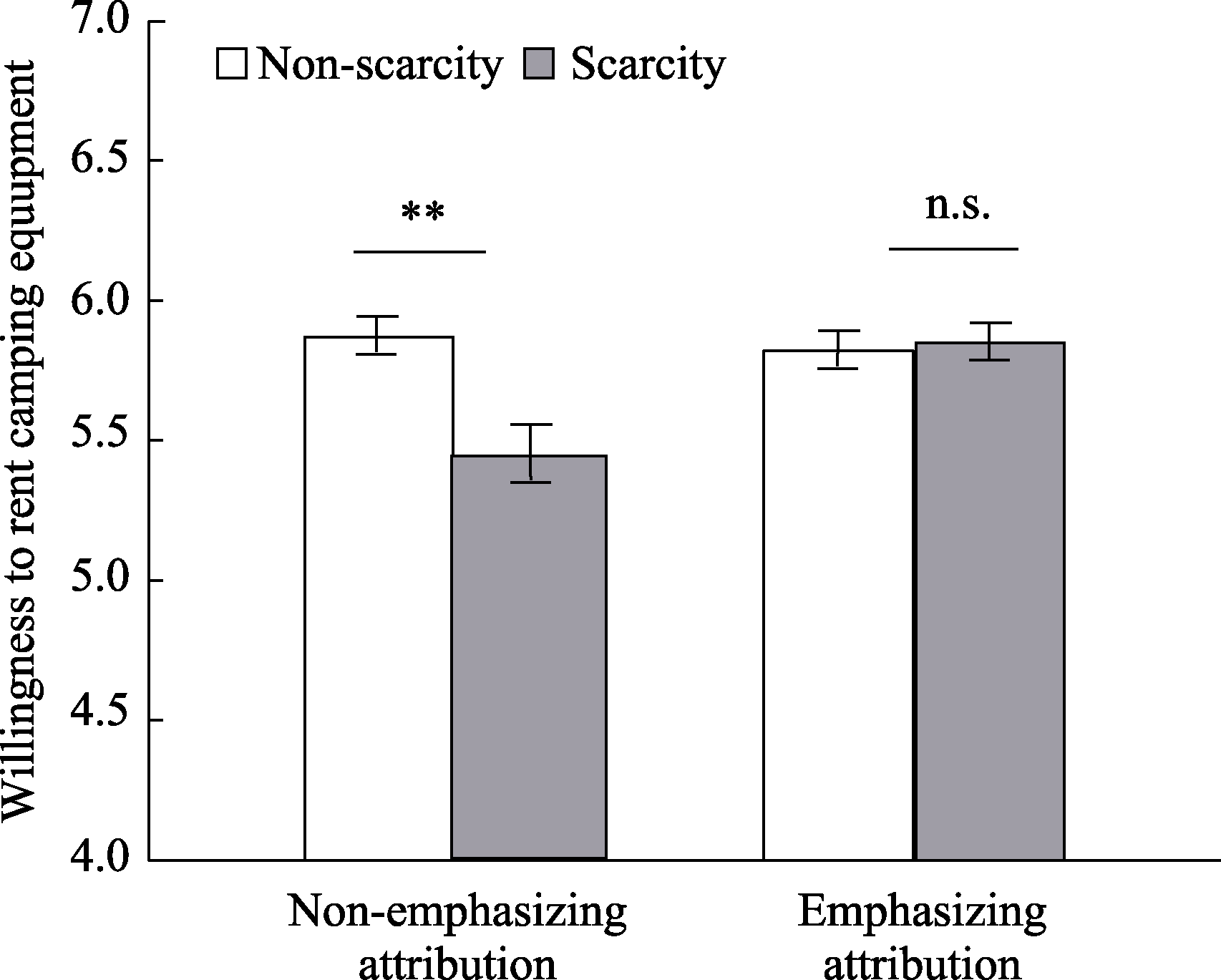
Figure 1. Interactive Effect between Financial Scarcity and Product Ownership Emphasis on the Rental Intention for Camping Equipment (Study 4). Note. **p < 0.01, n.s. not significant.
| [1] | Ackermann, L., & Tunn, V. S. C. (2024). Careless product use in access-based services: A rebound effect and how to address it. Journal of Business Research, 177, 114643. |
| [2] | Ailawadi, K. L., Neslin, S. A., & Gedenk, K. (2001). Pursuing the value-conscious consumer: Store brands versus national brand promotions. Journal of Marketing, 65(1), 71-89. |
| [3] | Aspara, J., & Wittkowski, K. (2019). Sharing-dominant logic? Quantifying the association between consumer intelligence and choice of social access modes. Journal of Consumer Research, 46(2), 201-222. |
| [4] | Atasoy, O., & Morewedge, C. K. (2018). Digital goods are valued less than physical goods. Journal of Consumer Research, 44(6), 1343-1357. |
| [5] | Belk, R. (2014). You are what you can access: Sharing and collaborative consumption online. Journal of Business Research, 67(8), 1595-1600. |
| [6] | Blocker, C., Zhang, J. Z., Hill, R. P., Roux, C., Corus, C., Hutton, M., Dorsey, J., & Minton, E. (2023). Rethinking scarcity and poverty: Building bridges for shared insight and impact. Journal of Consumer Psychology, 33(3), 489-509. |
| [7] | Botsman, R., & Rogers, R. (2010). What’s mine is yours: The rise of collaborative consumption. New York: Harper Collins. |
| [8] | Briers, B., & Laporte, S. (2013). A wallet full of calories: The effect of financial dissatisfaction on the desire for food energy. Journal of Marketing Research, 50(6), 767-781. |
| [9] | Cai, H. B., Han, J. R., & Su, L. F. (2019). Rent or buy? For properly matched marriage——Empirical analysis based on Chinese household financial survey. Economic Theory and Business Management, 3, 105-112. |
| [10] | Cannon, C., Goldsmith, K., & Roux, C. (2019). A self‐regulatory model of resource scarcity. Journal of Consumer Psychology, 29(1), 104-127. |
| [11] | Cannon, C., Goldsmith, K., & Roux, C. (2024). An integrative theory of resource discrepancies. Journal of Consumer Psychology, 35(1), 81-97. |
| [12] | Cheng, H. M., Yang, Y. P., & Wang, C. Y. (2024). Living space and social value of sharing platform. Journal of Management Sciences in China, 27(1), 1-16. |
| [13] |
Chou, E. Y., Parmar, B. L., & Galinsky, A. D. (2016). Economic insecurity increases physical pain. Psychological Science, 27(4), 443-454.
doi: 10.1177/0956797615625640 pmid: 26893293 |
| [14] | Costello, J. P., & Malkoc, S. A. (2022). Why are donors more generous with time than money? The role of perceived control over donations on charitable giving. Journal of Consumer Research, 49(4), 678-696. |
| [15] | Dai, H., Saccardo, S., Han, M. A., Roh, L., Raja, N., Vangala, S., ... Croymans, D. M. (2021). Behavioural nudges increase COVID-19 vaccinations. Nature, 597(7876), 404-409. |
| [16] | Donnelly, G. E., Wilson, A. V., Whillans, A. V., & Norton, M. I. (2021). Communicating resource scarcity and interpersonal connection. Journal of Consumer Psychology, 31(4), 726-745. |
| [17] |
Fan, L. (Sophie), Li, X. (Shirley), & Jiang, Y. (2019). Room for opportunity: Resource scarcity increases attractiveness of range marketing offers. Journal of Consumer Research, 46(1), 82-98.
doi: 10.1093/jcr/ucy059 |
| [18] | Fan, Y. F., & Jiang, J. (2017). The effects of financial constraints on variety-seeking behavior. Journal of Marketing Science, 13(2), 56-70. |
| [19] | Fraiberger, S. P., & Sundararajan, A. (2017). Peer-to-peer rental markets in the sharing economy [Working paper]. http://www.ssrn.com/abstract=2574337 |
| [20] |
Goldsmith, K., Roux, C., & Cannon, C. (2021). Understanding the relationship between resource scarcity and object attachment. Current Opinion in Psychology, 39, 26-30.
doi: 10.1016/j.copsyc.2020.07.012 pmid: 32801105 |
| [21] | Guo, Y. J., & Lamberton, C. (2021). When does sharing stigmatize? Saving money (vs. seeking variety) through access-based consumption. Frontiers in Psychology, 12, 778290. |
| [22] | Habibi, M. R., Kim, A., & Laroche, M. (2016). From sharing to exchange: An extended framework of dual modes of collaborative nonownership consumption. Journal of the Association for Consumer Research, 1(2), 277-294. |
| [23] |
Hamilton, R. W., Mittal, C., Shah, A., Thompson, D. V., & Griskevicius, V. (2019). How financial constraints influence consumer behavior: An integrative framework. Journal of Consumer Psychology, 29(2), 285-305.
doi: 10.1002/jcpy.1074 |
| [24] | Hayes, A. F. (2018). Partial, conditional, and moderated moderated mediation: Quantification, inference, and interpretation. Communication Monographs, 85(1), 4-40. |
| [25] | Hill, R. P. (2020). Does research on scarcity apply to impoverished consumers. Journal of the Association for Consumer Research, 5(4), 439-443. |
| [26] | Hmurovic, J., Lamberton, C., & Goldsmith, K. (2023). Examining the Efficacy of Time Scarcity Marketing Promotions in Online Retail. Journal of Marketing Research, 60(2), 299-328. |
| [27] | Karlsson, N., Garling, T., Dellgran, P., & Klingander, B. (2005). Social comparison and consumer behavior: When feeling richer or poorer than others is more important than being so. Journal of Applied Social Psychology, 35(6), 1206-1222. |
| [28] | Kim, K., & Jeon, J. S. (2012). Why do households rent while owning houses? Housing sub-tenure choice in South Korea. Habitat International, 36(1), 101-107. |
| [29] | Kumar, J. (2024). Psychological mechanisms behind access- based luxury brand consumption: Empirical investigation from the lens of new ownership paradigm. Journal of Business Research, 175, 114539. |
| [30] |
Laran, J., & Salerno, A. (2013). Life-history strategy, food choice, and caloric consumption. Psychological Science, 24(2), 167-173.
doi: 10.1177/0956797612450033 pmid: 23302296 |
| [31] | Lastovicka, J. L., & Sirianni, N. J. (2011). Truly, madly, deeply: Consumers in the throes of material possession love. Journal of Consumer Research, 38(2), 323-342. |
| [32] | Lawson, S. J., Gleim, M. R., Perren, R., & Hwang, J. (2016). Freedom from ownership: An exploration of access-based consumption. Journal of Business Research, 69(8), 2615-2623. |
| [33] |
Lei, L., Wang, J. Y., & Liu, W. M. (2020). The effect of scarcity on individuals’ psychology and behavior: An explanation from a more integrated perspective. Advances in Psychological Science, 28(5), 833-843.
doi: 10.3724/SP.J.1042.2020.00833 |
| [34] | Luangrath, A. W., Peck, J., Hedgcock, W., & Xu, Y. (2022). Observing product touch: The vicarious haptic effect in digital marketing and virtual reality. Journal of Marketing Research, 59(2), 306-326. |
| [35] | MacDonald, T., Trudel, R., & Morewedge, C. (2022). Ownership unwanted: Identity signals and preferences to consume without owning. Advances in Consumer Research, 50, 135-136. |
| [36] | Morewedge, C. K., Monga, A., Palmatier, R. W., Shu, S. B., & Small, D. A. (2021). Evolution of consumption: A psychological ownership framework. Journal of Marketing, 85(1), 196-218. |
| [37] | National Bureau of Statistics. (2024). Statistical Communiqué of the People’s Republic of China on the 2023 National Economic and Social Development. National Bureau of Statistics. https://www.stats.gov.cn/sj/zxfb/202402/t20240228_1947915.html |
| [38] | Netemeyer, R. G., Warmath, D., Fernandes, D., & Lynch, J. G. (2018). How am I doing? Perceived financial well-being, its potential antecedents, and its relation to overall well-being. Journal of Consumer Research, 45(1), 68-89. |
| [39] | Nie, X., Yang, Z., Zhang, Y., & Janakiraman, N. (2022). How does global-local identity affect consumer preference for access-based consumption? Investigating the mediating role of consumption openness. Journal of Marketing Research, 59(3), 555-577. |
| [40] |
Paley, A., Tully, S. M., & Sharma, E. (2019). Too constrained to converse: The effect of financial constraints on word of mouth. Journal of Consumer Research, 45(5), 889-905.
doi: 10.1093/jcr/ucy040 |
| [41] | Pang, Q. (2016). China's distinctive sharing economy: Essential characteristics and key pathways. Marxist Studies, 7, 65-71. |
| [42] | Park, H., Lalwani, A. K., & Silvera, D. H. (2020). The impact of resource scarcity on price-quality judgments. Journal of Consumer Research, 46(6), 1110-1124. |
| [43] | Peck, J., Kirk, C. P., Luangrath, A. W., & Shu, S. B. (2021). Caring for the commons: Using psychological ownership to enhance stewardship behavior for public goods. Journal of Marketing, 85(2), 33-49. |
| [44] | Peck, J., & Shu, S. B. (2009). The effect of mere touch on perceived ownership. Journal of Consumer Research, 36(3), 434-447. |
| [45] |
Pitesa, M., & Thau, S. (2014). A lack of material resources causes harsher moral judgments. Psychological Science, 25(3), 702-710.
doi: 10.1177/0956797613514092 pmid: 24434236 |
| [46] | Sarial-Abi, G., Ulqinaku, A., Viglia, G., & Das, G. (2023). The effect of financial scarcity on discretionary spending, borrowing, and investing. Journal of the Academy of Marketing Science, 51(6), 1214-1243. |
| [47] | Schaefers, T., Narayanamurthy, G., Moser, R., & Leban, M. (2021). The sharing economy at the base of the economic pyramid: How access-based services can help overcome ownership risks. Psychology & Marketing, 38(11), 2073-2088. |
| [48] |
Shah, A. K., Mullainathan, S., & Shafir, E. (2012). Some consequences of having too little. Science, 338(6107), 682-685.
doi: 10.1126/science.1222426 pmid: 23118192 |
| [49] | Sharma, E., & Alter, A. L. (2012). Financial deprivation prompts consumers to seek scarce goods. Journal of Consumer Research, 39(3), 545-560. |
| [50] | Sharma, E., Mazar, N., Alter, A. L., & Ariely, D. (2014). Financial deprivation selectively shifts moral standards and compromises moral decisions. Organizational Behavior and Human Decision Processes, 123(2), 90-100. |
| [51] |
Sharma, E., Tully, S. M., & Wang, X. (2023). Scarcity and intertemporal choice. Journal of Personality and Social Psychology, 125(5), 1036-1054.
doi: 10.1037/pspa0000353 pmid: 37707481 |
| [52] | Shu, S. B., & Peck, J. (2011). Psychological ownership and affective reaction: Emotional attachment process variables and the endowment effect. Journal of Consumer Psychology, 21(4), 439-452. |
| [53] | Song, J. (Flora), He, D., & Jiang, Y. (2023). The negative handmade effect: How and why control deprivation thwarts desire for handmade products. Psychology & Marketing, 40(7), 1431-1445. |
| [54] | Spiller, S. A. (2011). Opportunity cost consideration. Journal of Consumer Research, 38(4), 595-610. |
| [55] | Sun, J., Chen, C., & Lu, J. (2023). Research on the impact of resource scarcity on consumers’ preference for green products. Foreign Economics & Management, 45(2), 82-99. |
| [56] | Thompson, D. V., Banerji, I., & Hamilton, R. W. (2020). Scarcity of choice: The effects of childhood socioeconomic status on consumers’ responses to substitution. Journal of the Association for Consumer Research, 5(4), 415-426. |
| [57] | Tully, S. M., Hershfield, H. E., & Meyvis, T. (2015). Seeking lasting enjoyment with limited money: Financial constraints increase preference for material goods over experiences. Journal of Consumer Research, 42(1), 59-75. |
| [58] | Tully, S. M., & Sharma, E. (2022). Consumer wealth. Consumer Psychology Review, 5(1), 125-143. |
| [59] | Wang, L., You, Y., & Yang, C.-M. (2020). Restrained by resources: The effect of scarcity cues and childhood socioeconomic status (SES) on consumer preference for feasibility. International Journal of Research in Marketing, 37(3), 557-571. |
| [60] | Wei, X., Jung, S., & Choi, T.-M. (2022). Share it or buy it? Exploring the effects of product brand attachment on commercial sharing services. Journal of Business Research, 153, 115-127. |
| [61] | Wu, Y., Wang, R., Jin, H., & Zhu, M. (2023). Providing assets in the sharing economy: Low childhood socioeconomic status as a barrier. International Journal of Research in Marketing, 40(3), 534-551. |
| [62] | Xiong, J. W., Wei, H. Y., Chen, S., Y., & Yu, X. M. (2023) From distant to near: The effect of perceived financial constraint on consumer’s brand extension evaluation. Journal of Marketing Science, 3(3), 63-81. |
| [63] | Yang, H., & Zhang, K. (2022). How resource scarcity influences the preference for counterhedonic consumption. Journal of Consumer Research, 48(5), 904-919. |
| [64] | Zauberman, G., & Lynch, J. G. (2005). Resource slack and propensity to discount delayed investments of time versus money. Journal of Experimental Psychology: General, 134(1), 23. |
| [65] | Zhang, R., Ma, Q., & Guan, D. (2023). The impact of financial scarcity on green consumption: Sequential mediating effects of anxiety and self-efficacy. Psychology & Marketing, 40(6), 1162-1178. |
| [66] | Zhao, T., Lu, Y., Lynette Wang, V., Wu, B., Chen, Z., Song, W., & Zhou, L. (2023). Shared but unhappy? Detrimental effects of using shared products on psychological ownership and consumer happiness. Journal of Business Research, 169, 114306. |
| [1] | WEI Lihua, LIU Zhiqiang, LIAO Shudi, LONG Lirong, LIAO Jianqiao. Collective psychological ownership, status conferral criteria and team creativity [J]. Acta Psychologica Sinica, 2019, 51(6): 677-687. |
| [2] | LI Rui;LING Wen-Quan;Liu Shi-Shun. The Antecedents and Outcomes of Psychological Ownership for the Organization: An Analysis from the Perspective of Person-Situation Interactions [J]. Acta Psychologica Sinica, 2012, 44(9): 1202-1216. |
| [3] | ZHOU Hao,LONG Li-Rong. The Influence of Transformational Leadership on Voice Behavior: Mediating Effect of Psychological Ownership for the Organization and Moderating Effect of Traditionality [J]. , 2012, 44(3): 388-399. |
| Viewed | ||||||
|
Full text |
|
|||||
|
Abstract |
|
|||||
