
ISSN 0439-755X
CN 11-1911/B
CN 11-1911/B
Acta Psychologica Sinica ›› 2026, Vol. 58 ›› Issue (11): 2390-2404.doi: 10.3724/SP.J.1041.2026.2390
ZHU Yue1, ZHANG Anran2( ), XU Zhengliang1
Received:2025-09-09
Published:2026-11-25
Online:2026-09-11
Contact:
ZHANG Anran, E-mail: ZHU Yue, ZHANG Anran, XU Zhengliang. (2026). Warmth or competence? Exploring the impact of donation recognition on subsequent donations and information sharing. Acta Psychologica Sinica, 58(11), 2390-2404.
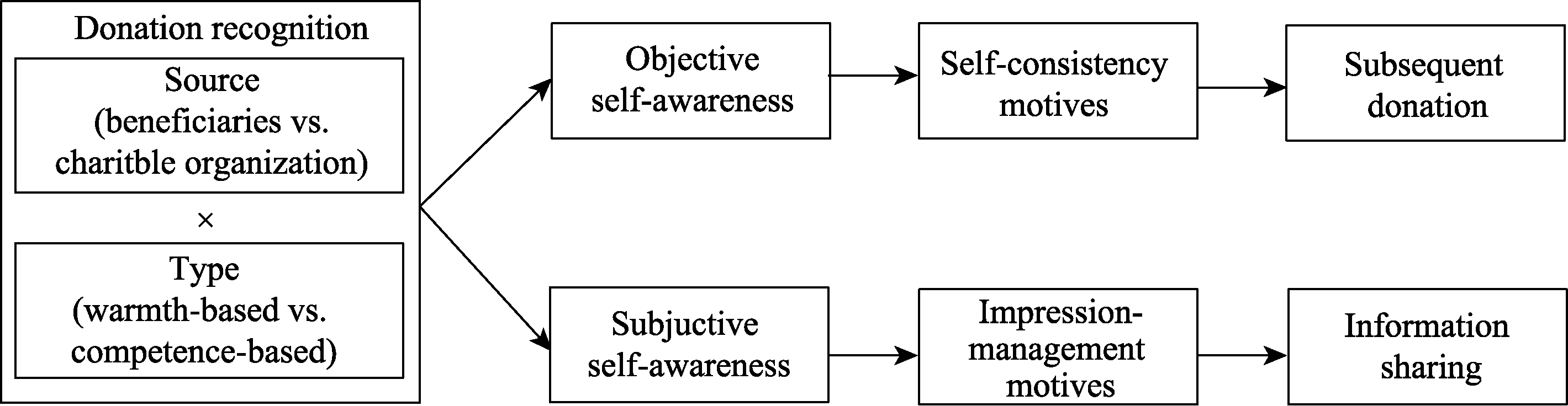
Figure 1. Research model.
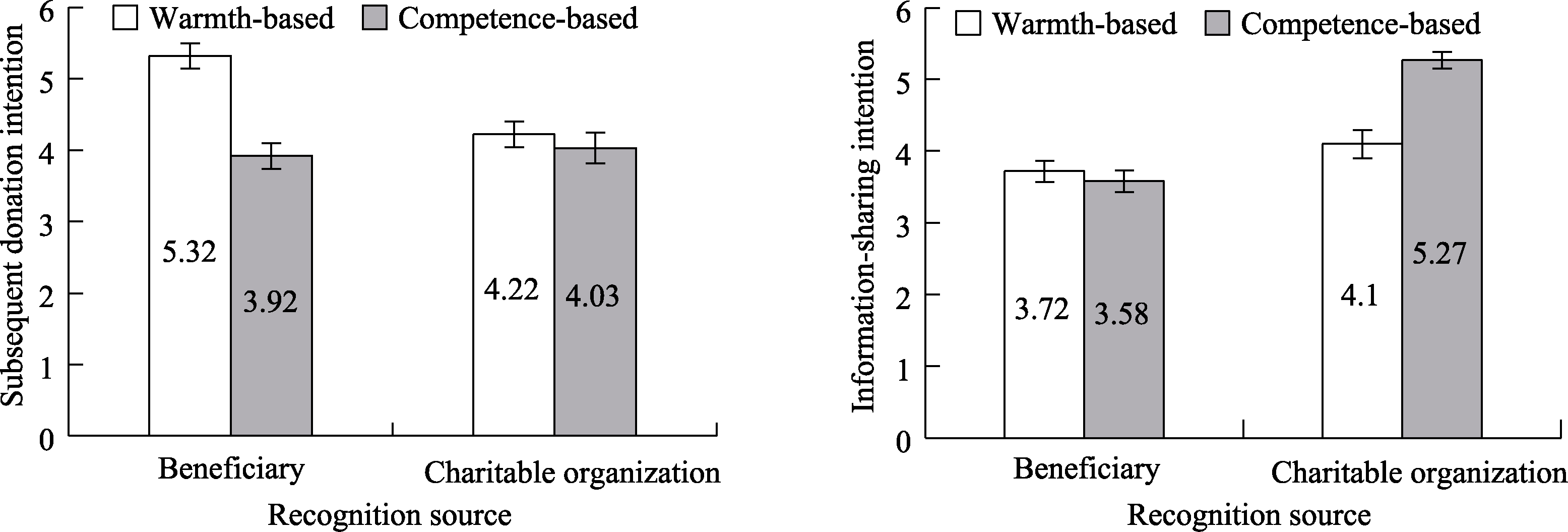
Figure 2. Effects of recognition source and type on subsequent donation and information-sharing intentions.

Figure 3. Serial mediation effect of objective self-awareness and self-consistency motives (Study 3). Note. Recognition type (0 = warmth-based, 1 = competence-based); self-awareness state (1 = objective self-awareness state, 7 = subjective self-awareness state). *** p < 0.001; ** p < 0.01; * p < 0.05. Key 1: Ind1: Recognition type → Self-awareness → Subsequent donation intention Key 2: Ind2: Recognition type → Self-consistency motives → Subsequent donation intention Key 3: Ind3: Recognition type → Self-awareness → Self-consistency motives → Subsequent donation intention

Figure 4. Serial mediation effect of subjective self-awareness and impression-management motives (Study 4). Note. Recognition type (0 = warmth-based, 1 = competence-based); self-awareness state (1 = objective self-awareness state, 7 = subjective self-awareness state). *** p < 0.001; ** p < 0.01; * p < 0.05. Key 1: Ind1: Recognition type → Self-awareness → Information-sharing intention Key 2: Ind2: Recognition type → Impression-management motives → Information-sharing intention Key 3: Ind3: Recognition type → Self-awareness → Impression-management motives → Information-sharing intention
| Self-awareness | Conditions | Subsequent donation intention (M ± SD) | F | p | Self-consistency motives (M ± SD) | F | p |
|---|---|---|---|---|---|---|---|
| Objective Self-awareness | Beneficiary×Warmth | 4.58 ± 0.84 | 0.51 | 0.476 | 4.30 ± 0.79 | 0.16 | 0.687 |
| Beneficiary×Competence | 4.45 ± 1.17 | 4.25 ± 0.74 | |||||
| Charity×Warmth | 4.49 ± 1.28 | 0.43 | 0.514 | 4.31 ± 1.00 | 2.34 | 0.129 | |
| Charity×Competence | 4.33 ± 1.32 | 4.05 ± 0.92 | |||||
| Subjective Self-awareness | Beneficiary×Warmth | 4.68 ± 1.24 | 29.76 | <0.001 | 4.35 ± 0.80 | 12.54 | <0.001 |
| Beneficiary×Competence | 3.63 ± 0.70 | 3.83 ± 0.71 | |||||
| Charity×Warmth | 3.87 ± 1.01 | 1.11 | 0.294 | 3.70 ± 0.64 | 0.03 | 0.857 | |
| Charity×Competence | 3.67 ± 0.95 | 3.67 ± 0.96 |
Table 1 Subsequent donation intention and self-consistency motives across self-awareness(Study 4)
| Self-awareness | Conditions | Subsequent donation intention (M ± SD) | F | p | Self-consistency motives (M ± SD) | F | p |
|---|---|---|---|---|---|---|---|
| Objective Self-awareness | Beneficiary×Warmth | 4.58 ± 0.84 | 0.51 | 0.476 | 4.30 ± 0.79 | 0.16 | 0.687 |
| Beneficiary×Competence | 4.45 ± 1.17 | 4.25 ± 0.74 | |||||
| Charity×Warmth | 4.49 ± 1.28 | 0.43 | 0.514 | 4.31 ± 1.00 | 2.34 | 0.129 | |
| Charity×Competence | 4.33 ± 1.32 | 4.05 ± 0.92 | |||||
| Subjective Self-awareness | Beneficiary×Warmth | 4.68 ± 1.24 | 29.76 | <0.001 | 4.35 ± 0.80 | 12.54 | <0.001 |
| Beneficiary×Competence | 3.63 ± 0.70 | 3.83 ± 0.71 | |||||
| Charity×Warmth | 3.87 ± 1.01 | 1.11 | 0.294 | 3.70 ± 0.64 | 0.03 | 0.857 | |
| Charity×Competence | 3.67 ± 0.95 | 3.67 ± 0.96 |
| Self-awareness | Conditions | Information-sharing intention (M ± SD) | F | p | impression management motives (M ± SD) | F | p |
|---|---|---|---|---|---|---|---|
| Objective Self-awareness | Beneficiary×Warmth | 3.33 ± 0.82 | 0.01 | 0.911 | 3.44 ± 0.73 | 0.01 | 0.915 |
| Beneficiary×Competence | 3.35 ± 0.81 | 3.43 ± 0.55 | |||||
| Charity×Warmth | 3.15 ± 0.94 | 0.08 | 0.783 | 3.68 ± 0.71 | 3.70 | 0.057 | |
| Charity×Competence | 3.11 ± 0.91 | 3.46 ± 0.84 | |||||
| Subjective Self-awareness | Beneficiary×Warmth | 3.54 ± 0.83 | 2.56 | 0.113 | 3.80 ± 0.83 | 2.23 | 0.138 |
| Beneficiary×Competence | 3.27 ± 0.86 | 3.60 ± 0.87 | |||||
| Charity×Warmth | 3.47 ± 1.04 | 12.12 | <0.001 | 3.44 ± 0.82 | 54.23 | <0.001 | |
| Charity×Competence | 4.13 ± 0.91 | 4.56 ± 0.76 |
Table 2 Information-sharing intention and impression management motives across self-awareness(Study 4)
| Self-awareness | Conditions | Information-sharing intention (M ± SD) | F | p | impression management motives (M ± SD) | F | p |
|---|---|---|---|---|---|---|---|
| Objective Self-awareness | Beneficiary×Warmth | 3.33 ± 0.82 | 0.01 | 0.911 | 3.44 ± 0.73 | 0.01 | 0.915 |
| Beneficiary×Competence | 3.35 ± 0.81 | 3.43 ± 0.55 | |||||
| Charity×Warmth | 3.15 ± 0.94 | 0.08 | 0.783 | 3.68 ± 0.71 | 3.70 | 0.057 | |
| Charity×Competence | 3.11 ± 0.91 | 3.46 ± 0.84 | |||||
| Subjective Self-awareness | Beneficiary×Warmth | 3.54 ± 0.83 | 2.56 | 0.113 | 3.80 ± 0.83 | 2.23 | 0.138 |
| Beneficiary×Competence | 3.27 ± 0.86 | 3.60 ± 0.87 | |||||
| Charity×Warmth | 3.47 ± 1.04 | 12.12 | <0.001 | 3.44 ± 0.82 | 54.23 | <0.001 | |
| Charity×Competence | 4.13 ± 0.91 | 4.56 ± 0.76 |
| [1] |
Aaker J., Vohs K. D., & Mogilner C. (2010). Nonprofits are seen as warm and for-profits as competent: Firm stereotypes matter. Journal of Consumer Research, 37(2), 224-237.
doi: 10.1086/651566 URL |
| [2] |
Aaker J. L., Garbinsky E. N., & Vohs K. D. (2012). Cultivating admiration in brands: Warmth, competence, and landing in the “golden quadrant”. Journal of Consumer Psychology, 22(2), 191-194.
doi: 10.1016/j.jcps.2011.11.012 URL |
| [3] |
Alicke M. D., & Sedikides C. (2009). Self-enhancement and self-protection: What they are and what they do. European Review of Social Psychology, 20(1), 1-48.
doi: 10.1080/10463280802613866 URL |
| [4] | Althoff T., & Leskovec J. (2015). Donor retention in online crowdfunding communities: A case study of DonorsChoose. org. In Proceedings of the 24th International Conference on World Wide Web(pp. 34-44). International World Wide Web Conferences Steering Committee. https://doi.org/10.1145/2736277.2741120 |
| [5] | Aronson, E. (1968). Dissonance theory:Progress and problems. In R. P. Abelson, E. Aronson, W. J. McGuire, T. M. Newcomb, M. J. Rosenberg, & P. H. Tannenbaum (Eds.), Theories of cognitive consistency: A sourcebook (pp. 5-27). Chicago, United States: Rand McNally. |
| [6] |
Barasch A., & Berger J. (2014). Broadcasting and narrowcasting: How audience size affects what people share. Journal of Marketing Research, 51(3), 286-299.
doi: 10.1509/jmr.13.0238 URL |
| [7] |
Boman L., & He X. (2025). Sharing to persuade: The role of donor- versus charity-focused word of mouth. Journal of Marketing Research, 62(1), 22-39.
doi: 10.1177/00222437241268491 URL |
| [8] | Carver C. S., & Scheier M. F. (2012). Attention and self-regulation: A control-theory approach to human behavior. New York, United States: Springer. |
| [9] |
Chang H. H., & Hung I. W. (2018). Mirror, mirror on the retail wall: Self-focused attention promotes reliance on feelings in consumer decisions. Journal of Marketing Research, 55(4), 586-599.
doi: 10.1509/jmr.15.0080 URL |
| [10] | Chell K., Mortimer G., Masser B. M., & Russell-Bennett R. (2023). An identity-based model explaining online donor appreciation. Australasian Marketing Journal, 31(1), 13-24. |
| [11] |
Chen S. Y., Wei H. Y., & Meng L. (2019). The impact of congruency between moral appeal and social perception on charitable donation. Acta Psychologica Sinica, 51(12), 1351-1362.
doi: 10.3724/SP.J.1041.2019.01351 |
| [12] |
Cialdini R. B., Trost M. R., & Newsom J. T. (1995). Preference for consistency: The development of a valid measure and the discovery of surprising behavioral implications. Journal of Personality and Social Psychology, 69(2), 318-328.
doi: 10.1037/0022-3514.69.2.318 URL |
| [13] | Dai B. (2014). Who is better to be the thanker? The influence of thank-you letter's actor on receiver's subsequent help willingness [Unpublished doctoral dissertation]. Wuhan University. |
| [14] | Dangubić M., Politi E., Storz N., Roblain A., Favre Y., & Green E. G. T.(2025). Feelings of recognition and long‐term engagement in favour of refugees. Journal of Community & Applied Social Psychology, 35(3), Article e70087. https://doi.org/10.1002/casp.70087 |
| [15] | Dirisam J. V., Bein D., & Verma A. (2021). Predictive analytics of donors in crowdfunding platforms: A case study on Donorschoose.org. In 2021 IEEE 11th Annual Computing and Communication Workshop and Conference (CCWC) (pp. 834-838). IEEE. https://doi.org/10.1109/CCWC51732.2021.9376094 |
| [16] | Duval S., & Wicklund R. A. (1972). A theory of objective self-awareness. New York: Academic Press. |
| [17] | Faulkner M., Romaniuk J., & Stern P. (2016). New versus frequent donors: Exploring the behaviour of the most desirable donors. Australasian Marketing Journal, 24(3), 198-204. |
| [18] | Fei X. Z., Wang H. Y., & Li R. X. (2024). “Viewing self” or “Viewing the world”? How consumers’ self-awareness influences advertising effectiveness in the use of social media. Nankai Business Review, 27(2), 193-205. |
| [19] | Feng W. T., Shen X. Y., & Yin Z. W. (2022). Self-focused or other-focused: The influence of acknowledgment type on subsequent donation desires. Frontiers in Psychology, 13, Article 959369. https://doi.org/10.3389/fpsyg.2022.959369 |
| [20] | Feng W. T., Xu Y. P., & Wang T. (2021). Beneficiaries or charity: The influence of the source of acknowledgments. Frontiers in Psychology, 12, Article 602410. https://doi.org/10.3389/fpsyg.2021.602410 |
| [21] |
Fiske S. T., Cuddy A. J. C., & Glick P. (2007). Universal dimensions of social cognition: Warmth and competence. Trends in Cognitive Sciences, 11(2), 77-83.
doi: 10.1016/j.tics.2006.11.005 pmid: 17188552 |
| [22] |
Fiske S. T., Cuddy A. J. C., Glick P., & Xu J. (2002). A model of (often mixed) stereotype content: Competence and warmth respectively follow from perceived status and competition. Journal of Personality and Social Psychology, 82(6), 878-902.
pmid: 12051578 |
| [23] | Gibbons F. X. (1990). Self-attention and behavior: A review and theoretical update. Advances in Experimental Social Psychology, 23, 249-303. |
| [24] |
Han J., & Balabanis G. (2024). Meta-analysis of social media influencer impact: Key antecedents and theoretical foundations. Psychology & Marketing, 41(2), 394-426.
doi: 10.1002/mar.v41.2 URL |
| [25] | Heider F. (1960). The gestalt theory of motivation. In M. R. Jones (Ed.), Nebraska symposium on motivation (Vol. 8, pp. 145-172). Lincoln, United States: University of Nebraska Press. |
| [26] |
Judd C. M., James-Hawkins L., Yzerbyt V., & Kashima Y. (2005). Fundamental dimensions of social judgment: Understanding the relations between judgments of competence and warmth. Journal of Personality and Social Psychology, 89(6), 899-913.
pmid: 16393023 |
| [27] |
Kervyn N., Fiske S. T., & Malone C. (2012). Brands as intentional agents framework: How perceived intentions and ability can map brand perception. Journal of Consumer Psychology, 22(2), 166-176.
doi: 10.1016/j.jcps.2011.09.006 URL |
| [28] |
Kim D., Jang S., & Adler H. (2015). What drives café customers to spread eWOM?: Examining self-relevant value, quality value, and opinion leadership. International Journal of Contemporary Hospitality Management, 27(2), 261-282.
doi: 10.1108/IJCHM-06-2013-0269 URL |
| [29] |
Kristofferson K., White K., & Peloza J. (2014). The nature of slacktivism: How the social observability of an initial act of token support affects subsequent prosocial action. Journal of Consumer Research, 40(6), 1149-1166.
doi: 10.1086/674137 URL |
| [30] |
Labrecque L. I., & Milne G. R. (2012). Exciting red and competent blue: The importance of color in marketing. Journal of the Academy of Marketing Science, 40(5), 711-727.
doi: 10.1007/s11747-010-0245-y URL |
| [31] |
Leary M. R., & Kowalski R. M. (1990). Impression management: A literature review and two-component model. Psychological Bulletin, 107(1), 34-47.
doi: 10.1037/0033-2909.107.1.34 URL |
| [32] | Liu B., Ma Y. B., & Lu L. H. (2016). The effect of gratitude feedback sources on donation intention: A moderated mediation model. Chinese Journal of Applied Psychology, 22(2), 162-172. |
| [33] |
Mehdizadeh S. (2010). Self-presentation 2.0: Narcissism and self-esteem on Facebook. Cyberpsychology, Behavior, and Social Networking, 13(4), 357-364.
doi: 10.1089/cyber.2009.0257 URL |
| [34] |
Merchant A., Ford J. B., & Sargeant A. (2010). “Don’t forget to say thank you”: The effect of an acknowledgement on donor relationships. Journal of Marketing Management, 26(7-8), 593-611.
doi: 10.1080/02672571003780064 URL |
| [35] |
Morin A. (2004). A Neurocognitive and socioecological model of self-awareness. Genetic, Social, and General Psychology Monographs, 130(3), 197-224.
doi: 10.3200/MONO.130.3.197-224 URL |
| [36] |
Moskalenko S., & Heine S. J. (2003). Watching your troubles away: Television viewing as a stimulus for subjective self-awareness. Personality and Social Psychology Bulletin, 29(1), 76-85.
pmid: 15272961 |
| [37] |
Osgood C. E., & Tannenbaum P. H. (1955). The principle of congruity in the prediction of attitude change. Psychological Review, 62(1), 42-55.
pmid: 14357526 |
| [38] |
Ponnappan V., Nivsarkar A., Satyavageeswaran P., & Bharadwaj S. (2026). Fit to persuade: The role of source-appeal congruence in cancer screening decisions. Journal of Marketing, 90(4), 97-121.
doi: 10.1177/00222429251355263 URL |
| [39] |
Pryor J. B., Gibbons F. X., Wicklund R. A., Fazio R. H., & Hood R. (1977). Self-focused attention and self-report validity. Journal of Personality, 45(4), 513-527.
pmid: 592083 |
| [40] |
Rifkin J. R., Du K. M., & Berger J. (2020). Penny for your preferences: Leveraging self-expression to encourage small prosocial gifts. Journal of Marketing, 85(3), 204-219.
doi: 10.1177/0022242920928064 URL |
| [41] | Sargeant A. (2013, August 15). Donor retention: What do we know and what can we do about it? Retrieved August 17, 2026, from https://nonprofitquarterly.org/donor-retention-nonprofit-donors/ |
| [42] |
Silver I., & Small D. A. (2024). Put your mouth where your money is: A field experiment encouraging donors to share about charity. Marketing Science, 43(2), 392-406.
doi: 10.1287/mksc.2023.1450 URL |
| [43] |
Simpson B., White K., & Laran J. (2018). When public recognition for charitable giving backfires: The role of independent self-construal. Journal of Consumer Research, 44(6), 1257-1273.
doi: 10.1093/jcr/ucx101 URL |
| [44] |
van Dongen A. (2015). Easy come, easy go. Retention of blood donors. Transfusion Medicine, 25(4), 227-233.
doi: 10.1111/tme.12249 pmid: 26399971 |
| [45] | Wang T., Feng W. T., Lei W. H., & Zhou N. (2016). How to recognize donors: The influence of recognition’s type on donation performance. Journal of Marketing Science, 12(3), 101-114. |
| [46] | White K., & Peloza J. (2009). Self-benefit versus other-benefit marketing appeals: Their effectiveness in generating charitable support. Journal of Marketing, 73(4), 109-124. |
| [47] |
Winterich K. P., Mittal V., & Aquino K. (2013). When does recognition increase charitable behavior? Toward a moral identity-based model. Journal of Marketing, 77(3), 121-134.
doi: 10.1509/jm.11.0477 URL |
| [48] | Worldmetrics. (2026, February 12). Nonprofit fundraising statistics. Retrieved June 25, 2026, from https://worldmetrics.org/nonprofit-fundraising-statistics/ |
| [49] | Zhu Y., Xu Z. L., & Lu H. (2024). Research on the influencing factors and generating mechanism of sharing donation recognition on charity platforms. Luojia Management Review, 57(6), 57-74. |
| [50] |
Zhu Z. Z., Liu F., & Chen A. (2020). Warmth or competence? The influence of advertising appeal and self-construal on consumer-brand identification and purchase intention. Acta Psychologica Sinica, 52(3), 357-370.
doi: 10.3724/SP.J.1041.2020.00357 |
| [1] | KUAI Ling, WEI Haiying, YAO Qi, XIAO Tingwen, XIE Shengcheng. The Impact of Temporal Landmarks on the Willingness of Conspicuous Prosocial Behavior* [J]. Acta Psychologica Sinica, 2025, 57(4): 526-543. |
| [2] |
HAN Yu-Lan,ZHANG Zhi-Xue,WANG Min . The Path to Integrative Agreements: The Role of Motivational Orientation and Information Sharing Quality in Negotiation Process [J]. , 2010, 42(02): 288-303. |
| [3] | Zhu Ying,Qi Jianli,Zhang Jian. Self-face identification in Chinese students [J]. , 2004, 36(04): 442-447. |
| [4] | Zhang Zhixue, Han Yulan. THE EFFECTS OF RECIPROCATION WARINESS ON THE PROCESS AND OUTCOMES OF DYADIC NEGOTIATION [J]. , 2004, 36(03): 370-377. |
| Viewed | ||||||
|
Full text |
|
|||||
|
Abstract |
|
|||||
