

ISSN 0439-755X
CN 11-1911/B
CN 11-1911/B
Acta Psychologica Sinica ›› 2026, Vol. 58 ›› Issue (11): 2270-2288.doi: 10.3724/SP.J.1041.2026.2270
Previous Articles Next Articles
CAI Jinfang1, WANG Sibo1, YUE Xiaoxi1, LIN Youting2( ), SUN Yanliang1()
Received:2025-12-14
Published:2026-11-25
Online:2026-09-11
Contact:
SUN Yanliang, E-mail: Supported by:CAI Jinfang, WANG Sibo, YUE Xiaoxi, LIN Youting, SUN Yanliang. (2026). The Normalization Mechanism of Emotional Modulation on Rhythmic Temporal Attention. Acta Psychologica Sinica, 58(11), 2270-2288.

Figure 1. (A) Schematic illustration of the experimental implementation. Before each block, participants watched an emotion-induction video to establish the corresponding emotional state, and then completed the orientation discrimination task. After target offset, the screen remained blank until participants made a key-press response. Participants rested for 5 minutes between blocks. (B)Schematic illustration of the trial procedure in Experiment 1. Three red squares served as rhythmic cues, each presented for 100 ms and separated by a 600 ms inter-stimulus interval (ISI). After a 600 ms delay following the final cue, a 100 ms white square appeared as a warning signal (shown as gray here for illustration). The target Gabor patch was then displayed centrally for 100 ms. On valid trials (60%), the target appeared at the rhythmically expected time point—600 ms after the warning signal. On invalid trials (40%), the target appeared either earlier (300 ms) or later (900 ms) than expected. Participants judged the orientation of the Gabor patch as quickly and accurately as possible; the display remained blank after target offset until a response was made.
| Negative | Neutral | Positive | F | η2p | Post-hoc | |
|---|---|---|---|---|---|---|
| Valence | 2.52±0.20 | 4.92±0.21 | 6.78±0.20 | 101.00*** | 0.842 | Pos>Neu***; Pos>Neg***; Neu>Neg*** |
| Arousal | 6.85±0.28 | 3.10±0.15 | 6.20±0.22 | 83.20*** | 0.814 | Neg>Neu***; Pos>Neu***; Neg vs Pos: ns |
| PANAS PA | 18.50±1.43 | 22.10±1.65 | 29.30±1.17 | 16.10*** | 0.573 | Pos>Neu***; Pos>Neg***; Neu vs Neg: ns |
| PANAS NA | 25.60±0.43 | 11.30±0.31 | 11.60±0.67 | 364.00*** | 0.968 | Neg>Neu***; Neg>Pos***; Neu vs Pos: ns |
Table 1 Valence, Arousal, and PANAS Scores Elicited by the Emotion Video Clips
| Negative | Neutral | Positive | F | η2p | Post-hoc | |
|---|---|---|---|---|---|---|
| Valence | 2.52±0.20 | 4.92±0.21 | 6.78±0.20 | 101.00*** | 0.842 | Pos>Neu***; Pos>Neg***; Neu>Neg*** |
| Arousal | 6.85±0.28 | 3.10±0.15 | 6.20±0.22 | 83.20*** | 0.814 | Neg>Neu***; Pos>Neu***; Neg vs Pos: ns |
| PANAS PA | 18.50±1.43 | 22.10±1.65 | 29.30±1.17 | 16.10*** | 0.573 | Pos>Neu***; Pos>Neg***; Neu vs Neg: ns |
| PANAS NA | 25.60±0.43 | 11.30±0.31 | 11.60±0.67 | 364.00*** | 0.968 | Neg>Neu***; Neg>Pos***; Neu vs Pos: ns |

Figure 2. Behavioral performance and normalization model fits for Experiment 1. Data are plotted as a function of stimulus contrast separately for the Negative (left column), Neutral (middle column), and Positive (right column) emotional conditions. (A) Accuracy. (B) Reaction time. (C) Discriminability (d') with corresponding normalization model fits. blue solid lines with circular markers represent the valid-cue condition, while red dashed lines with square markers represent the invalid-cue condition. Shaded regions denote the 95% confidence intervals computed from the standard error of the mean (SEM) across participants (N = 13). In panel C, solid and dashed curves show the best-fitting predictions of the normalization model applied to the group-averaged d' data. The model captured the data exceptionally well across emotional conditions (R2: Negative = 99.4%, Neutral = 98.0%, Positive = 99.0%).

Figure 3. Rhythmic temporal attentional gain across distinct emotional states in Experiment 1. Data are plotted as a function of stimulus contrast for Negative (left column), Neutral (middle column), and Positive (right column) conditions. The y-axis represents the magnitude of the attentional effect (calculated as the difference between valid and invalid cue conditions) for (A) Accuracy, (B) Reaction time, and (C) Discriminability (d'). The results reveal dissociable gain profiles: under negative emotion, attentional gain increases monotonically with stimulus contrast, exhibiting a response gain signature. Conversely, neutral and positive emotional states yield a canonical inverted-U profile with maximal effects at intermediate contrasts, a hallmark of contrast gain. Error bars denote the standard error of the mean (SEM).
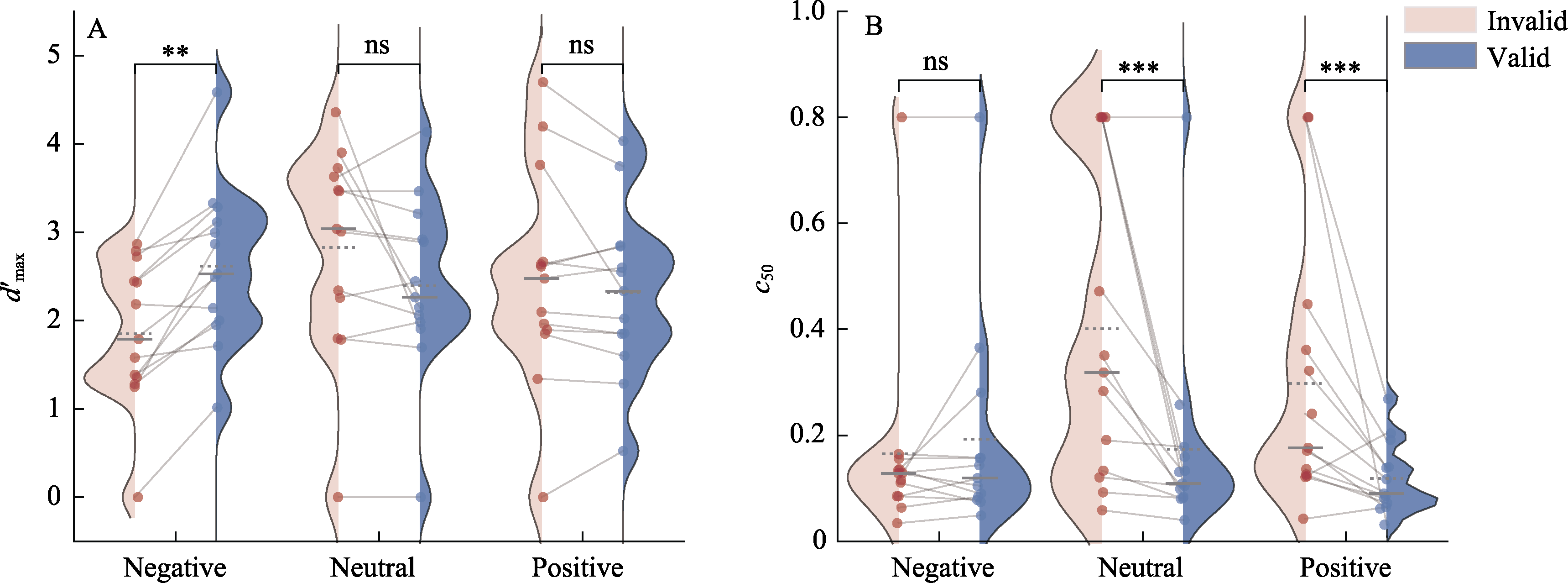
Figure 4. Emotion selectively modulates the gain parameters of the normalization model. Violin plots depict the distribution of best-fitting parameters for individual participants (N = 13) across emotional states (Negative, Neutral, Positive) and cue validity conditions (blue = valid; red = invalid). (A) Maximum response (d'max), indexing response gain. (B) Semi-saturation contrast (c50), indexing contrast gain. Individual data points are shown with gray lines linking valid and invalid conditions from the same participant. Solid horizontal bars denote medians; dotted bars denote means. Statistical comparisons between validity conditions within each emotion state are marked above the plots. A clear dissociation emerged: negative emotion selectively increased d'max (response gain), whereas neutral and positive emotions selectively decreased c50 (contrast gain). ns = not significant; **p < 0.01; ***p < 0.001.

Figure 5. Emotion modulates the dynamic build-up of rhythmic temporal attention in Experiment 2. (A) Accuracy, (B) Reaction Time, and (C) Discriminability (d′) are plotted as a function of Rhythmic Strength (i.e., number of preceding rhythmic cues) separately for Negative (left column), Neutral (middle column), and Positive (right column) emotional states. Blue solid lines with circular markers indicate the valid-cue condition, whereas red dashed lines with square markers indicate the invalid-cue condition. Shaded regions represent the standard error of the mean (SEM) across participants (N = 13). The smooth curves in panel (C) represent the best-fitting predictions of the dynamic normalization model. Temporal attention produced reliable benefits across all conditions, but emotion modulated both the magnitude and developmental trajectory of this effect: negative and positive emotions reduced the validity effect in reaction times relative to the neutral state, reflecting a broadened temporal attention window, and reshaped the dynamic allocation of attention as rhythmic evidence accumulated.
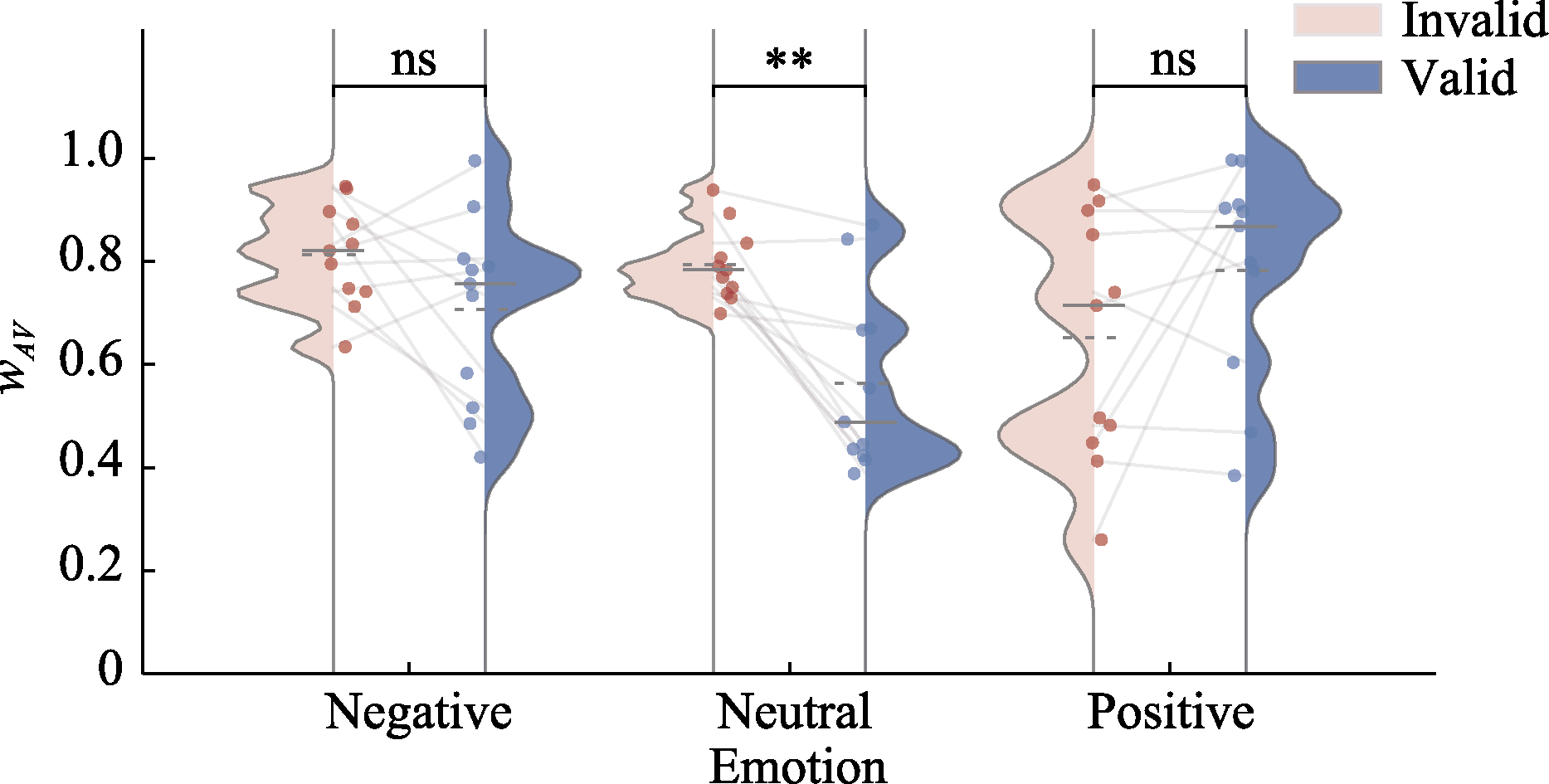
Figure 6. Emotion modulates the allocation of the attentional weight parameter (avWeight) in the dynamic normalization model of Experiment 2. The columns correspond to the distribution of attention weight parameters under valid (blue) and invalid (red) conditions for negative (left), neutral (middle), and positive (right) emotional states, respectively. Dots represent model-fitted parameters for individual participants (N = 11), with gray lines connecting data points from the same participant across conditions. Solid horizontal bars indicate medians, and dotted horizontal bars indicate means. Statistical annotations show that the weight difference between valid and invalid conditions was significant under neutral emotion, reflecting highly focused attentional resources, whereas the differences under negative and positive emotions did not reach significance, indicating a more evenly distributed resource allocation pattern. ns, not significant; ** p < 0.01; *** p < 0.001
| [1] |
Abreu R., Leal A., & Figueiredo P. (2018). EEG-informed fMRI: A review of data analysis methods. Frontiers in Human Neuroscience, 12, 29. https://doi.org/10.3389/fnhum.2018.00029
doi: 10.3389/fnhum.2018.00029 URL |
| [2] | Acerbi L., & Ma W. J. (2017). Practical bayesian optimization for model fitting with bayesian adaptive direct search. Advances in Neural Information Processing Systems, 30, 1834-1844. |
| [3] |
Arnal L. H., & Giraud A.-L. (2012). Cortical oscillations and sensory predictions. Trends in Cognitive Sciences, 16(7), 390-398. https:// doi.org/10.1016/j.tics.2012.05.003
doi: 10.1016/j.tics.2012.05.003 URL pmid: 22682813 |
| [4] |
Barr D. J., Levy R., Scheepers C., & Tily H. J. (2013). Random effects structure for confirmatory hypothesis testing: Keep it maximal. Journal of Memory and Language, 68(3), 255-278.
doi: 10.1016/j.jml.2012.11.001 URL |
| [5] |
Barrett L. F. (2017). The theory of constructed emotion: An active inference account of interoception and categorization. Social Cognitive and Affective Neuroscience, 12(1), 1-23. https://doi.org/10.1093/scan/nsw154
doi: 10.1093/scan/nsw154 URL pmid: 27798257 |
| [6] | Bates D., Mächler M., Bolker B., & Walker S. (2015). Fitting linear mixed-effects models using lme4. Journal of Statistical Software, 67(1), 1-48. https://doi.org/10.18637/jss.v067.i01 |
| [7] |
Breska A., & Deouell L. Y. (2017). Neural mechanisms of rhythm- based temporal prediction: Delta phase-locking reflects temporal predictability but not rhythmic entrainment. PLoS Biology, 15(2), e2001665.
doi: 10.1371/journal.pbio.2001665 URL |
| [8] |
Carandini M., & Heeger D. J. (2012). Normalization as a canonical neural computation. Nature Reviews Neuroscience, 13(1), 51-62. https://doi.org/10.1038/nrn3136
doi: 10.1038/nrn3136 URL |
| [9] |
Carrasco M. (2011). Visual attention: The past 25 years. Vision Research, 51(13), 1484-1525. https://doi.org/10.1016/j.visres.2011.04.012
doi: 10.1016/j.visres.2011.04.012 URL pmid: 21549742 |
| [10] |
Codispoti M., De Cesarei A., & Ferrari V. (2023). Alpha-band oscillations and emotion: A review of studies on picture perception. Psychophysiology, 60(12), e14438. https://doi.org/10.1111/psyp.14438
doi: 10.1111/psyp.v60.12 URL |
| [11] |
Cohen J. D., McClure S. M., & Yu A. J. (2007). Should I stay or should I go? How the human brain manages the trade-off between exploitation and exploration. Philosophical Transactions of the Royal Society B: Biological Sciences, 362(1481), 933-942. https://doi.org/10.1098/rstb.2007.2098
doi: 10.1098/rstb.2007.2098 URL |
| [12] | Damasio A. R. (1994). Descartes’ error: Emotion, reason, and the human brain. G.P. Putnam’s Sons. |
| [13] | den Ouden H. E. M., Kok P., & de Lange F. P. (2012). How prediction errors shape perception, attention, and motivation. Frontiers in Psychology, 3, 548. https://doi.org/10.3389/fpsyg.2012.00548 |
| [14] |
Denison R. N., Carrasco M., & Heeger D. J. (2021). A dynamic normalization model of temporal attention. Nature Human Behaviour, 5(12), 1674-1685. https://doi.org/10.1038/s41562-021-01129-1
doi: 10.1038/s41562-021-01129-1 URL pmid: 34140658 |
| [15] |
Droit-Volet S., & Meck W. H. (2007). How emotions colour our perception of time. Trends in Cognitive Sciences, 11(12), 504-513. https://doi.org/10.1016/j.tics.2007.09.008
URL pmid: 18023604 |
| [16] |
Eysenck M. W., Derakshan N., Santos R., & Calvo M. G. (2007). Anxiety and cognitive performance: Attentional control theory. Emotion, 7(2), 336-353. https://doi.org/10.1037/1528-3542.7.2.336
doi: 10.1037/1528-3542.7.2.336 URL pmid: 17516812 |
| [17] | Feldman H., & Friston K. J. (2010). Attention, uncertainty, and free- energy. Frontiers in Human Neuroscience, 4, 215. https://doi.org/10.3389/fnhum.2010.00215 |
| [18] |
Forgas J. P. (1995). Mood and judgment: The affect infusion model (AIM). Psychological Bulletin, 117(1), 39-66. https://doi.org/10.1037/0033-2909.117.1.39
doi: 10.1037/0033-2909.117.1.39 URL pmid: 7870863 |
| [19] |
Fredrickson B. L. (2001). The role of positive emotions in positive psychology: The broaden-and-build theory of positive emotions. American Psychologist, 56(3), 218-226. https://doi.org/10.1037/0003-066X.56.3.218
doi: 10.1037//0003-066x.56.3.218 URL pmid: 11315248 |
| [20] | Fredrickson B. L. (2004). The broaden-and-build theory of positive emotions. Philosophical Transactions of the Royal Society of London. Series B, Biological Sciences, 359(1449), 1367-1378. https://doi.org/10.1098/rstb.2004.1512 |
| [21] | Frijda N. H. (1986). The emotions. Cambridge University Press. https://books.google.com.sg/books?id=QkNuuVf-pBMC |
| [22] |
Friston K. J., Stephan K. E., Montague R., & Dolan R. J. (2014). Computational psychiatry: The brain as a phantastic organ. The Lancet. Psychiatry, 1(2), 148-158. https://doi.org/10.1016/S2215-0366(14)70275-5
doi: 10.1016/S2215-0366(14)70275-5 URL |
| [23] |
Gable P. A., & Harmon-Jones E. (2008). Approach-Motivated Positive Affect Reduces Breadth of Attention. Psychological Science, 19(5), 476-482. https://doi.org/10.1111/j.1467-9280.2008.02112.x
doi: 10.1111/j.1467-9280.2008.02112.x URL pmid: 18466409 |
| [24] | Gable P., & Harmon-Jones E. (2010). The motivational dimensional model of affect: Implications for breadth of attention, memory, and cognitive categorisation. Cognition & Emotion, 24(2), 322-337. https://doi.org/10.1080/02699930903378305 |
| [25] |
Gasper K., & Clore G. L. (2002). Attending to the big picture: Mood and global versus local processing of visual information. Psychological Science, 13(1), 34-40. https://doi.org/10.1111/1467-9280.00406
doi: 10.1111/1467-9280.00406 URL pmid: 11892776 |
| [26] |
Geddert R., & Egner T. (2022). No need to choose: Independent regulation of cognitive stability and flexibility challenges the stability-flexibility trade-off. Journal of Experimental Psychology: General, 151(12), 3009-3027. https://doi.org/10.1037/xge0001241
doi: 10.1037/xge0001241 URL |
| [27] |
Ghosh S., & Maunsell J. H. R. ,(2024). Locus coeruleus norepinephrine contributes to visual-spatial attention by selectively enhancing perceptual sensitivity. Neuron, 112(13), 2231-2240.e5. https://doi.org/10.1016/j.neuron.2024.04.001
doi: 10.1016/j.neuron.2024.04.001 URL pmid: 38701788 |
| [28] |
Glaze C. M., Kable J. W., & Gold J. I. (2015). Normative evidence accumulation in unpredictable environments. Elife, 4, e08825.
doi: 10.7554/eLife.08825 URL |
| [29] | Green D. M., & Swets J. A. (1966). Signal detection theory and psychophysics. John Wiley and Sons. |
| [30] |
Gross J. J., & Feldman Barrett L. (2011). Emotion generation and emotion regulation: One or two depends on your point of view. Emotion Review, 3(1), 8-16. https://doi.org/10.1177/1754073910380974
URL pmid: 21479078 |
| [31] |
Grupe D. W., & Nitschke J. B. (2013). Uncertainty and anticipation in anxiety: An integrated neurobiological and psychological perspective. Nature Reviews. Neuroscience, 14(7), 488-501. https://doi.org/10.1038/nrn3524
doi: 10.1038/nrn3524 URL pmid: 23783199 |
| [32] | Harmon-Jones E., Gable P. A., & Price T. F. (2012). The influence of affective states varying in motivational intensity on cognitive scope. Frontiers in Integrative Neuroscience, 6. https://doi.org/10.3389/fnint.2012.00073 |
| [33] |
Henry M. J., & Obleser J. (2012). Frequency modulation entrains slow neural oscillations and optimizes human listening behavior. Proceedings of the National Academy of Sciences, 109(49), 20095-20100. https://doi.org/10.1073/pnas.1213390109
doi: 10.1073/pnas.1213390109 URL |
| [34] |
Herrmann K., Heeger D. J., & Carrasco M. (2012). Feature-based attention enhances performance by increasing response gain. Vision Research, 74, 10-20. https://doi.org/10.1016/j.visres.2012.04.016
doi: 10.1016/j.visres.2012.04.016 URL pmid: 22580017 |
| [35] |
Insel T. R., & Cuthbert B. N. (2015). Brain disorders? Precisely: Precision medicine comes to psychiatry. Science, 348(6234), 499-500. https://doi.org/10.1126/science.aab2358
doi: 10.1126/science.aab2358 URL |
| [36] | Isen, A. M. (2010). Positive affect and decision making. In M. Lewis, J. M. Haviland-Jones, & L. F. Barrett (Eds.), Handbook of emotions(p.261-277). Guilford Press. |
| [37] |
Jones M. R., Moynihan H., MacKenzie N., & Puente J. (2002). Temporal Aspects of Stimulus-Driven Attending in Dynamic Arrays. Psychological Science, 13(4), 313-319. https://doi.org/10.1111/1467-9280.00458
doi: 10.1111/1467-9280.00458 URL pmid: 12137133 |
| [38] |
Kanai R., Komura Y., Shipp S., & Friston K. (2015). Cerebral hierarchies: Predictive processing, precision and the pulvinar. Philosophical Transactions of the Royal Society B: Biological Sciences, 370(1668), 20140169. https://doi.org/10.1098/rstb.2014.0169
doi: 10.1098/rstb.2014.0169 URL |
| [39] |
Ke S.-C., Lo Y.-H., & Tseng P. (2025). The bidirectional effect of attention on gamma sensory stimulation: 40 hz entrainment is weakened by externally-induced distraction but enhanced by internally-induced distraction. Journal of Alzheimer’s Disease, 108(1), 353-366. https://doi.org/10.1177/13872877251376383
doi: 10.1177/13872877251376383 URL |
| [40] |
Kensinger E. A. (2009). Remembering the details: Effects of emotion. Emotion Review, 1(2), 99-113. https://doi.org/10.1177/1754073908100432
doi: 10.1177/1754073908100432 URL pmid: 19421427 |
| [41] | Kuznetsova A., Brockhoff P. B., & Christensen R. H. B., (2017). lmerTest package: Tests in linear mixed effects models. Journal of Statistical Software, 82(13), 1-26. https://doi.org/10.18637/jss.v082.i13 |
| [42] | Lakatos P., Gross J., & Thut G. (2019). A new unifying account of the roles of neuronal entrainment. Current Biology: CB, 29(18), R890-R905. https://doi.org/10.1016/j.cub.2019.07.075 |
| [43] |
Lake J. I., LaBar K. S., & Meck W. H. (2016). Emotional modulation of interval timing and time perception. Neuroscience & Biobehavioral Reviews, 64, 403-420. https://doi.org/10.1016/j.neubiorev.2016.03.003
doi: 10.1016/j.neubiorev.2016.03.003 URL |
| [44] |
LeDoux J. (2012). Rethinking the emotional brain. Neuron, 73(4), 653-676. https://doi.org/10.1016/j.neuron.2012.02.004
doi: 10.1016/j.neuron.2012.02.004 URL pmid: 22365542 |
| [45] |
Lee T.-H., Greening S. G., Ueno T., Clewett D., Ponzio A., Sakaki M., & Mather M. (2018). Arousal increases neural gain via the locus coeruleus-noradrenaline system in younger adults but not in older adults. Nature Human Behaviour, 2(5), 356-366. https://doi.org/10.1038/s41562-018-0344-1
doi: 10.1038/s41562-018-0344-1 URL |
| [46] |
Lerner J. S., & Keltner D. (2001). Fear, anger, and risk. Journal of Personality and Social Psychology, 81(1), 146-159. https://doi.org/10.1037/0022-3514.81.1.146
URL pmid: 11474720 |
| [47] |
Lerner J. S., Li Y., Valdesolo P., & Kassam K. S. (2015). Emotion and decision making. Annual Review of Psychology, 66(1), 799-823. https://doi.org/10.1146/annurev-psych-010213-115043
doi: 10.1146/psych.2015.66.issue-1 URL |
| [48] |
Marshall T. R., O’Shea J., Jensen O., & Bergmann T. O. (2015). Frontal eye fields control attentional modulation of alpha and gamma oscillations in contralateral occipitoparietal cortex. Journal of Neuroscience, 35(4), 1638-1647. https://doi.org/10.1523/JNEUROSCI.3116-14.2015
doi: 10.1523/JNEUROSCI.3116-14.2015 URL pmid: 25632139 |
| [49] |
Mather M., Clewett D., Sakaki M., & Harley C. W. (2016). Norepinephrine ignites local hotspots of neuronal excitation: How arousal amplifies selectivity in perception and memory. The Behavioral and Brain Sciences, 39, e200. https://doi.org/10.1017/S0140525X15000667
doi: 10.1017/S0140525X15000667 URL |
| [50] | Mather M., & Sutherland M. R. (2011). Arousal-biased competition in perception and memory. Perspectives on Psychological Science: A Journal of the Association for Psychological Science, 6(2), 114-133. https://doi.org/10.1177/1745691611400234 |
| [51] |
Naar R., Taras S. E., Korts L., Uusberg A., & Uusberg H. (2025). High-frequency SSVEP: Evidence for task-driven but not for stimulus-driven affective attention. Psychophysiology, 62(12), e70209. https://doi.org/10.1111/psyp.70209
doi: 10.1111/psyp.v62.12 URL |
| [52] |
Nobre A., Correa A., & Coull J. (2007). The hazards of time. Current Opinion in Neurobiology, 17(4), 465-470. https://doi.org/10.1016/j.conb.2007.07.006
doi: 10.1016/j.conb.2007.07.006 URL pmid: 17709239 |
| [53] |
Nobre A. C., & van Ede F. (2018). Anticipated moments: Temporal structure in attention. Nature Reviews Neuroscience, 19(1), 34-48. https://doi.org/10.1038/nrn.2017.141
doi: 10.1038/nrn.2017.141 URL pmid: 29213134 |
| [54] |
Peirce J., Gray J. R., Simpson S., MacAskill M., Höchenberger R., Sogo H., Kastman E., & Lindeløv J. K. (2019). PsychoPy2: Experiments in behavior made easy. Behavior Research Methods, 51(1), 195-203. https://doi.org/10.3758/s13428-018-01193-y
doi: 10.3758/s13428-018-01193-y URL pmid: 30734206 |
| [55] |
Pessoa L. (2017). A network model of the emotional brain. Trends in Cognitive Sciences, 21(5), 357-371. https://doi.org/10.1016/j.tics.2017.03.002
doi: S1364-6613(17)30036-0 URL pmid: 28363681 |
| [56] |
Pessoa L., & Adolphs R. (2010). Emotion processing and the amygdala: From a “low road” to “many roads” of evaluating biological significance. Nature Reviews Neuroscience, 11(11), 773-782. https://doi.org/10.1038/nrn2920
doi: 10.1038/nrn2920 URL pmid: 20959860 |
| [57] |
Pestilli F., Ling S., & Carrasco M. (2009). A population-coding model of attention’s influence on contrast response: Estimating neural effects from psychophysical data. Vision Research, 49(10), 1144-1153. https://doi.org/10.1016/j.visres.2008.09.018
doi: 10.1016/j.visres.2008.09.018 URL pmid: 18926845 |
| [58] |
Phelps E. A. (2006). Emotion and cognition: Insights from studies of the human amygdala. Annual Review of Psychology, 57(1), 27-53. https://doi.org/10.1146/annurev.psych.56.091103.070234
doi: 10.1146/psych.2006.57.issue-1 URL |
| [59] |
Phelps E. A., Lempert K. M., & Sokol-Hessner P. (2014). Emotion and decision making: Multiple modulatory neural circuits. Annual Review of Neuroscience, 37, 263-287. https://doi.org/10.1146/annurev-neuro-071013-014119
doi: 10.1146/annurev-neuro-071013-014119 URL pmid: 24905597 |
| [60] |
Poe G. R., Foote S., Eschenko O., Johansen J. P., Bouret S., Aston-Jones G., Harley C. W., Manahan-Vaughan D., Weinshenker D., Valentino R., Berridge C., Chandler D. J., Waterhouse B., & Sara S. J. (2020). Locus coeruleus: A new look at the blue spot. Nature Reviews Neuroscience, 21(11), 644-659. https://doi.org/10.1038/s41583-020-0360-9
doi: 10.1038/s41583-020-0360-9 URL |
| [61] |
Pourtois G., Schettino A., & Vuilleumier P. (2013). Brain mechanisms for emotional influences on perception and attention: What is magic and what is not. Biological Psychology, 92(3), 492-512. https://doi.org/10.1016/j.biopsycho.2012.02.007
doi: 10.1016/j.biopsycho.2012.02.007 URL pmid: 22373657 |
| [62] |
Pruessner L., Barnow S., Holt D. V., Joormann J., & Schulze K. (2020). A cognitive control framework for understanding emotion regulation flexibility. Emotion, 20(1), 21-29. https://doi.org/10.1037/emo0000658
doi: 10.1037/emo0000658 URL pmid: 31961173 |
| [63] | R Core Team. (2023). R: A language and environment for statistical computing. R Foundation for Statistical Computing. https://www.R-project.org/ |
| [64] |
Reynolds J. H., & Heeger D. J. (2009). The Normalization Model of Attention. Neuron, 61(2), 168-185. https://doi.org/10.1016/j.neuron.2009.01.002
doi: 10.1016/j.neuron.2009.01.002 URL pmid: 19186161 |
| [65] |
Riva G., Wiederhold B. K., & Mantovani F. (2019). Neuroscience of virtual reality: From virtual exposure to embodied medicine. Cyberpsychology, Behavior and Social Networking, 22(1), 82-96. https://doi.org/10.1089/cyber.2017.29099.gri
doi: 10.1089/cyber.2017.29099.gri URL |
| [66] |
Rohenkohl G., Cravo A. M., Wyart V., & Nobre A. C. (2012). Temporal Expectation Improves the Quality of Sensory Information. Journal of Neuroscience, 32(24), 8424-8428. https://doi.org/10.1523/JNEUROSCI.0804-12.2012
doi: 10.1523/JNEUROSCI.0804-12.2012 URL pmid: 22699922 |
| [67] |
Rowe G., Hirsh J. B., & Anderson A. K. (2007). Positive affect increases the breadth of attentional selection. Proceedings of the National Academy of Sciences, 104(1), 383-388. https://doi.org/10.1073/pnas.0605198104
doi: 10.1073/pnas.0605198104 URL |
| [68] |
Sass K., Habel U., Kellermann T., Mathiak K., Gauggel S., & Kircher T. (2014). The influence of positive and negative emotional associations on semantic processing in depression: An fMRI study. Human Brain Mapping, 35(2), 471-482. https://doi.org/10.1002/hbm.22186
doi: 10.1002/hbm.22186 URL pmid: 23033120 |
| [69] |
Schroeder C. E., & Lakatos P. (2009). Low-frequency neuronal oscillations as instruments of sensory selection. Trends in Neurosciences, 32(1), 9-18. https://doi.org/10.1016/j.tins.2008.09.012
doi: 10.1016/j.tins.2008.09.012 URL pmid: 19012975 |
| [70] |
Seymour B., & Dolan R. (2008). Emotion, decision making, and the amygdala. Neuron, 58(5), 662-671.
doi: 10.1016/j.neuron.2008.05.020 pmid: 18549779 |
| [71] |
Singh G. S., & Acerbi L. (2024). PyBADS: Fast and robust black-box optimization inPython. Journal of Open Source Software, 9(94), 5694. https://doi.org/10.21105/joss.05694
doi: 10.21105/joss URL |
| [72] |
Smith C. A., & Ellsworth P. C. (1985). Patterns of cognitive appraisal in emotion. Journal of Personality and Social Psychology, 48(4), 813-838.
pmid: 3886875 |
| [73] |
Storbeck J., & Clore G. L. (2008). Affective arousal as information: How affective arousal influences judgments, learning, and memory. Social and Personality Psychology Compass, 2(5), 1824-1843. https://doi.org/10.1111/j.1751-9004.2008.00138.x
doi: 10.1111/j.1751-9004.2008.00138.x URL pmid: 25067943 |
| [74] | Teng X., & Zhang R.-Y. (2025). Sequential temporal anticipation characterized by neural power modulation and in recurrent neural networks. eLife, 13, RP99383. https://doi.org/10.7554/eLife.99383 |
| [75] |
Thiele A., & Bellgrove M. A. (2018). Neuromodulation of attention. Neuron, 97(4), 769-785. https://doi.org/10.1016/j.neuron.2018.01.008
doi: S0896-6273(18)30011-4 URL pmid: 29470969 |
| [76] |
Todd R. M., Cunningham W. A., Anderson A. K., & Thompson E. (2012). Affect-biased attention as emotion regulation. Trends in Cognitive Sciences, 16(7), 365-372. https://doi.org/10.1016/j.tics.2012.06.003
doi: 10.1016/j.tics.2012.06.003 URL pmid: 22717469 |
| [77] |
Vuilleumier P. (2005). How brains beware: Neural mechanisms of emotional attention. Trends in Cognitive Sciences, 9(12), 585-594. https://doi.org/10.1016/j.tics.2005.10.011
doi: 10.1016/j.tics.2005.10.011 URL pmid: 16289871 |
| [78] | Westermann R., Spies K., Stahl G., & Hesse F. W. (1996). Relative effectiveness and validity of mood induction procedures: A meta- analysis. European Journal of Social Psychology, 26(4), 557-580. https://doi.org/10.1002/(SICI)1099-0992(199607)26:4%253C557::AID-EJSP769%253E3.0.CO;2-4 |
| [79] |
Wise T., Michely J., Dayan P., & Dolan R. J. (2019). A computational account of threat-related attentional bias. PLOS Computational Biology, 15(10), e1007341. https://doi.org/10.1371/journal.pcbi.1007341
doi: 10.1371/journal.pcbi.1007341 URL |
| [80] |
Wu X., Wang A., & Zhang M. (2021). How the size of exogenous attentional cues alters visual performance: From response gain to contrast gain. Quarterly Journal of Experimental Psychology, 74(10), 1773-1783. https://doi.org/10.1177/17470218211024829
doi: 10.1177/17470218211024829 URL |
| [81] | Xu Q., Ye C., Gu S., Hu Z., Lei Y., Li X., Huang L., & Liu Q. (2021). Negative and positive bias for emotional faces: Evidence from the attention and working memory paradigms. Neural Plasticity, 2021, 8851066. https://doi.org/10.1155/2021/8851066 |
| [82] |
Yu A. J., & Dayan P. (2005). Uncertainty, neuromodulation, and attention. Neuron, 46(4), 681-692. https://doi.org/10.1016/j.neuron.2005.04.026
doi: 10.1016/j.neuron.2005.04.026 URL pmid: 15944135 |
| [83] |
Zhang X., Japee S., Safiullah Z., Mlynaryk N., & Ungerleider L. G. (2016). A Normalization Framework for Emotional Attention. PLOS Biology, 14(11), e1002578. https://doi.org/10.1371/journal.pbio.1002578
doi: 10.1371/journal.pbio.1002578 URL |
| Viewed | ||||||
|
Full text |
|
|||||
|
Abstract |
|
|||||
