
Psychological Evidence of Cultural Integration in the Chinese Nation: Experimental Findings Based on Han and Naxi Ethnic Groups in Scenario Experiments
LONG Juan, WANG Ting, ZHANG Jijia()
Faculty of Education/Academy of Community for the Chinese Nation/Research Center for Symbiotic Education, Guangxi Normal University, Guilin 541004, China
LONG Juan, WANG Ting, ZHANG Jijia. (2025). Psychological Evidence of Cultural Integration in the Chinese Nation: Experimental Findings Based on Han and Naxi Ethnic Groups in Scenario Experiments. Acta Psychologica Sinica, 57(12), 2242-2258.
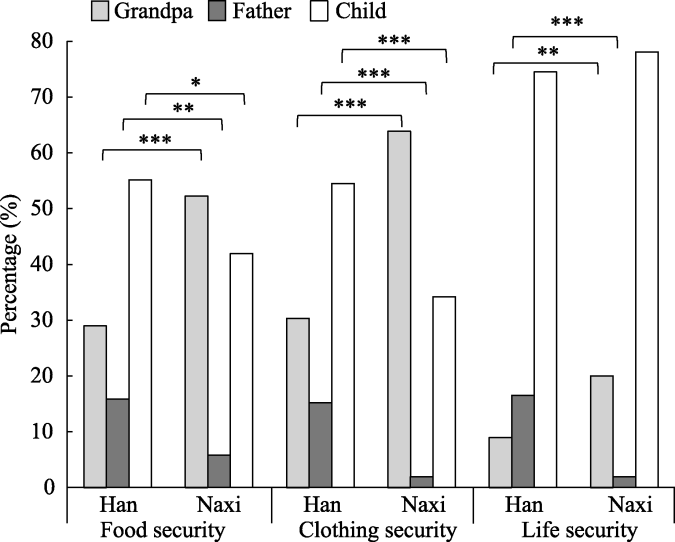
Figure 1Percentage of Han and Naxi middle-aged and elderly participants who prioritized each of the three security recipients under three security scenarios.
Figure 1 Percentage of Han and Naxi middle-aged and elderly participants who prioritized each of the three security recipients under three security scenarios.
Figure 2Percentage of Han and Naxi high school students who prioritized each of the three security recipients under three security scenarios.
Figure 2 Percentage of Han and Naxi high school students who prioritized each of the three security recipients under three security scenarios.
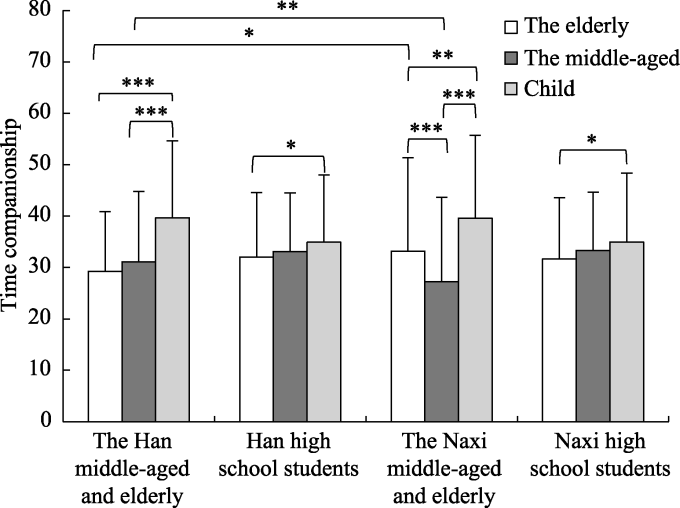
Figure 3Time distribution for accompanying the three types of support recipients under the scenario of time companionship (ms).
Figure 3 Time distribution for accompanying the three types of support recipients under the scenario of time companionship (ms).
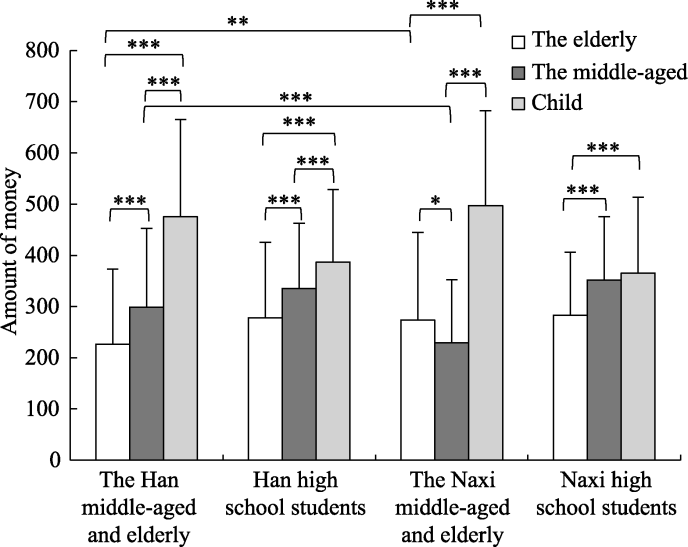
Figure 4Donation amounts to the three types of support recipients under the scenario of financial assistance (RMB).
Figure 4 Donation amounts to the three types of support recipients under the scenario of financial assistance (RMB).
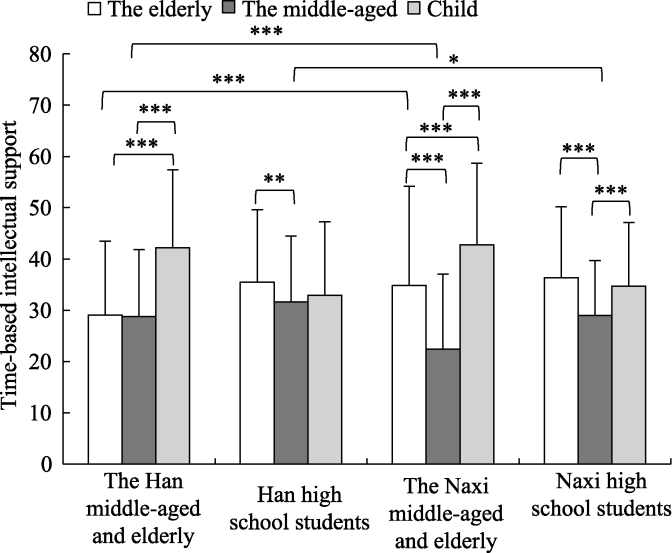
Figure 5Time distribution for helping the three types of support recipients under the scenario of time-based intellectual support (ms).
Figure 5 Time distribution for helping the three types of support recipients under the scenario of time-based intellectual support (ms).