

ISSN 0439-755X
CN 11-1911/B
CN 11-1911/B
Acta Psychologica Sinica ›› 2025, Vol. 57 ›› Issue (9): 1589-1608.doi: 10.3724/SP.J.1041.2025.1589
• Reports of Empirical Studies • Previous Articles Next Articles
HE Conglian, YUAN Jiajin( )
)
Published:2025-09-25
Online:2025-06-26
Contact:
YUAN Jiajin
E-mail:yuanjiajin168@sicnu.edu.cn
HE Conglian, YUAN Jiajin. (2025). The Influence of Emotional Motivation on Interpersonal Emotion Regulation Strategy Choice: Evidence from Behavioral and Hyperscanning. Acta Psychologica Sinica, 57(9), 1589-1608.
Add to citation manager EndNote|Ris|BibTeX
URL: https://journal.psych.ac.cn/acps/EN/10.3724/SP.J.1041.2025.1589

Figure 1. (a) Flowchart of Experiment 1. (b), (c), and (d) correspond to the mean rating of emotional picture on valence, arousal, and motivational intensity, respectively. Note. H: High; L: Low; W: Withdrawal; A: Approach. ***p < 0.001, ns: non significance. Bar: standard error (SE).
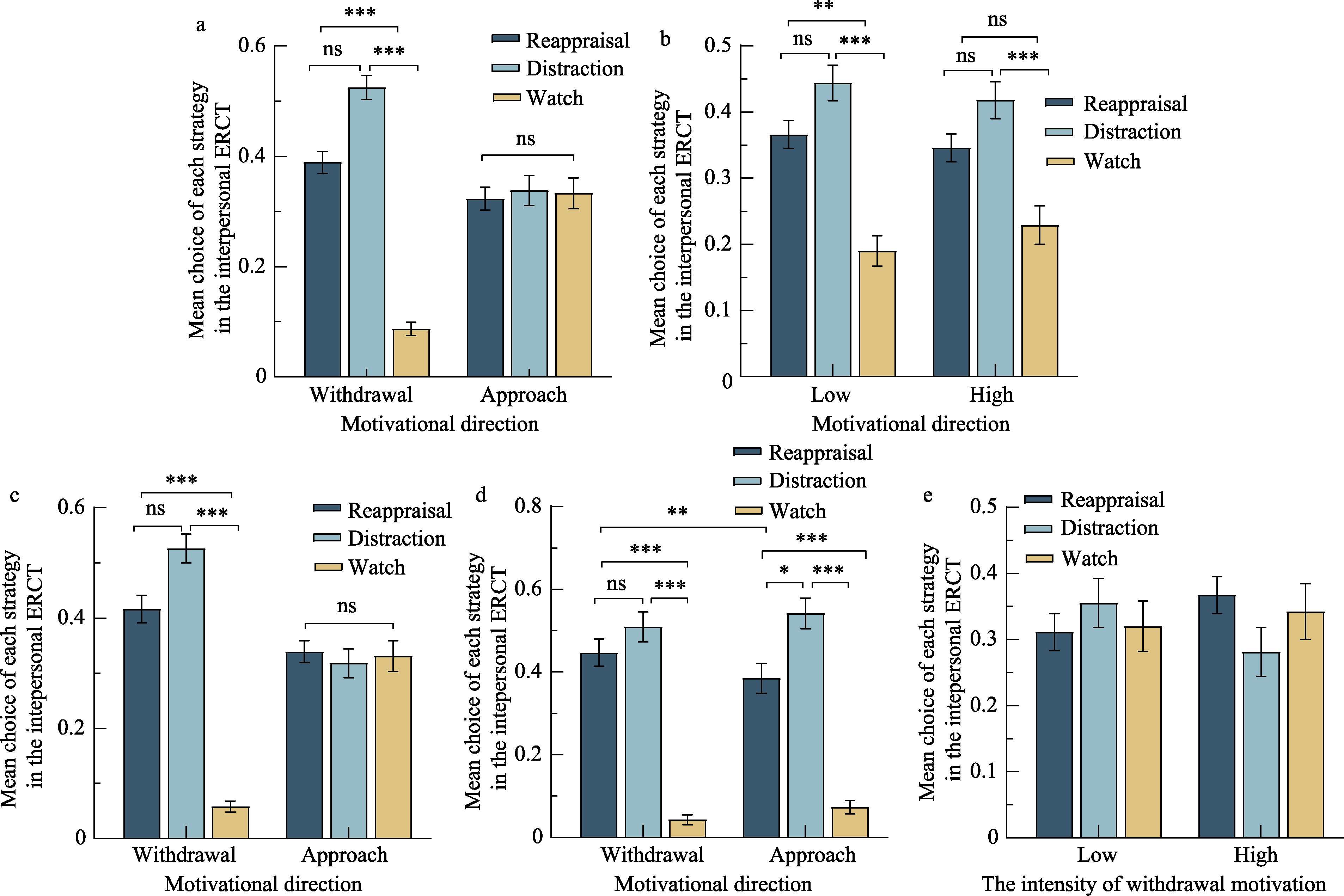
Figure 2. The influence of emotional motivation on the selection of emotional regulation strategies. (a) and (b) show the effects of emotional motivation direction and motivational intensity on strategy selection behavior in the intrapersonal ERCT, respectively. (c-e) present the effects of emotional motivation direction and intensity on the regulators' strategy selection in the interpersonal ERCT. *** p < 0.001, ** p < 0.01, * p < 0.05, ns: p > 0.05; bar: standard error (SE).

Figure 3. Flowchart of the Emotional Regulation Choice Task (ERCT) in Study 2. (a) and (b) correspond to the intrapersonal ERCT and interpersonal ERCT, respectively.

Figure 4. NIRS optrode distribution on the scalp
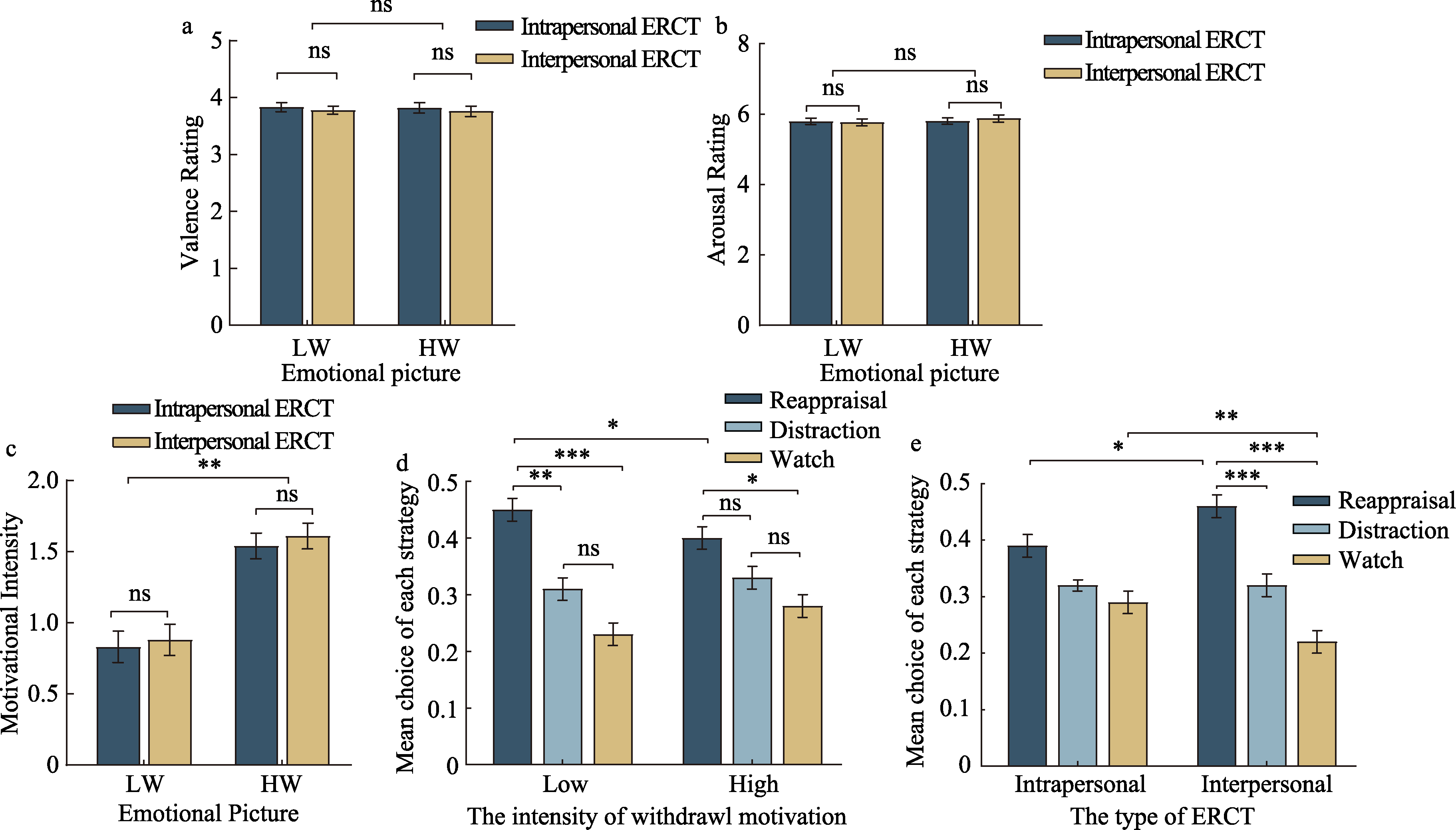
Figure 5. (a-c) show the results of emotional induction validity tests. (d) presents the effect of withdrawal motivation intensity on strategy selection, and (e) shows the strategy selection results of regulators in different ERCT. ***p < 0.001, **p < 0.01, *p < 0.05, ns: p > 0.05; bar: standard error (SE), and the same applies hereinafter.

Figure 6. Brain activation levels of Regulators under different conditions. The colors in the figure represent the F-values from analysis of variance (ANOVA, 0-5). The redder the color, the larger the F-value corresponding to the interaction effect or main effect in the brain region.
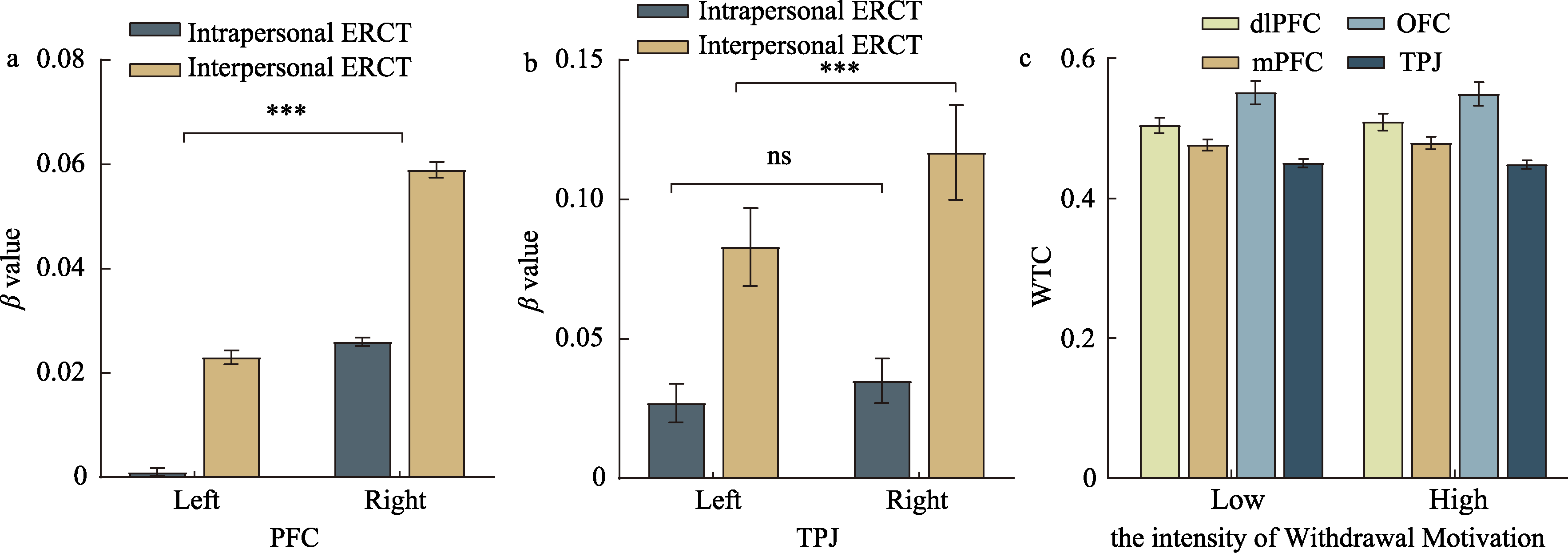
Figure 7. NIRS Imaging Results of Study 2. (a) and (b) show the activation levels in the prefrontal cortex (PFC) and temporoparietal junction (TPJ) of regulators during the stimulus presentation phases of the two task components. (c) depicts the inter-brain synchrony levels between regulators and targets during the stimulus presentation phase of the interpersonal ERCT under different avoidance motivation intensity conditions.
| Intensity of withdrawal motivaon | Dependent variable | Model parameters | Standardized regression coefficient (B) | Significance of t (p) |
|---|---|---|---|---|
| Low | Mean choice of reappraisal | R2 = 0.16 | right PFC = 0.13 | 0.457 |
| F(3, 40) = 2.57 p = 0.067 | left TPJ = −0.45 right TPJ = 0.02 | 0.022 0.939 | ||
| Mean choice of distraction | R2 = 0.09 F(3, 40) = 1.32 p = 0.283 | right PFC = 0.28 left TPJ = 0.14 right TPJ = −0.14 | 0.130 0.464 0.487 | |
| Mean choice of Watch | R2 = 0.21 F(3, 40) = 3.47 p = 0.025 | right PFC = −0.41 left TPJ = 0.39 right TPJ = 0.16 | 0.019 0.033 0.400 | |
| High | Mean choice of reappraisal | R2 = 0.01 F(3, 40) = 0.16 p = 0.922 | right PFC = 0.08 left TPJ = −0.02 right TPJ = 0.06 | 0.667 0.911 0.769 |
| Mean choice of distraction | R2 = 0.05 F(3, 40) = 0.75 p = 0.528 | right PFC = 0.26 left TPJ = 0.001 right TPJ = −0.14 | 0.143 0.998 0.479 | |
| Mean choice of Watch | R2 = 0.09 F(3, 40) = 1.36 p = 0.270 | right PFC = −0.28 left TPJ = 0.20 right TPJ = 0.02 | 0.104 0.259 0.922 |
Table 1 Prediction of Regulators' Brain Activation on Strategy Selection in Interpersonal ERCT (n = 44)
| Intensity of withdrawal motivaon | Dependent variable | Model parameters | Standardized regression coefficient (B) | Significance of t (p) |
|---|---|---|---|---|
| Low | Mean choice of reappraisal | R2 = 0.16 | right PFC = 0.13 | 0.457 |
| F(3, 40) = 2.57 p = 0.067 | left TPJ = −0.45 right TPJ = 0.02 | 0.022 0.939 | ||
| Mean choice of distraction | R2 = 0.09 F(3, 40) = 1.32 p = 0.283 | right PFC = 0.28 left TPJ = 0.14 right TPJ = −0.14 | 0.130 0.464 0.487 | |
| Mean choice of Watch | R2 = 0.21 F(3, 40) = 3.47 p = 0.025 | right PFC = −0.41 left TPJ = 0.39 right TPJ = 0.16 | 0.019 0.033 0.400 | |
| High | Mean choice of reappraisal | R2 = 0.01 F(3, 40) = 0.16 p = 0.922 | right PFC = 0.08 left TPJ = −0.02 right TPJ = 0.06 | 0.667 0.911 0.769 |
| Mean choice of distraction | R2 = 0.05 F(3, 40) = 0.75 p = 0.528 | right PFC = 0.26 left TPJ = 0.001 right TPJ = −0.14 | 0.143 0.998 0.479 | |
| Mean choice of Watch | R2 = 0.09 F(3, 40) = 1.36 p = 0.270 | right PFC = −0.28 left TPJ = 0.20 right TPJ = 0.02 | 0.104 0.259 0.922 |
| Dependent variable | Model parameters | Standardized regression coefficient (B) | Significance of t (p) |
|---|---|---|---|
| Mean choice of reappraisal | R2 = 0.42 F(6, 33) = 3.94 p = 0.004 | mPFC = 0.5 OFC = −0.83 left dlPFC = 0.86 right dlPFC = −0.23 left TPJ = −0.34 right TPJ = 0.39 | 0.116 0.043 0.033 0.546 0.087 0.037 |
| Mean choice of distraction | R2 = 0.23 F(6, 33) = 1.67 p = 0.159 | mPFC = −0.26 OFC = 0.20 left dlPFC = −0.38 right dlPFC = 0.14 left TPJ = 0.21 | 0.480 0.669 0.398 0.760 0.362 |
| Mean choice of Watch | R2 = 0.20 F(6, 33) = 1.40 p = 0.243 | mPFC = −0.40 OFC = 0.88 left dlPFC = −0.71 right dlPFC = 0.15 left TPJ = 0.23 | 0.288 0.066 0.126 0.735 0.320 |
Table 2 Prediction of Regulator-Target Inter-brain Synchrony Levels on Regulators' Strategy Selection Under Low Withdrawal Emotional Motivation (n = 40)
| Dependent variable | Model parameters | Standardized regression coefficient (B) | Significance of t (p) |
|---|---|---|---|
| Mean choice of reappraisal | R2 = 0.42 F(6, 33) = 3.94 p = 0.004 | mPFC = 0.5 OFC = −0.83 left dlPFC = 0.86 right dlPFC = −0.23 left TPJ = −0.34 right TPJ = 0.39 | 0.116 0.043 0.033 0.546 0.087 0.037 |
| Mean choice of distraction | R2 = 0.23 F(6, 33) = 1.67 p = 0.159 | mPFC = −0.26 OFC = 0.20 left dlPFC = −0.38 right dlPFC = 0.14 left TPJ = 0.21 | 0.480 0.669 0.398 0.760 0.362 |
| Mean choice of Watch | R2 = 0.20 F(6, 33) = 1.40 p = 0.243 | mPFC = −0.40 OFC = 0.88 left dlPFC = −0.71 right dlPFC = 0.15 left TPJ = 0.23 | 0.288 0.066 0.126 0.735 0.320 |
| Dependent variable | Model parameters | Standardized regression coefficient (B) | Significance of t (p) |
|---|---|---|---|
| Mean choice of reappraisal | R2 = 0.31 F(6, 33) = 2.52 p = 0.040 | mPFC = −0.18 OFC = −1.33 left dlPFC = 0.37 right dlPFC = 1.12 left TPJ = −0.10 right TPJ = 0.46 | 0.632 0.008 0.577 0.012 0.625 0.038 |
| Mean choice of distraction | R2 = 0.15 F(6, 33) = 0.94 p = 0.480 | mPFC = 0.27 OFC = −0.48 left dlPFC = 0.31 right dlPFC = −0.26 left TPJ = 0.03 right TPJ = −0.24 | 0.544 0.366 0.671 0.585 0.903 0.324 |
| Mean choice of Watch | R2 = 0.20 F(6, 33) = 1.33 p = 0.271 | mPFC = −0.20 OFC = 1.35 left dlPFC = −0.50 right dlPFC = −0.61 left TPJ = 0.09 right TPJ = −0.14 | 0.630 0.012 0.483 0.193 0.682 0.540 |
Table 3 Prediction of Regulator-Target Inter-brain Synchrony Levels on Regulators' Strategy Selection Under High Withdrawal Emotional Motivation (n = 40)
| Dependent variable | Model parameters | Standardized regression coefficient (B) | Significance of t (p) |
|---|---|---|---|
| Mean choice of reappraisal | R2 = 0.31 F(6, 33) = 2.52 p = 0.040 | mPFC = −0.18 OFC = −1.33 left dlPFC = 0.37 right dlPFC = 1.12 left TPJ = −0.10 right TPJ = 0.46 | 0.632 0.008 0.577 0.012 0.625 0.038 |
| Mean choice of distraction | R2 = 0.15 F(6, 33) = 0.94 p = 0.480 | mPFC = 0.27 OFC = −0.48 left dlPFC = 0.31 right dlPFC = −0.26 left TPJ = 0.03 right TPJ = −0.24 | 0.544 0.366 0.671 0.585 0.903 0.324 |
| Mean choice of Watch | R2 = 0.20 F(6, 33) = 1.33 p = 0.271 | mPFC = −0.20 OFC = 1.35 left dlPFC = −0.50 right dlPFC = −0.61 left TPJ = 0.09 right TPJ = −0.14 | 0.630 0.012 0.483 0.193 0.682 0.540 |
| the type of ERCT | Strategy | Low Withdrawal Motivation | High Withdrawal Motivation | Low Approach Motivation | High Approach Motivation |
|---|---|---|---|---|---|
| Intrapersonal ERCT | Reappraisal | 0.40 ± 0.15 | 0.38 ± 0.18 | 0.34 ± 0.19 | 0.31 ± 0.16 |
| Distraction | 0.53 ± 0.17 | 0.52 ± 0.20 | 0.36 ± 0.23 | 0.31 ± 0.21 | |
| Watch | 0.08 ± 0.08 | 0.09 ± 0.11 | 0.30 ± 0.19 | 0.36 ± 0.26 | |
| Interpersonal ERCT | Reappraisal | 0.45 ± 0.19 | 0.39 ± 0.21 | 0.31 ± 0.16 | 0.37 ± 0.16 |
| Distraction | 0.51 ± 0.21 | 0.54 ± 0.21 | 0.36 ± 0.22 | 0.28 ± 0.21 | |
| Watch | 0.04 ± 0.07 | 0.07 ± 0.21 | 0.32 ± 0.22 | 0.34 ± 0.24 |
Appendix table 1 Average Proportions of Individuals' Selection of Different Strategies (M ± SD)
| the type of ERCT | Strategy | Low Withdrawal Motivation | High Withdrawal Motivation | Low Approach Motivation | High Approach Motivation |
|---|---|---|---|---|---|
| Intrapersonal ERCT | Reappraisal | 0.40 ± 0.15 | 0.38 ± 0.18 | 0.34 ± 0.19 | 0.31 ± 0.16 |
| Distraction | 0.53 ± 0.17 | 0.52 ± 0.20 | 0.36 ± 0.23 | 0.31 ± 0.21 | |
| Watch | 0.08 ± 0.08 | 0.09 ± 0.11 | 0.30 ± 0.19 | 0.36 ± 0.26 | |
| Interpersonal ERCT | Reappraisal | 0.45 ± 0.19 | 0.39 ± 0.21 | 0.31 ± 0.16 | 0.37 ± 0.16 |
| Distraction | 0.51 ± 0.21 | 0.54 ± 0.21 | 0.36 ± 0.22 | 0.28 ± 0.21 | |
| Watch | 0.04 ± 0.07 | 0.07 ± 0.21 | 0.32 ± 0.22 | 0.34 ± 0.24 |
| Variables | F | p | Partial η2 |
|---|---|---|---|
| motivational direction | 3.15 | 0.09 | 0.09 |
| motivational intensity | 0.23 | 0.64 | 0.01 |
| task type | 0.40 | 0.53 | 0.01 |
| strategy type | 20.06 | < 0.001*** | 0.39 |
| motivational direction × motivational intensity | 0.15 | 0.70 | 0.01 |
| motivational direction × task type | 0.30 | 0.59 | 0.01 |
| motivational intensity × task type | 0.55 | 0.46 | 0.02 |
| motivational direction× strategy type | 38.48 | < 0.001*** | 0.55 |
| motivational intensity × strategy type | 3.21 | 0.05* | 0.09 |
| task type× strategy type | 0.59 | 0.56 | 0.02 |
| motivational direction× motivational intensity × task type | 0.47 | 0.50 | 0.01 |
| motivational direction × motivational intensity × strategy type | 3.61 | 0.03* | 0.10 |
| motivational direction × task type × strategy type | 0.35 | 0.70 | 0.01 |
| motivational intensity ×task type × strategy type | 0.31 | 0.74 | 0.01 |
| Four-Way Interaction | 3.68 | 0.03* | 0.10 |
Appendix table 2 Results of Four-Way Repeated Measures ANOVA (N = 33)
| Variables | F | p | Partial η2 |
|---|---|---|---|
| motivational direction | 3.15 | 0.09 | 0.09 |
| motivational intensity | 0.23 | 0.64 | 0.01 |
| task type | 0.40 | 0.53 | 0.01 |
| strategy type | 20.06 | < 0.001*** | 0.39 |
| motivational direction × motivational intensity | 0.15 | 0.70 | 0.01 |
| motivational direction × task type | 0.30 | 0.59 | 0.01 |
| motivational intensity × task type | 0.55 | 0.46 | 0.02 |
| motivational direction× strategy type | 38.48 | < 0.001*** | 0.55 |
| motivational intensity × strategy type | 3.21 | 0.05* | 0.09 |
| task type× strategy type | 0.59 | 0.56 | 0.02 |
| motivational direction× motivational intensity × task type | 0.47 | 0.50 | 0.01 |
| motivational direction × motivational intensity × strategy type | 3.61 | 0.03* | 0.10 |
| motivational direction × task type × strategy type | 0.35 | 0.70 | 0.01 |
| motivational intensity ×task type × strategy type | 0.31 | 0.74 | 0.01 |
| Four-Way Interaction | 3.68 | 0.03* | 0.10 |
| Channel No. | Source-Detector | MNI coordinates | Brodmann template (the percentage of the brain region in the channel)* | ||
|---|---|---|---|---|---|
| x | y | z | |||
| 1 | S1-D1 | 54.4087 | −64.7836 | 46.0082 | 39 - Angular gyrus_ part of Wernicke's area (0.93) |
| 2 | S1-D3 | 57.3263 | −50.6134 | 52.6095 | 40 - Supramarginal gyrus part of Wernicke's area (0.94) |
| 3 | S2-D1 | 34.9689 | −63.9744 | 62.5311 | 7 - Somatosensory Association Cortex (0.93) |
| 4 | S2-D3 | 36.8796 | −51.4079 | 69.6644 | 7 - Somatosensory Association Cortex (0.68) |
| 5 | S3-D2 | −36.359 | −64.26 | 59.7477 | 7 - Somatosensory Association Cortex (0.74) |
| 6 | S3-D4 | −38.614 | −52.4034 | 67.853 | 7 - Somatosensory Association Cortex (0.53) |
| 7 | S4-D2 | −56.5506 | −65.8067 | 41.4156 | 39 - Angular gyrus_ part of Wernicke's area (0.98) |
| 8 | S4-D4 | −60.0641 | −51.6615 | 48.1846 | 40 - Supramarginal gyrus part of Wernicke's area (0.87) |
| 9 | S5-D3 | 58.8422 | −34.7445 | 55.5872 | 40 - Supramarginal gyrus part of Wernicke's area (0.58) |
| 10 | S5-D5 | 56.0392 | −20.8439 | 57.6755 | 3 - Primary Somatosensory Cortex (0.47) |
| 12 | S6-D5 | 37.2309 | −21.3494 | 72.4971 | 4 - Primary Motor Cortex (0.63) |
| 14 | S7-D6 | −37.926 | −21.6228 | 72.0886 | 4 - Primary Motor Cortex (0.71) |
| 15 | S8-D4 | −61.0227 | −36.1116 | 53.2459 | 40 - Supramarginal gyrus part of Wernicke's area (0.80) |
| 16 | S8-D6 | −58.0916 | −20.8609 | 55.1969 | 3 - Primary Somatosensory Cortex (0.56) |
| 17 | S9-D5 | 53.1517 | −6.9137 | 54.9788 | 4 - Primary Motor Cortex (0.41) 6 - Pre-Motor and Supplementary Motor Cortex (0.59) |
| 18 | S9-D7 | 49.6831 | 7.6117 | 52.3461 | 6 - Pre-Motor and Supplementary Motor Cortex (0.7) |
| 19 | S10-D5 | 35.1598 | −9.7203 | 69.229 | 6 - Pre-Motor and Supplementary Motor Cortex (0.93) |
| 20 | S10-D7 | 32.7938 | 6.1663 | 66.2847 | 6 - Pre-Motor and Supplementary Motor Cortex (0.70) |
| 21 | S11-D6 | −34.4659 | −8.8191 | 68.7227 | 6 - Pre-Motor and Supplementary Motor Cortex (0.90) |
| 22 | S11-D8 | −31.8668 | 7.0903 | 66.1236 | 6 - Pre-Motor and Supplementary Motor Cortex (0.69) |
| 23 | S12-D6 | −55.2218 | −6.0424 | 53.363 | 6 - Pre-Motor and Supplementary Motor Cortex (0.66) |
| 24 | S12-D8 | −49.7183 | 9.0521 | 51.777 | 6 - Pre-Motor and Supplementary Motor Cortex (0.67) |
| 25 | S13-D7 | 30.6143 | 17.6711 | 62.1171 | 8 - Includes Frontal eye fields (0.90) |
| 26 | S14-D8 | −29.1546 | 18.9128 | 62.5035 | 8 - Includes Frontal eye fields (0.88) |
| 27 | S15-D9 | 27.9412 | 36.1898 | 51.7714 | 9 - Dorsolateral prefrontal cortex (0.63) |
| 28 | S15-D11 | 40.9107 | 38.1954 | 40.8476 | 9 - Dorsolateral prefrontal cortex (0.61) |
| 29 | S16-D9 | 12.3581 | 45.8872 | 52.179 | 9 - Dorsolateral prefrontal cortex (0.73) |
| 30 | S16-D10 | −9.3592 | 48.0675 | 52.3064 | 9 - Dorsolateral prefrontal cortex (0.81) |
| 31 | S16-D12 | 1.0456 | 55.6951 | 40.2499 | 9 - Dorsolateral prefrontal cortex (0.90) |
| 32 | S17-D10 | −26.0758 | 38.3257 | 51.4638 | 9 - Dorsolateral prefrontal cortex (0.74) |
| 33 | S17-D13 | −40.8262 | 40.0934 | 39.4797 | 9 - Dorsolateral prefrontal cortex (0.42) |
| 34 | S18-D9 | 20.6712 | 51.9917 | 41.5768 | 9 - Dorsolateral prefrontal cortex (0.99) |
| 35 | S18-D11 | 34.0131 | 54.4898 | 28.2762 | 46 - Dorsolateral prefrontal cortex (0.98) |
| 36 | S18-D12 | 13.4375 | 63.7052 | 30.858 | 10 - Frontopolar area (0.71) |
| 37 | S18-D14 | 25.3528 | 67.0449 | 16.7319 | 10 - Frontopolar area (0.98) |
| 38 | S19-D10 | −19.5523 | 53.1065 | 40.9674 | 9 - Dorsolateral prefrontal cortex (0.92) |
| 39 | S19-D10 | −12.1443 | 64.3739 | 31.2437 | 10 - Frontopolar area (0.72) |
| 40 | S19-D13 | −33.7944 | 55.0056 | 27.9028 | 46 - Dorsolateral prefrontal cortex (1) |
| 41 | S19-D15 | −23.5638 | 67.4366 | 16.6988 | 10 - Frontopolar area (0.96) |
| 42 | S20-D11 | 46.4588 | 52.1383 | 14.7427 | 46 - Dorsolateral prefrontal cortex (0.84) |
| 43 | S20-D14 | 38.7407 | 63.8563 | 1.1675 | 10 - Frontopolar area (0.74) |
| 44 | S21-D12 | 0.8251 | 67.1413 | 15.7566 | 10 - Frontopolar area (1) |
| 45 | S21-D14 | 14.6621 | 73.3848 | 1.9394 | 10 - Frontopolar area (0.78) |
| 46 | S21-D15 | −13.1752 | 73.3148 | 2.7291 | 10 - Frontopolar area (0.79) |
| 47 | S22-D13 | −46.6791 | 52.4921 | 14.0445 | 46 - Dorsolateral prefrontal cortex (0.78) |
| 48 | S22-D15 | −37.4194 | 64.5714 | 0.87567 | 10 - Frontopolar area (0.77) |
Appendix table 3 Spatial positioning of NIRS channels
| Channel No. | Source-Detector | MNI coordinates | Brodmann template (the percentage of the brain region in the channel)* | ||
|---|---|---|---|---|---|
| x | y | z | |||
| 1 | S1-D1 | 54.4087 | −64.7836 | 46.0082 | 39 - Angular gyrus_ part of Wernicke's area (0.93) |
| 2 | S1-D3 | 57.3263 | −50.6134 | 52.6095 | 40 - Supramarginal gyrus part of Wernicke's area (0.94) |
| 3 | S2-D1 | 34.9689 | −63.9744 | 62.5311 | 7 - Somatosensory Association Cortex (0.93) |
| 4 | S2-D3 | 36.8796 | −51.4079 | 69.6644 | 7 - Somatosensory Association Cortex (0.68) |
| 5 | S3-D2 | −36.359 | −64.26 | 59.7477 | 7 - Somatosensory Association Cortex (0.74) |
| 6 | S3-D4 | −38.614 | −52.4034 | 67.853 | 7 - Somatosensory Association Cortex (0.53) |
| 7 | S4-D2 | −56.5506 | −65.8067 | 41.4156 | 39 - Angular gyrus_ part of Wernicke's area (0.98) |
| 8 | S4-D4 | −60.0641 | −51.6615 | 48.1846 | 40 - Supramarginal gyrus part of Wernicke's area (0.87) |
| 9 | S5-D3 | 58.8422 | −34.7445 | 55.5872 | 40 - Supramarginal gyrus part of Wernicke's area (0.58) |
| 10 | S5-D5 | 56.0392 | −20.8439 | 57.6755 | 3 - Primary Somatosensory Cortex (0.47) |
| 12 | S6-D5 | 37.2309 | −21.3494 | 72.4971 | 4 - Primary Motor Cortex (0.63) |
| 14 | S7-D6 | −37.926 | −21.6228 | 72.0886 | 4 - Primary Motor Cortex (0.71) |
| 15 | S8-D4 | −61.0227 | −36.1116 | 53.2459 | 40 - Supramarginal gyrus part of Wernicke's area (0.80) |
| 16 | S8-D6 | −58.0916 | −20.8609 | 55.1969 | 3 - Primary Somatosensory Cortex (0.56) |
| 17 | S9-D5 | 53.1517 | −6.9137 | 54.9788 | 4 - Primary Motor Cortex (0.41) 6 - Pre-Motor and Supplementary Motor Cortex (0.59) |
| 18 | S9-D7 | 49.6831 | 7.6117 | 52.3461 | 6 - Pre-Motor and Supplementary Motor Cortex (0.7) |
| 19 | S10-D5 | 35.1598 | −9.7203 | 69.229 | 6 - Pre-Motor and Supplementary Motor Cortex (0.93) |
| 20 | S10-D7 | 32.7938 | 6.1663 | 66.2847 | 6 - Pre-Motor and Supplementary Motor Cortex (0.70) |
| 21 | S11-D6 | −34.4659 | −8.8191 | 68.7227 | 6 - Pre-Motor and Supplementary Motor Cortex (0.90) |
| 22 | S11-D8 | −31.8668 | 7.0903 | 66.1236 | 6 - Pre-Motor and Supplementary Motor Cortex (0.69) |
| 23 | S12-D6 | −55.2218 | −6.0424 | 53.363 | 6 - Pre-Motor and Supplementary Motor Cortex (0.66) |
| 24 | S12-D8 | −49.7183 | 9.0521 | 51.777 | 6 - Pre-Motor and Supplementary Motor Cortex (0.67) |
| 25 | S13-D7 | 30.6143 | 17.6711 | 62.1171 | 8 - Includes Frontal eye fields (0.90) |
| 26 | S14-D8 | −29.1546 | 18.9128 | 62.5035 | 8 - Includes Frontal eye fields (0.88) |
| 27 | S15-D9 | 27.9412 | 36.1898 | 51.7714 | 9 - Dorsolateral prefrontal cortex (0.63) |
| 28 | S15-D11 | 40.9107 | 38.1954 | 40.8476 | 9 - Dorsolateral prefrontal cortex (0.61) |
| 29 | S16-D9 | 12.3581 | 45.8872 | 52.179 | 9 - Dorsolateral prefrontal cortex (0.73) |
| 30 | S16-D10 | −9.3592 | 48.0675 | 52.3064 | 9 - Dorsolateral prefrontal cortex (0.81) |
| 31 | S16-D12 | 1.0456 | 55.6951 | 40.2499 | 9 - Dorsolateral prefrontal cortex (0.90) |
| 32 | S17-D10 | −26.0758 | 38.3257 | 51.4638 | 9 - Dorsolateral prefrontal cortex (0.74) |
| 33 | S17-D13 | −40.8262 | 40.0934 | 39.4797 | 9 - Dorsolateral prefrontal cortex (0.42) |
| 34 | S18-D9 | 20.6712 | 51.9917 | 41.5768 | 9 - Dorsolateral prefrontal cortex (0.99) |
| 35 | S18-D11 | 34.0131 | 54.4898 | 28.2762 | 46 - Dorsolateral prefrontal cortex (0.98) |
| 36 | S18-D12 | 13.4375 | 63.7052 | 30.858 | 10 - Frontopolar area (0.71) |
| 37 | S18-D14 | 25.3528 | 67.0449 | 16.7319 | 10 - Frontopolar area (0.98) |
| 38 | S19-D10 | −19.5523 | 53.1065 | 40.9674 | 9 - Dorsolateral prefrontal cortex (0.92) |
| 39 | S19-D10 | −12.1443 | 64.3739 | 31.2437 | 10 - Frontopolar area (0.72) |
| 40 | S19-D13 | −33.7944 | 55.0056 | 27.9028 | 46 - Dorsolateral prefrontal cortex (1) |
| 41 | S19-D15 | −23.5638 | 67.4366 | 16.6988 | 10 - Frontopolar area (0.96) |
| 42 | S20-D11 | 46.4588 | 52.1383 | 14.7427 | 46 - Dorsolateral prefrontal cortex (0.84) |
| 43 | S20-D14 | 38.7407 | 63.8563 | 1.1675 | 10 - Frontopolar area (0.74) |
| 44 | S21-D12 | 0.8251 | 67.1413 | 15.7566 | 10 - Frontopolar area (1) |
| 45 | S21-D14 | 14.6621 | 73.3848 | 1.9394 | 10 - Frontopolar area (0.78) |
| 46 | S21-D15 | −13.1752 | 73.3148 | 2.7291 | 10 - Frontopolar area (0.79) |
| 47 | S22-D13 | −46.6791 | 52.4921 | 14.0445 | 46 - Dorsolateral prefrontal cortex (0.78) |
| 48 | S22-D15 | −37.4194 | 64.5714 | 0.87567 | 10 - Frontopolar area (0.77) |
| Withdrawal motivation | Dependent variable | Model parameters | Standardized regression coefficient (B) | Significance of t (p) |
|---|---|---|---|---|
| Low | Mean choice of reappraisal | R2 = 0.01 F(3, 40) = 0.16 p = 0.92 | right PFC = 0.08 left TPJ = −0.02 right TPJ = 0.06 | 0.667 0.911 0.769 |
| Mean choice of distraction | R2 = 0.05 F(3, 40) = 0.75 p = 0.53 | right PFC = 0.01 left TPJ = −0.12 right TPJ = 0.16 | 0.943 0.607 0.500 | |
| Mean choice of watch | R2 = 0.11 F(3, 40) = 1.56 p = 0.21 | right PFC = −0.16 left TPJ = 0.48 right TPJ = −0.33 | 0.354 0.040 0.144 | |
| High | Mean choice of reappraisal | R2 = 0.06 F(3, 40) = 0.83 p = 0.49 | right PFC = −0.15 left TPJ = 0.20 right TPJ = −0.04 | 0.328 0.212 0.824 |
| Mean choice of distraction | R2 = 0.06 F(3, 40) = 0.86 p = 0.47 | right PFC = 0.04 left TPJ = −0.001 right TPJ = −0.25 | 0.821 0.996 0.125 | |
| Mean choice of watch | R2 = 0.09 F(3, 40) = 1.26 p = 0.30 | right PFC = 0.12 left TPJ = −0.20 right TPJ = 0.21 | 0.425 0.202 0.183 |
Appendix table 4 Prediction of Regulators' Brain Activation Levels on Strategy Selection Behavior in Intrapersonal ERCT (n = 44)
| Withdrawal motivation | Dependent variable | Model parameters | Standardized regression coefficient (B) | Significance of t (p) |
|---|---|---|---|---|
| Low | Mean choice of reappraisal | R2 = 0.01 F(3, 40) = 0.16 p = 0.92 | right PFC = 0.08 left TPJ = −0.02 right TPJ = 0.06 | 0.667 0.911 0.769 |
| Mean choice of distraction | R2 = 0.05 F(3, 40) = 0.75 p = 0.53 | right PFC = 0.01 left TPJ = −0.12 right TPJ = 0.16 | 0.943 0.607 0.500 | |
| Mean choice of watch | R2 = 0.11 F(3, 40) = 1.56 p = 0.21 | right PFC = −0.16 left TPJ = 0.48 right TPJ = −0.33 | 0.354 0.040 0.144 | |
| High | Mean choice of reappraisal | R2 = 0.06 F(3, 40) = 0.83 p = 0.49 | right PFC = −0.15 left TPJ = 0.20 right TPJ = −0.04 | 0.328 0.212 0.824 |
| Mean choice of distraction | R2 = 0.06 F(3, 40) = 0.86 p = 0.47 | right PFC = 0.04 left TPJ = −0.001 right TPJ = −0.25 | 0.821 0.996 0.125 | |
| Mean choice of watch | R2 = 0.09 F(3, 40) = 1.26 p = 0.30 | right PFC = 0.12 left TPJ = −0.20 right TPJ = 0.21 | 0.425 0.202 0.183 |
| Variables | M | SD | 1 | 2 | 3 | 4 | 5 | 6 | 7 |
|---|---|---|---|---|---|---|---|---|---|
| 1 Reappraisal Selection Proportion Difference | −0.12 | 0.27 | 1 | ||||||
| 2 Watch Selection Proportion Difference | 0.14 | 0.24 | −0.44 | 1 | |||||
| 3 Personal Distress | 9.75 | 3.56 | 0.06 | −0.18 | 1 | ||||
| 4 Empathic Concern | 17.57 | 3.19 | −0.01 | −0.04 | 0.21 | 1 | |||
| 5 Perspective Taking | 12.61 | 3.76 | 0.23* | −0.22* | 0.11 | 0.10 | 1 | ||
| 6 Fantasy | 13.98 | 3.25 | −0.01 | −0.08 | 0.29 | 0.44** | 0.34** | 1 | |
| 7 Total Empathy Score | 53.91 | 9.81 | 0.12 | −0.19 | 0.52*** | 0.49** | 0.50** | 0.69*** | 1 |
Appendix table 5 Correlation Between the Difference in Proportions of Regulators' Selection of Reappraisal and Watch and Empathy (n = 44)
| Variables | M | SD | 1 | 2 | 3 | 4 | 5 | 6 | 7 |
|---|---|---|---|---|---|---|---|---|---|
| 1 Reappraisal Selection Proportion Difference | −0.12 | 0.27 | 1 | ||||||
| 2 Watch Selection Proportion Difference | 0.14 | 0.24 | −0.44 | 1 | |||||
| 3 Personal Distress | 9.75 | 3.56 | 0.06 | −0.18 | 1 | ||||
| 4 Empathic Concern | 17.57 | 3.19 | −0.01 | −0.04 | 0.21 | 1 | |||
| 5 Perspective Taking | 12.61 | 3.76 | 0.23* | −0.22* | 0.11 | 0.10 | 1 | ||
| 6 Fantasy | 13.98 | 3.25 | −0.01 | −0.08 | 0.29 | 0.44** | 0.34** | 1 | |
| 7 Total Empathy Score | 53.91 | 9.81 | 0.12 | −0.19 | 0.52*** | 0.49** | 0.50** | 0.69*** | 1 |
| Predictor Variables | Dependent variable | b | SE | β |
|---|---|---|---|---|
| Perspective Taking Scores | Reappraisal Selection Proportion Difference | 0.03 | 0.01 | 0.38* |
| Watch Selection Proportion Difference | −0.02 | 0.01 | −0.29 |
Appendix table 6 Results of Linear Regression Analysis Between Reappraisal and Watch Selection Proportion Difference and Regulators' Perspective Taking Scores (n = 44)
| Predictor Variables | Dependent variable | b | SE | β |
|---|---|---|---|---|
| Perspective Taking Scores | Reappraisal Selection Proportion Difference | 0.03 | 0.01 | 0.38* |
| Watch Selection Proportion Difference | −0.02 | 0.01 | −0.29 |
| [1] | Aldao, A., Sheppes, G., & Gross, J. J. (2015). Emotion Regulation Flexibility. Cognitive Therapy and Research, 39(3), 263-278. |
| [2] | Amodio, D. M., & Frith, C. D. (2006). Meeting of minds:The medial frontal cortex and social cognition. Nature Reviews Neuroscience, 7(4), 268-277. |
| [3] | Aron, A., Aron, E. N., & Smollan, D. (1992). Inclusion of Other in the Self Scale and the structure of interpersonal closeness. Journal of Personality and Social Psychology, 63(4), 596-612. |
| [4] | Aron, A., Aron, E. N., Tudor, M., & Nelson, G. (1991). Close relationships as including other in the self. Journal of Personality and Social Psychology, 60(2), 241-253. |
| [5] | Babiloni, F., & Astolfi, L. (2014). Social neuroscience and hyperscanning techniques: Past, present and future. Neuroscience & Biobehavioral Reviews, 44, 76-93. |
| [6] | Butler, E. A., & Randall, A. K. (2013). Emotional coregulation in close relationships. Emotion Review, 5(2), 202-210. |
| [7] |
Cabib, S., Campus, P., & Colelli, V. (2012). Learning to cope with stress: Psychobiological mechanisms of stress resilience. Reviews in the Neurosciences, 23(5-6), 659-672.
doi: 10.1515/revneuro-2012-0080 pmid: 23159866 |
| [8] |
Campbell, N. M., Dawel, A., Edwards, M., & Goodhew, S. C. (2021). Does motivational intensity exist distinct from valence and arousal? Emotion, 21(5), 1013-1028.
doi: 10.1037/emo0000883 pmid: 33630627 |
| [9] |
Canli, T., Ferri, J., & Duman, E. A. (2009). Genetics of emotion regulation. Neuroscience, 164(1), 43-54.
doi: 10.1016/j.neuroscience.2009.06.049 pmid: 19559759 |
| [10] | Capuzzo, G., & Floresco, S. B. (2020). Prelimbic and infralimbic prefrontal regulation of active and inhibitory avoidance and reward-seeking. The Journal of Neuroscience, 40(24), 4773-4787. |
| [11] |
Carver, C. S., & Harmon-Jones, E. (2009). Anger is an approach-related affect: Evidence and implications. Psychological Bulletin, 135(2), 183-204.
doi: 10.1037/a0013965 pmid: 19254075 |
| [12] | Choate-Summers, M. (2011). Emotion regulation and psychopathology: A transdiagnostic approach to etiology and treatment. Cognitive Behaviour Therapy, 40(1), 78-78. |
| [13] |
Contardi, A., Imperatori, C., Penzo, I., Del Gatto, C., & Farina, B. (2016). The Association among Difficulties in Emotion Regulation, Hostility, and Empathy in a Sample of Young Italian Adults. Frontiers in Psychology, 7, 1068.
doi: 10.3389/fpsyg.2016.01068 pmid: 27486417 |
| [14] |
Dai, R., Liu, R., Liu, T., Zhang, Z., Xiao, X., Sun, P., Yu, X., Wang, D., & Zhu, C. (2018). Holistic cognitive and neural processes: A fNIRS-hyperscanning study on interpersonal sensorimotor synchronization. Social Cognitive and Affective Neuroscience, 13(11), 1141-1154.
doi: 10.1093/scan/nsy090 pmid: 30321411 |
| [15] |
Decety, J., & Jackson, P. L. (2004). The functional architecture of human empathy. Behavioral and Cognitive Neuroscience Reviews, 3(2), 71-100.
doi: 10.1177/1534582304267187 pmid: 15537986 |
| [16] | Domenech, P., & Koechlin, E. (2015). Executive control and decision-making in the prefrontal cortex. Current Opinion in Behavioral Sciences, 1, 101-106. |
| [17] | Doyen, S., Klein, O., Pichon, C.-L., & Cleeremans, A. (2012). Behavioral priming: It's all in the mind, but whose mind? PLOS ONE, 7(1), e29081. |
| [18] | Florean, I.-S., & Păsărelu, C.-R. (2019). Interpersonal emotion regulation and cognitive empathy as mediators between intrapersonal emotion regulation difficulties and couple satisfaction. Journal of Evidence-Based Psychotherapies, 19(2), 119-134. |
| [19] |
Friederici, A. D. (2011). The brain basis of language processing: From structure to function. Physiological Reviews, 91(4), 1357-1392.
doi: 10.1152/physrev.00006.2011 pmid: 22013214 |
| [20] |
Frith, C. D., & Frith, U. (2006). How we predict what other people are going to do. Brain Research, 1079(1), 36-46.
doi: 10.1016/j.brainres.2005.12.126 pmid: 16513098 |
| [21] | Gable, P., & Harmon-Jones, E. (2010). The motivational dimensional model of affect: Implications for breadth of attention, memory, and cognitive categorisation. Cognition & Emotion, 24(2), 322-337. |
| [22] | Geisler, F. C. M., Vennewald, N., Kubiak, T., & Weber, H. (2010). The impact of heart rate variability on subjective well-being is mediated by emotion regulation. Personality and Individual Differences, 49(7), 723-728. |
| [23] |
Goldin, P. R., McRae, K., Ramel., W., & Gross, J. J. (2008). The neural bases of emotion regulation: Reappraisal and suppression of negative emotion. Biological Psychiatry, 63(6), 577-86
doi: 10.1016/j.biopsych.2007.05.031 pmid: 17888411 |
| [24] | Gross, J. J. (1998a). The emerging field of emotion regulation: An integrative review. Emotion Regulation, 2(3), 271-299. |
| [25] | Gross, J. J. (1998b). Antecedent- and response-focused emotion regulation: Divergent consequences for experience, expression, and physiology. Journal of Personality and Social Psychology, 74(1), 224-237. |
| [26] | Gross, J. J. (2014). Emotion regulation:Conceptual and empirical foundations. In Guilford publications J. J. Gross (Ed.), Handbook of emotion regulation, 2, (pp.3-20). |
| [27] |
Hallam, G. P., Webb, T. L., Sheeran, P., Miles, E., Niven, K., Wilkinson, I. D., ... Farrow, T. F. D. (2014). The neural correlates of regulating another person’s emotions: An exploratory fMRI study. Frontiers in Human Neuroscience, 8, 376.
doi: 10.3389/fnhum.2014.00376 pmid: 24936178 |
| [28] | Harmon-Jones, E., & Gable, P. A. (2008). Incorporating motivational intensity and direction into the study of emotions: Implications for brain mechanisms of emotion and cognition-emotion interactions. Netherlands Journal of Psychology, 64(4), 132-142. |
| [29] |
Harmon-Jones, E., Harmon-Jones, C., Amodio, D. M., & Gable, P. A. (2011). Attitudes toward emotions. Journal of Personality and Social Psychology, 101(6), 1332-1350.
doi: 10.1037/a0024951 pmid: 21843012 |
| [30] |
Hyde, D. C., Simon, C. E., Ting, F., & Nikolaeva, J. I. (2018). Functional organization of the temporal-parietal junction for theory of mind in preverbal infants: A near-infrared spectroscopy study. Journal of Neuroscience, 38(18), 4264-4274.
doi: 10.1523/JNEUROSCI.0264-17.2018 pmid: 29593053 |
| [31] |
Jones, B., & Rachlin, H. (2006). Social discounting. Psychological Science, 17(4), 283-286.
pmid: 16623683 |
| [32] | Kahneman, D. (1973). Attention and effort (Vol. 1063, pp. 218-226). Englewood Cliffs, NJ: Prentice-Hall. |
| [33] |
Kashdan, T. B., & Rottenberg, J. (2010). Psychological flexibility as a fundamental aspect of health. Clinical Psychology Review, 30(7), 865-878.
doi: 10.1016/j.cpr.2010.03.001 pmid: 21151705 |
| [34] | Kim, H. S., Sherman, D. K., Sasaki, J. Y., Xu, J., Chu, T. Q., Ryu, C., ... Taylor, S. E. (2010). Culture, distress, and oxytocin receptor polymorphism (OXTR) interact to influence emotional support seeking. Proceedings of the National Academy of Sciences, 107(36), 15717-15721. |
| [35] |
Konovalov, A., Hill, C., Daunizeau, J., & Ruff, C. C. (2021). Dissecting functional contributions of the social brain to strategic behavior. Neuron, 109(20), 3323-3337.
doi: 10.1016/j.neuron.2021.07.025 pmid: 34407389 |
| [36] |
Kruglanski, A. W., Bélanger, J. J., Chen, X., Köpetz, C., Pierro, A., & Mannetti, L. (2012). The energetics of motivated cognition: A force-field analysis. Psychological Review, 119(1), 1-20.
doi: 10.1037/a0025488 pmid: 21967165 |
| [37] |
Lancaster, J. L., Woldorff, M. G., Parsons, L. M., Liotti, M., Freitas, C. S., Rainey, L., ... Fox, P. T. (2000). Automated talairach atlas labels for functional brain mapping. Human Brain Mapping, 10(3), 120-131.
doi: 10.1002/1097-0193(200007)10:3<120::aid-hbm30>3.0.co;2-8 pmid: 10912591 |
| [38] |
Levy, S. R., Freitas, A. L., & Salovey, P. (2002). Construing action abstractly and blurring social distinctions: Implications for perceiving homogeneity among, but also empathizing with and helping, others. Journal of Personality and Social Psychology, 83(5), 1224-1238.
pmid: 12416924 |
| [39] | Liu, Z., Lu, K., Hao, N., & Wang, Y. (2023). Cognitive reappraisal and expressive suppression evoke distinct neural connections during interpersonal emotion regulation. The Journal of Neuroscience, 43(49), 8456-8471. |
| [40] | Long, Q., Yang, J., Lou, Y., Cai, A., & Yuan, J. (2015). Humans’ emotional habituation to pleasant stimuli: Behavioral and electrophysiological evidence. Chinese Science Bulletin, 60(36), 3594-3605. |
| [41] | Luo, S., Yuan, H., Wang, Y., & Bond, M. H. (2024). Culturomics: Taking the cross-scale, interdisciplinary science of culture into the next decade. Neuroscience & Biobehavioral Reviews, 167, 105942. |
| [42] | Mandel, D. R. (2006). Economic transactions among friends: Asymmetric generosity but not agreement in buyers’ and sellers’ offers. Journal of Conflict Resolution, 50(4), 584-606. |
| [43] | Marton‐Alper, I. Z., Markus, A., Nevat, M., Bennet, R., & Shamay‐Tsoory, S. G. (2023). Differential contribution of between and within‐brain coupling to movement synchronization. Human Brain Mapping, 44(10), 4136-4151. |
| [44] | Matthews, M., Webb, T. L., & Sheppes, G. (2022). Do people choose the same strategies to regulate other people’s emotions as they choose to regulate their own? Emotion, 22(8), 1723-1738. |
| [45] |
Molavi, B., & Dumont, G. A. (2012). Wavelet-based motion artifact removal for functional near-infrared spectroscopy. Physiological Measurement, 33(2), 259-270.
doi: 10.1088/0967-3334/33/2/259 pmid: 22273765 |
| [46] | Miller, E. K., & Cohen, J. D. (2001). An integrative theory of prefrontal cortex function. Annual Review of Neuroscience, 24(1), 167-202. |
| [47] |
Muraven, M., Shmueli, D., & Burkley, E. (2006). Conserving self-control strength. Journal of Personality and Social Psychology, 91(3), 524-537.
pmid: 16938035 |
| [48] |
Niven, K. (2017). The four key characteristics of interpersonal emotion regulation. Current Opinion in Psychology, 17, 89-93.
doi: S2352-250X(17)30027-1 pmid: 28950980 |
| [49] | Nyklíček, I., Vingerhoets, A. D., & Zeelenberg, M. (2011). Emotion regulation and well-being: A view from different angles (pp. 1-9). Springer New York. |
| [50] |
Ochsner, K. N., Ray, R. D., Cooper, J. C., Robertson, E. R., Chopra, S., Gabrieli, J. D., & Gross, J. J. (2004). For better or for worse: Neural systems supporting the cognitive down-and up-regulation of negative emotion. Neuroimage, 23(2), 483-499.
doi: 10.1016/j.neuroimage.2004.06.030 pmid: 15488398 |
| [51] | Ochsner, K. N., Silvers, J. A., & Buhle, J. T. (2012). Functional imaging studies of emotion regulation:A synthetic review and evolving model of the cognitive control of emotion. Annals of the New York Academy of Sciences, 1251(1), e1-e24. |
| [52] |
Plass, J. L., & Kalyuga, S. (2019). Four ways of considering emotion in cognitive load theory. Educational Psychology Review, 31(2), 339-359.
doi: 10.1007/s10648-019-09473-5 |
| [53] |
Rachlin, H., & Jones, B. A. (2008). Altruism among relatives and non-relatives. Behavioural Processes, 79(2), 120-123.
doi: 10.1016/j.beproc.2008.06.002 pmid: 18625292 |
| [54] |
Reeck, C., Ames, D. R., & Ochsner, K. N. (2016). The social regulation of emotion: An integrative, cross-disciplinary model. Trends in Cognitive Sciences, 20(1), 47-63.
doi: S1364-6613(15)00227-2 pmid: 26564248 |
| [55] | Sang, L. Q., Wang, L., Qiao, L., Zhang, J. N., Li, P. Y., Shang, G. R., ... Qiu, M. G. (2022). Load-dependent activation of bilateral prefrontal cortex: An fNIRS study. Journal of Army Medical University, 44(3), 210-216. |
| [56] |
Saxe, R., & Kanwisher, N. (2003). People thinking about thinking people: The role of the temporo-parietal junction in “theory of mind”. NeuroImage, 19(4), 1835-1842.
doi: 10.1016/s1053-8119(03)00230-1 pmid: 12948738 |
| [57] |
Shafir, R., Schwartz, N., Blechert, J., & Sheppes, G. (2015). Emotional intensity influences pre-implementation and implementation of distraction and reappraisal. Social Cognitive and Affective Neuroscience, 10(10), 1329-1337.
doi: 10.1093/scan/nsv022 pmid: 25700568 |
| [58] | Sheppes, G. (2014). Emotion regulation choice:Theory and findings. In Psychology Press J. J. Gross (Ed.), Handbook of Emotion Regulation, 2, (pp.126-139). |
| [59] |
Sheppes, G., Catran, E., & Meiran, N. (2009). Reappraisal (but not distraction) is going to make you sweat: Physiological evidence for self-control effort. International Journal of Psychophysiology, 71(2), 91-96.
doi: 10.1016/j.ijpsycho.2008.06.006 pmid: 18625273 |
| [60] |
Sheppes, G., & Meiran, N. (2007). Better late than never? On the dynamics of online regulation of sadness using distraction and cognitive reappraisal. Personality and Social Psychology Bulletin, 33(11), 1518-1532.
pmid: 17933748 |
| [61] |
Sheppes, G., Scheibe, S., Suri, G., & Gross, J. J. (2011). Emotion-regulation choice. Psychological Science, 22(11), 1391-1396.
doi: 10.1177/0956797611418350 pmid: 21960251 |
| [62] | Sheppes, G., Scheibe, S., Suri, G., Radu, P., Blechert, J., & Gross, J. J. (2014). Emotion regulation choice: A conceptual framework and supporting evidence. Journal of Experimental Psychology: General, 143(1), 163-181. |
| [63] | Singer, T., & Lamm, C. (2009). The social neuroscience of empathy. Annals of the New York Academy of Sciences, 1156(1), 81-96. |
| [64] | Steward, T., Davey, C. G., Jamieson, A. J., Stephanou, K., Soriano-Mas, C., Felmingham, K. L., & Harrison, B. J. (2021). Dynamic neural interactions supporting the cognitive reappraisal of emotion. Cerebral Cortex, 31(2), 961-973. |
| [65] | Suri, G., Whittaker, K., & Gross, J. J. (2015). Launching reappraisal: It’s less common than you might think. Emotion, 15(1), 73-77. |
| [66] |
Tamir, M., & Ford, B. Q. (2012). Should people pursue feelings that feel good or feelings that do good? Emotional preferences and well-being. Emotion, 12(5), 1061-1070.
doi: 10.1037/a0027223 pmid: 22309724 |
| [67] | Tong, Y., Hocke, L. M., & Frederick, B. D. (2011). Isolating the sources of widespread physiological fluctuations in functional near-infrared spectroscopy signals. Journal of Biomedical Optics, 16(10), 106005. |
| [68] | Torrence, C., & Compo, G. P. (1998). A practical guide to wavelet analysis. Bulletin of the American Meteorological Society, 79(1), 61-78. |
| [69] | Wang, J., Yang, Z., Klugah-Brown, B., Zhang, T., Yang, J., Yuan, J., & Biswal, B. (2024). The critical mediating roles of the middle temporal gyrus and ventrolateral prefrontal cortex in the dynamic processing of interpersonal emotion regulation. NeuroImage, 300, 120789. |
| [70] |
Watson, D., Hubbard, B., & Wiese, D. (2000). Self-other agreement in personality and affectivity: The role of acquaintanceship, trait visibility, and assumed similarity. Journal of Personality and Social Psychology, 78(3), 546-558.
pmid: 10743880 |
| [71] |
Webb, T. L., Miles, E., & Sheeran, P. (2012). Dealing with feeling: A meta-analysis of the effectiveness of strategies derived from the process model of emotion regulation. Psychological Bulletin, 138(4), 775-808.
doi: 10.1037/a0027600 pmid: 22582737 |
| [72] | Yan, X., Gao, W., Yang, J., Campanella, S., & Yuan, J. (2025). Neurophysiological mechanisms underlying the influence of motivational intensity on emotion regulation choice. Psychophysiology, 62(1), e14722. |
| [73] | Yang, J., Yan, X., Chen, S., Liu, W., Zhang, X., & Yuan, J. (2022). Increased motivational intensity leads to preference for distraction over reappraisal during emotion regulation: Mediated by attentional breadth. Emotion, 22(7), 1595-1603. |
| [74] | Yuan, D., Zhang, R., Liu, J., Feng, D., Hu, Y., Li, X., Wang, Y., & Zhou, X. (2022). Interpersonal neural synchronization could predict the outcome of mate choice. Neuropsychologia, 165, 108112. |
| [75] |
Zaki, J., & Williams, W. C. (2013). Interpersonal emotion regulation. Emotion, 13(5), 803-810.
doi: 10.1037/a0033839 pmid: 24098929 |
| [76] | Zhang, F., Dong, Y., Wang, K., Zhan, Z. Y., & Xie, L. F. (2010). Reliability and validity of the Chinese Version of the Interpersonal Reactivity Index-C. Chinese Journal of Clinical Psychology, 18(2), 155-157. |
| [77] | Zhang, S. H., Sang, B., Pan, S. H., Liu, Y., & Ma, M. W. (2017). Emotion regulation flexibility: An integrative review. Journal of Psychological Science, 40(4), 905-912. |
| [78] | Zhang, W., Qiu, L., Tang, F., & Li, H. (2023). Affective or cognitive interpersonal emotion regulation in couples: An fNIRS hyperscanning study. Cerebral Cortex, 33(12), 7960-7970. |
| [79] | Zhou, K., Xu, H., Lu, S., Jiang, S., Hou, G., Deng, X., He, M., & Zhu, Y. (2022). Reward and aversion processing by input-defined parallel nucleus accumbens circuits in mice. Nature Communications, 13(1), 6244. |
| [1] | XU Chuyan, ZHU Lin, WANG Yunping, WANG Ruibing, LIU Conghui. The effect of foreign language speaking anxiety on the quality of verbal interaction: A fNIRS-based hyperscanning study [J]. Acta Psychologica Sinica, 2023, 55(12): 1949-1965. |
| [2] | ZHANG Ruqian, LIU Jieqiong, LI Xianchun. Neural mechanisms of fairness formation in the perspective of social interactions [J]. Acta Psychologica Sinica, 2019, 51(9): 1007-1017. |
| [3] | Lu Jiamei,Sun Juncai,Liu Wei. The Impacts of Interpersonal and Intrapersonal Emotion Regulation on Negative-Emotion-Induced Prospective Memory [J]. , 2008, 40(12): 1258-1265. |
| Viewed | ||||||
|
Full text |
|
|||||
|
Abstract |
|
|||||
