

ISSN 0439-755X
CN 11-1911/B
CN 11-1911/B
Acta Psychologica Sinica ›› 2026, Vol. 58 ›› Issue (10): 2069-2081.doi: 10.3724/SP.J.1041.2026.2069
• Reports of Empirical Studies • Previous Articles Next Articles
WANG Fan, CHEN Guanghui( ), CHEN Peikun, ZHI Nuo, CHANG Yuan, XIAN Yemin, ZHANG Wenxin
Received:2026-02-08
Published:2026-10-25
Online:2026-08-04
Contact:
CHEN Guanghui
E-mail:chengh2100@sdnu.edu.cn
Supported by:WANG Fan, CHEN Guanghui, CHEN Peikun, ZHI Nuo, CHANG Yuan, XIAN Yemin, ZHANG Wenxin. (2026). Punishing bullies, compensating victims, and rewarding defenders: Third-party behaviors from the perspective of bullying prevention and intervention. Acta Psychologica Sinica, 58(10), 2069-2081.
| Context type | Content |
|---|---|
| Bullying context | During a class break, B went out to get water and was walking back to his/her seat. A intentionally stretched out a foot and tripped B, and the water in B’s cup spilled all over the floor. A said mockingly, “You are really stupid; you can even fall while walking! Hahaha!” Several classmates nearby also joined in and laughed loudly. This was not the first time A had treated B this way; similar behavior had occurred before. B endured the pain, supported him/herself on a stool, stood up, mopped the floor, and then went out to get water again. |
| Everyday context | During a class break, Yi went out to get water and was walking back to his/her seat. Jia stopped Yi and said, “Is this your new water cup? It looks really nice!” The two began chatting about the new water cup. |
Table 1 “Dyadic Interaction” Contexts
| Context type | Content |
|---|---|
| Bullying context | During a class break, B went out to get water and was walking back to his/her seat. A intentionally stretched out a foot and tripped B, and the water in B’s cup spilled all over the floor. A said mockingly, “You are really stupid; you can even fall while walking! Hahaha!” Several classmates nearby also joined in and laughed loudly. This was not the first time A had treated B this way; similar behavior had occurred before. B endured the pain, supported him/herself on a stool, stood up, mopped the floor, and then went out to get water again. |
| Everyday context | During a class break, Yi went out to get water and was walking back to his/her seat. Jia stopped Yi and said, “Is this your new water cup? It looks really nice!” The two began chatting about the new water cup. |
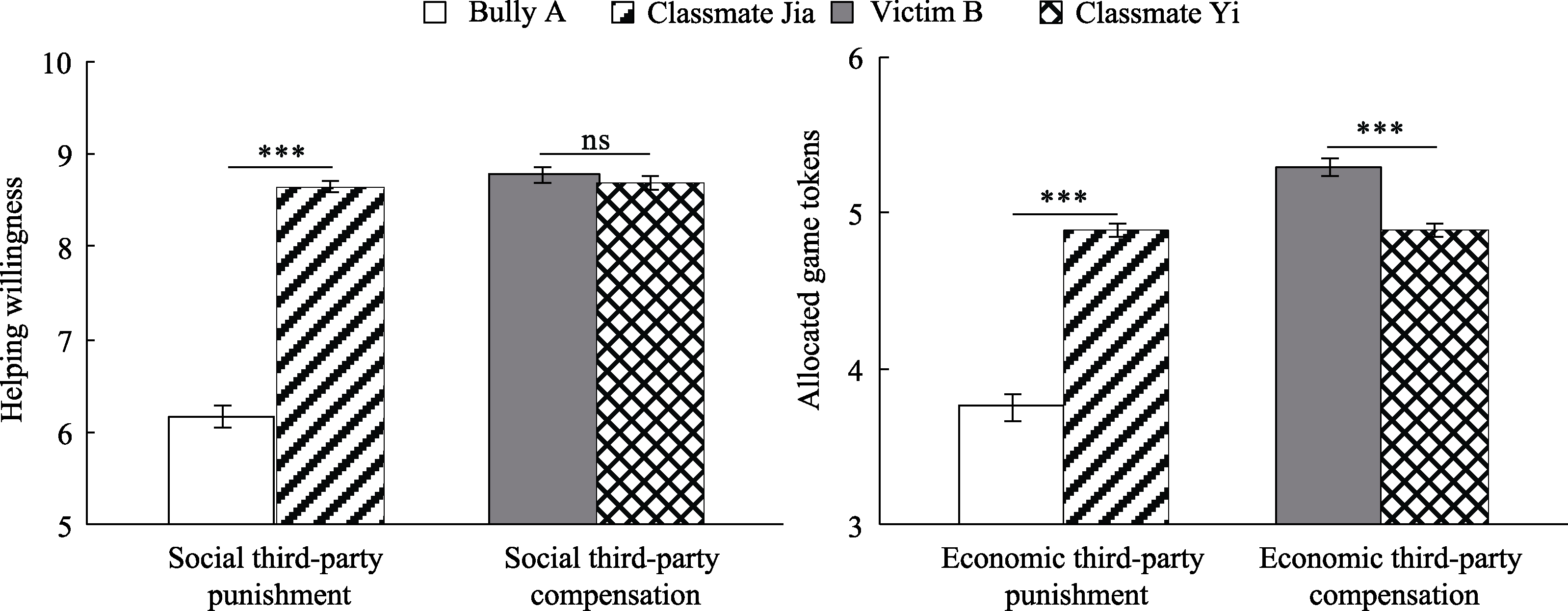
Figure 1. Social and economic third-party punishment and compensation among primary and secondary school students. Note. *** p < 0.001
| Context type | Content |
|---|---|
| Bullying context | During a class break, B went out to get water and was walking back to his/her seat. A intentionally stretched out a foot and tripped B, and the water in B’s cup spilled all over the floor. A said mockingly, “You are really stupid; you can even fall while walking! Hahaha!” Several classmates nearby also joined in and laughed loudly. This was not the first time A had treated B this way; similar behavior had occurred before. At this moment, C, who was nearby, could not stand it, went over to help B up, and went with B to get water again. After school, C reported the matter to the homeroom teacher. |
| Everyday context | During a class break, Yi went out to get water and was walking back to his/her seat. Jia stopped Yi and said, “Is this your new water cup? It looks really nice!” The two began chatting about the new water cup. Bing, who was nearby, also joined the conversation. |
Table 2 “Triadic Interaction” Contexts
| Context type | Content |
|---|---|
| Bullying context | During a class break, B went out to get water and was walking back to his/her seat. A intentionally stretched out a foot and tripped B, and the water in B’s cup spilled all over the floor. A said mockingly, “You are really stupid; you can even fall while walking! Hahaha!” Several classmates nearby also joined in and laughed loudly. This was not the first time A had treated B this way; similar behavior had occurred before. At this moment, C, who was nearby, could not stand it, went over to help B up, and went with B to get water again. After school, C reported the matter to the homeroom teacher. |
| Everyday context | During a class break, Yi went out to get water and was walking back to his/her seat. Jia stopped Yi and said, “Is this your new water cup? It looks really nice!” The two began chatting about the new water cup. Bing, who was nearby, also joined the conversation. |
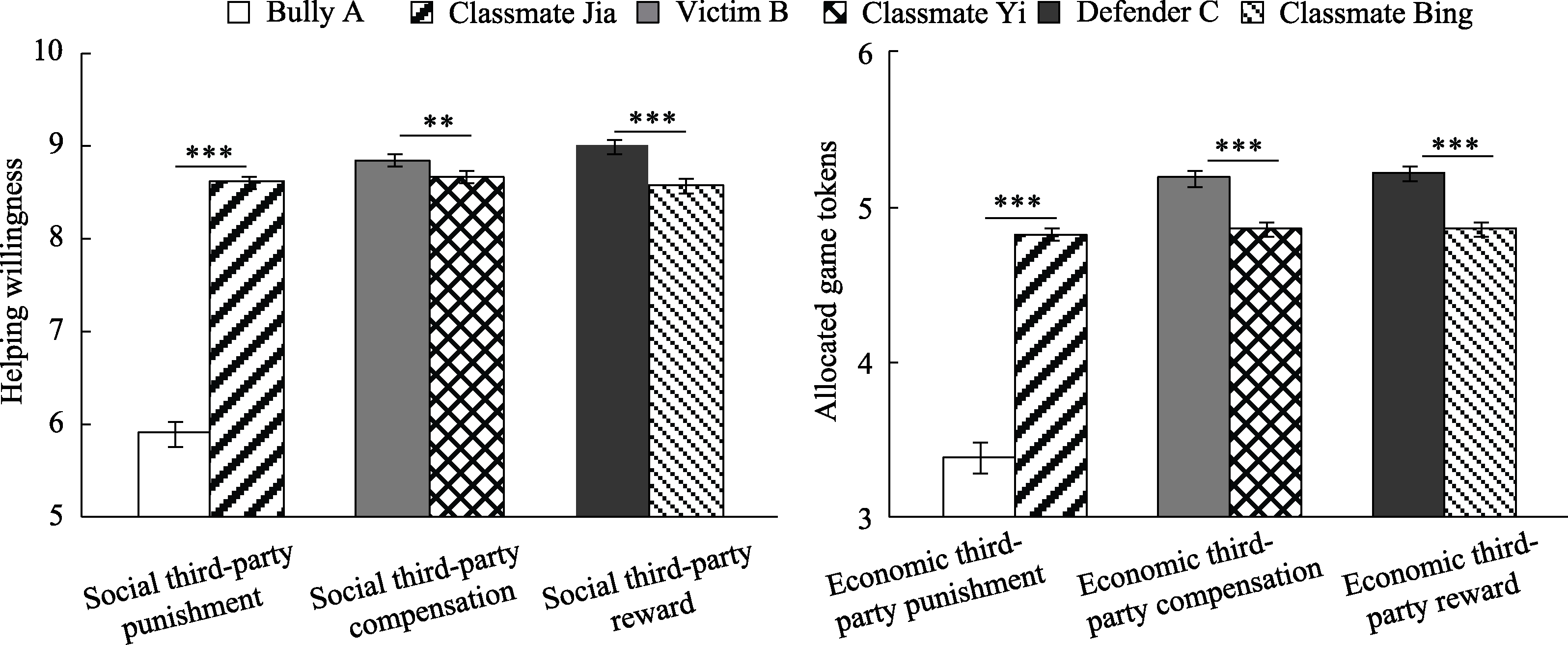
Figure 2. Third-party punishment, compensation, and reward among primary and secondary school students. Note. ** p < 0.01, *** p < 0.001
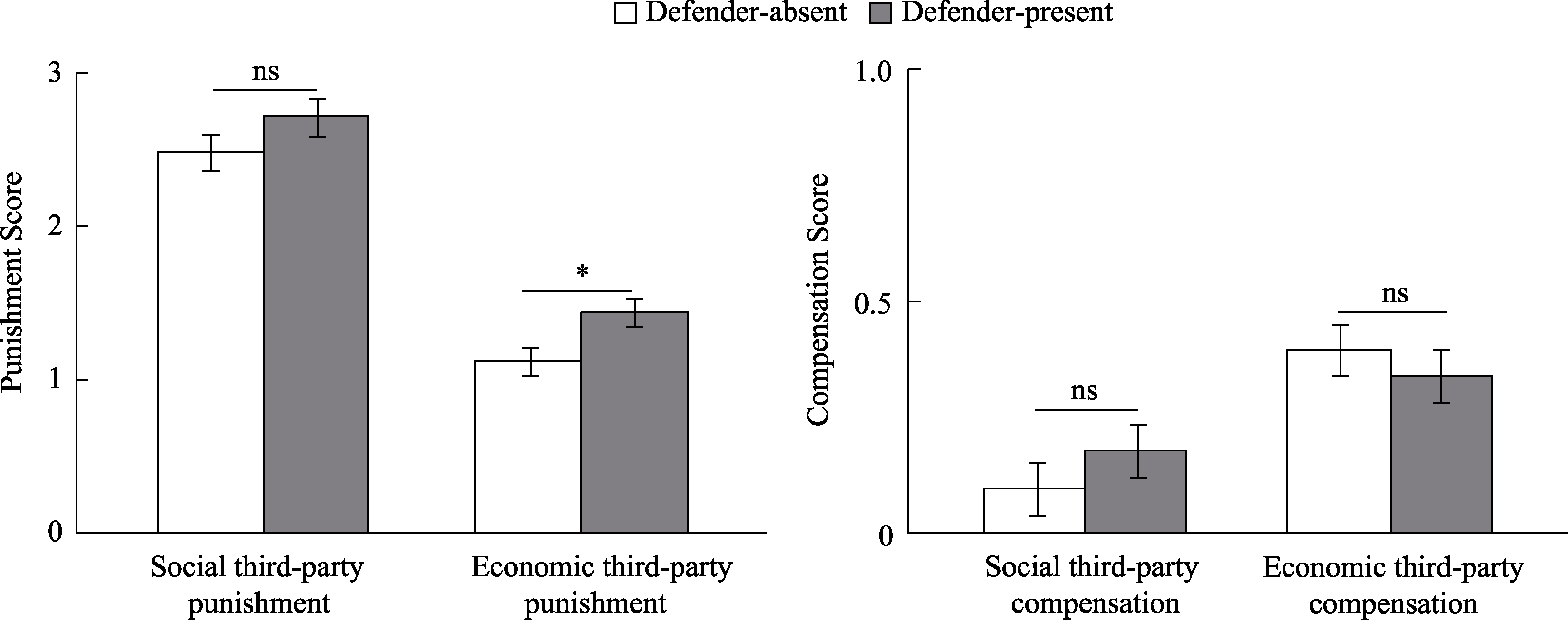
Figure 3. Social and economic third-party punishment and compensation under defender-absent and defender-present conditions. Note. * p < 0.05
| [1] |
Al-Alawi, K. S., Eltayib, R., A. A., Al Saadoon, M., Alhaj, A. H., Aldhafri, S., Al-Adawi, S., & Chan, M. F. (2025). Efficacy of psycho‐educational interventions on school bullying in social isolation, loneliness and PTSD among schoolchildren: A systematic review and meta‐analysis. Child: Care, Health and Development, 51(2), e70062.
doi: 10.1111/cch.v51.2 URL |
| [2] |
Alsawalqa, R., Alrawashdeh, M., & Hasan, S. (2021). Understanding the Man Box: The link between gender socialization and domestic violence in Jordan. Heliyon, 7(10), e08264.
doi: 10.1016/j.heliyon.2021.e08264 URL |
| [3] |
Andrews, J. L., Ahmed, S. P., & Blakemore, S. J. (2021). Navigating the social environment in adolescence: The role of social brain development. Biological Psychiatry, 89(2), 109-118.
doi: 10.1016/j.biopsych.2020.09.012 pmid: 33190844 |
| [4] |
Artavia-Mora, L., Bedi, A. S., & Rieger, M. (2017). Intuitive help and punishment in the field. European Economic Review, 92, 133-145.
doi: 10.1016/j.euroecorev.2016.12.007 URL |
| [5] |
Balafoutas, L., Nikiforakis, N., & Rockenbach, B. (2014). Direct and indirect punishment among strangers in the field. Proceedings of the National Academy of Sciences of the United States of America, 111(45), 15924-15927.
doi: 10.1073/pnas.1413170111 pmid: 25349390 |
| [6] |
Baum, G., Cui, Z., Roalf, D., Ciric, R., Betzel, R., Larsen, B., … Satterthwaite, T. (2020). Development of structure-function coupling in human brain networks during youth. Proceedings of the National Academy of Sciences of the United States of America, 117(1), 771-778.
doi: 10.1073/pnas.1912034117 pmid: 31874926 |
| [7] |
Camacho, A., Runions, K., Ortega-Ruiz, R., & Romera, E. (2025). Norm misperception and witnessing bullying: The role of individual and contextual characteristics. Journal of Adolescence, 97(7), 1807-1817.
doi: 10.1002/jad.v97.7 URL |
| [8] | Chen, G. H. (2014). The perception to definition of Qifu phenomenon from primary and junior middle students. Studies of Psychology and Behavior, 12(5), 639-644. |
| [9] |
Chen, G., Kong, Y., Deater-Deckard, K., & Zhang, W. (2018). Bullying victimization heightens cortisol response to psychosocial stress in Chinese children. Journal of Abnormal Child Psychology, 46(5), 1051-1059.
doi: 10.1007/s10802-017-0366-6 pmid: 29196916 |
| [10] |
Chen, G., Zhang, W., Zhang, W., & Deater-Deckard, K. (2020). A “defender protective effect” in multiple-role combinations of bullying among Chinese adolescents. Journal of Interpersonal Violence, 35(7-8), 1587-1609.
doi: 10.1177/0886260517698278 URL |
| [11] | Chen, Q., Lin, W., Wu, Q., & Chan, K. L. (2025). The effectiveness of interventions on bullying and cyberbullying bystander: A meta-analysis. Trauma, Violence, & Abuse, 26(5), 938-954. |
| [12] |
Darley, J. M., & Pittman, T. S. (2003). The psychology of compensatory and retributive justice. Personality and Social Psychology Review, 7(4), 324-336.
doi: 10.1207/S15327957PSPR0704_05 pmid: 14650389 |
| [13] |
de Kwaadsteniet, E. W., Rijkhoff, S. A., & van Dijk, E. (2013). Equality as a benchmark for third-party punishment and reward: The moderating role of uncertainty in social dilemmas. Organizational Behavior and Human Decision Processes, 120(2), 251-259.
doi: 10.1016/j.obhdp.2012.06.007 URL |
| [14] |
Decrop, R., McManamon, B., Williams, K., Houlihan, K., Bok, H. C., Knestrick, K., … Cauffman, E. (2025). Cognitive loopholes of crime: Mapping the codevelopment of moral disengagement within perceptions of risks and rewards. Journal of Research on Adolescence, 35(3), e70056.
doi: 10.1111/jora.v35.3 URL |
| [15] |
Dhaliwal, N. A., Patil, I., & Cushman, F. (2021). Reputational and cooperative benefits of third-party compensation. Organizational Behavior and Human Decision Processes, 164(7), 27-51.
doi: 10.1016/j.obhdp.2021.01.003 URL |
| [16] |
Eagly, A. H., & Wood, W. (1999). The origins of sex differences in human behavior: Evolved dispositions versus social roles. American Psychologist, 54(6), 408-423.
doi: 10.1037/0003-066X.54.6.408 URL |
| [17] |
Faul, F., Erdfelder, E., Buchner, A., & Lang, A. G. (2009). Statistical power analyses using G*Power 3.1: Tests for correlation and regression analyses. Behavior Research Methods, 41(4), 1149-1160.
doi: 10.3758/BRM.41.4.1149 pmid: 19897823 |
| [18] |
Fehr, E., & Fischbacher, U. (2004). Third-party punishment and social norms. Evolution and Human Behavior, 25(2), 63-87.
doi: 10.1016/S1090-5138(04)00005-4 URL |
| [19] |
Feijóo, S. S., O’Higgins-Norman, J., Foody, M., Pichel, R., Braña, T., Varela, J., & Rial, A. (2021). Sex differences in adolescent bullying behaviours. Psychosocial Intervention, 30(2), 95-100.
doi: 10.5093/pi2021a1 URL |
| [20] |
Fox, C. L., Jones, S. E., Stiff, C. E., & Sayers, J. (2014). Does the gender of the bully/victim dyad and the type of bullying influence children’s responses to a bullying incident? Aggressive Behavior, 40(4), 359-368.
doi: 10.1002/ab.v40.4 URL |
| [21] |
Gaffney, H., Ttofi, M., & Farrington, D. (2021). What works in anti-bullying programs? Analysis of effective intervention components. Journal of School Psychology, 85, 37-56.
doi: 10.1016/j.jsp.2020.12.002 pmid: 33715780 |
| [22] |
Geraci, A., & Surian, L. (2021). Toddlers' expectations of third‐party punishments and rewards following an act of aggression. Aggressive Behavior, 47(5), 521-529.
doi: 10.1002/ab.v47.5 URL |
| [23] |
Grueneisen, S., & Warneken, F. (2022). The development of prosocial behavior-from sympathy to strategy. Current Opinion in Psychology, 43, 323-328.
doi: 10.1016/j.copsyc.2021.08.005 URL |
| [24] |
Gutierrez, B. C., Halim, M. L. D., Martinez, M. A., & Arredondo, M. (2020). The heroes and the helpless: The development of benevolent sexism in children. Sex Roles, 82, 558-569.
doi: 10.1007/s11199-019-01074-4 |
| [25] |
Hall, H. K., Millear, P. M., Summers, M. J., & Isbel, B. (2021). Longitudinal research on perspective taking in adolescence: A systematic review. Adolescent Research Review, 6(2), 125-150.
doi: 10.1007/s40894-021-00150-9 |
| [26] |
Hawkins, D. L., Pepler, D. J., & Craig, W. M. (2001). Naturalistic observations of peer interventions in bullying. Social Development, 10(4), 512-527.
doi: 10.1111/sode.2001.10.issue-4 URL |
| [27] |
Jordan, J., Hoffman, M., Bloom, P., & Rand, D. (2016). Third-party punishment as a costly signal of trustworthiness. Nature, 530, 473-476.
doi: 10.1038/nature16981 |
| [28] | Knauf, R. K., & Eschenbeck, H. (2025). School bullying and cyberbullying-associations of student’s roles with social-cognitive and affective reactions. Social Psychology of Education, 28(1), 51. |
| [29] |
Laninga‐Wijnen, L., Malamut, S. T., Garandeau, C. F., & Salmivalli, C. (2023). Does defending affect adolescents' peer status, or vice versa? Testing the moderating effects of empathy, gender, and anti‐bullying norms. Journal of Research on Adolescence, 33(3), 913-930.
doi: 10.1111/jora.v33.3 URL |
| [30] | Ma, R., Wu, N., Tian, M. Q., & Wu, Z. (2023). Punishing perpetrators or compensating victims: The third-party punishment motivation of children aged 7-10. Chinese Science Bulletin, 68(17), 2258-2268. |
| [31] |
Ma, T. L., & Chen, W. T. (2019). The benefits of being defended: Perceived bystander participant roles and victims’ emotional and psychosocial adjustment. Journal of School Violence, 18(1), 77-91.
doi: 10.1080/15388220.2017.1387132 URL |
| [32] |
Ma, T. L., Meter, D. J., Chen, W. T., & Lee, Y. (2019). Defending behavior of peer victimization in school and cyber context during childhood and adolescence: A meta-analytic review of individual and peer-relational characteristics. Psychological Bulletin, 145(9), 891-928.
doi: 10.1037/bul0000205 URL |
| [33] |
Michalska, K. J., Kinzler, K. D., & Decety, J. (2013). Age-related sex differences in explicit measures of empathy do not predict brain responses across childhood and adolescence. Developmental Cognitive Neuroscience, 3, 22-32.
doi: 10.1016/j.dcn.2012.08.001 pmid: 23245217 |
| [34] | Molho, C., Tybur, J. M., Van Lange, P. A., & Balliet, D. (2020). Direct and indirect punishment of norm violations in daily life. Nature Communications, 11(1), 3432. |
| [35] |
Ng, K., Niven, K., & Hoel, H. (2020). ‘I could help, but...’: A dynamic sensemaking model of workplace bullying bystanders. Human Relations, 73(12), 1718-1746.
doi: 10.1177/0018726719884617 URL |
| [36] | Olweus, D. (1993). Bullying at school: What we know and what we can do. Oxford, UK: Blackwell. |
| [37] |
Priess, H. A., Lindberg, S. M., & Hyde, J. S. (2009). Adolescent gender-role identity and mental health: Gender intensification revisited. Child Development, 80(5), 1531-1544.
doi: 10.1111/j.1467-8624.2009.01349.x pmid: 19765016 |
| [38] |
Richard, F. D., Bond, C. F., Jr., & Stokes-Zoota, J. J. (2003). One hundred years of social psychology quantitatively described. Review of General Psychology, 7(4), 331-363.
doi: 10.1037/1089-2680.7.4.331 URL |
| [39] |
Romer, D., Reyna, V. F., & Satterthwaite, T. D. (2017). Beyond stereotypes of adolescent risk taking: Placing the adolescent brain in developmental context. Developmental Cognitive Neuroscience, 27, 19-34.
doi: S1878-9293(17)30102-0 pmid: 28777995 |
| [40] |
Salmivalli, C., Lagerspetz, K., Björkqvist, K., Österman, K., & Kaukiainen, A. (1996). Bullying as a group process: Participant roles and their relations to social status within the group. Aggressive Behavior, 22(1), 1-15.
doi: 10.1002/(SICI)1098-2337(1996)22:1<>1.0.CO;2-H URL |
| [41] |
Salmivalli, C., & Voeten, M. (2004). Connections between attitudes, group norms, and behaviour in bullying situations. International Journal of Behavioral Development, 28(3), 246-258.
doi: 10.1080/01650250344000488 URL |
| [42] |
Silvers, J. (2022). Adolescence as a pivotal period for emotion regulation development. Current Opinion in Psychology, 44, 258-263.
doi: 10.1016/j.copsyc.2021.09.023 URL |
| [43] | Thornberg, R., Pozzoli, T., & Gini, G. (2022). Defending or remaining passive as a bystander of school bullying in Sweden: The role of moral disengagement and antibullying class norms. Journal of Interpersonal Violence, 37(19-20), NP18666-NP18689. |
| [44] |
Toribio-Flórez, D., Saße, J., & Baumert, A. (2023). “Proof under reasonable doubt”: Ambiguity of the norm violation as boundary condition of third-party punishment. Personality and Social Psychology Bulletin, 49(3), 429-446.
doi: 10.1177/01461672211067675 URL |
| [45] |
Turillo, C. J., Folger, R., Lavelle, J. J., Umphress, E. E., & Gee, J. O. (2002). Is virtue its own reward? Self-sacrificial decisions for the sake of fairness. Organizational Behavior and Human Decision Processes, 89(1), 839-865.
doi: 10.1016/S0749-5978(02)00032-8 URL |
| [46] |
Van der Graaff, J., Carlo, G., Crocetti, E., Koot, H. M., & Branje, S. (2018). Prosocial behavior in adolescence: Gender differences in development and links with empathy. Journal of Youth and Adolescence, 47(5), 1086-1099.
doi: 10.1007/s10964-017-0786-1 pmid: 29185207 |
| [47] |
van der, Ploeg, R., Kretschmer, T., Salmivalli, C., & Veenstra, R. (2017). Defending victims: What does it take to intervene in bullying and how is it rewarded by peers? Journal of School Psychology, 65, 1-10.
doi: S0022-4405(17)30075-4 pmid: 29145937 |
| [48] |
Warthen, K. G., Boyse-Peacor, A., Jones, K. G., Sanford, B., Love, T. M., & Mickey, B. J. (2020). Sex differences in the human reward system: Convergent behavioral, autonomic and neural evidence. Social Cognitive and Affective Neuroscience, 15(7), 789-801.
doi: 10.1093/scan/nsaa104 pmid: 32734300 |
| [49] |
Xiao, S. X., Hashi, E. C., Korous, K. M., & Eisenberg, N. (2019). Gender differences across multiple types of prosocial behavior in adolescence: A meta-analysis of the prosocial tendency measure-revised (PTM-R). Journal of Adolescence, 77, 41-58.
doi: S0140-1971(19)30154-X pmid: 31648167 |
| [50] |
Yang, H., Zhang, Y., Lyu, Y., & Tang, C. (2023). Group bias under uncertain environment: A perspective of third-party punishment. Acta Psychologica, 237, 103957.
doi: 10.1016/j.actpsy.2023.103957 URL |
| [51] | Zhang, W. X. (2023). The definition of bullying: From cross-cultural and developmental perspectives. Psychological Development and Education, 39(4), 590-598. |
| [52] |
Zhao, K., Yan, Y., Zhou, Z. E., Xiao, S., Shan, D., & Iqbal, M. (2025). Punish or help? Third parties’ constructive responses to witnessed workplace incivility: The role of political skill. Humanities and Social Sciences Communications, 12, 516.
doi: 10.1057/s41599-025-04811-1 |
| Viewed | ||||||
|
Full text |
|
|||||
|
Abstract |
|
|||||
