

ISSN 0439-755X
CN 11-1911/B
CN 11-1911/B
Acta Psychologica Sinica ›› 2026, Vol. 58 ›› Issue (10): 2008-2021.doi: 10.3724/SP.J.1041.2026.2008
• Reports of Empirical Studies • Previous Articles Next Articles
TANG Yuyao, LI Yiwei, GUO Xinyu, ZHANG Dandan( )
)
Published:2026-10-25
Online:2026-08-04
Contact:
ZHANG Dandan
E-mail:zhangdd05@gmail.com
Supported by:TANG Yuyao, LI Yiwei, GUO Xinyu, ZHANG Dandan. (2026). Emotion regulation via conditioning placebo effects: The role of the dorsolateral prefrontal cortex in conditioning formation. Acta Psychologica Sinica, 58(10), 2008-2021.

Figure 1. Experimental procedure. A: Overall timeline of the experiment across 2 days. B: Simulated TMS-induced current distribution, with normalized electric-field strength shown in color. C: Meaning of the three cue shapes. For half of the participants in each group, the triangle predicted high-intensity negative pictures and the square predicted low-intensity negative pictures; for the other half, this mapping was reversed. D: Schematic trial structure for the pre-conditioning test, conditioning, and post-conditioning test phases. In the test phases, all three cues were paired with medium-intensity negative pictures. In the conditioning phase, the high- and low-intensity cues were probabilistically paired with high- and low-intensity negative pictures, respectively.

Figure 2. Results from the conditioning phase. A: Negative-emotion ratings for pictures. B: Mean cue-evoked changes in pupil diameter. C: Cue-evoked pupil-diameter waveforms; the shaded region indicates the time window used to compute the mean values in Panel B. D: Correlation between picture-evoked pupil diameter and negative-emotion ratings (p = 0.042), combining both groups. E: Mean picture-evoked changes in pupil diameter. F: Picture-evoked pupil-diameter waveforms; the shaded region indicates the time window used to compute the mean values in Panel E. Error bars represent SEM. Panels A, B, and E use the same legend, and Panels C and F use the same legend. * p < 0.05, ** p < 0.01.

Figure 3. Negative-emotion ratings during the post-conditioning test phase. A: Interaction between TMS group and cue type. B: Conditioned placebo and nocebo effects in the two groups. C: Pre- versus post-conditioning ratings in the DLPFC group. D: Pre- versus post- conditioning ratings in the control group. Error bars represent SEM. Panels A and B use the same legend. * p < 0.05, ** p < 0.01, *** p < 0.001.
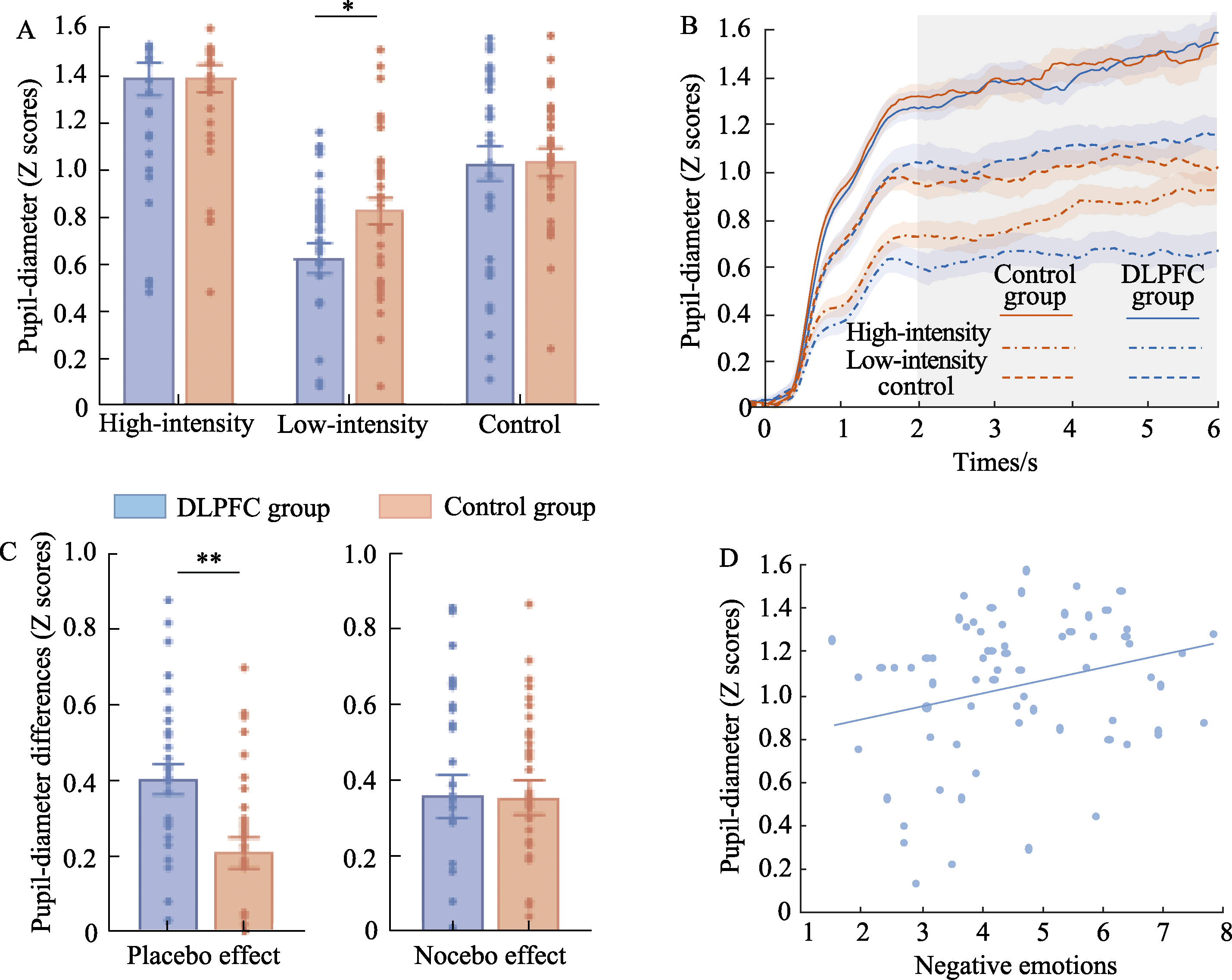
Figure 4. Pupil-diameter responses during the post-conditioning test phase. A: Interaction between TMS group and cue type. B: Picture-evoked pupil-diameter waveforms; the shaded region indicates the time window used to compute the mean values in Panel A. C: Conditioned placebo and nocebo effects in the two groups. D: Correlation between pupil diameter and negative-emotion ratings (p = 0.022), combining both groups. Error bars represent SEM. Panels A and C use the same legend. * p < 0.05, ** p < 0.01.

Figure 5. Mediation analyses. A: Mediation model based on subjective ratings. B: Serial mediation model based on pupil diameter. Dashed paths indicate nonsignificant effects. * p < 0.05, ** p < 0.01, *** p < 0.001.
| [1] |
Amanzio, M., Benedetti, F., Porro, C. A., Palermo, S., & Cauda, F. (2013). Activation likelihood estimation meta‐analysis of brain correlates of placebo analgesia in human experimental pain. Human Brain Mapping, 34(3), 738-752.
doi: 10.1002/hbm.v34.3 URL |
| [2] |
Atlas, L. Y. (2021). A social affective neuroscience lens on placebo analgesia. Trends in Cognitive Sciences, 25(11), 992-1005.
doi: 10.1016/j.tics.2021.07.016 pmid: 34538720 |
| [3] |
Bąbel, P. (2019). Classical conditioning as a distinct mechanism of placebo effects. Frontiers in Psychiatry, 10, 449.
doi: 10.3389/fpsyt.2019.00449 pmid: 31293460 |
| [4] |
Bąbel, P., Adamczyk, W., Świder, K., Bajcar, E. A., Kicman, P., & Lisińska, N. (2018). How classical conditioning shapes placebo analgesia: Hidden versus open conditioning. Pain Medicine, 19(6), 1156-1169.
doi: 10.1093/pm/pnx177 pmid: 29016984 |
| [5] | Bingel, U., Wanigasekera, V., Wiech, K., Ni Mhuircheartaigh, R., Lee, M. C., Ploner, M., & Tracey, I. (2011). The effect of treatment expectation on drug efficacy: Imaging the analgesic benefit of the opioid remifentanil. Science Translational Medicine, 3(70), 70ra14. |
| [6] | Bo, K., & Wager, T. D. (2025). Placebo effects and emotion regulation: Conceptual and neural similarities and differences. Handbook of Clinical Neurology, 213, 17-29. |
| [7] | Bräscher, A. K., Witthöft, M., & Becker, S. (2018). The underestimated significance of conditioning in placebo hypoalgesia and nocebo hyperalgesia. Pain Research and Management, 2018, 6841985. |
| [8] |
Braunstein, L. M., Gross, J. J., & Ochsner, K. N. (2017). Explicit and implicit emotion regulation: A multi-level framework. Social Cognitive and Affective Neuroscience, 12(10), 1545-1557.
doi: 10.1093/scan/nsx096 pmid: 28981910 |
| [9] |
Crawford, L. S., Mills, E. P., Peek, A., Macefield, V. G., Keay, K. A., & Henderson, L. A. (2023). Function and biochemistry of the dorsolateral prefrontal cortex during placebo analgesia: How the certainty of prior experiences shapes endogenous pain relief. Cerebral Cortex, 33(17), 9822-9834.
doi: 10.1093/cercor/bhad247 URL |
| [10] |
Dawel, A., Mewton, P., Gulliver, A., Farrer, L. M., Calear, A. L., Newman, E., & Cherbuin, N. (2024). For whom and what does cognitive reappraisal help? A prospective study. Cognitive Therapy and Research, 48(4), 687-703.
doi: 10.1007/s10608-023-10407-3 |
| [11] | Dickey, L., Dao, A., Pegg, S., & Kujawa, A. (2024). Neural markers of emotion regulation difficulties in adolescent depression and risk for depression. Journal of Mood & Anxiety Disorders, 5, 100051. |
| [12] |
Egorova, N., Yu, R., Kaur, N., Vangel, M., Gollub, R. L., Dougherty, D. D., Kong, J., & Camprodon, J. A. (2015). Neuromodulation of conditioned placebo/nocebo in heat pain: Anodal vs. cathodal transcranial direct current stimulation to the right dorsolateral prefrontal cortex. Pain, 156(7), 1342-1347.
doi: 10.1097/j.pain.0000000000000163 pmid: 25806605 |
| [13] |
Feurer, C., Jimmy, J., Bhaumik, R., Duffecy, J., Medrano, G. R., Ajilore, O., … Klumpp, H. (2022). Anterior cingulate cortex activation during attentional control as a transdiagnostic marker of psychotherapy response: A randomized clinical trial. Neuropsychopharmacology, 47(7), 1350-1357.
doi: 10.1038/s41386-021-01211-2 |
| [14] |
Freeman, S., Yu, R., Egorova, N., Chen, X., Kirsch, I., Claggett, B., … Kong, J. (2015). Distinct neural representations of placebo and nocebo effects. NeuroImage, 112, 197-207.
doi: S1053-8119(15)00196-2 pmid: 25776211 |
| [15] |
Fu, J., Wu, S., Liu, C., Camilleri, J. A., Eickhoff, S. B., & Yu, R. (2021). Distinct neural networks subserve placebo analgesia and nocebo hyperalgesia. NeuroImage, 231, 117833.
doi: 10.1016/j.neuroimage.2021.117833 URL |
| [16] |
Gao, K., Tang, Y., Zhang, Y., & Zhang, D. (2026). The cognitive and neural mechanisms of implicit emotion regulation. Advances in Psychological Science, 34(1), 108-122.
doi: 10.3724/SP.J.1042.2026.0108 |
| [17] |
Gao, K., Wong, A. B., Li, S., Zhang, Y., & Zhang, D. (2024). The ventromedial prefrontal cortex plays an important role in implicit emotion regulation: A focality‐optimized multichannel tDCS study in anxiety individuals. Human Brain Mapping, 45(13), e26812.
doi: 10.1002/hbm.v45.13 URL |
| [18] |
Gross, J. J. (2015). Emotion regulation: Current status and future prospects. Psychological Inquiry, 26(1), 1-26.
doi: 10.1080/1047840X.2014.940781 URL |
| [19] |
Grujic, N., Polania, R., & Burdakov, D. (2024). Neurobehavioral meaning of pupil size. Neuron, 112(20), 3381-3395.
doi: 10.1016/j.neuron.2024.05.029 URL |
| [20] |
Halfmann, K., Hedgcock, W., & Denburg, N. L. (2021). Neural correlates of cognitive reappraisal of positive and negative affect in older adults. Aging & Mental Health, 25(1), 126-133.
doi: 10.1080/13607863.2019.1693970 URL |
| [21] |
Harvie, D. S., Meulders, A., Madden, V. J., Hillier, S. L., Peto, D. K., Brinkworth, R., & Moseley, G. L. (2016). When touch predicts pain: Predictive tactile cues modulate perceived intensity of painful stimulation independent of expectancy. Scandinavian Journal of Pain, 11(1), 11-18.
doi: 10.1016/j.sjpain.2015.09.007 URL |
| [22] |
He, Z., Lin, Y., Xia, L., Liu, Z., Zhang, D., & Elliott, R. (2018). Critical role of the right VLPFC in emotional regulation of social exclusion: A tDCS study. Social Cognitive and Affective Neuroscience, 13(4), 357-366.
doi: 10.1093/scan/nsy026 pmid: 29618116 |
| [23] |
Hershman, R., Henik, A., & Cohen, N. (2019). CHAP: Open-source software for processing and analyzing pupillometry data. Behavior Research Methods, 51(3), 1059-1074.
doi: 10.3758/s13428-018-01190-1 pmid: 30710333 |
| [24] | Icenhour, A., Labrenz, F., Ritter, C., Theysohn, N., Forsting, M., Bingel, U., & Elsenbruch, S. (2017). Learning by experience? Visceral pain-related neural and behavioral responses in a classical conditioning paradigm. Neurogastroenterology & Motility, 29(6), e13026. |
| [25] |
Jensen, K. B., Kaptchuk, T. J., Chen, X., Kirsch, I., Ingvar, M., Gollub, R. L., & Kong, J. (2015). A neural mechanism for nonconscious activation of conditioned placebo and nocebo responses. Cerebral Cortex, 25(10), 3903-3910.
doi: 10.1093/cercor/bhu275 URL |
| [26] |
Kalisch, R., & Gerlicher, A. M. (2014). Making a mountain out of a molehill: On the role of the rostral dorsal anterior cingulate and dorsomedial prefrontal cortex in conscious threat appraisal, catastrophizing, and worrying. Neuroscience and Biobehavioral Reviews, 42, 1-8.
doi: 10.1016/j.neubiorev.2014.02.002 pmid: 24525267 |
| [27] |
Kinley, I., & Levy, Y. (2022). PuPl: An open-source tool for processing pupillometry data. Behavior Research Methods, 54(4), 2046-2069.
doi: 10.3758/s13428-021-01717-z |
| [28] |
Krummenacher, P., Candia, V., Folkers, G., Schedlowski, M., & Schönbächler, G. (2010). Prefrontal cortex modulates placebo analgesia. Pain, 148(3), 368-374.
doi: 10.1016/j.pain.2009.09.033 pmid: 19875233 |
| [29] |
Labrenz, F., Icenhour, A., Schlamann, M., Forsting, M., Bingel, U., & Elsenbruch, S. (2016). From Pavlov to pain: How predictability affects the anticipation and processing of visceral pain in a fear conditioning paradigm. NeuroImage, 130(49), 104-114.
doi: 10.1016/j.neuroimage.2016.01.064 URL |
| [30] | Lam, C. L., Wong, C. H., Junghöfer, M., & Roesmann, K. (2023). Implicit threat learning involves the dorsolateral prefrontal cortex and the cerebellum. International Journal of Clinical and Health Psychology, 23(2), 100357. |
| [31] | Lang, P. J., Bradley, M. M., & Cuthbert, B. N. (1997). International affective picture system (IAPS): Technical manual and affective ratings. NIMH Center for the Study of Emotion and Attention, 1(39-58), 3. |
| [32] |
Li, S., Chen, J., Gao, K., Xu, F., & Zhang, D. (2023). Excitatory brain stimulation over the left dorsolateral prefrontal cortex enhances voluntary distraction in depressed patients. Psychological Medicine, 53(14), 6646-6655.
doi: 10.1017/S0033291723000028 URL |
| [33] |
Li, S., Tang, Y., Li, Q., Wang, T., & Zhang, D. (2026). Make your emotions heard: How emotion sharing boosts interpersonal emotion regulation across various interpersonal distances. Acta Psychologica Sinica, 58(5), 840-852.
doi: 10.3724/SP.J.1041.2026.0840 |
| [34] |
Lui, F., Colloca, L., Duzzi, D., Anchisi, D., Benedetti, F., & Porro, C. A. (2010). Neural bases of conditioned placebo analgesia. Pain, 151(3), 816-824.
doi: 10.1016/j.pain.2010.09.021 pmid: 20943318 |
| [35] | Liu, X., Xu, A., & Zhou, R. (2009). Native research of the International Affective Picture System: Assessment in university students. Chinese Journal of Clinical Psychology, 17(6), 687-689. |
| [36] | Madaboosi, S., Grasser, L. R., Chowdury, A., & Javanbakht, A. (2021). Neurocircuitry of contingency awareness in Pavlovian fear conditioning. Cognitive, Affective, & Behavioral Neuroscience, 21(5), 1039-1053. |
| [37] |
Madden, V. J., Harvie, D. S., Parker, R., Jensen, K. B., Vlaeyen, J. W., Moseley, G. L., & Stanton, T. R. (2016). Can pain or hyperalgesia be a classically conditioned response in humans? A systematic review and meta-analysis. Pain Medicine, 17(6), 1094-1111.
doi: 10.1093/pm/pnv044 pmid: 26814278 |
| [38] |
Meyer, B., Yuen, K. S., Ertl, M., Polomac, N., Mulert, C., Büchel, C., & Kalisch, R. (2015). Neural mechanisms of placebo anxiolysis. Journal of Neuroscience, 35(19), 7365-7373.
doi: 10.1523/JNEUROSCI.4793-14.2015 pmid: 25972166 |
| [39] | Mo, L., Li, S., & Zhang, D. (2024). Neural mechanism of emotion regulation of social pain. Journal of Psychological Science, 47(3), 530-537. |
| [40] |
Monachesi, B., Pisanu, E., Chiffi, D., Rumiati, R. I., & Grecucci, A. (2025). Distinct prefrontal lateralization in placebo and reappraisal mechanisms: An ALE meta-analysis. NeuroImage, 320, 121459.
doi: 10.1016/j.neuroimage.2025.121459 URL |
| [41] |
Okusogu, C., & Colloca, L. (2019). Placebo hypoalgesia: Above and beyond expectancy and conditioning. Current Opinion in Behavioral Sciences, 26, 75-81.
doi: 10.1016/j.cobeha.2018.10.008 pmid: 31538101 |
| [42] |
Overman, M. J., Sarrazin, V., Browning, M., & O'Shea, J. (2023). Stimulating human prefrontal cortex increases reward learning. Neuroimage, 271, 120029.
doi: 10.1016/j.neuroimage.2023.120029 URL |
| [43] | Pecina, M., Heffernan, J., Wilson, J., Zubieta, J. K., & Dombrovski, A. Y. (2018). Prefrontal expectancy and reinforcement-driven antidepressant placebo effects. Translational Psychiatry, 8(1), 222. |
| [44] |
Prutean, N., Martin-Arevalo, E., Leiva, A., Jiménez, L., Vallesi, A., & Lupiáñez, J. (2021). The causal role of DLPFC top-down control on the acquisition and the automatic expression of implicit learning: State of the art. Cortex, 141, 293-310.
doi: 10.1016/j.cortex.2021.04.012 pmid: 34116383 |
| [45] | Radua, J., Savage, H. S., Vilajosana, E., Jamieson, A., Abler, B., Åhs, F., … Fullana, M. A. (2025). Neural correlates of human fear conditioning and sources of variability in 2199 individuals. Nature Communications, 16(1), 7869. |
| [46] |
Raghuraman, N., Cottam, J., Akintola, T., Watson, L., Nabi, M., Colloca, L., … Wang, Y. (2025). Placebo and nocebo effects. Pain, 166(11S), S111-S115.
doi: 10.1097/j.pain.0000000000003637 pmid: 41086341 |
| [47] |
Reicherts, P., Pauli, P., Mösler, C., & Wieser, M. J. (2019). Placebo manipulations reverse pain potentiation by unpleasant affective stimuli. Frontiers in Psychiatry, 10, 663.
doi: 10.3389/fpsyt.2019.00663 pmid: 31607964 |
| [48] |
Sevel, L. S., O'Shea, A. M., Letzen, J. E., Craggs, J. G., Price, D. D., & Robinson, M. E. (2015). Effective connectivity predicts future placebo analgesic response: A dynamic causal modeling study of pain processing in healthy controls. NeuroImage, 110, 87-94.
doi: 10.1016/j.neuroimage.2015.01.056 pmid: 25659463 |
| [49] | Shafir, R., Israel, M., & Colloca, L. (2023). Harnessing the placebo effect to enhance emotion regulation effectiveness and choice. Scientific Reports, 13(1), 2373. |
| [50] |
Stein, N., Sprenger, C., Scholz, J., Wiech, K., & Bingel, U. (2012). White matter integrity of the descending pain modulatory system is associated with interindividual differences in placebo analgesia. Pain, 153(11), 2210-2217.
doi: 10.1016/j.pain.2012.07.010 pmid: 22959599 |
| [51] |
Stewart-Williams, S., & Podd, J. (2004). The placebo effect: Dissolving the expectancy versus conditioning debate. Psychological Bulletin, 130(2), 324-340.
pmid: 14979775 |
| [52] |
Tang, Y., Mo, L., Peng, Z., Li, Y., & Zhang, D. (2025). Causal enhancement of cognitive reappraisal through synchronized dorsolateral and ventrolateral prefrontal cortex activity. Emotion, 25(6), 1418-1428.
doi: 10.1037/emo0001507 pmid: 39977692 |
| [53] | Thielscher, A., Antunes, A., & Saturnino, G. B. (2015). Field modeling for transcranial magnetic stimulation: A useful tool to understand the physiological effects of TMS? Annual International Conference of the IEEE Engineering in Medicine and Biology Society.IEEE Engineering in Medicine and Biology Society. Annual International Conference, 2015, 222-225. |
| [54] | Tu, Y., Wilson, G., Camprodon, J., Dougherty, D. D., Vangel, M., Benedetti, F., … Kong, J. (2021). Manipulating placebo analgesia and nocebo hyperalgesia by changing brain excitability. Proceedings of the National Academy of Sciences of the United States of America, 118(19), e2101273118. |
| [55] |
Turton, H., Berry, K., Danquah, A., & Pratt, D. (2021). The relationship between emotion dysregulation and suicide ideation and behaviour: A systematic review. Journal of Affective Disorders Reports, 5, 100136.
doi: 10.1016/j.jadr.2021.100136 URL |
| [56] |
Wager, T. D., & Atlas, L. Y. (2015). The neuroscience of placebo effects: Connecting context, learning and health. Nature Reviews Neuroscience, 16(7), 403-418.
doi: 10.1038/nrn3976 pmid: 26087681 |
| [57] |
Wang, M., Cheng, S., Li, Y., Li, H., & Zhang, D. (2023). The role of dorsolateral prefrontal cortex on placebo effect of regulating social pain: A TMS study. Acta Psychologica Sinica, 55(7), 1063-1073.
doi: 10.3724/SP.J.1041.2023.01063 |
| [58] |
Webler, R. D., Fox, J., McTeague, L. M., Burton, P. C., Dowdle, L., Short, E. B., … Nahas, Z. (2022). DLPFC stimulation alters working memory related activations and performance: An interleaved TMS-fMRI study. Brain Stimulation, 15(3), 823-832.
doi: 10.1016/j.brs.2022.05.014 pmid: 35644517 |
| [59] |
Yu, W., Li, Y., Cao, X., Mo, L., Chen, Y., & Zhang, D. (2023). The role of ventrolateral prefrontal cortex on voluntary emotion regulation of social pain. Human Brain Mapping, 44(13), 4710-4721.
doi: 10.1002/hbm.v44.13 URL |
| [60] |
Yuan, J., Zhang, Y., Zhao, Y., Gao, K., Tan, S., & Zhang, D. (2023). The emotion-regulation benefits of implicit reappraisal in clinical depression: Behavioral and electrophysiological evidence. Neuroscience Bulletin, 39(6), 973-983.
doi: 10.1007/s12264-022-00973-z |
| [61] |
Zhang, W., Guo, J., Zhang, J., & Luo, J. (2013). Neural mechanism of placebo effects and cognitive reappraisal in emotion regulation. Progress in Neuro-Psychopharmacology and Biological Psychiatry, 40, 364-373.
doi: 10.1016/j.pnpbp.2012.10.020 URL |
| [62] |
Zhang, Y., Li, S., Gao, K., Li, Y., Yuan, J., & Zhang, D. (2023). Implicit, but not explicit, emotion regulation relieves unpleasant neural responses evoked by high-intensity negative images. Neuroscience Bulletin, 39(8), 1278-1288.
doi: 10.1007/s12264-023-01036-7 |
| [63] |
Zhao, J., Mo, L., Bi, R., He, Z., Chen, Y., Xu, F., Xie, H., & Zhang, D. (2021). The VLPFC versus the DLPFC in downregulating social pain using reappraisal and distraction strategies. The Journal of Neuroscience, 41(6), 1331-1339.
doi: 10.1523/JNEUROSCI.1906-20.2020 URL |
| [1] | ZHANG Wenjie, LONG Ruyi, LI Miaoqing, FAN Wei, FU Xiaolan. The Impact of Emotional Valence and Response Orientation on Helping Behavior in Young Children: Evidence from Behavior and fNIRS [J]. Acta Psychologica Sinica, 2026, 58(6): 1143-1159. |
| [2] | LI Sijin, TANG Yuyao, LI Qi, WANG Tingdong, ZHANG Dandan. Make your emotions heard: How emotion sharing boosts interpersonal emotion regulation across various interpersonal distances [J]. Acta Psychologica Sinica, 2026, 58(5): 840-852. |
| [3] | SONG Yi, FU Xiaotong, YUAN Jiajin, SUN Meng, YANG Jiemin. Buildup of a self-compassion sentence collection in the construct of implementation intention and its application in emotion regulation [J]. Acta Psychologica Sinica, 2026, 58(3): 480-499. |
| [4] | LI Yaqin, DAI Jiajia, GAO Wei, YUAN Jiajin. Sustainable regulation effects of implementation intention-based reappraisal on negative emotions: Longitudinal EEG evidence [J]. Acta Psychologica Sinica, 2025, 57(9): 1572-1588. |
| [5] | HE Conglian, YUAN Jiajin. The Influence of Emotional Motivation on Interpersonal Emotion Regulation Strategy Choice: Evidence from Behavioral and Hyperscanning [J]. Acta Psychologica Sinica, 2025, 57(9): 1589-1608. |
| [6] | TONG Tingting, BAI Youling, FENG Tingyong. The cognitive mechanism of reducing procrastination by emotion regulation: The mediation role of task aversiveness [J]. Acta Psychologica Sinica, 2024, 56(4): 458-468. |
| [7] | WANG Mei, CHENG Si, LI Yiwei, LI Hong, ZHANG Dandan. The role of dorsolateral prefrontal cortex on placebo effect of regulating social pain: A TMS study [J]. Acta Psychologica Sinica, 2023, 55(7): 1063-1073. |
| [8] | XIE Hui, LIN Xuanyi, HU Wanrou, HU Xiaoqing. Emotion regulation promotes forgetting of negative social feedback: Behavioral and EEG evidence [J]. Acta Psychologica Sinica, 2023, 55(6): 905-919. |
| [9] | WANG Xiaoqin, TAN Yafei, MENG Jie, LIU Yuan, WEI Dongtao, YANG Wenjing, QIU Jiang. The influence of emotion regulation flexibility on negative emotions: Evidence from experience sampling [J]. Acta Psychologica Sinica, 2023, 55(2): 192-209. |
| [10] | GAO Kexiang, ZHANG Yueyao, LI Sijin, YUAN Jiajin, LI Hong, ZHANG Dandan. Ventromedial prefrontal cortex plays a critical role on implicit emotion regulation: A tDCS study [J]. Acta Psychologica Sinica, 2023, 55(2): 210-223. |
| [11] | LIU Yuping, ZHOU Bingtao, YANG Bo. How does emotion shape aggressive behavior of violent offenders? An explanation based on emotion regulation theory [J]. Acta Psychologica Sinica, 2022, 54(3): 270-280. |
| [12] | CHENG Rui, LU Kelong, HAO Ning. The effect of anger on malevolent creativity and strategies for its emotion regulation [J]. Acta Psychologica Sinica, 2021, 53(8): 847-860. |
| [13] | YUAN Jiajin, ZHANG Yicheng, CHEN Shengdong, LUO Li, RU Yishan. The establishment of the Chinese Emotion Regulation Word System (CERWS) and its pilot test [J]. Acta Psychologica Sinica, 2021, 53(5): 445-455. |
| [14] | CHEN Yuming, LI Sijin, GUO Tianyou, XIE Hui, XU Feng, ZHANG Dandan. The role of dorsolateral prefrontal cortex on voluntary forgetting of negative social feedback in depressed patients: A TMS study [J]. Acta Psychologica Sinica, 2021, 53(10): 1094-1104. |
| [15] | CAO Na, MENG Haijiang, WANG Yanqiu, QIU Fanghui, TAN Xiaoying, WU Yin, ZHANG Jian. Functional role of the left dorsolateral prefrontal cortex in procedural motor learning [J]. Acta Psychologica Sinica, 2020, 52(5): 597-608. |
| Viewed | ||||||
|
Full text |
|
|||||
|
Abstract |
|
|||||
