


1 引言
印象更新是指在新的外界线索(如与目标同时呈现的其他面孔或情境信息)出现后, 个体基于这些线索对目标面孔的原有印象进行调整, 从而使得个体对目标的初始印象发生改变的过程(Li et al., 2018)。以往面孔印象更新研究侧重言语线索, 但却忽略了非言语线索(Shen & Ferguson, 2021)。而面孔社会评价情境效应研究从另一个角度支持基于非言语线索的面孔印象更新是可能的(侯文霞 等, 2021)。尽管如此, 面孔印象更新随目标−线索相似性变化的结果模式仍并不统一(Cogan et al., 2013)。此外, 以往研究关注的主要是被评价者因素(即面孔所有者本身相关的因素) (Barker & Imhoff, 2021), 但评价者因素(如心理社会因素)少得到关注。这使得评价者/目标与非言语线索之间的社会距离的作用及其认知机制尚不清楚。印象更新天然是涉及人际双方的过程, 非语言线索也是人际互动最重要的信息源之一(Burgoon et al., 2010)。因此, 本研究通过2个眼动实验来考察社会距离对非言语线索面孔印象更新的影响及其认知机制, 这不仅从理论上填补了非言语线索印象更新研究的空白, 更通过操控评价者/目标−线索社会距离, 深入探究了社会距离作用于非言语线索面孔印象更新的深层心理机制, 从实践上为理解人际知觉和印象形成、更新过程提供了新的视角。
1.1 面孔印象更新研究中的言语线索与非言语线索
面孔印象更新的线索可以分为言语线索和非言语线索两种(Hall et al., 2009)。
非言语线索是指在人际互动中, 除了言语信息之外的能够传递信息并影响他人对目标个体知觉的各种信号。它包括目标本身的非言语特征, 如声音的音调、音色、语速等, 表情的类型、强度等, 同时也涵盖目标之外的人际情境因素所产生的线索, 如线索面孔。关于非言语线索, 前人涉及一些目标本身的非言语特征(Hall et al., 2009), 却鲜少关注目标之外的人际非言语线索(如线索面孔)。然而, 相近领域的面孔社会评价情境效应研究则侧面印证了存在基于人际非言语线索的面孔印象更新。例如, 单独呈现一张面孔之后再将其与一张漂亮面孔同时呈现, 我们可能会觉得这张面孔突然变得逊色了(侯文霞 等, 2021)。通常来说, 我们将这些与需评价的目标面孔同时呈现的不需要个体进行评价的面孔称为线索面孔, 将线索面孔对目标面孔评价产生的影响称为情境效应。从定义上来看, 我们可以将这种情境效应类比到面孔印象更新领域: Barker等人(2020)的研究首先单独呈现目标面孔(仅一次, 可视为快速形成第一印象), 随后同时呈现目标面孔和线索面孔(非言语线索), 结果显示即使线索面孔处于中等水平, 依然出现了面孔印象的更新(实验过程中线索面孔可信度与目标面孔相差1SD或4SD, 均出现了同化效应)。这些结果恰恰说明, 快速形成的初始面孔印象是可以被人际非言语线索即时更新的。
对比两类研究发现, 前述行为线索研究发现的面孔印象似乎比较难更新(Shen & Ferguson, 2021), 但Barker等人(2020)的线索面孔研究中的面孔印象更新却很容易。二者在面孔印象更新难易程度上的这种差异原因尚不明确, 其中一种可能是“不同线索类型的作用”。前者使用的行为线索本质上属于言语线索, 后者使用的线索面孔则属于非言语线索。尽管基于言语线索(如行为线索)的面孔印象更新普遍产生同化效应(Baum & Rahman, 2021; Shen & Ferguson, 2021), 但非言语线索的更新模式是否不同尚未可知。因此, 本研究要探讨的第一个层面的问题就是“基于非言语线索的面孔印象更新是否存在特有的模式?”
1.2 社会距离对非言语线索面孔印象更新的影响
在面孔印象更新过程中, 由于线索对目标印象的影响方向不同, 可将印象更新的形式分同化效应和对比效应两种类型: 同化效应是指相比于目标单独呈现时, 与线索同时呈现时的目标印象向线索靠近的现象; 对比效应则是指与线索同时呈现时, 目标印象反而远离线索的现象(侯文霞 等, 2021; 邢淑芬, 俞国良, 2005; Blanton, 2001)。根据线索与目标在相关维度(如可信度)上的相对高低关系, 还可以将同化效应和对比效应进一步细分为“上行”和“下行”。具体而言, 当线索在该维度上高于目标且目标印象提升时为上行同化效应, 线索高于目标但目标印象降低时为上行对比效应; 线索低于目标且目标印象提升时为下行对比效应, 线索低于目标且目标印象降低时为下行同化效应。
王一漫等人(2023)发现, 评价者与被评价目标之间基于社会经济地位的社会距离会影响对目标面孔可信度的印象更新。低社会经济地位的评价者相较于高地位评价者, 会对低地位的目标面孔给出更高的可信度评分, 其原因在于内群体成员之间社会距离更近。这符合Tajfel和Turner (1979)的社会认同理论, 即个体倾向于偏爱自己的内群体, 对其成员展现更积极态度。换言之, 评价者和被评价目标之间的社会距离对面孔可信度产生了跨维度同化效应。跨维度是指一个维度的信息(如社会经济地位差异)不仅能够影响自身(如社会距离判断), 还能够影响另一维度的判断(如面孔可信度评价), 体现在社会距离越近, 面孔可信度评价也越高。
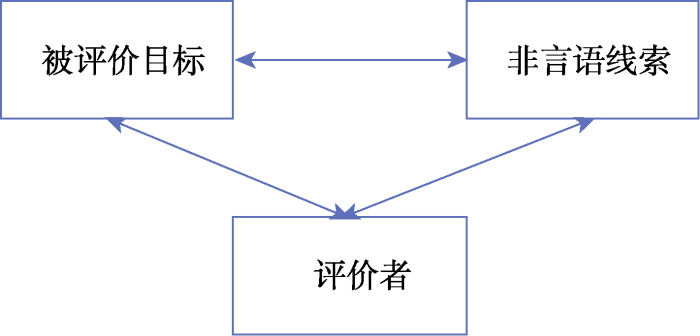
然而, 由于前人大多关注的言语线索(如行为线索)并不是社会性个体, 因此先前的面孔印象更新研究鲜少涉及“评价者与线索之间的社会距离”和“被评价目标与线索之间的社会距离”这两个概念。而本研究关注基于非言语线索的面孔印象更新, 则有必要对“评价者/被评价目标与非言语线索之间的社会距离是否也会对面孔印象更新的结果产生影响?”这一问题进行探索, 这是本研究要探讨的第二个层面的问题。由此, 我们可以将社会距离这一因素拓展到由评价者、被评价目标和线索面孔组成的三元系统中(图1)。
图1
另外, 视觉加工过程中的眼动与潜在的认知过程有关(Henderson et al., 2005), 且眼动技术的时间和空间精度均比较高, 能直观地反馈认知加工过程, 其中注视时长和注视次数这两个最常用的眼动指标与人们在该兴趣区内消耗的认知资源成正比。因此眼动技术在面孔研究领域已经有了非常广泛的应用, 大量研究体现了眼动技术在面孔研究中的应用价值(杜小普, 2023; 史晓露, 2019)。因此, 本研究在采用行为实验的同时, 结合眼动技术, 重点关注被试对于目标面孔和线索面孔各个兴趣区的注视时长和注视次数, 从而在探讨行为模式的基础上, 进一步探索社会距离影响非言语线索面孔印象更新的认知机制。
1.3 问题提出和假设
综上, 以往的印象更新研究大多侧重言语线索而忽略非言语线索, 且评价者/被评价目标与非言语线索之间的社会距离对印象更新的影响及其认知机制也尚不清楚。另外, 面孔可信度是面孔社会知觉的主要维度(Oosterhof & Todorov, 2008), 先前基于言语线索的面孔印象更新研究也多在可信度维度展开。因此, 我们选择在可信度维度开展非言语线索面孔印象更新模式研究, 以更好地与先前的言语线索研究结果进行比较。
本研究采用经典的印象更新范式, 即先将目标单独呈现, 再将目标和非言语线索一起呈现, 以被试的两次目标可信度印象差值作为面孔印象更新的衡量指标, 并在两次评分之间加入想象范式以操纵社会距离(实验1: 评价者−线索社会距离, 实验2: 目标−线索社会距离)。同时结合眼动技术, 为下述3个研究问题提供实证依据。
(1)本研究的第一个问题是, 非言语线索面孔印象更新随目标−线索相似性变化的模式如何?
图2
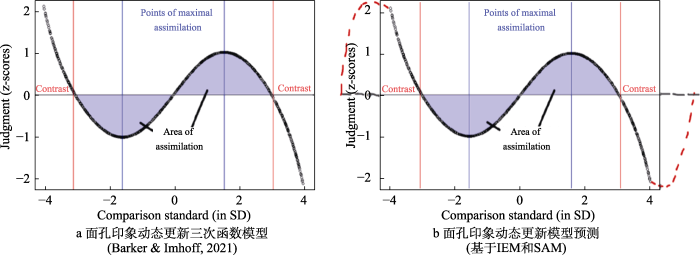
图2
面孔印象动态更新模式示例及模型预测
注: 图中横轴代表线索面孔与目标面孔的初始客观差值(标准差); 纵轴代表线索面孔出现后与出现前, 个体对目标面孔主观印象的差值(Z分数)。结合前述同化/对比效应定义, 线索面孔初始值高于/低于目标面孔, 且目标印象提升/降低, 则为同化效应(图中中间紫色区域); 线索面孔初始值高于/低于目标面孔, 且目标印象降低/提升, 则为对比效应(图中两侧区域)。
对于同化/对比动态变化模式(随着目标−线索差异增大, 同化效应转变成对比效应), 其心理机制可以从不同理论来解释。自我归因理论认为, 个体在面对新的线索信息时, 会倾向于将目标的行为或特征归因于其内在特质或外部情境, 从而影响印象更新。即当个体认为目标与线索具有相似性时, 更可能将线索的特征归因于目标, 产生同化效应; 反之则可能产生对比效应(Jones & Davis, 1965)。参照点理论也表明, 个体在进行判断时会依赖一定的参照点, 在面孔印象更新中, 线索可能成为个体判断目标面孔可信度的参照点, 当目标面孔与线索面孔的差异较小时, 可能产生同化效应, 差异较大时则可能产生对比效应(Kahneman & Tversky, 1979)。也就是说, 非言语线索印象更新的结果究竟是同化效应还是对比效应, 目标和线索之间的相似性起很大作用。
然而, 何婷婷等人(2023)在综合分析了社会评价领域的两个经典理论模型——包含/排除模型(Inclusion/Exclusion Model, IEM, Bless & Schwarz, 2010)和选择性通达模型(Selective Accessibility Model, SAM, Mussweiler, 2003)及后续实证研究(Barker & Imhoff, 2021; Cogan et al., 2013)的基础上, 对面孔印象更新中“目标−线索相似性”的作用提出了更精细的见解: 尽管相似性是主要影响因素, 但目标−线索相似性高/低与同化/对比效应并非简单的对应关系, 即相似性高不一定产生同化效应, 相似性低也不一定产生对比效应。
具体来说, 当个体知觉到目标与线索之间相似时, 倾向于进行相似性检验, 将二者归为一类, 从而形成对目标的表征, 进而产生同化效应, 在一定范围内, 相似性越高同化效应越大。但同化效应并不会无限增大, 当二者的相似性太高时, 即使目标评价完全靠拢线索, 评价也并不会有显著变化, 因此同化效应消失。当个体知觉到目标与线索之间相异时, 倾向于进行相异性检验, 将二者归为两类, 从而形成对比较标准的表征, 进而产生对比效应, 在一定程度上, 相异性越高对比效应也越大。对比效应也不会无限增大, 当二者的相异性太大时, 个体倾向于减少甚至不再与之进行比较, 因此对比效应也消失。因此Barker和Imhoff (2021)得出的三次函数模型(图2a)可能并不准确, 即对比效应并不会无限增大, 而是也会和同化效应一样呈现出一种先增大后减小的模式(模型预测见图2b)。但这也只是一个理论推测, 领域内相关研究也并没有穷尽这种相似性的所有变化范围(何婷婷 等, 2023)。因此, 我们提出第一个假设:
假设1: 非言语线索面孔印象更新随目标−线索相似性变化呈图2b所示的同化对比动态交互模式, 即随着目标−线索相似性降低, 同化效应先增大后减小, 随后转换为对比效应, 随后对比效应也先增大后减小, 但整体变化模式可能受到社会距离等因素的调节。
其中目标−线索相似性为自变量, 以被试在线索面孔呈现前后对目标面孔可信度评分的变化作为因变量来衡量印象更新的大小和方向, 以考察目标−线索相似性对印象更新的影响。同时, 为了更好地验证这个理论预测是否可靠, 本研究在前人研究的基础上进一步将目标−线索相似性的变化范围扩大至±5 SD内。
(2)本研究的第二个问题是, 评价者/目标−线索社会距离如何影响非言语线索面孔印象更新?
基于社会认同理论, 当评价者/目标与线索属于同一群体(社会距离近)时, 会表现出对内群体的偏好, 给予目标更高的可信度评分, 反之则给予较低评分(Tajfel & Turner, 1979)。因此类似于前人在评价者−目标社会距离上得出的跨维度同化, 我们提出第二个假设:
假设2: 评价者/目标−线索社会距离均会对目标面孔可信度印象产生跨维度同化效应, 即评价者/目标−线索社会距离近时, 目标面孔可信度印象提升; 距离远时, 印象降低。
其中评价者/目标−线索社会距离为自变量, 同样以被试在线索面孔呈现前后对目标面孔可信度评分的变化作为因变量来衡量印象更新的大小和方向, 以考察社会距离对印象更新的影响。
(3)本研究的第三个问题是, 社会距离影响非言语线索面孔印象更新的认知机制如何?
鉴于“目标−线索社会距离”与前人明确得出的影响印象更新的主要因素“目标−线索相似性”的操纵对象一致, 预期它对面孔印象更新的作用将是直接的。“评价者−线索社会距离”的作用将更为间接, 且很可能通过影响被试对目标和线索这两个对象之间的关系的感知来实现。因此, 我们提出第三个假设:
假设3: 评价者−线索社会距离通过影响个体对目标和线索的相对注意值(个体对目标和线索各兴趣区的注视时间/注视次数差值, 如眼睛部位的注视时间和注视次数差值)间接影响面孔可信度印象更新; 目标−线索社会距离直接影响面孔可信度印象更新。
我们通过中介效应分析来验证假设3, 其中评价者/目标−线索社会距离为自变量, 印象更新程度为因变量, 目标−线索相对注意值为中介变量, 目标−线索相似性为协变量。实验1先对“评价者−线索社会距离”影响印象更新的机制进行探讨, 实验2则进一步探讨“目标−线索社会距离”的作用是否更为直接。具体体现在结果中预期是“完全中介”和“仅直接效应”的区别。
2 实验1: 基于非言语线索的面孔可信度印象更新及评价者−线索社会距离的影响
2.1 实验目的
实验1探讨基于非言语线索的面孔可信度印象更新随目标−线索相似性变化的动态模式, 并考察评价者−线索社会距离对其的影响。
2.2 实验方法
2.2.1 被试
参与本实验的被试均视力或矫正视力正常(0.8及以上), 近视小于600度, 散光小于150度(近视/散光者佩戴有框眼镜参与实验), 无弱视、斜视, 且未做过激光手术。使用G*Power 3.1, 以3PDe-c × 4ET两因素混合设计[其中PDe-c (Psychological Distance between the Evaluator and the Cue)为评价者−线索的社会距离, 被试间因素; ET (Effect Type)为印象更新效应类型, 被试内因素]计算的最小样本量为15人(f = 0.40, α = 0.05, Power = 0.80) (Cohen, 1988; Faul et al., 2007, 2009)。实验1有效被试为中国人民大学及广州大学的在校生53人(其中女性29人, 优势眼为右眼的31人), 年龄18~28岁(Mage = 19.68岁, SDage = 2.00岁), 分为评价者−线索社会距离近(18人)/对照(17人)/远(18人)三组。本研究获得了中国人民大学心理学系伦理委员会的批准, 编号为22-031。
2.2.2 实验材料及仪器
(1)实验材料
从中国情绪面孔图片库(王妍, 罗跃嘉, 2005)和侯文霞等人(2021)使用的面孔材料中选取280张面孔。所有面孔均为中性情绪的中国女性面孔, 以最大程度减少面孔的性别、种族、情绪等因素对实验结果的干扰, 提高实验的内部效度。正式实验开始前, 预先招募了20名被试(Mage = 21.44岁, SDage = 2.07岁, 其中女性10人)对所选面孔的情绪和可信度进行了0~100的评分(分数越高, 可信度越高), 确保所选面孔材料的情绪均为中性, 而后根据这个可信度评分, 操纵目标面孔和线索面孔的初始可信度差值(记作TCS, Similarity between the Target and the Cue), 目标−线索相似性)在±5 SD内连续变化。
(2)实验仪器
实验程序由E-Prime 3.0软件编写。眼动数据采集仪器是Eyelink Portable Duo, 采样率为1000 Hz, 空间分辨率为1920×1080像素点, 时间分辨率为1 ms。刺激呈现在19英寸、分辨率为1024×768像素的DELL显示器上。实验过程中, 用下巴托固定被试的头部, 保持眼睛与屏幕的距离为70 cm。采用9点校准(calibration)和验证(validation), 对每位被试进行多次校验, 每次校验时记录平均误差, 待平均误差小于1°后, 结束校正过程, 开始实验, 实验过程中记录被试优势眼的数据; 若平均误差一直大于1°, 则视为眼动校准失败, 该被试不进入正式实验。本研究因校准失败排除了少量被试, 这些被试没有进行实验, 不过他们在人口统计学特征上与正式实验被试无显著差异, 因此预计不会对整体数据分析结果产生实质性影响。
2.2.3 实验设计
自变量①为“目标−线索相似性”: 目标面孔初始可信度记为Ttarget, 线索面孔初始可信度为Tcue, 二者的差值即为“目标−线索相似性”, 记作TCS = Ttarget − Tcue, TCS为被试内变量, 操纵其在±5SD内连续变化。根据实际分析的需要, 目标−线索相似性在方差分析部分依据最终的同化对比效应情况转换为效应类型(ET, 上行对比 vs. 上行同化 vs. 下行对比 vs. 下行同化, 被试内)。
自变量②为“评价者−线索社会距离”: 操纵被试感知到的自己与线索之间的社会距离为1、3、4、5、7分, 根据得分划分为社会距离远、近和对照组, 1、3分为社会距离远组, 5、7分为社会距离近组, 4分为对照组。记作PDe-c, 被试间变量。
因变量的行为指标为被试对目标面孔可信度的评分变化: 以目标面孔单独呈现时的可信度评分为基础值T0, 与线索面孔同时呈现时的可信度评分为T1, 可信度评分变化为Tchange = T0 − T1。眼动指标包括注视时间TFD (Total Fixation Duration)和注视次数TFC (Total Fixation Counts),其中, TFD指在单个试次中, 被试注视每个兴趣区的时长(单位: ms); TFC指在单个试次中, 被试注视每个兴趣区的次数(单位: 次)。
2.2.4 实验流程
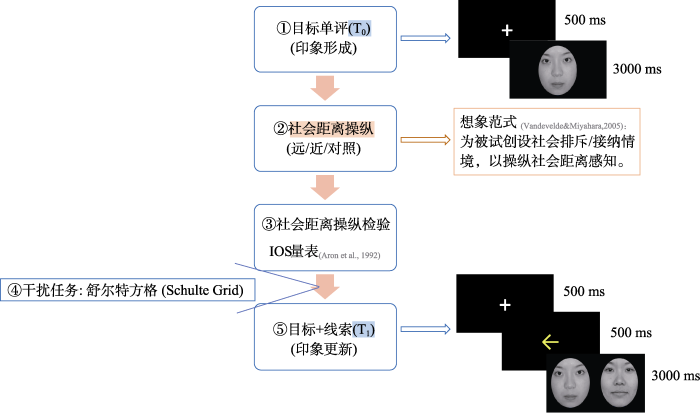
1)目标单评: block1中首先呈现注视点“+” 500 ms, 随后呈现目标面孔3000 ms, 最后呈现0~100的评分轴, 被试要对面孔的可信度进行0~100的评分(T0), 0代表可信度最低, 100代表可信度最高, 评分完成后点击Next即可进入下一个试次。记录眼动数据, 实验前需进行校准。
2)评价者−线索社会距离操纵: block2为评价者−线索社会距离操纵, 采用想象范式, 即营造社会排斥/接纳情境, 以操纵社会距离感知(Vandevelde & Miyahara, 2005)。以往研究操纵社会距离时大多选择“网络掷球范式”、“最简群体范式”等任务(Tajfel et al., 1971; Williams & Jarvis, 2006), 而这些任务一般涉及双方的“交互”。而本研究中涉及需要操纵社会距离的双方并非都是具体的某一个人, 而是一群人; 由于人数较多, 前述方法操纵起来工作量较大, 被试在长时间的任务过程中容易疲劳, 且可能引入其他无关变量。因此, 我们参考Vandevelde和Miyahara (2005)研究中用到的营造特定情境(又称“想象范式”)的方法, 通过让被试发送照片并根据反馈信息来操纵其感知到的自己与线索人物这一群体之间的社会距离, 该方法能够在相对简单的操作过程中有效地引发被试的社会距离感知。
具体流程为: (1)被试参与实验之前, 要求其发送一张照片(证件照)给主试, 告知其仅用于实验; (2) T0结束后, 为被试呈现线索面孔, 让其逐一评定“你在多大程度上愿意与ta成为朋友[1~7分]”, 1代表非常不愿意, 7代表非常愿意; (3)而后告知“前述线索面孔是我们从所有对你的照片也进行过交友意愿评定的人中选出的, 在评定你的照片时均表示愿意与你成为朋友的程度为1/3/5/7的人”, 以此操纵被试感知到的自己与线索这一群体之间的社会距离(评价者−线索社会距离)由远及近, 对照组不进行社会距离操纵。
3)社会距离操纵检验: 填写改编版的IOS量表(Aron et al., 1992)。“圆圈的不同重叠程度代表了你所感受到的自己与线索之间的关系远近, 重叠程度越大表示你们关系越近。重叠程度从“1”到“7”依次增大, “1”表示非常远, “7”表示非常近。请选择最能描述你们之间关系远近的一对圆圈。” 由此对社会距离操纵有效性进行检验。随后休息1分钟。
4)干扰任务: 进入block3之前, 为减弱面孔熟悉性对后续评价的影响, 需先完成一个与实验任务无关的干扰任务, 即舒尔特方格(Schulte Grid): 5×5的25个方格, 1~25的数字随机散布, 要求被试又快又准确地按顺序找出这25个数字。该任务常用于注意力训练(卢宏亮 等, 2021)。
5)印象更新: 如图3所示, block3与block1的区别在于, 呈现注视点“+” 500 ms后, 再呈现“←” / “→” 500 ms以提示下一屏中目标面孔方位, 随后同时呈现目标面孔和线索面孔3000 ms, 最后呈现0~100的评分轴, 被试再次对目标面孔的可信度进行0~100的评分(T1)。同时记录眼动数据。
图3
2.3 结果
2.3.1 评价者−线索社会距离操纵检验
对评价者−线索社会距离近/对照/远三组被试的IOS量表评分进行单因素方差分析。结果显示: 三组被试IOS评分差异显著, F(2, 50) = 15.16, pbonf < 0.001, η2p = 0.38。多重比较(Bonferroni校正)结果显示, PDe-c近组的IOS评分(M = 4.22, SD = 1.17)显著高于PDe-c远组(M = 2.50, SD = 0.79) [pbonf < 0.001], 对照组(M = 3.82, SD = 0.95)介于PDe-c近组与PDe-c远组之间, PDe-c远组评分显著低于PDe-c近组[pbonf < 0.001]和对照组[pbonf < 0.001], 呈现出PDe-c近>对照组> PDe-c远的模式。这个结果表明对评价者−线索社会距离的操纵有效。
2.3.2 行为结果
图4
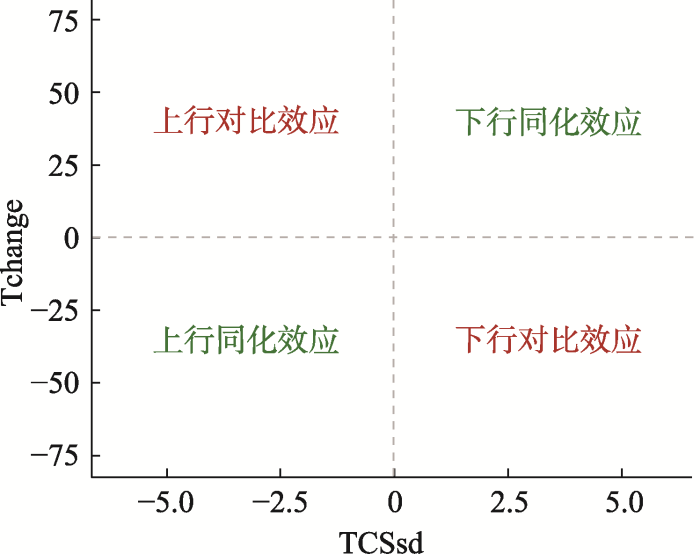
图5
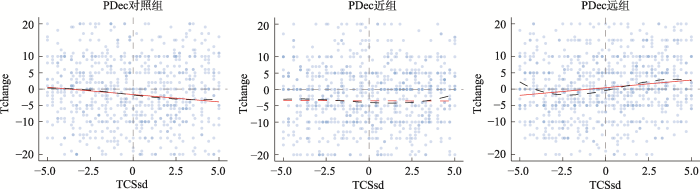
①对照组: Tchange与TCS呈显著线性关系[p = 0.017], 回归线斜率为负。当TCS > 0时, 表现为下行对比效应, 且对比效应均随TCS增大而增大; 当TCS < 0 时, 随TCS (绝对值)增大, 上行同化效应逐渐减小, 并转化为上行对比效应。
②PDe-c远组: Tchange与TCS呈三次函数关系[p = 0.050]。TCS > 0时, 表现出同化对比动态交互, 随TCS增大, 同化效应先增大后减小, 进而转换为对比效应; 同样地, TCS < 0时, 表现出同化对比动态交互, 随TCS增大(绝对值), 同化效应先增大后减小, 进而转换为对比效应。
③PDe-c近组: Tchange与TCS之间无显著相关关系。TCS > 0时, 呈现下行对比效应趋势; TCS < 0时, 呈现上行同化效应趋势。
由于目标−线索相似性这一自变量是连续变量, 水平较多, 基本上一个试次就是TCS的一个水平, 因此下面的分析采用基于试次的数据。分别对三组被试的Tchange做单样本t检验, 结果显示PDe-c近时个体对目标面孔的可信度印象变得更好(M = −3.48, SD = 14.56) (Tchange < 0, t(917) = −7.24, pbonf <0.001, Cohen’s d = −0.24); 对照组个体对目标面孔的可信度印象也变得更好(M = −1.69, SD = 15.27) (Tchange < 0, t(866) = −3.246, pbonf = 0.004, Cohen’s d = −0.11); PDe-c远时个体对目标面孔的可信度印象则变差(M = 0.44, SD = 12.56) (Tchange > 0, t(509) = −0.15, pbonf = 0.852, Cohen’s d = 0.04)。即总体上看, PDe-c对目标面孔的可信度印象产生了跨维度同化。
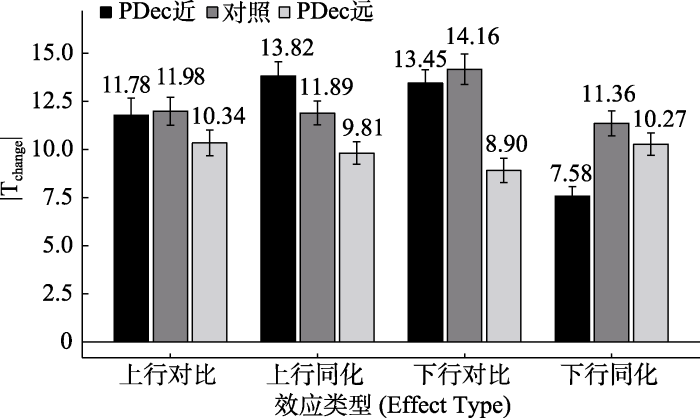
进一步将效应划分为上行对比/上行同化/下行对比/下行同化后, 对Tchange的绝对值(即印象更新程度)进行3 (PDe-c: 远 vs. 对照 vs. 近) × 4 (ET: 上行对比 vs. 上行同化 vs. 下行对比 vs. 下行同化)的两因素重复测量方差分析, 其中ET为被试内因素、PDe-c为被试间因素。当重复测量因素违反球形假设时, 采用Greenhouse-Geisser校正调整自由度, 本文报告的p值及自由度均基于校正后的结果。对于显著或边缘显著的主效应与交互作用, 进一步采用Bonferroni校正的事后配对比较进行简单效应分析。结果显示(图6)PDe-c和ET交互作用显著, F(5.49, 134.41) = 2.68, p = 0.021, η2p = 0.10。简单效应分析结果(Bonferroni校正)表明, PDe-c近组的下行对比效应(13.45)大于PDe-c远组(8.90) (p = 0.053, 边缘显著)。也就是说, 相较于PDe-c远组, PDe-c近使得目标可信度印象被提高地更多。
图6
2.3.3 眼动结果
图7
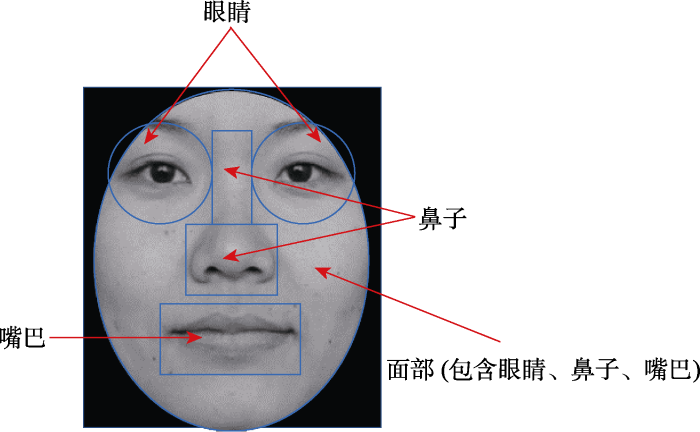
对于T0的眼动数据, 以兴趣区(眼睛、鼻子、嘴巴)为自变量, 分别对总注视时间和总注视次数进行了单因素方差分析。结果显示(表1): ①总注视时间: 被试对三个兴趣区的总注视时间差异显著, F(1.90, 60.95) = 7.13, p = 0.002, η2p = 0.16。多重比较(Bonferroni校正)结果显示, 对嘴巴的总注视时间(M =758, SD = 745)显著短于鼻子(M =1430, SD = 982) [p < 0.001]和眼睛(M = 1166, SD = 910) [p = 0.08, 边缘显著], 眼睛和鼻子差异不显著。②总注视次数: 被试对三个兴趣区的总注视次数差异也显著, F(1.79, 57.17) = 13.11, p < 0.001, η2p = 0.27。多重比较(Bonferroni校正)结果显示, 对嘴巴的总注视次数(M = 2.38, SD = 2.17)显著少于眼睛(M = 4.15, SD = 3.46) [p = 0.02]和鼻子(M = 5.34, SD = 3.34) [p < 0.001], 眼睛和鼻子差异不显著。即当前研究结果显示, 在T0阶段, 被试对鼻子和眼睛的注视时间及次数均多于嘴巴。嘴巴在可信度判断中的作用相对较弱, 因此被试对其注视较少, 这与前人研究相符。这种注视模式与面孔可信度判断的心理机制相关联, 表明中国被试在形成面孔可信度印象时的确会更关注眼、鼻区域。
表1 实验1-T0眼动数据描述性统计表
| 兴趣区 | 总注视时间(ms)[M ± SD] | 总注视次数(次)[M ± SD] |
|---|---|---|
| 鼻子 | 890.00 ± 656.00 | 3.33 ± 2.16 |
| 眼睛 | 726.00 ± 637.00 | 2.59 ± 2.31 |
| 嘴巴 | 472.00 ± 571.00 | 1.48 ± 1.66 |
对于T1的眼动数据, 分别对总注视时间和总注视次数进行了3 (PDe-c: 远 vs. 近 vs. 对照组) × 2 (兴趣区: 目标面孔 vs. 线索面孔)的重复测量方差分析, 结果显示(表2): ①总注视时间: PDe-c主效应显著, F(2, 2700) = 4.16, pbonf = 0.016, η2p = 0.001; 兴趣区主效应显著, F(1, 2700) = 6472.46, pbonf < 0.001, η2p = 0.653; 交互作用不显著, F(2, 2700) = 0.40, p = 0.669。简单效应分析结果显示: 在三种PDe-c条件下, 兴趣区主效应均显著, 且个体对于目标面孔的总注视时间均长于线索面孔[psbonf < 0.001]。②总注视次数: PDe-c主效应显著, F(2, 2700) = 40.29, pbonf < 0.001, η2p = 0.01; 兴趣区主效应显著, F(1, 2700) = 5479.70, pbonf < 0.001, η2p = 0.57; 交互作用显著, F(2, 2700) = 14.71, pbonf < 0.001, η2p = 0.01。简单效应分析结果显示: 在三种PDe-c条件下, 个体对于目标面孔的总注视次数均多于线索面孔[psbonf < 0.001]。总结来看, 当前研究结果显示, 在印象更新过程中(目标面孔和线索面孔同时呈现时), 相比于线索面孔, 个体更多关注目标面孔。
表2 实验1-T1眼动数据描述性统计表
| PDe-c组别 | 兴趣区 | 总注视时间(ms) [M ± SD] | 总注视次数(次) [M ± SD] |
|---|---|---|---|
| 近 | 目标面孔 | 1884 ± 633 | 7.50 ± 2.74 |
| 线索面孔 | 383 ± 422 | 1.73 ± 1.85 | |
| 远 | 目标面孔 | 1911 ± 628 | 6.64 ± 2.51 |
| 线索面孔 | 399 ± 427 | 1.69 ± 1.83 | |
| 对照 | 目标面孔 | 1904 ± 632 | 6.60 ± 2.66 |
| 线索面孔 | 432 ± 480 | 1.61 ± 1.76 |
2.3.4 行为−眼动联合分析结果
采用Hayes (2018)提供的SPSS Process 4.1插件, 选择模型4。以评价者−线索社会距离(PDe-c)为自变量、印象更新程度(|Tchange|)为因变量、目标−线索相对注意值(目标、线索面孔各兴趣区的相对TFD、TFC, 即目标线索的眼动指标之间的差值“目标−线索”)为中介变量、目标−线索相似性(|TCS|)为协变量, 运用Bootstrap抽样的方法对中介效应进行检验, 设置重复样本为5000次, 计算95%置信区间, 若不包含0, 则间接效应成立, 检验水准为α = 0.05。其中仅TFCTmouth-Cmouth (目标−线索嘴巴相对注视次数)的中介效应显著, Effect = −0.162, 95% CI [−0.371, −0.006]。同时, 模型的直接效应不显著。这表明, TFCTmouth-Cmouth在PDe-c和|Tchange|之间起完全中介作用。
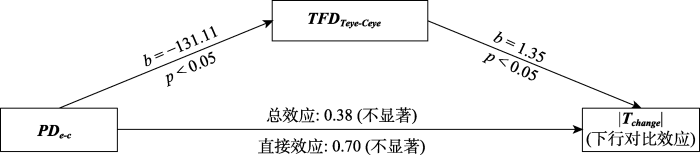
进一步将印象更新按照结果划分为上行对比、上行同化、下行对比、下行同化效应后, 分别进行上述中介效应检验, 结果显示TFDTeye-Ceye (目标−线索眼睛相对注视时间)对于PDe-c和下行对比效应程度的中介效应显著, Effect = −0.239, 95% CI [−0.572, −0.005], 且直接效应不显著。这表明, TFDTeye-Ceye在 PDe-c和|Tchange|(下行对比效应程度)之间起完全中介作用(具体路径系数见图8), 其他三种效应类型下均未出现显著的中介效应。即当前研究结果显示, PDe-c通过目标和线索眼睛相对注意值影响|Tchange|, 且主要体现在印象提升程度(下行对比效应)上: 评价者−线索社会距离越近, 个体对目标和线索眼睛的注视时间差值越小, 可信度印象提升程度越小。
图8
2.4 讨论
实验1结果表明:
第一, 综合评价者−线索社会距离(PDe-c)远/近/对照组三组被试来看, Tchange随TCS变化过程中, 同化效应和对比效应均出现, 效应大小随TCS产生规律的动态变化。且仅评价者−线索社会距离远组的面孔可信度印象更新(Tchange)随目标−线索相似性(TCS)变化的模式呈现预期的三次函数模式, 与前人研究中评价者与线索并无社会关系时所得出的结果模式高度一致(Barker & Imhoff, 2021)。
第二, 总体上看, 评价者−线索社会距离对可信度印象产生了跨维度同化, 即PDe-c近时可信度印象变好, PDe-c远时可信度印象变差, 这与前人对评价者−目标社会距离的研究结果一致(王一漫 等, 2023)。但有趣的是, 评价者−线索社会距离也对可信度印象产生了跨维度对比效应, 即PDe-c近时可信度印象变差和PDe-c远时可信度印象变好, 且PDe-c近组下行对比效应大于PDe-c远组, 即PDe-c近使目标可信度印象提升程度更大。
第三, 眼动结果显示, 个体对面孔可信度的判断主要来自眼、鼻区域; 目标和线索面孔同时呈现时, 个体对目标的注视远多于线索。
第四, 个体对目标和线索眼睛部位的相对注意值(TFDTeye-Ceye)在评价者−线索社会距离和面孔可信度印象更新程度(|Tchange|, 下行对比效应的大小)之间起完全中介作用: 个体自己与线索之间的社会距离越近, 其对目标(眼睛)的相对注视越少, 进而目标可信度印象提升程度越小。这个结果再次验证眼睛对于面孔可信度判断的重要性。这还表明, 评价者−线索社会距离可能是通过影响被试对目标和线索之间的关系的感知而对面孔可信度印象更新起作用的, 即其作用较为间接。
因此, 基于以上实验1的结果, 为进一步考察目标−线索社会距离在面孔印象更新中的作用机制, 接下来, 实验2直接研究目标和线索之间的社会距离对面孔可信度印象更新的影响, 以检验其作用是否更为直接。
3 实验2: 目标−线索社会距离对基于非言语线索的面孔可信度印象更新的影响
3.1 实验目的
在实验1得出“评价者−线索社会距离只能通过目标−线索相对注意值而间接作用于面孔可信度印象更新”的基础上, 实验2直接研究目标和线索之间的社会距离对面孔可信度印象更新的影响, 以检验其作用是否更为直接。
3.2 实验方法
3.2.1 被试
参与本实验的被试均视力或矫正视力正常(0.8及以上), 近视小于600度, 散光小于150度(近视/散光者佩戴有框眼镜参与实验), 无弱视、斜视, 且未做过激光手术。样本量计算同实验1。实验2有效被试为中国人民大学及广州大学的在校生51人(其中女性33人, 优势眼为右眼的29人), 年龄18~28岁(Mage = 20.31, SDage = 2.81), 分为目标−线索社会距离近(17人)/对照(17人)/远(17人)三组。
3.2.2 实验材料及仪器
同实验1。
3.2.3 实验设计
自变量为目标−线索相似性(TCS, 连续变量, 被试内)和目标−线索社会距离(PDt-c, 远vs.近vs.对照, 被试间)。目标−线索社会距离指被试感知到的目标与线索之间的社会距离。根据实际分析的需要, 目标−线索相似性在方差分析部分依据最终的同化对比效应情况转换为效应类型(ET, 上行对比 vs. 上行同化 vs. 下行对比 vs. 下行同化, 被试内)。因变量的行为指标为被试对目标面孔可信度的评分变化(Tchange), 眼动指标包括TFD和TFC。
3.2.4 实验流程
实验2的流程与实验1基本一致, 即目标单评→社会距离操纵→社会距离操纵检验→干扰任务→印象更新(图3)。区别在于, 实验2在block2操纵的是被评价目标−线索社会距离。其具体流程为: T0结束后, 以指导语的形式告知被试“目标和线索这两个群体在评定对方照片时[1~7分], 均表示愿意与之成为朋友的程度为1/3/5/7, 1代表非常不愿意, 7代表非常愿意”, 以此操纵被试感知到的目标和线索这两个群体之间的社会距离(目标−线索社会距离)由远及近, 对照组不进行社会距离操纵。
3.3 结果
3.3.1 目标−线索社会距离操纵检验
对目标−线索社会距离近/对照/远三组被试的IOS量表评分进行单因素方差分析。结果显示: 三组被试IOS评分差异显著, F(2, 48) = 41.09, pbonf < 0.001, η2p = 0.631。多重比较(Bonferroni校正)结果显示, PDt-c近组的IOS评分(M = 5.29, SD = 0.92)显著高于PDt-c远组(M = 2.24, SD = 1.03) [pbonf < 0.001], 对照组(M = 3.53, SD = 1.01)介于PDt-c近组与PDt-c远组之间, PDt-c远组评分显著低于PDt-c近组[pbonf < 0.001]和对照组[pbonf < 0.001], 呈现出PDt-c近>对照组>PDt-c远的模式。这个结果表明对目标−线索社会距离的操纵有效。
3.3.2 行为结果
图9
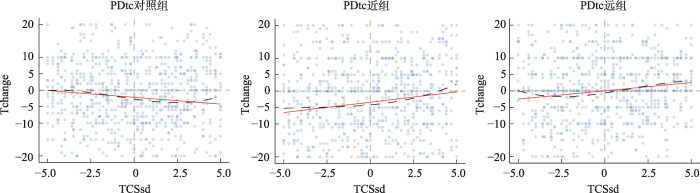
①对照组: Tchange与TCS呈显著线性关系[p = 0.025], 回归线斜率为负。当TCS > 0时, 表现为下行对比效应, 且对比效应均随TCS增大而增大; 当 TCS < 0 时, 随TCS (绝对值)增大, 上行同化效应逐渐减小, 并转化为上行对比效应。
②PDt-c远组: Tchange与TCS呈线性关系[p = 0.001]。回归线斜率为正, 整体表现为同化效应。TCS > 0时, 表现为下行同化效应, 且同化效应随TCS增大而增大; TCS < 0时, 表现为上行同化效应, 且同化效应随TCS (绝对值)增大而增大。
③PDt-c近组: Tchange与TCS呈线性关系[p = 0.002], 回归线斜率为正。当TCS > 0时, 表现为下行对比效应, 且对比效应均随TCS增大而增大; 当TCS < 0时, 表现为上行同化效应, 且同化效应均随TCS (绝对值)增大而增大。
分别对三组被试的Tchange做单样本t检验, 结果显示PDt-c近时个体对目标面孔的可信度印象变得更好(M = −3.37, SD = 16.78) (Tchange < 0, t(866) = −6.55, pbonf < 0.001, Cohen’s d = −0.20); 对照组个体对目标面孔的可信度印象也变得更好(M = −2.16, SD =14.97) (Tchange < 0, t(866) = −1.94, pbonf < 0.001, Cohen’s d = −0.14); PDt-c远时个体对目标面孔的可信度印象则变差(M = 0.01, SD = 12.79) (Tchange > 0, 趋势如此, 但不显著)。即整体来看, PDt-c也对目标面孔可信度印象产生了跨维度同化。
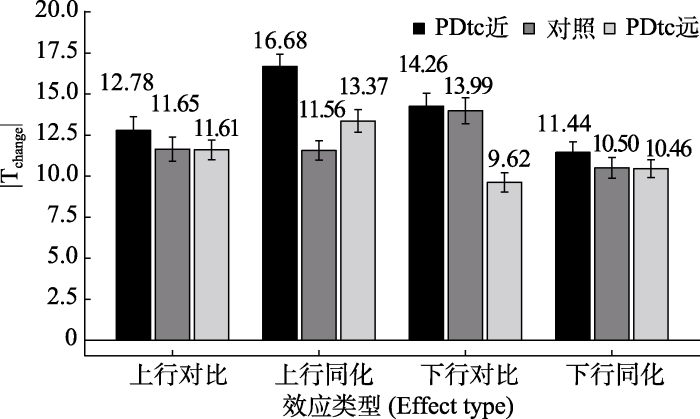
进一步将效应划分为上行对比/上行同化/下行对比/下行同化后, 对Tchange的绝对值(即印象更新程度)进行3 (PDt-c: 远 vs. 对照 vs. 近) × 4 (ET: 上行对比 vs. 上行同化 vs. 下行对比 vs. 下行同化)的两因素重复测量方差分析, 其中ET为被试内因素、PDt-c为被试间因素。结果显示(图10), PDt-c和ET交互作用显著, F(5.43, 124.90) = 3.97, p = 0.002, η2p = 0.15。简单效应分析结果(Bonferroni校正)表明, PDt-c近组的下行对比效应(14.26)显著大于PDe-c远组(9.62) (p = 0.007), 即相较于PDt-c远组, PDt-c近也使得目标可信度印象的提升程度更大。
图10
3.3.3 眼动结果
同实验1, 对于T0的眼动数据, 以兴趣区为自变量, 分别对总注视时间和总注视次数进行了单因素方差分析。结果显示(表3): ①总注视时间: 被试对三个兴趣区的总注视时间差异显著, F(1.65, 70.88) =15.91, p < 0.001, η2p = 0.26。多重比较(Bonferroni校正)结果显示, 对鼻子的总注视时间(M = 1113, SD = 863)显著长于眼睛(M = 693, SD = 606) [p = 0.006]和嘴巴(M = 514, SD = 623) [p < 0.001]。②总注视次数: 被试对三个兴趣区的总注视次数差异也显著, F(1.72, 74.09) = 26.54, p < 0.001, η2p = 0.33。多重比较(Bonferroni校正)结果显示, 对嘴巴的总注视次数(M = 1.70, SD = 1.80)显著少于鼻子(M = 4.07, SD = 2.76) [p < 0.001]和眼睛(M = 2.51, SD = 2.15) [p = 0.012]。同实验1一致, 这表明中国被试在形成面孔可信度印象时的确会更关注眼、鼻区域。
表3 实验2-T0眼动数据描述性统计表
| 兴趣区(IA) | 总注视时间(ms) [M ± SD] | 总注视次数(次) [M ± SD] |
|---|---|---|
| 鼻子 | 961.00 ± 673.00 | 3.52 ± 2.12 |
| 眼睛 | 598.00 ± 568.00 | 2.16 ± 2.03 |
| 嘴巴 | 443.00 ± 536.00 | 1.46 ± 1.58 |
对于T1的眼动数据, 分别对总注视时间和总注视次数进行了3 (PDt-c: 远 vs. 近 vs. 对照组) × 2 (IA: 目标面孔 vs. 线索面孔)的重复测量方差分析, 结果显示(表4): ①总注视时间: PDt-c主效应显著, F(2, 2598) = 12.12, p < 0.001, η2p = 0.002; 兴趣区主效应显著, F(1, 2598) = 4438.63, p < 0.001, η2p = 0.58; 交互作用显著, F(2, 2598) = 24.90, p < 0.001, η2p = 0.02。简单效应分析结果显示: 在三种PDt-c条件下, 个体对于目标面孔的总注视时间均长于线索面孔[ps < 0.001], 且对照组的目标−线索注视时间差异最大。②总注视次数: PDt-c主效应显著, F(2, 2598) = 18.89, p < 0.001, η2p = 0.01; 兴趣区主效应显著, F(1, 1374) = 1826.61, p < 0.001, η2p = 0.57; 交互作用显著, F(1, 2598) = 3941.29, p < 0.001, η2p = 0.51。简单效应分析结果显示: 在三种PDt-c条件下, 个体对于目标面孔的总注视次数均多于线索面孔[ps < 0.001], 且对照组的目标−线索注视次数差异也最大。同实验1一致, 当前研究结果显示, 在印象更新过程中, 相比于线索面孔, 个体更多关注目标面孔。
表4 实验2-T1眼动数据描述性统计表
| PDt-c组别 | 兴趣区 | 总注视时间(ms) [M ± SD] | 总注视次数(次) [M ± SD] |
|---|---|---|---|
| 近 | 目标面孔 | 1693 ± 637 | 6.55 ± 2.53 |
| 线索面孔 | 524 ± 486 | 2.13 ± 1.96 | |
| 远 | 目标面孔 | 1737 ± 546 | 6.77 ± 2.69 |
| 线索面孔 | 535 ± 497 | 2.21 ± 2.03 | |
| 对照 | 目标面孔 | 1904 ± 632 | 6.60 ± 2.66 |
| 线索面孔 | 432 ± 480 | 1.61 ± 1.76 |
3.3.4 行为−眼动联合分析结果
同实验1, 以目标−线索社会距离(PDt-c)为自变量、印象更新程度(|Tchange|)为因变量、目标−线索相对注意值为中介变量、目标−线索相似性(|TCS|)为协变量, 进行中介效应检验。结果显示, 各目标−线索相对注意值的中介效应均不显著, 总直接效应不显著。
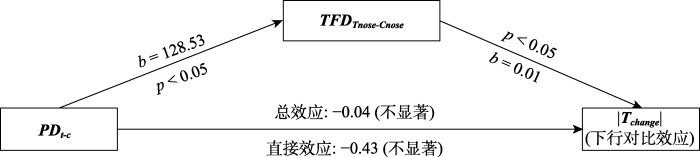
进一步将印象更新按照结果划分为上行对比、上行同化、下行对比、下行同化效应后, 分别进行上述中介效应检验, 结果显示, TFDTnose-Cnose (目标−线索鼻子相对注视时间)对于PDe-c和下行对比效应程度的中介效应显著, Effect = 0.743, 95% CI [0.313,1.440], 且直接效应不显著。这表明, TFDTnose-Cnose在PDt-c和|Tchange| (下行对比效应程度)之间起完全中介作用(具体路径系数见图11), 其他三种效应类型下均未出现显著的中介效应。即当前研究结果显示, PDt-c通过目标和线索鼻子相对注意值对|Tchange|产生影响, 且主要体现在印象提升程度(下行对比效应)上: 目标−线索社会距离越近, 个体对目标和线索鼻子的注视时间差值越大, 可信度印象提升程度越大。
图11
3.4 讨论
实验2结果表明:
第一, 综合目标−线索社会距离(PDt-c)远/近/对照组三组被试来看, Tchange随TCS变化过程中, 同化效应和对比效应均出现, 效应大小随TCS产生规律的动态变化。
第二, 总体上看, 目标−线索社会距离也对可信度印象产生了跨维度同化, 即PDt-c近时可信度印象变好, PDt-c远时可信度印象变差, 这与王一漫等人(2023)对评价者−目标社会距离的研究结果及实验1对评价者−线索社会距离的结果一致。同实验1类似, 目标−线索社会距离也对可信度印象产生跨维度对比效应, 即存在PDt-c近时可信度印象变差和PDt-c远时可信度印象变好的情况, 且PDt-c近组的下行对比效应大于PDt-c远组, 即PDt-c近使目标可信度印象提升程度更大。
第三, 类似于实验1, 眼动结果显示, 个体对面孔可信度的判断主要来自眼、鼻区域; 目标和线索面孔同时呈现时, 个体对目标的注视远多于线索。
第四, 不同于实验1, 实验2中目标−线索社会距离和面孔可信度印象更新程度(|Tchange|, 下行对比效应的大小)之间的完全中介作用, 是由个体对目标和线索鼻子部位的相对注意值(TFDTeye-Ceye)起的: 个体感知到的目标和线索之间的社会距离越近, 其对目标(鼻子)的相对注意越多, 进而目标可信度印象提升程度越大。这个结果也验证了鼻子对于面孔可信度判断同样重要。
这表明, 相较于评价者−线索社会距离, 目标−线索社会距离对面孔可信度印象更新的影响并非更为直接, 而是从由眼睛中介, 转换为由鼻子中介, 这两个部位均为面孔可信度判断的重要部位。
4 综合讨论
实验1和实验2均关注社会距离对非言语线索面孔印象更新的影响, 但在操控社会距离的主体上有所不同, 分别为评价者−线索社会距离和目标−线索社会距离。二者都发现了社会距离对目标面孔可信度印象产生跨维度同化效应, 且都观察到了同化对比动态变化模式的存在。然而, 在具体的作用机制上存在差异。综合两个实验的结果, 本研究发现: 第一, 区别于前人言语线索研究普遍发现的同化效应, 非言语线索对面孔可信度的印象更新呈现出同化对比动态变化的模式(图5和图9)。第二, 评价者/目标−线索社会距离总体上均对面孔可信度印象产生跨维度同化效应, 但具体来看, 跨维度对比效应同样存在(图6和图10)。第三, 评价者−线索社会距离和目标−线索社会距离均只能通过“目标−线索相对注意值” (前者通过眼睛、后者通过鼻子)来间接影响面孔可信度印象更新, 且二者均主要影响可信度印象提升程度(图8和图11)。
4.1 非言语线索面孔印象更新的模式
对于本研究的第一个研究问题, “非言语线索面孔印象更新随目标−线索相似性变化的模式如何”, 两个实验的结果均表明, 非言语线索对面孔可信度的印象更新整体上呈同化与对比动态变化的模式, 但具体的模式在不同社会距离条件下并不稳定。
仅在评价者−线索社会距离远组中, 被试表现出了符合预期且与Barker和Imhoff (2021)在无社会关系情境中所得到的更新模式一致的: 由同化向对比转换的三次函数动态更新模式。相比之下, 其他条件下的模式则均有所不同。基于当前研究结果和已有前人研究, 模式差异除社会距离因素外, 还可能受到目标面孔类型的影响。本研究的目标面孔混合了高、中、低三种可信度面孔类型, 而Barker和Imhoff (2021)则控制了目标面孔为中等可信度面孔。侯文霞等(2021)在吸引力维度的研究发现, 高吸引力目标的同化对比动态交互模式较为特殊。而同一张面孔的吸引力和可信度评分高度相关(Calvo et al., 2018)。这些前人研究结果进一步支持了目标面孔类型影响同化对比动态交互模式的观点。除此之外, 前人在神经层面也早已发现高目标的确存在特殊性, 如, 高吸引力面孔诱发出的N170波幅更大、潜伏期更短; 且被试做决策时, 高吸引力面孔诱发的N2波幅更负, 即高吸引力面孔会分走更多的注意资源(黄华炎, 2016; 罗一峰 等, 2006)。高目标的注意分配优势有可能也是影响印象更新模式的一个重要因素。未来应精细操纵面孔类型以探讨其对印象更新的具体作用。
4.2 社会距离对非言语线索面孔印象更新的影响
对于本研究的第二个研究问题, “评价者/目标−线索社会距离如何影响非言语线索面孔印象更新”, 实验1、2的结果表明, 评价者−线索社会距离和目标−线索社会距离均对目标可信度印象产生跨维度同化效应, 这与王一漫等人(2023)的研究发现一致。但具体来看, 也存在评价者/目标−线索社会距离对可信度印象的跨维度对比效应。
4.2.1 社会距离对面孔可信度印象的跨维度同化效应
总体来看, 评价者/目标−线索社会距离近时, 个体对目标的可信度印象相比其单独呈现时均变好了(Tchange < 0), 评价者/目标−线索社会距离远时则均变差了(Tchange > 0)。即评价者−线索社会距离和目标−线索社会距离整体上均对面孔可信度产生了跨维度同化效应, 这支持了我们的研究假设2, 也与前人对评价者−目标社会距离的研究结果类似。那么, 评价者/目标−线索社会距离为什么会对面孔可信度产生跨维度同化呢?
根据解释水平理论, 社会距离较远时, 个体对事物的表征更抽象、更核心; 社会距离较近时, 表征更具体、更细节(Trope & Liberman, 2010)。而对于面孔加工, 有研究表明, 相较于细节加工, 整体加工会使得个体对面孔的印象更好(田欣然 等, 2021)。因此, 在当前研究中出现社会距离对面孔可信度产生跨维度同化效应的心理机制可能是: 当被试/目标与线索之间的社会距离较远时, 个体对线索的表征可能会更抽象、更笼统, 而更多的认知资源则放到了对目标面孔的更为精细的加工上(细节表征), 从而使得目标面孔上的细节/瑕疵被更多看到, 因此降低了对其的可信度印象。相反, 当被试/目标与线索之间的社会距离较近时, 个体对线索的表征可能会更具体、更细节, 因此分到目标面孔加工上的认知资源相应减少, 从而对目标面孔的加工更为抽象、笼统(整体表征), 因此对目标的可信度印象提高。
结合认知神经科学研究来看, 社会距离可能通过调节杏仁核的自动化反应与前额叶皮层的认知控制过程, 来对可信度产生跨维度同化作用。具体而言, 当被试/目标与线索的社会距离较远时, 个体对线索进行抽象表征, 此时杏仁核可能更容易被激活并对目标面孔中潜在的“威胁性”或“不可信”等细节特征做出敏感反应, 从而降低对目标面孔的可信度评价(Engell et al., 2007)。相反, 社会距离较近时, 个体对线索进行更具体的表征, 前额叶皮层(尤其是腹内侧前额叶和背外侧前额叶)可能参与调节情绪反应, 抑制杏仁核的激活, 并促进对目标面孔整体性的积极加工, 从而提高目标面孔的可信度印象(Lieberman et al., 2007)。Brambilla等人(2021)的研究也提出, 基于面孔的信任评估涉及一个分布式的脑网络, 其中杏仁核参与低水平的、细节的面孔特征并编码信任值, 而前额叶区域则参与高水平的、整合型的信任判断。因此, 社会距离可能通过调制“杏仁核−前额叶”功能回路的动态平衡, 进而对面孔可信度产生跨维度同化效应。因此, 未来研究可以加入脑电、核磁等技术, 以进一步探索面孔印象更新的神经生理机制。
除解释水平理论之外, 评价者与线索的社会距离影响目标印象更新的另一种可能机制是“社会距离的泛化效应”。当评价者与线索的社会距离近时, 二者的积极社会联结可能被“泛化”或迁移到与线索同时出现的目标上, 从而对目标产生更积极的可信度评价(即“爱屋及乌”); 而当评价者与线索的社会距离远时, 则可能产生连带的消极评价。侯文霞等人(2021)的研究为此提供了一种相近的解释: 物理距离的接近可能使观察者将线索与目标视为同一群体, 从而影响评价。因此, 未来在研究评价者−线索社会距离时可以加入评价者−目标社会距离的前后测, 以检验评价者−线索社会距离是否会“泛化”到评价者−目标之间。同时, 评价者−线索社会距离还可能先通过影响评价者感知到的线索面孔的可信度(Tajfel & Turner, 1979; Turner et al., 1987), 进而影响评价者感知到的目标−线索相似性, 最终才影响到目标面孔评价的。因此, 未来研究可以再追加一个线索单评的前后测, 看评价者对线索的评价在社会距离操纵后是否确实发生了相应的变化, 以验证前述可能是否真实存在。
当前研究由于需操纵目标−线索相似性在大范围内变化, 面孔材料需求量较大, 故采用营造社会排斥/社会接纳情境的方式, 来操纵被试所感知到的目标与线索之间的社会距离。受限于这一社会距离操纵方式, 前述跨维度同化效应还可能与一些其他因素有关。首先, 从锚定效应的角度来看, 我们得出的跨维度同化效应的心理机制还可能是: 当被试/目标与线索之间的社会距离远时, 由于该远社会距离是我们通过营造社会排斥情境而得来的, 因此可能导致被试形成一个负面的认知锚点, 进而导致可信度印象变得更低; 相反, 当被试/目标与线索之间的社会距离近时, 我们营造的社会接纳情境则可能会导致被试形成一个正面的认知锚点, 进而导致可信度印象更好(Trope & Liberman, 2010; Yudkin et al., 2020)。其次, 社会排斥/社会接纳行为有可能会影响到被试对目标的亲社会性的感知(林培钿, 2023), 从而可能造成实验结果并非纯粹是社会距离的作用。因此, 未来研究在操纵社会距离时, 应注意控制其他因素的影响, 采用更为纯粹地的方式来操纵社会距离。
此外, 社会排斥和接纳情境还可能诱发不同的情绪。不论评价者自身卷入(评价者−线索)与否(目标−线索), 直接或替代性社会排斥(即看到别人被社会排斥)都会导致消极情绪增强, 积极情绪减弱(杨晓莉, 邹妍, 2020; Cuadrado et al., 2021; Giesen & Echterhoff, 2018), 而消极情绪则可能会造成任务厌恶(童廷婷 等, 2024), 从而导致社会排斥情境下(即社会距离远时), 被试对目标的印象降低; 直接或替代性社会接纳的影响方向则相反。因此, 当前研究中社会距离对面孔可信度的跨维度同化效应, 可能部分源于此情绪路径。然而, 对社会距离这类具有较强社会性的变量的操纵难以完全避免情绪的影响, 如何在未来研究中更纯粹地操纵, 仍面临挑战。
4.2.2 社会距离对面孔可信度印象的跨维度对比效应
具体来看, 评价者/目标−线索社会距离近时的目标可信度印象比其初评时变差(上行对比或下行同化, Tchange > 0)和远时变好(上行同化或下行对比, Tchange < 0)的情况也存在, 即存在评价者−线索社会距离和目标−线索社会距离对面孔可信度的跨维度对比效应。
结合当前研究中整体和具体的情况来看, 评价者/目标−线索社会距离近和远组内部均同时存在印象提升和降低的情况, 但评价者/目标−线索社会距离近时, 目标可信度印象整体上是提升的; 社会距离远时, 目标可信度印象整体上是降低的。基于这些研究结果可推测, 评价者/目标−线索社会距离近时, 目标可信度印象提升的程度是大于降低程度的; 评价者/目标−线索社会距离远时, 目标可信度印象降低的程度是大于提升程度的。的确, 当前研究结果也显示, 评价者−线索社会距离近组的下行对比效应大于远组; 目标−线索社会距离近组的下行对比效应也大于远组。也就是说, 评价者/目标−线索社会距离整体上对目标可信度的跨维度同化效应, 并不能否定非言语线索对目标可信度印象的影响, 而是说明, 社会距离会影响非言语线索对目标面孔可信度的印象更新程度。
那么, 前述两种社会距离具体是通过什么样的机制来影响非言语线索对目标面孔可信度印象的更新的呢?当前研究中对行为数据和眼动数据的联合分析为其提供了可能的解释。
4.3 社会距离影响非言语线索面孔印象更新的认知机制
对于本研究的第三个研究问题, “社会距离影响非言语线索面孔印象更新的认知机制如何”, 行为和眼动数据的联合分析结果表明, 评价者−线索社会距离和目标−线索社会距离均只能通过“目标−线索相对注意值”来间接影响面孔可信度印象更新, 二者分别通过眼睛和鼻子来中介, 且二者均主要影响可信度印象提升程度。
实验1发现, 评价者−线索社会距离需要通过影响个体对目标和线索(眼睛)的相对注意值才能间接影响面孔可信度印象更新: 个体自己与线索之间的社会距离越近, 其对目标(眼睛)的相对注视越少, 进而目标可信度印象更新程度越小。这可能与社会归属感和认知资源分配的差异有关(Tajfel & Turner, 1979; Turner et al., 1987)。具体来说, 当评价者与线索社会距离近时, 可能会增强对线索所在群体的归属感, 进而在判断目标时更多地关注线索, 即这种影响是通过改变对目标和线索的相对注意来实现的。这一观点与认知资源有限理论相契合, 即个体在面对多任务或复杂情境时, 会优先分配认知资源给更重要或更相关的信息(Kahneman, 1973)。在本研究中, 评价者与线索社会距离近, 可能使得线索被视为更重要的信息, 从而吸引了更多的认知资源, 影响了对目标的印象更新。实验2发现, 目标−线索社会距离也需要通过影响个体对目标和线索(鼻子)的相对注意值, 才能间接影响面孔可信度印象更新: 个体感知到的目标和线索之间的社会距离越近, 其对目标(鼻子)的相对注视越多, 进而目标可信度印象更新程度越大。这可能与认知整合有关, 根据社会分类理论, 当目标和线索的社会距离较远时, 个体倾向于将二者分开单独加工; 而二者社会距离较近时, 个体则倾向于将二者归类为同一内群体中的两个相似的个体, 这种归类会触发整体性加工(Levin, 2000), 并伴随对群体特质的自动化推断(Ferguson & Bargh, 2004)。而我们的任务要求是评价目标, 线索的特质信息又可通过内群体归类进行概括(Park & Rothbart, 1982)。因此, 当目标与线索社会距离近时, 被试无需过多关注一个作为目标的“内群体”的线索, 从而将更多的认知资源集中到需要评价的目标上, 进而影响了目标的印象更新。
另外, 无论是评价者−线索社会距离(通过眼睛相对注意值), 还是目标−线索社会距离(通过鼻子相对注意值), 二者主要影响的是可信度印象的提升程度。然而, 王一漫等人(2023)发现评价者−目标社会距离主要影响线索对目标可信度的下行同化效应, 即目标可信度印象被低线索拉低的程度。但该研究除了自变量不同于当前研究外(即其社会距离是评价者和目标之间的), 其社会距离还是基于评价者和目标在社会经济地位上的内外群体关系来设定的, 这可能引入了社会经济地位这一因素的干扰。同样, 如前文所述, 当前研究对评价者/目标−线索社会距离的操纵也可能带来感知亲社会性、参与者情绪等因素的干扰。因此未来研究应采用更纯粹的社会距离操纵方式, 并在同一个实验框架里, 同时探索评价者−目标−线索这一三元系统中, 两两之间的社会距离对印象更新的影响到底有何异同。
4.4 当前研究贡献及未来研究展望
本研究将经典的印象更新范式与想象范式相结合, 通过两个眼动实验, 探索了非言语线索下, 面孔可信度印象更新随目标−线索相似性变化的模式、评价者或目标与线索的社会距离在其中的影响及其认知机制。这不仅填补了非言语线索印象更新领域的研究空白, 也进一步推进了对传统面孔印象动态更新的“三次函数模式”的挑战, 为构建新的更为合理的动态更新模式提供了新的证据和可能。此外, 纳入评价者/目标与线索之间的社会距离这一因素, 更是很好的完善了我们对基于非言语线索的“评价者−目标−线索”这一常见的人际交往三元系统的认识, 同时为我们理解人际知觉和印象形成、更新过程提供了一个新的视角。
前文讨论了未来可进一步深入改进的两个方面, 即精细操纵面孔类型和纯粹化社会距离操纵方式, 除此之外还有一些不足之处和值得未来研究去继续探索的问题。
第一, 由于前人所关注的影响印象更新的心理社会因素大多是固定的静态因素, 如评价者−目标社会距离(王一漫 等, 2023), 本研究所探讨的评价者/目标−线索社会距离也不例外, 动态社会互动对印象更新的影响则尚不明确。因此, 未来研究可以对评价者−目标−线索三者之间的动态社会互动对面孔印象更新的影响展开探索, 以使得研究更加贴近真实社交情境。
第二, 当前研究中, 我们对于对照组并没有进行社会距离的操纵, 尽管操纵检验显示对照组被试感知到的社会距离的确介于社会距离远和社会距离近这两组中间, 且差异显著。但对照组不进行操纵依然可能对结果带来一些干扰, 因此未来研究应参考实验组的操纵, 对对照组也进行相对中性的操纵, 如进行他人中性评价的反馈, 这样会更加精准。
第三, 当前研究中仅使用了女性面孔, 可能存在性别偏差, 未来研究应使用多元化的面孔材料, 包括不同性别、种族、年龄等因素, 全面探究这些因素在非言语线索面孔印象更新中的作用。
第四, 当前研究的样本量有限, 虽然在实验设计时根据一定的统计方法计算了样本量, 但并非足够大的样本量仍可能导致一些效应未能完全检测到或结果的稳定性受到一定影响。在未来研究中, 应进一步扩大样本量, 确保研究具有足够的统计功效, 能够更准确地揭示变量之间的稳定关系。
5 结论
(1)基于非言语线索的可信度印象更新呈同化对比动态变化模式。
(2)评价者/目标−线索社会距离总体上均对面孔可信度印象产生跨维度同化效应。
(3)评价者−线索社会距离和目标−线索社会距离均只能通过“目标−线索相对注意值”来间接影响面孔可信度印象更新, 且二者均主要影响可信度印象提升程度。
参考文献
Inclusion of other in the self scale and the structure of interpersonal closeness
DOI:10.1037/0022-3514.63.4.596 URL [本文引用: 1]
Assimilation and contrast in spontaneous comparisons: Heterogeneous effects of standard extremity in facial evaluations
DOI:10.5334/irsp.291 URL [本文引用: 2]
The dynamic interactive pattern of assimilation and contrast: Accounting for standard extremity in comparative evaluations
Negative news dominates fast and slow brain responses and social judgments even after source credibility evaluation
Evaluating the self in the context of another:The three-selves model of social comparison assimilation and contrast
In G. B. Moskowitz (Ed.),
Chapter 6-Mental construal and the emergence of assimilation and contrast effects: The inclusion/exclusion model
The neural dynamics of face ensemble and trustworthiness processing
DOI:10.1016/j.neuroimage.2021.118167 URL [本文引用: 1]
Neural time course and brain sources of facial attractiveness vs. trustworthiness judgment
Beauty beyond compare: Effects of context extremity and categorization on hedonic contrast
DOI:10.1037/a0031020
PMID:23244047
[本文引用: 3]

Three studies investigated the effects of extreme context stimuli and categorization on hedonic contrast by having subjects judge the attractiveness of faces. Experiment 1 demonstrated hedonic contrast in both directions by using 2 sets of stimuli presented in different orders. Preceding moderately unattractive faces with moderately attractive faces made the unattractive faces more unattractive. When the order of presentation was reversed, the moderately attractive faces became more attractive. Experiment 2 found that this hedonic contrast was eliminated when the moderately attractive faces were replaced with extremely attractive faces. Experiment 3 showed that even with those 2 sets of extremely different stimuli, hedonic contrast occurred if subjects were instructed to think of both sets of stimuli as belonging to the same category. These findings, using hedonic judgments, parallel Sarris's (1967, 1968) finding with weights that when 2 sets of stimuli are too different in the dimension being judged, no contrast occurs. They also lend support to his explanation for this result. When the 2 sets of stimuli are too different they are not seen as belonging to the same category. They are therefore not compared, and contrast does not occur. The authors propose that these principles might apply to contrast in all settings.PsycINFO Database Record (c) 2013 APA, all rights reserved.
The arousal effect of exclusionary and inclusionary situations on social affiliation motivation and its subsequent influence on prosocial behavior
An eye movement study on the influence of self-disgust on individual self-face fixation (Abstract)
See Chinese Psychological Society (eds.), Summary Collection of the 25th National Conference on Psychology ——Forum for Doctoral/Postgraduate Students (pp.
自我厌恶对个体自我面孔注视影响的眼动研究 (摘要)
Implicit trustworthiness decisions: Automatic coding of face properties in the human amygdala
DOI:10.1162/jocn.2007.19.9.1508
PMID:17714012
[本文引用: 1]
Deciding whether an unfamiliar person is trustworthy is one of the most important decisions in social environments. We used functional magnetic resonance imaging to show that the amygdala is involved in implicit evaluations of trustworthiness of faces, consistent with prior findings. The amygdala response increased as perceived trustworthiness decreased in a task that did not demand person evaluation. More importantly, we tested whether this response is due to an individual's idiosyncratic perception or to face properties that are perceived as untrustworthy across individuals. The amygdala response was better predicted by consensus ratings of trustworthiness than by an individual's own judgments. Individual judgments accounted for little residual variance in the amygdala after controlling for the shared variance with consensus ratings. These findings suggest that the amygdala automatically categorizes faces according to face properties commonly perceived to signal untrustworthiness.
How social perception can automatically influence behavior
Do we always know the reasons for our actions? Or is our behavior sometimes unknowingly and unintentionally influenced by what we have recently perceived? It has been traditionally assumed that the automatic influence of knowledge in memory is limited to people's interpretation of the world, and stops short of shaping their actual behavior. Researchers in experimental social psychology have begun to challenge this assumption by documenting how people's behaviors can be unknowingly influenced by knowledge that is incidentally activated in memory during social perception. We review findings that suggest that the social knowledge that is incidentally activated while reading words or imagining events subsequently affects participants' behaviors across a range of ostensibly unrelated domains.
When and how implicit first impressions can be updated
DOI:10.1177/0963721419835206
[本文引用: 1]
Human perceivers continually react to the social world implicitly-that is, spontaneously and rapidly. Earlier research suggested that implicit impressions of other people are slower to change than self-reported impressions in the face of contradictory evidence, often leaving them miscalibrated from what one learns to be true. Recent work, however, has identified conditions under which implicit impressions can be rapidly updated. Here, we review three lines of work showing that implicit impressions are responsive to information that is highly diagnostic, believable, or reframes earlier experience. These findings complement ongoing research on mechanisms of changing implicit impressions in a wider variety of groups, from real people to robots, and provide support for theoretical frameworks that embrace greater unity in the factors that can impact implicit and explicit social cognition.
G*Power 3: A flexible statistical power analysis program for the social, behavioral, and biomedical sciences
DOI:10.3758/bf03193146
PMID:17695343
[本文引用: 1]
G*Power (Erdfelder, Faul, & Buchner, 1996) was designed as a general stand-alone power analysis program for statistical tests commonly used in social and behavioral research. G*Power 3 is a major extension of, and improvement over, the previous versions. It runs on widely used computer platforms (i.e., Windows XP, Windows Vista, and Mac OS X 10.4) and covers many different statistical tests of the t, F, and chi2 test families. In addition, it includes power analyses for z tests and some exact tests. G*Power 3 provides improved effect size calculators and graphic options, supports both distribution-based and design-based input modes, and offers all types of power analyses in which users might be interested. Like its predecessors, G*Power 3 is free.
Do I really feel your pain? Comparing the effects of observed and personal ostracism
DOI:10.1177/0146167217744524
PMID:29231078
[本文引用: 1]
It has been argued that "we feel the pain of others' ostracism as our own". However, it is unknown whether observed ostracism is as distressing as self-experienced ostracism. We conducted two studies to address this lacuna. In Study 1, participants played or observed an online ball-tossing game, in which they or a stranger were ostracized or included by others. In Study 2, participants imagined themselves or someone else being ostracized or included. Across both studies, self-experienced and observed ostracism had the same negative effect on mood. Also, both self-experienced and observed ostracism evoked need threat, but this effect was slightly lower after observed ostracism. In sum, the findings suggest that we do feel the pain of others' ostracism as our own, consistent with the notion that humans are equipped with a system that detects violations of social inclusion norms in the environment.
Psychosocial correlates of interpersonal sensitivity: A meta-analysis
DOI:10.1007/s10919-009-0070-5 URL [本文引用: 2]
Contextual effect of social comparison and social evaluation: Insights from the perspective of joint evaluation
DOI:10.3724/SP.J.1042.2023.01055
[本文引用: 3]
<em>Preference reversal</em> of joint evaluation is well known in the field of decision-making. The Generalized Evaluability Theory (GET), as a theory for preference reversal with the strongest explanatory power, emphasizes the role of the <em>mode of evaluation</em> (i.e., the presence or absence of contextual information) in the decision-making process. The theoretical models for the <em>contextual effect</em> of social comparison and social evaluation, e.g., the Inclusion/Exclusion Model (IEM), also emphasizes the role of <em>contextual information </em>(especially the <em>similarity</em> between context and target) in the evaluation process. Analogous to<em> preference reversal,</em> the <em>contextual effect</em> can also be explained as a kind of "decision preference" (upward assimilation and downward contrast) and its "reversal" (upward contrast and downward assimilation). Taken as analogous concepts, preference reversal and contextual effect are first introduced and compared, and then contextual effect is explained and extended from the new perspective of joint evaluation. Future research should pay attention to the following aspects to deepen the understanding of the contextual effect and promote the theoretical integration and practical implications of these two fields.<br/> First, how to <em>measure</em> contextual effects. Previous studies usually measured the contextual effects as the relative difference of the target evaluations among different contexts, which might lead to a contrary conclusion. Similar to the fact that preference reversal is concluded from the difference between joint and separate evaluations, future research on contextual effect should also take the baseline condition (i. e., the target is evaluated separately) into account. This is to avoid the inapposite measure of contextual effects of social comparison and social evaluation. <br/> Second, what <em>factors influence</em> contextual effects. Inspired from the contextual factors of preference reversal effects of joint evaluations, future research may pay more attention to the target-context similarity for various evaluation dimensions of social comparison and social evaluation. <br/> Third, the contextual effect may be extended to <em>cross-dimensional domains</em>. It is common for cross-dimensional trade-offs in decision-making during joint evaluations. Thus, the cross-dimensional contextual effects should not be rare in social comparison and social evaluation. Specifically, the cross-dimensional domains may be manifested as followings: 1) context and target are cross-dimensional, 2) target evaluation on one dimension (e.g., trustworthiness) is impacted by the ingroup/outgroup relationships between the evaluator and target resulted from another feature (e.g., race), and 3) contextual effects are modulated by the relevance between the contextual dimension and the target dimension, and so on. <br/> Finally, the contextual effect can be linked into <em>practical applications</em>. Decision-making is common in practical context, and the new perspective of joint evaluation can provide insights for the decision-making dilemma related to contextual effects, in particular when the target and the context are extremely similar leading to a hard prediction of the occurrence of the assimilation effect. Besides, based on the perspective of joint evaluation, multidimensional criteria in real situations such as interviews should be evaluated separately to minimize the adverse impact of contextual assimilation and contrast, when it is more difficult to evaluate the key criterion than the less important criterion. Therefore, the perspective of joint evaluation can inspire the application of contextual effect in a wider range of evaluation and decision-making situations in the future.
社会比较和社会评价的背景效应——来自联合评估视角的启示
DOI:10.3724/SP.J.1042.2023.01055
[本文引用: 3]
决策领域存在一个经典的联合评估的偏好反转现象(又称评估模式效应), 其解释力最强的广义可评估性理论(GET)强调了评估模式(即背景信息是否存在)的作用。社会认知领域也存在社会比较和社会评价的背景效应, 其著名的包含排除模型(IEM)也强调背景信息的作用, 尤其是目标-背景相似性的作用。因此, 背景效应可以类比于评估模式效应, 也可以理解为一种“偏好” (上行同化和下行对比)及其“反转” (上行对比和下行同化)现象。基于从联合评估这一新的视角对背景效应进行的解释和拓展, 未来研究应该关注背景效应的测量标准、影响因素之间的交互作用、跨维度作用及其实践应用等方面, 以促进对背景效应的深化理解和两个领域的理论融合和实践结合。
Eye movements are functional during face learning
DOI:10.3758/BF03195300 URL [本文引用: 1]
Continuum effect in assimilation process of facial attractiveness
DOI:10.3724/SP.J.1042.2021.01210
[本文引用: 6]
Previous studies showed that the attractiveness rating of a face was influenced by context face, which may lead the evaluation to be closer to or far away from the attractiveness of the context, known as assimilation effect or contrast effect. It suggests the influence of context face on target attractiveness evaluation varies and needs to further clarify how it happens. However, there are two problems remain to be solved according to the manner on how the assimilation effect is calculated in previous studies. Firstly, the calculation method of assimilation effect is based on a relative standard by comparing attractiveness ratings of target faces between different contexts (i.e., T1 vs T2), which ignores the initial attractiveness of target face (T0) presented alone. This might lead to an illusive assimilation effect, where both T1 and T2 are far away from T0 and is actually a contrast effect. Secondly, there is a change of assimilation effect associated with the change of target-context difference if an illusive assimilation effect is true. But the change of target-context difference is ignored in previous studies, and how it impact on the attractiveness rating of target face remains unlcear. In this study, the assimilation effect was calculated based on an absolute standard by comparing attractiveness ratings of target faces with their initial attractiveness rated without context. In the experiment, the medium attractive faces was chosen as target face and high-attractive faces as context faces, and the attractiveness difference between the target and the context was changed in a consecutive way. A within-participant design was adopted with the attractiveness difference between the target and the context and exposure time as independent variables. The results found that under highly attractive context faces, individuals' attractiveness ratings of medium target were increased to be closer to the context, resulted in an assimilation effect. In particular, we found the assimilation effect was changed with the attractiveness difference between the target and the context, called the continuum effect in assimilation process. More interestingly, an illusive contrast effect would be concluded if comparing attractiveness ratings between different context without considering th initial attractiveness rating (i.e., a relative standard). That is, the assimilation effect might be mistaken as a contrast effect in previous studies. In addition, the exposure time affected the evaluation of facial attractiveness, and individuals were more inclined to overestimate facial attractiveness in short time.
面孔吸引力同化的连续性效应
DOI:10.3724/SP.J.1042.2021.01210
[本文引用: 6]
以往研究表明目标面孔的吸引力评价会偏向背景面孔, 产生同化效应。但同化效应的计算常常是对不同背景下目标面孔吸引力评分进行比较, 并没有考虑目标面孔单独呈现时的吸引力评分, 可能是虚假的同化效应。本文以单独呈现的目标面孔吸引力评分作为基准值计算同化效应, 考察了呈现时间和目标与背景面孔吸引力的差异对目标面孔吸引力评价的影响。结果发现, 个体对目标面孔吸引力的评分会偏向背景面孔的吸引力, 并表现出同化的连续性效应, 即目标和背景面孔的吸引力差异越大, 同化效应越小。
From acts to dispositions:The attribution process in person perception
In L. Berkowitz (Ed.),
Prospect theory: An analysis of decision under risk
DOI:10.2307/1914185 URL [本文引用: 1]
Race as a visual feature: Using visual search and perceptual discrimination tasks to understand face categories and the cross-race recognition deficit
DOI:10.1037/0096-3445.129.4.559 URL [本文引用: 1]
The impact of contextual information on the trustworthiness of faces: An event- related potential study
Psychological distance
In A. W. Kruglanski, & E. T. Higgins (Eds.),
Putting feelings into words: Affect labeling disrupts amygdala activity in response to affective stimuli
Putting feelings into words (affect labeling) has long been thought to help manage negative emotional experiences; however, the mechanisms by which affect labeling produces this benefit remain largely unknown. Recent neuroimaging studies suggest a possible neurocognitive pathway for this process, but methodological limitations of previous studies have prevented strong inferences from being drawn. A functional magnetic resonance imaging study of affect labeling was conducted to remedy these limitations. The results indicated that affect labeling, relative to other forms of encoding, diminished the response of the amygdala and other limbic regions to negative emotional images. Additionally, affect labeling produced increased activity in a single brain region, right ventrolateral prefrontal cortex (RVLPFC). Finally, RVLPFC and amygdala activity during affect labeling were inversely correlated, a relationship that was mediated by activity in medial prefrontal cortex (MPFC). These results suggest that affect labeling may diminish emotional reactivity along a pathway from RVLPFC to MPFC to the amygdala.
Enhancing effect of repetitive transcranial direct current stimulation and Schulte grid training on attention of healthy undergraduates
重复经颅直流电刺激与舒尔特方格训练对健康大学生注意力的提升效果
The influence of facial information on N170 in face cognition
面孔认知中容颜信息对N170的影响
Comparison processes in social judgment: mechanisms and consequences
DOI:10.1037/0033-295x.110.3.472
PMID:12885111
[本文引用: 2]
This article proposes an informational perspective on comparison consequences in social judgment. It is argued that to understand the variable consequences of comparison, one has to examine what target knowledge is activated during the comparison process. These informational underpinnings are conceptualized in a selective accessibility model that distinguishes 2 fundamental comparison processes. Similarity testing selectively makes accessible knowledge indicating target-standard similarity, whereas dissimilarity testing selectively makes accessible knowledge indicating target-standard dissimilarity. These respective subsets of target knowledge build the basis for subsequent target evaluations, so that similarity testing typically leads to assimilation whereas dissimilarity testing typically leads to contrast. The model is proposed as a unifying conceptual framework that integrates diverse findings on comparison consequences in social judgment.
The functional basis of face evaluation
DOI:10.1073/pnas.0805664105
PMID:18685089
[本文引用: 1]
People automatically evaluate faces on multiple trait dimensions, and these evaluations predict important social outcomes, ranging from electoral success to sentencing decisions. Based on behavioral studies and computer modeling, we develop a 2D model of face evaluation. First, using a principal components analysis of trait judgments of emotionally neutral faces, we identify two orthogonal dimensions, valence and dominance, that are sufficient to describe face evaluation and show that these dimensions can be approximated by judgments of trustworthiness and dominance. Second, using a data-driven statistical model for face representation, we build and validate models for representing face trustworthiness and face dominance. Third, using these models, we show that, whereas valence evaluation is more sensitive to features resembling expressions signaling whether the person should be avoided or approached, dominance evaluation is more sensitive to features signaling physical strength/weakness. Fourth, we show that important social judgments, such as threat, can be reproduced as a function of the two orthogonal dimensions of valence and dominance. The findings suggest that face evaluation involves an overgeneralization of adaptive mechanisms for inferring harmful intentions and the ability to cause harm and can account for rapid, yet not necessarily accurate, judgments from faces.
Perception of out-group homogeneity and levels of social categorization: Memory for the subordinate attributes of in-group and out-group members
DOI:10.1037/0022-3514.42.6.1051 URL [本文引用: 1]
How resistant are implicit impressions of facial trustworthiness? When new evidence leads to durable updating
Beware a dishonest face?: Updating face-based implicit impressions using diagnostic behavioral information
Social Categorization and Intergroup Behaviour
DOI:10.1002/ejsp.v1:2 URL [本文引用: 1]
An integrative theory of intergroup conflict
In W. G. Austin & S. Worchel (Eds.),
Average percept in ensemble perception is based on morphed average object: Evidence from average facial attractiveness
DOI:10.3724/SP.J.1041.2021.00714
[本文引用: 1]
Previous research demonstrated that ensemble perception of groups can be formed rapidly by extraction of the average of high-level complex features. However, it is unclear whether the average percept is the outcome of extraction from the characteristic value of the average stimulus (for example, average face) created from group members, or from calculation of the average value of group members’ characteristic values. The above two values were confused with each other in prior research, since most average value of group members are similar as the characteristic value of the average stimulus. However, the attractiveness rating of the average face created from a group of faces is usually systematically higher than the mean value of attractiveness ratings of this group of faces. Therefore, it is easier to explore how the ensemble coding of crowd face attractiveness (i.e. group attractiveness) is formed by comparing the attractiveness of the average face with the mean value of attractiveness rating of a group of faces. This could provide a useful approach to explore how the average percept is formed. The present study used the average discrimination paradigm (Experiment 1 & 2) and the scoring paradigm (Experiment 3 & 4) to clarify the mechanism of the formation of average percept by comparing the group attractiveness with the attractiveness of average face. To tackle this issue, whether the average face was presented in the group of faces or not was manipulated (conditions: Avg vs. NoAvg). Group size were also manipulated to explore whether group size modulated the formation of average percept. In the average discrimination paradigm, a group of faces served as group stimuli to be compare with the probe face for attractiveness. Participants were asked to judge which is more attractive between the group stimuli and the probe face. In the scoring paradigm, participants were asked to rate the attractiveness of group stimuli, the average face created from the group, and each face of the group in isolated manner. Each group consisted of twelve (in Experiments 1 and 3) or four faces (in Experiments 2 and 4). There were two kinds of groups: one is that all group members are original faces, without the average face. The other is that an average face morphed from other original faces was included in the group. In Experiment 1, the proportions for judging probe average face more attractive than group attractiveness in the Avg condition was similar with the NoAvg condition. In Experiment 2, when the set size was four, the proportions for judging probe average face more attractive than group attractiveness were significantly higher in the NoAvg condition. Moreover, in Experiment 3, the ratings for group attractiveness were not significantly different between Avg and NoAvg conditions. This may indicate that the group attractiveness is based on the average face which was created from group members rather than the mean value calculated from group members’ attractiveness. In addition, the diffusion model analysis showed that the coding time was longer for NoAvg condition, which indicated that the formation of average face needed cognitive resource. In Experiment 4, when the set size was four, the attractiveness rating of the average face was significantly higher than group ratings for the two kinds of groups. The different results in different group size may be interpreted as the outcome of weakened average percept caused by the salient individual face representations in small group. This was evident from several analyses: 1) group attractiveness and the attractiveness of morphed average face decreased with smaller set size (Experiment 4); 2) When the probe face was morphed average face, the proportion for judging probe face as more attractive than group attractiveness was greater, comparing with the condition when the probe was a new face whose attractiveness was similar with the morphed average face (Experiment 2); 3) The performance for the hypothesized condition with average percept included in the set is in between the conditions with/without real average face included (Experiment 2-4). In addition, comparing with Experiment 1, the information accumulation speed in Experiment 2 is slower, the processing time of group attractiveness is longer, reflecting the disturbance of the individual face representation. In summary, the findings supported the hypothesis that group attractiveness is based on the morphed average face. Thus, the ensemble percept relies on the extraction from the average stimulus created from the group.
基于合成平均刺激的平均表征机制——来自平均面孔吸引力的证据
DOI:10.3724/SP.J.1041.2021.00714
[本文引用: 1]
人类能够快速提取集合中的统计信息, 形成平均表征。对于平均表征的产生机制, 研究者提出整合集合成员以合成平均刺激, 或计算集合成员特征值的平均值两种观点。以往研究中合成的平均刺激的特征值和计算成员特征值的平均值两种方式的结果相似, 难以区分两种观点。由于多个面孔的吸引力评分的均值与用这些面孔合成的平均面孔的吸引力评分存在差异, 本研究使用经典的平均辨别任务(实验1和2)和吸引力评价任务(实验3和4)为平均表征的产生来源于合成平均刺激的观点提供了支持证据。4个实验分别采用大容量面孔集合和小容量面孔集合探讨平均表征的形成机制, 结果发现大、小集合都形成了平均刺激, 并且平均表征的评定和加工可能更多依赖合成的平均刺激, 而非简单的对成员特征值进行平均; 此外, 集合吸引力出现了高评现象, 但小集合高评现象更少出现, 说明平均刺激的作用受到集合大小的影响。本研究为集合平均表征的形成机制和面孔集合吸引力高评现象的产生机制提供了新证据。
The cognitive mechanism of reducing procrastination by emotion regulation: The mediation role of task aversiveness
DOI:10.3724/SP.J.1041.2024.00458
[本文引用: 1]
<p id="p00005">Previous research has shown that using adaptive emotion-regulation strategies, particularly cognitive reappraisal, can help reduce procrastination. However, the precise cognitive mechanisms underlying the impact of emotion regulation on procrastination remain unclear. The temporal decision model of procrastination posits that procrastination is primarily influenced by the tradeoff between task aversiveness and outcome utility. When task aversiveness surpasses outcome utility, individuals are more likely to procrastinate, whereas when outcome utility outweighs task aversiveness, immediate action is more probable. Consequently, emotion regulation could reduce procrastination by diminishing task aversiveness or by improving outcome utility.</p> <p id="p00010">To investigate this issue, based on Gross’s emotion regulation theory and the temporal decision model of procrastination, this research focuses on individuals exhibiting high levels of procrastination (as measured by the General Procrastination Scale, with scores above 67.5). These participants were divided into two groups: the positive reappraisal group (consisting of 34 individuals) and the ineffective strategy group (also consisting of 34 individuals). Over a period of 7 days, the two groups were longitudinally tracked through empirical sampling, resulting in a total of 14 data collection points.</p> <p id="p00015">The results showed that: (1) There was no notable disparity between the two groups in task executive willingness during the pre-test, while the positive reappraisal group demonstrated a significantly higher task executive willingness compared to the ineffective strategy group in the post-test, indicating that positive reappraisal significantly enhanced individuals’ task executive willingness. (2) No significant difference was observed in task aversiveness between the two groups during the pre-test, while the positive reappraisal group exhibited noticeably lower levels of task aversiveness compared to the ineffective strategy group in the post-test. Additionally, initial outcome utility levels did not differ significantly between the two groups, while the positive reappraisal group demonstrated significantly higher outcome utility compared to the ineffective strategy group in the post-test. (3) Mediation analysis indicated that the reduction of task aversiveness mediated the influence of emotion regulation on the degree of improvement in procrastination (that is, the increase in task executive willingness), whereas the increase of outcome utility did not mediate the impact of emotion regulation on the degree of improvement in procrastination (that is, the increase in task executive willingness).</p> <p id="p00020">These findings suggest that emotion regulation mainly enhance individuals’ task executive willingness by diminishing task aversiveness, thereby reducing procrastination behavior. This offers a strong theoretical foundation for interventions targeting procrastination through the lens of emotional regulation.</p>
情绪调节改善拖延行为的认知机制: 任务厌恶中介作用
DOI:10.3724/SP.J.1041.2024.00458
[本文引用: 1]
先前研究表明, 使用适应性情绪调节策略越多则拖延行为越少, 但情绪调节影响拖延行为的认知机制仍不清楚。拖延的时间决策模型认为拖延与否主要取决于任务厌恶与结果效用之间的权衡。因此, 情绪调节可能是通过降低任务厌恶或提升结果效用来改善拖延。为探明此问题, 本研究选取高拖延人群作为研究对象, 分为积极重评组(34人)和无效策略组(34人), 对两组被试进行了为期7天的经验采样法的纵向追踪(共14次)研究。结果发现:(1)后测中积极重评组执行意愿显著高于无效策略组,前测中两组无显著差异。(2)后测中积极重评组任务厌恶显著低于无效策略组,前测中两组无显著差异; 后测中积极重评组结果效用显著高于无效策略组,前测中两组无显著差异。(3)任务厌恶降低量中介了情绪调节对拖延改善程度的作用, 而结果效用提升量不能中介此作用。结果表明:情绪调节主要通过降低任务厌恶来提升执行意愿, 从而降低拖延行为, 这为从情绪调节角度干预拖延提供了坚实的理论依据。
Construal-level theory of psychological distance
DOI:10.1037/a0018963
PMID:20438233
[本文引用: 3]
People are capable of thinking about the future, the past, remote locations, another person's perspective, and counterfactual alternatives. Without denying the uniqueness of each process, it is proposed that they constitute different forms of traversing psychological distance. Psychological distance is egocentric: Its reference point is the self in the here and now, and the different ways in which an object might be removed from that point-in time, in space, in social distance, and in hypotheticality-constitute different distance dimensions. Transcending the self in the here and now entails mental construal, and the farther removed an object is from direct experience, the higher (more abstract) the level of construal of that object. Supporting this analysis, research shows (a) that the various distances are cognitively related to each other, (b) that they similarly influence and are influenced by level of mental construal, and (c) that they similarly affect prediction, preference, and action.PsycINFO Database Record (c) 2010 APA, all rights reserved.
Impact of group rejections from a physical activity on physical self-esteem among university students
DOI:10.1007/s11218-004-3951-9 URL [本文引用: 2]
Cross-dimensional assimilation effect in facial trustworthiness evaluation: The asymmetry of in-group favoritism under the moderation of socioeconomic status (in Chinese)
面孔可信度评价的跨维度同化效应: 社会经济地位调节下的内群体偏好不对称性
Standardization and assessment of college students’ facial expression of emotion
大学生面孔表情材料的标准化及其评定
Cyberball: A program for use in research on interpersonal ostracism and acceptance
DOI:10.3758/bf03192765
PMID:16817529
[本文引用: 1]
Since the mid-1990s, research on interpersonal acceptance and exclusion has proliferated, and several paradigms have evolved that vary in their efficiency, context specificity, and strength. This article describes one such paradigm, Cyberball, which is an ostensibly online ball-tossing game that participants believe they are playing with two or three others. In fact, the "others" are controlled by the programmer. The course and speed of the game, the frequency of inclusion, player information, and iconic representation are all options the researcher can regulate. The game was designed to manipulate independent variables (e.g., ostracism) but can also be used as a dependent measure of prejudice and discrimination. The game works on both PC and Macintosh (OS X) platforms and is freely available.
A review on research of social comparison
Social comparison is a common social psychological phenomenon for human being. In western, the studies on social comparison are becoming an important domain for psychologists especially for social psychologists. The article mainly reviewed the studies of social comparison from Festinger in 1954, including the concept、types、motivations and strategies of social comparison. In the end, the author puts forward some perspectives for further studies on social comparison in the future.
社会比较研究的现状与发展趋势
社会比较是人类普遍存在的一种社会现象,在西方关于社会比较的研究已经成为心理学界的一个重要课题。该文从社会比较的概念、类型、动机和策略等几个方面,回顾了国外近50年来研究者关于社会比较的研究脉络;最后,在回顾近几年研究的基础上对社会比较的未来研究趋势进行了展望。
Can we really empathize? The influence of vicarious ostracism on individuals and its theoretical explanation
DOI:10.3724/SP.J.1042.2020.01575
[本文引用: 1]
Vicarious ostracism refers to a form of ostracism that observes other's experience of ostracism and also feels the experience of ostracism. From the perspective of behavioral study and neuroimaging, it is found that experiencing vicarious ostracism can trigger individual's needs, emotion, behavior and brain network responses, etc. Ostracism detection system theory, multimotive model theory, moral attribution theory, social identity theory and empathy theory provide a theoretical basis for why individuals were experiencing vicarious ostracism make these responses. Future research can also continue to explore the complexity of ostracism situations, individual's empathy and theoretical explanation in order to expand the scope of vicarious ostracism.
我们真的能感同身受吗?——替代性排斥对个体的影响及理论解释
DOI:10.3724/SP.J.1042.2020.01575
[本文引用: 1]
替代性排斥是指观察别人遭受排斥, 其自身也感受到排斥体验的一种排斥形式。基于行为研究视角和神经影像视角发现, 经历替代性排斥会引发个体需求、情绪、行为和神经网络等方面的反应。排斥觉察系统理论、多元动机模型理论、道德归因理论、社会认同理论以及共情理论为经历替代性排斥的个体为何做出这些反应提供了理论依据。未来研究还可以从个体的特质共情、排斥情境的复杂程度以及理论解释等方面继续探索, 以丰富替代性排斥的研究范畴。
Young children are more likely to spontaneously attribute mental states to members of their own group


