


1 引言
错误信息持续影响效应(the continued-influence effect of misinformation, CIEM)是错误信息被更正后仍能影响人们的推理判断和决策过程的现象(Gordon et al., 2019; Johnson & Seifert, 1994; Swire et al., 2017; Wahlheim et al., 2020)。CIEM的常用范式是先要求被试阅读依次呈现错误信息与更正信息的故事, 接着要求被试回答与故事有关的几个推理问题(Ecker et al., 2017; Rich & Zaragoza, 2016)。推理问题通常是围绕之前错误信息发生后可能采取的措施来提出, 如错误信息“火灾”对应的推理问题是“审查预防火灾的措施”。以被试在回答推理问题时利用原始错误信息的程度来衡量CIEM (Johnson & Seifert, 1994)。利用程度也可直接采用李克特评分来测量, 如被试对此问题的评分(0 = 完全不同意 ~ 10 = 完全同意)越高, 则表明被试越依赖之前的错误信息, 即CIEM越大(Ecker et al., 2020; Swire et al., 2017)。也有研究同时设置含错误信息的更正条件和不含错误信息的控制条件, 通过比较错误更正条件和基线下推理评分的差异来衡量CIEM (Gordon et al., 2017; Rich & Zaragoza, 2016)。这一设置能够避免仅关注错误更正条件推理评分而导致的评分虚高或其他额外因素的干扰。
已有研究已证明了CIEM这一现象的存在(Ecker et al., 2015; Johnson & Seifert, 1994; Rich & Zaragoza, 2016), 但这一现象背后的认知机制和神经基础尚不清楚。认知层面, 心理模型更新和记忆提取失败假说试图解释这一现象(Ecker et al., 2015; Johnson & Seifert, 1994; Lewandowsky et al., 2012)。心理模型更新假说认为, 人们阅读一个故事或事件时会围绕事件的因果链构建一个情境模型或心理模型(Graesser et al., 1994; Rich & Zaragoza, 2020)。人们在试图用更正信息取代错误信息时会威胁到模型内部的一致性, 因此CIEM的发生是因为更正信息较差的编码或未能完整地整合到模型中(Brydges et al., 2018; Gordon et al., 2019)。记忆提取失败假说基于记忆的双加工理论(Brydges et al., 2018; Rugg & Curran, 2007), 认为当读者遇到问题时, 所有与故事相关的信息(包括错误信息和更正信息)都会被激活(Rich & Zaragoza, 2020)。此时需要策略监测(与自动加工相对立, 包括上下文细节的提取、对输出信息的评估等)过程来确定这一自动提取信息的有效性(Lewandowsky et al., 2012), 以阻止被激活的错误信息影响推理过程(Brydges et al., 2018)。因此, 策略监测过程失败、未能有效地抑制被激活的错误信息(Brydges et al., 2020)是导致CIEM的主要原因。可见, 心理模型更新假说更侧重于信息编码或整合阶段, 而记忆提取失败假说则更侧重于信息提取阶段。但已有实验的行为指标无法有效区分上述两个加工阶段。
神经层面, 已有研究试图同时解决CIEM的认知机制和神经基础(Brydges et al., 2020; Gordon et al., 2017; Gordon et al., 2019)。以信息编码或提取时神经活动变化的时空特征揭示CIEM的基本逻辑如下:如果符合心理模型更新假说, 编码或整合更正和无更正信息应该存在系统性差异, 这种差异应该与大脑活动的明显变化有关。与非更正相比, 相关脑区在编码或整合更正信息过程中活动变化的痕迹可以为CIEM的心理模型更新假说提供证据。如果符合记忆提取失败假说, 与记忆中信息选择和抑制相关的脑区(例如海马和前额皮层)的活动可能出现条件间的差异(Gordon et al., 2017)。但相关研究较少且结果间存在较大分歧。如Gordon等人(2017)的研究结果部分支持了心理模型更新的假说。他们在信息编码或整合阶段发现了条件间的脑激活差异, 控制条件下关键信息在右侧楔前叶(延伸至右侧后扣带回皮质和中央后回)产生的激活强于更正条件下, 但在脑-行为分析中仅发现控制条件的激活与行为的相关。信息提取阶段未发现不同条件间脑活动的差异, 但脑-行为分析发现更正条件和控制条件的脑激活均与行为有相关。但Gordon等人(2019)的研究似乎更支持记忆提取失败假说。他们发现与记忆相关的两个脑区在提取阶段的活动表现出了条件间的差异, 推理问题在更正条件下的加工比在控制条件下的加工引发了左侧角回和双侧楔前叶更强的活动, 但脑-行为的相关不显著。来自神经电生理学的研究结果也是如此。Brydges和Ecker (2018)1(1注:Brydges和Ecker (2018), Brydges, Gordon和Ecker (2018)两篇研究目前为OSF平台预注册的形式, 并非为期刊正式发表的形式。)及Brydges, Gordon和Ecker (2018)1(1注:Brydges和Ecker (2018), Brydges, Gordon和Ecker (2018)两篇研究目前为OSF平台预注册的形式, 并非为期刊正式发表的形式。)均未能发现脑电成分在条件间的差异, 但Brydges等人(2020)发现额叶中线区域的FN400和左侧顶叶区域的LPC在提取阶段存在条件间的差异, 结果支持记忆提取失败假说。
可见, 已有研究尚未能对CIEM的理论假说和神经基础形成统一的认识。这一现状可能和不同研究在方法学上的差异有关。在利用fMRI技术的研究中, Gordon等(2017)和(2019)的研究在研究范式上存在很大的区别。在信息编码或整合阶段, Gordon等(2017)采用由6句话组成的短篇虚构新闻故事为材料, 句2为条件句, 呈现错误信息或是中性信息。句5为目标句, 呈现更正信息。而Gordon等(2019)将故事长度缩短为2个句子, 首句为事件的描述及原因, 第2句呈现确认或更正信息。故事长度特别是错误信息和更正信息间间隔距离的不同可能导致更正信息和故事语境不同的整合(Commander & Stanwyck, 1997; 王瑞明 等, 2008)而产生不同的神经活动。在信息提取阶段, Gordon等(2017)采用经典的CIEM范式, 通过个体回答推理问题时的得分衡量CIEM的存在, 如果错误信息更正条件下的推理分高于无错误信息的控制条件则说明存在CIEM。而Gordon等(2019)采用图文匹配范式, 通过个体判断图片内容与句2信息是否匹配时的准确率(反应时和漂移率)衡量CIEM, 如果更正条件下图文不匹配的判断准确率低于匹配的, 表明更正之后个体仍未能成功拒绝包含错误信息的图片, 提示存在CIEM。CIEM效标的这种改变也可能改变信息提取过程进而改变条件间神经活动的差异。而且已有研究仅局限于激活区定位的分析, 并未关注不同脑区之间的功能连接水平。与单个脑区的激活分析相比, 功能连接能更好地探索脑区间的相互作用, 以明确不同条件间的脑网络基础。因此, 本研究将进一步考虑功能连接的分析。
另外, 在CIEM的神经基础-认知机制上, 已有文献均忽略了抑制成分及其神经基础的可能贡献。心理模型更新失败或是信息提取失败产生CIEM可能均涉及抑制过程。研究发现抑制控制通过管理无关信息的激活实时影响阅读理解过程(Butterfuss & Kendeou, 2020; Christopher et al., 2012)。如Butterfuss和Kendeou (2020)发现, 在未对错误信息进行反驳或解释的条件下, 抑制能力较高的被试阅读目标句的速度慢于抑制能力较低的被试, 表明抑制能力较高的被试可能进行了一些额外的加工, 以应对错误信息的干扰。Masson等人(2014)的fMRI研究也发现错误概念加工涉及到与抑制控制相关脑区的激活。在CIEM范式中, 在加工更正信息时, 被试可能需要排除或抑制原始的错误信息, 促进新信息整合入事件心理模型。在加工推理问题时, 也需要抑制先前激活的干扰信息, 从而提取正确信息的记忆。
本研究将采用基于兴趣区(regions of interest, ROI)的分析方法来分离CIEM的心理模型更新和记忆提取失败假说及探讨CIEM的神经基础。一类ROI为与语义抑制、错误抑制有关的脑区, 包括左腹外侧前额皮层(left ventrolateral prefrontal cortex, L_VLPFC, BA45)、左背外侧前额皮层(left dorsolateral prefrontal cortex, L_DLPFC, BA9)、右前扣带回皮层(right anterior cingulate cortex, R_ACC, BA32)和左额中回(left middle frontal gyrus, L_MFG, BA10) (Collette & van der Linden, 2002; Masson et al., 2014; Nathaniel-James et al., 1997)。此外, CIEM材料为短篇故事, 在对错误信息更正的加工中, 可能首先(或同时)需要加工句子并整合理解语篇的内容。因此, 为进一步明确错误信息更正的编码过程是否仅涉及到抑制还是也涉及语篇加工, 研究也将文本(信息)理解相关的脑区作为另一类ROI。根据Yang等人(2019)对语篇理解的脑成像研究的元分析, 与文本理解有关的脑区包括左侧额下回(left inferior frontal gyrus, L_IFG, BA45/47)、左侧颞中回(left middle temporal gyrus, L_MTG, BA21/22)和额内侧回(left medial frontal gyrus, L_MFG, BA6)等。类似地, 在随后的信息提取阶段, 除了考虑抑制相关脑区外, 还会涉及到一般的语义提取过程。与一般语义提取相关的fMRI研究发现, 左侧海马(left hippocampus)和双侧海马旁回(bilateral parahippocampal gyrus)通常在语义记忆提取中存在激活(Hoscheidt et al., 2010)。基于此, 为明确CIEM神经加工过程是否与一般的信息的记忆提取也存在关联, 本研究同样也将左侧海马和双侧海马旁回作为感兴趣的脑区。对CIEM认知-神经机制的深入研究有利于更清晰地了解CIEM的发生原因, 可以在为已有理论假说提供更多证据的同时进一步明确相应假说的作用阶段。
综上, 本研究拟采用经典的CIEM研究范式和fMRI技术, 基于已有的CIEM整合更新失败及记忆提取失败假说, 从语义加工、干扰信息抑制的角度考察CIEM的神经基础及认知机制。考虑到fMRI扫描一般需设置基线条件以方便对比, 同时为避免文本信息过长导致的扫描时间过长而引发较大头动, 故本研究主要参照Gordon等(2017)的研究范式。该研究范式为简短故事形式且包括控制条件, 其衡量方式也为CIEM经典的推理问题, 因此方便实验操纵以有效揭示CIEM的可能发生原因。根据已有文献及上述分析, 我们提出以下假设:1)行为上存在CIEM, 错误更正下的推理评分将显著高于控制条件; 2)神经基础-认知机制上, 心理模型更新假说和记忆提取失败假说可能解释了CIEM发生的不同阶段, 具体体现为:① CIEM发生与编码阶段文本加工或抑制控制脑区的激活异常有关, 即个体未能有效编码当前语义信息或抑制先前错误信息而致心理模型的整合更新不完整或是失败, 支持心理模型更新假说; ② CIEM发生也与提取阶段语义提取或语义抑制脑区的激活异常有关, 即个体未能有效进行语义信息提取或抑制不相关的语义信息而致提取无效或失败, 支持记忆提取失败的假说; ③文本理解、语义提取与抑制相关脑区在编码或提取阶段表现出功能连接上的变化, 提示CIEM发生与对应阶段脑区间的相互作用有关, 为心理模型更新及记忆提取失败假说提供更多证据。
2 研究方法
2.1 被试
共招募31名在校学生参加实验, 其中男生10名, 被试平均年龄21.23 ± 1.77岁。其中6名被试由于头动过大(平动 > 3 mm, 转动 > 1.5°)未能通过fMRI头动检查, 被排除在fMRI分析之外。所有被试视力或矫正视力正常, 无神经或精神疾病史, 无MRI禁忌症。所有被试在实验前均签署了知情同意书, 实验结束后给予一定报酬。
2.2 刺激
实验材料是在Gordon等(2017)材料的基础上进行改编的, Gordon等(2017)的研究中共包括22篇虚构的新闻故事。实验中为避免文化差异引起的理解歧义, 对部分材料进行了修正, 如将国外的地名替换为“某城” “某地区”等。同时考虑到事件相关fMRI中的BOLD信号包含较高的背景噪声, 需要一定数量的试次叠加才能得到有效信号, 故在Gordon等(2017)已有材料的基础上, 又编写了类似的虚构新闻故事, 将材料数量增加至40篇故事。每个故事均由6句话组成, 分为两个版本, 不同版本通过改变第2句话的内容进行操纵。当故事中的第2句没有呈现错误信息时, 则为控制版本; 当第2句出现错误信息时, 则为错误信息更正版本。错误更正版本中的第5句为更正信息, 控制条件因不存在错误信息则第5句为一般过渡句。
两个版本具有相同的关键句5和推理问题, 推理问题均采用9点评分(1 = 完全不同意, 9 = 完全同意)。这一操纵使得在这两个条件的对比中, 目标句是完全相同的, 不会因内容、效价的不同而对结果造成额外干扰。在40个故事中, 每4个主题相近的故事也具有相同的关键句5和推理问题, 如故事“大楼失火”和“机舱失火”均对应的更正信息为“调查发现没有火灾迹象”, 推理问题为“消防队应必须赶到现场”等(见网络版附录), 以最大限度的避免不同故事间因目标句的差异过大导致的额外因素的影响。此外, 已有研究发现, 信息的熟悉度会影响CIEM (Swire et al., 2017)。由于本研究主要对比错误更正和控制条件下推理分的差异, 因此作为基线的控制条件的熟悉度要与错误更正条件相匹配。对此, 在正式实验前又招募了20名被试(不参加之后的正式扫描, 男生5名, 平均年龄为22.05 ± 3.19岁)对控制和错误更正条件下的事件初始描述信息进行熟悉度(1 = 完全不熟悉, 7 = 完全熟悉)的评定。结果发现, 控制条件和错误更正条件下的熟悉度不存在显著差异(4.13 ± 0.40 vs. 4.21 ± 0.36), t(39) = -1.05, p = 0.30。所有材料的字数均控制在10~14字。实验中, 对于同一个故事, 一半被试接受该故事的控制版本, 另一半被试则接受该故事的更正版本。所有故事采用伪随机排列, 在实验中每个故事作为一个试次, 每个被试均需完成40个试次。根据已有文献(Gordon et al., 2017), 本研究将重点关注的加工阶段为加工更正句的编码阶段和加工推理问题的提取阶段。
2.3 fMRI任务和程序
正式实验前, 为使被试熟悉实验流程, 首先需要在磁体外的电脑上进行练习, 所有的练习材料均不在正式扫描中出现。同时, 扫描中被试需要利用手势对推理问题进行反应, 即被试需要通过手势表示数字1~9。手势的反应以被试的已有习惯为主, 在模拟机中反复练习达到要求后再进入核磁室正式实验。练习时要求被试平躺并在尽量避免抬动胳膊和手腕的条件下变化伸出的手指示意1~9的数字。正式扫描时分4个run进行, 每个run中间被试可以进行短暂的休息, 但仍需保持头部不动, 整个扫描完成大约需要50分钟。
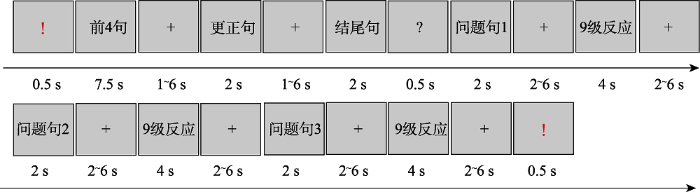
fMRI采用快速(基于jitter)的事件相关实验设计。每个试次均以红色的感叹号“!”开始, 0.5 s之后自动呈现事件的前4个句子(7.5 s), 随之出现1~6 s的注视点“+”, 接着继续呈现句子及注视点“+”直至事件结束。进入推理评定后首先会呈现0.5 s的问号“?”, 接着呈现推理问题句1 (2 s), 2~6 s的注视点“+”后为4 s的等级评定(9点评分), 随后在2~6 s的抖动间隔后依次进入推理问题句2和句3(具体见图1)。
图1
2.4 数据采集
采用天津师范大学西门子Prisma 3.0T磁共振扫描仪和64通道头线圈。被试取仰卧位, 线圈内放置海绵垫以固定头部, 要求其在扫描过程中尽可能保持头部及身体静止。实验材料通过E-prime软件呈现, 被试通过固定在头部线圈上的镜子观看投影仪所呈现的材料。BOLD功能像序列, 采用EPI (echo-planar imaging sequence)序列, TR = 2000 ms, TE = 30 ms, 翻转角 = 90°, 视野 = 224 mm × 224 mm, 矩阵64×64, 层厚3.5 mm, 层间距0.7 mm, 33层。高分辨率的T1加权像采用MP-RAGE序列, TR = 2530 ms, TE = 2.98 ms, 翻转角 = 7°, 视野 = 256 mm × 256 mm, 矩阵256×256, 层厚1 mm。
2.5 fMRI预处理
预处理采用的是基于Matlab R2015a平台的 DPABI V4.2 (Yan et al., 2016)软件。预处理中为了提高磁场均匀性及排除被试对核磁环境的适应过程, 去掉每个扫描模块的前5张图像, 之后进行时间层校正以及头动校正。在空间标准化中, 采用DARTEL的方法首先将每个被试的结构像配准到平均功能像中, 之后将功能像标准化到 MNI (Montreal Neurological Institute, MNI)标准空间, 最后采用高斯平滑核(FWHM = 8 mm)进行空间平滑。
3 数据分析
3.1 行为数据分析
行为数据主要采用SPSS 25进行统计分析, 对因变量推理评分进行配对样本t检验。如果错误信息更正之后的推理评分仍未能降低到控制条件的基线水平, 则认为被试在推理过程中部分依赖了原始的错误信息进行判断, 即存在显著的CIEM。以统计中p < 0.05作为阈值。
3.2 fMRI数据分析
本研究主要对比控制条件和错误更正条件在编码阶段和提取阶段的差异。脑成像数据将进行两个层次的分析:首先进行基于ROI的分析对比, 同时分析脑-行为的相关关系。其次采用任务态fMRI功能连接分析中的常用分析方法——心理生理交互分析(psychophysiological interaction, PPI) (Di et al., 2021)进行基于种子点的功能连接分析。
3.2.1 基于ROI的激活及与行为的相关分析
对于脑成像数据, 每个被试预处理后的功能图像用一般线性模型(General Linear Model, GLM)进行分析。根据先前的论述, 本研究感兴趣的加工阶段是加工更正信息(编码阶段)和加工推理问题(提取阶段)时的大脑BOLD信号。首先, 对所有数据进行个体水平上的分析。利用SPM 12 (
如前所述, 基于以往研究(Masson et al., 2014; Yang et al., 2019), ROI的选取包括与信息编码加工相关的左侧额下回(BA45/47)、左侧颞中回(BA21/ 22)及额内侧回(BA6)。同时包括与抑制控制相关的左侧的腹外侧前额皮层(BA45) (与额下回具有部分重叠)、左侧背外侧前额皮层(BA9)、右侧前扣带回皮层(BA32)和左额中回(BA10)。这些区域将采用布鲁德曼分区(Brodmann areas, BA)为模板。与此同时, BA分区并未明确划分海马和海马旁回, 故此时与一般语义信息提取的左侧海马(37)和双侧海马旁回(39/40)将结合AAL (Anatomical Automatic Labeling)为模板。分析中通过RESTplus V1.24 (Jia et al., 2019)创建Mask, 之后利用DPABI V4.2软件提取各个条件下ROI的BOLD信号值。通过统计分析软件SPSS 25对比不同条件下每个ROI激活信号值的差异, 以统计中p < 0.05作为阈值。
脑-行为的相关分析主要关注编码阶段和提取阶段大脑活动的变化与被试在推理问题上评分的关系。脑成像数据是上述基于各个ROI提取出的BOLD信号值, 行为数据则为每个故事中所对应的三个推理问题评分的均值。利用SPSS 25, 采用相关分析的方法分析脑-行为的变化趋势, 以统计中p < 0.05作为阈值。
3.2.2 基于种子点的功能连接分析
PPI分析中, 首先会选择一个种子点, 考察在特定条件下该种子点与全脑间的功能连接。PPI分析步骤通常为:定义种子点、提取时间序列、在个体水平上进行PPI建模分析及在组水平上进行功能连接的比较。在定义种子点中, 本研究将基于前述分析的结果, 通过小体积校正(small volume corrected, SVC)的方法(Steuwe et al., 2015), 寻找种子点相对应的峰值坐标, SVC阈值采用未校正p < 0.005。确定种子点的峰值坐标后, 以6 mm为半径画立体小球, 以考察在不同条件下种子点分别与全脑其他区域的连接情况, PPI分析在SPM 12中进行。建立的PPI一般线性模型(GLM)包括:(1)种子点激活的主效应; (2)实验条件的主效应; (3)种子点激活和实验条件的交互作用。在GLM中, 也将被试的6列头动参数纳入, 以避免对信号的微小影响。研究重点关注的是心理生理交互变量, 因此这一变量进入之后的组水平分析。功能连接分析阈值采用FWE p < 0.05, 体素k > 50。
4 结果
4.1 行为结果
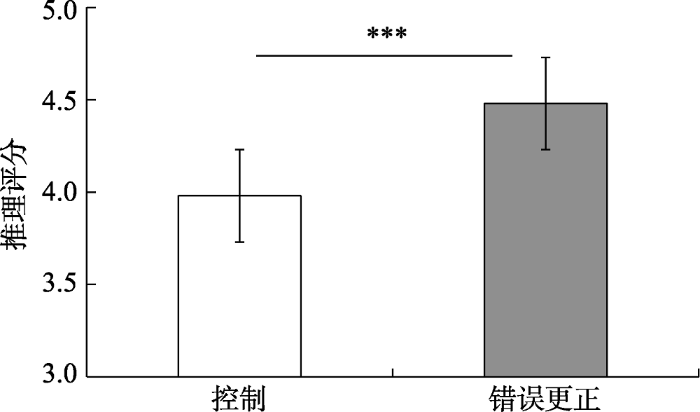
对推理评分的分析发现(见图2), 错误更正条件下的推理评分(4.48 ± 1.27)显著高于无错误信息的控制条件(3.98 ± 1.20 ), t(30) = 3.94, p < 0.001, Cohen’s d = 0.71, 95% CI [0.24, 0.75]。结果表明错误信息更正之后, 被试在随后的推理评分仍未能降低到无错误信息的基线水平, 证明推理判断中存在着对原始错误信息的显著依赖, 即存在显著的CIEM。
图2
4.2 fMRI结果
4.2.1 基于ROI的条件间脑激活差异及相关分析
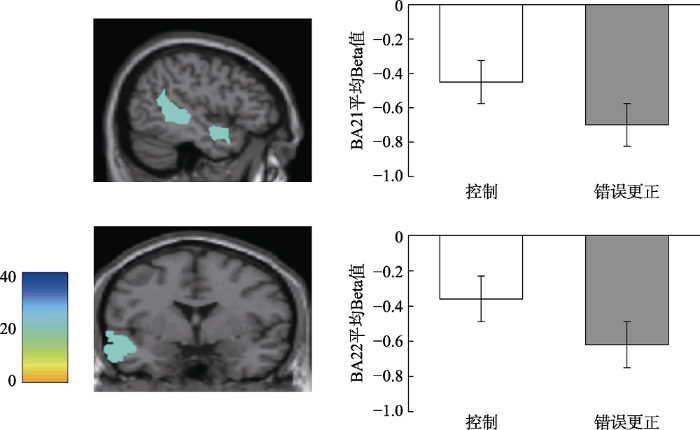
在编码阶段, 采用配对样本t检验对比不同条件间基于ROI的提取信号值。结果发现, 错误更正条件和控制条件在左侧颞中回(BA21/22)存在条件间激活差异(BA21: t(24) = 2.34, p = 0.03, Cohen’s d = 0.47, 95% CI [0.03, 0.48]; BA22: t(24) = 2.26, p = 0.03, Cohen’s d = 0.45, 95% CI [0.02, 0.48]) (见图3)。而在其他与抑制控制、语篇理解相关的ROI上均未发现显著的条件间激活差异。
图3
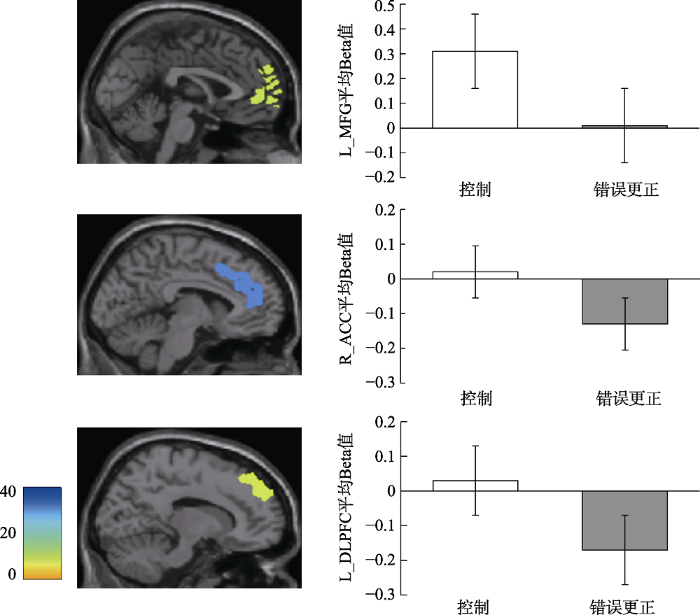
在提取阶段, 采用同样的方法进行分析。对比结果发现(见图4), 以下脑区在更正条件下的激活显著弱于控制条件:左侧额中回(BA10), t(24) = 2.39, p = 0.03, Cohen’s d = 0.48, 95% CI [0.04, 0.55]和右侧前扣带回(BA32), t(24) = 2.24, p = 0.04, Cohen’s d = 0.45, 95% CI [0.01, 0.28]。同时还发现条件间存在边缘显著差异的脑区, 即左侧背外侧前额(BA9), t(24) = 2.05, p = 0.05, Cohen’s d = 0.41, 95% CI [-0.001, 0.40]。而在与抑制相关的腹外侧前额皮层(BA45)和与一般语义信息提取有关的海马和海马旁回中均未发现条件间的显著差异。
图4
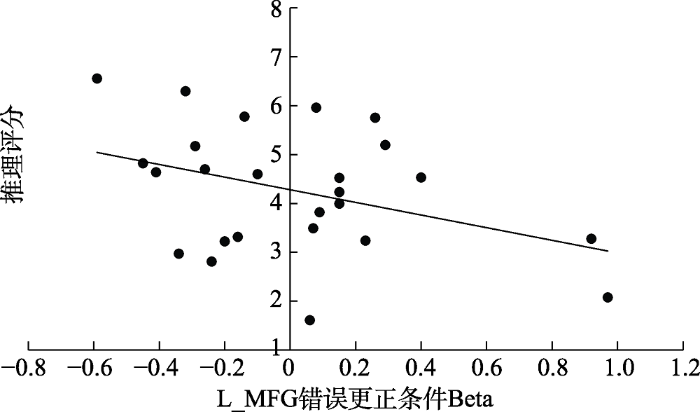
随后对基于ROI分析存在条件间差异的脑区Beta值与个体的行为推理评分进行相关分析, 结果仅发现错误更正下左侧额中回的Beta值与随后的推理评分呈边缘显著的负相关(见图5), r = -0.38, p = 0.06, 表明当该区域的激活变化较弱时, 行为推理评分越高, 被试对原始错误信息的依赖程度越大, 即CIEM越大。而在与语篇理解相关的左侧颞中回以及与抑制相关的其他脑区中并未发现与行为的显著相关, p > 0.05。
图5
4.2.2 脑功能连接特征的条件间差异
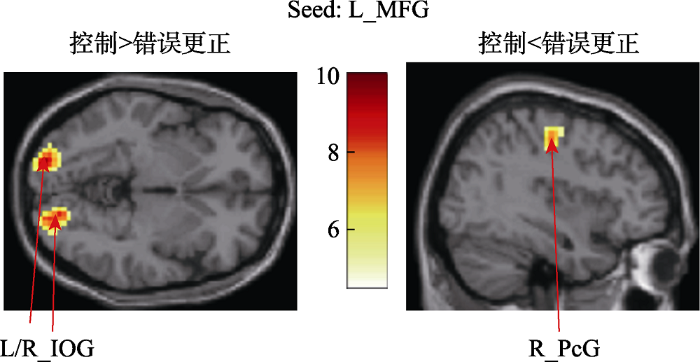
根据前面的结果, 功能连接分析中将以提取阶段发现的左侧额中回及右侧前扣带回、编码阶段发现的左侧颞中回作为种子点。SVC得到左颞中回(MNI: -60, -35, -11)、右侧前扣带回(MNI: 0, 46, 28)和左侧额中回(MNI: -32, 63, 0)的峰值坐标。
表1 以右侧前扣带回为种子点的功能连接的条件间比较
| 脑区 | 体素数 | 峰值点MNI坐标 | 峰值点 T值 | ||
|---|---|---|---|---|---|
| x | y | z | |||
| 控制条件 > 错误更正条件 | |||||
| 左侧枕下回 | 166 | -24.5 | -91 | -7 | 10.11 |
| 右侧枕下回 | 123 | 21 | -84 | -7 | 10.10 |
| 控制条件 < 错误更正条件 | |||||
| 无激活 | |||||
注:p < 0.05 (FWE校正), k > 50; 下同。
图6
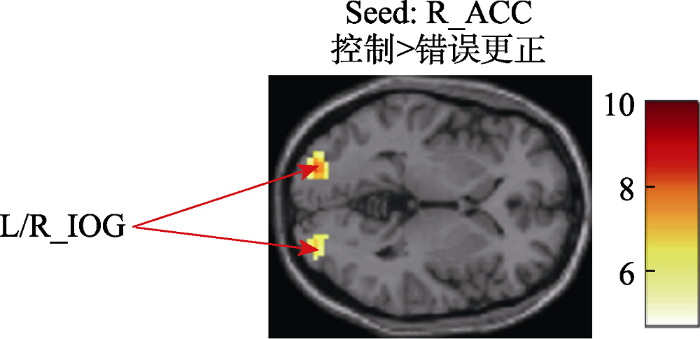
表2 以左侧额中回为种子点的功能连接的条件间比较
| 脑区 | 体素数 | 峰值点MNI坐标 | 峰值点 T值 | ||
|---|---|---|---|---|---|
| x | y | z | |||
| 控制条件 > 错误更正条件 | |||||
| 左侧枕下回 | 158 | -17.5 | -94.5 | -7 | 10.34 |
| 右侧枕下回 | 101 | 21 | -84 | -7 | 8.95 |
| 控制条件 < 错误更正条件 | |||||
| 右侧中央前回 | 61 | 35 | -17.5 | 49 | 8.44 |
图7
5 讨论
本研究结合CIEM的经典范式和任务态fMRI技术, 从抑制控制和语义加工的角度探讨了CIEM可能的神经基础和认知机制。行为结果与已有文献(Gordon et al., 2017; Rich & Zaragoza, 2016)和假设1一致, 发现错误信息更正之后的推理评分显著高于控制条件, 表明错误信息并未完全得到更正, 被试判断过程中存在着对错误信息的部分依赖, 即存在CIEM。fMRI结果发现, 抑制相关脑区在信息编码或整合阶段的激活无条件间差异, 但左额中回(MFG)及右前扣带回(ACC)在信息提取阶段的激活存在条件间差异, 且这种差异和推理评分相关。同时与阅读理解相关的左颞中回(MTG)在信息编码或整合中的激活存在条件间差异。功能连接分析还发现了右ACC与双侧枕下回(IOG)、左MFG与右中央前回(PcG)的功能连接存在条件间差异。结果提示, 更正信息编码或整合过程中左MTG的激活变化、更正信息提取过程中右侧ACC及左MFG的激活(包括功能连接)变化可能是CIEM的神经基础。CIEM的发生既与文本阅读过程中的信息编码或整合有关, 也与阅读结束后的信息提取过程有关, 心理模型更新和记忆提取失败假说解释了CIEM产生的不同阶段。
5.1 CIEM发生的神经基础
左MTG、左MFG和右侧ACC可能在信息加工不同阶段参与了CIEM的形成。编码阶段仅发现与文本理解相关的左MTG在更正条件下的激活显著弱于控制条件, 提示左MTG可能在更正信息的编码或整合阶段参与了CIEM的形成, 与假设2中的①一致。MTG通常与一般的阅读理解有关(Weber et al., 2019; Yang et al., 2019), 如Weber等人(2019)在语言定位任务的全脑分析中发现左MTG在默读句子时的激活显著大于伪词列表。编码阶段仅涉及到文本加工的脑区且更正条件下的激活较弱, 这与篇章理解中上下文一致性的研究结果一致(van Moort et al., 2020)。van Moort等人(2020)发现基于文本的不一致导致了较弱的神经反应, 并推测可能由于目标句与之前的文本并不是完全矛盾的。本研究推测该阶段更多涉及的是基于文本理解的过程, 且仅对上下文一致(控制)条件更敏感。同时更正条件较低的激活且并没有涉及到抑制相关脑区可能是由于此时的加工过程中前、后信息的冲突或矛盾并未达到需要启动抑制控制的水平。结果提示, 更正信息的加工异常和篇章理解中语义加工脑区的激活变化有关, 而与抑制相关脑区的激活变化无关。
左MFG和右ACC在信息提取阶段表现出了相似的条件间激活和功能连接差异, 提示这两个脑区在信息提取阶段参与了CIEM的形成, 这一结果与假设2中的②和③一致。一般控制网络的功能连接与阅读行为有关(Jolles et al., 2020)。Yuan等人(2021)的研究发现, 语言控制和认知控制在检测冲突和抑制控制过程中具有重叠的脑网络机制(如背侧前扣带回皮层等)。实验条件下的脑活动低于控制条件下的现象可能反映了任务诱导下的神经元抑制(Morita et al., 2019)。以往多数研究均发现抑制控制等相关区域的激活增加与成功的抑制控制相关(Hinault et al., 2019)。Cohen-Gilbert等人(2017)要求23名健康的大学新生在fMRI扫描中完成抑制控制任务。结果发现在负性和中性对比的抑制试次中, 3个月内酗酒发生率与背外侧前额皮层、背内侧前额皮层和前扣带皮层的激活降低显著相关。此外, 本结果也与Gordon等(2017)发现的更正条件下的激活更低相一致。他们发现编码阶段中更正条件在右楔前叶上的激活较弱, 推测这一激活的降低与整合困难有关。综合起来, 左MFG和右ACC的激活减弱可能更多反映了在该条件下抑制执行的失败或困难。而左MFG和右ACC在错误更正下与双侧IOG的功能连接减弱可能和一般性文本信息加工的相对减弱有关。IOG被发现与文本阅读等存在一定联系(Jin et al., 2009)。Jin等人(2009)也观察到了双侧枕中叶和枕下叶在故事阅读和预测性推理中的激活。与控制条件相比, 错误更正条件下除了需要被试进行一般的视觉阅读和判断外, 还涉及对错误信息的抑制, 这可能相对减弱了与IOG的连接、增强了与抑制相关的连接。
5.2 对CIEM认知假说的启示
如前所述, 目前主要有两种理论假说试图对CIEM进行解释。“心理模型更新”假说更关注加工更正信息的编码阶段, 认为CIEM的发生是由于编码阶段对更正信息的编码或整合存在异常。“记忆提取失败”强调提取阶段对推理问题的加工异常。因此, 编码阶段出现的脑激活差异更可能支持“心理模型更新”的假说, 而提取阶段出现的差异则更可能支持“记忆提取失败”的假说。
本研究发现与阅读理解相关的左MTG在信息编码或整合中存在条件间的激活差异, 支持“心理模型更新”假说。在情境或心理模型的更新中, 当前、后信息不一致时, 读者会力图消除矛盾或不协调性(王瑞明 等, 2006)。错误更正下心理模型的更新也需要消除相矛盾的先前信息, 这可能也涉及到抑制控制过程。本研究未观察到抑制相关的脑区在条件间的激活或功能连接差异, 这提示CIEM可能与编码阶段对更正信息的编码而非整合异常有关, 进一步明确了“心理模型更新”假说对CIEM发生的解释。在文本理解层面, 编码异常源于哪种认知成分(如情境模型更新失败还是更新没有启动等)则需要新的实验设计去探讨。
在提取阶段, 参与一般语义信息提取的脑区如海马等并未表现出条件间的差异, 抑制相关脑区(左侧MFG和右侧ACC)出现了不同条件间的激活差异和功能连接强度的差异。结果支持“记忆提取失败”假说, 并进一步明确了“记忆提取失败”假说的内容, 即提取失败并不是语义信息的一般提取失败, 而可能是干扰语义信息的抑制过程失败。基于记忆双加工理论(Brydges et al., 2018; Rugg & Curran, 2007)的提取失败假说, 在提取过程中有效(更正信息)和无效信息(错误信息)均自动激活, 加工过程中策略提取过程失败或是没有进行策略提取会导致CIEM (Ecker et al., 2011; Lewandowsky et al., 2012)。本结果从抑制的角度证明了错误信息更正中可能进行了策略提取, 因为提取阶段与抑制相关的脑区发生了激活, 但抑制相关脑区的激活较弱以及连接强度的增加对应着提取阶段时的抑制失败或不完善, 从而导致被试对先前错误信息的持续依赖性。抑制脑区(MFG)与推理评分的负相关也部分支持了上述解释。
综上, CIEM的发生可能同时和信息理解过程中的编码失败、信息提取过程中的提取失败有关, 心理模型更新和记忆提取失败假说有可能解释了CIEM形成的不同阶段。然而目前对于更精确的作用机制, 如上述的编码失败和提取失败在CIEM的发生中是否起着不同的决定性作用, 则需进一步探讨。
5.3 不足与展望
本研究结果为阐明CIEM的神经基础和明确CIEM理论假说提供了更为丰富的实验证据, 但本研究也存在以下局限。首先, 参照Gordon等(2017)的范式, 基线设置为无错误信息的控制条件。这一项目内设计虽然最大程度避免了不同条件间目标句本身物理特征和语义等的不同引入的信号污染, 但也存在一定的局限性。更正条件下目标句5和条件句2表达的信息部分重叠, 而控制条件下目标句和条件句表达的信息无重叠。观察到的条件间的脑激活也可能混入了这一条件间信息重复性上的差异。但本研究观察到的不同条件下目标句脑激活上的差异不太可能是这些目标句和对应的条件句的信息重复性不同所导致的。词汇或句子重复导致的信息增强效应主要引发了相关大脑区域的活动增加(Wang et al., 2016; Weber et al., 2016), 而本研究发现错误更正条件下的激活是减弱的。无论如何, 未来研究有必要进一步完善材料设置以直接排除上述可能性。
其次, 本研究目前重点关注了抑制相关的脑区, 而抑制干扰(错误信息)的加工可能也涉及对冲突信息的监测与解决过程。如Li等(2017)的元分析发现冲突监测和冲突解决既有共同的也有特异性的认知控制网络组合。本研究范式中更正信息与先前的错误信息是存在冲突的, 这可能涉及到冲突加工的不同阶段(监测和解决冲突)。本研究纳入的脑区与Li等人(2017)发现的脑区存在部分重叠(如背外侧前额、前扣带回等), 但并不全面。未来研究可进一步考虑其他认知控制相关的脑区, 如额-顶网络中的顶下、顶上皮层等, 以更全面的揭示CIEM的神经基础。另外, 有研究发现认知能力影响更正效果(De Keersmaecker & Roets, 2017), 而抑制能力对阅读能力有预测性(Doyle et al., 2018)。未来可通过考察抑制控制能力不同的个体在CIEM中的神经基础差异, 以更加直接的证明抑制控制和CIEM的关系。
6 结论
本研究考察任务态下语义理解及抑制相关脑区中CIEM的脑激活特征、与行为指标的关系及脑功能连接强度的变化。结果表明, CIEM的发生不仅与信息编码时左MTG的激活减弱有关, 还与信息提取时左MFG和右ACC的激活、与双侧IOG的功能连接减弱及与左MFG和PcG的功能连接增强有关。结果提示, CIEM的发生可能同时和信息理解过程中的语义编码失败、信息提取过程中的错误信息提取的抑制失败有关, 心理模型更新和记忆提取失败假说有可能解释了CIEM形成的不同阶段。
致谢:本研究的数据采集与分析过程得到了王正光、赵光、章鹏、李骋诗、张琪涵、汪强、徐战胜、刘婷、梁紫平、邵梦灵、朱子良、张羽萍、金晓康、王超等的帮助与指导, 在此一并致谢。同时, 非常感谢所有被试对本研究的支持。
附录
fMRI实验材料样例
| 控制条件 | 错误更正条件 |
|---|---|
| 1=今天一座新的办公楼突然倒塌 | |
| 2=旁观者说倒塌发生在早上11点 | 2=旁观者说较低楼层发生了火灾 |
| 3=这座大楼在两个月前才完工 | |
| 4=周围地区已被禁止公众使用 | |
| 5=现场消防人员说没有火灾迹象 | |
| 6=已联系大楼的负责人做出解释 |
推理问题:1. 应审查预防火灾的措施
2. 消防队必须尽快赶到现场
3.火警警报很可能已经被激活了
参考文献
Putamen functional connectivity during inhibitory control in smokers and non-smokers
DOI:10.1111/adb.12482
PMID:27917562
[本文引用: 1]

The putamen has been shown to play a key role in inhibitory control and addiction, and consists of distinct subregions associated with distinct functions. The anterior putamen is thought to be specialized in goal-directed control or response-monitoring in connection with frontal regions, whereas the posterior part is specialized in habitual or automatic responding in connection with sensorimotor regions. The present study is the first to delineate functional networks of the anterior and posterior putamen in a Go-NoGo response inhibition task, and to examine differences between smokers (n = 25) and non-smokers (n = 23) within these networks. Functional connectivity analyses were conducted on fMRI data from a Go-NoGo study, using the generalized form of psychophysiological interaction with anterior and posterior putamen seed regions. In the context of inhibition, the anterior putamen exhibited connectivity with the anterior cingulate cortex (ACC) and precuneus (p< .05), which was in line with previous literature. Conversely, the posterior putamen showed connectivity with regions implicated in sensorimotor processing. When we compared smokers to non-smokers, we did not observe the expected weaker connectivity between the anterior putamen and ACC during inhibition in smokers. Instead, our study revealed stronger inhibition-related connectivity between the anterior putamen and right insula in smokers. This finding highlights the involvement of putamen - insula interactions in addiction and impulse control.© 2016 Society for the Study of Addiction.
Working memory capacity, short-term memory capacity, and the continued influence effect: A latent-variable analysis
DOI:10.1016/j.intell.2018.03.009 URL [本文引用: 4]
Electrophysiological correlates of the continued influence effect of misinformation: An exploratory study
DOI:10.1080/20445911.2020.1849226 URL [本文引用: 3]
Reducing interference from misconceptions: The role of inhibition in knowledge revision
DOI:10.1037/edu0000385 URL [本文引用: 2]
Predicting word reading and comprehension with executive function and speed measures across development: A latent variable analysis
DOI:10.1037/a0027375 URL [本文引用: 1]
College binge drinking associated with decreased frontal activation to negative emotional distractors during inhibitory control
DOI:10.3389/fpsyg.2017.01650
PMID:29018380
[本文引用: 1]
The transition to college is associated with an increase in heavy episodic alcohol use, or binge drinking, during a time when the prefrontal cortex and prefrontal-limbic circuitry continue to mature. Traits associated with this immaturity, including impulsivity in emotional contexts, may contribute to risky and heavy episodic alcohol consumption. The current study used blood oxygen level dependent (BOLD) multiband functional magnetic resonance imaging (fMRI) to assess brain activation during a task that required participants to ignore background images with positive, negative, or neutral emotional valence while performing an inhibitory control task (Go-NoGo). Subjects were 23 college freshmen (seven male, 18-20 years) who engaged in a range of drinking behavior (past 3 months' binge episodes range = 0-19, mean D 4.6, total drinks consumed range = 0-104, mean = 32.0). Brain activation on inhibitory trials (NoGo) was contrasted between negative and neutral conditions and between positive and neutral conditions using non-parametric testing (5000 permutations) and clusterbased thresholding (z = 2.3), p <= 0.05 corrected. Results showed that a higher recent incidence of binge drinking was significantly associated with decreased activation of dorsolateral prefrontal cortex (DLPFC), dorsomedial prefrontal cortex (DMPFC), and anterior cingulate cortex (ACC), brain regions strongly implicated in executive functioning, during negative relative to neutral inhibitory trials. No significant associations between binge drinking and brain activation were observed for positive relative to neutral images. While task performance was not significantly associated with binge drinking in this sample, subjects with heavier recent binge drinking showed decreased recruitment of executive control regions under negative versus neutral distractor conditions. These findings suggest that in young adults with heavier recent binge drinking, processing of negative emotional images interferes more with inhibitory control neurocircuitry than in young adults who do not binge drink often. This pattern of altered frontal lobe activation associated with binge drinking may serve as an early marker of risk for future self-regulation deficits that could lead to problematic alcohol use. These findings underscore the importance of understanding the impact of emotion on cognitive control and associated brain functioning in binge drinking behaviors among young adults.
Brain imaging of the central executive component of working memory
DOI:10.1016/S0149-7634(01)00063-X URL [本文引用: 1]
Illusion of knowing in adult readers: Effects of reading skill and passage length
DOI:10.1006/ceps.1997.0925 URL [本文引用: 1]
“Fake news”: Incorrect, but hard to correct. The role of cognitive ability on the impact of false information on social impressions
DOI:10.1016/j.intell.2017.10.005 URL [本文引用: 1]
Understanding psychophysiological interaction and its relations to beta series correlation
DOI:10.1007/s11682-020-00304-8 URL [本文引用: 1]
Inhibition and updating, but not switching, predict developmental dyslexia and individual variation in reading ability
DOI:10.3389/fpsyg.2018.00795 URL [本文引用: 1]
Can you believe it? An investigation into the impact of retraction source credibility on the continued influence effect
DOI:10.3758/s13421-020-01129-y URL [本文引用: 1]
Reminders and repetition of misinformation: Helping or hindering its retraction?
DOI:10.1037/h0101809 URL [本文引用: 1]
He did it! she did it! no, she did not! multiple causal explanations and the continued influence of misinformation
DOI:10.1016/j.jml.2015.09.002 URL [本文引用: 2]
Correcting false information in memory: Manipulating the strength of misinformation encoding and its retraction
DOI:10.3758/s13423-011-0065-1 URL [本文引用: 1]
The effectiveness of short-format refutational fact-checks
DOI:10.1111/bjop.v111.1 URL [本文引用: 2]
Exploring the neural substrates of misinformation processing
DOI:10.1016/j.neuropsychologia.2017.10.003 URL [本文引用: 16]
Keeping track of ‘alternative facts’: The neural correlates of processing misinformation corrections
DOI:10.1016/j.neuroimage.2019.03.014 URL [本文引用: 7]
Constructing inferences during narrative text comprehension
The authors describe a constructionist theory that accounts for the knowledge-based inferences that are constructed when readers comprehend narrative text. Readers potentially generate a rich variety of inferences when they construct a referential situation model of what the text is about. The proposed constructionist theory specifies that some, but not all, of this information is constructed under most conditions of comprehension. The distinctive assumptions of the constructionist theory embrace a principle of search (or effort) after meaning. According to this principle, readers attempt to construct a meaning representation that addresses the reader's goals, that is coherent at both local and global levels, and that explains why actions, events, and states are mentioned in the text. This study reviews empirical evidence that addresses this theory and contrasts it with alternative theoretical frameworks.
Spatio-temporal patterns of cognitive control revealed with simultaneous electroencephalography and functional magnetic resonance imaging
DOI:10.1002/hbm.24356
PMID:30259592
[本文引用: 1]
Optimal performance depends in part on the ability to inhibit the automatic processing of irrelevant information and also on the adjusting the level of control from one trial to the next. In this study, we investigated the spatio-temporal neural correlates of cognitive control using simultaneous functional magnetic resonance imaging and electroencephalography, while 22 participants (10 women) performed a numerical Stroop task. We investigated the spatial and temporal dynamic of the conflict adaptation effects (i.e., reduced interference on items that follow an incongruent stimulus compared to after a congruent stimulus). Joint independent component analysis linked the N200 component to activation of anterior cingulate cortex (ACC) and the conflict slow potential to widespread activations within the fronto-parietal executive control network. Connectivity analyses with psychophysiological interactions and dynamic causal modeling demonstrated coordinated engagement of the cognitive control network after the processing of an incongruent item, and this was correlated with better behavioral performance. Our results combined high spatial and temporal resolution to propose the following network of conflict adaptation effect and specify the time course of activation within this model: first, the anterior insula and inferior frontal gyrus are activated when incongruence is detected. These regions then signal the need for higher control to the ACC, which in turn activates the fronto-parietal executive control network to improve the performance on the next trial.© 2018 Wiley Periodicals, Inc.
Hippocampal activation during retrieval of spatial context from episodic and semantic memory
DOI:10.1016/j.bbr.2010.04.010
PMID:20385169
[本文引用: 1]
The hippocampus, a region implicated in the processing of spatial information and episodic memory, is central to the debate concerning the relationship between episodic and semantic memory. Studies of medial temporal lobe amnesic patients provide evidence that the hippocampus is critical for the retrieval of episodic but not semantic memory. On the other hand, recent neuroimaging studies of intact individuals report hippocampal activation during retrieval of both autobiographical memories and semantic information that includes historical facts, famous faces, and categorical information, suggesting that episodic and semantic memory may engage the hippocampus during memory retrieval in similar ways. Few studies have matched episodic and semantic tasks for the degree to which they include spatial content, even though spatial content may be what drives hippocampal activation during semantic retrieval. To examine this issue, we conducted a functional magnetic resonance imaging (fMRI) study in which retrieval of spatial and nonspatial information was compared during an episodic and semantic recognition task. Results show that the hippocampus (1) participates preferentially in the retrieval of episodic memories; (2) is also engaged by retrieval of semantic memories, particularly those that include spatial information. These data suggest that sharp dissociations between episodic and semantic memory may be overly simplistic and that the hippocampus plays a role in the retrieval of spatial content whether drawn from a memory of one's own life experiences or real-world semantic knowledge.Published by Elsevier B.V.
RESTplus: An improved toolkit for resting-state functional magnetic resonance imaging data processing
DOI:10.1016/j.scib.2019.05.008 URL [本文引用: 1]
Involvement of the left inferior frontal gyrus in predictive inference making
DOI:10.1016/j.ijpsycho.2008.08.009 URL [本文引用: 2]
Sources of the continued influence effect: When misinformation in memory affects later inferences
DOI:10.1037/0278-7393.20.6.1420 URL [本文引用: 4]
Relationships between intrinsic functional connectivity, cognitive control, and reading achievement across development
DOI:10.1016/j.neuroimage.2020.117202 URL [本文引用: 1]
Misinformation and its correction
DOI:10.1177/1529100612451018
PMID:26173286
[本文引用: 3]
The widespread prevalence and persistence of misinformation in contemporary societies, such as the false belief that there is a link between childhood vaccinations and autism, is a matter of public concern. For example, the myths surrounding vaccinations, which prompted some parents to withhold immunization from their children, have led to a marked increase in vaccine-preventable disease, as well as unnecessary public expenditure on research and public-information campaigns aimed at rectifying the situation. We first examine the mechanisms by which such misinformation is disseminated in society, both inadvertently and purposely. Misinformation can originate from rumors but also from works of fiction, governments and politicians, and vested interests. Moreover, changes in the media landscape, including the arrival of the Internet, have fundamentally influenced the ways in which information is communicated and misinformation is spread. We next move to misinformation at the level of the individual, and review the cognitive factors that often render misinformation resistant to correction. We consider how people assess the truth of statements and what makes people believe certain things but not others. We look at people's memory for misinformation and answer the questions of why retractions of misinformation are so ineffective in memory updating and why efforts to retract misinformation can even backfire and, ironically, increase misbelief. Though ideology and personal worldviews can be major obstacles for debiasing, there nonetheless are a number of effective techniques for reducing the impact of misinformation, and we pay special attention to these factors that aid in debiasing. We conclude by providing specific recommendations for the debunking of misinformation. These recommendations pertain to the ways in which corrections should be designed, structured, and applied in order to maximize their impact. Grounded in cognitive psychological theory, these recommendations may help practitioners-including journalists, health professionals, educators, and science communicators-design effective misinformation retractions, educational tools, and public-information campaigns. © The Author(s) 2012.
Imaging response inhibition in a stop-signal task: Neural correlates independent of signal monitoring and post- response processing
DOI:10.1523/JNEUROSCI.3741-05.2006 URL [本文引用: 2]
Conflict detection and resolution rely on a combination of common and distinct cognitive control networks
DOI:10.1016/j.neubiorev.2017.09.032 URL [本文引用: 2]
Differences in brain activation between novices and experts in science during a task involving a common misconception in electricity
Developmental changes in task-induced brain deactivation in humans revealed by a motor task
DOI:10.1002/dneu.22701 URL [本文引用: 1]
The functional anatomy of verbal initiation and suppression using the hayling test
This study utilised positron emission tomography (PET) to identify the cortical areas involved in verbal initiation and suppression in normal subjects whilst performing a sentence completion test (the Hayling Test). In the first condition (response initiation) subjects were required to complete a sentence from which the last word was omitted, whereas in the second condition (response suppression) subjects were asked to complete a sentence with a word which made no sense in the context of the sentence. Subjects were also required to perform a control task in which they had to read out the last word of given sentences. Compared to the control task, response initiation was associated with left-sided activation of the frontal operculum, inferior frontal gyrus, middle temporal gyrus and the right anterior cingulate gyrus, whereas response suppression was associated with left frontal operculum, inferior frontal gyrus and right anterior cingulate gyrus activation. The difference in activation between the two conditions of the Hayling Test lay in the increased activation of the left middle temporal gyrus and the left inferior frontal gyrus during response initiation.
Working memory for complex figures: An fMRI comparison of letter and fractal n-back tasks
n-back letter and fractal tasks were administered to 11 participants during functional magnetic resonance imaging to test process specificity theories of prefrontal cortex (PFC) function and assess task validity. Tasks were matched on accuracy, but fractal n-back responses were slower and more conservative. Maintenance (1-back minus 0-back) activated inferior parietal and dorsolateral PFC, with additional activation in right ventrolateral PFC during letter n-back and left lingual gyrus during fractal n-back. Maintenance plus manipulation (2-back minus 0-back) activated inferior parietal, Broca's area, insula, and dorsolateral and ventral PFC, with greater right dorsolateral PFC activation for letter n-back. Manipulation only (2-back minus 1-back) produced additional and equivalent dorsolateral PFC and anterior cingulate activation in both tasks. Results support fractal n-back validity and indicate substantial overlap in working memory functions of dorsal and ventral PFC.
The continued influence of implied and explicitly stated misinformation in news reports
DOI:10.1037/xlm0000155 URL [本文引用: 4]
Correcting misinformation in news stories: An investigation of correction timing and correction durability
DOI:10.1037/h0101850 URL [本文引用: 2]
Event-related potentials and recognition memory
DOI:10.1016/j.tics.2007.04.004 URL [本文引用: 2]
Effect of direct eye contact in women with PTSD related to interpersonal trauma: Psychophysiological interaction analysis of connectivity of an innate alarm system
DOI:10.1016/j.pscychresns.2015.02.010 URL [本文引用: 1]
The role of familiarity in correcting inaccurate information
DOI:10.1037/xlm0000422 URL [本文引用: 4]
What you read versus what you know: Neural correlates of accessing context information and background knowledge in constructing a mental representation during reading
DOI:10.1037/xge0000764 URL [本文引用: 2]
Reminders of everyday misinformation statements can enhance memory for and beliefs in corrections of those statements in the short term
DOI:10.1177/0956797620952797 URL [本文引用: 1]
Mechanism of constructing and updating situation models in text-reading
文本阅读中情境模型建构和更新的机制
Mechanism of the coordinating integration in text-reading
DOI:10.3724/SP.J.1041.2008.01165 URL [本文引用: 1]
文本阅读中协调性整合的发生机制
On known unknowns: Fluency and the neural mechanisms of illusory truth
DOI:10.1162/jocn_a_00923 URL [本文引用: 1]
fMRI syntactic and lexical repetition effects reveal the initial stages of learning a new language
DOI:10.1523/JNEUROSCI.3180-15.2016 URL [本文引用: 1]
Sentence processing is modulated by the current linguistic environment and a priori information: An fMRI study
Dpabi: Data processing & analysis for (resting-state) brain imaging
Uncovering cortical activations of discourse comprehension and their overlaps with common large-scale neural networks
DOI:10.1016/j.neuroimage.2019.116200 URL [本文引用: 3]
Neural interaction between language control and cognitive control: Evidence from cross-task adaptation
DOI:10.1016/j.bbr.2020.113086 URL [本文引用: 1]


