


1 引言
认知控制指个体在不断变化的环境中, 灵活调动认知资源以调整行为的一种目标导向的心理过程(Miller & Cohen, 2001)。任务切换是研究认知控制的常用范式之一(史艺荃, 周晓林, 2004; 黄四林, 林崇德, 2009; Vandierendonck et al., 2010)。与任务重复相比, 任务切换的反应时更长、错误率更高, 这被称为切换代价(Kiesel et al., 2010; Wylie & Allport, 2000; Wylie, et al., 2009; Xie et al., 2020; Zhuo et al., 2021a, 2021b)。切换代价(任务切换减任务重复)受到准备时间(Altmann, 2019; Kiesel et al., 2010)、任务属性(Woodward et al., 2003)、任务比例(蒋浩, 2018; Baene & Brass, 2013; Fröber et al., 2018; Grzyb & Hubner, 2013; Monsell & Mizon, 2006; Rogers & Monsell, 1995)和反应选择(Schuch & Koch, 2003)等诸多因素的影响。关于切换代价的主要理论解释有任务重构理论和干扰抑制论这两大主流观点。重构论的主要观点是:切换代价的产生是被试需要花费更多的时间进行一种内源性的、自上而下的控制加工。这种执行控制加工需要重构新任务, 即重新设置切换的相关任务, 而这种重新设置或重构的加工过程涉及额外的控制需求(Mayr & Kliegl, 2000; Rogers & Monsell, 1995)。相反, 干扰抑制论认为切换代价并非源于新任务集的重构, 而是产生于前一任务和当前任务执行之间的干扰(Allport & Wylie, 1999; Meiran, 2008; Waszak et al., 2003; Wylie & Allport, 2000)。
1.1 任务切换的主动性控制和反应性控制
认知控制的双理论模型(Dual Mechanisms of Cognitive Control Account, 简称DMC理论, Braver et al., 2007)指出认知控制可区分为主动性控制(Proactive control)和反应性控制(Reactive control)。主动性控制指对即将出现的任务给予不同程度的自上而下的准备过程, 这些过程可以通过改变目标出现前的准备时间、线索属性操纵。研究者采用交替运行范式(Karayanidis et al., 2003, 2010)、线索-任务切换范式(Kieffaber & Hetrick, 2005; Nicholson et al., 2005; Swainson et al., 2006)以及威斯康星卡片分类任务(Barceló et al., 2000)进行的研究发现, 与任务重复相比, 在任务切换的线索出现时, 头皮中央和后部所诱发的切换正波(Switch-related positivity; Karayanidis et al., 2003; Kieffaber & Hetrick, 2005; Nicholson et al., 2005; Swainson et al., 2006)可能反映了这一主动性控制的过程。切换正波会受到线索有效性(Nicholson et al., 2006; Karayanidis & Jamadar, 2014)以及线索与目标之间时间间隔的调节(Baene & Brass, 2013; Karayanidis et al., 2003; Kieffaber & Hetrick, 2005; Nicholson et al., 2005), 并且与反应时切换代价相关联(Karayanidis et al., 2010)。另外, 研究发现在线索加工完成后至目标即将呈现之前的时间窗口, 任务切换和重复均在额中区域诱发了伴随性负波(Contingent negative variation, CNV), 这一成分可能和预期性注意(Brunia, 1999)或反应准备过程相关(Karayanidis & Jamadar, 2014)。另一些脑电研究也为任务切换主动性控制过程提供了相应的证据。例如, 采用线索-任务切换范式发现线索锁时阶段任务切换诱发的P3和晚期正成分(Late positive component, LPC)波幅更大(Han et al., 2018; Kieffaber & Hetrick, 2005), 这反映了个体在任务或规则学习阶段, 对相应任务或规则的准备过程(Altmann, 2019; Kiesel et al., 2010)。
反应性控制指目标出现后个体通过最大限度地减少与目标无关信息的干扰来优化目标处理的过程。研究发现, 在目标锁时的ERPs中, 相比任务重复, 任务切换诱发了更负的大脑前部和中部N2以及更小的顶叶P3b波幅(Karayanidis et al., 2003; Nicholson et al., 2005), 反映了个体对目标特别是任务切换条件下的反应性控制。大脑前部和中部诱发的N2成分通常反映了冲突监测与干扰控制(Folstein & van Petten, 2008; Gajewski et al., 2008; Yeung & Cohen, 2006; Zhu et al., 2020)。Nicholson等(2005)亦发现, 与任务重复相比较, 任务切换下目标诱发更大的N2波幅, 反映了被试在任务切换时表现出更大的反应冲突(Gajewski et al., 2010)。紧随N2成分之后的是P3b成分, 目标锁时的P3b成分是任务切换研究领域中最为常见的一种成分, 然而不同于线索锁时的P3b成分, 相对于任务重复, 任务切换诱发的目标锁时的P3b波幅更小, 即表现出切换负波(Barceló et al., 2000; Kieffaber & Hetrick, 2005; Karayanidis et al., 2003, 2010; Nicholson et al., 2005)。这一切换负波可能反映了任务切换相比任务重复具有更高的任务要求和更大的工作记忆负荷(Barceló et al., 2000; Karayanidis et al., 2003)。对任务切换进行按键反应时, 需要更新任务集, 即在工作记忆系统中重新提取新的规则以及S-R联结, 因此相对于任务重复, 其S-R联结更不稳固(Barceló, et al., 2000; Waszak et al., 2003)。
1.2 任务切换的层级性
层级表征在感知(Hommel et al., 2000)、工作记忆(Nie et al., 2017)以及动作执行(Rosenbaum et al., 1983)等诸多认知过程中存在。在日常生活中, 某一任务及动作执行通常由多个步骤组成, 这些步骤以层级的形式表征(Lashley, 1951)。例如, ‘煮咖啡’这一任务是由一系列嵌套的子任务(研磨咖啡豆、冲泡等)构成。因此, 层级表征是一种由相互嵌套的成分及其子成分构成的心理表征, 其中上位信息对下位的子成分产生影响(Schneider & Logan, 2006)。层级表征在目标任务导向中扮演着重要的角色(Badre & Nee, 2018),人们可以对客体属性按层级分类, 降低属性或类别内的自由度, 以便在有限的认知资源下更好更快地做出决策并进行反应(Badre & Nee, 2018; Collins, et al., 2014; Kleinsorge & Heuer, 1999)。Kleinsorge和Heuer (1999)利用‘任务集(task-set)’的维度组织结构探索维度数量及层级水平对切换代价的影响, 并提出了层级任务切换模型。该模型包含了任务判断类型、S-R联结的一致性以及反应是否切换三种不同层级水平。其中, 任务判断类型为最高层级, S-R联结的一致性为中间层级, 反应切换与重复层级最低。研究者采用线索与目标相结合的实验范式, 通过呈现于屏幕中心点上下两个方框的空间线索提示被试需要执行的任务是判断中央数字的大小还是判断一侧数字所处方位(左或右); 通过数字的颜色提示被试应当选用与日常行为一致或不一致的S-R联结规则(如对于数字大小任务, 绿色表示采用一致规则, 即左小右大的按键规则, 红色表示采用不一致规则, 即左大右小的按键规则); 反应是否切换是指前后两个试次的物理按键是否相同。结果发现, 当任务判断类型切换时, 其切换代价最高; 当任务判断类型重复, S-R联结规则切换相比S-R联结规则重复时切换代价更大, 但当任务判断类型切换, 其切换代价更小; 另外, 当任务判断类型和S-R联结规则均重复, 反应切换会产生切换代价, 反之会降低切换代价。据此, 切换代价的变化取决于层级结构中需要改变的维度数量和维度的层级水平。他们认为, 在一个任务集中, 若层级结构的顶层发生变化, 所有层级都须重新设置; 相反, 若最低层级发生变化, 只有该层级参与重新设置。当个体切换某一层级, 他们也会自动切换所有较低层级。因此, 当任务判断类型和S-R联结规则都发生切换时, 与只有一个任务判断类型发生切换时相比, 切换代价更小。简言之, 在一个任务集里, 做什么(即任务目标), 怎么做(即反应规则)以及动作执行是以由高到低的层级形式被表征的。
近年来, 一些研究表明, 任务集的元素(如刺激的知觉特征或S-R规则)都能以层级的形式表征(Collins et al., 2014; Han et al., 2018, 2019)。如Collins等(2014)采用刺激与反应的强化学习任务, 给被试呈现颜色(红色, 黄色)与形状(三角形, 圆形)正交组合的四种不同刺激并且对应四个不同的按键, 让被试进行学习并给予反馈。研究者关注的是被试能否将刺激的某一维度(如颜色)视为高层属性, 将另一维度(形状)视为低层属性; 如果能则比较高层级切换(如红色圆形切换到黄色圆形或黄色三角形)与低层级切换(如红色圆形切换到红色三角形)的切换代价的差异及其神经机制。行为结果表明, 被试确实能自主形成刺激知觉特征的层级表征, 脑电结果表明, 高层级切换(如红色圆形切换到黄色圆形或黄色三角形)相对于低层级切换(如红色圆形切换到红色三角形)在顶叶皮层诱发了更负的晚期ERP成分(450~609 ms), 表明高层级切换需消耗更多的认知资源。Han等(2018)采用线索任务-切换范式, 将线索(字母R)的三种知觉维度中的一种(如实心或空心)设为高层属性, 另外两种则设为低层属性, 并采用嵌套的方式使低层属性隶属于高层属性。要求被试根据线索的不同属性指引的规则对随后的目标刺激(即数字1~9中的一个)进行反应。结果发现, 在线索锁时阶段, 高层规则切换比低层规则切换诱发了更小的N2和更大的P3波幅, 反映了在规则学习阶段增强的主动性控制; 在目标锁时阶段, 高层规则切换比低层规则切换诱发更负的N2和更小的P3波幅, 反映了任务执行阶段增强的反应性控制。Han等(2019)将线索和任务同时呈现, 得出类似的结果。另外, Li等(2019)采用嵌套的任务切换范式并定义了三种不同层级水平的数字判断任务, 发现向上切换(即从低层级任务切换到中层级任务)比向下切换(即从高层级任务切换到中层级任务)诱发更负的N2波幅和持续正波(Slow Positvity), 反映了不同的反应抑制和任务重构过程。
现有行为研究表明, 任务切换中的任务集和其中的元素(如刺激的知觉特征与反应规则)的表征存在层级性, 高层级表征间的切换代价高于低层级表征间的切换代价(Collins et al., 2014; Han et al., 2018, 2019); 现有脑电研究却因为不同研究者的关注点不同得出不尽相同的结论。例如, Li等(2019)采用了嵌套的三层级任务, 关注切换代价的层级不对称性的, 即不同方向的跨层级切换问题, 发现由低向高跨级切换的认知控制的增大与N2波幅的增大相联系; 另外三项研究(Collins et al., 2014; Han et al., 2018, 2019)关注的是刺激知觉维度或反应规则的层级性。Collins等(2014)发现, 高层级的知觉维度切换相对于低层级知觉维度切换在顶叶皮层诱发了更负的晚期负波; Han等(2018, 2019)发现高层级的反应规则切换条件下的靶刺激诱发了比低层反应规则切换更负的N2波幅。本研究与已有两个研究(Han et al., 2018, 2019)一样, 依然围绕认知控制的层级性及其神经机制进行探索。不同的是研究切入点有所不同, Han等(2018, 2019)的研究切入点是反应规则切换的层级性, 即比较两个高层规则(如规则1“如果线索字母R为实体则根据颜色选择不同的任务”与规则2“如果线索字母R为空心则根据方向选择不同的任务”)之间的切换代价与两个低层规则(如规则3“如果实体线索字母R为红色则做大小判断任务”与规则4“如果实体线索字母R为绿色则做奇偶判断任务”)之间的切换代价的差异。而本研究的切入点是任务切换的层级性, 即比较两个高层级任务(如任务1“判断大数的奇偶性”与任务2“判断奇数的大小”)之间的切换代价与两个低层级任务(如任务3“判断数字的大小”与任务4“判断数字的奇偶”)之间的切换代价的差异。本研究特别关注不同层级内的任务切换代价差异背后的神经机制。简言之, 大量行为研究已经揭示高层级任务切换的代价大于低层级任务切换的代价, 但至今无人采用ERP技术揭示任务集内另一重要的元素, 即任务本身的层级性所诱发的认知控制的神经机制, 尽管部分研究者从刺激的知觉维度的层级性(Collins et al., 2014)与反应规则的层级性(Han et al., 2018, 2019), 以及跨层级切换的不对称性(Li et al., 2019)进行了一些探索, 但这些研究都未涉及任务的层级性。
1.3 本研究目的与假设
本研究旨在利用ERP高时间分辨率的优点探索在任务切换过程中认知控制的层级性及其神经机制。本研究将以线索-任务范式考察线索加工相关的主动性控制与目标相关的反应性控制是否会受任务层级性的调节, 如果是, 层级对这两种控制过程的调节分别在哪些ERP成分上体现, 是否也会在N2/P3等与冲突反应抑制和任务设置重构的成分上体现出这一层级性?
本研究设计了具有层级嵌套结构的两层级任务(Li et al., 2019; Lu et al., 2017)。在低层级任务中, 个体需要判断数字大小(或奇偶), 而高层级任务则需要被试在执行低层级任务之前, 先识别刺激的某一语义特征。基于以往有关任务切换和层级控制的研究(Karayanidis et al., 2003, 2010; Kleinsorge & Heuer, 1999; Collins et al., 2014; Han et al., 2018; Li et al., 2019), 本研究假设:(1)低层级任务和高层级任务之间存在维度数量的不同, 低层级任务只需加工一个维度, 而高层级任务需要加工数字的两个维度; 因此, 高层级任务相较于低层级任务可能诱发更长的反应时与更高的错误率; 高层级任务切换时, 两个维度均需要切换, 受前一任务干扰的可能性更高, 同时重置新任务集时间可能更长; 因此, 高层级任务切换代价相较于低层级任务切换代价更大。(2)现有关于线索-任务切换范式下的脑电研究表明, 在线索锁时阶段的任务切换相对于任务重复诱发更小的N2和更大的P3波幅(即切换正波), 但目标刺激诱发的N2和P3波幅在任务切换与任务重复之间的差异却出现了反转(即切换负波); 本研究假设, 无论是线索诱发的切换正波还是目标诱发的切换负波, 都可能受到任务层级性的调节, 并体现于N2、P3或慢波(Slow potential, SP)等反映主动性与反应性控制的成分上, 即在这些成分上高层级任务切换与重复的波幅差异可能大于低层级任务切换与重复的波幅差异。(3)根据Kleinsorge和Heuer (1999)层级任务切换模型, 与S-R联结规则相比, 任务目标的层级更高, 其认知控制的需求也更高, 完成控制加工的时间可能也更长, 因此, 其认知控制的层级性在切换正波(或负波)上的出现时间可能较Han等(2018)的规则切换的层级效应出现时间更晚。
2 方法
2.1 被试
江西师范大学30名右利手志愿者(15名男性; 年龄18~23岁; 平均年龄19.3岁)参加实验。所有被试无任何精神或神经系统疾病, 视力正常或矫正至正常, 无色盲。2名被试因脑电伪迹过多而被排除。采用G-power软件计算, 使用中等的效果量(ηp2 = 0.25), 期望的功效值(1 - β = 0.80)以及显著性水平(α = 0.05), 计算需要被试样本量为24, 因此实际样本量符合要求。所有被试均提供了书面知情同意书, 并在完成实验后获得一定数额的报酬。
2.2 材料和设计
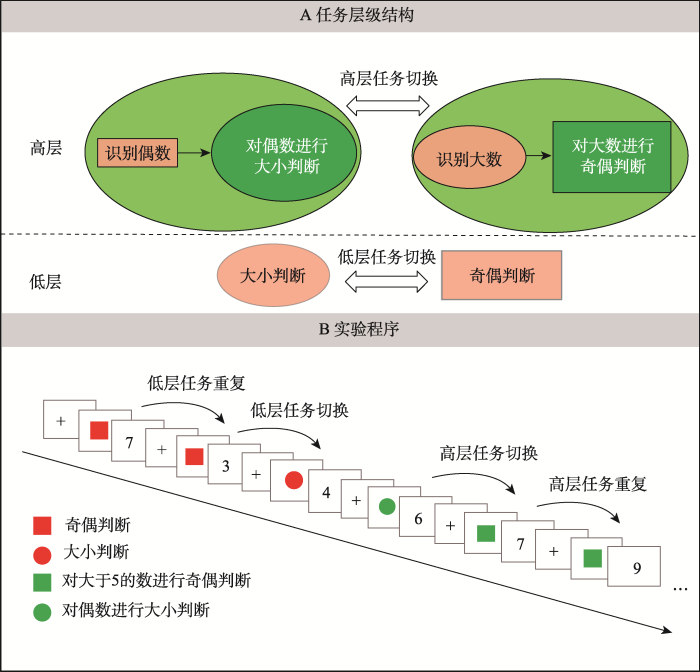
高层级任务要求被试在执行低层级任务之前须先识别数字的某种属性。例如, 对大于5的数进行奇偶判断, 被试首先需要确认当前刺激的数字是否大于5, 如果“是”则对其进行奇偶判断。如果“否”则不需要做任何反应(nogo试次)。nogo试次出现频率约为16%。nogo试次及随后的第一个go试次作为填充试次不计入统计分析。在高层级任务中, 对两种语义(奇偶和大小)均需要进行加工, 奇偶和大小属性可以正交组合成4种不同类型的高层级任务, 分别是“对大于5的数进行奇偶判断”、“对小于5的数进行奇偶判断”、“对奇数进行大小判断”以及“对偶数进行大小判断”。为了确保被试在执行高层级任务切换时, 两个相邻目标数字的属性确认过程和数字判断均需切换, 两种相同语义加工的高层级任务(如对大于5的数进行奇偶判断和对小于5的数进行奇偶判断)不会被安排在同一个实验程序内。 颜色和形状组合的线索对应不同类型的任务, 高、低层级任务伪随机安排在同一Block中。被试根据线索指定的规则对奇数或大于5的数字用左手食指按F键反应, 对偶数或小于5的数用右手食指按J键反应。线索对应的任务及反应按键在被试间进行平衡。
采用2 (切换类型:任务重复, 任务切换) × 2 (层级:低层, 高层)的被试内设计。根据前后两个试次间的关系, 设定低层级任务重复、低层级任务切换、高层级任务重复、高层级任务切换4种实验条件; 每种条件的试次数为85个。其它条件(如由高层级任务切换到低层)为填充试次, 其中由高层级任务切换到低层级任务及由低层级任务切换到高层级任务的试次数均为85个; nogo试次数115个, 随后的试次数115个, 共计740个试次。分4个Block进行, 每个Block一共有185个试次。整个实验耗时约60分钟左右。
2.3 程序
被试的任务是根据线索提示对目标刺激进行不同的语义加工。任务规则如图1所示。要求被试判断当前数字是否为奇数。在实验中, 首先在屏幕中心呈现500 ms的“+”字注视点, 随后500~800 ms的随机空屏后呈现线索1000 ms, 再次呈现500~ 800 ms的随机空屏之后呈现数字刺激, 刺激在被试按键后消失。被试在正式实验开始之前, 需要完成一个练习Block, 练习中给被试提供反馈。在整个实验过程中, 告知被试需要尽可能快速准确地做出反应。
图1
2.4 EEG记录及分析
采用BP脑电系统采集和记录脑电数据。使用10-20国际标准扩展的64导联电极帽, 在线参考点位于FCz电极, 接地点位于AFz电极, 垂直眼电(EOG)放置于右眼框正下方1 cm处。采样频率为500 Hz, 带通滤波为0.05~100 Hz。所有电极电阻均小于10 KΩ。
离线分析将双侧乳突(TP9和TP10)重新设置为参考点, 通过独立主成分分析(ICA)剔除所有电极点上的眨眼、眼漂、肌电等伪迹, 离线带通滤波为0.1~24 Hz; 伪迹剔除标准为±80 μV。ERP分段时程为-200~1000 ms, 基线为刺激出现前200 ms, 对每个条件正确的试次进行叠加平均, 最后把所有被试的各个条件分别进行总平均。
基于以往任务切换和层级控制的相关研究(Han et al., 2018; Li et al., 2019; Lu et al., 2017), 选择了18个电极点, 分别是F1、F2、F3、F4、F5、F6、C1、C2、C3、C4、C5、C6、P1、P2、P3、P4、P5和P6电极点, 并根据区域合并电极点形成6大脑区, 分别是左侧额区(F1、F3和F5)、右侧额区(F2、F4和F6)、左侧中央区(C1、C3和C5)、右侧中央区(C2、C4和C6)、左侧顶区(P1、P3和P5)和右侧顶区(P2、P4和P6)。根据以往研究及肉眼可视的ERP波形差异, 在线索锁时阶段, 选取左侧顶区的P2 (220~270 ms)和CNV (800~1000 ms)的平均波幅进行2 (层级:高、低) × 2 (任务类型:重复、切换)的重复测量方差分析。为了更为直观地展现不同层级下切换代价在不同脑电成分上的特点, 进一步对切换试次与重复试次间的的差异波(任务切换减任务重复)进行配对样本t检验。在目标锁时阶段, 选取了P2 (150~200 ms)、N2 (200~250 ms)、P3 (340~ 420 ms)及SP (600~1000 ms)四个时窗进行重复测量方差分析。因为N2差异主要体现于前中部, 所以对N2的平均波幅进行2 (层级:高、低) × 2 (任务类型:重复、切换) × 2 (前后脑区:额区、中央区) × 2 (左右半球:左、右)的重复测量方差分析; 对P2、P3和SP的平均波幅进行2 (层级:高、低) × 2 (任务类型:重复、切换) × 3 (前后脑区:额区、中央区和顶区) × 2 (左右半球:左、右)的重复测量方差分析。此外, 对N2的差异波进行2 (层级:高、低) × 2 (前后脑区:额区、中央区) × 2 (左右半球:左、右)的重复测量方差分析; 对P2、P3和SP的差异波幅进行2 (层级:高、低) × 3 (前后脑区:额区、中央区和顶区) × 2 (左右半球:左、右)的重复测量方差分析。采用Greenhouse-Geisser方法对p值进行校正, 多重检验时采用Bonferroni方法对p值进行校正, 显著性水平α为0.05。
3 结果
行为反应时和脑电数据均基于正确试次进行分析, 这些试次中不包含练习数据和每个Block的第一个数据; 不包括行为反应时快于200 ms, 或超过被试平均反应时的2.5个标准差的试次; 不包括错误后的试次; 不包括nogo试次以及随后的第一个go试次; 不包括填充试次。对于正确率, 计算了除nogo试次以及随后的第一个go试次和填充试次以外的正式实验数据。
3.1 行为结果
不同条件下的正确率与反应时如表1所示。对正确率的分析结果表明, 任务类型主效应边缘显著, F(1, 27) = 4.21, p = 0.050, ηp2 = 0.13, 任务切换的正确率(94.9%)低于任务重复(96.3%); 层级主效应显著, F(1, 27) = 43.06, p < 0.001, ηp2 = 0.61, 高层级任务的正确率(93.9%)低于低层级任务(97.3%)。任务类型和层级交互作用不显著(p = 0.341)。对低层级任务切换代价(-0.8%)及高层级任务切换代价(-2%)进行配对样本t检验表明两者之间差异不显著(p > 0.050)。
表1 不同条件下的反应时(ms)和正确率(%) (M ± SD)
| 实验条件 | 反应时 | 正确率 |
|---|---|---|
| 低层级任务重复 | 763 ± 170 | 97.7 ± 2 |
| 低层级任务切换 | 850 ± 206 | 96.9 ± 3 |
| 高层级任务重复 | 975 ± 138 | 94.9 ± 4 |
| 高层级任务切换 | 1211 ± 202 | 92.9 ± 5 |
对反应时分析结果表明, 任务类型主效应显著, F(1, 27) = 62.84, p < 0.001, ηp2 = 0.69, 任务切换的反应时(1030 ms)长于任务重复(869 ms); 层级主效应显著, F(1, 27) = 115.87, p < 0.001, ηp2 = 0.81, 高层级任务的反应时(1093 ms)长于低层级任务(806 ms)。任务类型和层级交互作用显著, F(1, 27) = 21.61, p < 0.001, ηp2 = 0.44。简单效应分析发现:不论是高层级或低层级, 任务切换反应时均长于任务重复; 不论是任务重复还是任务切换, 高层级任务的反应时均长于低层级任务。对低层级任务切换代价及高层级任务切换代价进行配对样本t检验的结果表明, 高层级任务切换代价(236 ms)显著大于低层级任务切换代价(87 ms), t (27) = 4.65, p < 0.001, d = 1.78。
3.2 脑电结果
3.2.1 线索锁时ERP
P2 层级主效应显著, F(1, 27) = 8.71, p = 0.006, ηp2 = 0.24, 高层级任务(5.65 μV)相比低层级任务(4.75 μV)诱发更大的P2波幅(如图2)。其他主效应及交互作用不显著(ps > 0.050)。对差异波进行配对样本t检验发现, 高层级任务切换与任务重复间的波幅差异(0.31 μV)与低层级任务切换与任务重复间的波幅差异(0.30 μV)相比无显著性差异, t (27) = -0.01, p = 0.989, d = -0.005。
图2
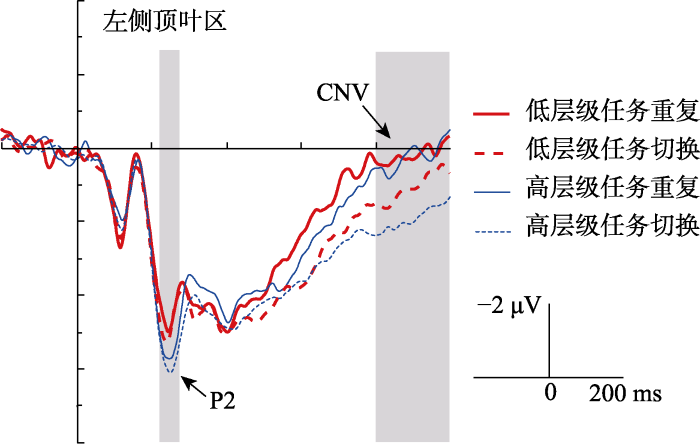
CNV 层级主效应不显著(p > 0.050)。任务类型主效应显著, F(1, 27) = 24.36, p < 0.001, ηp2 = 0.47, 任务切换(1.51 μV)相比任务重复(0.23 μV)诱发的波幅更正; 层级与任务类型之间交互作用显著, F(1, 27) = 5.17, p = 0.031, ηp2 = 0.16, 进一步简单效应分析发现, 在每一种层级水平上, 任务切换相比任务重复都诱发了更正的CNV波幅(p 低层 = 0.004, p 高层 < 0.001); 对于任务切换, 高层级任务切换(1.92 μV)相比低层级任务切换(1.09 μV)诱发更正的波幅(p = 0.018), 任务重复不存在层级间的差异(p = 0.995)。对差异波进行配对样本t检验发现, 高层级任务切换与重复间的波幅差异(0.82 μV)显著大于低层级任务切换与重复间的波幅差异(-0.01 μV), t (27) = 2.27, p = 0.031, d = 0.87。
3.2.2 目标锁时ERP
P2 任务类型主效应显著, F(1, 27) = 5.47, p = 0.027, ηp2 = 0.16, 任务切换(2.27 μV)比任务重复(2.76 μV)诱发更小的P2波幅; 层级与任务类型之间交互作用显著, F(1, 27) = 8.41, p = 0.007, ηp2 = 0.238, 进一步简单效应分析发现在高层级任务水平上, 任务切换(2.14 μV)比任务重复(3.08 μV)诱发的P2波幅更小(p = 0.002), 在低层级水平上无差异(p = 0.860)。对差异波进行重复测量分析发现, 层级主效应显著, F(1, 27) = 8.41, p = 0.007, ηp2 = 0.23, 高层级任务差异波(-0.93 μV)相比低层级任务差异波(-0.04 μV)更大。脑区主效应显著, F(1, 27) = 14.35, p < 0.001, ηp2 = 0.34; 顶叶区域的差异波(0.04 μV)相比额叶区域(-0.81 μV)、中央区域(-0.68 μV)的差异波更小。左右半球主效应边缘显著, F(1, 27) = 3.66, p = 0.066, ηp2 = 0.119。
N2 任务类型主效应显著, F(1, 27) = 6.31, p = 0.018, ηp2 = 0.18, 任务切换(2.31 μV)相比任务重复(2.86 μV)诱发更负的N2波幅(如图3); 层级与任务类型之间交互作用边缘显著, F(1, 27) = 3.68, p = 0.066, ηp2 = 0.12。对差异波进行重复测量方差分析发现, 层级主效应显著, F(1, 27) = 4.82, p = 0.037, ηp2 = 0.15, 高层级任务差异波(-0.89 μV)相比低层级任务差异波(-0.20 μV)更大; 左右半球主效应显著, F(1, 27) = 6.10, p = 0.020, ηp2 = 0.18, 左半球差异波(-0.69 μV)相比右半球差异波(-0.40 μV)更大; 其他主效应及交互作用不显著(ps > 0.050)。
图3
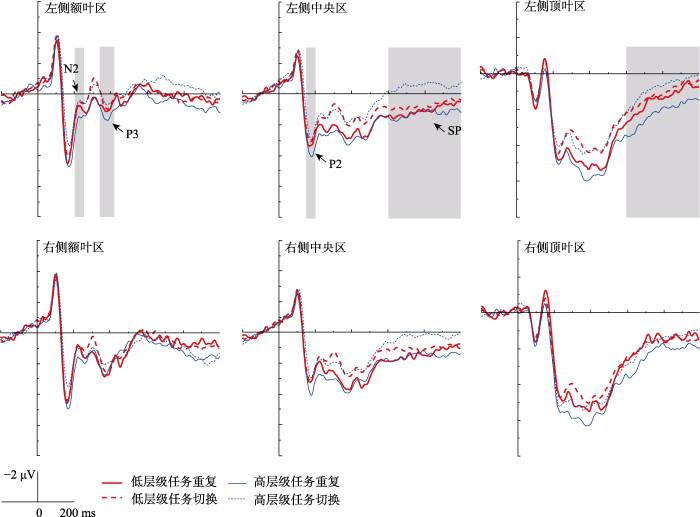
P3 任务类型主效应显著, F(1, 27) = 9.52, p = 0.005, ηp2 = 0.26, 任务切换(2.71 μV)相比任务重复(3.53 μV)诱发更小的P3波幅; 层级、前后脑区与左右半球之间交互作用显著, F(2, 54) = 8.59, p = 0.002, ηp2 = 0.24, 但是进一步简单效应分析未发现显著性的结果(ps > 0.050)。任务类型与左右半球之间交互作用显著, F(1, 27) = 4.26, p = 0.049, ηp2 = 0.13, 进一步简单效应分析发现两侧半球, 任务切换相比任务重复诱发更小的P3波幅(p左= 0.004; p 右= 0.008)。其他主效应及交互作用不显著(ps > 0.050)。对高、低层级任务差异波进行方差分析发现主效应及其交互作用均不显著(ps > 0.050)。
SP 任务类型主效应显著, F(1, 27) = 6.48, p = 0.017, ηp2 = 0.19, 任务切换(0.69 μV)相比任务重复(1.27 μV)诱发更小的SP波幅; 层级与任务类型之间交互作用显著, F(1, 27) = 4.99, p = 0.034, ηp2 = 0.15, 简单效应分析发现在高层级任务水平上, 任务切换(0.45 μV)相比任务重复(1.51 μV)诱发更小的SP波幅(p = 0.004), 低层级任务水平上不存在任务切换和重复试次的波幅差异(p = 0.693)。任务类型与前后脑区之间交互作用边缘显著, F(2, 54) = 3.35, p = 0.062, ηp2 = 0.11。任务类型与左右半球脑区之间存在交互作用, F(1, 27) = 4.21, p = 0.05, ηp2 = 0.13, 简单效应分析发现在左侧区域, 任务切换(0.32 μV)相比任务重复(1.13 μV)诱发更小的SP波幅(p = 0.003); 右侧无差异(p = 0.172)。层级、任务类型与左右半球之间交互作用显著, F(1, 27) = 5.83, p = 0.023, ηp2 = 0.17, 简单效应分析发现在左侧区域, 高层级任务切换(-0.07 μV)相比高层级任务重复(1.36 μV)诱发更小的SP波幅(p = 0.001); 在右侧区域无其它显著性结果(ps > 0.050)。其他主效应及交互作用不显著(ps > 0.050)。对差异波进行重复测量方差分析发现, 层级主效应显著, F(1, 27) = 4.99, p = 0.034, ηp2 = 0.15, 高层级任务差异波(-1.05 μV)相比低层级任务差异波(-0.11 μV)更大; 左右半球主效应边缘显著, F(1, 27) = 4.21, p = 0.050, ηp2 = 0.135, 左半球差异波(-0.80 μV)相比右半球差异波(-0.36 μV)更大; 左右半球与层级交互作用显著, F(1, 27) = 5.83, p = 0.023, ηp2 = 0.178, 简单效应分析发现在左侧半球, 高层级任务差异波(-1.44 μV)相比低层级任务差异波(-0.16 μV)更大(p = 0.011), 在右侧半球不存在差异(p = 0.166); 其他主效应及交互作用不显著(ps > 0.050)。
4 讨论
本研究采用线索-任务切换范式, 比较了高低两种层级任务切换的认知控制(即主动性控制和反应性控制)相关的电生理学差异。行为结果发现, 相比于任务重复, 任务切换的反应时更长, 错误率更高, 反映了典型的切换代价(Barceló & Cooper, 2018; Kiesel et al., 2010; Rogers & Monsell, 1995; Schneider, 2017; Swainson et al., 2017, 2019; Tarantino et al., 2016); 与低层级任务相比, 高层级任务的反应时更长, 错误率更高, 这与已有关于层级任务的研究结果一致, 反映了高层级任务更复杂更抽象的特点(Hirsch et al., 2020; Li et al., 2019; Lu et al., 2017)。
任务类型与层级存在交互作用, 切换代价受到层级的调控, 高层级任务切换代价显著高于低层级任务切换代价, 这一结果与以往相关研究的结论一致(Kleinsorge & Heuer, 1999; Collins et al., 2014)。在本研究中, 高低层级任务之间信息加工的复杂性不同。在执行低层级任务时, 个体只需加工刺激的一种语义特征(如判断数字的奇偶性), 在任务切换时只需将任务目标转移到另一语义特征(如判断大小)。相比之下, 在高层级任务切换时, 数字识别和语义判断过程都发生了切换。根据惯性论(干扰论)的观点(Allport et al., 1999; Meiran, 2008; Waszak et al., 2003; Wylie & Allport, 2000), 低层级任务切换时, 先前任务只涉及刺激的一种属性(奇偶判断), 个体在执行当前任务时(大小判断)只需要抑制先前的奇偶判断即可。而在高层级任务当中, 先前的任务涉及刺激的两种属性(如对大数进行奇偶判断), 而当前任务是对偶数进行大小判断, 即需要的抑制控制更多。根据任务设置重构论(Mayr & Kliegl, 2000; Rogers & Monsell, 1995), 在高层级任务中需要重构的任务元素(如在本研究中的数字识别与随后的语义判断、反应选择等)较低层级任务更丰富、复杂, 从而导致其切换更困难。第二, 高低层级任务间由线索诱发的主动性控制不同。Nicholson等(2006)通过操纵线索的信息有效性程度分离预期准备对主动性控制和反应性控制的调节过程。结果发现增加线索-刺激的间隔(Cue stimulus interval, CSI)只对主动性控制产生影响。在本研究中, 线索-刺激的时间间隔为1.6秒, 低层级任务可以通过预先的准备降低切换代价, 然而在高层级任务中是否需要执行任务必须待目标刺激出现之后, 完成第一阶段的加工方可知晓该试次是否需要执行(按键反应), 因此, 高层级切换代价增大也可能是由于CSI期间主动性控制加工更不充分造成的。
需要注意的是, 本研究中高层级任务相比低层级任务存在更大的反应时切换代价并非由偶尔的分心(nogo)试次导致。被试在遇到这些试次时不需要做出任何反应, 这与考察反应抑制的研究中的nogo试次相似。以往研究表明, 在任务转换中引入nogo试次会诱发任务重复试次中的N-2重复代价, 即导致一些重复试次的反应时间延长, 从而导致切换代价的降低甚至消失(Schuch & Koch, 2003)。然而, 本研究在包括一些nogo试次的高层级任务条件下, 其切换代价更大。因此可以推断, 高层和低层级任务之间的显著差异不是由于nogo试次造成的。
4.1 主动性控制的层级性
在线索任务切换的研究中, 研究者常常将线索加工阶段定义为主动性控制的过程 (Karayanidis et al., 2003), 即被试有选择地对任务相关的线索信息进行注意加工, 在工作记忆中积极地表征和维持这一线索信息, 从而形成相应的反应准备。本研究发现, 在线索锁时的P2时窗上存在明显的层级效应, 这一结果与Han等(2018)的结论一致。这说明不论是他们操纵的层级规则, 还是本研究中的层级任务, 高低层级间的差异都最早在线索呈现后200 ms左右被大脑感知。顶区P2与早期的感知过程(Han et al., 2018)、注意过程(Luck & Hillyard, 2010)相关联。例如, 当个体需要对目标刺激是否与任务相关的知觉特征进行甄别时会观察到明显的P2成分(Han et al., 2018)。在本实验中, 高层级任务的线索相比低层级任务诱发更大的P2波幅, 说明被试在对高层级任务进行准备时, 对线索的知觉维度特征进行编码时给予的注意资源更多, 为后续提取更复杂的任务规则做足准备。
在CNV时窗, 无论是在高层级任务还是在低层级任务中, 任务切换均相比任务重复诱发了更正的波幅, 这一切换正波反映了任务切换和任务重复之间不同的任务准备过程。以往研究表明, 任务范式(Karayanidis et al., 2003, 2010; Kieffaber & Hetrick, 2005; Nicholson et al., 2005; Swainson et al., 2006)、线索呈现方式(Kieffaber & Hetrick, 2005)、线索的明确性(Rushworth et al., 2002)以及练习程度(Karayanidis et al., 2003; Nicholson et al., 2005)都不影响切换正波的出现, 表明提示任务切换与任务重复的线索呈现时主动性控制过程的卷入程度不同。在本研究中, 线索锁时的CNV时窗的切换正波可能反映了这一主动性控制过程。
此外, 在CNV时窗, 高层级任务切换与重复间的波幅差异显著大于低层级任务切换与重复间的波幅差异。这一任务切换与重复的差异波在两层级间的差异源于高层级任务切换相比低层级任务切换诱发波幅更正的走向。有研究表明CNV作为主动性控制的有效指标, 对困难任务相对简单任务的准备更需要主动性控制参与(Poljac & Yeung, 2014), 并且受到任务集维度数量的调控(Kieffaber et al., 2013), 任务集的维度越多, 需要的主动性控制越强, 诱发的CNV波幅就越正。在应对具有不同维度参数的任务切换时, 大脑给予多维度任务切换更多的主动性控制(Kleinsorge & Heuer, 1999)。本研究认为线索诱发的CNV波幅可能反映了对不同任务的准备过程, 即当任务重复时, 个体只需要重复应用上一个任务规则即可完成任务的准备, 因而其诱发的CNV波幅较负, 但当任务线索发生切换时, 个体维持在工作记忆的规则已不再适用, 需要重新从工作记忆中提取与当前线索匹配的规则才能完成任务的准备, 进而诱发更正的CNV波幅。与低层级任务切换相比, 高层级任务切换需要在记忆中提取的线索信息更复杂, 重构任务规则的时间更长, 因此其诱发的CNV波幅的正走向更明显。
4.2 反应性控制的层级性
反应性控制指在将要做出反应时, 灵活地运用即时出现的任务相关信息解决冲突, 并在需要运用先前的线索解决当前的冲突时, 通过检索来重新激活先前的线索信息, 以指导当前的反应并修正可能存在的错误反应倾向(Braver et al., 2007)。在本研究的低层级任务中, 个体已经在线索呈现后的任务准备过程中进行了有效的准备, 待目标出现时直接提取线索信息进行按键反应; 而在高层级任务中, 目标刺激出现之后, 仍需要检索激活先前的线索信息所代表的规则对目标刺激的第一个维度(先决条件)进行加工, 判断该任务是否需要按键反应, 如需则提取反应按键规则, 并根据规则进行按键反应。因此, 在高层级任务中需要更多的反应性控制。脑电结果表明, 任务切换相比任务重复诱发更小的P2波幅。P2成分被认为与任务激活相关(Kieffaber & Hetrick, 2005), 有研究者将这一成分解释为检索S-R联结或评估刺激维度特征是否与目标刺激相关的指标(Rushworth et al., 2002)。同时, 本研究发现切换效应受到层级属性的调控, 具体表现为在高层级任务切换相比高层级任务重复诱发更小的P2波幅, 而在低层级任务中, 低层级任务切换相比低层级任务重复诱发的P2波幅并无差异。因此, 我们推断当目标数字出现时, 高层级任务仍需对数字的维度特征进行加工, 判别当前试次是否需要进行按键反应。倘若线索指示的规则是对奇数进行大小判断而出现的目标数字是偶数, 被试无需按键反应。因此, P2成分在本研究中可能与评估刺激维度特征是否属于目标刺激的过程相关。
在目标锁时阶段, N2时窗存在显著的切换效应, 即任务切换相对于任务重复诱发更负的N2波幅, 这一结果重复了以往的研究结果(Han et al., 2018; Gajewski et al., 2010; Nicholson et al., 2005; Swainson, et al., 2006; Swainson et al., 2003)。以往研究结果发现, 目标锁时的N2成分在前额及中央区分布最为广泛, 源定位分析发现N2成分主要来源于扣带回前侧。N2成分在冲突条件下更大, 因此它与冲突监控(van Veen & Carter, 2002; Yeung & Cohen, 2006)或与反应选择机制有关(Gajewski et al., 2008, 2010, 2018; Yeung & Cohen, 2006)。在本研究中, 当任务切换时, 个体必须克服不相关任务集的干扰, 从而完成目标任务(Allport & Wylie, 1999; Wylie & Allport, 2000)。在N2成分上, 高层级任务切换与任务重复间的波幅差异相比低层级任务更大, 可能是因为在执行高层级任务切换时要求个体抑制的信息更多。例如, 当被试从 “对大于5的数进行奇偶判断”切换到“对偶数进行大小判断”时, 他们需要抑制数字识别(即是否大于5)和语义信息的加工。而在低层级任务水平上, 当被试“从奇偶判断”切换到“大小判断”时, 个体只需抑制上一个数字的一种语义信息(奇偶判断)。
已有研究表明, 目标锁时的任务切换比任务重复诱发更小的P3或SP波幅主要反映了与任务执行相关的过程(Han et al, 2019)以及反应设置重构加工过程(Barceló et al., 2000; Waszak et al., 2003; Xie et al, 2020)。在本研究中, P3时窗也存在着明显的切换效应, 即相对于任务重复, 任务切换诱发更小的P3波幅, 这和以往关于目标锁时P3的研究结果一致(Han et al., 2018; Karayanidis et al., 2003; 2010; Kieffaber & Hetrick, 2005; Nicholson et al., 2006; Swainson et al., 2003)。研究者认为, 更小的P3波幅(即切换负波)可能反映了S-R联结稳定性降低(Barceló et al., 2000), 在任务重复时, S-R联结仍与上一个试次保持相同, 个体只要按照之前的规则进行反应即可, 然而在任务切换时, 新建立的S-R联结的稳定性较低。因此, 反应设置重构所需的时间就更长(即更长的反应时)。以往有部分研究(Hsieh & Wu, 2011; Li et al., 2019)将目标锁时的P3和晚期成分统称为晚期持续慢波, 认为其与反应执行中的反应准备相关联。在本研究中, 观察到在SP时窗上发现了显著的切换效应, 任务切换相对于任务重复诱发了更小的SP波幅。因此推断这一反应设置重构进程延续到SP时窗。
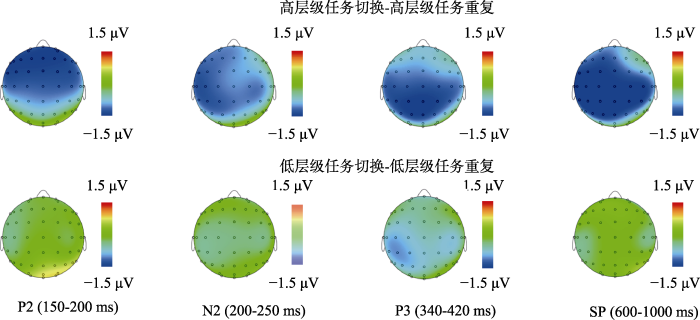
最为重要的是, 对高层级任务切换与任务重复间的SP的波幅差异和低层级任务切换与任务重复间的SP波幅差异进行比较, 发现在左侧中后部区域, 高层级任务切换的差异波波幅显著大于低层级任务(如图4), 表明高、低层级任务在反应设置重构过程中认知控制过程的差异, 即相对于低层级任务切换时的任务集的重构, 高层级任务切换的重构更不容易, 新建立的S-R联结也更不稳定。需要注意的是, 根据Kleinsorge和Heuer (1999)层级任务切换模型, 与S-R联结规则相比, 任务目标的层级更高, 其认知控制的需求更高, 层级性对任务目标的影响可能不同于对S-R联结规则的影响。与Han等(2018)中关于层级规则的重构过程相关的ERP成分即切换负波所体现的层级效应相比, 本研究中在任务重构上的层级效应出现较晚。 在Han等(2018)的研究中反映任务集重构的层级效应出现在P3窗口(350~450 ms), 而本研究出现于SP (600~1000 ms)窗口, 对这一研究结果的差异可能是这两个研究操纵的任务集元素不同。如Han等(2018)通过对线索特征指示的反应规则的操纵来探究规则切换的层级性。而本研究操纵的是任务的层级性。在一个任务集, 任务比反应规则的层级更高、更抽象(Kleinsorge & Heuer, 1999), 其重构也更困难。因此, 其重构过程中所体现的层级性也可能较晚出现。
图4
本研究在已有研究基础上通过线索任务切换范式进一步探讨了认知控制的层级性, 但存在如下不足之处。第一, 在本研究中, 层级的变化不可避免地伴随着任务复杂性的变化(即层级越高, 任务越复杂)。在未来的研究中, 如何将层级和复杂性进行有效的区分值得进一步去探索。第二, 在本研究中, 设置nogo试次的目的是确保被试能够按照既定规则进行按键反应, 虽然nogo试次数量较少, 仅仅作为填充试次未纳入数据分析, 后续研究可将其作为一个变量纳入进来以考察反应选择、反应抑制, 以及向后抑制对层级任务切换的影响。
5 结论
本研究通过嵌套的线索-任务切换范式来探究任务切换的层级控制过程及其神经机制, 结果发现, 高层级任务切换代价显著高于低层级任务切换代价; 线索锁时的脑电结果表明, 高层级任务切换与重复间的CNV波幅差异显著大于低层级任务切换与重复间的波幅差异, 反映了在主动性控制阶段, 个体对高层级任务给予更多的主动性控制以完成对紧随其后目标任务的准备。目标锁时的脑电结果表明, 在N2及SP成分上, 高层级任务切换与重复间的波幅差异显著大于低层级任务切换与重复间的波幅差异, 分别反映了在抑制旧任务集与重构新反应集的过程中增大的反应性控制。这些结果表明, 在任务切换中, 随着任务本身的层级(抽象或复杂程度)的提高, 任务准备的主动性控制与对旧任务集的抑制与新任务集的重构相关的反应性控制水平都随之提高。
参考文献
Task-switching:Positive and negative priming of task-set
Response-cue interval effects in extended-runs task switching: Memory, or monitoring?
DOI:10.1007/s00426-017-0921-3
PMID:28951972
[本文引用: 2]

This study investigated effects of manipulating the response-cue interval (RCI) in the extended-runs task-switching procedure. In this procedure, a task cue is presented at the start of a run of trials and then withdrawn, such that the task has to be stored in memory to guide performance until the next task cue is presented. The effects of the RCI manipulation were not as predicted by an existing model of memory processes in task switching (Altmann and Gray, Psychol Rev 115:602-639, 2008), suggesting that either the model is incorrect or the RCI manipulation did not have the intended effect. The manipulation did produce a theoretically meaningful pattern, in the form of a main effect on response time that was not accompanied by a similar effect on the error rate. This pattern, which replicated across two experiments, is interpreted here in terms of a process that monitors for the next task cue, with a longer RCI acting as a stronger signal that a cue is about to appear. The results have implications for the human factors of dynamic task environments in which critical events occur unpredictably.
Functional magnetic resonance imaging evidence for a hierarchical organization of the prefrontal cortex
The prefrontal cortex (PFC) is central to flexible and organized action. Recent theoretical and empirical results suggest that the rostro-caudal axis of the frontal lobes may reflect a hierarchical organization of control. Here, we test whether the rostro-caudal axis of the PFC is organized hierarchically, based on the level of abstraction at which multiple representations compete to guide selection of action. Four functional magnetic resonance imaging (fMRI) experiments parametrically manipulated the set of task-relevant (a) responses, (b) features, (c) dimensions, and (d) overlapping cue-to-dimension mappings. A systematic posterior to anterior gradient was evident within the PFC depending on the manipulated level of representation. Furthermore, across four fMRI experiments, activation in PFC subregions was consistent with the sub- and superordinate relationships that define an abstract representational hierarchy. In addition to providing further support for a representational hierarchy account of the rostro-caudal gradient in the PFC, these data provide important empirical constraints on current theorizing about control hierarchies and the PFC.
Frontal cortex and the hierarchical control of behavior
DOI:S1364-6613(17)30245-0
PMID:29229206
[本文引用: 2]
The frontal lobes are important for cognitive control, yet their functional organization remains controversial. An influential class of theory proposes that the frontal lobes are organized along their rostrocaudal axis to support hierarchical cognitive control. Here, we take an updated look at the literature on hierarchical control, with particular focus on the functional organization of lateral frontal cortex. Our review of the evidence supports neither a unitary model of lateral frontal function nor a unidimensional abstraction gradient. Rather, separate frontal networks interact via local and global hierarchical structure to support diverse task demands.Copyright © 2017 Elsevier Ltd. All rights reserved.
Switch probability context (in) sensitivity within the cognitive control network
DOI:10.1016/j.neuroimage.2013.03.057 URL [本文引用: 2]
An information theory account of late frontoparietal ERP positivities in cognitive control
Attentional set shifting modulates the target P3b response in the wisconsin card sorting test
For years the Wisconsin card sorting test (WCST) has been used as a test of frontal lobe function. Recent event-related potential (ERP) research has shown large differences in the amplitude of P3b responses evoked by early and late trials within each WCST series ([8]: Barceló F., Sanz M., Molina V., Rubia FJ. The Wisconsin Card Sorting Test and the assessment of frontal function: A validation study with event-related potentials. Neuropsychologia 1997;35:399-408). In this study, 16 normal subjects performed a WCST adaptation to investigate the role of attentional set shifting in these WCST P3b effects. Two control tasks were designed to examine whether early-late WCST P3b changes reflect category selection (attention) or category storage (memory) operations. Results suggest both a sharp P3b attenuation during shift WCST trials, followed by a gradual P3b build-up during post-shift trials. This P3b modulation could not be attributed to selection or storage of simple sensory stimulus dimensions, nor was it observed when the new rule was externally prompted by the first card in the WCST series. Instead, WCST P3b changes seem related to the endogenously generated shift in the perceptual rule used to sort the cards (i.e., the shift in set). The gradual build-up in P3b amplitude paralleled a progressive improvement in sorting efficiency over several post-shift WCST trials. A model based on formal theories of visual attention and attentional set shifting is proposed to account for these effects. The model offers firm grounds for prediction and bridges the gap between related clinical and experimental evidence.
Explaining the many varieties of working memory variation:Dual mechanisms of cognitive control
In
Neural aspects of anticipatory behavior
Anticipatory behavior reveals itself in the perceptual domain and in the motor domain. Expectant attention and motor preparation are characterized by selection, aimed at an amelioration of the signal-to-noise ratio in the information to be processed. The functional similarity of anticipatory attention and motor preparation is reflected in the underlying anatomical substrate. The prefrontal cortex, involved in a number of different networks, organizes anticipatory behavior in a top-down way by activating cortico-cortical loops and thalamo-cortical loops to sensory and motor areas. The sensory areas are set to receive the impinging stimulus presentation, the motor areas are set to implement and execute the different motor programs. Thalamic nuclei are also activated from the prefrontal cortex, especially the large association nuclei, the dorsomedial nucleus and the pulvinar. In different models of selective attention the reticular nucleus of the thalamus has a special role in the distribution of the inhibitory control upon the information processing in the "relay" nuclei. It is hypothesized that it has the same pivotal position in motor preparation. Although the anatomical relations do not allow a direct test of the proposed hypothesis, the available psychophysiological evidence does not contradict it.
Human EEG uncovers latent generalizable rule structure during learning
DOI:10.1523/JNEUROSCI.3900-13.2014
PMID:24672013
[本文引用: 10]
Human cognition is flexible and adaptive, affording the ability to detect and leverage complex structure inherent in the environment and generalize this structure to novel situations. Behavioral studies show that humans impute structure into simple learning problems, even when this tendency affords no behavioral advantage. Here we used electroencephalography to investigate the neural dynamics indicative of such incidental latent structure. Event-related potentials over lateral prefrontal cortex, typically observed for instructed task rules, were stratified according to individual participants' constructed rule sets. Moreover, this individualized latent rule structure could be independently decoded from multielectrode pattern classification. Both neural markers were predictive of participants' ability to subsequently generalize rule structure to new contexts. These EEG dynamics reveal that the human brain spontaneously constructs hierarchically structured representations during learning of simple task rules.
Influence of cognitive control and mismatch on the N2 component of the ERP: A review
Recent years have seen an explosion of research on the N2 component of the event-related potential, a negative wave peaking between 200 and 350 ms after stimulus onset. This research has focused on the influence of "cognitive control," a concept that covers strategic monitoring and control of motor responses. However, rich research traditions focus on attention and novelty or mismatch as determinants of N2 amplitude. We focus on paradigms that elicit N2 components with an anterior scalp distribution, namely, cognitive control, novelty, and sequential matching, and argue that the anterior N2 should be divided into separate control- and mismatch-related subcomponents. We also argue that the oddball N2 belongs in the family of attention-related N2 components that, in the visual modality, have a posterior scalp distribution. We focus on the visual modality for which components with frontocentral and more posterior scalp distributions can be readily distinguished.
The dynamic balance between cognitive flexibility and stability: The influence of local changes in reward expectation and global task context on voluntary switch rate
DOI:10.1007/s00426-017-0922-2
PMID:28939942
[本文引用: 1]
Current theories describe cognitive control as a dynamic balance between two antagonistic control functions, namely cognitive stability and flexibility. Recent evidence suggests that this balance between these control modes is modulated by changing reward prospects on the one side and contextual parameters on the other. In the present study, we aim to investigate how both factors interact. In a between-subjects design, we manipulated the context by the ratio of free- to forced-choice trials (80:20, 50:50, 20:80) in a hybrid task-switching paradigm, combining forced- and free-choice task switching. In addition, two reward magnitudes changed randomly from trial to trial. Results showed an overall increase in voluntary switch rate (VSR) with increasing forced-choice frequency, demonstrating a robust context effect. Moreover, the trial-by-trial reward manipulation interacted with this global context effect: with a stability bias (80% free:20% forced), only an increase in reward expectation increased VSR, whereas with a more flexible global bias (in the 50:50 or 20:80 conditions) VSR increased when reward expectation changed and reduced when reward expectation remained high. Taken together, results suggest that the cognitive system is able to adapt to global context parameters and to respond to rapid changes in reward expectation at the same time.
Understanding sources of adult age differences in task switching: Evidence from behavioral and ERP studies
DOI:S0149-7634(17)30395-0
PMID:29885425
[本文引用: 1]
The task-switching paradigm is a valid tool to measure age-related changes in executive functions. It allows identifying the most vulnerable cognitive control processes affected by aging. This review provides an overview about the current evidence on behavioral and electrophysiological signatures of adult age differences in task switching with a focus on age-related changes in ERP correlates of three task-processing phases: (1) advanced task preparation as reflected by the cue-P3 and the CNV; (2) task implementation including P1 / N1, P2, N2, N450 / Ni as well as target-P3; and (3) response monitoring mechanisms as indicated by the Nc / CRN / MFN during correct responding and Ne / ERN in error trials. While most of these ERP correlates of executive control are reduced in older age, qualitative ERP differences between age groups are less consistent. We also report some recent findings from cognitive training research showing the potential for enhancement in task switching in older age. The results are discussed in the light of current models of cognitive control.Copyright © 2018 The Authors. Published by Elsevier Ltd.. All rights reserved.
Electrophysiological correlates of residual switch costs
DOI:10.1016/j.cortex.2009.07.014
PMID:19717147
[本文引用: 3]
Switching among cognitive tasks results in switch costs which are only partly reduced even after sufficient task preparation. These residual switch costs are frequently explained in terms of interference of simultaneously active task representations that delays selection of a correct response. Recent studies showed that the benefit of a task- and response-set repetition can also explain residual costs. We aimed to extend the findings by clarifying the mechanisms underlying task- and response-mode repetition benefit as well as costs arising by switch of one or both dimensions. To this end we used a combination of task-switching and go/no-go paradigm during an electrophysiological recording. Particularly, we focused on the frontocentral N2, which has been usually related to conflict, but also to response selection. The behavioral results replicate previous findings of lack of residual switch costs due to slower responses in task repetitions (TRs) following no-go relative to go trials. This indicates elimination of TR benefit when in a previous trial no response was selected and prepared. In other words, task sets clearly benefits from repetition of response mode whereas interference seems to occur whenever the task-set, the response mode or both were switched. Trial incongruity increased reaction times. The event-related potentials (ERPs) revealed a frontocentral N2 in all conditions which followed the same pattern as the reaction times (RTs), showing smaller amplitude and peaking earlier when both the task and response mode were repeated relative to the three switching conditions. Similar to the behavioral data, the N2 increased as a function of incongruity. Finally, both the N2 amplitude and latency correspond closely to the residual switch costs. This finding suggests that task-set or response mode switching intensify and delay response selection, relative to the repetition of both dimensions.Copyright © 2009 Elsevier Srl. All rights reserved.
ERP-correlates of response selection in a response conflict paradigm
Neuroimaging and electrophysiological studies suggest that the anterior cingulate cortex (ACC) is involved in the cognitive control of response related action. A frontocentral negative ERP-component, the N2, which probably originates from the ACC, is usually enhanced in conflict-trials that demand an unexpected response. We here used stepped adjustment of response expectation in a response-cueing task, and measured how the N2 varied with global and local cue validity. Results showed that, irrespective of the current cue validity, response times, error rates, and the frontocentral components P2, N2 and P3 increased in unexpected trials. Nevertheless, a N2 was also seen in expected trials, and its latency correlated positively with reaction times, indicating that this potential does not express response conflict only. In line with roles suggested for the ACC, we here propose that the N2 is related to the process of response selection which influences subsequent processing stages reflected in the P3. Unexpected revisions of response programs enhance and delay the N2.
Excessive response-repetition costs under task switching: How response inhibition amplifies response conflict
DOI:10.1037/a0028477 URL [本文引用: 1]
Brain responses associated with different hierarchical effects on cues and targets during rule shifting
DOI:S0301-0511(18)30128-5
PMID:29476839
[本文引用: 21]
Numerous studies have explored the neural mechanisms related to task switching or rule shifting, but few have revealed the neural substrates related to rule shifting at different hierarchical levels. The purpose of this study is to explore the different event-related potentials (ERPs) elicited by higher and lower hierarchical levels of rule shifting in a cue-target task. In the task, participants were presented with Arabic digits (1-9, excluding 5), and performed a parity or magnitude judgment according to the preceding cues, a letter R. The rules were constructed in a hierarchical set, and the rule was either repeated or shifted between neighboring trials. Importantly, the rule shifting would be at a higher or lower hierarchical level. The results showed that, for the cues, the higher hierarchical shifting evoked increased P2, P3, late positive component (LPC), and decreased N2 relative to lower hierarchical shifting, reflecting the increased demand in selective attention, rule processing, and proactive control during the rule acquisition stage. For the targets, the hierarchical effects were reversed, and emerged later than the rule shift effect. These findings imply that, in the cue-target rule-shifting task, the brain responds differently to different hierarchical levels of rule shifting.Copyright © 2018 Elsevier B.V. All rights reserved.
More abstract, more difficult to shift: Behavior and electrophysiological evidence
DOI:S0166-4328(18)31192-6
PMID:30615892
[本文引用: 10]
Previous studies on task or rule shifting have shown that the switch cost is affected by the hierarchical level of abstraction. The present study aimed to explore the neural correlates of hierarchical modulation in rule shifting. Participants were required to respond to number stimuli (1-9, excluding 5) while adhering to alternative rules cued by different perceptual features of the stimuli. Across trials, the rules might repeat or shift at either high or low hierarchical levels. Behavioral results indicated that the reaction times were significantly slower in the high-shift than in the low-shift condition. The electrophysiological results revealed (1) significant difference in P300 between high- and low-shift conditions, with larger P300 in the high-shift condition; and (2) increased amplitude of the late positive component (LPC) elicited by the high-shift condition as compared to that by the low-shift condition. These findings demonstrate that the task-set reconfiguration and rule selection is more difficult for higher hierarchical level of rule shifting as compared with lower level.Copyright © 2019 Elsevier B.V. All rights reserved.
Evidence for a multicomponent hierarchical representation of dual tasks
DOI:10.3758/s13421-020-01097-3 URL [本文引用: 1]
Hierarchical coding in the perception and memory of spatial layouts
DOI:10.1007/s004260000032 URL [本文引用: 1]
Electrophysiological correlates of preparation and implementation for different types of task shifts
DOI:10.1016/j.brainres.2011.09.018
PMID:22000079
[本文引用: 1]
The ability to flexibly shift between tasks is central to cognitive control, but whether the same brain mechanisms mediate shifting across different tasks is unknown. In this study, we investigated whether variations in stimulus-dimensions or response-mapping might influence task switching in terms of its preparatory processes, as reflected in cue-locked event-related potentials (ERPs), and its implementation processes, as reflected in stimulus-locked ERPs. Participants judged pairs of digits as same or different in one of two conditions. In one condition, the task-relevant stimulus-dimension was either repeated or switched across trials while the response-mapping rule was kept constant. In the other condition, the task-relevant stimulus-dimension was kept constant while the response-mapping rule was repeated or switched across trials. The length of the preparatory interval was manipulated. Data revealed switch-related preparatory ERP components (including N2 and a late slow positivity) that were associated with both types of task shifting and an N400-like negativity that distinguished between the two types. Several switch-related implementation ERP components associated with both types of task shifting were found at posterior sites. Distinct frontal modulations of the N1, P2, and N2 were found to associate with the implementation of the response-mapping shift, whereas a slow positivity was associated with the implementation of the stimulus-dimension shift. Therefore, this study demonstrates that there are shared and distinct processes across different types of task shifting. Finally, because the same transition-cue was used for different task shifts, the distinct processes cannot be explained simply by differences in cue processing.Copyright © 2011 Elsevier B.V. All rights reserved.
Theoretical controversy and integration of task switching research
任务切换机制研究的理论争议与整合
Reconfiguration and interference in voluntary task switching
DOI:10.3724/SP.J.1042.2018.01624 URL [本文引用: 1]
自主任务转换中的重构和干扰
Electrophysiological correlates of anticipatory and poststimulus components of task switching
PMID:12946108
[本文引用: 11]
Task-switching paradigms can shed light on cognitive and neural processes underlying attentional control mechanisms. An alternating runs task-switching paradigm (R. D. Rogers & S. Monsell, 1995) is used to identify ERP components associated with anticipatory and poststimulus components of task-switching processes. Subjects alternated between two tasks in a predictable series (AABB). Reaction time (RT) switch cost reduced with increasing response-stimulus (R-S) interval and a residual switch cost remained at the longest R-S interval. A switch-related positivity (D-Pos) developed in the R-S interval. D-Pos was time-locked to response onset, peaked around 400 ms post-response onset, and was unaffected by task-set interference. A switch-related negativity (D-Neg) emerged after stimulus onset. D-Neg peaked earlier with increasing R-S interval and its amplitude and latency were affected by task-set interference. D-Pos and D-Neg were interpreted within current models of task-switching.
Event-related potentials reveal multiple components of proactive and reactive control in task switching
Advance preparation in task-switching: Converging evidence from behavioral, brain activation, and model-based approaches
DOI:10.3389/fpsyg.2010.00025
PMID:21833196
[本文引用: 6]
Recent research has taken advantage of the temporal and spatial resolution of event-related brain potentials (ERPs) and functional magnetic resonance imaging (fMRI) to identify the time course and neural circuitry of preparatory processes required to switch between different tasks. Here we overview some key findings contributing to understanding strategic processes in advance preparation. Findings from these methodologies are compatible with advance preparation conceptualized as a set of processes activated for both switch and repeat trials, but with substantial variability as a function of individual differences and task requirements. We then highlight new approaches that attempt to capitalize on this variability to link behavior and brain activation patterns. One approach examines correlations among behavioral, ERP and fMRI measures. A second "model-based" approach accounts for differences in preparatory processes by estimating quantitative model parameters that reflect latent psychological processes. We argue that integration of behavioral and neuroscientific methodologies is key to understanding the complex nature of advance preparation in task-switching.
Event-related potential correlates of task switching and switch costs
Studies of task switching demonstrate that task switches are associated with response costs and that these costs are reduced when a cue is presented in advance of a switch. The present study examined cortical event-related potential correlates of task switching and switch costs in 39 participants during a cued match/mismatch discrimination task. Compared with non-switch trials, switch trials were associated with a larger cue-related, anticipatory P3b-like waveform. Switch trials were also associated with smaller target-related, stimulus-dependent P2 and P3-like components. Moreover, the switch-related amplitude variability in the P3b to the cue and the P2 to the target were associated with unique components of the residual switch costs. The results support an integrated model of task switching with complementary yet distinct roles for anticipatory and stimulus-dependent processes in task switching and switch costs.
Dissociating stimulus-set and response-set in the context of task-set switching
DOI:10.1037/a0029545 URL [本文引用: 1]
Control and interference in task switching—A review
DOI:10.1037/a0019842 URL [本文引用: 4]
Hierarchical switching in a multi-dimensional task space
DOI:10.1007/s004260050060 URL [本文引用: 8]
The problem of serial order in behavior
Not inertia but reconfiguration: Asymmetric switch cost in a hierarchical task
Event-related potentials and neural oscillations dissociate levels of cognitive control
DOI:S0166-4328(16)31239-6
PMID:27979693
[本文引用: 3]
Recent models of human behavior suggest a hierarchical organization of cognitive control processes. These models assume that different sub-goals of cognitive control processes are nested in each other, such that higher-level sub-goals can only be accomplished when lower-level sub-goals have been realized. While the neuroanatomical localization of this organizational principle has already been successfully tested, the exact temporal nature remains to be explored. The present study applied event-related potentials (ERPs) and investigated neural oscillations during performance of three different nested cognitive control tasks. Results demonstrated a parametric modulation of the P300 component as well as beta-band (13-25Hz) oscillations as a function of different levels of cognitive control. Moreover, conditions requiring flexible updating of information exhibited similar alpha-band (8-13Hz) oscillations, which differed from the condition without flexible updating (low-level). These results suggest dissociable mechanisms of flexible information updating and complexity of cognitive control processes indexed by different oscillatory effects.Copyright © 2016 Elsevier B.V. All rights reserved.
Electrophysiological correlates of feature analysis during visual search
DOI:10.1111/j.1469-8986.1994.tb02218.x URL [本文引用: 1]
Task-set switching and long-term memory retrieval
DOI:10.1037/0278-7393.26.5.1124 URL [本文引用: 2]
The dual implication of dual affordance: Stimulus-task binding and attentional focus changing during task preparation
In task switching experiments, comparing performance with bivalent stimuli (affording both tasks) to univalent stimuli (affording one task) confounds the need to change focus between dimensions and stimulus-task binding, because bivalent stimuli require focusing (and refocusing) but also appeared in the competing task before. To separate these influences, participants switched between vertical and horizontal judgments performed on bivalent (e.g., up-left) or univalent (e.g., left) actual locations or location words. In a critical condition involving bivalence without stimulus-task binding, actual locations and location words were each linked to a different task. Bivalence increased switch costs and preparation reduced switch costs only with bivalent stimuli. Stimulus-task binding affected performance in task repetitions, especially when little preparation time was afforded.
An integrative theory of prefrontal cortex function
The prefrontal cortex has long been suspected to play an important role in cognitive control, in the ability to orchestrate thought and action in accordance with internal goals. Its neural basis, however, has remained a mystery. Here, we propose that cognitive control stems from the active maintenance of patterns of activity in the prefrontal cortex that represent goals and the means to achieve them. They provide bias signals to other brain structures whose net effect is to guide the flow of activity along neural pathways that establish the proper mappings between inputs, internal states, and outputs needed to perform a given task. We review neurophysiological, neurobiological, neuroimaging, and computational studies that support this theory and discuss its implications as well as further issues to be addressed
Can the task-cuing paradigm measure an endogenous task-set reconfiguration process?
ERPs dissociate the effects of switching task sets and task cues
Recent studies have suggested that reaction time (RT) costs associated with switching tasks do not reflect an endogenous control process of task set reconfiguration [Logan, G. D., Bundesen, C., 2003. Clever Homunculus: Is There an Endogenous Act of Control in the Explicit Task-Cuing Procedure? J. Exp. Psychol. Hum. Percept. Perform. 29 (3), 575-599]. Participants randomly switched between two simple tasks. Task was cued 600 ms prior to stimulus presentation using either a color or shape cue. A significant RT task switch cost was found when controlling for either a repeat or switch in cue category. In comparison, a switch in cue category had no effect on RT, even when examined across a cumulative distribution. Electrophysiological data revealed early cue processing effects within the first 300 ms after cue onset. However, replicating previous findings, an increased parietal positivity was found for task switch relative to task repeat trials that emerged prior to stimulus onset. This suggests that task set reconfiguration processes are activated when switching between tasks and supports the usefulness of task-switching paradigms in investigating cognitive control processes.
Electrophysiological correlates of anticipatory task-switching processes
Recent studies show a differential switch-related positivity emerging before a switch trial and reflecting anticipatory task-set reconfiguration processes. In this study, the switch-related positivity was examined in a cued task-switching paradigm. Cue-stimulus and response-stimulus intervals were independently manipulated to dissociate between the effects of anticipatory preparation and passive dissipation of task-set interference. Reaction time switch cost declined with increasing cue-stimulus and response-stimulus intervals, suggesting a contribution from both active preparation and passive interference processes. In cue-related difference waveforms, a switch positivity peaked around 350-400 ms and is interpreted as reflecting differential activation of task-set reconfiguration. In stimulus-related difference waveforms, a switch-related negativity is believed to indicate the role of S-R priming and response interference in task-switching.
Hierarchical organization in visual working memory: From global ensemble to individual object structure
DOI:10.1016/j.cognition.2016.11.009 URL [本文引用: 1]
Dissociable neural correlates of intention and action preparation in voluntary task switching
DOI:10.1093/cercor/bhs326 URL [本文引用: 1]
Costs of a predictible switch between simple cognitive tasks
DOI:10.1037/0096-3445.124.2.207 URL [本文引用: 4]
Hierarchical control of rapid movement sequences
DOI:10.1037/0096-1523.9.1.86 URL [本文引用: 1]
Components of switching intentional set.
Despite the intuition that we can shift cognitive set on instruction, some behavioral studies have suggested that set shifting might only be accomplished once we engage in performance of the new task. It is possible that set switching consists of more than one component cognitive process and that the component processes might segregated in time. We recorded event-related potentials (ERPs) during two set-switching tasks to test whether different component processes were responsible for (i) set initiation and reconfiguration when presented with the instruction to switch, and (ii) the implementation of the new set once subjects engaged in performing the new task. The response switching (RS) task required shifts of intentional set; subjects selected between responses according to one of two conflicting intentional sets. The results demonstrated the existence of more than one constituent process. Some of the processes were linked to the initiation and reconfiguration of the set prior to actual performance of the new task. Other processes were time locked to performance of new task items. Set initiation started with modulation of medial frontal ERPs and was followed by modulation over parietal electrodes. Implementation of intentional set was associated with modulation of response-related ERPs.
Phasic alertness and residual switch costs in task switching
DOI:10.1037/xhp0000318 URL [本文引用: 1]
Hierarchical control of cognitive processes: Switching tasks in sequences
DOI:10.1037/0096-3445.135.4.623 URL [本文引用: 1]
The role of response selection for inhibition of task sets in task shifting
DOI:10.1037/0096-1523.29.1.92 URL [本文引用: 2]
Task switching, a paradigm in the study of executive control
执行控制研究的重要范式——任务切换
Cognitive control mechanisms revealed by ERP and fMRI: Evidence from repeated task-switching
We investigated the extent to which a common neural mechanism is involved in task set-switching and response withholding, factors that are frequently confounded in task-switching and go/no-go paradigms. Subjects' brain activity was measured using event-related electrical potentials (ERPs) and event-related functional MRI (fMRI) neuroimaging in separate studies using the same cognitive paradigm. Subjects made compatible left/right keypress responses to left/right arrow stimuli of 1000 msec duration; they switched every two trials between responding at stimulus onset (GO task-green arrows) and stimulus offset (WAIT task-red arrows). With-holding an immediate response (WAIT vs. GO) elicited an enhancement of the frontal N2 ERP and lateral PFC activation of the right hemisphere, both previously associated with the "no-go" response, but only on switch trials. Task-switching (switch vs. nonswitch) was associated with frontal N2 amplification and right hemisphere ventrolateral PFC activation, but only for the WAIT task. The anterior cingulate cortex (ACC) was the only brain region to be activated for both types of task switch, but this activation was located more rostrally for the WAIT than for the GO switch trials. We conclude that the frontal N2 ERP and lateral PFC activation are not markers for withholding an immediate response or switching tasks per se, but are associated with switching into a response-suppression mode. Different regions within the ACC may be involved in two processes integral to task-switching: processing response conflict (rostral ACC) and overcoming prior response suppression (caudal ACC).
Using advance information in dynamic cognitive control: An ERP study of task-switching
Ensuring that behavior remains appropriate over time requires dynamic, flexible control. We used the task-switching procedure to investigate the mechanisms whereby advance information is used to control behavior under conditions of frequently changing task-rules. The color of target stimuli signaled which task-set (or behavioral 'rule') was required on each trial. We provided different forms of advance information in two conditions and found a double dissociation in their effects: visual precues ('precueing') facilitated task-switching, whereas a fixed task-sequence ('predictability') facilitated task-repetition. In addition, precueing was associated with a late parietal positive ERP which preceded target onset, whereas predictability produced an increase in the target-locked centro-parietal P3b ERP. We suggest that these results indicate the activity of two distinct mechanisms. The first, driven by a task-cue and indexed by the late parietal positivity, may drive efficient task-performance on precued switch trials but occurs too late on non-precued switch trials to index an anticipatory task-set reconfiguration process. The second may constitute active consolidation or maintenance of a particular task-set which occurs at least one trial ahead, when task-repetitions are predictable, and results in facilitation of target stimulus evaluation.
Task-switch costs subsequent to cue-only trials
DOI:10.1080/17470218.2016.1188321 URL [本文引用: 1]
The effect of performing versus preparing a task on the subsequent switch cost
DOI:10.1007/s00426-019-01254-7 URL [本文引用: 1]
Electrophysiological correlates of the cognitive control processes underpinning mixing and switching costs
DOI:S0006-8993(16)30410-3
PMID:27238463
[本文引用: 1]
Typically, in task-switching contexts individuals are slower and less accurate when repeating a task in mixed blocks compared to single-task blocks (mixing cost) and when switching to a new task compared to repeating a previous one (switch cost). Previous research has shown that distinct electrophysiological correlates underlie these two phenomena. However, this evidence is not a consistent result. The goal of this study was to better characterize differences between the control processes involved in mixing and switch costs. To this aim, we examined event-related potentials (ERPs) evoked during a cued task-switching experiment. In order to minimize the confounding effects of cognitive demands unrelated to task-switching, we asked participants to shift between two simple tasks (a letter identity task and a letter position task). The mixing cost was defined, in terms of ERPs, by contrasting repeat and single-task trials, whereas the ERP switch cost was obtained from the comparison of switch and repeat trials. Cue-locked ERPs showed that the mixing cost was mediated by two sustained components, an early posterior positivity and a late anterior negativity. On the other hand, the switch cost was associated with two early phasic positive components, one principally distributed over centro-parietal sites and the other located over left posterior sites. In target-locked ERPs the mixing cost was expressed by a frontal positivity, whereas the switch cost was expressed by a reduced parietal P3b. Overall, the results extend previous findings by providing elucidating ERP evidence on distinct proactive and reactive control processes involved in mixing and switch costs.Copyright © 2016 Elsevier B.V. All rights reserved.
Task switching: Interplay of reconfiguration and interference control
DOI:10.1037/a0019791
PMID:20565170
[本文引用: 1]
The task-switching paradigm is being increasingly used as a tool for studying cognitive control and task coordination. Different procedural variations have been developed. They have in common that a comparison is made between transitions in which the previous task is repeated and transitions that involve a change toward another task. In general, a performance switch cost is observed such that switching to a new task results in a slower and more error-prone execution of the task. The present article reviews the theoretical explanations of the switch cost and the findings collected in support of those explanations. Resolution and protection from interference by previous events explain part of the switching cost, but processes related to task setting and task preparation also play a prominent role, as testified by faster execution and lower switch costs when the preparation time is longer. The authors discuss the evidence in favor of each of these sets of accounts and raise a number of questions that situate task switching in a broader context of cognitive control processes. The role of several aspects of the task set, including task variations, task-set overlap, and task-set structure, is addressed, as is the role of knowledge about probability of task changes and about the structure of task sequences.
The timing of action--monitoring processes in the anterior cingulate cortex
DOI:10.1162/08989290260045837 URL [本文引用: 1]
Task-switching and long-term priming: Role of episodic stimulus-task bindings in task-shift costs
When subjects switch between two tasks, performance is slower after a task switch than after a task repetition. We report five experiments showing that a large part of these "task-shift-costs" cannot be attributed to a control operation, needed to configure the cognitive system for the upcoming task (e.g., ). In all experiments subjects switched between picture-naming and word-reading. We presented different stimuli either in just one of the two tasks, or in both of them. Shift-costs were larger for stimuli presented in both tasks than for those presented in only one task, even after more than 100 intervening trials between prime and probe events. We suggest (as proposed by ) that stimuli acquire associations with the tasks in which they occur. When the current task activation is weak, as on a switch of tasks, stimuli can trigger retrieval of the associated, competing task, provoking larger time costs.
Bivalency is costly: Bivalent stimuli elicit cautious responding
When performing tasks in alternation, substantial slowing occurs when the stimuli have features relevant to both tasks (i.e., when stimuli are bivalent as opposed to univalent). One possible source of this slowing, herein called a bivalency cost, is that encountering bivalent stimuli leads to a more cautious response style. To investigate this, we employed a paradigm that required performing three simple tasks, with bivalent stimuli occasionally encountered on one task. The results show that regardless of the feature overlap among the stimuli used for the different tasks, the introduction of bivalent stimuli slowed responding on all tasks and it was accompanied by a decrease in response errors. Overall, it appears that bivalent stimuli recruit a more cautious approach to task-switching performance.
Task switching and the measurement of “switch costs”
DOI:10.1007/s004269900003 URL [本文引用: 4]
Distinct neurophysiological mechanisms mediate mixing costs and switch costs
DOI:10.1162/jocn.2009.21009
PMID:18476759
[本文引用: 1]
Using event-related potentials (ERPs), we investigated the neural response associated with preparing to switch from one task to another. We used a cued task-switching paradigm in which the interval between the cue and the imperative stimulus was varied. The difference between response time (RT) to trials on which the task switched and trials on which the task repeated (switch cost) decreased as the interval between cue and target (CTI) was increased, demonstrating that subjects used the CTI to prepare for the forthcoming task. However, the RT on repeated-task trials in blocks during which the task could switch (mixed-task blocks) were never as short as RTs during single-task blocks (mixing cost). This replicates previous research. The ERPs in response to the cue were compared across three conditions: single-task trials, switch trials, and repeat trials. ERP topographic differences were found between single-task trials and mixed-task (switch and repeat) trials at approximately 160 and approximately 310 msec after the cue, indicative of changes in the underlying neural generator configuration as a basis for the mixing cost. In contrast, there were no topographic differences evident between switch and repeat trials during the CTI. Rather, the response of statistically indistinguishable generator configurations was stronger at approximately 310 msec on switch than on repeat trials. By separating differences in ERP topography from differences in response strength, these results suggest that a reappraisal of previous research is appropriate.
Neural dynamics of cognitive control in various types of incongruence
DOI:10.3389/fnhum.2020.00214
PMID:32581754
[本文引用: 2]
Conflict-control is a core function of cognitive control. Although numerous studies have considered cognitive control to be domain-general, the shared and distinct brain responses to different types of incongruence or conflict remain unclear. Using a hybrid flanker task, the present study explored the temporal dynamics of brain activation to three types of incongruence: flanker interference, rule-based response switch (rule-switch), and action-based response switch (response-alternation). The results showed that: (1) all three types of incongruence evoked larger N2 amplitudes than the congruent condition in the frontal region, with the N2 amplitudes and topographical distribution of the N2 effect differing between the different types of incongruence; and (2) in the P300 time window, the flanker interference condition yielded the most delayed P300 latency, whereas the rule-switch and response-alternation conditions yielded smaller P300 amplitudes with a longer interval from P300 peak to a keypress. These findings suggest that different types of incongruence are first monitored similarly by the cognitive control system and then resolved differently.Copyright © 2020 Xie, Cao, Li and Li.
The impact of cognitive deficits on conflict monitoring: Predictable dissociations between the error-related negativity and N2
Monitoring of ongoing processing plays a critical role in regulating cognitive function. Two event-related potential components, the error-related negativity (ERN) and N2, have been proposed to reflect this monitoring function. Specifically, it has been suggested that both components reflect the role of anterior cingulate cortex (ACC) in monitoring for the occurrence of response conflict. This view appears to be challenged by findings that alcohol consumption and lesions in ACC have dissociable effects on the ERN and N2. Using a computational model, the present research demonstrates that the conflict-monitoring theory can account for these dissociations in terms of the dissociable effects of alcohol and ACC lesions on processing of relevant stimulus information (which determines ERN amplitude) and processing of irrelevant, distracting information (which determines N2 amplitude). The simulation results suggest new interpretations of the cognitive deficits caused by alcohol consumption (impaired stimulus processing) and ACC lesions (impaired attentional control).
Distinct brain activation in response to negative feedback at different stages in a variant of the wisconsin card sorting Test
Response variations can promote the efficiency of task switching: Electrophysiological evidence
More change in task repetition, less cost in task switching: Behavioral and event-related potential evidence
DOI:10.1111/ejn.15113 URL [本文引用: 1]


