

ISSN 0439-755X
CN 11-1911/B
主办:中国心理学会
中国科学院心理研究所
出版:科学出版社
CN 11-1911/B
主办:中国心理学会
中国科学院心理研究所
出版:科学出版社
心理学报 ›› 2025, Vol. 57 ›› Issue (8): 1391-1413.doi: 10.3724/SP.J.1041.2025.1391 cstr: 32110.14.2025.1391
水祎舟1,2, 车翔2, 赵治豪1, 张禹3, 李杰4, 刘晨涛5, 密思雨5, 万炳军1( ), 游旭群2()
收稿日期:2024-09-19
发布日期:2025-05-22
出版日期:2025-08-25
通讯作者:
万炳军, E-mail: bingjunw55@snnu.edu.cn;作者简介:第一联系人:水祎舟和车翔是本文的共同第一作者。
基金资助:
SHUI Yizhou1,2, CHE Xiang2, ZHAO Zhihao1, ZHANG Yu3, LI Jie4, LIU Chentao5, MI Siyu5, WAN Bingjun1(), YOU Xuqun2()
Received:2024-09-19
Online:2025-05-22
Published:2025-08-25
摘要: 足球裁判员的判罚决策不仅关乎着比赛的程序公平, 还对比赛结果有着重要影响。本研究结合决策的感知、多线索处理、决策形成三阶段模型及功能性近红外脑成像技术, 通过比较国家级及以上、一级和三级足球裁判员对不同犯规程度时判罚决策的行为及神经活动差异, 尝试揭示高水平足球裁判员判罚决策的行为及神经活动特点。结果发现, 相比于一级和三级裁判员, 国家级及以上裁判员在面对较轻犯规程度时, 其判罚决策的正确率更高; 该群体在在战术影响和最终判罚决策中表现出更广泛的前额叶−枕叶协同激活模式。此外, 国家级裁判的判罚正确率与特定脑区激活存在相关性:侵犯等级决策中, 中度犯规时双侧前额叶及前扣带回激活更强; 战术影响决策中, 枕叶与额下回参与程度随犯规程度变化; 最终判罚时, 重度犯规激活双侧枕叶多个亚区。研究表明, 高水平足球裁判员的判罚决策优势可能源于前额叶−枕叶激活反映的高效的感知与多线索处理的整合能力, 为裁判员选拔与培训提供了神经科学依据。
中图分类号:
水祎舟, 车翔, 赵治豪, 张禹, 李杰, 刘晨涛, 密思雨, 万炳军, 游旭群. (2025). 高水平足球裁判员判罚决策的优势及神经机制. 心理学报, 57(8), 1391-1413.
SHUI Yizhou, CHE Xiang, ZHAO Zhihao, ZHANG Yu, LI Jie, LIU Chentao, MI Siyu, WAN Bingjun, YOU Xuqun. (2025). Performance and cognitive neuromechanisms of high-level football referees' foul decision-making. Acta Psychologica Sinica, 57(8), 1391-1413.
| 裁判等级 | 国家级及以上1 (N = 54) | 一级2 (N = 36) | 三级3 (N = 39) | 差异检验(方差分析) |
|---|---|---|---|---|
| 年龄(年) | 30.01 ± 5.67 | 24.19 ± 5.25 | 20.61 ± 1.76 | p < 0.001 (1 > 2 > 3) |
| 裁判年限(年) | 9.26 ± 5.27 | 4.89 ± 3.13 | 0.95 ± 1.03 | p < 0.001 (1 > 2 > 3) |
| 年均执法场次(次) | 42.96 ± 36.30 | 49.64 ± 42.73 | 5.39 ± 10.86 | p < 0.001 (1或2 > 3) |
| 裁判生涯总执法场次(次) | 381.02 ± 433.81 | 204.28 ± 180.29 | 13.54 ± 36.47 | p < 0.001 (1 > 2 > 3) |
| 执裁比赛层次在所在级别样本占比(%) | ||||
| 中国足球协会职业联赛 | 57.41 ± 49.91 | - | - | - |
| 中国足球协会业余联赛 | 57.41 ± 49.91 | 47.22 ± 50.63 | 5.13 ± 22.35 | - |
| 全国青少年联赛 | 79.63 ± 40.65 | 8.33 ± 28.03 | 2.56 ± 16.01 | - |
| 校园足球联赛 | 74.07 ± 44.23 | 80.56 ± 40.14 | 51.28 ± 50.64 | - |
表1 不同等级裁判员群体的人口统计学信息(M ± SD)
| 裁判等级 | 国家级及以上1 (N = 54) | 一级2 (N = 36) | 三级3 (N = 39) | 差异检验(方差分析) |
|---|---|---|---|---|
| 年龄(年) | 30.01 ± 5.67 | 24.19 ± 5.25 | 20.61 ± 1.76 | p < 0.001 (1 > 2 > 3) |
| 裁判年限(年) | 9.26 ± 5.27 | 4.89 ± 3.13 | 0.95 ± 1.03 | p < 0.001 (1 > 2 > 3) |
| 年均执法场次(次) | 42.96 ± 36.30 | 49.64 ± 42.73 | 5.39 ± 10.86 | p < 0.001 (1或2 > 3) |
| 裁判生涯总执法场次(次) | 381.02 ± 433.81 | 204.28 ± 180.29 | 13.54 ± 36.47 | p < 0.001 (1 > 2 > 3) |
| 执裁比赛层次在所在级别样本占比(%) | ||||
| 中国足球协会职业联赛 | 57.41 ± 49.91 | - | - | - |
| 中国足球协会业余联赛 | 57.41 ± 49.91 | 47.22 ± 50.63 | 5.13 ± 22.35 | - |
| 全国青少年联赛 | 79.63 ± 40.65 | 8.33 ± 28.03 | 2.56 ± 16.01 | - |
| 校园足球联赛 | 74.07 ± 44.23 | 80.56 ± 40.14 | 51.28 ± 50.64 | - |

图1 fNIRS通道布置示意图 注:(1)为2D俯视图; (2)为3D俯视图; (3)为3D后视图; (4)为3D前视图。
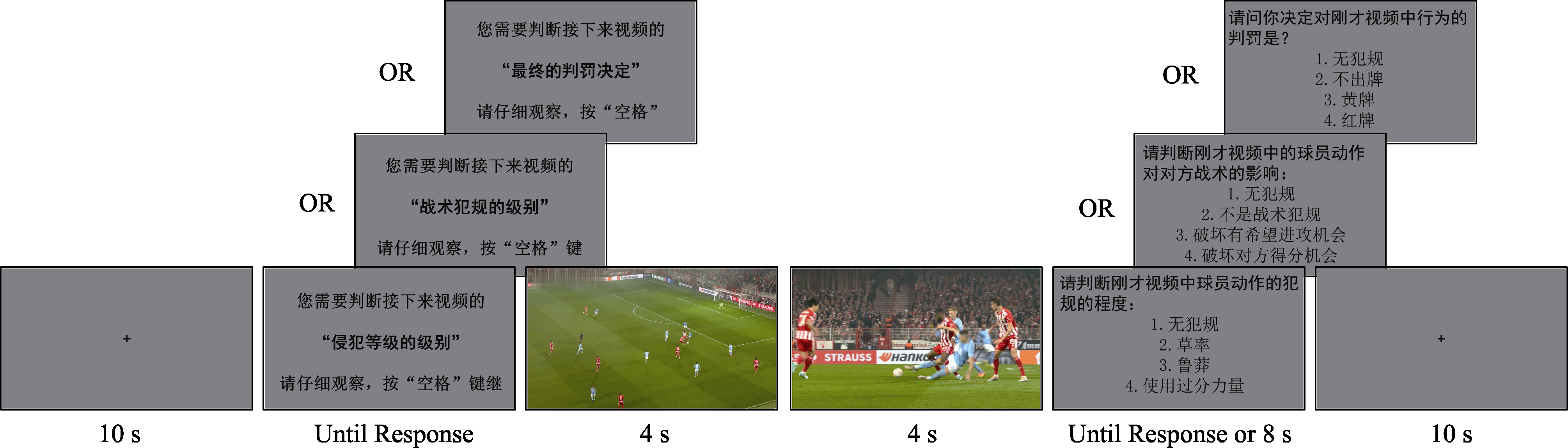
图2 判罚决策任务流程图 注:所有视频材料中均有明确的判罚决定, 即每个试次的视频有标准的犯规程度答案。对决策类型为“最终判罚”的试次, 犯规程度由无到重的决策选择分别为:无犯规、不出牌、黄牌、红牌; 对决策类型为“侵犯等级”的试次, 犯规程度由无到重的决策选择分别为:无犯规、草率、鲁莽、使用过分力量; 对决策类型为“战术影响”的试次, 犯规程度由无到重的决策选择分别为:无犯规、不是战术犯规、破坏有希望的进攻机会、破坏潜在得分机会。
| 左侧脑区 | 右侧脑区 | ||||
|---|---|---|---|---|---|
| 光源, 探测器 | MNI坐标 (x, y, z) | 脑区(ROI) | 光源, 探测器 | MNI坐标 (x, y, z) | 脑区(ROI) |
| 1, 1 | −18 59 40 | 背外侧额上回(Frontal_Sup_L) | 16, 16 | 14 46 27 | 背外侧额上回(Frontal_Sup_R) |
| 1, 2 | −17 60 23 | 背外侧额上回(Frontal_Sup_L) | 15, 16 | 22 67 27 | 背外侧额上回(Frontal_Sup_R) |
| 2, 1 | −23 42 36 | 背外侧额上回(Frontal_Sup_L) | 16, 14 | 31 52 46 | 背外侧额上回(Frontal_Sup_R) |
| 2, 2 | −22 46 21 | 背外侧额上回(Frontal_Sup_L) | 15, 14 | 30 55 26 | 背外侧额上回(Frontal_Sup_R) |
| 2, 6 | −33 22 24 | 额中回(Frontal_Mid_L) | 11, 14 | 46 29 35 | 额中回(Frontal_Mid_R) |
| 2, 3 | −38 37 20 | 额中回(Frontal_Mid_L) | 13, 14 | 41 35 18 | 额中回(Frontal_Mid_R) |
| 3, 2 | −30 65 14 | 背外侧额上回(Frontal_Sup_L) | 15, 15 | 31 61 15 | 背外侧额上回(Frontal_Sup_R) |
| 3, 3 | −33 45 8 | 额中回(Frontal_Mid_L) | 13, 15 | 37 44 6 | 额中回(Frontal_Mid_R) |
| 3, 4 | −30 53 3 | 额中回(Frontal_Mid_L) | 14, 15 | 39 54 1 | 额中回(Frontal_Mid_R) |
| 4, 4 | −33 46 1 | 眶部额下回(Frontal_Inf_Orb_L) | 14, 13 | 48 49 −2 | 眶部额下回(Frontal_Inf_Orb_R) |
| 4, 3 | −30 41 8 | 额中回(Frontal_Mid_L) | 13, 13 | 51 45 5 | 额中回(Frontal_Mid_R) |
| 4, 5 | −39 22 2 | 眶部额下回(Frontal_Inf_Orb_L) | 12, 13 | 63 24 −4 | 眶部额下回(Frontal_Inf_Orb_R) |
| 5, 6 | −40 16 25 | 三角部额下回(Frontal_Inf_Tri_L) | 11, 12 | 55 17 31 | 三角部额下回(Frontal_Inf_Tri_R) |
| 5, 3 | −35 22 22 | 三角部额下回(Frontal_Inf_Tri_L) | 13, 12 | 54 31 20 | 三角部额下回(Frontal_Inf_Tri_R) |
| 5, 5 | −55 13 13 | 三角部额下回(Frontal_Inf_Tri_L) | 12, 12 | 48 9 10 | 三角部额下回(Frontal_Inf_Tri_R) |
| 6, 7 | −40 −67 12 | 颞中回(Temporal_Mid_L) | 10, 11 | 51 −75 12 | 颞中回(Temporal_Mid_R) |
| 6, 8 | −44 −75 28 | 枕上回(Occipital_Mid_L) | 10, 10 | 44 −74 28 | 枕上回(Occipital_Sup_R) |
| 7, 7 | −22 −84 −1 | 枕下回(Occipital_Inf_L) | 9, 11 | 28 −89 2 | 枕下回(Occipital_Inf_R) |
| 7, 8 | −24 −97 18 | 枕中回(Occipital_Mid_L) | 9, 10 | 31 −96 18 | 枕中回(Occipital_Mid_R) |
| 7, 9 | −9 −95 6 | 枕下回(Occipital_ Inf_L) | 9, 9 | 18 −96 7 | 枕下回(Occipital_Inf_R) |
| 8, 8 | −16 −91 36 | 枕上回(Occipital_Sup_L) | 8, 10 | 19 −76 32 | 枕上回(Occipital_Sup_R) |
| 8, 9 | 0 −99 24 | 楔叶(Cuneus_L) | 1, 16 | 3 50 23 | 前扣带和旁扣带回(Cingulum_Ant_R) |
表2 fNIRs的通道布置MNI坐标和解剖定位(AAL)
| 左侧脑区 | 右侧脑区 | ||||
|---|---|---|---|---|---|
| 光源, 探测器 | MNI坐标 (x, y, z) | 脑区(ROI) | 光源, 探测器 | MNI坐标 (x, y, z) | 脑区(ROI) |
| 1, 1 | −18 59 40 | 背外侧额上回(Frontal_Sup_L) | 16, 16 | 14 46 27 | 背外侧额上回(Frontal_Sup_R) |
| 1, 2 | −17 60 23 | 背外侧额上回(Frontal_Sup_L) | 15, 16 | 22 67 27 | 背外侧额上回(Frontal_Sup_R) |
| 2, 1 | −23 42 36 | 背外侧额上回(Frontal_Sup_L) | 16, 14 | 31 52 46 | 背外侧额上回(Frontal_Sup_R) |
| 2, 2 | −22 46 21 | 背外侧额上回(Frontal_Sup_L) | 15, 14 | 30 55 26 | 背外侧额上回(Frontal_Sup_R) |
| 2, 6 | −33 22 24 | 额中回(Frontal_Mid_L) | 11, 14 | 46 29 35 | 额中回(Frontal_Mid_R) |
| 2, 3 | −38 37 20 | 额中回(Frontal_Mid_L) | 13, 14 | 41 35 18 | 额中回(Frontal_Mid_R) |
| 3, 2 | −30 65 14 | 背外侧额上回(Frontal_Sup_L) | 15, 15 | 31 61 15 | 背外侧额上回(Frontal_Sup_R) |
| 3, 3 | −33 45 8 | 额中回(Frontal_Mid_L) | 13, 15 | 37 44 6 | 额中回(Frontal_Mid_R) |
| 3, 4 | −30 53 3 | 额中回(Frontal_Mid_L) | 14, 15 | 39 54 1 | 额中回(Frontal_Mid_R) |
| 4, 4 | −33 46 1 | 眶部额下回(Frontal_Inf_Orb_L) | 14, 13 | 48 49 −2 | 眶部额下回(Frontal_Inf_Orb_R) |
| 4, 3 | −30 41 8 | 额中回(Frontal_Mid_L) | 13, 13 | 51 45 5 | 额中回(Frontal_Mid_R) |
| 4, 5 | −39 22 2 | 眶部额下回(Frontal_Inf_Orb_L) | 12, 13 | 63 24 −4 | 眶部额下回(Frontal_Inf_Orb_R) |
| 5, 6 | −40 16 25 | 三角部额下回(Frontal_Inf_Tri_L) | 11, 12 | 55 17 31 | 三角部额下回(Frontal_Inf_Tri_R) |
| 5, 3 | −35 22 22 | 三角部额下回(Frontal_Inf_Tri_L) | 13, 12 | 54 31 20 | 三角部额下回(Frontal_Inf_Tri_R) |
| 5, 5 | −55 13 13 | 三角部额下回(Frontal_Inf_Tri_L) | 12, 12 | 48 9 10 | 三角部额下回(Frontal_Inf_Tri_R) |
| 6, 7 | −40 −67 12 | 颞中回(Temporal_Mid_L) | 10, 11 | 51 −75 12 | 颞中回(Temporal_Mid_R) |
| 6, 8 | −44 −75 28 | 枕上回(Occipital_Mid_L) | 10, 10 | 44 −74 28 | 枕上回(Occipital_Sup_R) |
| 7, 7 | −22 −84 −1 | 枕下回(Occipital_Inf_L) | 9, 11 | 28 −89 2 | 枕下回(Occipital_Inf_R) |
| 7, 8 | −24 −97 18 | 枕中回(Occipital_Mid_L) | 9, 10 | 31 −96 18 | 枕中回(Occipital_Mid_R) |
| 7, 9 | −9 −95 6 | 枕下回(Occipital_ Inf_L) | 9, 9 | 18 −96 7 | 枕下回(Occipital_Inf_R) |
| 8, 8 | −16 −91 36 | 枕上回(Occipital_Sup_L) | 8, 10 | 19 −76 32 | 枕上回(Occipital_Sup_R) |
| 8, 9 | 0 −99 24 | 楔叶(Cuneus_L) | 1, 16 | 3 50 23 | 前扣带和旁扣带回(Cingulum_Ant_R) |
| 行为指标 | 决策类型 | 侵犯等级 (M ± SE, 95% CI) | 战术影响 (M ± SE, 95% CI) | 最终判罚 (M ± SE, 95% CI) | ||||
|---|---|---|---|---|---|---|---|---|
| 犯规程度 | 裁判等级 | |||||||
| 正确率(%) | 无 | 国家级及以上 | 59.72 ± 3.90 | [52.00~67.45] | 55.09 ± 3.96 | [47.27~62.92] | 55.09 ± 4.32 | [46.54~63.64] |
| 一级 | 39.58 ± 4.78 | [30.12~49.05] | 34.72 ± 4.84 | [25.14~44.31] | 31.94 ± 5.29 | [21.47~42.42] | ||
| 三级 | 44.87 ± 4.59 | [35.78~53.96] | 41.03 ± 4.65 | [31.82~50.24] | 40.38 ± 5.08 | [30.32~50.45] | ||
| 轻 | 国家级及以上 | 61.73 ± 2.79 | [56.20~67.26] | 71.91 ± 3.49 | [65.01~78.82] | 62.04 ± 3.79 | [54.54~69.53] | |
| 一级 | 48.84 ± 3.42 | [42.07~55.62] | 61.57 ± 4.27 | [53.12~70.03] | 61.11 ± 4.64 | [51.93~70.29] | ||
| 三级 | 37.18 ± 3.29 | [30.67~43.69] | 36.11 ± 4.10 | [27.99~44.23] | 45.51 ± 4.46 | [36.69~54.33] | ||
| 中 | 国家级及以上 | 64.51 ± 2.53 | [59.51~69.51] | 76.08 ± 2.41 | [71.31~80.85] | 69.60 ± 2.46 | [64.73~74.47] | |
| 一级 | 57.87 ± 3.10 | [51.75~64.00] | 68.75 ± 2.95 | [62.91~74.59] | 61.34 ± 3.02 | [55.38~67.31] | ||
| 三级 | 56.20 ± 2.97 | [50.31~62.08] | 71.37 ± 2.83 | [65.76~76.98] | 61.54 ± 2.90 | [55.81~67.27] | ||
| 重 | 国家级及以上 | 48.89 ± 2.83 | [43.29~54.49] | 69.44 ± 2.98 | [63.55~75.34] | 55.14 ± 2.34 | [50.51~59.77] | |
| 一级 | 40.83 ± 3.47 | [33.97~47.69] | 56.11 ± 3.65 | [48.89~63.33] | 47.07 ± 2.87 | [41.40~52.74] | ||
| 三级 | 23.85 ± 3.33 | [17.25~30.44] | 66.41 ± 3.51 | [59.47~73.35] | 34.05 ± 2.75 | [28.60~39.49] | ||
| 反应时(s) | 无 | 国家级及以上 | 1.89 ± 0.10 | [1.69~2.08] | 2.23 ± 0.12 | [1.99~2.47] | 2.09 ± 0.11 | [1.88~2.31] |
| 一级 | 2.27 ± 0.12 | [2.03~2.50] | 2.48 ± 0.15 | [2.19~2.78] | 2.41 ± 0.13 | [2.15~2.68] | ||
| 三级 | 1.95 ± 0.11 | [1.73~2.18] | 2.30 ± 0.14 | [2.02~2.59] | 2.13 ± 0.13 | [1.87~2.38] | ||
| 轻 | 国家级及以上 | 2.22 ± 0.10 | [2.03~2.41] | 2.63 ± 0.10 | [2.42~2.83] | 2.45 ± 0.11 | [2.24~2.66] | |
| 一级 | 2.40 ± 0.12 | [2.16~2.63] | 2.81 ± 0.13 | [2.56~3.06] | 2.50 ± 0.13 | [2.24~2.75] | ||
| 三级 | 2.27 ± 0.12 | [2.04~2.49] | 2.76 ± 0.12 | [2.52~3.00] | 2.25 ± 0.12 | [2.00~2.50] | ||
| 中 | 国家级及以上 | 2.13 ± 0.09 | [1.94~2.31] | 2.33 ± 0.10 | [2.12~2.53] | 2.11 ± 0.09 | [1.94~2.29] | |
| 一级 | 2.24 ± 0.11 | [2.01~2.47] | 2.57 ± 0.13 | [2.32~2.82] | 2.25 ± 0.11 | [2.04~2.47] | ||
| 三级 | 2.16 ± 0.11 | [1.95~2.38] | 2.35 ± 0.12 | [2.11~2.59] | 2.14 ± 0.10 | [1.93~2.34] | ||
| 重 | 国家级及以上 | 2.13 ± 0.09 | [1.95~2.31] | 2.48 ± 0.09 | [2.30~2.67] | 2.11 ± 0.08 | [1.94~2.28] | |
| 一级 | 2.22 ± 0.11 | [1.99~2.44] | 2.61 ± 0.11 | [2.39~2.83] | 2.17 ± 0.10 | [1.96~2.37] | ||
| 三级 | 2.08 ± 0.11 | [1.87~2.30] | 2.31 ± 0.11 | [2.09~2.53] | 2.03 ± 0.10 | [1.83~2.23] | ||
表3 不同等级足球裁判员在不同条件下的正确率和反应时的描述性统计
| 行为指标 | 决策类型 | 侵犯等级 (M ± SE, 95% CI) | 战术影响 (M ± SE, 95% CI) | 最终判罚 (M ± SE, 95% CI) | ||||
|---|---|---|---|---|---|---|---|---|
| 犯规程度 | 裁判等级 | |||||||
| 正确率(%) | 无 | 国家级及以上 | 59.72 ± 3.90 | [52.00~67.45] | 55.09 ± 3.96 | [47.27~62.92] | 55.09 ± 4.32 | [46.54~63.64] |
| 一级 | 39.58 ± 4.78 | [30.12~49.05] | 34.72 ± 4.84 | [25.14~44.31] | 31.94 ± 5.29 | [21.47~42.42] | ||
| 三级 | 44.87 ± 4.59 | [35.78~53.96] | 41.03 ± 4.65 | [31.82~50.24] | 40.38 ± 5.08 | [30.32~50.45] | ||
| 轻 | 国家级及以上 | 61.73 ± 2.79 | [56.20~67.26] | 71.91 ± 3.49 | [65.01~78.82] | 62.04 ± 3.79 | [54.54~69.53] | |
| 一级 | 48.84 ± 3.42 | [42.07~55.62] | 61.57 ± 4.27 | [53.12~70.03] | 61.11 ± 4.64 | [51.93~70.29] | ||
| 三级 | 37.18 ± 3.29 | [30.67~43.69] | 36.11 ± 4.10 | [27.99~44.23] | 45.51 ± 4.46 | [36.69~54.33] | ||
| 中 | 国家级及以上 | 64.51 ± 2.53 | [59.51~69.51] | 76.08 ± 2.41 | [71.31~80.85] | 69.60 ± 2.46 | [64.73~74.47] | |
| 一级 | 57.87 ± 3.10 | [51.75~64.00] | 68.75 ± 2.95 | [62.91~74.59] | 61.34 ± 3.02 | [55.38~67.31] | ||
| 三级 | 56.20 ± 2.97 | [50.31~62.08] | 71.37 ± 2.83 | [65.76~76.98] | 61.54 ± 2.90 | [55.81~67.27] | ||
| 重 | 国家级及以上 | 48.89 ± 2.83 | [43.29~54.49] | 69.44 ± 2.98 | [63.55~75.34] | 55.14 ± 2.34 | [50.51~59.77] | |
| 一级 | 40.83 ± 3.47 | [33.97~47.69] | 56.11 ± 3.65 | [48.89~63.33] | 47.07 ± 2.87 | [41.40~52.74] | ||
| 三级 | 23.85 ± 3.33 | [17.25~30.44] | 66.41 ± 3.51 | [59.47~73.35] | 34.05 ± 2.75 | [28.60~39.49] | ||
| 反应时(s) | 无 | 国家级及以上 | 1.89 ± 0.10 | [1.69~2.08] | 2.23 ± 0.12 | [1.99~2.47] | 2.09 ± 0.11 | [1.88~2.31] |
| 一级 | 2.27 ± 0.12 | [2.03~2.50] | 2.48 ± 0.15 | [2.19~2.78] | 2.41 ± 0.13 | [2.15~2.68] | ||
| 三级 | 1.95 ± 0.11 | [1.73~2.18] | 2.30 ± 0.14 | [2.02~2.59] | 2.13 ± 0.13 | [1.87~2.38] | ||
| 轻 | 国家级及以上 | 2.22 ± 0.10 | [2.03~2.41] | 2.63 ± 0.10 | [2.42~2.83] | 2.45 ± 0.11 | [2.24~2.66] | |
| 一级 | 2.40 ± 0.12 | [2.16~2.63] | 2.81 ± 0.13 | [2.56~3.06] | 2.50 ± 0.13 | [2.24~2.75] | ||
| 三级 | 2.27 ± 0.12 | [2.04~2.49] | 2.76 ± 0.12 | [2.52~3.00] | 2.25 ± 0.12 | [2.00~2.50] | ||
| 中 | 国家级及以上 | 2.13 ± 0.09 | [1.94~2.31] | 2.33 ± 0.10 | [2.12~2.53] | 2.11 ± 0.09 | [1.94~2.29] | |
| 一级 | 2.24 ± 0.11 | [2.01~2.47] | 2.57 ± 0.13 | [2.32~2.82] | 2.25 ± 0.11 | [2.04~2.47] | ||
| 三级 | 2.16 ± 0.11 | [1.95~2.38] | 2.35 ± 0.12 | [2.11~2.59] | 2.14 ± 0.10 | [1.93~2.34] | ||
| 重 | 国家级及以上 | 2.13 ± 0.09 | [1.95~2.31] | 2.48 ± 0.09 | [2.30~2.67] | 2.11 ± 0.08 | [1.94~2.28] | |
| 一级 | 2.22 ± 0.11 | [1.99~2.44] | 2.61 ± 0.11 | [2.39~2.83] | 2.17 ± 0.10 | [1.96~2.37] | ||
| 三级 | 2.08 ± 0.11 | [1.87~2.30] | 2.31 ± 0.11 | [2.09~2.53] | 2.03 ± 0.10 | [1.83~2.23] | ||
| 变量 | 正确率(ACC) | 反应时(RTs) | ||||||
|---|---|---|---|---|---|---|---|---|
| F | df | p | η2p | F | df | p | η2p | |
| 裁判等级 | 26.91 | 2.00, 126.00 | < 0.001 | 0.30 | 1.35 | 2.00, 126.00 | 0.264 | 0.02 |
| 决策类型 | 60.11 | 2.00, 252.00 | < 0.001 | 0.32 | 64.33 | 1.86, 233.97 | < 0.001 | 0.34 |
| 犯规程度 | 27.76 | 2.45, 309.14 | < 0.001 | 0.18 | 17.34 | 1.94, 244.64 | < 0.001 | 0.12 |
| 决策类型 × 裁判等级 | 1.37 | 3.96, 249.32 | 0.244 | 0.02 | 0.45 | 3.71, 233.97 | 0.762 | 0.01 |
| 犯规程度 × 裁判等级 | 3.92 | 4.91, 309.14 | 0.002 | 0.06 | 1.14 | 3.88, 244.64 | 0.340 | 0.02 |
| 决策类型 × 犯规程度 | 20.26 | 5.31, 669.00 | < 0.001 | 0.14 | 3.00 | 4.48, 564.39 | 0.014 | 0.02 |
| 决策类型 × 犯规程度 × 裁判等级 | 4.20 | 10.62, 669.00 | < 0.001 | 0.06 | 0.77 | 8.96, 564.39 | 0.642 | 0.01 |
表4 决策正确率和反应时的方差分析结果
| 变量 | 正确率(ACC) | 反应时(RTs) | ||||||
|---|---|---|---|---|---|---|---|---|
| F | df | p | η2p | F | df | p | η2p | |
| 裁判等级 | 26.91 | 2.00, 126.00 | < 0.001 | 0.30 | 1.35 | 2.00, 126.00 | 0.264 | 0.02 |
| 决策类型 | 60.11 | 2.00, 252.00 | < 0.001 | 0.32 | 64.33 | 1.86, 233.97 | < 0.001 | 0.34 |
| 犯规程度 | 27.76 | 2.45, 309.14 | < 0.001 | 0.18 | 17.34 | 1.94, 244.64 | < 0.001 | 0.12 |
| 决策类型 × 裁判等级 | 1.37 | 3.96, 249.32 | 0.244 | 0.02 | 0.45 | 3.71, 233.97 | 0.762 | 0.01 |
| 犯规程度 × 裁判等级 | 3.92 | 4.91, 309.14 | 0.002 | 0.06 | 1.14 | 3.88, 244.64 | 0.340 | 0.02 |
| 决策类型 × 犯规程度 | 20.26 | 5.31, 669.00 | < 0.001 | 0.14 | 3.00 | 4.48, 564.39 | 0.014 | 0.02 |
| 决策类型 × 犯规程度 × 裁判等级 | 4.20 | 10.62, 669.00 | < 0.001 | 0.06 | 0.77 | 8.96, 564.39 | 0.642 | 0.01 |
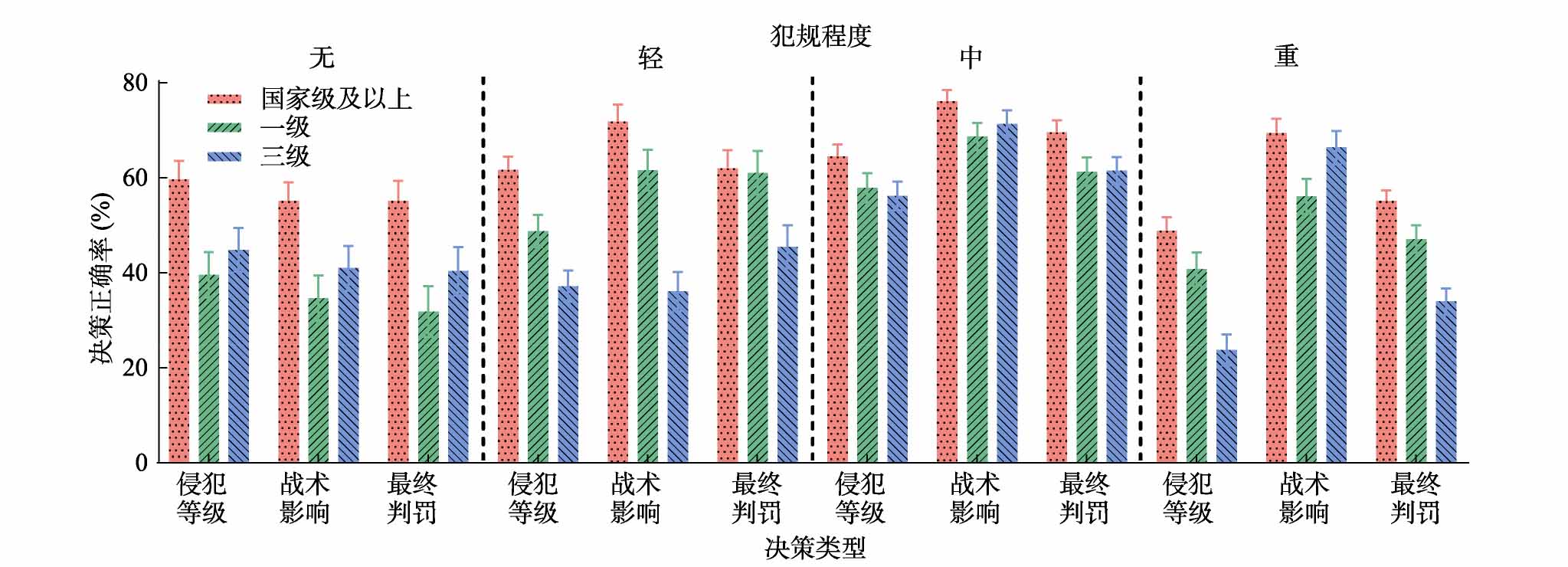
图3 决策正确率结果 注:图中误差棒为标准误。彩图见电子版, 下同
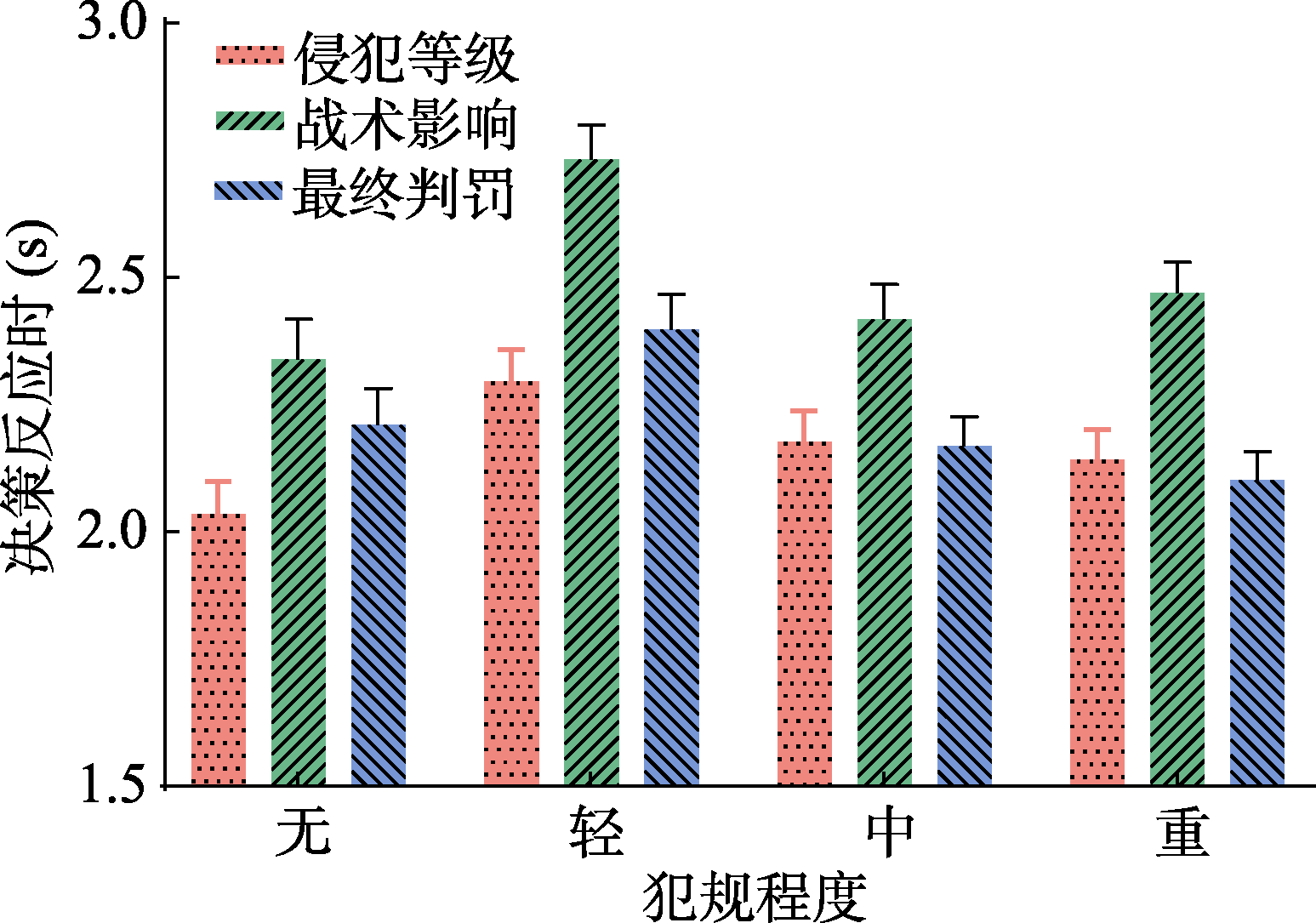
图4 决策反应时结果 注:图中误差棒为标准误。
| 脑区ROI | 裁判等级 | 决策类型 | 犯规程度 | ||||||
|---|---|---|---|---|---|---|---|---|---|
| F(2, 126) | p (FDR) | ηp2 | F(2, 252) | p (FDR) | ηp2 | F(3, 378) | p (FDR) | ηp2 | |
| 左侧背外侧额上回 | 3.24 | 0.042 | 0.05 | 10.25 | < 0.001 | 0.08 | 1.53 | 0.205 | 0.01 |
| 左侧额中回 | 4.22 | 0.017 | 0.06 | 2.42 | 0.091 | 0.02 | 6.19 | < 0.001 | 0.05 |
| 左侧眶部额下回 | 2.44 | 0.092 | 0.04 | 1.24 | 0.290 | 0.01 | 0.97 | 0.407 | 0.01 |
| 左侧三角部额下回 | 1.01 | 0.369 | 0.02 | 0.43 | 0.650 | 0.00 | 1.71 | 0.164 | 0.01 |
| 左侧颞中回 | 1.28 | 0.282 | 0.02 | 0.03 | 0.970 | 0.00 | 1.93 | 0.124 | 0.02 |
| 左侧枕中回 | 0.11 | 0.900 | 0.00 | 5.82 | 0.003 | 0.04 | 0.73 | 0.537 | 0.01 |
| 左侧枕下回 | 0.55 | 0.581 | 0.01 | 2.04 | 0.132 | 0.02 | 5.11 | 0.002 | 0.04 |
| 左侧枕上回 | 0.42 | 0.656 | 0.01 | 0.78 | 0.459 | 0.01 | 1.22 | 0.302 | 0.01 |
| 左侧楔叶 | 0.50 | 0.610 | 0.01 | 0.01 | 0.993 | 0.00 | 1.12 | 0.341 | 0.01 |
| 右侧背外侧额上回 | 2.86 | 0.061 | 0.04 | 9.10 | < 0.001 | 0.07 | 1.01 | 0.388 | 0.01 |
| 右侧额中回 | 1.24 | 0.294 | 0.02 | 2.84 | 0.060 | 0.02 | 0.35 | 0.790 | 0.00 |
| 右侧眶部额下回 | 1.46 | 0.237 | 0.02 | 0.27 | 0.767 | 0.00 | 4.30 | 0.005 | 0.03 |
| 右侧三角部额下回 | 1.02 | 0.365 | 0.02 | 0.75 | 0.476 | 0.01 | 1.96 | 0.119 | 0.02 |
| 右侧颞中回 | 1.34 | 0.267 | 0.02 | 0.43 | 0.653 | 0.00 | 1.82 | 0.143 | 0.01 |
| 右侧枕中回 | 2.56 | 0.081 | 0.04 | 0.17 | 0.841 | 0.00 | 3.52 | 0.015 | 0.03 |
| 右侧枕下回 | 0.09 | 0.916 | 0.00 | 0.04 | 0.960 | 0.00 | 0.44 | 0.726 | 0.00 |
| 右侧枕上回 | 2.23 | 0.112 | 0.03 | 0.04 | 0.958 | 0.00 | 1.37 | 0.252 | 0.01 |
| 右侧前扣带和旁扣带回 | 0.94 | 0.395 | 0.02 | 5.02 | 0.007 | 0.04 | 1.32 | 0.268 | 0.01 |
表5 不同变量条件下的脑区激活情况主效应结果
| 脑区ROI | 裁判等级 | 决策类型 | 犯规程度 | ||||||
|---|---|---|---|---|---|---|---|---|---|
| F(2, 126) | p (FDR) | ηp2 | F(2, 252) | p (FDR) | ηp2 | F(3, 378) | p (FDR) | ηp2 | |
| 左侧背外侧额上回 | 3.24 | 0.042 | 0.05 | 10.25 | < 0.001 | 0.08 | 1.53 | 0.205 | 0.01 |
| 左侧额中回 | 4.22 | 0.017 | 0.06 | 2.42 | 0.091 | 0.02 | 6.19 | < 0.001 | 0.05 |
| 左侧眶部额下回 | 2.44 | 0.092 | 0.04 | 1.24 | 0.290 | 0.01 | 0.97 | 0.407 | 0.01 |
| 左侧三角部额下回 | 1.01 | 0.369 | 0.02 | 0.43 | 0.650 | 0.00 | 1.71 | 0.164 | 0.01 |
| 左侧颞中回 | 1.28 | 0.282 | 0.02 | 0.03 | 0.970 | 0.00 | 1.93 | 0.124 | 0.02 |
| 左侧枕中回 | 0.11 | 0.900 | 0.00 | 5.82 | 0.003 | 0.04 | 0.73 | 0.537 | 0.01 |
| 左侧枕下回 | 0.55 | 0.581 | 0.01 | 2.04 | 0.132 | 0.02 | 5.11 | 0.002 | 0.04 |
| 左侧枕上回 | 0.42 | 0.656 | 0.01 | 0.78 | 0.459 | 0.01 | 1.22 | 0.302 | 0.01 |
| 左侧楔叶 | 0.50 | 0.610 | 0.01 | 0.01 | 0.993 | 0.00 | 1.12 | 0.341 | 0.01 |
| 右侧背外侧额上回 | 2.86 | 0.061 | 0.04 | 9.10 | < 0.001 | 0.07 | 1.01 | 0.388 | 0.01 |
| 右侧额中回 | 1.24 | 0.294 | 0.02 | 2.84 | 0.060 | 0.02 | 0.35 | 0.790 | 0.00 |
| 右侧眶部额下回 | 1.46 | 0.237 | 0.02 | 0.27 | 0.767 | 0.00 | 4.30 | 0.005 | 0.03 |
| 右侧三角部额下回 | 1.02 | 0.365 | 0.02 | 0.75 | 0.476 | 0.01 | 1.96 | 0.119 | 0.02 |
| 右侧颞中回 | 1.34 | 0.267 | 0.02 | 0.43 | 0.653 | 0.00 | 1.82 | 0.143 | 0.01 |
| 右侧枕中回 | 2.56 | 0.081 | 0.04 | 0.17 | 0.841 | 0.00 | 3.52 | 0.015 | 0.03 |
| 右侧枕下回 | 0.09 | 0.916 | 0.00 | 0.04 | 0.960 | 0.00 | 0.44 | 0.726 | 0.00 |
| 右侧枕上回 | 2.23 | 0.112 | 0.03 | 0.04 | 0.958 | 0.00 | 1.37 | 0.252 | 0.01 |
| 右侧前扣带和旁扣带回 | 0.94 | 0.395 | 0.02 | 5.02 | 0.007 | 0.04 | 1.32 | 0.268 | 0.01 |
| 脑区ROI | 裁判等级×决策类型 | 裁判等级×犯规程度 | 决策类型×犯规程度 | 裁判等级×决策类型× 犯规程度 | ||||||||
|---|---|---|---|---|---|---|---|---|---|---|---|---|
| F(4, 252) | p (FDR) | ηp2 | F(6, 378) | p (FDR) | ηp2 | F(6, 756) | p (FDR) | ηp2 | F(12, 756) | p (FDR) | ηp2 | |
| 左侧背外侧额上回 | 2.41 | 0.049 | 0.04 | 1.44 | 0.197 | 0.02 | 6.96 | < 0.001 | 0.05 | 1.01 | 0.436 | 0.02 |
| 左侧额中回 | 2.93 | 0.022 | 0.04 | 0.57 | 0.755 | 0.01 | 3.13 | 0.005 | 0.02 | 1.79 | 0.046 | 0.03 |
| 左侧眶部额下回 | 1.20 | 0.311 | 0.02 | 0.50 | 0.808 | 0.01 | 2.84 | 0.010 | 0.02 | 1.03 | 0.415 | 0.02 |
| 左侧三角部额下回 | 1.11 | 0.351 | 0.02 | 0.45 | 0.849 | 0.01 | 2.62 | 0.016 | 0.02 | 1.10 | 0.355 | 0.02 |
| 左侧颞中回 | 1.50 | 0.202 | 0.02 | 2.16 | 0.046 | 0.03 | 0.94 | 0.464 | 0.01 | 1.59 | 0.089 | 0.03 |
| 左侧枕中回 | 0.81 | 0.519 | 0.01 | 1.59 | 0.149 | 0.03 | 2.88 | 0.009 | 0.02 | 0.85 | 0.599 | 0.01 |
| 左侧枕下回 | 0.11 | 0.980 | 0.00 | 0.40 | 0.879 | 0.01 | 0.79 | 0.578 | 0.01 | 0.70 | 0.755 | 0.01 |
| 左侧枕上回 | 0.32 | 0.863 | 0.01 | 1.37 | 0.226 | 0.02 | 0.59 | 0.739 | 0.01 | 0.94 | 0.510 | 0.02 |
| 左侧楔叶 | 4.10 | 0.003 | 0.06 | 1.09 | 0.370 | 0.02 | 0.36 | 0.905 | 0.00 | 2.57 | 0.002 | 0.04 |
| 右侧背外侧额上回 | 1.51 | 0.200 | 0.02 | 1.96 | 0.070 | 0.03 | 2.64 | 0.015 | 0.02 | 0.73 | 0.724 | 0.01 |
| 右侧额中回 | 1.62 | 0.169 | 0.03 | 0.53 | 0.784 | 0.01 | 3.33 | 0.003 | 0.03 | 1.38 | 0.172 | 0.02 |
| 右侧眶部额下回 | 1.40 | 0.234 | 0.02 | 0.85 | 0.530 | 0.01 | 1.22 | 0.292 | 0.01 | 0.54 | 0.889 | 0.01 |
| 右侧三角部额下回 | 1.31 | 0.266 | 0.02 | 1.17 | 0.324 | 0.02 | 2.50 | 0.021 | 0.02 | 0.79 | 0.662 | 0.01 |
| 右侧颞中回 | 0.71 | 0.585 | 0.01 | 1.82 | 0.143 | 0.01 | 2.25 | 0.037 | 0.02 | 0.54 | 0.892 | 0.01 |
| 右侧枕中回 | 3.20 | 0.014 | 0.05 | 1.85 | 0.089 | 0.03 | 4.77 | < 0.001 | 0.04 | 1.12 | 0.343 | 0.02 |
| 右侧枕下回 | 1.67 | 0.157 | 0.03 | 2.38 | 0.029 | 0.04 | 0.84 | 0.542 | 0.01 | 0.52 | 0.900 | 0.01 |
| 右侧枕上回 | 0.19 | 0.942 | 0.00 | 0.76 | 0.601 | 0.01 | 0.44 | 0.853 | 0.00 | 0.85 | 0.603 | 0.01 |
| 右侧前扣带和旁扣带回 | 2.08 | 0.084 | 0.03 | 0.93 | 0.475 | 0.02 | 0.66 | 0.684 | 0.01 | 1.12 | 0.343 | 0.02 |
表6 不同变量条件下的脑区激活情况交互作用结果
| 脑区ROI | 裁判等级×决策类型 | 裁判等级×犯规程度 | 决策类型×犯规程度 | 裁判等级×决策类型× 犯规程度 | ||||||||
|---|---|---|---|---|---|---|---|---|---|---|---|---|
| F(4, 252) | p (FDR) | ηp2 | F(6, 378) | p (FDR) | ηp2 | F(6, 756) | p (FDR) | ηp2 | F(12, 756) | p (FDR) | ηp2 | |
| 左侧背外侧额上回 | 2.41 | 0.049 | 0.04 | 1.44 | 0.197 | 0.02 | 6.96 | < 0.001 | 0.05 | 1.01 | 0.436 | 0.02 |
| 左侧额中回 | 2.93 | 0.022 | 0.04 | 0.57 | 0.755 | 0.01 | 3.13 | 0.005 | 0.02 | 1.79 | 0.046 | 0.03 |
| 左侧眶部额下回 | 1.20 | 0.311 | 0.02 | 0.50 | 0.808 | 0.01 | 2.84 | 0.010 | 0.02 | 1.03 | 0.415 | 0.02 |
| 左侧三角部额下回 | 1.11 | 0.351 | 0.02 | 0.45 | 0.849 | 0.01 | 2.62 | 0.016 | 0.02 | 1.10 | 0.355 | 0.02 |
| 左侧颞中回 | 1.50 | 0.202 | 0.02 | 2.16 | 0.046 | 0.03 | 0.94 | 0.464 | 0.01 | 1.59 | 0.089 | 0.03 |
| 左侧枕中回 | 0.81 | 0.519 | 0.01 | 1.59 | 0.149 | 0.03 | 2.88 | 0.009 | 0.02 | 0.85 | 0.599 | 0.01 |
| 左侧枕下回 | 0.11 | 0.980 | 0.00 | 0.40 | 0.879 | 0.01 | 0.79 | 0.578 | 0.01 | 0.70 | 0.755 | 0.01 |
| 左侧枕上回 | 0.32 | 0.863 | 0.01 | 1.37 | 0.226 | 0.02 | 0.59 | 0.739 | 0.01 | 0.94 | 0.510 | 0.02 |
| 左侧楔叶 | 4.10 | 0.003 | 0.06 | 1.09 | 0.370 | 0.02 | 0.36 | 0.905 | 0.00 | 2.57 | 0.002 | 0.04 |
| 右侧背外侧额上回 | 1.51 | 0.200 | 0.02 | 1.96 | 0.070 | 0.03 | 2.64 | 0.015 | 0.02 | 0.73 | 0.724 | 0.01 |
| 右侧额中回 | 1.62 | 0.169 | 0.03 | 0.53 | 0.784 | 0.01 | 3.33 | 0.003 | 0.03 | 1.38 | 0.172 | 0.02 |
| 右侧眶部额下回 | 1.40 | 0.234 | 0.02 | 0.85 | 0.530 | 0.01 | 1.22 | 0.292 | 0.01 | 0.54 | 0.889 | 0.01 |
| 右侧三角部额下回 | 1.31 | 0.266 | 0.02 | 1.17 | 0.324 | 0.02 | 2.50 | 0.021 | 0.02 | 0.79 | 0.662 | 0.01 |
| 右侧颞中回 | 0.71 | 0.585 | 0.01 | 1.82 | 0.143 | 0.01 | 2.25 | 0.037 | 0.02 | 0.54 | 0.892 | 0.01 |
| 右侧枕中回 | 3.20 | 0.014 | 0.05 | 1.85 | 0.089 | 0.03 | 4.77 | < 0.001 | 0.04 | 1.12 | 0.343 | 0.02 |
| 右侧枕下回 | 1.67 | 0.157 | 0.03 | 2.38 | 0.029 | 0.04 | 0.84 | 0.542 | 0.01 | 0.52 | 0.900 | 0.01 |
| 右侧枕上回 | 0.19 | 0.942 | 0.00 | 0.76 | 0.601 | 0.01 | 0.44 | 0.853 | 0.00 | 0.85 | 0.603 | 0.01 |
| 右侧前扣带和旁扣带回 | 2.08 | 0.084 | 0.03 | 0.93 | 0.475 | 0.02 | 0.66 | 0.684 | 0.01 | 1.12 | 0.343 | 0.02 |
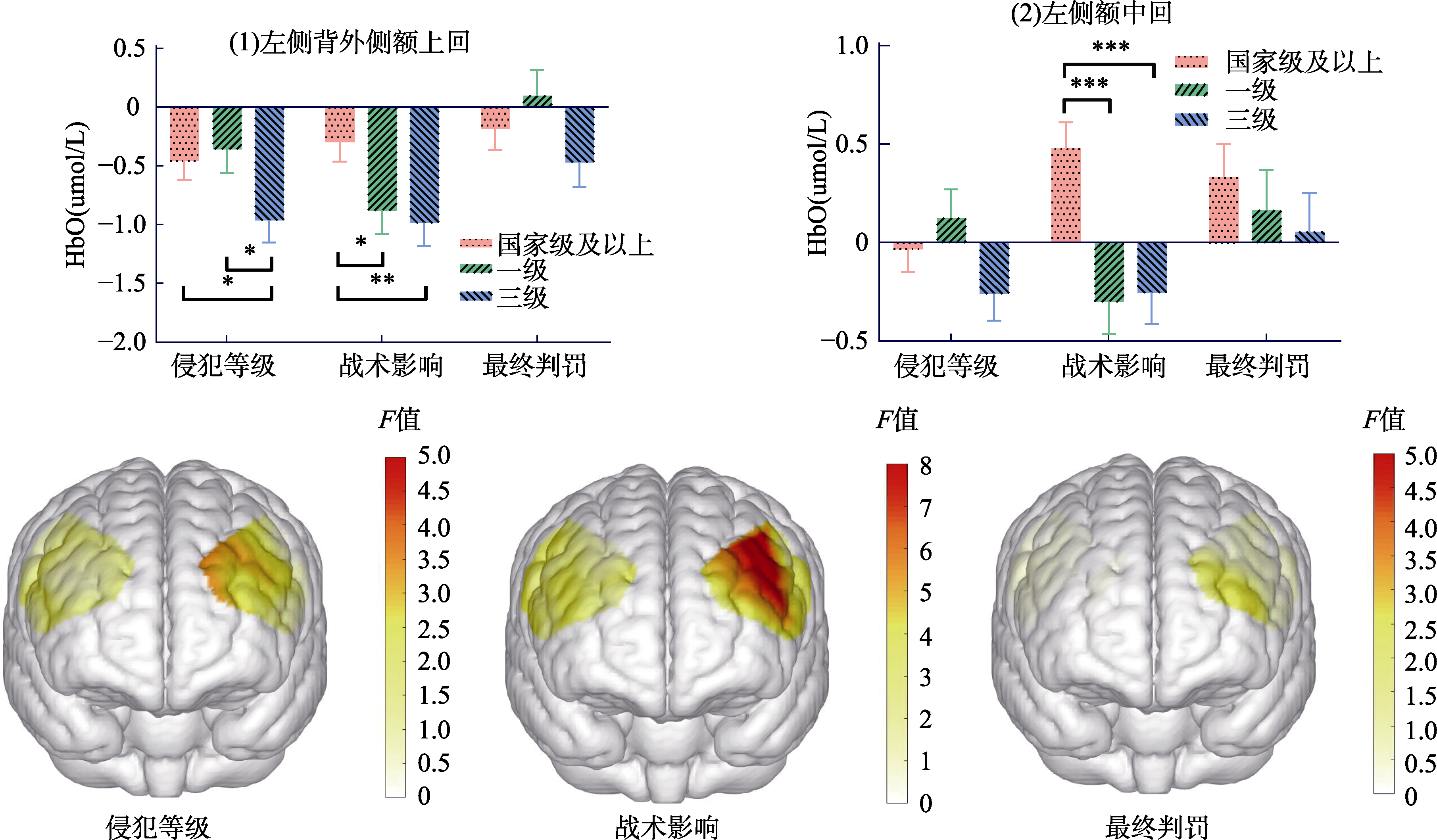
图5 上图为左侧背外侧额上回(1)和左侧额中回(2)的HbO血氧激活表现; 下图为额叶皮层在决策类型水平下进行裁判等级变量两两比较的结果
注:* p < 0.05; ** p < 0.01; *** p < 0.001
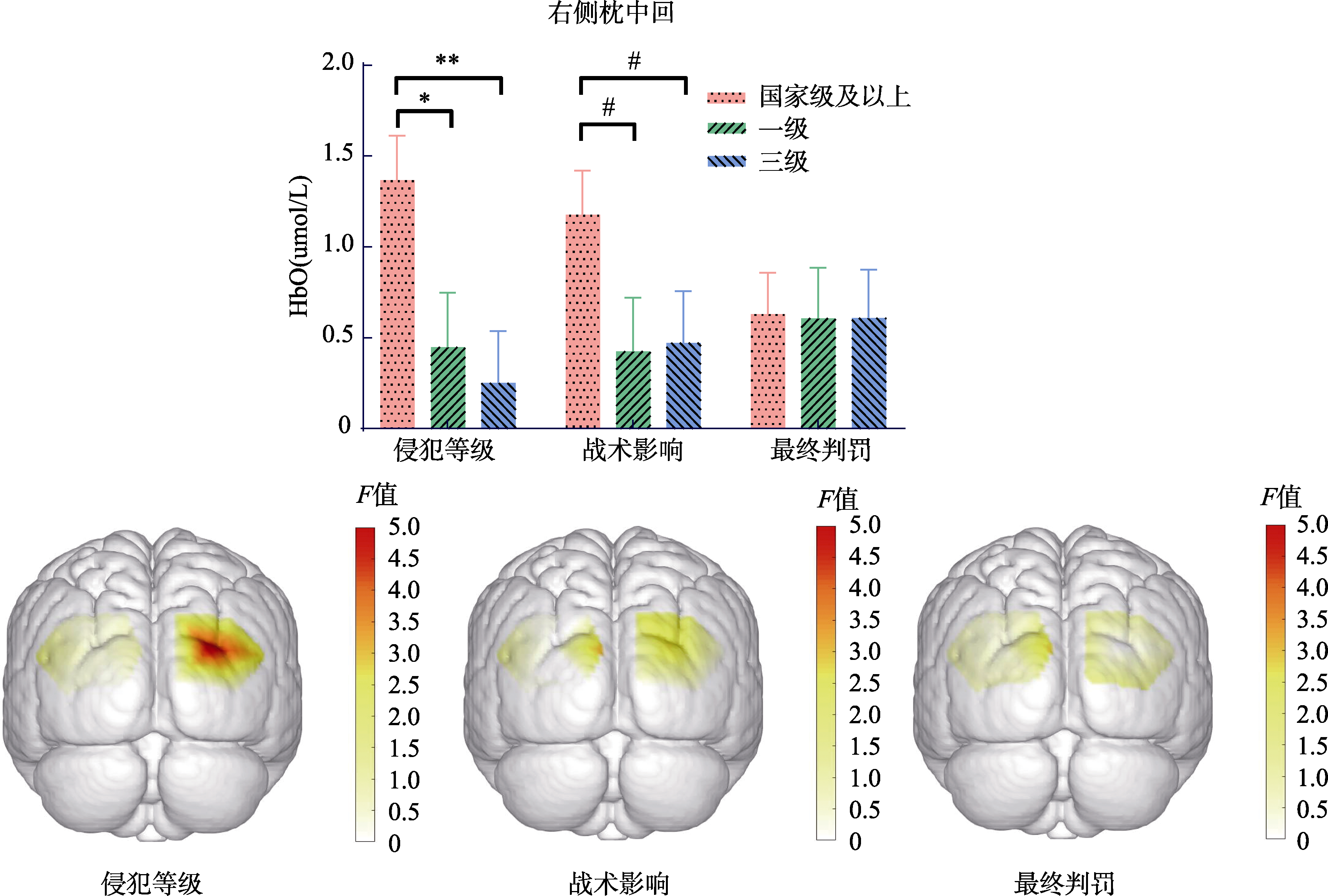
图6 上图为右侧枕中回的HbO血氧激活表现; 下图为枕叶皮层在决策类型水平下进行裁判等级变量两两比较的结果
注:# p < 0.07; * p < 0.05; ** p < 0.01

图7 前额叶、枕叶皮层HbO激活结果 注:上图(1)为无犯规条件下右侧额上回和枕中回脑区在不同裁判等级条件的HbO激活表现; (2)为右侧枕下回脑区在裁判等级和犯规程度交互作用下的HbO激活表现; 下图为对应条件下进行裁判等级变量两两比较的结果; * p < 0.05; ** p < 0.01。
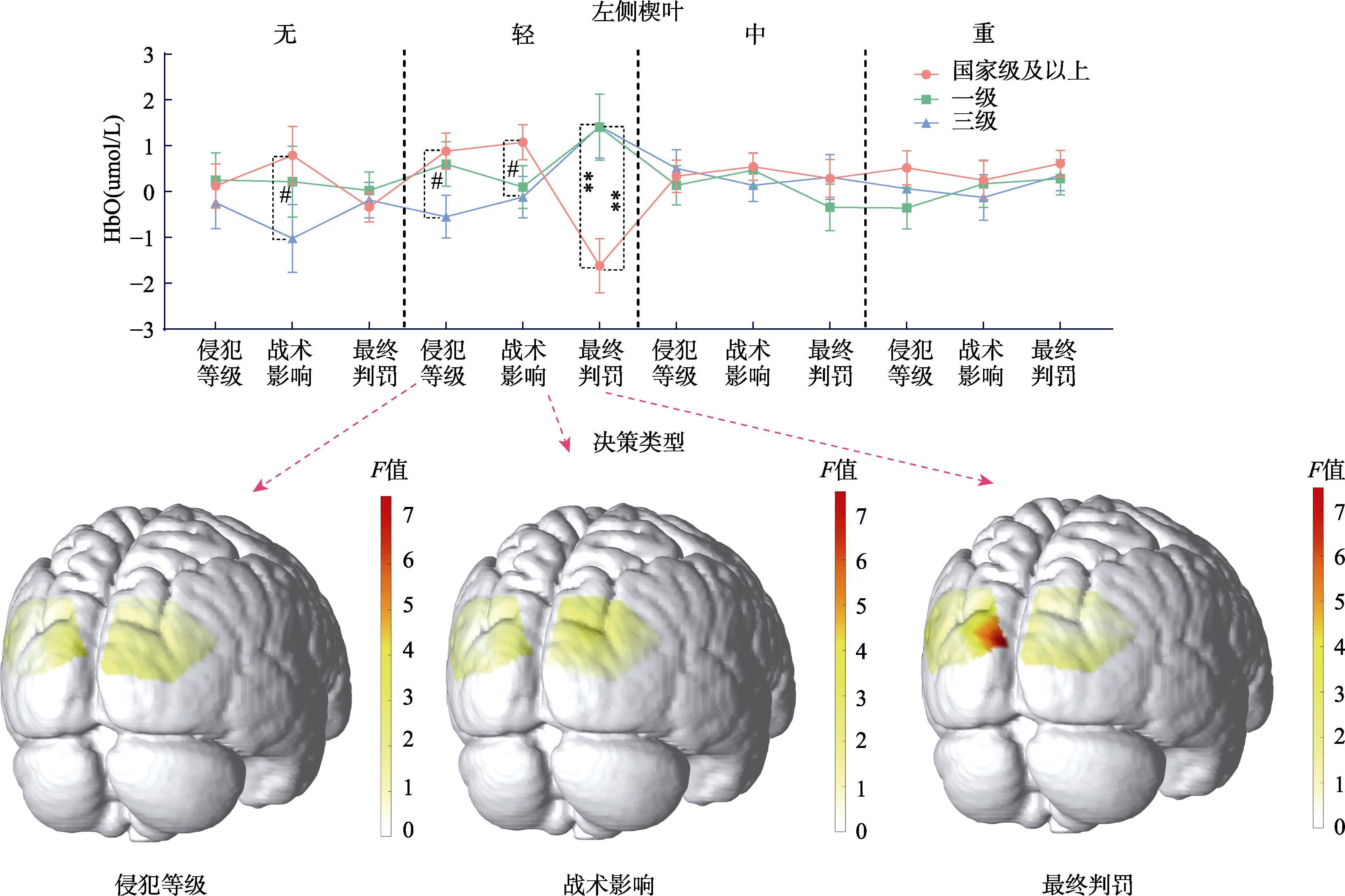
图8 上图为左侧楔叶脑区在裁判等级、决策类型和犯规程度三者间交互作用下的HbO激活表现; 下图为对应条件下进行裁判等级变量两两比较的结果
注:# p < 0.07; * p < 0.05; ** p < 0.01
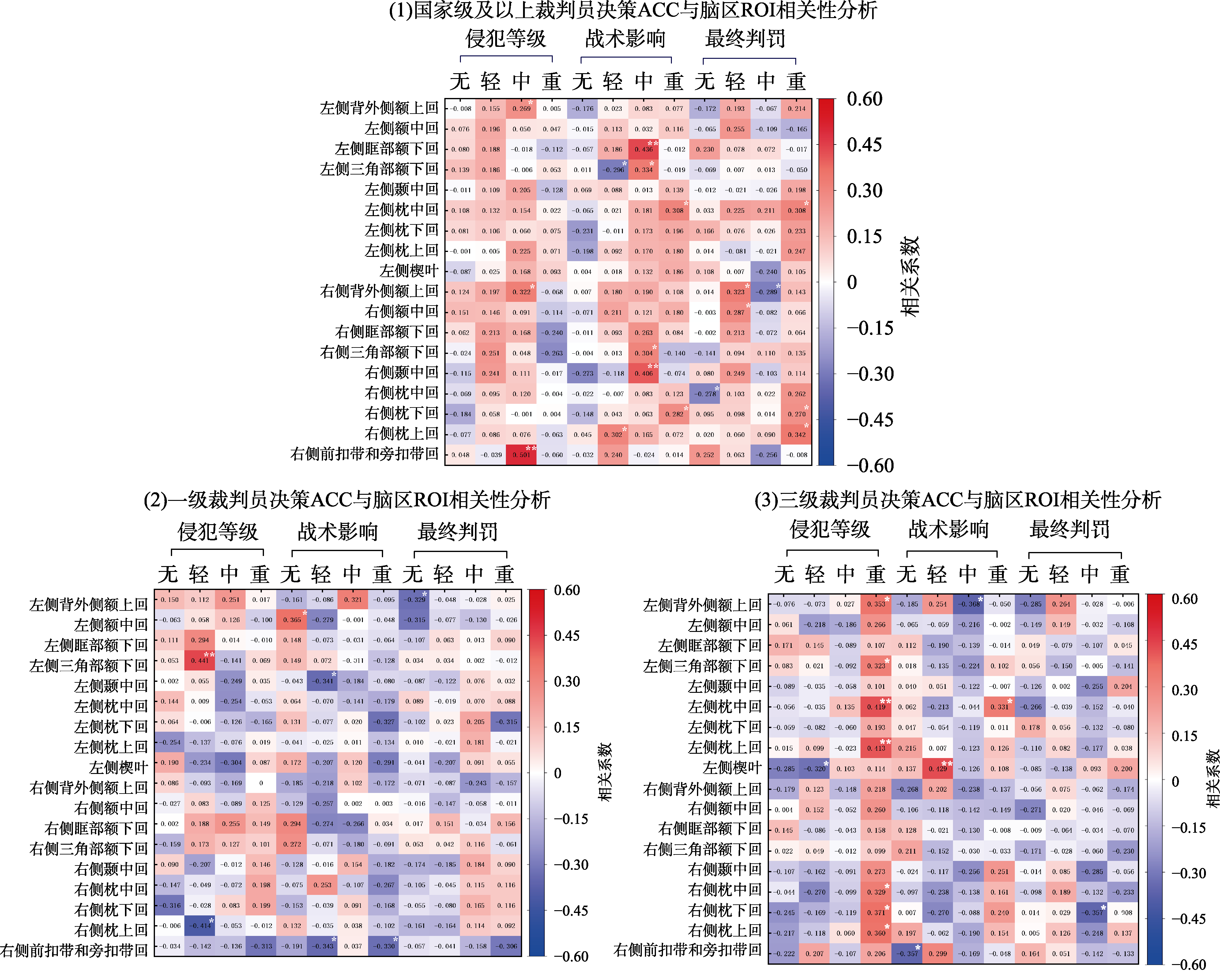
图9 不同决策类型和犯规程度下的判罚决策正确率与脑区ROI相关热图 注:(1)国家级、(2)一级和(3)三级, * p < 0.05; ** p < 0.01。
| 犯规 程度 | 最终判罚 | 侵犯等级 | 战术影响 | |||
|---|---|---|---|---|---|---|
| 判罚决策 | 解释说明 | 判罚决策 | 解释说明 | 判罚决策 | 解释说明 | |
| 无 | 无犯规 | 未发生违反规则的行为, 比赛正常进行。裁判认为动作符合规则, 无需处罚。 | 无犯规 | 动作在规则允许范围内, 无不当接触或意图。 | 无犯规 | 动作不构成战术干扰, 比赛进程未受影响。 |
| 轻度 | 不出牌 | 存在轻微犯规, 但未达到需警告或处罚的程度。裁判可能口头提醒, 但不出示黄牌或红牌。 | 草率 | 动作缺乏控制或判断, 但未对对手造成明显危险。例如意外绊倒对方球员。 | 不是战术 犯规 | 犯规行为无明确战术目的, 如无心手球或意外碰撞。 |
| 中度 | 黄牌 | 对草率、重复性犯规或非恶意但影响比赛的违规行为进行警告。例如战术性拉拽、拖延时间等。 | 鲁莽 | 动作具有较高风险, 可能对对手造成伤害。例如高速冲撞未收脚。 | 破坏有希望 的进攻机会 | 通过犯规阻止对方正在形成的进攻机会(如中场快速反击)。裁判可能出示黄牌并判罚任意球。 |
| 重度 | 红牌 | 针对严重犯规(如暴力行为、恶意报复、使用过分力量、破坏得分机会等)或累积两张黄牌的球员, 直接罚下场。 | 使用 过分力量 | 动作明显超出合理范围, 严重威胁对手安全。例如恶意飞铲、肘击等。 | 破坏潜在得 分机会 | 在禁区附近故意犯规以阻止明显进球机会(如单刀球被拉倒)。通常判罚红牌+点球。 |
附表1 足球裁判员在不同犯规程度下进行“最终判罚”“侵犯等级”和“战术影响”的判罚决策的内容及相关解释(IFAB, 2024)
| 犯规 程度 | 最终判罚 | 侵犯等级 | 战术影响 | |||
|---|---|---|---|---|---|---|
| 判罚决策 | 解释说明 | 判罚决策 | 解释说明 | 判罚决策 | 解释说明 | |
| 无 | 无犯规 | 未发生违反规则的行为, 比赛正常进行。裁判认为动作符合规则, 无需处罚。 | 无犯规 | 动作在规则允许范围内, 无不当接触或意图。 | 无犯规 | 动作不构成战术干扰, 比赛进程未受影响。 |
| 轻度 | 不出牌 | 存在轻微犯规, 但未达到需警告或处罚的程度。裁判可能口头提醒, 但不出示黄牌或红牌。 | 草率 | 动作缺乏控制或判断, 但未对对手造成明显危险。例如意外绊倒对方球员。 | 不是战术 犯规 | 犯规行为无明确战术目的, 如无心手球或意外碰撞。 |
| 中度 | 黄牌 | 对草率、重复性犯规或非恶意但影响比赛的违规行为进行警告。例如战术性拉拽、拖延时间等。 | 鲁莽 | 动作具有较高风险, 可能对对手造成伤害。例如高速冲撞未收脚。 | 破坏有希望 的进攻机会 | 通过犯规阻止对方正在形成的进攻机会(如中场快速反击)。裁判可能出示黄牌并判罚任意球。 |
| 重度 | 红牌 | 针对严重犯规(如暴力行为、恶意报复、使用过分力量、破坏得分机会等)或累积两张黄牌的球员, 直接罚下场。 | 使用 过分力量 | 动作明显超出合理范围, 严重威胁对手安全。例如恶意飞铲、肘击等。 | 破坏潜在得 分机会 | 在禁区附近故意犯规以阻止明显进球机会(如单刀球被拉倒)。通常判罚红牌+点球。 |
| [1] |
Aglioti S. M., Cesari P., Romani M., & Urgesi C. (2008). Action anticipation and motor resonance in elite basketball players. Nature Neuroscience, 11(9), 1109-1116. https://doi.org/10.1038/nn.2182
URL pmid: 19160510 |
| [2] |
Aquino T. G., Cockburn J., Mamelak A. N., Rutishauser U., & O’Doherty J. P. (2023). Neurons in human pre-supplementary motor area encode key computations for value-based choice. Nature Human Behaviour, 7(6), 970-985. https://doi.org/10.1038/s41562-023-01548-2
doi: 10.1038/s41562-023-01548-2 URL pmid: 36959327 |
| [3] | Aragão e Pina J., Passos A., Araújo D., & Maynard M. T. (2018). Football refereeing: An integrative review. Psychology of Sport and Exercise, 35, 10-26. https://doi.org/10.1016/j.psychsport.2017.10.006 |
| [4] |
Aragão e Pina J., Passos A. M., Carvalho H., & Travis Maynard M. (2019). To be or not to be an excellent football referee: Different experts’ viewpoints. Journal of Sports Sciences, 37(6), 692-700. https://doi.org/10.1080/02640414.2018.1522940
doi: 10.1080/02640414.2018.1522940 URL pmid: 30326773 |
| [5] | Avugos S., MacMahon C., Bar-Eli M., & Raab M. (2021). Inter-individual differences in sport refereeing: A review of theory and practice. Psychology of Sport and Exercise, 55, 101926. https://doi.org/10.1016/j.psychsport.2021.101926 |
| [6] |
Baddeley A. (2012). Working memory: Theories, models, and controversies. Annual Review of Psychology, 63, 1-29. https://doi.org/10.1146/annurev-psych-120710-100422
doi: 10.1146/annurev-psych-120710-100422 URL pmid: 21961947 |
| [7] |
Brehmer B. (1992). Dynamic decision making: Human control of complex systems. Acta Psychologica, 81(3), 211-241. https://doi.org/10.1016/0001-6918(92)90019-A
doi: 10.1016/0001-6918(92)90019-a URL pmid: 1462786 |
| [8] |
Callan A. M., Osu R., Yamagishi Y., Callan D. E., & Inoue N. (2009). Neural correlates of resolving uncertainty in driver’s decision making. Human Brain Mapping, 30(9), 2804-2812. https://doi.org/10.1002/hbm.20710
doi: 10.1002/hbm.20710 URL pmid: 19117274 |
| [9] | Cappelen A. W., Nielsen U. H., Tungodden B., Tyran J.-R., & Wengström E. (2016). Fairness is intuitive. Experimental Economics, 19(4), 727-740. https://doi.org/10.1007/s10683-015-9463-y |
| [10] | Catteeuw P., Gilis B., Wagemans J., & Helsen W. (2010). Perceptual-cognitive skills in offside decision making: Expertise and training effects. Journal of Sport & Exercise Psychology, 32(6), 828-844. https://doi.org/10.1123/jsep.32.6.828 |
| [11] |
Cavanna A. E., & Trimble M. R. (2006). The precuneus: A review of its functional anatomy and behavioural correlates. Brain, 129(Pt 3), 564-583. https://doi.org/10.1093/brain/awl004
doi: 10.1093/brain/awl004 URL pmid: 16399806 |
| [12] |
Chapman G. B., & Johnson E. J. (1999). Anchoring, Activation, and the Construction of Values. Organizational Behavior and Human Decision Processes, 79(2), 115-153. https://doi.org/10.1006/obhd.1999.2841
doi: 10.1006/obhd.1999.2841 URL pmid: 10433900 |
| [13] | Chen J., Xu Q., Fang D., Zhang D., & Liao P.-C. (2022). Perceptual decision-making ‘in the wild’: How risk propensity and injury exposure experience influence the neural signatures of occupational hazard recognition. International Journal of Psychophysiology, 177, 92-102. https://doi.org/10.1016/j.ijpsycho.2022.04.012 |
| [14] | Chen M.-Y., Jimura K., White C. N., Maddox W. T., & Poldrack R. A. (2015). Multiple brain networks contribute to the acquisition of bias in perceptual decision-making. Frontiers in Neuroscience, 9, 63. https://doi.org/10.3389/fnins.2015.00063 |
| [15] | Chen S., Weidner R., Zeng H., Fink G. R., Müller H. J., & Conci M. (2020). Tracking the completion of parts into whole objects: Retinotopic activation in response to illusory figures in the lateral occipital complex. NeuroImage, 207, 116426. https://doi.org/10.1016/j.neuroimage.2019.116426 |
| [16] | Chinese Football Association. (2016). Notice on the issuance of the implementation rules for the management of referees of the Chinese football association [Online document]. Chinese Football Association Official Website. https://www.thecfa.cn/cpwjxz/20160414/23346.html |
| [ 中国足球协会. (2016). 关于印发《中国足球协会裁判员管理办法实施细则》的通知[EB/OL]. 中国足球协会官方网站. 2025-02-03取自 https://www.thecfa.cn/cpwjxz/20160414/23346.html] | |
| [17] |
Cohen M. X., Heller A. S., & Ranganath C. (2005). Functional connectivity with anterior cingulate and orbitofrontal cortices during decision-making. Cognitive Brain Research, 23(1), 61-70. https://doi.org/10.1016/j.cogbrainres.2005.01.010
URL pmid: 15795134 |
| [18] |
Corbetta M., & Shulman G. L. (2011). Spatial neglect and attention networks. Annual Review of Neuroscience, 34, 569-599. https://doi.org/10.1146/annurev-neuro-061010-113731
doi: 10.1146/annurev-neuro-061010-113731 URL pmid: 21692662 |
| [19] |
Curtis C. E., & Lee D. (2010). Beyond working memory: The role of persistent activity in decision making. Trends in Cognitive Sciences, 14(5), 216-222. https://doi.org/10.1016/j.tics.2010.03.006
doi: 10.1016/j.tics.2010.03.006 URL pmid: 20381406 |
| [20] | Dawson P., Dobson S., Goddard J., & Wilson J. (2007). Are football referees really biased and inconsistent? Evidence on the incidence of disciplinary sanction in the English premier league. Journal of the Royal Statistical Society Series A: Statistics in Society, 170(1), 231-250. https://doi.org/10.1111/j.1467-985X.2006.00451.x |
| [21] | Dennison J. B., Sazhin D., & Smith D. V. (2022). Decision neuroscience and neuroeconomics: Recent progress and ongoing challenges. Wiley Interdisciplinary Reviews. Cognitive Science, 13(3), e1589. https://doi.org/10.1002/wcs.1589 |
| [22] | Diederich A. (2003). Decision making under conflict: Decision time as a measure of conflict strength. Psychonomic Bulletin & Review, 10(1), 167-176. https://doi.org/10.3758/BF03196481 |
| [23] | Ding J. L., Huang Q., Zhang L., Ma L. X., Ding Y. F., & Wang H. Q. (2021). Influence of refereeing experience on the decision-making process of football referees: In the view of neuromanagement. Journal of Shanghai University of Sport, 45(9), 29-39. https://doi.org/10.16099/j.sus.2021.09.003 |
| [丁建岚, 黄谦, 张犁, 马林晓, 丁逸菲, 王欢庆. (2021). 执裁经验对足球裁判员判罚决策的影响——基于神经管理学视角. 上海体育学院学报, 45(9), 29-39. https://doi.org/10.16099/j.sus.2021.09.003 ] | |
| [24] | Dohmen T., & Sauermann J. (2016). Referee bias. Journal of Economic Surveys, 30(4), 679-695. https://doi.org/10.1111/joes.12106 |
| [25] | Draganski B., Gaser C., Busch V., Schuierer G., Bogdahn U., & May A. (2004). Neuroplasticity: Changes in grey matter induced by training. Nature, 427(6972), 311-312. https://doi.org/10.1038/427311a |
| [26] | Ebitz R. B., Tu J. C., & Hayden B. Y. (2020). Rules warp feature encoding in decision-making circuits. PLoS Biology, 18(11), e3000951. https://doi.org/10.1371/journal.pbio.3000951 |
| [27] |
Engelmann J. B., & Tamir D. (2009). Individual differences in risk preference predict neural responses during financial decision-making. Brain Research, 1290, 28-51. https://doi.org/10.1016/j.brainres.2009.06.078
doi: 10.1016/j.brainres.2009.06.078 URL pmid: 19576868 |
| [28] | Erdeniz B., & Done J. (2019). Common and distinct functional brain networks for intuitive and deliberate decision making. Brain Sciences, 9(7). https://doi.org/10.3390/brainsci9070174 |
| [29] | Fang P., Chen M., & Jiang Y. (2009). The neural basis of decision-making. Journal of Psychological Science, 32(3), 640-642. https://doi.org/10.16719/j.cnki.1671-6981.2009.03.032 |
| [方平, 陈满琪, 姜媛. (2009). 决策的脑认知神经机制. 心理科学, 32(3), 640-642. https://doi.org/10.16719/j.cnki.1671-6981.2009.03.032 ] | |
| [30] |
Fasold F., & Redlich D. (2018). Foul or no foul? Effects of permitted fouls on the defence performance in team handball. Journal of Human Kinetics, 63, 53-59. https://doi.org/10.2478/hukin-2018-0006
doi: 10.2478/hukin-2018-0006 URL pmid: 30279941 |
| [31] | Fink A., Bay J. U., Koschutnig K., Prettenthaler K., Rominger C., Benedek M., … Memmert D. (2019). Brain and soccer: Functional patterns of brain activity during the generation of creative moves in real soccer decision- making situations. Human Brain Mapping, 40(3), 755-764. https://doi.org/10.1002/hbm.24408 |
| [32] |
Freedman D. J., & Assad J. A. (2016). Neuronal mechanisms of visual categorization: An abstract view on decision making. Annual Review of Neuroscience, 39, 129-147. https://doi.org/10.1146/annurev-neuro-071714-033919
doi: 10.1146/annurev-neuro-071714-033919 URL pmid: 27070552 |
| [33] | General Administration of Sport of China. (2016). Regulations on the management of sports competition referees [EB/OL]. China Government Website. https://www.gov.cn/gongbao/content/2016/content_2979724.htm |
| [ 国家体育总局. (2016). 体育竞赛裁判员管理办法[EB/OL]. 中国政府网. 2025-02-03取自 https://www.gov.cn/gongbao/content/2016/content_2979724.htm ] | |
| [34] | Ghayebzadeh S., Zardoshtian S., Amiri E., Giboin L.-S., & Da Silva Machado D. G. (2023). Anodal transcranial direct current stimulation over the right dorsolateral prefrontal cortex boosts decision making and functional impulsivity in female sports referees. Life, 13(5), 1131. https://doi.org/10.3390/life13051131 |
| [35] |
Gigerenzer G., & Gaissmaier W. (2011). Heuristic decision making. Annual Review of Psychology, 62, 451-482. https://doi.org/10.1146/annurev-psych-120709-145346
doi: 10.1146/annurev-psych-120709-145346 URL pmid: 21126183 |
| [36] |
Golan H., & Ert E. (2015). Pricing decisions from experience: The roles of information-acquisition and response modes. Cognition, 136, 9-13. https://doi.org/10.1016/j.cognition.2014.11.008
doi: 10.1016/j.cognition.2014.11.008 URL pmid: 25490124 |
| [37] | Gugliotta A., Ventsislavova P., Garcia-Fernandez P., Peña-Suarez E., Eisman E., Crundall D., & Castro C. (2017). Are situation awareness and decision-making in driving totally conscious processes? Results of a hazard prediction task. Transportation Research Part F: Traffic Psychology and Behaviour, 44, 168-179. https://doi.org/10.1016/j.trf.2016.11.005 |
| [38] | Häusler A. N., Becker B., Bartling M., & Weber B. (2015). Goal or gold: Overlapping reward processes in soccer players upon scoring and winning money. PloS One, 10(4), e0122798. https://doi.org/10.1371/journal.pone.0122798 |
| [39] |
He X., Li X., Fu J., Xu J., Liu H., Zhang P., … Qin W. (2021). The morphometry of left cuneus mediating the genetic regulation on working memory. Human Brain Mapping, 42(11), 3470-3480. https://doi.org/10.1002/hbm.25446
doi: 10.1002/hbm.25446 URL pmid: 33939221 |
| [40] |
Heekeren H. R., Marrett S., Ruff D. A., Bandettini P. A., & Ungerleider L. G. (2006). Involvement of human left dorsolateral prefrontal cortex in perceptual decision making is independent of response modality. Proceedings of the National Academy of Sciences of the United States of America, 103(26), 10023-10028. https://doi.org/10.1073/pnas.0603949103
doi: 10.1073/pnas.0603949103 URL pmid: 16785427 |
| [41] |
Helsen W., & Bultynck J.-B. (2004). Physical and perceptual-cognitive demands of top-class refereeing in association football. Journal of Sports Sciences, 22(2), 179-189. https://doi.org/10.1080/02640410310001641502
URL pmid: 14998096 |
| [42] | Hotaling, J. M., & Kellen D. (2022). Dynamic decision making:Empirical and theoretical directions. In K. D.Federmeier (Ed.), Psychology of learning and motivation (Vol. 76, pp. 207-238). Elsevier. https://doi.org/10.1016/bs.plm.2022.03.004 |
| [43] | Huang D., Chen S., Wang S., Shi J., Ye H., Luo J., & Zheng H. (2017). Activation of the DLPFC Reveals an Asymmetric Effect in Risky Decision Making: Evidence from a tDCS Study. Frontiers in Psychology, 8, 38. https://doi.org/10.3389/fpsyg.2017.00038 |
| [44] | Huang M.-H., Lang J., Li J., Qin Z., & Cao Y.-P. (2023). Characteristics of brain activation in high-level football players at different stages of decision-making tasks off the ball: An fMRI study. Frontiers in Human Neuroscience, 17, 1189841. https://doi.org/10.3389/fnhum.2023.1189841 |
| [45] | Huppert T. J., Diamond S. G., Franceschini M. A., & Boas D. A. (2009). Homer: A review of time-series analysis methods for near-infrared spectroscopy of the brain. Applied Optics, 48(10), D280-98. https://doi.org/10.1364/ao.48.00d280 |
| [46] | IFAB. (2024). Football rules, simplified laws of the game 24/25[DB/OL] |
| [DB/OL.Retrieved August 6, 2024, from https://www.footballrules.com/introduction/simplified-football-rules/] | |
| [47] | Imani E., Harati A., Pourreza H., & Goudarzi M. M. (2021). Brain-behavior relationships in the perceptual decision- making process through cognitive processing stages. Neuropsychologia, 155, 107821. https://doi.org/10.1016/j.neuropsychologia.2021.107821 |
| [48] | Inbar Y., Botti S., & Hanko K. (2011). Decision speed and choice regret: When haste feels like waste. Journal of Experimental Social Psychology, 47(3), 533-540. https://doi.org/10.1016/j.jesp.2011.01.011 |
| [49] |
Jahn G., Wendt J., Lotze M., Papenmeier F., & Huff M. (2012). Brain activation during spatial updating and attentive tracking of moving targets. Brain and Cognition, 78(2), 105-113. https://doi.org/10.1016/j.bandc.2011.12.001
doi: 10.1016/j.bandc.2011.12.001 URL pmid: 22206809 |
| [50] |
Kennerley S. W., & Walton M. E. (2011). Decision making and reward in frontal cortex: Complementary evidence from neurophysiological and neuropsychological studies. Behavioral Neuroscience, 125(3), 297-317. https://doi.org/10.1037/a0023575
doi: 10.1037/a0023575 URL pmid: 21534649 |
| [51] |
Kerns J. G., Cohen J. D., MacDonald A. W., Cho R. Y., Stenger V. A., & Carter C. S. (2004). Anterior cingulate conflict monitoring and adjustments in control. Science, 303(5660), 1023-1026. https://doi.org/10.1126/science.1089910
doi: 10.1126/science.1089910 URL pmid: 14963333 |
| [52] | Koenigs M., & Tranel D. (2007). Irrational economic decision-making after ventromedial prefrontal damage: Evidence from the Ultimatum Game. The Journal of Neuroscience, 27(4), 951-956. https://doi.org/10.1523/JNEUROSCI.4606-06.2007 |
| [53] |
Krawczyk D. C. (2002). Contributions of the prefrontal cortex to the neural basis of human decision making. Neuroscience and Biobehavioral Reviews, 26(6), 631-664. https://doi.org/10.1016/s0149-7634(02)00021-0
doi: 10.1016/s0149-7634(02)00021-0 URL pmid: 12479840 |
| [54] |
Lee D. (2013). Decision making: From neuroscience to psychiatry. Neuron, 78(2), 233-248. https://doi.org/10.1016/j.neuron.2013.04.008
doi: 10.1016/j.neuron.2013.04.008 URL pmid: 23622061 |
| [55] | Li J., Lu H., Yang Z., Li Q., Zhou Q., Che X., & Zhang Y. (2024). Quantity and quality of memory and guesses in pattern recall of complex soccer scenarios. International Journal of Sport and Exercise Psychology. https://doi.org/10.1080/1612197X.2024.2369222 |
| [56] | Loued-Khenissi L., Pfeuffer A., Einhäuser W., & Preuschoff K. (2020). Anterior insula reflects surprise in value-based decision-making and perception. NeuroImage, 210, 116549. https://doi.org/10.1016/j.neuroimage.2020.116549 |
| [57] | Ma L. X., Xing J. M., Zhai Y. B., & Wang X. Y. (2024). Theoretical exploration of cognitive and emotional neural mechanisms in referees' decision-making process of penalty calls. Journal of Wuhan Institute of Physical Education, 58(8), 89-96. |
| [马林晓, 邢金明, 翟泳宾, 王锡营. (2024). 裁判员判罚决策的认知与情绪神经机制的理论探索. 武汉体育学院学报, 58(8), 89-96. | |
| [58] | Märtins J., Westmattelmann D., & Schewe G. (2023). Affected but not involved: Two-scenario based investigation of individuals’ attitude towards decision support systems based on the example of the video assistant referee. Journal of Decision Systems, 32(2), 384-408. https://doi.org/10.1080/12460125.2022.2041274 |
| [59] | Maus G. W., Weigelt S., Nijhawan R., & Muckli L. (2010). Does area V3A predict positions of moving objects? Frontiers in Psychology, 1, 186. https://doi.org/10.3389/fpsyg.2010.00186 |
| [60] |
Mederos S., Sánchez-Puelles C., Esparza J., Valero M., Ponomarenko A., & Perea G. (2021). Gabaergic signaling to astrocytes in the prefrontal cortex sustains goal-directed behaviors. Nature Neuroscience, 24(1), 82-92. https://doi.org/10.1038/s41593-020-00752-x
doi: 10.1038/s41593-020-00752-x URL pmid: 33288910 |
| [61] |
Megías A., Cándido A., Maldonado A., & Catena A. (2018). Neural correlates of risk perception as a function of risk level: An approach to the study of risk through a daily life task. Neuropsychologia, 119, 464-473. https://doi.org/10.1016/j.neuropsychologia.2018.09.012
doi: S0028-3932(18)30628-6 URL pmid: 30244003 |
| [62] |
Miao X. Y., & Chi L. Z. (2016). Regulatory fit in the field of sport behavior. Advances in Psychological Science, 24(11), 1811-1818.
doi: 10.3724/SP.J.1042.2016.01811 |
|
[苗秀影, 迟立忠. (2016). 运动行为领域中的调节匹配. 心理科学进展, 24(11), 1811-1818.]
doi: 10.3724/SP.J.1042.2016.01811 |
|
| [63] | Miao X. Y., & Chi L. Z. (2017). The Research of unconscious thought in sport decision making. Journal of Psychological Science, 40(2), 329-334. https://doi.org/10.16719/j.cnki.1671-6981.20170212 |
| [苗秀影, 迟立忠. (2017). 运动决策中的无意识思维研究. 心理科学, 40(2), 329-334. https://doi.org/10.16719/j.cnki.1671-6981.20170212 ] | |
| [64] |
Miller E. K., & Cohen J. D. (2001). An integrative theory of prefrontal cortex function. Annual Review of Neuroscience, 24, 167-202. https://doi.org/10.1146/annurev.neuro.24.1.167
URL pmid: 11283309 |
| [65] |
Minati L., Grisoli M., Seth A. K., & Critchley H. D. (2012). Decision-making under risk: A graph-based network analysis using functional MRI. NeuroImage, 60(4), 2191-2205. https://doi.org/10.1016/j.neuroimage.2012.02.048
doi: 10.1016/j.neuroimage.2012.02.048 URL pmid: 22387471 |
| [66] | Mintzberg H., Raisinghani D., & Theoret A. (1976). The structure of “unstructured” decision processes. Administrative Science Quarterly, 21(2), 246-275. https://doi.org/10.2307/2392045 |
| [67] | Mostert P., Kok P., & de Lange F. P. (2015). Dissociating sensory from decision processes in human perceptual decision making. Scientific Reports, 5, 18253. https://doi.org/10.1038/srep18253 |
| [68] | Neal A., & Kilner J. M. (2010). What is simulated in the action observation network when we observe actions? The European Journal of Neuroscience, 32(10), 1765-1770. https://doi.org/10.1111/j.1460-9568.2010.07435.x |
| [69] |
Paradis A. L., Cornilleau-Pérès V., Droulez J., van de Moortele P. F., Lobel E., Berthoz A., Le Bihan D., & Poline J. B. (2000). Visual perception of motion and 3-D structure from motion: An fMRI study. Cerebral Cortex, 10(8), 772-783. https://doi.org/10.1093/cercor/10.8.772
URL pmid: 10920049 |
| [70] | Plessner H. (1999). Expectation Biases in Gymnastics Judging. Journal of Sport & Exercise Psychology, 21(2), 131-144. https://doi.org/10.1123/jsep.21.2.131 |
| [71] | Plessner H., & Haar T. (2006). Sports performance judgments from a social cognitive perspective. Psychology of Sport and Exercise, 7(6), 555-575. https://doi.org/10.1016/j.psychsport.2006.03.007 |
| [72] |
Plessner H., Schweizer G., Brand R., & O’Hare D. (2009). A multiple-cue learning approach as the basis for understanding and improving soccer referees’ decision making. Progress in Brain Research, 174, 151-158. https://doi.org/10.1016/S0079-6123(09)01313-2
doi: 10.1016/S0079-6123(09)01313-2 URL pmid: 19477337 |
| [73] | Praschinger A., Pomikal C., & Stieger S. (2011). May I curse a referee? Swear words and consequences. Journal of Sports Science & Medicine, 10(2), 341-345. |
| [74] | Qin W., Xuan Y., Liu Y., Jiang T., & Yu C. (2015). Functional connectivity density in congenitally and late blind subjects. Cerebral Cortex, 25(9), 2507-2516. https://doi.org/10.1093/cercor/bhu051 |
| [75] | Raab M. (2012). Simple heuristics in sports. International Review of Sport and Exercise Psychology, 5(2), 104-120. https://doi.org/10.1080/1750984X.2012.654810 |
| [76] | Raab M., Avugos S., Bar-Eli M., & MacMahon C. (2021). The referee’s challenge: A threshold process model for decision making in sport games. International Review of Sport and Exercise Psychology, 14(1), 208-228. https://doi.org/10.1080/1750984X.2020.1783696 |
| [77] |
Roca A., Williams A. M., & Ford P. R. (2012). Developmental activities and the acquisition of superior anticipation and decision making in soccer players. Journal of Sports Sciences, 30(15), 1643-1652. https://doi.org/10.1080/02640414.2012.701761
doi: 10.1080/02640414.2012.701761 URL pmid: 22769067 |
| [78] |
Rolls E. T., Joliot M., & Tzourio-Mazoyer N. (2015). Implementation of a new parcellation of the orbitofrontal cortex in the automated anatomical labeling atlas. NeuroImage, 122, 1-5. https://doi.org/10.1016/j.neuroimage.2015.07.075
doi: 10.1016/j.neuroimage.2015.07.075 URL pmid: 26241684 |
| [79] | Samuel R. D., Galily Y., Guy O., Sharoni E., & Tenenbaum G. (2019). A decision-making simulator for soccer referees. International Journal of Sports Science & Coaching, 14(4), 480-489. https://doi.org/10.1177/1747954119858696 |
| [80] | Schnyder U., & Hossner E.-J. (2016). Psychological issues in football officiating: An interview study with top-level referees. Current Issues in Sport Science, 1. https://doi.org/10.15203/CISS_2016.004 |
| [81] | Shui Y., Che X., Zhang Y., Ma N., Li J., You X., & Wan B. (2024). The role of offensive processes and age development for female soccer players’ anticipation. Scientific Reports, 14(1), 6054. https://doi.org/10.1038/s41598-024-54311-6 |
| [82] | Sohn M.-H., Albert M. V., Jung K., Carter C. S., & Anderson J. R. (2007). Anticipation of conflict monitoring in the anterior cingulate cortex and the prefrontal cortex. Proceedings of the National Academy of Sciences of the United States of America, 104(25), 10330-10334. https://doi.org/10.1073/pnas.0703225104 |
| [83] | Souchon N., Cabagno G., Traclet A., Trouilloud D., & Maio G. (2009). Referees’ use of heuristics: The moderating impact of standard of competition. Journal of Sports Sciences, 27(7), 695-700. https://doi.org/10.1080/02640410902874729 |
| [84] | Spitz J., Moors P., Wagemans J., & Helsen W. F. (2018). The impact of video speed on the decision-making process of sports officials. Cognitive Research: Principles and Implications, 3(1), 16. https://doi.org/10.1186/s41235-018-0105-8 |
| [85] | Tarasenko S. (2012). Modeling multistage decision processes with Reflexive Game Theory. arXiv:1203. 2315 https://doi.org/10.48550/arXiv.1203.2315 |
| [86] |
Thura D., & Cisek P. (2014). Deliberation and commitment in the premotor and primary motor cortex during dynamic decision making. Neuron, 81(6), 1401-1416. https://doi.org/10.1016/j.neuron.2014.01.031
doi: S0896-6273(14)00062-2 URL pmid: 24656257 |
| [87] |
Tseng B. Y., Uh J., Rossetti H. C., Cullum C. M., Diaz-Arrastia R. F., Levine B. D., Lu H., & Zhang R. (2013). Masters athletes exhibit larger regional brain volume and better cognitive performance than sedentary older adults. Journal of Magnetic Resonance Imaging, 38(5), 1169-1176. https://doi.org/10.1002/jmri.24085
doi: 10.1002/jmri.24085 URL pmid: 23908143 |
| [88] | Undorf M., Söllner A., & Bröder A. (2018). Simultaneous utilization of multiple cues in judgments of learning. Memory & Cognition, 46(4), 507-519. https://doi.org/10.3758/s13421-017-0780-6 |
| [89] |
van den Berg B., Geib B.R., San Martín R., & Woldorff M. G.(2019). A key role for stimulus-specific updating of the sensory cortices in the learning of stimulus-reward associations. Social Cognitive and Affective Neuroscience, 14(2), 173-187. https://doi.org/10.1093/scan/nsy116
doi: 10.1093/scan/nsy116 URL pmid: 30576533 |
| [90] | Walton M. E., Croxson P. L., Behrens T. E. J., Kennerley S. W., & Rushworth M. F. S. (2007). Adaptive decision making and value in the anterior cingulate cortex. NeuroImage, 36(Suppl 2), T142-154. https://doi.org/10.1016/j.neuroimage.2007.03.029 |
| [91] | Wang B., Chen B., Duan H., & Hu W. (2015). Inter- hemispheric interaction: A factor of impacting cognitive activities. Advances in Psychological Science, 23(7), 1181-1186. |
|
[王博韬, 陈泊蓉, 段海军, 胡卫平. (2015). 大脑半球互动: 一个影响认知活动的因素. 心理科学进展, 23(7), 1181-1186.]
doi: 10.3724/SP.J.1042.2015.01181 |
|
| [92] | Ward P., Ericsson K. A., & Williams A. M. (2013). Complex perceptual-cognitive expertise in a simulated task environment. Journal of Cognitive Engineering and Decision Making, 7(3), 231-254. https://doi.org/10.1177/1555343412461254 |
| [93] |
Williams A. M., & Ericsson K. A. (2005). Perceptual- cognitive expertise in sport: Some considerations when applying the expert performance approach. Human Movement Science, 24(3), 283-307. https://doi.org/10.1016/j.humov.2005.06.002
URL pmid: 16095739 |
| [94] | Williams, A. M., & Jackson R. C. (Eds.). (2019). Anticipation and decision making in sport. London: Routledge. |
| [95] | Wright M. J., Bishop D. T., Jackson R. C., & Abernethy B. (2013). Brain regions concerned with the identification of deceptive soccer moves by higher-skilled and lower-skilled players. Frontiers in Human Neuroscience, 7, 851. https://doi.org/10.3389/fnhum.2013.00851 |
| [96] | Xue X., Wang S., & Lu B. (2015). Computational experiment approach to controlled evolution of procurement pattern in cluster supply chain. Sustainability, 7(2), 1516-1541. https://doi.org/10.3390/su7021516 |
| [97] |
Ye H., Chen S., Huang D., Wang S., Jia Y., & Luo J. (2015). Transcranial direct current stimulation over prefrontal cortex diminishes degree of risk aversion. Neuroscience Letters, 598, 18-22. https://doi.org/10.1016/J.NEULET.2015.04.050
doi: 10.1016/j.neulet.2015.04.050 URL pmid: 25956033 |
| [98] | Zhao Y., Wang D., Wang X., & Chiu S. C. (2022). Brain mechanisms underlying the influence of emotions on spatial decision-making: An EEG study. Frontiers in Neuroscience, 16, 989988. https://doi.org/10.3389/fnins.2022.989988 |
| [1] | 白学军;张琪涵;章鹏;周菘;刘颖;宋星;彭国慧. 基于fNIRS的运动执行与运动想象脑激活模式比较[J]. 心理学报, 2016, 48(5): 495-508. |
| 阅读次数 | ||||||
|
全文 |
|
|||||
|
摘要 |
|
|||||
