

ISSN 0439-755X
CN 11-1911/B
主办:中国心理学会
中国科学院心理研究所
出版:科学出版社
CN 11-1911/B
主办:中国心理学会
中国科学院心理研究所
出版:科学出版社
心理学报 ›› 2025, Vol. 57 ›› Issue (4): 513-525.doi: 10.3724/SP.J.1041.2025.0513 cstr: 32110.14.2025.0513
• 亲社会行为专刊(2) • 下一篇
何宁, 王紫祎, 林嘉浩, 李梦, 游旭群( )
)
收稿日期:2023-08-21
发布日期:2025-02-06
出版日期:2025-04-25
通讯作者:
游旭群, E-mail: youxuqun@snnu.edu.cn基金资助:
HE Ning, WANG Ziyi, LIN Jiahao, LI Meng, YOU Xuqun()
Received:2023-08-21
Online:2025-02-06
Published:2025-04-25
摘要:
根据“普遍主义”和“狭隘主义”可将合作行为分为普遍合作(无差别与内外群体合作)与狭隘合作(与内群体存在更高合作水平)。近年来各种“脱钩”与“抱团”等逆全球化事件均体现出狭隘合作的典型特征。如何摒弃狭隘主义、促进合作共赢, 是人类应对全球挑战和谋求长远福祉的重要课题。据此, 本研究采用经典公共物品系列范式, 通过三个实验探讨叙述性信息对狭隘合作行为的影响及其作用机制。结果发现:(1)观点相关叙述性信息比事件相关叙述性信息更能减少狭隘合作行为; (2)感知相似性在叙述性信息与强狭隘合作行为之间具有完全中介作用; (3)群际关系在叙述性信息与狭隘及强狭隘合作行为之间起调节作用, 观点相关叙述性信息在竞争群际关系下反而增加了狭隘及强狭隘合作水平。本研究从日常社会信息交流的角度探索促进群际合作的可行路径, 对于助推构建人类命运共同体具有启示意义。
中图分类号:
何宁, 王紫祎, 林嘉浩, 李梦, 游旭群. (2025). 叙述性信息对狭隘合作行为的影响机制. 心理学报, 57(4), 513-525.
HE Ning, WANG Ziyi, LIN Jiahao, LI Meng, YOU Xuqun. (2025). The impact of narrative information on parochial cooperative and its mechanisms. Acta Psychologica Sinica, 57(4), 513-525.
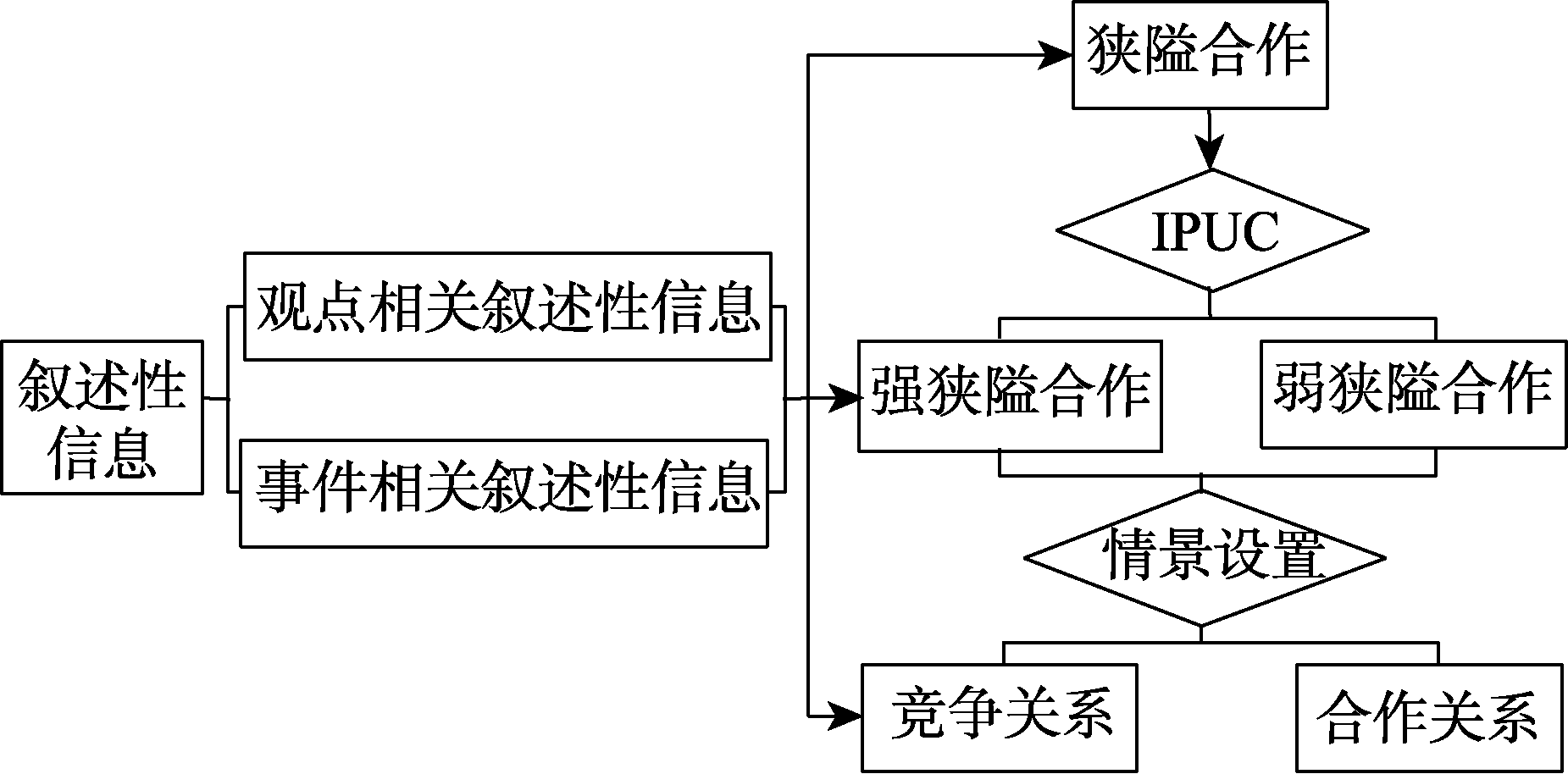
图1 研究流程图
| 回归方程 | 整体拟合指数 | 回归系数显著性 | ||||
|---|---|---|---|---|---|---|
| 结果变量 | 预测变量 | R | R² | F | β | t |
| 强狭隘合作行为 | 0.32 | 0.1 | 8.72** | |||
| 叙述性信息 | −0.24 | −2.22* | ||||
| 感知相似性 | 0.24 | 0.06 | 4.91* | |||
| 叙述性信息 | 0.32 | 2.95** | ||||
| 强狭隘合作行为 | 0.43 | 0.18 | 8.72*** | |||
| 感知相似性 | −0.37 | 3.44*** | ||||
| 叙述性信息 | −0.13 | −1.15 | ||||
表1 叙述性信息中介模型的回归分析
| 回归方程 | 整体拟合指数 | 回归系数显著性 | ||||
|---|---|---|---|---|---|---|
| 结果变量 | 预测变量 | R | R² | F | β | t |
| 强狭隘合作行为 | 0.32 | 0.1 | 8.72** | |||
| 叙述性信息 | −0.24 | −2.22* | ||||
| 感知相似性 | 0.24 | 0.06 | 4.91* | |||
| 叙述性信息 | 0.32 | 2.95** | ||||
| 强狭隘合作行为 | 0.43 | 0.18 | 8.72*** | |||
| 感知相似性 | −0.37 | 3.44*** | ||||
| 叙述性信息 | −0.13 | −1.15 | ||||
| 效应类型 | 效应值 | Boot SE | Bootstrap 95% CI | 相对效应 占比 | |
|---|---|---|---|---|---|
| 下限 | 上限 | ||||
| 总效应 | −2.50 | −0.02 | −4.64 | −0.38 | 100.00% |
| 直接效应 | −1.29 | 1.09 | −3.52 | 0.82 | 51.60% |
| 间接效应 | −1.21 | 0.55 | −2.39 | −0.27 | 48.40% |
表2 叙述性信息中介效应Bootstrap检验
| 效应类型 | 效应值 | Boot SE | Bootstrap 95% CI | 相对效应 占比 | |
|---|---|---|---|---|---|
| 下限 | 上限 | ||||
| 总效应 | −2.50 | −0.02 | −4.64 | −0.38 | 100.00% |
| 直接效应 | −1.29 | 1.09 | −3.52 | 0.82 | 51.60% |
| 间接效应 | −1.21 | 0.55 | −2.39 | −0.27 | 48.40% |
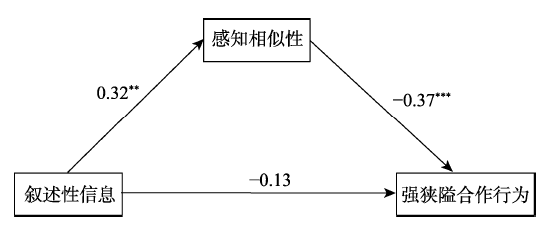
图2 感知相似性在叙述性信息影响狭隘合作行为中的中介效应路径图 注: **p < 0.01; ***p < 0.001
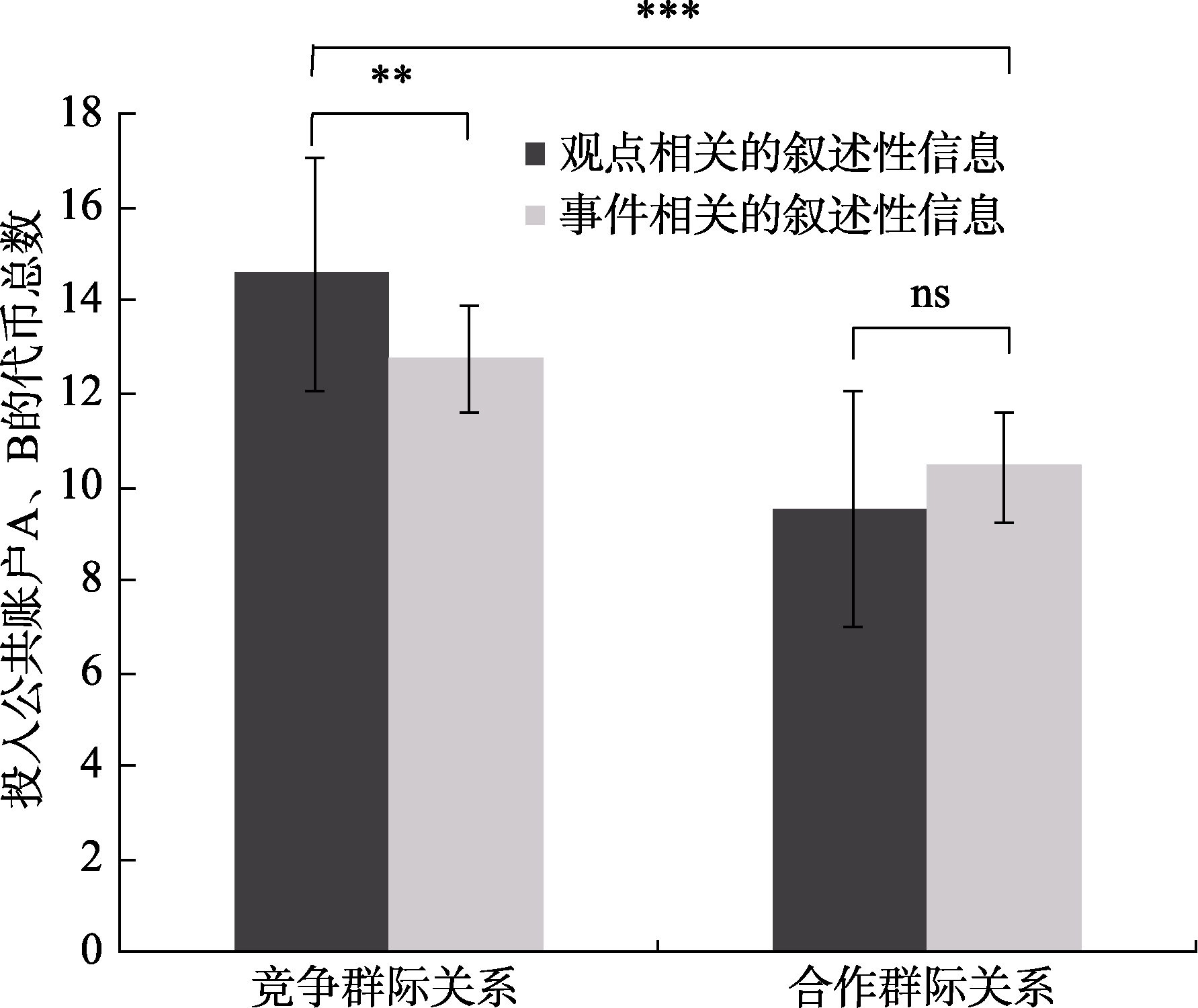
图3 群际关系与叙述性信息的交互作用(狭隘合作) 注: 误差线为 SD。ns p > 0.05, ** p < 0.01, *** p < 0.001。
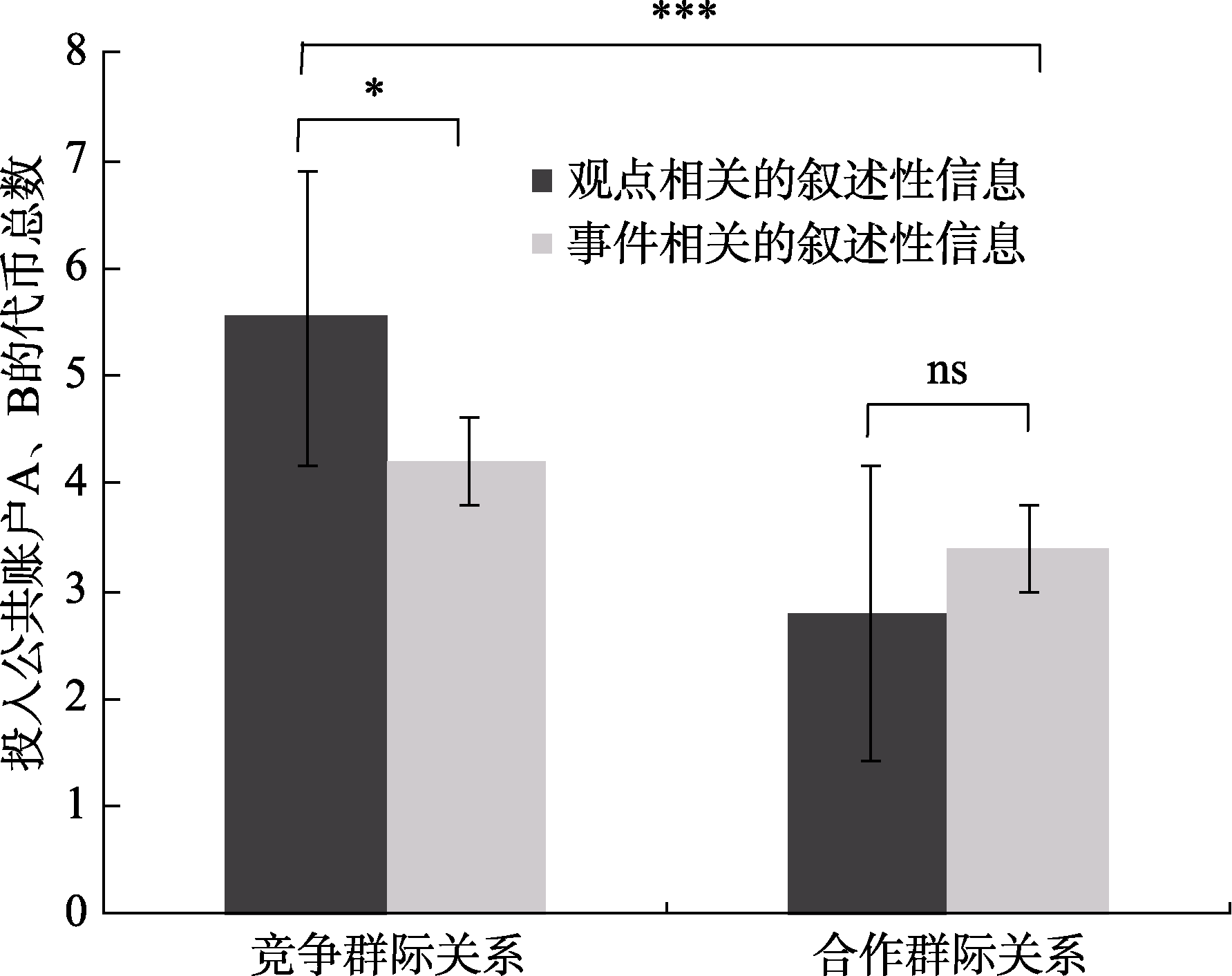
图4 群际关系与叙述性信息的交互作用(强狭隘合作) 注: 误差线为 SD。ns p > 0.05, * p < 0.05, *** p < 0.001。
| [1] | Aaldering, H., & Böhm, R. (2019). Parochial versus universal cooperation: Introducing a novel economic game of within- and between-group interaction. Social Psychological and Personality Science, 11(1), 36-45. https://doi.org/10.1177/1948550619841627 |
| [2] |
Aaldering, H., Ten Velden, F. S., van Kleef, G. A., & De Dreu, C. K. (2018). Parochial cooperation in nested intergroup dilemmas is reduced when it harms out-groups. Journal of Personality and Social Psychology, 114(6), 909-923. https://doi.org/10.1037/pspi0000125
doi: 10.1037/pspi0000125 URL pmid: 29389154 |
| [3] | Almaraz, S. M., Hugenberg, K., & Young, S. G. (2017). Perceiving sophisticated minds influences perceptual individuation. Personality and Social Psychology Bulletin, 44(2), 143-157. https://doi.org/10.1177/0146167217733070 |
| [4] | Aron, A., Aron, E. N., & Smollan, D. (1992). Inclusion of other in the self scale and the structure of interpersonal closeness. Journal of Personality and Social Psychology, 63(4), 596-612. https://doi.org/10.1037/0022-3514.63.4.596 |
| [5] | Baron, J. (2001). Confusion of group interest and self-interest in parochial cooperation on behalf of a group. Journal of Conflict Resolution, 45(3), 283-296. https://doi.org/10.1177/0022002701045003002 |
| [6] | Batson, C. D., Lishner, D. A., Cook, J., & Sawyer, S. (2005). Similarity and nurturance: Two possible sources of empathy for strangers. Basic and Applied Social Psychology, 27(1), 15-25. https://doi.org/10.1207/s15324834basp2701_2 |
| [7] | Beekman, G., Cheung, S. L., & Levely, I. (2017). The effect of conflict history on cooperation within and between groups: Evidence from a laboratory experiment. Journal of Economic Psychology, 63, 168-183. https://doi.org/10.1016/j.joep.2017.02.004 |
| [8] | Bernhard, H., Fischbacher, U., & Fehr, E. (2006). Parochial altruism in humans. Nature, 442(7105), 912-915. https://doi.org/10.1038/nature04981 |
| [9] | Böhm, R. (2016). Intuitive participation in aggressive intergroup conflict: Evidence of weak versus strong parochial altruism. Frontiers in Psychology, 7, 1535. https://doi.org/10.3389/fpsyg.2016.01535 |
| [10] | Bornstein, G., Kugler, T., & Ziegelmeyer, A. (2004). Individual and group decisions in the centipede game: Are groups more “rational” players?. Journal of Experimental Social Psychology, 40(5), 599-605. https://doi.org/10.1016/j.jesp.2003.11.003 |
| [11] | Bowen, H. R. (1943). The interpretation of voting in the allocation of economic resources. The Quarterly Journal of Economics, 58(1), 27-48. https://doi.org/10.2307/1885754 |
| [12] | Bowes, A., & Katz, A. (2015). Metaphor creates intimacy and temporarily enhances theory of mind. Memory & Cognition, 43(6), 953-963. https://doi.org/10.3758/s13421-015-0508-4 |
| [13] | Bruneau, E. G., Cikara, M., & Saxe, R. (2015). Minding the gap: Narrative descriptions about mental states attenuate parochial empathy. Plos One, 10(10), e0140838. https://doi.org/10.1371/journal.pone.0140838 |
| [14] |
Bruneau, E., Lane, D., & Saleem, M. (2017). Giving the underdog a leg up: A counternarrative of nonviolent resistance improves sustained third-party support of a disempowered group. Social Psychological and Personality Science, 8(7), 746-757. https://doi.org/10.1177/1948550616683019
doi: 10.1177/1948550616683019 URL pmid: 29187958 |
| [15] | Chen, H. Y., & Chao, L. Q. (2021). Racial discrimination in the US under COVID-19 and Chinese American’s response. Journal of Overseas Chinese History Studies, (4), 39-49. https://doi.org/10.3969/j.issn.1002-5162.2021.04.006 |
| [陈惠扬, 潮龙起. (2021). 疫情冲击下美国的种族歧视与华人的应对. 华侨华人历史研究, (4), 39-49. https://doi.org/10.3969/j.issn.1002-5162.2021.04.006 ] | |
| [16] |
Chen, L., & Xu, X. D. (2020). How does literature reading affect readers’ theory of mind?. Advances in Psychological Science, 28(3), 434-442. https://doi.org/10.3724/SP.J.1042.2020.00434
doi: 10.3724/SP.J.1042.2020.00434 URL |
|
[陈丽娟, 徐晓东. (2020). 文学阅读如何影响读者的心理理论. 心理科学进展, 28(3), 434-442. https://doi.org/10.3724/SP.J.1042.2020.00434 ]
doi: 10.3724/SP.J.1042.2020.00434 URL |
|
| [17] | Costello, K., & Hodson, G. (2010). Exploring the roots of dehumanization: The role of animal-human similarity in promoting immigrant humanization. Group Processes & Intergroup Relations, 13(1), 3-22. https://doi.org/10.1177/1368430209347725 |
| [18] | Crisp, R. J., & Turner, R. N. (2009). Can imagined interactions produce positive perceptions?: Reducing prejudice through simulated social contact. American Psychologist, 64(4), 231-240. https://doi.org/10.1037/a0014718 |
| [19] |
Dang, B. B., Gao, C. H., Yang, Y., & Wang, M. G. (2014). Intergroup threat: The contributing factors and reduction strategies. Advances in Psychological Science, 22(4), 711-720. https://doi.org/10.3724/SP.J.1042.2014.00711
doi: 10.3724/SP.J.1042.2014.00711 URL |
|
[党宝宝, 高承海, 杨阳, 万明钢. (2014). 群际威胁:影响因素与减少策略. 心理科学进展, 22(4), 711-720. https://doi.org/10.3724/SP.J.1042.2014.00711]
doi: 10.3724/SP.J.1042.2014.00711 URL |
|
| [20] | Dawes, R. M. (1980). Social dilemmas. Annual Review of Psychology, 31(1), 169-193, https://doi.org/10.1146/annurev.ps.31.020180.001125 |
| [21] | De Dreu, C. K. W., Balliet, D., & Halevy, N. (2014). Parochial cooperation in humans:Forms and functions of self-sacrifice in intergroup conflict. In A. J. Elliot (Ed.), Advances in motivation science (pp. 1-47). Elsevier. doi: 10.1016/bs.adms.2014.08.001 |
| [22] | Dodell-Feder, D., & Tamir, D. I. (2018). Fiction reading has a small positive impact on social cognition: A meta-analysis. Journal of Experimental Psychology: General, 147(11), 1713-1727. https://doi.org/10.1037/xge0000395 |
| [23] | Dovidio, J. F., Gaertner, S. L., & Kawakami, K. (2003). Intergroup contact: The past, present, and the future. Group Processes & Intergroup Relations, 6(1), 5-20. https://doi.org/10.1177/1368430203006001009 |
| [24] | Faul, F., Erdfelder, E., Lang, A.-G., & Buchner, A. (2007). G* Power 3: A flexible statistical power analysis program for the social, behavioral, and biomedical sciences. Behavior Research Methods, 39(2), 175-191. https://doi.org/10.3758/bf03193146 |
| [25] | Fu, Z. G. (2005). The exploration of social psychological mechanism of intergroup relations. Journal of Shandong Normal University (Humanities and Social Sciences Edition), (2), 122-124. https://doi.org/10.16456/j.cnki.1001-5973.2005.02.027 |
| [付宗国. (2005). 群际关系的社会心理机制探析. 山东师范大学学报(人文社会科学版), (2), 122-124. https://doi.org/10.16456/j.cnki.1001-5973.2005.02.027 ] | |
| [26] |
Gaertner, S. L., Dovidio, J. F., Rust, M. C., Nier, J. A., Banker, B. S., Ward, C. M., Mottola, G. R., & Houlette, M. (1999). Reducing intergroup bias: Elements of intergroup cooperation. Journal of Personality and Social Psychology, 76(3), 388-402. https://doi.org/10.1037/0022-3514.76.3.388
URL pmid: 10101876 |
| [27] |
Gaesser, B., Shimura, Y., & Cikara, M. (2020). Episodic simulation reduces intergroup bias in prosocial intentions and behavior. Journal of Personality and Social Psychology, 118(4), 683-705. https://doi.org/10.1037/pspi0000194
doi: 10.1037/pspi0000194 URL pmid: 31157527 |
| [28] |
Garcia, S. M., Tor, A., & Schiff, T. M. (2013). The psychology of competition: A social comparison perspective. Perspectives on Psychological Science, 8(6), 634-650. https://doi.org/10.1177/1745691613504114
doi: 10.1177/1745691613504114 URL pmid: 26173228 |
| [29] | Genevsky, A., Västfjäll, D., Slovic, P., & Knutson, B. (2013). Neural underpinnings of the identifiable victim effect: Affect shifts preferences for giving. The Journal of Neuroscience, 33(43), 17188-17196. https://doi.org/10.1523/JNEUROSCI.2348-13.2013 |
| [30] |
Gray, H. M., Gray, K., & Wegner, D. M. (2007). Dimensions of mind perception. Science, 315(5812), 619-619. https://doi.org/10.1126/science.1134475
URL pmid: 17272713 |
| [31] | Gross, J., & De Dreu, C. K. W. (2019). The rise and fall of cooperation through reputation and group polarization. Nature Communications, 10(1), 776. https://doi.org/10.1038/s41467-019-08727-8 |
| [32] | Halevy, N., Chou, E. Y., Cohen, T. R., & Bornstein, G. (2010). Relative deprivation and intergroup competition. Group Processes & Intergroup Relations, 13(6), 685-700. https://doi.org/10.1177/1368430210371639 |
| [33] | Harrison, D. A., Price, K. H., & Bell, M. P. (1998). Beyond relational demography: Time and the effects of surface-and deep-level diversity on work group cohesion. Academy of Management Journal, 41(1), 96-107. https://doi.org/10.5465/256901 |
| [34] | Harrison, D. A., Price, K. H., Gavin, J. H., & Florey, A. T. (2002). Time, teams, and task performance: Changing effects of surface-and deep-level diversity on group functioning. Academy of Management Journal, 45(5), 1029-1045. https://doi.org/10.5465/3069328 |
| [35] | Haslam, N., & Loughnan, S. (2014). Dehumanization and infrahumanization. Annual Review of Psychology, 65(1), 399-423. https://doi.org/10.1146/annurev-psych-010213-115045 |
| [36] | Hayes, A. F. (2009). Beyond Baron and Kenny: Statistical mediation analysis in the new millennium. Communication Monographs, 76(4), 408-420. https://doi.org/10.1080/03637750903310360 |
| [37] | Hayes, A. F. Ed. (2013). Introduction to mediation, moderation, and conditional process analysis. New York, NY: The Guildford Press. |
| [38] | Hehman, E., Stolier, R. M., Freeman, J. B., Flake, J. K., & Xie, S. Y. (2019). Toward a comprehensive model of face impressions: What we know, what we do not, and paths forward. Social and Personality Psychology Compass, 13(2), e12431. https://doi.org/10.1111/spc3.12431 |
| [39] | Henrich, J., & Muthukrishna, M. (2021). The origins and psychology of human cooperation. Annual Review of Psychology, 72(1), 207-240. https://doi.org/10.1146/annurev-psych-081920-042106 |
| [40] | Johnson, D. R., Jasper, D. M., Griffin, S., & Huffman, B. L. (2013). Reading narrative fiction reduces Arab-Muslim prejudice and offers a safe haven from intergroup anxiety. Social Cognition, 31(5), 578-598. https://doi.org/10.1521/soco.2013.31.5.578 |
| [41] |
Kidd, D. C., & Castano, E. (2013). Reading literary fiction improves Theory of mind. Science, 342(6156), 377-380. https://doi.org/10.1126/science.1239918
doi: 10.1126/science.1239918 URL pmid: 24091705 |
| [42] | Koch, A., Dorrough, A., Glöckner, A., & Imhoff, R. (2020). The ABC of society: Perceived similarity in agency/ socioeconomic success and conservative-progressive beliefs increases intergroup cooperation. Journal of Experimental Social Psychology, 90, 103996. https://doi.org/10.1016/j.jesp.2020.103996 |
| [43] | Labov, W., & Waletzky, J. (1997). Narrative analysis: Oral versions of personal experience. Journal of Narrative and Life History, 7(1-4), 3-38. https://doi.org/10.1075/jnlh.7.02nar |
| [44] | Lammers, J., Gordijn, E. H., & Otten, S. (2008). Looking through the eyes of the powerful. Journal of Experimental Social Psychology, 44(5), 1229-1238. https://doi.org/10.1016/j.jesp.2008.03.015 |
| [45] | Lee, V. K., Kranton, R. E., Conzo, P., & Huettel, S. A. (2021). The hidden cost of humanization: Individuating information reduces prosocial behavior toward in-group members. Journal of Economic Psychology, 86, 102424. https://doi.org/10.1016/j.joep.2021.102424 |
| [46] | Leyens, J. P., Cortes, B., Demoulin, S., Dovidio, J. F., Fiske, S. T., Gaunt, R., … Vaes, J. (2003). Emotional prejudice, essentialism, and nationalism The 2002 Tajfel lecture. European Journal of Social Psychology, 33(6), 703-717. https://doi.org/10.1002/ejsp.170 |
| [47] | Liebkind, K., & McAlister, A. L. (1999). Extended contact through peer modelling to promote tolerance in Finland. European Journal of Social Psychology, 29(5-6), 765-780. https://doi.org/10.1002/(sici)1099-0992(199908/09)29:5/6<765::aid-ejsp958>3.0.co;2-j |
| [48] | Mar, R. A., Oatley, K., Djikic, M., & Mullin, J. (2011). Emotion and narrative fiction: Interactive influences before, during, and after reading. Cognition & Emotion, 25(5), 818-833. https://doi.org/10.1080/02699931.2010.515151 |
| [49] | McDonald, M., Porat, R., Yarkoney, A., Reifen Tagar, M., Kimel, S., Saguy, T., & Halperin, E. (2016). Intergroup emotional similarity reduces dehumanization and promotes conciliatory attitudes in prolonged conflict. Group Processes & Intergroup Relations, 20(1), 125-136. https://doi.org/10.1177/1368430215595107 |
| [50] | Mifune, N., Simunovic, D., & Yamagishi, T. (2017). Intergroup biases in fear-induced aggression. Frontiers in Psychology, 8, 49. https://doi.org/10.3389/fpsyg.2017.00049 |
| [51] | Montoya, R. M., Horton, R. S., & Kirchner, J. (2008). Is actual similarity necessary for attraction? A meta-analysis of actual and perceived similarity. Journal of Social and Personal Relationships, 25(6), 889-922. https://doi.org/10.1177/026540750809670 |
| [52] | Ng, Y. L., Kulik, C. T., & Bordia, P. (2015). The moderating role of intergroup contact in race composition, perceived similarity, and applicant attraction relationships. Journal of Business and Psychology, 31(3), 415-431. https://doi.org/10.1007/s10869-015-9419-4 |
| [53] | Oatley, K. (1999a). Meetings of minds: Dialogue, sympathy, and identification, in reading fiction. Poetics, 26(5-6), 439-454. https://doi.org/10.1016/s0304-422x(99)00011-x |
| [54] | Oatley, K. (1999b). Why fiction may be twice as true as fact: Fiction as cognitive and emotional simulation. Review of General Psychology, 3(2), 101-117. https://doi.org/10.1037/1089-2680.3.2.101 |
| [55] | Park, J. H., & Schaller, M. (2005). Does attitude similarity serve as a heuristic cue for kinship? Evidence of an implicit cognitive association. Evolution and Human Behavior, 26(2), 158-170. https://doi.org/10.1016/j.evolhumbehav.2004.08.013 |
| [56] | Shah, A. K., & LaForest, M. (2022). Knowledge about others reduces one’s own sense of anonymity. Nature, 603(7900), 297-301. https://doi.org/10.1038/S41586-022-04452-3 |
| [57] | Sharifian, M., Hatami, J., Batouli, S. A. H., & Boroujeni, M. M. F. (2022). Citizens of the world: National stereotypes do not affect empathic response in the presence of individuating information. International Journal of Psychology, 57(2), 251-260. https://doi.org/10.1002/ijop.12807 |
| [58] | Singh, R., Tay, Y. Y., & Sankaran, K. (2016). Causal role of trust in interpersonal attraction from attitude similarity. Journal of Social and Personal Relationships, 34(5), 717-731. https://doi.org/10.1177/0265407516656826 |
| [59] |
Stapel, D. A., & Koomen, W. (2005). Competition, cooperation, and the effects of others on me. Journal of Personality and Social Psychology, 88(6), 1029-1038. https://doi.org/10.1037/0022-3514.88.6.1029
URL pmid: 15982120 |
| [60] | Sun, J. Y., & Liu, Y. L. (2021). Dehumanization: Concept, measurement and related researches. Psychological Development and Education, 37(3), 447-456. https://doi.org/10.16187/j.cnki.issn1001-4918.2021.03.16 |
| [孙钾诒, 刘衍玲. (2021). 去人性化知觉: 内涵、测量及相关研究. 心理发展与教育, 37(3), 447-456. https://doi.org/10.16187/j.cnki.issn1001-4918.2021.03.16 ] | |
| [61] | Turban, D. B., Dougherty, T. W., & Lee, F. K. (2002). Gender, race, and perceived similarity effects in developmental relationships: The moderating role of relationship duration. Journal of Vocational Behavior, 61(2), 240-262. https://doi.org/10.1006/jvbe.2001.1855 |
| [62] | Turner, R. N., & West, K. (2011). Behavioural consequences of imagining intergroup contact with stigmatized outgroups. Group Processes & Intergroup Relations, 15(2), 193-202. https://doi.org/10.1177/1368430211418699 |
| [63] | Van Lange, P. A. M., Joireman, J., Parks, C. D., & van Dijk, E. (2013). The psychology of social dilemmas: A review. Organizational Behavior and Human Decision Processes, 120(2), 125-141, https://doi.org/10.1016/j.obhdp.2012.11.003 |
| [64] | Vollberg, M. C., Gaesser, B., & Cikara, M. (2021). Activating episodic simulation increases affective empathy. Cognition, 209, 104558. https://doi.org/10.1016/j.cognition.2020.104558 |
| [65] | Wolf, S. T., Insko, C. A., Kirchner, J. L., & Wildschut, T. (2008). Interindividual-intergroup discontinuity in the domain of correspondent outcomes: The roles of relativistic concern, perceived categorization, and the doctrine of mutual assured destruction. Journal of Personality and Social Psychology, 94(3), 479. https://doi.org/10.1037/0022-3514.94.3.479 |
| [66] |
Yang, W. Q., Jin, S. H., He, S. R. N., Zhang, X. X., & Fan, Q. (2015). Dehumanization: Theoretical comparison and application. Advances in Psychological Science, 23(7), 1267-1279. https://doi.org/10.3724/SP.J.1042.2015.01267
doi: 10.3724/SP.J.1042.2015.01267 URL |
|
[杨文琪, 金盛华, 何苏日那, 张潇雪, 范谦. (2015). 非人化研究: 理论比较及其应用. 心理科学进展, 23(7), 1267-1279. https://doi.org/10.3724/SP.J.1042.2015.01267]
doi: 10.3724/SP.J.1042.2015.01267 URL |
|
| [67] |
Zaki, J. (2014). Empathy: A motivated account. Psychological Bulletin, 140(6), 1608-1647. https://doi.org/10.1037/a0037679
doi: 10.1037/a0037679 URL pmid: 25347133 |
| [68] | Zhao, L. H., Yang, Y. M., & Li, J. (2022). The relationship between children’s reading and theory of mind. Advances in Psychological Science, 30(1), 65-76. https://doi.org/10.3724/SP.J.1042.2022.00065 |
|
[赵丽华, 杨运梅, 李晶. (2022). 儿童阅读与心理理论间的关系. 心理科学进展, 30(1), 65-76. https://doi.org/10.3724/SP.J.1042.2022.00065 ]
doi: 10.3724/SP.J.1042.2022.00065 URL |
|
| [69] |
Zhao, X., Liu, L., Zhang, X. X., Xiang, Z. D., & Fu, H. L. (2012). Perspective-taking: Concept, manipulation and its impact on intergroup relations. Advances in Psychological Science, 20(12), 2079-2088. https://doi.org/10.3724/SP.J.1042.2012.02079
doi: 10.3724/SP.J.1042.2012.02079 URL |
|
[赵显, 刘力, 张笑笑, 向振东, 付洪岭. (2012). 观点采择:概念、操纵及其对群际关系的影响. 心理科学进展, 20(12), 2079-2088. https://doi.org/10.3724/SP.J.1042.2012.02079 ]
doi: 10.3724/SP.J.1042.2012.02079 URL |
|
| [70] | Zuo, B., & Zhao, J. (2008). The effect of positive emotions on perceptions of intergroup relationships. Psychological Development and Education, 24(3), 119-123. https://doi.org/10.16187/j.cnki.1001-4918.2008.03.014 |
| [佐斌, 赵菊. (2008). 积极情绪对群际关系认知的影响. 心理发展与教育, 24(3), 119-123. https://doi.org/10.16187/j.cnki.1001-4918.2008.03.014 ] |
| [1] | 康萤仪,周文芝,杨永瑞,詹尼弗·罗斯纳. 理论的建构与验证:来自社会认同研究的经验[J]. 心理学报, 2010, 42(01): 22-36. |
| [2] | 樊艾梅,李文馥. 3─6岁儿童层级类概念发展的实验研究[J]. 心理学报, 1995, 27(1): 28-36. |
| 阅读次数 | ||||||
|
全文 |
|
|||||
|
摘要 |
|
|||||
