



1 问题提出
拖延行为妨碍着人们生活中的方方面面(Klingsieck, 2013), 包括工作(Metin et al., 2018)、学业(Balkis, 2013)、睡眠(Chung et al., 2020)、运动计划(Kelly & Walton, 2021)以及疾病防治(Sirois, 2015)。数据显示, 65%的成年人至少在生活的某一个方面受到了拖延的困扰, 而25%的成年人则在四个及以上的方面为拖延所苦恼(Hen & Goroshit, 2018)。拖延行为不仅困扰着几乎全年龄段的个体(Beutel et al., 2016; Ferrari & Roster, 2018), 还影响着不同文化和国家的人们(Steel & Ferrari, 2013), 甚至还能够通过遗传和家庭教育危害到下一代(Gustavson et al., 2014; Khalid et al., 2019)。由此可见, 探明如何减少拖延行为对个体与社会而言至关重要。
良好的自我控制能力有望长效地减少拖延行为。自我控制是人们实现长远目标的一种重要能力, 但却是一种相对有限的认知资源(Baumeister et al., 2007)。研究显示, 自我控制能力较强的个体具有较低的拖延倾向(Przepiórka et al., 2019)。元分析的结果也证实, 个体的自我控制能力是预测拖延行为最主要的人格变量(Steel, 2007; Steel & Klingsieck, 2016; Eerde, 2003)。尽管如此, 自我控制减少拖延行为的机制却仍不清楚。早期的拖延理论虽然强调拖延是自我控制失败的结果, 但却并未论述自我控制如何减少拖延行为(Sirois & Pychyl, 2013; Tice & Bratslavsky, 2000)。此外, 早期的拖延理论由于并不清楚拖延的核心认知机制, 也难以为研究自我控制如何减少拖延行为提供理论框架(Zhang & Feng, 2020; Zhang, Liu et al., 2019; 张顺民, 冯廷勇, 2017a)。因此, 目前的理论成果尚无法指导如何高效地利用自我控制能力减少拖延行为(Grunschel et al., 2018; Visser et al., 2017)。由此可见, 为了高效地发挥自我控制的作用, 探明自我控制如何减少拖延行为十分必要。
自我控制减少拖延行为的神经基础仍不清楚。由于缺乏合适的实验室范式, 多数研究依赖于静息态或结构态MRI技术考察拖延相关的神经基础。研究发现个体的高拖延倾向与腹内侧前额叶(vmPFC)、外侧前额叶(lPFC)等区域的指标异常有关(Liu & Feng, 2017; Wu, Li et al., 2016; Zhang et al., 2016)。由于vmPFC和lPFC是负责自我控制相关能力的主要脑区(Bechara et al., 2006; Tanji & Hoshi, 2008)。研究者们推测自我控制可能通过vmPFC和lPFC减少拖延行为(Chen & Feng, 2022; Zhang, Liu et al., 2019)。然而, 由于实验范式的缺乏, 研究者难以进一步验证这一猜想。少量研究虽然尝试借助其他领域的任务范式, 但仍然难以较为生态地模拟拖延行为(Wypych et al., 2019; 倪亚琨 et al., 2019)。由此可见, 合适的脑成像实验范式对于深入探究自我控制减少拖延行为的神经基础必不可少。
2 国内外研究现状
2.1 拖延行为的认知机制
2.1.1 拖延早期理论
情绪调节观点(emotion-regulation perspective)和时间动机理论(the temporal motivation theory)是能够较好解释拖延行为的早期理论。情绪调节观点认为拖延是一种应对任务厌恶的消极策略(Sirois & Pychyl, 2013)。这种消极策略的表现为: 明知不利于长远目标, 仍推迟任务以暂时性地回避执行任务的负性情绪。另一方面, 时间动机理论认为延迟折扣效应(delay discounting effect)使人们对任务远期结果的考虑不足, 从而选择了拖延(Steel & König, 2006)。根据延迟折扣效应, 远期结果对任务的促进作用会随着其延迟时间的增加以双曲线的形式折扣。因此, 个体只有在足够临近截止日期时才会充分地意识到远期结果的价值, 选择执行任务。
2.1.2 拖延的时间决策模型
在某一时间点t, 执行某任务的决策效用主要取决于以下两种效用的综合影响:
(1)过程效用(process utility): 执行任务的主观体验(愉悦程度/不愉悦程度);
(2)结果效用(outcome utility): 个体对任务结果的主观价值(喜欢程度/不喜欢程度)。
时间决策模型根据过程效用和结果效用对任务执行的作用确定其符号的正负。过程效用或结果效用促进任务执行时为正, 而阻碍任务执行时为负。分析可知, 只有过程效用为负而结果效用为正时(例如: 写论文), 推迟任务才符合拖延行为的定义。此时, 个体的决策效用取决于负性过程效用与正性结果效用之间的竞争结果:
公式1. 是否拖延的决策效用取决于负性过程效用和正性结果效用的竞争结果。E代表期望, V代表价值, Г代表个体对于延迟时间的敏感性。D代表延迟时间。其中D过程表示任务的延迟时间, 而D结果表示是任务执行的时间点t与结果兑现日期的距离。β表示过程效用与结果效用的作用转换系数。
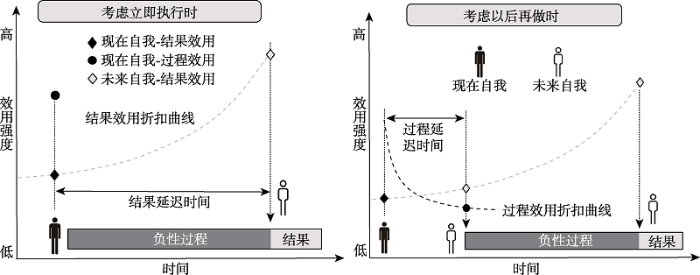
拖延决策模型突显的是现在自我与未来自我的矛盾。现在自我不愿意承受任务的负性过程, 希望推迟任务; 而未来自我则需要对任务的执行结果负责, 希望尽早完成任务。考虑立即执行任务时, 任务过程对于现在自我而言是即时的, 而任务结果是延迟的(图1左)。此时, 现在自我将会感受到极高的负性过程效用, 却只能感受到较低的正性结果效用, 因此不愿意立即执行。而考虑以后执行时, 由于自利偏差, 现在自我更多地关注“现在自我的负性过程效用”和“未来自我的正性结果效用” (图1右)。此时, 随着任务被推迟得越远, 现在自我所感受到的负性过程效用越低, 而预期未来自我所感受到的结果效用会相对更高。因此, 现在自我会觉得“以后再做”是不错的选择。目前的研究不仅验证了时间决策模型提出的现在不做以后再做的认知机制(Zhang & Feng, 2020), 也揭示了任务效用评估的神经基础(Zhang et al., 2021)。时间决策模型利用决策的视角综合地阐述了拖延行为的认知机制, 能够为研究自我控制如何减少拖延行为提供理论框架。
图1
2.2 拖延的神经基础
尽管有研究指出: 结合任务态、静息态和结构态的多模态MRI技术(multimodal magnetic resonance imaging technique)进行交互验证有助于确认更具稳定性的拖延神经基础(张顺民, 冯廷勇, 2017b)。然而, 由于缺少生态的拖延脑成像实验范式, 拖延神经基础的探索主要依赖于静息态fMRI和结构态MRI指标(voxel-based morphometry, VBM), 只有少量的结果得到了任务态的交互验证。静息态和结构态交互验证的结果主要集中于海马旁回(parahippocampal gyrus, PHG)、腹内侧前额叶(vmPFC)和外侧前额叶(lPFC) (Zhang, Liu et al., 2019)。此外, 大样本的研究还发现前脑岛(anterior insula)的灰质体积与个体的拖延倾向存在正相关(Chen et al., 2019)。随后的任务态fMRI研究也交互验证了这一结果, 发现任务评估时的杏仁核与前脑岛的功能连接(the amygdala-insula connection)能够中介负性过程效用对任务拖延的影响(Zhang et al., 2021)。
由于海马旁回是负责预期想象(episodic prospection)的核心脑区之一, 研究者们推测海马旁回通过预期想象的能力影响拖延行为(Chen & Feng, 2022; Zhang, Liu et al., 2019)。利用不同神经指标和不同模态的脑成像技术, 研究者们都发现个体的拖延倾向与海马旁回存在关联(Hu et al., 2018; Liu & Feng, 2019; Zhang et al., 2016)。基于任务态fMRI的研究也确认了海马对拖延行为的影响(Zhang, Becker et al., 2019; Zhang et al., 2021)。此外, 海马与纹状体的功能连接(the hippocampus- striatum connection)也能够显著地中介任务远期结果对拖延行为的影响。
由于腹内侧前额叶(vmPFC)和外侧前额叶(lPFC)都是负责自我控制的主要脑区, 研究者们推测腹内侧前额叶(vmPFC)和外侧前额叶(lPFC)通过自我控制的能力影响拖延行为(Chen & Feng, 2022; Zhang, Liu et al., 2019)。静息态和结构态交互验证的结果显示, 腹内侧前额叶(vmPFC)及外侧前额叶(lPFC)与个体的拖延倾向有着稳定的联系(Chen et al., 2019; Liu & Feng, 2017; Zhang, Liu et al., 2019)。功能连接的结果也显示, 高低拖延个体的差异集中于腹内侧前额叶(vmPFC)与背外侧前额叶(dlPFC)之间的功能连接( Wu, Gui et al., 2016; Zhang et al., 2016)。
2.3 自我控制与拖延行为
自我控制被认为是帮助个体实现长远目标的一种能力(Baumeister et al., 2007)。具体而言, 研究者们认为反应抑制、延迟满足以及情绪调节等行为都体现了自我控制能力。尽管大量研究都证实自我控制能够减少拖延行为(Rebetez et al., 2016; Steel, 2007), 但自我控制如何减少拖延行为却仍不清楚。虽然早期理论都强调拖延行为是一种自我控制失败, 但这些理论并没有进一步论述自我控制如何影响拖延行为(Steel & Ferrari, 2013; Steel & König, 2006)。目前, 脑成像研究只考察了与个体自我控制能力和拖延倾向同时存在关联的功能连接(Xu et al., 2021)。该研究发现: 背外侧前额叶(dlPFC)的功能链接能够中介自我控制能力对个体拖延倾向的影响。由此可见, 自我控制很可能通过背外侧前额叶(dlPFC)等区域减少拖延行为。然而, 由于缺乏拖延的脑成像实验范式, 以往研究未能深入地揭示自我控制减少拖延行为的神经基础。
3 研究构想
图2
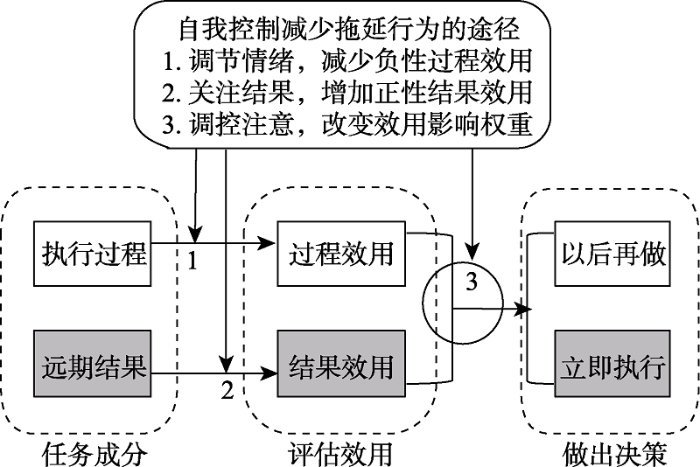
途径1: 调节负性情绪, 通过降低负性过程效用减少拖延。
途径2: 关注任务结果, 通过增强正性结果效用减少拖延。
途径3: 调控注意分配, 通过决策时更少地注意负性过程或者更多地注意正性结果减少拖延。
3.1 研究1: 自我控制减少拖延决策的认知机制及其稳定性
虽然已有研究证实拖延依赖于对负性过程效用和正性结果效用的权衡(Zhang & Feng, 2020), 但自我控制在其中的作用机制仍不清楚。研究一将着重揭示自我控制减少拖延决策的认知机制(研究1a), 并检验自我控制作用机制的稳定性(研究1b)。
3.1.1 研究1a: 自我控制减少拖延决策的认知机制
研究1a拟结合自我控制问卷和拖延决策范式, 利用模型比较考察自我控制减少拖延决策的认知机制。结合本研究的理论框架(见图2)可知, 自我控制能力可能有多种减少拖延决策的途径。研究1a拟通过比较三组模型确定自我控制的高效途径。模型组一假设: 自我控制通过途径1、2减少拖延(即改变过程效用或结果效用)。模型组二假设: 自我控制只通过途径3调节任务效用对拖延决策的影响权重减少拖延。模型组三假设: 自我控制可以同时通过途径1、2和3减少拖延决策。三组模型下均设有更具体的子模型以考虑各种更具体的情况。
自我控制能力通过问卷测量(Tangney et al., 2004), 而任务效用和拖延决策利用拖延决策范式测量。拖延决策范式使用被试计划执行的真实任务事件(例如: 考试复习)以及促进任务执行的主要远期结果(例如: 取得好成绩)作为个性化的刺激材料。为了专注研究拖延行为, 本研究拟选取过程效用可能为负而结果效用可能为正的任务事件, 收集任务的过程效用、结果效用以及决策效用。
3.1.2 研究1b: 自我控制作用机制的稳定性
研究1b将在研究1a的基础上, 通过经验取样法追踪不同自我控制作用方式减少拖延行为的效果, 从而考察自我控制作用机制的稳定性。经验取样法是一种纵向数据收集方法, 采用重复抽样的方式, 多次收集人们在较短时间内对生活中经历的事件的瞬时评估, 具有良好的信度和较高的生态效度(Csikszentmihalyi & Larson, 2014)。本研究预期每名被试追踪至少30天。其中自我控制方式利用简短的问卷测量。该问卷将考察个体调节负性情绪、关注任务结果的倾向以及做出拖延决策的难易度。拖延行为拟通过个体按计划完成任务的程度进行衡量。此外, 本研究还将询问被试是否因为正当原因未能完成计划, 以排除特殊情况的影响。
3.2 研究2: 自我控制减少拖延决策的神经基础及神经刺激
3.2.1 研究2a: 多模态MRI交互验证自我控制减少拖延决策的神经基础
研究2a将基于时间决策模型, 开发能够生态地模拟任务评估(过程效用和结果效用)和拖延决策的脑成像实验范式并结合多模态MRI技术考察自我控制减少拖延决策的神经基础。
由于拖延决策范式依赖于主观报告(Zhang & Feng, 2020), 容易引入额外的认知过程, 从而混淆任务评估和拖延决策的神经活动。因此, 本研究将操纵目标任务的负性过程效用和正性结果效用设计新的实验室范式。具体而言, 研究将设置难度较大但有金钱奖励目标任务, 以及轻松但无金钱奖励的干扰任务。通过目标任务的难度操纵负性过程效用, 而通过改变数点任务的奖金大小操纵任务的正性结果效用。被试可以自由选择目标任务和干扰任务。当被试选择目标任务时, 可以认为其选择了“立即执行”; 而选择干扰任务时, 则认为其选择了“拖延”目标任务。
在任务态fMRI以外, 研究还将结合静息态和结构态MRI交互验证检验结果的稳定性。任务态fMRI将结合问卷测量和拖延决策的脑成像实验范式确认自我控制减少拖延决策的神经基础, 而静息态fMRI和结构态MRI则通过自我控制问卷和拖延问卷确认二者共同的神经基础。
3.2.2 研究2b: 基于自我控制脑区的神经刺激
研究2b将在研究2a的基础上, 利用神经刺激技术增强自我控制脑区的神经元兴奋性, 考察作用效果及机制。研究将利用高精度经颅直流电刺激技术(high-definition transcranial direct current stimulation, HD-tDCS)刺激自我控制的相关脑区(例如: dlPFC或vmPFC)。采用组别×前后测(实验组/对照组×神经刺激前测/后测)的被试内设计, 考察任务效用和拖延决策的变化。探索神经刺激的作用有助于了解自我控制的脑区如何改变拖延决策并且为神经干预提供参考。
4 理论构建
时间决策模型(temporal decision model)通过阐述个体“现在做还是以后做”的决策机制, 揭示了拖延行为的核心认知机制(张顺民, 冯廷勇, 2017a)。目前, 时间决策模型对拖延的解释已得到验证(Zhang & Feng, 2020)。由于揭示了核心的认知机制, 时间决策模型不仅有助于理解拖延行为, 也能够为研究不同的拖延影响因素(例如: 自我控制能力)提供理论框架(Zhang, Liu et al., 2019)。而拖延行为核心认知机制的揭示也能够为设计更合适的脑成像实验范式提供理论指导(Zhang, Becker et al., 2019; Zhang et al., 2021)。
在缺少外部监督的情况下, 许多人都有着严重的拖延行为(Arifiana et al., 2020; Wang et al., 2020)。作为自主减少拖延的主要能力, 良好的自我控制对提高学习工作效率而言至关重要。然而, 自我控制却是一种相对有限的认知资源(Baumeister et al., 2007)。因此, 有必要考察自我控制的作用机制, 以便高效地减少拖延行为。具体而言, 自我控制可能有三条影响拖延行为的途径(见图2)。途径1: 减少负性过程效用; 途径2: 增加正性结果效用; 途径3: 调节决策时的注意分配, 影响不同效用在决策中的作用权重。探明自我控制的作用机制能够为拖延干预的开发提供理论指导。如果途径1更为有效, 拖延干预应该更多借鉴情绪调节的训练方案(Eckert et al., 2016)。如果途径2更为有效, 目标管理的能力训练可能更值得参考(Gustavson & Miyake, 2017)。如果途径3更为有效, 拖延干预可以更多地考虑针对注意调控的训练方式(例如: 冥想)。鉴于以往拖延干预研究缺乏系统的理论参考(Eerde & Klingsieck, 2018), 深入探究自我控制的作用机制势在必行。
神经机制的揭示能够加深对自我控制作用机制的理解。自我控制拥有复杂的内在结构, 难以从行为层面形象地揭示其作用机制。而认知神经科学中的双系统理论(dual-system theories)则能够提供更为具体的视角(Evans & Stanovich, 2013; Hofmann, Friese, & Strack, 2009)。双系统理论认为大脑中存在两个不同的系统分别负责产生冲动和执行自我控制。总体而言, 双系统理论认为皮层下的区域, 包括中脑与边缘系统, 负责产生冲动, 并表征较近未来的快感和苦痛; 而位于前额叶的区域则负责执行自我控制, 并负责考虑长远的未来。而自我控制减少拖延行为的机制可以通过两个系统的具体作用模式更清楚地体现。从应用角度而言, 神经机制的揭示能够为神经干预提供作用靶点。目前拖延的神经机制研究仍多依赖于静息态与结构态fMRI (Chen et al., 2021; Zhang et al., 2019), 无法提供精细的参照靶点。本项目所开发的实验室范式将能帮助每名拖延个体定位各自的神经靶点。随着个性化干预的需求不断增长(Klingsieck, 2013), 更有针对性的神经刺激有望成为拖延干预的未来趋势。
目前拖延领域已经发现了许多影响因素(Procee et al., 2013)。在任务特征方面, 任务厌恶、延迟时间、任务的组织结构等都对拖延行为有影响。在人格特质方面, 尽责性、冲动性、自我效能感、神经质等与个体的拖延倾向有着稳定的关联(Steel, 2007)。随着所发现的影响因素增多, 如何解释众多影响因素的作用机制成为了一个新的难题。在时间决策的理论框架中, 各种因素的特征可以被包含在过程效用与结果效用之中。例如, 缺乏自主性、挫折感以及无聊感都可能是增加负性过程效用的任务特征(Blunt & Pychyl, 2000)。而任务结构则可能通过调节过程与结果的延迟时间来影响任务的效用评估。各种人格因素也可能通过影响效用评估从而影响任务决策。例如: 研究发现高拖延特质的个体可能存在系统的评估偏差, 他们更倾向于高估任务的负性过程(Lay, 1992)。此外, 高拖延者对未来结果的预期想象能力确实比低拖延者差(Rebetez et al., 2016)。由此可见, 时间决策模型能够为整合众多拖延的影响因素提供理论框架, 而验证其对自我控制作用机制的预测也是重要的理论扩展。
由于缺乏拖延的实验范式, 一些研究尝试利用跨期选择任务或者反应抑制任务作为替代(Wu, Gui et al., 2016; Wypych et al., 2019), 另一些研究则要求被试报告其对应生活事件的评估或者决策(Raphaël & Mathias, 2022; Zhang, Liu et al., 2019; Zhang et al., 2021)。然而, 这些方式都难以引发拖延者回避任务负性过程的心理, 难以生态地模拟拖延行为。而实验室研究范式的缺乏则长期阻碍了拖延认知神经机制的研究。例如, 虽然大量研究显示拖延特质与旁海马、前额叶等脑区有稳定关联(Chen & Feng, 2022; Zhang, Liu et al., 2019), 但实验室范式的缺乏却使得研究者难以深入探讨此关联的机制。本项目拟基于时间决策模型, 开发出能够揭示拖延决策时神经活动的实验范式。这一研究范式有望成为未来拖延研究的经典范式, 推动拖延决策神经机制的探索。
综合而言, 本项目将基于时间决策模型中“现在做还是以后做”的决策机制, 从认知机制和神经基础两个方面系统地考察“自我控制如何减少拖延决策”。在理论方面, 本项目能够将自我控制失败对拖延行为的解释纳入到时间决策模型的理论框架中。在实践方面, 本项目能够为设计新的拖延干预方案提供理论和实践指导。其中, 认知机制的研究成果能够帮助设计基于自我控制策略的行为训练方案, 而神经基础的研究成果能够为神经刺激及神经反馈训练等干预手段提供更精确和个性化的作用靶点。
参考文献
高低拖延者的跨期选择差异: 基于ERP的研究
本研究采用跨期选择任务,运用ERP技术考察了高低拖延者的跨期选择差异。结果发现:高低拖延组的反应时不存在显著差异,但高拖延组选择即时选项的概率显著高于低拖延组;低拖延组被试在N1成分上出现了右偏侧化效应;高拖延组的P2峰值显著低于低拖延组,且在损失情景下出现了更大的LPP波幅,而低拖延组正好相反。这说明高拖延组被试更加偏好即时奖励,同时在实验任务中投入了更少的注意资源,并且对消极情绪体验的唤醒度更高。
风险条件下的跨期选择
跨期选择是指对发生在未来不同时间点上的结果做出权衡的决策过程。由于大部分跨期选择的情景都处于某种风险之中, 把风险变量纳入跨期选择的研究中则至为关键。针对以往研究在研究范围、理论构建、现实意义等诸方面的不足, 本研究拟采用实验室实验与纸笔测验相结合的方法, 深入揭示高、中、低三种概率水平下风险对跨期选择的影响特征, 探索其发生的机制、各类经典效应的大小。在此基础上, 根据全国不同地区的大样本调查结果, 了解各地区风险条件下跨期选择的差异及其与本地宏观经济指标(如, 消费者物价指数)的关联, 进而探讨研究的现实意义。本研究期望对风险条件下的跨期选择做出系统、全面的科学探索, 并为国家相关部门制定政策提供有价值的参考。
Stop academic procrastination during Covid 19: Academic procrastination reduces subjective well-being
Academic procrastination, academic life satisfaction and academic achievement: The mediation role of rational beliefs about studying
The strength model of self-control
DOI:10.1111/j.1467-8721.2007.00534.x
URL
[本文引用: 3]

Self-control is a central function of the self and an important key to success in life. The exertion of self-control appears to depend on a limited resource. Just as a muscle gets tired from exertion, acts of self-control cause short-term impairments (ego depletion) in subsequent self-control, even on unrelated tasks. Research has supported the strength model in the domains of eating, drinking, spending, sexuality, intelligent thought, making choices, and interpersonal behavior. Motivational or framing factors can temporarily block the deleterious effects of being in a state of ego depletion. Blood glucose is an important component of the energy.
Loss of willpower:Abnormal neural mechanisms of impulse control and decision making in addiction
Procrastination, distress and life satisfaction across the age range-A German representative community study
Task aversiveness and procrastination: A multi-dimensional approach to task aversiveness across stages of personal projects
DOI:10.1016/S0191-8869(99)00091-4 URL [本文引用: 1]
Neural connectome features of procrastination: Current progress and future direction
DOI:10.1016/j.bandc.2022.105882 URL [本文引用: 5]
Brain morphological dynamics of procrastination: The crucial role of the self-control, emotional, and episodic prospection network
DOI:10.1093/cercor/bhz278
URL
[本文引用: 2]
Globally, about 17% individuals are suffering from the maladaptive procrastination until now, which impacts individual’s financial status, mental health, and even public policy. However, the comprehensive understanding of neuroanatomical understructure of procrastination still remains gap. 688 participants including 3 independent samples were recruited for this study. Brain morphological dynamics referred to the idiosyncrasies of both brain size and brain shape. Multilinear regression analysis was utilized to delineate brain morphological dynamics of procrastination in Sample 1. In the Sample 2, cross-validation was yielded. Finally, prediction models of machine learning were conducted in Sample 3. Procrastination had a significantly positive correlation with the gray matter volume (GMV) in the left insula, anterior cingulate gyrus (ACC), and parahippocampal gyrus (PHC) but was negatively correlated with GMV of dorsolateral prefrontal cortex (dlPFC) and gray matter density of ACC. Furthermore, procrastination was positively correlated to the cortical thickness and cortical complexity of bilateral orbital frontal cortex (OFC). In Sample 2, all the results were cross-validated highly. Predication analysis demonstrated that these brain morphological dynamic can predict procrastination with high accuracy. This study ascertained the brain morphological dynamics involving in self-control, emotion, and episodic prospection brain network for procrastination, which advanced promising aspects of the biomarkers for it.
Neural markers of procrastination in white matter microstructures and networks
What do people do before going to bed? A study of bedtime procrastination using time use surveys
Validity and reliability of the experience-sampling method
Overcome procrastination: Enhancing emotion regulation skills reduce procrastination
DOI:10.1016/j.lindif.2016.10.001 URL [本文引用: 1]
Dual-process theories of higher cognition: Advancing the debate
DOI:10.1177/1745691612460685
PMID:26172965
[本文引用: 1]
Dual-process and dual-system theories in both cognitive and social psychology have been subjected to a number of recently published criticisms. However, they have been attacked as a category, incorrectly assuming there is a generic version that applies to all. We identify and respond to 5 main lines of argument made by such critics. We agree that some of these arguments have force against some of the theories in the literature but believe them to be overstated. We argue that the dual-processing distinction is supported by much recent evidence in cognitive science. Our preferred theoretical approach is one in which rapid autonomous processes (Type 1) are assumed to yield default responses unless intervened on by distinctive higher order reasoning processes (Type 2). What defines the difference is that Type 2 processing supports hypothetical thinking and load heavily on working memory. © The Author(s) 2013.
Delaying disposing: Examining the relationship between procrastination and clutter across generations
DOI:10.1007/s12144-017-9679-4 URL [本文引用: 1]
“I’ll stop procrastinating now!” Fostering specific processes of self-regulated learning to reduce academic procrastination
Academic procrastination and goal accomplishment: A combined experimental and individual differences investigation
DOI:10.1016/j.lindif.2017.01.010
PMID:28943742
[本文引用: 1]
This study examined the relationship between academic procrastination and goal accomplishment in two novel ways. First, we experimentally tested whether undergraduate students ( = 177) could reduce their academic procrastination over a course of three weeks after performing goal-related exercises to set so-called SMART goals and/or to prepare those students with specific strategies to resist their temptations (forming implementation intentions). Second, we conducted systematic regression analyses to examine whether academic procrastination at baseline uniquely predicts later goal-related outcomes, controlling for various correlated variables, including personality traits (e.g., impulsivity), motivational factors (e.g., motivation for the generated goals), and situational factors (e.g., memory for the goals). Results indicated that neither the SMART-goal nor implementation-intention intervention significantly reduced academic procrastination in the three-week interval, even when relevant moderating variables were examined. Initial levels of academic procrastination, however, were predictive of the success of accomplishing the goals generated during the initial exercises, above and beyond a wide range of other candidate correlates. These results provided new correlational evidence for the association between academic procrastination and goal accomplishment, but suggest a need for further research to understand what interventions are effective at reducing academic procrastination.
Genetic relations among procrastination, impulsivity, and goal-management ability implications for the evolutionary origin of procrastination
DOI:10.1177/0956797614526260
PMID:24705635
[本文引用: 1]
Previous research has revealed a moderate and positive correlation between procrastination and impulsivity. However, little is known about why these two constructs are related. In the present study, we used behavior-genetics methodology to test three predictions derived from an evolutionary account that postulates that procrastination arose as a by-product of impulsivity: (a) Procrastination is heritable, (b) the two traits share considerable genetic variation, and (c) goal-management ability is an important component of this shared variation. These predictions were confirmed. First, both procrastination and impulsivity were moderately heritable (46% and 49%, respectively). Second, although the two traits were separable at the phenotypic level (r =.65), they were not separable at the genetic level (r genetic = 1.0). Finally, variation in goal-management ability accounted for much of this shared genetic variation. These results suggest that procrastination and impulsivity are linked primarily through genetic influences on the ability to use high-priority goals to effectively regulate actions.© The Author(s) 2014.
Self-control in decision-making involves modulation of the vmPFC valuation system
DOI:10.1126/science.1168450
PMID:19407204
[本文引用: 1]
Every day, individuals make dozens of choices between an alternative with higher overall value and a more tempting but ultimately inferior option. Optimal decision-making requires self-control. We propose two hypotheses about the neurobiology of self-control: (i) Goal-directed decisions have their basis in a common value signal encoded in ventromedial prefrontal cortex (vmPFC), and (ii) exercising self-control involves the modulation of this value signal by dorsolateral prefrontal cortex (DLPFC). We used functional magnetic resonance imaging to monitor brain activity while dieters engaged in real decisions about food consumption. Activity in vmPFC was correlated with goal values regardless of the amount of self-control. It incorporated both taste and health in self-controllers but only taste in non-self-controllers. Activity in DLPFC increased when subjects exercised self-control and correlated with activity in vmPFC.
General and life-domain procrastination in highly educated adults in Israel
DOI:10.3389/fpsyg.2018.01173
URL
PMID:30022965
[本文引用: 1]
Procrastination is usually perceived as a general behavioral tendency, and was studied mostly in college students in academic settings. Recently there is a growing body of literature to support the study of procrastination in older adults and in different life-domains. Based on these advances in the literature, the present study examined procrastination in 430 highly educated adults in Israel. Findings showed that respondents reported significantly higher procrastination in maintaining health behaviors and spending leisure time rather in other life-domains. Forty percent of participants reported high procrastination in health behaviors, while only 9.5% reported this level of procrastination in parenting and 1% in the general tendency to procrastinate. Further findings suggested that 25% of respondents reported high procrastination in four or more life-domains, and 40%-in one to three life-domains. The general tendency to procrastinate was moderately associated with procrastination in finance, education, and career life-domains and weekly with other life-domains. Fourteen percent of participants reported that procrastination influenced their life the most in health behaviors, 12% in career and education and 11% in romance and family life. These initial findings contribute to the overall perspective of life-domain specificity of procrastination in adults, and emphasize the importance to further study and develop a life-span perspective.
Three ways to resist temptation: The independent contributions of executive attention, inhibitory control, and affect regulation to the impulse control of eating behavior
DOI:10.1016/j.jesp.2008.09.013 URL [本文引用: 1]
Impulse and self-control from a dual-systems perspective
DOI:10.1111/j.1745-6924.2009.01116.x
PMID:26158943
[本文引用: 1]
Though human beings embody a unique ability for planned behavior, they also often act impulsively. This insight may be important for the study of self-control situations in which people are torn between their long-term goals to restrain behavior and their immediate impulses that promise hedonic fulfillment. In the present article, we outline a dual-systems perspective of impulse and self-control and suggest a framework for the prediction of self-control outcomes. This framework combines three elements that, considered jointly, may enable a more precise prediction of self-control outcomes than they do when studied in isolation: impulsive precursors of behavior, reflective precursors, and situational or dispositional boundary conditions. The theoretical and practical utility of such an approach is demonstrated by drawing on recent evidence from several domains of self-control such as eating, drinking, and sexual behavior. © 2009 Association for Psychological Science.
The neural substrates of procrastination: A voxel-based morphometry study
DOI:S0278-2626(17)30252-X
URL
PMID:29309854
[本文引用: 1]
Procrastination is a pervasive phenomenon across different cultures and brings about lots of serious consequences, including performance, subjective well-being, and even public policy. However, little is known about the neural substrates of procrastination. In order to shed light upon this question, we investigated the neuroanatomical substrates of procrastination across two independent samples using voxel-based morphometry (VBM) method. The whole-brain analysis showed procrastination was positively correlated with the graymatter (GM) volume of clusters in the parahippocampal gyrus (PHG) and the orbital frontal cortex (OFC), while negatively correlated with the GM volume of clusters in the inferior frontal gyrus (IFG) and the middle frontal gyrus (MFG) in sample one (151 participants). We further conducted a verification procedure on another sample (108 participants) using region-of-interest analysis to examine the reliability of these results. Results showed procrastination can be predicted by the GM volume of the OFC and the MFG. The present findings suggest that the MFG and OFC, which are the key regions of self-control and emotion regulation, may play an important role in procrastination.Copyright © 2018 Elsevier Inc. All rights reserved.
“I’ll work out tomorrow”: The procrastination in exercise scale
DOI:10.1177/1359105320916541
URL
[本文引用: 1]
Exercise procrastination (i.e. the voluntary delay of intended exercise) represents a novel, reasoned route to self-regulatory failure in physical activity. This study sought to develop and evaluate a scale to measure exercise procrastination and assess its relationship with self-reported physical activity. Two surveys were administered to community samples ( n = 270, 279). In both samples, the Procrastination in Exercise Scale was positively correlated with general procrastination and predicted lower physical activity after controlling for intentions and general procrastination. Exercise procrastination appears to be a common phenomenon, and better understanding its role in physical activity may lead to novel intervention approaches.
The relationship between procrastination, perceived stress, saliva alpha-amylase level and parenting styles in Chinese first year medical students
DOI:10.2147/PRBM.S207430
PMID:31308770
[本文引用: 1]
Procrastination is prevalent among students today, and this negatively impacts upon their academic achievement. The current study aimed to explore the relationship between procrastination, perceived stress, saliva alpha-amylase (sAA) levels, and the parenting styles of Chinese first year medical students (MBBS).We recruited 140 MBBS students aged 18-22 years. Assessments included the Procrastination Assessment Scale-Students (PASS), the Chinese version of the Perceived Stress Scale (PSS), saliva alpha-amylase level (sAA), and the Chinese version of the Egna Minnen av Barndoms Uppfostran (EMBU) which assesses parenting style. PSS and sAA levels were assessed at week 1 (baseline), then again at week 2 and week 4.Male students reported higher levels of procrastination and perceived stress reactions than their female counterparts. Male students reported experiencing higher punishing/severe and rejecting (ie negative) parenting styles, while female students reported experiencing higher warm and affectionate (ie positive) parenting styles. Positive parenting styles were negatively associated with to procrastination and stress reactions, while negative parenting styles were positively associated with procrastination and delayed stress reactions among MBBS students.Procrastination induced stress in MBBS students, providing further evidence that procrastination enhances stress in young adulthood. Negative parenting styles, such as being punishing and rejecting, had a positive correlation with procrastination.
Procrastination in different life-domains: Is procrastination domain specific?
DOI:10.1007/s12144-013-9171-8 URL [本文引用: 2]
Trait procrastination and the perception of person-task characteristics
The overlapping brain region accounting for the relationship between procrastination and impulsivity: A voxel-based morphometry study
DOI:S0306-4522(17)30519-5
URL
PMID:28757243
[本文引用: 2]
Procrastination is a prevalent problematic behavior that brings serious consequences, such as lower levels of health, wealth, and well-being. Previous research has verified that impulsivity is one of the traits most strongly correlated with procrastination. However, little is known about why there is a tight behavioral relationship between them. To address this question, we used voxel-based morphometry (VBM) to explore the common neural substrates between procrastination and impulsivity. In line with previous findings, the behavioral results showed a strong behavioral correlation between procrastination and impulsivity. Neuroimaging results showed impulsivity and procrastination shared the common neurobiological underpinnings in the dorsolateral prefrontal cortex (DLPFC) based on the data from 85 participants (sample 1). Furthermore, the mediation analysis revealed that impulsivity mediated the impact of gray matter (GM) volumes of this overlapping region in the DLPFC on procrastination on another independent 84 participants' data (sample 2). In conclusion, the overlapping brain region in the DLPFC would be responsible for the close relationship between procrastination and impulsivity. As a whole, the present study extends our knowledge on procrastination, and provides a novel perspective to explain the tight impulsivity - procrastination relationship.Copyright © 2017 IBRO. Published by Elsevier Ltd. All rights reserved.
The effect of future time perspective on procrastination: The role of parahippocampal gyrus and ventromedial prefrontal cortex
DOI:10.1007/s11682-018-9874-4
PMID:29744798
[本文引用: 1]
Procrastination is an almost universal affliction, which occurs across culture and brings serious consequences across multiple fields, such as finance, health and education. Previous research has showed procrastination can be influenced by future time perspective (FTP). However, little is known about the neural basis underlying the impact of FTP on procrastination. To address this question, we used voxel-based morphometry (VBM) based on brain structure. In line with previous findings, the behavioral result indicated that FTP inventory scores were significantly negatively correlated with procrastination inventory scores (r = -0.63, n = 160). The whole-brain VBM results showed that FTP scores were significantly negatively correlated with the grey matter (GM) volumes of the parahippocampal gyrus (paraPHC) and ventromedial prefrontal cortex (vmPFC) after the multiple comparisons correction. Furthermore, mediation analyses revealed that the effect of GM volumes of the paraPHC and vmPFC on procrastination was mediated by FTP. These results suggested that paraPHC and vmPFC, the critical brain regions about episodic future thinking, could be the neural basis responsible for the impact of FTP on procrastination. The present study extends our knowledge on procrastination, and provides a novel perspective to understand the relationship between FTP and procrastination.
Correlates of procrastination and performance at work: The role of having “good fit”
The effect of strategies, goals and stimulus material on the neural mechanisms of emotion regulation: A meta-analysis of fMRI studies
DOI:10.1016/j. neubiorev.2016.11.014 URL [本文引用: 1]
The neural basis of executive function in working memory: An fMRI study based on individual differences
DOI:10.1016/j.neuroimage.2003.09.069
PMID:14980565
[本文引用: 1]
Using fMRI, neural substrates of the executive system were investigated with respect to differences in working memory capacity. To explore the executive control processes, reading span test (RST) and read conditions were performed. Two subject groups were selected: those with large working memory capacities, labeled high-span subjects (HSS) according to the reading span test, and those with small working memory capacities, labeled low-span subjects (LSS). Significant activation was found mainly in three regions in comparison with the control: anterior cingulate cortex (ACC), left inferior frontal gyrus (IFG), visual association cortex (VAC) and superior parietal lobule (SPL). For both groups, the fMRI signal intensity increased in ACC and IFG during the RST condition compared to that under the read condition. A group difference was also found in the ACC and IFG region, specifically a significant increase in signal intensity was observed only for the HSS group but not for the LSS group. Behavioral data also showed that the performance was better in HSS than in LSS. Moreover, the cross correlation of signal change between ACC and IFG was higher in HSS than in LSS, indicating that the network system between ACC and IFG was more activated in HSS compared to that of LSS. These results suggest that executive function, that is, working attention controlling system is more active in HSS than in LSS. Moreover, the results confirmed our hypothesis that there is a general neural basis for the central executive function in both RST and previous LST (listening span test) tasks despite differences in modality-specific buffers.
A formal model of procrastination
The relationships between self-efficacy, self-control, chronotype, procrastination and sleep problems in young adults
DOI:10.1080/07420528.2019.1607370
PMID:31070062
[本文引用: 1]
The main aim of our study was to examine whether there was a relationship between psychological characteristics such as self-efficacy, self-control and chronotype as well as procrastination on the one hand and sleep problems on the other. There were 315 young adults aged between 18 and 27 years ( = 20.57). We used the General Procrastination Scale, the General Self-Efficacy Scale (GSES), Brief Self-Control Scale, the Composite Scale of Morningness (CSM) and the Pittsburgh Sleep Quality Index (PSQI). Our results indicated that low self-efficacy, low self-control and eveningness were positive predictors of procrastination. The reciprocal relationship exists between procrastination and sleep problems. Procrastination positively contributed to sleep problems, whereas sleep problems were a negative predictor of procrastination.
A neuro-computational account of procrastination behavior
DOI:10.1038/s41467-021-27699-2 [本文引用: 1]
Procrastination, consideration of future consequences, and episodic future thinking
DOI:S1053-8100(16)30050-2
PMID:27107893
[本文引用: 2]
Despite the intrinsic temporal nature of procrastination, little research has examined the link between this form of self-regulatory failure and the consideration of future consequences, and no study has addressed the link between procrastination and episodic future thinking. The aim of the present study was to explore these relationships. Participants were asked to project themselves into possible future events and to rate the amount of sensory-perceptual details and autonoetic consciousness associated with their representations. They were also asked to complete questionnaires that assessed procrastination, the consideration of future consequences, and negative affect. Results showed that both the consideration of future consequences and episodic future thinking were associated with procrastination, and in particular with procrastination-related decision making abilities and procrastination-related motivational dispositions, respectively.Copyright © 2016 Elsevier Inc. All rights reserved.
Is procrastination a vulnerability factor for hypertension and cardiovascular disease? Testing an extension of the procrastination-health model
DOI:10.1007/s10865-015-9629-2
PMID:25804373
[本文引用: 1]
Personality is an important epidemiological factor for understanding health outcomes. This study investigated the associations of trait procrastination with hypertension and cardiovascular disease (HT/CVD) and maladaptive coping by testing an extension of the procrastination-health model among individuals with and without HT/CVD. Individuals with self-reported HT/CVD (N = 182) and healthy controls (N = 564), from a community sample, completed an online survey including measures of personality, coping, and health outcomes. Logistic regression analysis controlling for demographic and higher order personality factors found that older age, lower education level and higher procrastination scores were associated with HT/CVD. Moderated mediation analyses with bootstrapping revealed that procrastination was more strongly associated with maladaptive coping behaviours in participants with HT/CVD than the healthy controls, and the indirect effects on stress through maladaptive coping were larger for the HT/CVD sample. Results suggest procrastination is a vulnerability factor for poor adjustment to and management of HT/CVD.
Procrastination and the priority of short‐term mood regulation: Consequences for future self
The nature of procrastination: A meta-analytic and theoretical review of quintessential self-regulatory failure
DOI:10.1037/0033-2909.133.1.65
PMID:17201571
[本文引用: 3]
Procrastination is a prevalent and pernicious form of self-regulatory failure that is not entirely understood. Hence, the relevant conceptual, theoretical, and empirical work is reviewed, drawing upon correlational, experimental, and qualitative findings. A meta-analysis of procrastination's possible causes and effects, based on 691 correlations, reveals that neuroticism, rebelliousness, and sensation seeking show only a weak connection. Strong and consistent predictors of procrastination were task aversiveness, task delay, self-efficacy, and impulsiveness, as well as conscientiousness and its facets of self-control, distractibility, organization, and achievement motivation. These effects prove consistent with temporal motivation theory, an integrative hybrid of expectancy theory and hyperbolic discounting. Continued research into procrastination should not be delayed, especially because its prevalence appears to be growing.(c) 2007 APA, all rights reserved.
Sex, education and procrastination: An epidemiological study of procrastinators' characteristics from a global sample
DOI:10.1002/per.1851
URL
[本文引用: 2]
Procrastination is a common form of self–regulatory failure with substantive connections to lower levels of health, wealth and well–being. Conducting an epidemiological study, we determined the characteristics of prototypical procrastinators from a global sample based on several relevant self–reported demographic variables. Using an internet sampling strategy, we surveyed 16 413 English–speaking adults (58.3% women; 41.7% men: M age = 38.3 years, SD = 14), specifically on the variables of sex, age, marital status, family size, education, community location, and national origin. Almost all the results were statistically significant because of our large sample size. However, procrastination tendencies were most prominently associated with sex, age, marital status, education and nationality. Procrastinators tended to be young, single men with less education, residing in countries with lower levels of self–discipline. Notably, procrastination mediated the relationship between sex and education, providing further support that men are lagging behind women academically because of lower self–regulatory skills. Given procrastination's connection with a variety of societal ailments (e.g. excessive debt, delayed medical treatment), identifying risk factors and at risk populations should be helpful for directing preventative public policy. Copyright © 2012 John Wiley & Sons, Ltd.
Academic procrastination: Psychological antecedents revisited
DOI:10.1111/ap.12173 URL [本文引用: 1]
Integrating theories of motivation
DOI:10.5465/amr.2006.22527462 URL [本文引用: 2]
High self‐control predicts good adjustment, less pathology, better grades, and interpersonal success
DOI:10.1111/j.0022-3506.2004.00263.x
PMID:15016066
[本文引用: 1]
What good is self-control? We incorporated a new measure of individual differences in self-control into two large investigations of a broad spectrum of behaviors. The new scale showed good internal consistency and retest reliability. Higher scores on self-control correlated with a higher grade point average, better adjustment (fewer reports of psychopathology, higher self-esteem), less binge eating and alcohol abuse, better relationships and interpersonal skills, secure attachment, and more optimal emotional responses. Tests for curvilinearity failed to indicate any drawbacks of so-called overcontrol, and the positive effects remained after controlling for social desirability. Low self-control is thus a significant risk factor for a broad range of personal and interpersonal problems.
Role of the lateral prefrontal cortex in executive behavioral control
DOI:10.1152/physrev.00014.2007
PMID:18195082
[本文引用: 1]
The lateral prefrontal cortex is critically involved in broad aspects of executive behavioral control. Early studies emphasized its role in the short-term retention of information retrieved from cortical association areas and in the inhibition of prepotent responses. Recent studies of subhuman primates and humans have revealed the role of this area in more general aspects of behavioral planning. Novel findings of neuronal activity have specified how neurons in this area take part in selective attention for action and in selecting an intended action. Furthermore, the involvement of the lateral prefrontal cortex in the implementation of behavioral rules and in setting multiple behavioral goals has been discovered. Recent studies have begun to reveal neuronal mechanisms for strategic behavioral planning and for the development of knowledge that enables the planning of macrostructures of event-action sequences at the conceptual level.
Giving in to feel good: The place of emotion regulation in the context of general self-control
DOI:10.1207/S15327965PLI1103_03 URL [本文引用: 1]
A meta-analytically derived nomological network of procrastination
DOI:10.1016/S0191-8869(02)00358-6 URL [本文引用: 1]
Overcoming procrastination? A meta-analysis of intervention studies
DOI:10.1016/j.edurev.2018.09.002 URL [本文引用: 1]
A field experimental design of a strengths-based training to overcome academic procrastination: Short-and long-term effect
Achieving effective remote working during the COVID‐19 pandemic: A work design perspective
DOI:10.1111/apps.12290
PMID:33230359
[本文引用: 1]
Existing knowledge on remote working can be questioned in an extraordinary pandemic context. We conducted a mixed-methods investigation to explore the challenges experienced by remote workers at this time, as well as what virtual work characteristics and individual differences affect these challenges. In Study 1, from semi-structured interviews with Chinese employees working from home in the early days of the pandemic, we identified four key remote work challenges (work-home interference, ineffective communication, procrastination, and loneliness), as well as four virtual work characteristics that affected the experience of these challenges (social support, job autonomy, monitoring, and workload) and one key individual difference factor (workers' self-discipline). In Study 2, using survey data from 522 employees working at home during the pandemic, we found that virtual work characteristics linked to worker's performance and well-being via the experienced challenges. Specifically, social support was positively correlated with lower levels of all remote working challenges; job autonomy negatively related to loneliness; workload and monitoring both linked to higher work-home interference; and workload additionally linked to lower procrastination. Self-discipline was a significant moderator of several of these relationships. We discuss the implications of our research for the pandemic and beyond.© 2020 International Association of Applied Psychology.
The procrastinators want it now: Behavioral and event- related potential evidence of the procrastination of intertemporal choices
DOI:10.1016/j.bandc.2016.06.005 URL [本文引用: 2]
Individual differences in resting-state functional connectivity predict procrastination
DOI:10.1016/j.paid.2016.02.016 URL [本文引用: 1]
Attenuated brain activity during error processing and punishment anticipation in procrastination-A monetary Go/No-go fMRI study
DOI:10.1038/s41598-018-37186-2
[本文引用: 2]
Polycyclic aromatic compounds (PACs) are known due to their mutagenic activity. Among them, 2-nitrobenzanthrone (2-NBA) and 3-nitrobenzanthrone (3-NBA) are considered as two of the most potent mutagens found in atmospheric particles. In the present study 2-NBA, 3-NBA and selected PAHs and Nitro-PAHs were determined in fine particle samples (PM 2.5) collected in a bus station and an outdoor site. The fuel used by buses was a diesel-biodiesel (96:4) blend and light-duty vehicles run with any ethanol-to-gasoline proportion. The concentrations of 2-NBA and 3-NBA were, on average, under 14.8 µg g−1 and 4.39 µg g−1, respectively. In order to access the main sources and formation routes of these compounds, we performed ternary correlations and multivariate statistical analyses. The main sources for the studied compounds in the bus station were diesel/biodiesel exhaust followed by floor resuspension. In the coastal site, vehicular emission, photochemical formation and wood combustion were the main sources for 2-NBA and 3-NBA as well as the other PACs. Incremental lifetime cancer risk (ILCR) were calculated for both places, which presented low values, showing low cancer risk incidence although the ILCR values for the bus station were around 2.5 times higher than the ILCR from the coastal site.
Neural basis responsible for self-control association with procrastination: Right MFC and bilateral OFC functional connectivity with left dlPFC
DOI:10.1016/j.jrp.2021.104064 URL [本文引用: 1]
Insufficient task‐outcome association promotes task procrastination through a decrease of hippocampal-striatal interaction
DOI:10.1002/hbm.v40.2 URL [本文引用: 3]
Modeling procrastination: Asymmetric decisions to act between the present and the future
DOI:10.1037/xge0000643 URL [本文引用: 5]
To do it now or later: The cognitive mechanisms and neural substrates underlying procrastination
DOI:10.1002/wcs.2019.10.issue-4 URL [本文引用: 12]
Outcome value and task aversiveness impact task procrastination through separate neural pathways
DOI:10.1093/cercor/bhab053
URL
[本文引用: 5]
The temporal decision model of procrastination has proposed that outcome value and task aversiveness are two separate aspects accounting for procrastination. If true, the human brain is likely to implicate separate neural pathways to mediate the effect of outcome value and task aversiveness on procrastination. Outcome value is plausibly constructed via a hippocampus-based pathway because of the hippocampus’s unique role in episodic prospection. In contrast, task aversiveness might be represented through an amygdala-involved pathway. In the current study, participants underwent fMRI scanning when viewing both tasks and future outcomes, without any experimental instruction imposed. The results revealed that outcome value increased activations in the caudate, and suppressed procrastination through a hippocampus-caudate pathway. In contrast, task aversiveness increased activations in the anterior insula, and increased procrastination via an amygdala–insula pathway. In sum, this study demonstrates that people can incorporate both outcome value and task aversiveness into task valuation to decide whether to procrastinate or not; and it elucidates the separate neural pathways via which this occurs.
Identifying the neural substrates of procrastination: A resting-state fMRI study
DOI:10.1038/s41598-016-0001-8
[本文引用: 3]
Krabbe disease (KD) is a neurodegenerative disorder caused by the lack of β- galactosylceramidase enzymatic activity and by widespread accumulation of the cytotoxic galactosyl-sphingosine in neuronal, myelinating and endothelial cells. Despite the wide use of Twitcher mice as experimental model for KD, the ultrastructure of this model is partial and mainly addressing peripheral nerves. More details are requested to elucidate the basis of the motor defects, which are the first to appear during KD onset. Here we use transmission electron microscopy (TEM) to focus on the alterations produced by KD in the lower motor system at postnatal day 15 (P15), a nearly asymptomatic stage, and in the juvenile P30 mouse. We find mild effects on motorneuron soma, severe ones on sciatic nerves and very severe effects on nerve terminals and neuromuscular junctions at P30, with peripheral damage being already detectable at P15. Finally, we find that the gastrocnemius muscle undergoes atrophy and structural changes that are independent of denervation at P15. Our data further characterize the ultrastructural analysis of the KD mouse model, and support recent theories of a dying-back mechanism for neuronal degeneration, which is independent of demyelination.


