



1 引言
大学作为人才培育的摇篮和社会公平的“平衡器”, 应是学生锻炼自身技能、追求目标、实现人生理想的“净土”, 也应为来自不同社会背景学生的自由发展提供平等的机会。然而, 大学是否成功实现了社会对她的角色要求和角色期待呢?大多数社会学家一致认为当代大学在其“平衡”功能上存在着一定的局限(许长青, 梅国帅, 2020; 王兆鑫, 2020; 张传洲, 2019; Batruch et al., 2019), 阻碍了某些特定社会背景学生的发展。这其中颇受研究者关注的一个问题就是大学既定的以“独立”为代表的个人主义文化规范对家庭第一代大学生形成了更多的心理挑战。一般来说, 按照所处社会背景的不同可以将大学生分为家庭第一代大学生(First-Generation College Students)和非家庭第一代大学生。家庭第一代大学生是指父母双方均没有接受过高等教育的大学生; 而非家庭第一代大学生指父母双方中至少一方有过高等教育经历的大学生(Garriott et al., 2013; Stephens et al., 2014)。在现有心理学相关领域的文献中, 对大学功能“失衡性”的研究多集中在家庭第一代大学生这一群体当中。探讨家庭第一代大学生心理行为挑战的成因及其作用机制对于促进现行教育体系公平的实现以及教育资源在社会阶层间的流动具有重要的理论意义和实践价值(何树彬, 2020; 郭永玉 等, 2017)。本文通过对文化不匹配理论视角下家庭第一代大学生心理行为特征的相关研究及其干预进行了系统梳理, 期望能够引起相关领域研究者对大学“平衡”功能的再思考。
家庭第一代大学生在进入大学时面临着比非家庭第一代大学生更多的挑战, 包括较低的入学比例和较高被边缘化的可能(Astin & Oseguera, 2004; Barry et al., 2009; Schwartz et al., 2018)。同时, 与非家庭第一代大学生相比, 家庭第一代大学生在学业任务中会产生更强的生理反应, 感受到更多的负面情绪(Jenkins et al., 2013)。在人际和动机方面, 家庭第一代大学生更容易表现出社会孤立、消极的自我能力预期及动机不强等问题(Jury et al., 2016)。研究还表明, 与非家庭第一代大学相比, 家庭第一代大学生的学业表现更差, 主观幸福感水平更低(Ellis et al., 2019)。更值得关注的是, 家庭第一代大学生的经历不仅降低其顺利毕业的可能性(Delima, 2019), 还会对家庭第一代大学生进入社会后的工作生活表现产生持续的影响(Rivera & Tilcsik, 2016)。考虑到背景因素如种族、家庭收入、家庭社会阶层地位, 以及户籍等因素亦会对家庭第一代大学生与非家庭第一代大学生产生如上影响, 研究者通过控制来排除这些因素影响后, 与非家庭第一代大学生相比, 家庭第一代大学生依然在校园适应、人际关系、学业表现、情绪健康和幸福感水平等方面都表现出了一定的局限和不足(郭娇, 2020; 熊静, 2016; Ishitani, 2003; Ramos-Sánchez & Nichols, 2007; Soria & Stebleton, 2012)。
以往研究系统地探讨了个体的个性特征以及组织环境结构对家庭第一代大学生心理劣势的影响(Crook & Evans, 2014; Rivera & Tilcsik, 2016), 在此基础上, 也有研究者关注了校园文化规范对于塑造家庭第一代大学生健康人格的重要意义。这种由文化因素引发的心理、行为上的差异为研究家庭第一代大学生的学校经历以及学校经历在家庭第一代大学生步入社会后所发挥的持续影响提供了新视角。从文化视角对家庭第一代大学生所面临的心理行为挑战解析的研究者主要关注高等教育所倡导的以“独立”为代表的文化规范的效应。近年来, “个人主义上升、集体主义式微”的文化取向在全球范围内逐渐流行, 中、美、日、德, 以及土耳其与墨西哥等国的研究均表现出了此趋势(蔡华俭 等, 2020; Greenfield et al., 2003; Hamamura, 2012; Kagitcibasi & Ataca, 2005; Keller & Lamm, 2005)。并且有研究者认为, 这一全球范围内的变化趋势与现代化理论的假设相一致, 即随着社会经济的不断发展, 个人主义的文化取向将持续增强(Inglehart & Baker, 2000)。这一文化取向的改变, 不仅改变了民众的认知方式以及价值取向, 也导致嵌套于其中的大学文化与人才培养模式更加偏向对独立文化规范的强调, 进而悄无声息地阻碍着教育公平性的实现(黄梓航 等, 2018; 李立国, 2013; 邬大光, 王旭辉, 2015; Stephens, Markus, et al., 2012)。大学教育中的文化取向渗透会加剧家庭第一代大学生和非家庭第一代学生在情绪适应、学业表现以及职业规划上的差异(Garriott et al., 2015; Dittmann et al., 2020; McNaughtan et al., 2020)。目前, 关于文化特征与家庭第一代大学生所面临的心理行为挑战的关系已经得到了研究者们的广泛关注, 并取得了一定的成果(Carey & Markus, 2017; Chen et al., 2020; Herrmann & Varnum, 2018; Phillips et al., 2020)。在“个人主义上升、集体主义式微”的背景下, 亟需对文化不匹配理论视角下家庭第一代大学生心理特征的研究进行系统地梳理, 为制定相应方案提升教育公平性以应对文化变迁所带来的新的挑战提供理论依据, 促进大学“平衡”功能的实现。
2 文化不匹配理论的基本观点
2.1 背景理论
文化心理学家普遍认为自我与环境之间相互塑造。个体的自我会随着其所参与文化的变化而变化。研究者普遍认为个体的自我在社会环境中不断发展, 形成生理上和社会文化上的“心理自我” (Northoff et al., 2006)。在以往文献中, 研究者们普遍认可了两种与个体自我密切相关的社会关系模式(Cross & Madson, 1997; Markus & Kitayama, 2010)。一种是个人导向的社会关系。这种类型的社会关系是在个体工具性利益和目标的基础上形成的, 其主要特征包括独立、自我中心和个人主义。在这种社会关系背景中形成的自我的类型往往被称为“独立我” (Cross et al., 2000)。另一种是关系导向的社会关系。这种类型的社会关系则认为个体通过与他人的关系而变得有意义, 其主要特征包括相互依存、社会中心和集体主义。关系导向的社会关系模式对应形成的自我的类型可以称为“互依我” (Cross et al., 2011; Chen et al., 2020)。
不同的社会阶层背景也会塑造出学生不同的文化自我模式。由社会和历史构建的社会阶层文化背景包含一系列特定的文化理念、实践和制度, 这些因素塑造了社会阶层背景中的文化自我模式。Stephens, Fryberg等人(2012)认为社会阶层背景塑造了学生在进入大学时所持有的文化自我模式。来自较高社会阶层的学生在成长过程中更多地受到独立规范的影响, 其所拥有的物质和社会条件倾向于培育和促进“独立我”主导的自我模式。而来自较低社会阶层的学生所处的环境会鼓励学生认同其所在社会等级中的地位, 遵守规则和社会规范, 并顺应他人的需求(Piff et al., 2010; Stephens et al., 2011)。低社会阶层的学生所拥有的物质和社会条件往往倾向于培育和促进“互依我”主导的自我模式。
2.2 基本观点
文化不匹配理论是在讨论文化与自我关系的过程中提出来的。文化不匹配理论整合了身份的动机理论(Identity-Based Motivation Theory) (Oyserman et al., 2007; Oyserman & Destin, 2010)、主体间文化理论(Intersubjective Culture Theory) (Chiu et al., 2010; Wan et al., 2007)和个人-环境“匹配”理论(Person-Culture Match Theory) (Fulmer et al., 2010)等理论的核心观点, 重点关注了自我与文化环境之间的关系, 强调高等教育环境下自我和文化在塑造个人学校经历、动机和行为表现的关键作用。具体地说, 文化不匹配理论认为大学环境中主导的文化规范会对不同社会阶层背景的大学生产生不同的影响(Dittmann & Stephens, 2017; Stephens, Fryberg, et al., 2012)。大学生的学校经历是否成功取决于社会阶层塑造的自我模式与大学文化规范的匹配程度。自我模式与大学文化规范相匹配的大学生能更好地适应大学生活, 取得更高的学业成就; 而自我模式与大学文化规范不匹配的大学生则面临更多的心理挑战(Townsend et al., 2019)。
一般来说, 来自不同社会背景的大学生在自我模式上存在显著差异。通过家庭、社区和学校等社会情境, 不同社会阶层背景的学生发展出与自身阶层相适应的自我模式, 这种受社会阶层文化影响发展出的自我模式与其本身所处的社会阶层情景相适应。虽然高、低社会阶层文化塑造的自我模式存在差异, 但这些差异均对处于不同社会阶层情境下的学生具有适应性意义(邓子谦 等, 2020)。在以往文献中, 研究者倾向于认为家庭第一代大学生属于低社会阶层背景的学生, 其自我模式以“互依我”为主; 而非家庭第一代大学生属于高社会阶层背景的学生, 其自我模式以“独立我”为主(Markus & Kitayama, 2010)。然而, 在高等教育中, 大学往往优先考虑以“独立”为代表的个人主义取向的文化规范, 重视学生自我的表达和独立性的实现。如调查发现, 高校的管理人员普遍认为自己所在大学的文化是鼓励独立的, 并认为高等教育更应当注重培养学生独立思考、解决问题以及表达自己观点、影响他人的能力。对大学生群体的研究也发现, 他们在新环境中从事社会化活动时, 也常常会感到大学是以“独立”为标准来组织这些活动的(Stephens, Fryberg, et al., 2012)。很显然, 这种大学的文化规范更符合非家庭第一代大学生群体中的独立型文化, 而忽略了在家庭第一代大学生群体中对互依型文化特征的需求(Carey & Markus, 2017)。
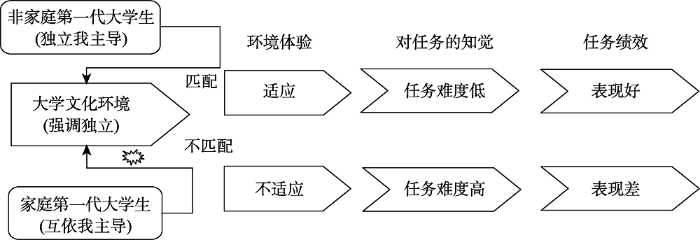
诚如上所述, 当代大学文化规范应该与非家庭第一代大学生的“独立我”为主的自我模式更为匹配。文化不匹配理论从这个角度出发, 为解释家庭第一代大学生在大学中面对的心理行为挑战提出了新视角(Stephens et al., 2011; Stephens et al., 2014)。相关领域的研究者认为, 个体在进入大学后, 大学文化规范与其已有的自我模式之间的交互作用会持续影响大学生的感觉、思维和行为。在这种背景下, 非家庭第一代大学生的自我模式与大学文化特征形成文化匹配。文化特征和自我模式需求的匹配会进一步帮助非家庭第一代大学生对环境体验的适应以及对任务难度作出更加积极的知觉和判断, 最终在任务表现中处于有利地位。与非家庭第一代大学生相对比, 家庭第一代大学生则在大学教育中面临更多的文化壁垒(Covarrubias & Fryberg, 2015)。家庭第一代大学生的“互依我”为主的自我模式与大学文化所鼓励的以“独立”为代表的文化特征产生文化不匹配。文化特征和自我模式需求的不匹配会持续阻碍家庭第一代大学生心理和社会功能的健康发展(朱新卓, 王欧, 2014; Stephens, Townsend, et al., 2012) (见图1)。总之, 两种自我模式与高等教育中所倡导的文化规范存在文化匹配与不匹配的交互模式。在这两种交互模式的基础上学生自我与学校环境之间便产生了适应或不适应两种状态。这就可以很好地解释了为何家庭第一代大学生在大学教育中会面对更多的心理挑战。
图1
2.3 文化不匹配效应的持续时间
文化不匹配理论从早期经历以及社会奖励塑造的自我与环境特征之间的关系模式出发, 对个体的适应性和行为进行了解释。该理论强调了不同社会阶层所关注的文化自我模式与环境特征的关系, 并认为自我模式需求与文化特征是否匹配是造成大学生学业成就和主观幸福感社会阶层差异的一个重要原因。以往大量研究都认可了文化不匹配对家庭第一代大学生心理行为特征的消极影响。然而, 对于文化不匹配是否随着时间的推移持续影响家庭第一代大学生主观适应这一问题上, 不同的学者之间还存在着明显的分歧。
一种观点认为家庭第一代大学生在刚入校时会产生不适, 但现有大学教育环境能够促进其主观适应感的提高以及文化自我模式的转变。具体地说, 持变化观的研究者认为, 在大学4年中, 家庭第一代大学生主导的文化自我模式会从互依型转变为独立型。家庭第一代大学生可以通过有效的策略来克服最初的文化不匹配, 并逐渐发展主观适应性(Morphew & Hartley, 2006)。积极的社会化是促进家庭第一代大学生提高主观适应性的一个有效途径(Sam & Berry, 2010)。事实上, 大学提供了一个“强大的环境”, 可以进行密集的社会化活动和文化适应行为(Saks et al., 2007)。大学生可以完全沉浸在新环境中, 并通过课堂、宿舍生活以及实践活动进行文化互动(Fryberg & Markus, 2007), 推进社会化, 实现自我模式的转变。通过与新的大学环境的持续接触, 家庭第一代大学生可能会经历从互依型自我向独立型自我的转变。综上, 变化观认为家庭第一代大学生早期的文化不匹配所带来的负面影响会随着时间逐渐减弱, 主观适应感逐渐提高, 并最终获得更好的学业成绩和社会成果。
另一种观点则相信即使经历4年大学生活, 家庭第一代大学生也无法较好地适应大学的文化环境, 最初的文化自我模式也不会发生转变。具体地说, 持不变观的研究者则认为早期的文化不匹配会阻碍家庭第一代大学生文化自我模式的改变(Phillips et al., 2020)。也就是说, 家庭第一代大学生会一直保持着其进入大学时已有的互依型自我模式。持有这样观点的研究者相信尽管随着时间的发展家庭第一代大学生对大学文化规范越来越熟悉, 但是熟悉性的增加并不能有效地促进适应性的积极发展, 有效的社会支持对于主观适应性的发展更加重要(Edwards, 2008)。研究发现, 家庭第一代大学生进入大学后很容易就会发现大学校园优先考虑独立文化规范, 并不会根据互依型自我模式提供其所需的有效的社会支持。在缺乏有效社会支持的情况下, 熟悉性的增加难以促进家庭第一代大学生文化自我模式的转变(Gelfand & Harrington, 2015)。同时, 在进入新环境后, 家庭第一代大学生也会很快意识到大学校园是以独立的标准来组织各类社会化活动。这种情境将会加深家庭第一代大学生对自我模式和文化规范不匹配的感知, 最终导致大学组织的密集的社会化活动并不能像预期的那样帮助大学生转变不利的文化自我模式(Batruch et al., 2019)。因此, 互依型自我模式的学生并不能在大学中完成自我模式的变化。初期的文化不匹配带来的负面影响会一直持续到毕业, 并加大家庭第一代大学生与其他高社会阶层个体之间的差距。
为了进一步检验上述两种观点, Phillips等人(2020)对刚入学的大学生进行了为期4年的追踪研究。结果表明, 在自我方面, 家庭第一代大学生在大学毕业时仍以互依型自我为主, 非家庭第一代大学生以独立型自我为主; 在适应性方面, 家庭第一代大学生的主观适应感停滞不前, 而非家庭第一代大学生的主观适应感随时间的推移逐渐增强。此外, Tibbetts等人(2016)的研究发现即使在大学学习了4年后, 家庭第一代大学生也没有对大学建立起有效的归属感。基于以上研究证据不难发现, 在没有任何干预的情况下, 家庭第一代大学生的自我模式很难随着时间的推移而逐渐发生改变。家庭第一代大学生自我模式与大学校园文化规范的匹配程度也难以在4年的时间内得到显著提高(Pratt et al., 2019)。也就是说, 家庭第一代大学生自我模式与大学文化规范的不匹配会一直存在, 并在整个大学阶段都会持续发挥作用。
3 文化不匹配的作用机制
在相关领域的研究中, 标准幸福感模型(Normative Well-being Model)和关键文化财富模型(Critical Cultural Wealth Model)对于我们系统地理解文化不匹配对家庭第一代大学生产生效应的机制及其相关的边界条件具有重要的理论价值。标准幸福感模型认为压力事件下幸福感的发展受社会认知因素和文化因素的影响。当追求的目标在文化环境中受到重视时, 个体将积极参与追求既定目标(Lent et al., 2004)。基于该模型的研究认为对目标任务的参与、结果的预期以及相关环境中获取的社会支持是文化不匹配对个体产生影响的重要机制(Garriott et al., 2015; Garriott et al., 2018)。
学校-家庭冲突指大学的独立的文化规范和家庭的相互依存的文化需求之间的冲突(Garriott et al., 2020)。在高等教育背景下, 学校普遍以学业成绩为前提, 重视学生独立性的发展, 期望学生能够为个人成长付出更多的时间。而来自较低社会阶层背景且由互依我主导的学生通常需要承担更多的家庭义务。研究表明, 低社会阶层背景的学生受互依型文化规范的影响, 更愿意在帮助家庭成员、参与家庭决策中花费更多的时间(Vasquez-Salgado et al., 2015)。并且, 对于来自低社会阶层的家庭第一代大学生来说, 由于所处社会阶层的不符合大学独立标准的价值观、文化规范和实践经验, 离开家庭进入大学环境会成为其明显的压力事件。离开家庭环境使家庭第一代大学生花时间和家人相处、履行家庭义务、帮助家人完成任务变得更加困难。在以往文献中, 学者们普遍认为低水平家庭支持和高水平的家庭成就内疚感是学校-家庭冲突的主要表现。
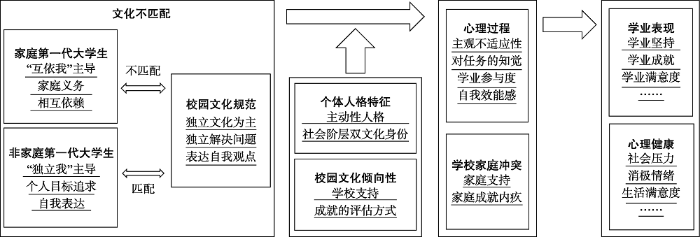
基于以上论述, 对目标任务的参与、结果的预期、相应环境下的社会支持、以及与家庭相关的某些变量是文化不匹配对家庭第一代大学生心理行为效应的重要机制。与此相对应, 相关领域的研究者则主要关注了学业参与度、对任务难度的知觉、自我效能感、主观不适应、感知到的家庭支持和家庭成就内疚感等变量在文化不匹配效应中的中介作用。此外, 基于个人特质和校园文化倾向与文化不匹配相互影响的观点, 现有的研究文献则探讨了主动性人格、社会阶层双文化身份、学校支持和成就的评估方式等变量对文化不匹配效应的调节作用。图2可以清楚系统地呈现文化不匹配对家庭第一代大学生心理行为效应的中介变量(中介机制)及其相关的边界条件变量(调节机制)。
图2
3.1 文化不匹配效应的中介机制
3.1.1 主观不适应性
主观不适应性是文化不匹配对学业成绩产生负面效应的一个重要中介机制变量。主观不适应性指个体在特定组织环境中产生的不适的主观体验(Edwards et al., 2006; Schmader & Sedikides, 2018)。文化不匹配理论认为, 自我模式与文化规范的不匹配会增加家庭第一代大学生的主观不适感。Phillips等人(2020)通过对入学动机的测量来评估大学生的文化自我模式。结果与文化不匹配理论一致, 即家庭第一代大学生的依赖动机更强, 对应的自我模式以“互依我”为主; 非家庭第一代大学生的独立动机更强, 自我模式以“独立我”为主。同时, 研究结果进一步发现, 在大学环境中, 以“互依我”为主的家庭第一代大学生的主观适应感显著低于“独立我”为主的非家庭第一代大学生。总之, 自我模式与学校文化规范之间的匹配程度决定了学生的主观适应感。匹配程度低的学生主观上会怀疑自己是否适合大学环境。这种怀疑所造成的不确定感会使学生对其所属社会阶层的自我意识增强, 从而更难做出适应新环境的改变(Harackiewicz et al., 2014)。同时, 主观不适应还会进一步影响家庭第一代大学生在大学期间的学业表现。较低的主观适应感也会导致学生在面对困难时作出更多的内归因, 认为表现不佳的原因是自己不适合这项任务或者自己不够聪明。由此可见, 文化不匹配所导致的主观不适应会让学生经历更多的社会压力和学业困难(Johnson et al., 2011)。因此, 主观不适应感是文化不匹配对家庭第一代大学生产生消极影响的一个重要的中介机制变量。
3.1.2 任务难度的知觉
由于文化规范与自我模式需求不匹配, 家庭第一代大学生更容易高估其在大学校园中从事的相关任务的难度。不当的任务难度知觉会降低家庭第一代大学生的任务表现。文化不匹配理论强调了不同社会阶层背景的学生对学术任务难度的认知在学业成绩中的中介作用(Dittmann & Stephens, 2017; Stephens et al., 2014)。由于认为大学主流文化规范与自身主导的文化自我不一致, 家庭第一代大学生会对自己应对大学生活和学习的能力产生怀疑。这种不确定性会使家庭第一代大学生对自我能力产生消极认知, 进而影响家庭第一代大学生的学业表现(Atherton, 2014; Wright et al., 2013)。已有研究发现, 文化不匹配会通过增加家庭第一代大学生知觉到的任务难度进而影响其在相关领域的任务表现。Stephens, Fryberg等人(2012)曾通过两封截然不同的大学欢迎信(强调独立或互相依赖)来操纵大学新生首次接触到的大学文化, 以此创设了文化匹配或不匹配两种情境。结果发现与强调依赖文化的实验情境相比, 在强调独立文化的实验情境中, 家庭第一代大学生更容易将各类实验任务定义为难以完成的困难任务。也就是说, 文化不匹配会通过家庭第一代大学生对任务难度的知觉影响其任务表现。
3.1.3 学业参与度
文化不匹配还可能通过学业参与度对家庭第一代大学生的心理行为表现产生影响。作为衡量大学生投入各类学业活动程度的重要指标, 学业参与度的水平可以显著地预测大学生的学业成就。Krista等人(2012)通过问卷法调查了大学生在大学第一年参与各类学业活动的频率和卷入程度。研究结果表明, 在各类学业活动中, 家庭第一代大学生的学业参与度均显著低于非家庭第一代大学生。此外, 蒋承等人(2015)发现父母的受教育程度通过学业参与度影响大学生的学业表现。也就是说, 除了大众熟知的父母受教育程度会对大学生的学业表现有着直接影响外, 父母受教育程度还会通过学业参与度的中介作用对大学生的学业表现产生间接影响。这些研究表明, 家庭第一代大学生的较低的学业参与度很可能是其面临学业挑战的一个重要原因。同时, 学业参与的水平与不同社会阶层背景所拥有的文化资本是密不可分。研究者普遍认为, 非家庭第一代大学生因父母接受过高等教育, 能够从父母的亲身经历中认识到学业参与的重要性。这些间接经历就成为非家庭第一代大学生额外的与大学环境相关的文化资本。然而, 对于家庭第一代大学生来说, 这类文化资本的缺乏将影响其学业信心, 从而在学业活动中产生回避行为(Jack, 2016; Jenkins et al., 2009; Yee, 2016)。很明显, 学业活动的参与不足与大学文化中所强调的“自我表达”、“独立”等规范是相悖的, 这也造成了家庭第一代大学生因学业参与程度较低而在学业上表现出显著不足。
3.1.4 自我效能感
文化不匹配可以影响社会阶层背景不同的大学生的自我效能感, 进而对其发展结果产生影响。自我效能感是指个体对自身是否有能力完成特定目标的信念(Bandura, 2004; Skaalvik & Skaalvik; 2017)。邹璐等人(2014)对自我模式与自我效能感之间的关系进行了系统地探究。他们的研究发现以“独立我”为主的个体重视个人目标的实现, 并愿意付出不懈的努力直至目标的达成。在这一过程中, 随着既定目标的实现, 自我效能感将得到极大提升。相反, 以“互依我”为主的个体往往独立动机不强, 对成就的需求不高, 付出努力的程度较小, 因而自我效能感难以获得提升。Ramos-Sánchez和Nichols (2007)的研究也发现, 以“互依我”为主的家庭第一代大学生的自我效能感显著低于以“独立我”为主的非家庭第一代大学生。这种差距在为期一年的追踪中一直存在。这也表明, 拥有较强独立动机的非家庭第一代大学生在重视独立规范的大学环境中自我效能感能够得到较快的提升, 而家庭第一代大学生的自我效能感则停滞不前(Ramos-Sánchez & Nichols, 2007)。并且, 作为影响学业表现的重要因素, 自我效能感的积极发展有利于大学生学业表现的提高(Vuong et al., 2010)。基于以上研究证据, 家庭第一代大学生自我效能感发展的停滞将阻碍其在大学学习中的学业表现。也就是说, 在高等教育环境下, 自我模式的不同会影响大学生自我效能感的发展, 这就成为了家庭第一代大学生学业表现不足的又一个重要原因。
3.1.5 家庭支持
在现有文献中, 大学生从家庭中获得的支持主要包括信息支持和情感支持两个方面。在信息支持方面, 非家庭第一代大学生的父母中至少一方拥有高等教育经历。因此, 非家庭第一代大学生的家庭能够提供更多有关大学的信息支持(如课程建议、职业规划帮助)。而家庭第一代大学生的父母则无法依据自身经验为孩子提供适时的信息支持, 这就造成了家庭第一代大学生在大学过渡阶段面临更多的困难。研究指出, 家庭第一代大学生普遍认为家庭提供的信息支持显著低于非家庭第一代大学生(Harper et al., 2020)。低水平的家庭信息支持会使家庭第一代大学生感知到的压力水平增加(Wang & Castañeda-Sound, 2008)。
在情感支持方面, Sy等人(2011)研究发现, 家庭第一代大学生感知到的家庭情感支持水平也显著低于非家庭第一代大学生。并且, 缺乏家庭情感支持的学生在大学的适应能力更低(Dennis et al., 2005)。除此之外, 与非家庭第一代大学生相比, 家庭第一代大学生在进入大学后需要承担更多的家庭义务(Pascarella et al., 2004; Vasquez-Salgado et al., 2015)。这就造成了家庭第一代大学生在缺乏有效家庭支持应对文化转变的同时还需根据原有文化规范履行家庭义务。这无疑进一步减少了家庭第一代大学生追求个人目标和学业成就的时间, 加重了学校-家庭冲突, 削弱了他们的适应能力。总之, 经历文化不匹配的家庭第一代大学生因来自家庭的信息支持和情感支持不足而面临更多的适应困难。
3.1.6 家庭成就内疚感
家庭成就内疚感(Family Achievement Guilt)是家庭第一代大学生因离开家庭进入高等教育, 开始拥有父母未曾得到的机会而产生的一种消极情感(Covarrubias et al., 2014)。当家庭第一代大学生产生家庭成就内疚感后, 他们将为缩小自身所取得的成就与家庭原有成就之间的差距而选择降低自身在高等教育中的学业表现。并且, 随着家庭成就内疚的增长, 家庭第一代大学生感受到的挣扎水平增加, 心理健康水平显著下降, 抑郁症状显著上升(Covarrubias & Fryberg, 2015)。后续对家庭成就内疚和负面情绪的研究也发现, 相比于非家庭第一代大学生, 家庭第一代大学生的家庭内疚水平更高, 感受到的沮丧、恐惧、紧张、羞愧等负面情绪也更多。也就是说, 因自我模式与大学文化环境的不匹配, 家庭第一代大学生感受到了更多的家庭成就内疚, 这种内疚感还进一步影响了其在学业上的表现以及心理适应水平(Covarrubias et al., 2020)。然而, 与家庭第一代大学生不同, 文化不匹配理论认为由于接受高等教育经历与文化自我模式相契合, 来自较高社会阶层的非家庭第一代大学生可以把更多的精力用于追求个人目标, 感到的家庭成就内疚感也相应较少。
3.2 文化不匹配效应的调节机制
3.2.1 主动性人格
虽然家庭第一代大学生在经历文化不匹配后整体表现出心理适应水平低, 学业参与不足, 自我效能感发展停滞等问题, 但仍旧存在部分家庭第一代大学生能够较好的适应大学生活(Demetriou et al., 2017)。已有研究发现, 在进入大学环境后, 大学新生的主动行为对第一年平均绩点的提高有显著影响(Wang et al., 2013)。大学生在新环境中表现出的主动行为与个体本身具有的主动性人格密不可分。作为一种相对稳定的个体特质, 主动性人格对个体在新环境中的适应水平、学业自我效能感以及社会化均会产生积极的影响(毛凯贤, 李超平, 2018; Lin et al., 2014; Yu & Davis, 2016)。在遭遇情境阻碍时, 具有主动性人格的个体会积极采取行动来改变现状, 并表现出足够的坚持性, 直至达到预期的结果(Bateman & Crant, 1993)。因此, 对于在大学环境中处于相对劣势的家庭第一代大学生来说, 主动性人格可能会调节文化不匹配对家庭第一代大学生发展的影响。在面对因文化不匹配产生的心理行为挑战时, 主动性人格倾向强的家庭第一代大学生更可能积极采取行动, 缩小与非家庭第一代大学生在适应性和学业表现中的差距。Hu等人(2020)的研究也发现, 在经历文化不适应的大学生中, 主动性人格对学业和社会适应有正向的预测作用。具体而言, 当文化环境发生变化时, 具有典型主动性人格的大学生会积极应对挑战, 在探索中适应或改变外部环境, 从而激发自身潜能、实现既定目标。但主动性人格倾向弱的家庭第一代大学生在文化不匹配情境下则较为被动, 更可能消极地接受现有环境, 难以实现适应水平的提升及学业表现的提高。
3.2.2 社会阶层双文化身份
根据文化不匹配理论, 家庭第一代大学生具有着“大学生” (中产阶层)和“低社会阶层成员”的双层身份。为更好应对文化不匹配的各种挑战, 家庭第一代大学生需要整合自身中产阶层身份(大学生)和较低社会阶层身份(家庭成员) (Nguyen & Benet-Martínez, 2007)。以往研究表明, 整合身份与社会适应有关:顺利整合多种身份的个体社会文化适应能力更强, 在学业成就、工作能力和人际交往中具有明显优势(Nguyen & Benet-Martínez, 2013)。也就是说, 家庭第一代大学生面对的文化不匹配对于其自身发展既是挑战也是机遇。Herrmann和Varnum (2018)对家庭第一代大学生和非家庭第一代大学生的社会阶层文化认同情况进行系统的研究。结果发现, 在较低阶层文化方面, 家庭第一代大学生的认同程度明显高于非家庭第一代大学生; 在中产阶层文化方面, 两者之间不存在显著差异。也即是说, 相较于非家庭第一代大学生, 家庭第一代大学生更可能拥有社会阶层双文化身份。社会阶层双文化身份整合程度高的家庭第一代大学生在大学环境中的活动参与度、生活满意度和学业水平均显著提高。并且, 社会阶层双文化身份整合可以有效降低文化适应压力, 进而提高心理健康水平(Herrmann & Varnum, 2018)。总之, 社会阶层双文化身份整合的水平能有效调节文化不匹配对家庭第一代大学生的心理行为效应。
3.2.3 学校支持
学校支持会对家庭第一代大学生和非家庭第一代大学生产生不同影响。学校支持是指大学针对大学生在人员、环境、资源上提供的支持(Torsheim & Wold, 2001)。一般来说, 非家庭第一代大学生从自身所属的社会阶层中可以获得足够的文化资本(Duffy et al., 2020)。同时, 非家庭第一代大学生从自身阶层所获得的文化资本与高等教育中所具有的文化规范是一致的。已有研究表明, 受所继承文化资本的影响, 非家庭第一代大学生在学业准备上存在显著优势, 并在学业活动中更重视与助教、导师间的交流和沟通。在强调参与、表达的大学环境中, 这些互动有利于非家庭第一代大学生取得更高的学业成就(Atherton, 2014; Yee, 2016)。因此, 非家庭第一代大学生对于学校支持的依赖性较弱, 对于依靠学校支持来缓解学校经历中压力事件的需求也随之减少。相对应, 家庭第一代大学生因其所处的社会阶层难以获得与高等教育相关的文化资本, 学校支持对于他们的学业成就以及主观幸福感水平就显得尤为重要(Jenkins et al., 2013)。Garriott等人(2018)的研究也发现, 相较于非家庭第一代大学生, 家庭第一代大学生的压力感知更多地受到学校支持的影响。具体而言, 学校支持的提升能够显著降低家庭第一代大学生知觉到的压力, 但并未对非家庭第一代大学生的压力知觉产生显著影响。总之, 因缺乏与学校相关的文化资本, 学校支持对家庭第一代大学生应对文化不匹配造成的心理行为挑战更为重要。
3.2.4 成就评估方式
文化不匹配对家庭第一代大学生的心理行为效应还受到成就评估方式影响。现行高等教育中, 在对大学生学业成就进行评价时多采用单独评估的方式。这种评价方式究其本质是对学生独立思考、独立解决问题的能力进行考察, 是与大学所倡导的独立文化规范相一致的。然而, 由于家庭第一代大学生的文化自我模式由“互依我”主导, 上述大学现行的评价方式也成为了家庭第一代大学生在成就评估上一个难以逾越的文化壁垒。基于这种观点, Dittmann等人(2020)认为应该丰富成就评估方式, 将对集体成果的评估也纳入到现有的成就评估体系之中。以往有研究者采用个人任务表现评估、小组任务结果评估、同组成员评估以及有效小组加工等指标, 比较了不同社会阶层背景学生在个人任务成就和共同任务成就上的差异。研究结果发现, 当采用单独评估的方式对任务成绩进行评判时, 非家庭第一代大学生的表现要好于家庭第一代大学生。而当采用共同工作成就作为评估标准时, 家庭第一代大学生比例高的团队有明显的优势(Hildreth & Anderson, 2016; Huang et al., 2017)。由此可以看出, 共同工作成就的评估方式可以很好地匹配家庭第一代大学生的自我模式, 进而促进了家庭第一代大学生的任务表现水平。在共同工作成就评估下, 家庭第一代大学生可以感受到自我模式与大学文化规范需求的一致性, 感受到高等教育对“互依我”的重视, 从而达到潜能的激发(Townsend et al., 2021)。也就是说, 大学任务表现的评估方式可以调节文化不匹配的消极效应。通过丰富成就评估方式, 可以进一步地激发家庭第一代大学生的学业能力和学业潜力。
4 基于文化不匹配理论的干预
根据文化不匹配理论, 家庭第一代大学生经历较多心理行为挑战的根本原因是其成长环境文化与大学文化规范的不同所导致的适应问题及其相关的并发障碍。应对文化不匹配消极效应的一个有效途径就是从家庭第一代大学生所属的社会阶层中寻找有益的心理资源, 帮助他们应对在校园文化中的不利因素。因此, 研究者们尝试通过各种心理行为技术促使家庭第一代大学生挖掘出自身社会阶层文化中可利用的有效资源, 减少他们由于文化不匹配造成的心理挑战。在以往文献中, 研究者们基于文化不匹配理论开发了价值观肯定(Values Affirmation)和差异教育(Difference Education)两种干预策略, 通过提升社会支持、促进社会化来提高家庭第一代大学生的大学适应与学业成就。
4.1 价值观肯定策略
价值观肯定策略是通过肯定个人核心价值观提高个体自我完整性和自我价值感知的一种干预策略。高水平的自我完整性和自我价值感有助于缓解压力, 并可以提高个体应对新环境中挑战的能力(McQueen & Klein, 2006; Cohen & Sherman, 2014)。以往研究表明, 这种干预方式有效地促进了在评价环境中经历身份威胁群体的学习成绩(Sherman et al., 2013), 缩小了大学生在入门级物理课程成绩的性别差距(Miyake et al., 2010), 以及显著地提高了出身于低社会阶层的生物专业大学生的学业成就(Harackiewicz et al., 2014)。基于价值观肯定策略在以往相关领域研究中的良好表现, 研究者们也尝试将该策略运用到了消除文化不匹配对家庭第一代大学生消极效应的干预实践中。在以往研究基础上, 针对家庭第一代大学生这一特殊人群, 研究者们又进一步设计了两种略有差异的价值观肯定策略。
4.1.1 效用价值干预策略
效用价值干预(Utility Value Intervention)是以Eccles的期望价值模型为基础而开发设计的(Eccles et al., 1983)。根据期望价值理论, 学生在学校环境中的不适感多源于未能对所学知识的价值有着清晰的认知(Hulleman et al., 2017; Klebanov et al., 2017)。基于这种假设, 效用价值干预鼓励实践者可以将学校开设的课程内容与学习者积极动机进行有效联结, 让学习者发现所学知识对于自身的价值(Rosenzweig et al., 2018)。在所学知识价值被凸显的情境中, 环境中其他因素的效应会随之淡化。在这种条件下, 环境带给学习者的不适感会显著降低, 自我价值感得到确认和肯定。另一方面, Harackiewicz等人(2016)的研究显示家庭第一代大学生群体拥有一个独特的动机特征, 即能够应用自己所掌握的知识和技能帮助他人, 回馈社会。即使处于对环境高度不适的状态下, 家庭第一代大学生的这种动机依然强烈。结合效用价值理论的假设和家庭第一代大学生的动机特征, 研究者通过课程论文的形式将家庭第一代大学生的上述动机与其所学知识联系起来, 设计了一套消除文化不匹配消极效应的干预方案。在干预实践中, 干预者通过电子邮件的形式将课程作业发送给学生, 要求学生将学习过的课程内容与实际生活相联系, 并举例解释这些学习过的内容如何对生活和生产实践产生帮助。通过4个学期的干预, 研究者发现, 不同社会阶层背景学生的学习成绩均有提高。值得肯定的是, 在接受这一干预后, 家庭第一代大学生受益更多, 显著地缩小了与其他高社会阶层背景学生的学业成绩的差距(Harackiewicz et al., 2016)。
4.1.2 对家庭第一代大学生独立动机的训练与强化
在价值观肯定策略中, 研究者通过写作任务的形式对面临挑战的各类群体进行干预。研究者提供应对挑战所需的价值观, 接受干预的群体结合研究者提供的价值观进行写作。通过写作任务, 接受干预的群体对面临挑战所需且自己本身具有的价值观进行反思, 从而提高自身的应对能力(Jordt et al., 2017; Rapa et al., 2020)。在回顾文化不匹配理论的基本观点后, 研究者们认为独立动机是帮助家庭第一代大学生应对各种挑战的核心价值观。独立动机的增强将缩小家庭第一代大学生与高等教育文化环境间不匹配的程度, 从而提高该群体的学业表现。Tibbetts等人(2016)将包含独立动机和中立观点的价值观集合呈现给大学生, 让其分析这些观点在高等教育中对个人发展的重要性。很明显, 这种干预方式在避免家庭第一代大学生猜到干预目的的同时达到了对独立价值观的强调。虽然这种干预训练强化的动机类型与家庭第一代大学生的主导自我模式的类型并不一致, 但其通过对独立动机的强调, 在不改变参与者自身主导文化自我模式的基础上, 使家庭第一代大学生感受到自身属性与大学文化规范更多的相似性。也正是因为如此, 接受这一训练的家庭第一代大学生更容易认为自己是符合高等教育中强调的独立文化要求的。相应地, 家庭第一代大学生的学业归属感增强, 主观不适感减少, 参与活动的积极性增加, 学术表现水平显著提高(Brannon et al., 2015; Tibbetts et al., 2016)。
4.2 差异教育干预策略
另一种成功提高家庭第一代大学生心理行为表现的干预策略是差异教育干预。差异教育干预策略强调大学生的不同社会阶层背景都有着各自的优势, 在正确认识并发挥相关优势的基础上都有着能够成功适应大学环境的潜力(Stephens, Brannon, et al., 2015)。基于此观点, 研究者们也设计了能够成功激发这些潜力的心理行为策略(Townsend et al., 2019)。在差异教育干预中, 干预实施者通常会引导家庭第一代大学生了解不同社会阶层背景的差异以及相关差异属性对社会发展和进步的重要意义。这样的操作通常可以帮助家庭第一代大学生确认自己所属社会阶层的不可替代性, 增强自我价值感, 获得有效适应大学文化和提高学业成绩所需要的心理资源(Townsend et al., 2021)。具体来说, 差异教育干预一般以新生入学前旁听老生针对如何应对大学生活中常见的适应性问题而开展讨论的形式进行。讨论组的成员由社会阶层背景不同的高年级学生组成。在讨论过程中, 主持人根据事先准备好的问题进行提问, 有相关经验的老生随机回答。讨论的问题涉及大学生活中可能经常遇到的各种各样的挑战性问题。不同社会阶层背景的高年级学生在回答问题时往往将自己的经历与其社会阶层背景文化属性结合起来, 为即将入学的新生提供基于自身社会阶层背景文化属性的、特异性的问题解决策略。这种干预策略可以帮助不同社会阶层背景的学生理解其各自的特殊大学经历, 增加主观适应性, 提高问题解决和应对的能力, 最终达到对新的大学环境的适应(Stephens et al., 2014)。
差异教育干预策略在家庭第一代大学生应对文化不匹配效应的研究中也得到了一定的应用。如Stephens等人(2014)利用高年级不同社会阶层背景大学生在校园中遭遇的独特经历对新生进行了一小时的差异教育干预。在干预过程中, 主持人每次提出问题后都分别邀请不同社会阶层背景的高年级学生进行回答。老生在自己真实经历的基础上结合自身社会阶层背景对主持人事先准备好的问题进行回答。旁听会议的新生在会议结束后需要完成一份与会议内容有关的简短调查。研究的结果表明, 参与过干预的家庭第一代大学生和非家庭第一代大学生在第一学年结束时所取得的学业差异比没有参与干预前减少了63%; 同时, 家庭第一代大学生在心理适应性以及学术参与、社会参与等方面都得到了明显的改善。通过对相关领域研究结果的总结, Stephens等人发现与其他缩小社会成就差异的干预措施不同, 差异教育干预不仅能够改善家庭第一代大学生的心理适应状态和学业成就, 也可以通过强调不同社会阶层背景个体之间的差异来改善非家庭第一代大学生的社会成就(Stephens, Townsend, et al., 2015; Stephens et al., 2018)。总之, 差异教育干预策略以一种支持性、建设性的方式使家庭第一代大学生了解自身阶层背景的独特性, 使其在面对挑战时可以借鉴有着相似背景的高年级学生的应对经验, 从而实现对大学环境的适应。
5 总评和展望
文化不匹配理论强调环境中的特定文化属性与个体的文化自我模式之间存在着匹配与不匹配两种关系。大学提倡的文化规范与自我模式的匹配与否是不同社会阶层背景出身学生在适应和学业表现上存在差距的一个重要的原因。文化不匹配理论可以解释家庭第一代大学生这一特定群体在高等教育中的心理行为表现上面临更多挑战的原因, 并对改善家庭第一代大学生的学校经历提供了新的理论支持。也就是说, 文化不匹配理论对促进大学生全面发展、缩小社会阶层的成就差异、提高现行高等教育的公平性等方面具有重要的理论意义和实践价值。尽管现有文献对文化不匹配理论及其应用的领域已经有了较为系统、深入的论述, 但不可否认的是, 该理论本身还是存在着一定的局限(如过于宏观, 对具体的心理行为特征的效应受到复杂的无关变量的干扰), 仍然无法完全满足教育实践中一些重大问题解决的需求。因此, 相关领域的研究还存在着广阔的拓展空间和发展潜力。未来研究者除了需要继续完善文化不匹配理论本身外, 也可以在以下领域继续展开进一步的探索, 为更全面地理解家庭第一代大学生的心理特征及其成因、促进家庭第一代大学生的全面适应提供切实有效的理论基础。
5.1 人格因素的角色
现有研究主要关注了自我模式和文化规范需求之间匹配程度对家庭第一代大学生学校适应的影响, 即从社会文化视角对家庭第一代大学生在大学校园中要面对心理行为挑战的原因进行了解析。此外, Stephens团队在提出文化不匹配理论后, 越来越多的研究者也在不断地探讨有效的干预方法来缩小不同社会阶层背景的大学生心理行为表现的差距。然而, 该领域的研究却忽视了个体人格特征对文化不匹配效应本身的影响, 也忽视了个体人格特征与文化不匹配两者的交互作用对家庭第一代大学生心理行为表现的效应。尤其是特质性的动机在大学生的适应过程中往往能够扮演着比较重要的角色, 其对文化不匹配效应的影响值得研究者的进一步关注。在阶层间视角下, 不同阶层的社会经历塑造了不同群体大学生的思维过程、目标设定倾向和应对方式(Stephens et al., 2018; Townsend et al., 2019)。有研究者提出了“先赋性动力”的概念, 即个体因其自身的阶层处境而自然生发的向上拼搏的动力。这种动力可以解释为何一部分来自较低社会阶层背景的学生在进入高等教育前的学习中能够取得一定的超出预期的成就, 并顺利适应高等教育过程的现象(程猛, 康永久, 2016)。研究者认为勤奋、坚韧、懂事是低社会阶层背景所具有的独特优势, 能使学生在客观社会资本存在劣势时发挥出自然的、向上的动力(程猛, 康永久, 2018; 张聪聪, 朱新卓, 2018; 曾东霞, 2019)。但并没有实证研究系统地揭示这种动力在学生进入大学后, 如何持续以及能够在多大程度上缓和由文化不匹配造成的学业挑战。动机如此, 其他人格特征亦然。众所周知, 由于所处的原生家庭环境、生活区域的经济发展水平等方面往往存在着显著差异, 即使出身于同一社会阶层背景的学生也存在着迥然不同的人格特征。因此, 未来研究应重视检验家庭第一代大学生群体本身的异质性, 并尝试揭示该群体在参与、应对与心理韧性等人格特征方面存在的差异及其对文化不匹配效应的调节作用。
5.2 教育多元化
探讨教育环境对不同社会阶层成就的不同影响是推进教育在不同社会阶层流动的一个重要步骤。根据文化不匹配理论, 在大学校园中尝试多元化的培养理念或者多元化的文化规范, 可以减少不同社会阶层背景大学生自我模式与大学文化不匹配的程度或几率, 也能够缩小不同社会阶层背景大学生之间社会成就的差距, 并最终实现高等教育情境中的教育平等。具体来说, 高等教育的多元化可以体现在对大学生自我模式的多元化塑造和对高校文化环境多元化的倡导。
5.2.1 自我模式多元化的塑造
在已有文献中, “独立我”与“互依我”两种文化自我模式是应对心理挑战的重要心理资源和心理工具。相当多的研究者都倾向于关注特定群体某一自我模式特征而忽略另一种。事实上, 两者并非是文化自我模式单个维度的两个极端, 而是两个不同的维度。“独立我”和“互依我”并非是“非此即彼”的相互排斥的两种属性, 而是可以“互生共荣”地同时存在于在同一个体身上。因此, 未来的研究可以从自我模式多维发展的角度来提高家庭第一代大学生的心理适应感。也即是说, 为提高家庭第一代大学生在不同文化情境中的适应能力, 在教育实践中, 可以尝试培育多元化自我, 使家庭第一代大学生的自我模式从以“互依我”为主转变为以“独立我”为主, 或“互依我”与“独立我”的“双高”, 甚至是无我状态(魏新东, 汪凤炎, 2020)。研究表明, 拥有多种自我的个体, 可以在特定情境中恰当地调整和运用合适的自我模式及其相对应的行为方式, 并在此基础上对社会阶层差异带来的资源上的不对等采取情境式的解释, 提高社会适应能力, 改变自己的不利处境(Townsend et al., 2019)。因此, 未来研究可以通过尝试多元化自我的塑造来消除家庭第一代大学生文化不匹配的消极效应。
5.2.2 高校文化环境多元化的倡导
在改善文化不匹配与家庭第一代大学生关系的研究领域, 高校文化环境应该发挥更加重要的功能。为降低或者消除家庭第一代大学生进入大学校园后的不适应, 未来可以考虑从以下三方面对高校文化进行改善。首先, 创设更具包容性的大学环境。文化不匹配理论强调了大学在文化规范的偏向性及其带来的消极影响。在大学校园中, 能够认识到家庭第一代大学生“互依我”为主的自我模式并据此设计相应的文化规范对于缩小不同社会阶层学业表现差距具有重要的实践价值。实证研究的结果为这一设想的可行性提供了依据。正如上面的研究结果所示, 在学业任务中, 仅通过校长欢迎信(强调互依型文化规范)的变化就能影响家庭第一代大学生对文化匹配程度的感知, 提高任务表现(Stephens, Fryberg, et al., 2012)。依据该研究结果, 在未来大学校园文化管理中, 可以考虑在家庭第一代大学生入学前收到的新生手册中加入家庭责任、合作学习、人际互助等文化规范。其次, 强化大学教师教育。家庭第一代大学生在学习过程中所表现出来适应不良问题的解决不能仅依靠学生个人的力量。未来的大学教师教育活动中, 应使高校教师能够认识到造成家庭第一代大学生学习心理问题的原因, 并在此基础上对日常工作和教学方式进行调整。大学教师不能单一地强化学生独立解决问题的能力, 而是要同时参考学生完成团体任务时的表现, 使家庭第一代大学生拥有发挥自身文化优势的机会。同时, 校园活动组织者也可以鼓励来自较低社会阶层的大学教师积极通过正式或非正式的活动分享自身成功经验, 给家庭第一代大学生应对各项挑战提供间接的经验。最后, 学校可以通过各类实践活动为家庭第一代大学生创设实现自身价值的机会。例如, 大学可以借鉴“差异教育干预”和“效用价值干预”组织“走进高中”活动(Harackiewicz et al., 2016; Townsend et al., 2021)。在活动中, 可以让家庭第一代大学生向高中生分享知识和自身的成功的经历, 在为家庭第一代大学生提供实现自身价值机会的同时, 又可以帮助未来可能成为家庭第一代大学生的高中生先一步了解大学的多元文化, 避免在进入高等教育后陷入文化不匹配的困境。
5.3 我国家庭第一代大学生的特征
5.3.1 社会变迁下的自我发展
目前从文化不匹配角度解析家庭第一代大学生所面对的心理行为挑战的实证研究主要集中在受个人主义文化主导的西方高校中, 尚未有研究系统关注深受儒家文化和集体主义文化影响下的我国家庭第一代大学生的心理行为特征。尽管有人认为个人主义增强、集体主义衰弱是目前我国文化发展的趋势, 但针对我国国民的研究已表明, 作为中国几千年来社会变迁和世界文明演变的一部分, 文化变迁具有其复杂性, 传统文化中的集体主义价值观在一定程度上得到了很好的延续。多元文化共存已成为我国当前乃至以后相当时间内社会发展的显著特色。家庭第一代大学生的自我发展也会受到社会变迁下的历史、政治和政策等因素的影响(黄梓航 等, 2021)。随着我国从传统的、贫穷的、集体主义文化背景发展到现代的、富裕的、多元文化并存的社会, 作为文化承载的家庭是否在社会文化变迁过程中也出现了“互依我”向“独立我”的转变, 或者出现了“双高”的自我模式还有待相关研究的进一步确认。相应地, 在社会文化变迁的大背景下, 我国家庭第一代大学生的自我模式是否也会或业已向“互依我”与“独立我”双高的方向发展也需要未来研究的进一步探讨。已有研究表明, 虽然双重身份转变为从低社会阶层向高社会阶层流动的家庭第一代大学生带来适应压力, 但若能够有效整合这种跨阶层的双文化身份, 家庭第一代大学生将适应得更好, 取得好成绩(Herrmann & Varnum, 2018)。因此, 自我向“双高”发展的同时是否会导致跨阶层的双文化身份自动整合, 或者通过外部教育手段实现这种双文化身份整合将对提高我国家庭第一代大学生适应水平和减少家庭第一代大学生的心理行为挑战具有重大的理论意义和实践价值。
5.3.2 独特文化属性的作用
与西方相比, 我国文化中存在某些特定的思维模式。这些特定思维模式的存在可能会使我国家庭第一代大学生在经历文化不匹配时呈现更加复杂的特点。以往对家庭第一代大学生的国际横向比较的研究发现, 不同国家的家庭第一代大学生在韧性、足智多谋、大学适应上的表现具有独特的文化属性和文化特异性(Reed et al., 2019)。因此, 在采用北美研究者发现的文化不匹配理论探究家庭第一代大学生的心理挑战时需要考虑到我国文化的独特属性。在儒家文化影响下, “困而弥坚”与“乐知天命”的观念受到了中国人的认同和推崇, 这有助于家庭第一代大学生在面对文化壁垒时发挥其坚韧性。此外, 中庸思维作为一种在“自我”和“情境”中探求平衡的思维方式, 可以帮助个体追求自我和情境双重价值的最大化(彭文会, 黄希庭, 2015; 孙旭 等, 2014; 王轶楠, 2010)。在文化不匹配情境下, 中庸思维有助于家庭第一代大学生通过认知重评的方式缓解自我和环境之间的冲突, 重点关注文化困境对成长的价值, 采取更积极的应对方式。同时, 实证研究也发现, 中庸思维可以通过提升大学生心理弹性水平促进其自我适应、校园生活适应、学业适应等能力的发展(李启明, 陈志霞, 2016)。作为帮助个体在经历压力、困境后恢复正常的较为稳定的心理特质, 心理弹性水平的提升也有助于经历文化不匹配的家庭第一代大学生更好的适应校园生活。因此, 在探讨我国家庭第一代大学生的独特心理行为特点的同时, 也要努力揭示传统文化的独特属性在我国家庭第一代大学生校园适应中是否起到一定的保护作用或缓冲作用。
参考文献
半个多世纪来中国人的心理与行为变化--心理学视野下的研究
个人主义上升, 集体主义式微?--全球文化变迁与民众心理变化
中国社会转型过程中的心理变化:社会学视角的研究及其对心理学家的启示
The declining “equity” of American higher education
DOI:10.1353/rhe.2004.0001 URL [本文引用: 1]
Academic preparedness of first-generation college students: Different perspectives
DOI:10.1353/csd.2014.0081 URL [本文引用: 2]
Health promotion by social cognitive means
DOI:10.1177/1090198104263660 URL [本文引用: 1]
Differences in self-reported disclosure of college experiences by first-generation college student status
Disclosure of stressful life experiences is described here as a potential means of stress reduction and as a potential indicator of available support. This study compared reports of the disclosure of college experiences by college freshmen (N = 1,539). Using a student survey conducted at four universities across the country, disclosure by first-generation student status was compared. The targets of students' disclosure, including family, friends from home, friends at school, and professionals at school also were examined. Differences by first-generation status were found in disclosure and the targets of disclosure. Implications include first-generation college students' need for increased opportunities to disclose stressful college-related experiences to others.
The proactive component of organizational behavior: A measure and correlates
DOI:10.1002/job.4030140202 URL [本文引用: 1]
School selection and the social class divide: How tracking contributes to the reproduction of inequalities
DOI:10.1177/0146167218791804
PMID:30111241
[本文引用: 2]

Selection practices in education, such as tracking, may represent a structural obstacle that contributes to the social class achievement gap. We hypothesized that school's function of selection leads evaluators to reproduce social inequalities in tracking decisions, even when performance is equal. In two studies, participants (students playing the role of teachers, = 99, or preservice and in-service teachers, = 70) decided which school track was suitable for a pupil whose socioeconomic status (SES) was manipulated. Although pupils' achievement was identical, participants considered a lower track more suitable for lower SES than higher SES pupils, and the higher track more suitable for higher SES than lower SES pupils. A third study ( = 160) revealed that when the selection function of school was salient, rather than its educational function, the gap in tracking between social classes was larger. The selection function of tracking appears to encourage evaluators to artificially create social class inequalities.
“Two souls, two thoughts,” two self-schemas: Double consciousness can have positive academic consequences for African Americans
DOI:10.1037/a0038992 URL [本文引用: 1]
Social class shapes the form and function of relationships and selves
DOI:10.1016/j.copsyc.2017.08.031 URL [本文引用: 2]
Dispositional self-construal modulates the empathy for others’ pain: An ERP study
DOI:10.3389/fpsyg.2020.508141 URL [本文引用: 2]
Intersubjective culture: The role of intersubjective perceptions in cross-cultural research
DOI:10.1177/1745691610375562
PMID:26162194
[本文引用: 1]
Intersubjective perceptions refer to shared perceptions of the psychological characteristics that are widespread within a culture. In this article, we propose the intersubjective approach as a new approach to understanding the role that culture plays in human behavior. In this approach, intersubjective perceptions, which are distinct from personal values and beliefs, mediate the effect of the ecology on individuals' responses and adaptations. We review evidence that attests to the validity and utility of the intersubjective approach in explicating culture's influence on human behaviors and discuss the implications of this approach for understanding the interaction between the individual, ecology, and culture; the nature of cultural competence; management of multicultural identities; cultural change; and measurement of culture. © The Author(s) 2010.
The psychology of change: Self-affirmation and social psychological intervention
DOI:10.1146/annurev-psych-010213-115137 URL [本文引用: 1]
Movin’ on up (to college): First-generation college students’ experiences with family achievement guilt
DOI:10.1037/a0037844
PMID:25198416
[本文引用: 2]
As the first in their families to attend college, first-generation college students (FGCs) experience a discrepancy between the opportunities available to them and those available to their non-college-educated family members that elicits family achievement guilt. The present studies examined family achievement guilt among an ethnically diverse sample of FGCs and continuing-generation college students (CGCs), those whose parents attended college (Studies 1 and 2), and tested a strategy to alleviate such guilt (Study 2). In Study 1, on open-ended and closed-ended measures, FGCs (N = 53) reported more guilt than CGCs (N = 68), and Latinos (N = 60) reported more guilt than Whites (N = 61). Latino FGCs reported more family achievement guilt than the other 3 groups. In Study 2, we examined whether reflecting on a time when one helped family would alleviate family achievement guilt for FGCs. Specifically, FGCs (N = 58) and CGCs (N = 125) described a time they helped their family with a problem (help condition) or did not describe an example (control), then completed the guilt measure. Analyses revealed that (a) consistent with Study 1, FGCs reported higher guilt than CGCs and minorities reported more guilt than Whites, and (b) FGCs in the help condition reported significantly less guilt than FGCs in the control condition and reported no differences in guilt from CGCs across conditions. Finally, perceptions of family struggle mediated this relationship such that reflecting on helping one's family led to perceiving less family struggle, which led to less family achievement guilt for FGCs.(c) 2015 APA, all rights reserved).
Developing a family achievement guilt scale grounded in first-generation college student voices
DOI:10.1177/0146167220908382 URL [本文引用: 1]
Family achievement guilt and mental well-being of college students
DOI:10.1007/s10826-014-0003-8 URL [本文引用: 1]
The role of planning skills in the income-achievement gap
DOI:10.1111/cdev.12129
PMID:23815401
[本文引用: 1]
The pervasive income-achievement gap has been attributed in part to deficiencies in executive functioning (EF). The development of EF is related to children's planning ability, an aspect of development that has received little attention. Longitudinal data from the National Institute of Child Health and Human Development study of early child care show that early childhood poverty (1 and 24 months) is significantly related to fifth grade, math, and reading achievement (n = 1,009). The ability to plan in Grade 3, indexed by the Tower of Hanoi task, mediates the income-achievement gap in math and to a lesser extent in reading. IQ was incorporated as a statistical control throughout.© 2013 The Authors. Child Development © 2013 Society for Research in Child Development, Inc.
The relational-interdependent self-construal and relationships
Three studies describe the development and validation of a measure of the relational-interdependent self-construal, which is defined as the tendency to think of oneself in terms of relationships with close others. Study 1 reports the development, psychometric properties, and tests of validity of this new measure. Individuals who scored high on the Relational-Interdependent Self-Construal (RISC) Scale characterized their important relationships as closer and more committed than did individuals who scored low on this measure (Study 1) and were more likely to take into account the needs and wishes of others when making decisions (Study 2). In Study 3, using a dyadic interaction paradigm with previously unacquainted participants, the partners of persons who scored high on the RISC scale viewed them as open and responsive to their needs and concerns; these perceptions were related to positive evaluations of the relationship.
The what, how, why, and where of self-construal
DOI:10.1177/1088868310373752
PMID:20716643
[本文引用: 1]
Since the publication of Markus and Kitayama's pivotal article on culture and the self, the concepts of independent, relational, and interdependent self-construal have become important constructs in cultural psychology and research on the self. The authors review the history of these constructs, their measurement and manipulation, and their roles in cognition, emotion, motivation, and social behavior. They make suggestions for future research and point to problems still to be sorted out. Researchers interested in these constructs have many opportunities to make important contributions to the literature in a variety of fields, including health psychology, education, counseling, and international relations.
Models of the self: self-construals and gender
The authors first describe individual differences in the structure of the self. In the independent self-construal, representations of others are separate from the self. In the interdependent self-construal, others are considered part of the self (H. Markus & S. Kitayama, 1991). In general, men in the United States are thought to construct and maintain an independent self-construal, whereas women are thought to construct and maintain an interdependent self-construal. The authors review the psychological literature to demonstrate that many gender differences in cognition, motivation, emotion, and social behavior may be explained in terms of men's and women's different self-construals. Recognition of the interdependent self-construal as a possible alternative conception of the self may stimulate new investigations into the ways the self influences a person's thinking, feeling, and behaving.
Making a case for a funds of knowledge approach to teaching and learning for first-generation college students
DOI:10.1080/87567555.2019.1630355 URL [本文引用: 1]
The activities, roles, and relationships of successful first-generation college students
DOI:10.1353/csd.2017.0001 URL [本文引用: 1]
The role of motivation, parental support, and peer support in the academic success of ethnic minority first-generation college students
DOI:10.1353/csd.2005.0023 URL [本文引用: 1]
Interventions aimed at closing the social class achievement gap: Changing individuals, structures, and construals
DOI:S2352-250X(17)30074-X
PMID:28869839
[本文引用: 2]
Understanding the sources of the social class achievement gap in education is an important step toward ensuring that education serves its purpose as an engine of social mobility. The goal of the current article is to provide a brief overview of the sources of the social class achievement gap as well as interventions aimed at closing this gap. We outline three major sources of the social class achievement gap-individual skills, structural conditions, and people's processes of meaning-making, or construals-and the interventions that target them. While all of these interventions can effect change, we propose that interventions will be most effective when tailored to fit the specific needs of students and the context in which they are delivered.Copyright © 2017 Elsevier Ltd. All rights reserved.
Achievement is not class-neutral: Working together benefits people from working-class contexts
DOI:10.1037/pspa0000194
PMID:32378921
[本文引用: 3]
Previous research has documented that people from working-class contexts have fewer skills linked to academic success than their middle-class counterparts (e.g., worse problem-solving skills). Challenging this idea, we propose that one reason why people from working-class contexts underperform is because U.S. measures of achievement tend to assess people individually. We theorize that working together on measures of achievement will create a cultural match with the interdependent selves common among people from working-class contexts, therefore improving their sense of fit and performance. We further theorize that effective group processes will serve as a mechanism that helps to explain when and why working together affords these benefits. Four studies utilizing diverse methods support our theorizing. Using archival data on college student grades, Study 1 finds that groups with higher proportions of students from working-class contexts perform better. Utilizing a nationally representative sample of collegiate student-athletes, Study 2 suggests that the benefits of working together for people from working-class contexts are moderated by whether groups engage in effective group processes. Studies 3 and 4 demonstrate that working together (vs. individually) causally improves the fit and performance of people from working-class contexts. Study 4 identifies effective group processes as a mediator: People from working-class (vs. middle-class) contexts more frequently engage in effective group processes, thus improving their performance. Our findings suggest that assessing achievement individually is not class-neutral. Instead, assessing achievement in a way that is congruent with interdependent models of self-as people work together-can help realize the full potential of people from working-class contexts. (PsycInfo Database Record (c) 2020 APA, all rights reserved).
Testing a critical cultural wealth model of well-being among first-generation students
DOI:10.1037/cou0000388
PMID:31697118
[本文引用: 2]
The current study examined predictors of career choice and life satisfaction among a diverse sample of first-generation college students (N = 424). Grounded in the critical cultural wealth model (CCWM; Garriott, 2019), financial stress, sense of belonging, and work volition were found to directly predict life satisfaction and work volition was found to directly predict career choice satisfaction. Additionally, work volition and/or a sense of belonging were found to significantly mediate the relation of financial stress and experiences of discrimination to career choice and life satisfaction. Invariance testing revealed that the model fit equally well for students identifying as a racial/ethnic minority compared with White students, for freshman/sophomores compared with juniors/seniors, and for students who were part of a first-generation scholarship program versus those who were not. Overall, findings suggest that first-generation students' sense of career choice and life satisfaction is predicted primarily by feelings of work volition and belonging on campus, each of which may be negatively affected by experiencing higher levels of financial stress or discrimination on campus. Implications for research and practice are discussed. (PsycINFO Database Record (c) 2020 APA, all rights reserved).
Expectancies, values, and academic behaviors
In Spence, J. T., (Ed.), Achievement and Achievement Motivation (pp.75-149). W. H. Freeman, San Francisco.
Person-environment fit in organizations: An assessment of theoretical progress
DOI:10.5465/19416520802211503 URL [本文引用: 1]
The phenomenology of fit: Linking the person and environment to the subjective experience of person-environment fit
The authors distinguished 3 approaches to the study of perceived person-environment fit (P-E fit): (a) atomistic, which examines perceptions of the person and environment as separate entities; (b) molecular, which concerns the perceived comparison between the person and environment; and (c) molar, which focuses on the perceived similarity, match, or fit between the person and environment. Distinctions among these approaches have fundamental implications for theory, measurement, and the subjective experience of P-E fit, yet research has treated these approaches as interchangeable. This study investigated the meaning and relationships among the atomistic, molecular, and molar approaches to fit and examined factors that influence the strength of these relationships. Results showed that the relationships among the approaches deviate markedly from the theoretical logic that links them together. Supplemental analyses indicated that molar fit overlaps with affect and molecular fit gives different weight to atomistic person and environment information depending on how the comparison is framed. These findings challenge fundamental assumptions underlying P-E fit theories and have important implications for future research.((c) 2006 APA, all rights reserved).
Examining first-generation college student lived experiences with microaggressions and microaffirmations at a predominately white public research university
DOI:10.1037/cdp0000198
PMID:29902019
[本文引用: 1]
Studies have described the experiences of racial microaggressions in everyday life and on college campuses, yet prior research has not explored how microaggressions and microaffirmations are experienced by students who are first in their family to attend college.This qualitative investigation of 296 open-ended survey responses described the lived experiences of first-generation college students at a large, public, predominately White institution.Students experienced microaggressions in the form microinsults, microassaults, and microinvalidations, and microaffirmations in the form of microsupports, microcompliments, and microvalidations on campus.Study implications include the development and implementation of regular positive and intentional communications by faculty, staff, and peers on college campuses. (PsycINFO Database Record (c) 2019 APA, all rights reserved).
Cultural models of education in American Indian, Asian American and European American contexts
DOI:10.1007/s11218-007-9017-z URL [本文引用: 1]
On “feeling right” in cultural contexts: How person-culture match affects self-esteem and subjective well-being
DOI:10.1177/0956797610384742 URL [本文引用: 1]
A critical cultural wealth model of first-generation and economically marginalized college students’ academic and career development
DOI:10.1177/0894845319826266 URL [本文引用: 2]
Predicting the math/science career goals of low-income prospective first-generation college students
DOI:10.1037/a0032074
PMID:23506512
[本文引用: 1]
The present study used social cognitive career theory (SCCT; Lent, Brown, & Hackett, 1994) to predict the math/science goal intentions of a sample of low-income prospective first-generation college students (N = 305). Structural equation modeling was used to test a model depicting relationships between contextual (i.e., social class, learning experiences, proximal supports and barriers) and person-cognitive (i.e., self-efficacy, outcome expectations, interests, goals) variables as hypothesized in SCCT and based on previous literature on low-income first-generation college students. Results indicated that the hypothesized model provided the best representation of the data. All paths in the model were statistically significant, with the exceptions of paths from self-efficacy to goals, outcome expectations to interests, and perceived barriers to self-efficacy. Bootstrapping procedures revealed that the relationships between social class, self-efficacy, and outcome expectations were mediated through learning experiences. Furthermore, the relationship between social supports and goals was mediated by self-efficacy and interests and the relationships between self-efficacy, outcome expectations, and goals were mediated by interests. Contrary to hypotheses, the relationship between barriers and goals was not mediated by self-efficacy and interests. The hypothesis that proximal contextual supports and barriers would moderate the relationship between interests and goals was not supported. The final model explained 66% and 55% of the variance in math/science interests and goals, respectively. Implications for future research and practice are discussed.
Social cognitive predictors of first-and non-first-generation college students’ academic and life satisfaction
DOI:10.1037/cou0000066
PMID:25730170
[本文引用: 2]
The present study tested Lent's (2004) social-cognitive model of normative well-being in a sample (N = 414) of first- and non-first-generation college students. A model depicting relationships between: positive affect, environmental supports, college self-efficacy, college outcome expectations, academic progress, academic satisfaction, and life satisfaction was examined using structural equation modeling. The moderating roles of perceived importance of attending college and intrinsic goal motivation were also explored. Results suggested the hypothesized model provided an adequate fit to the data while hypothesized relationships in the model were partially supported. Environmental supports predicted college self-efficacy, college outcome expectations, and academic satisfaction. Furthermore, college self-efficacy predicted academic progress while college outcome expectations predicted academic satisfaction. Academic satisfaction, but not academic progress predicted life satisfaction. The structural model explained 44% of the variance in academic progress, 56% of the variance in academic satisfaction, and 28% of the variance in life satisfaction. Mediation analyses indicated several significant indirect effects between variables in the model while moderation analyses revealed a 3-way interaction between academic satisfaction, intrinsic motivation for attending college, and first-generation college student status on life satisfaction. Results are discussed in terms of applying the normative model of well-being to promote first- and non-first-generation college students' academic and life satisfaction.(c) 2015 APA, all rights reserved).
Stress, coping, and perceived academic goal progress in first-generation college students: The role of institutional supports
DOI:10.1037/dhe0000068 URL [本文引用: 2]
The motivational force of descriptive norms: For whom and when are descriptive norms most predictive of behavior?
Historical change, cultural learning, and cognitive representation in Zinacantec Maya children
DOI:10.1016/j.cogdev.2003.09.004 URL [本文引用: 1]
Are cultures becoming individualistic? A cross-temporal comparison of individualism-collectivism in the United States and Japan
DOI:10.1177/1088868311411587
PMID:21700795
[本文引用: 1]
Individualism-collectivism is one of the best researched dimensions of culture in psychology. One frequently asked but underexamined question regards its cross-temporal changes: Are cultures becoming individualistic? One influential theory of cultural change, modernization theory, predicts the rise of individualism as a consequence of economic growth. Findings from past research are generally consistent with this theory, but there is also a body of evidence suggesting its limitations. To examine these issues, cross-temporal analyses of individualism-collectivism in the United States and Japan were conducted. Diverging patterns of cultural changes were found across indices: In both countries, some of the obtained indices showed rising individualism over the past several decades, supporting the modernization theory. However, other indices showed patterns that are best understood within the frameworks of a shifting focus of social relationships and a persisting cultural heritage. A comprehensive theory of cultural change requires considerations of these factors in addition to the modernization effect.
Closing the social class achievement gap for first-generation students in undergraduate biology
Many students start college intending to pursue a career in the biosciences, but too many abandon this goal because they struggle in introductory biology. Interventions have been developed to close achievement gaps for underrepresented minority students and women, but no prior research has attempted to close the gap for first-generation students, a population that accounts for nearly a fifth of college students. We report a values affirmation intervention conducted with 798 U.S. students (154 first-generation) in an introductory biology course for majors. For first-generation students, values affirmation significantly improved final course grades and retention in the second course in the biology sequence, as well as overall GPA for the semester. This brief intervention narrowed the achievement gap between first-generation and continuing generation students for course grades by 50% and increased retention in a critical gateway course by 20%. Our results suggest that educators can expand the pipeline for first-generation students to continue studying in the biosciences with psychological interventions.
Closing achievement gaps with a utility-value intervention: Disentangling race and social class
Many college students abandon their goal of completing a degree in science, technology, engineering, or math (STEM) when confronted with challenging introductory-level science courses. In the U.S., this trend is more pronounced for underrepresented minority (URM) and first-generation (FG) students, and contributes to persisting racial and social-class achievement gaps in higher education. Previous intervention studies have focused exclusively on race or social class, but have not examined how the 2 may be confounded and interact. This research therefore investigates the independent and interactive effects of race and social class as moderators of an intervention designed to promote performance, measured by grade in the course. In a double-blind randomized experiment conducted over 4 semesters of an introductory biology course (N = 1,040), we tested the effectiveness of a utility-value intervention in which students wrote about the personal relevance of course material. The utility-value intervention was successful in reducing the achievement gap for FG-URM students by 61%: the performance gap for FG-URM students, relative to continuing generation (CG)-Majority students, was large in the control condition,.84 grade points (d =.98), and the treatment effect for FG-URM students was.51 grade points (d = 0.55). The UV intervention helped students from all groups find utility value in the course content, and mediation analyses showed that the process of writing about utility value was particularly powerful for FG-URM students. Results highlight the importance of intersectionality in examining the independent and interactive effects of race and social class when evaluating interventions to close achievement gaps and the mechanisms through which they may operate. (PsycINFO Database Record(c) 2016 APA, all rights reserved).
Parents and families of first-generation college students experience their own college transition
DOI:10.1080/00221546.2019.1647583 URL [本文引用: 1]
Integrated social class identities improve academic performance, well-being, and workplace satisfaction
DOI:10.1177/0022022118761107 URL [本文引用: 5]
Failure at the top: How power undermines collaborative performance
DOI:10.1037/pspi0000045
PMID:26785063
[本文引用: 1]
All too commonly, we see groups of leaders fail to accomplish their stated goals when working together--legislators who cannot agree on a bill, heads of state who cannot draft meaningful environmental policy, or boards of trustees who make disastrous decisions for their school. The current research examines whether groups of leaders fail as often as they do in part because of the power each leader is accustomed to possessing among his or her constituents. In multiple studies we found that high power individuals, when working together in groups, performed worse than did other groups: individuals randomly assigned power in an initial task were less creative when they then worked together in groups on a subsequent task (Studies 1A and 4). Individuals with higher power who worked together in groups were also less likely to reach agreement on a difficult negotiation task, whether these groups comprised actual executives from an extant organization (Study 2) or participants randomly assigned power in the laboratory (Study 3). Mediation analyses suggest that groups of high power individuals performed worse because they fought over their relative status in the group, were less focused on the task, and shared information with each other less effectively. However, high power individuals were more effective when working on tasks that required less coordination: they were more creative (Studies 1B and 4) and persisted longer on a difficult task than other groups. Therefore, group processes are the key problem for groups of high power individuals when they work together.(c) 2016 APA, all rights reserved).
Proactive personality and cross-cultural adjustment: Roles of social media usage and cultural intelligence
DOI:10.1016/j.ijintrel.2019.10.002 URL [本文引用: 2]
It doesn’t hurt to ask: Question-asking increases liking
DOI:10.1037/pspi0000097 URL [本文引用: 1]
Making connections: replicating and extending the utility value intervention in the classroom
DOI:10.1037/edu0000146 URL [本文引用: 1]
Modernization, cultural change, and the persistence of traditional values
DOI:10.2307/2657288 URL [本文引用: 1]
A longitudinal approach to assessing attrition behavior among first-generation students: Time-varying effects of pre-college characteristics
DOI:10.1023/A:1024284932709 URL [本文引用: 1]
(No) harm in asking: Class, acquired cultural capital, and academic engagement at an elite university
DOI:10.1177/0038040715614913 URL [本文引用: 1]
Predictors that distinguish first-generation college students from non-first generation college students
First-generation undergraduate students’ social support, depression, and life satisfaction
DOI:10.1002/j.2161-1882.2013.00032.x URL [本文引用: 2]
Middle class and marginal? Socioeconomic status, stigma, and self-regulation at an elite university
DOI:10.1037/a0021956
PMID:21280968
[本文引用: 1]
In four studies, the authors investigated the proposal that in the context of an elite university, individuals from relatively lower socioeconomic status (SES) backgrounds possess a stigmatized identity and, as such, experience (a) concerns regarding their academic fit and (b) self-regulatory depletion as a result of managing these concerns. Study 1, a correlational study, revealed the predicted associations between SES, concerns about academic fit, and self-regulatory strength. Results from Studies 2 and 3 suggested that self-presentation involving the academic domain is depleting for lower (but not higher) SES students: After a self-presentation task about academic achievement, lower SES students consumed more candy (Study 2) and exhibited poorer Stroop performance (Study 3) relative to their higher SES peers; in contrast, the groups did not differ after discussing a nonacademic topic (Study 3). Study 4 revealed the potential for eliminating the SES group difference in depletion via a social comparison manipulation. Taken together, these studies support the hypothesis that managing concerns about marginality can have deleterious consequences for self-regulatory resources.(c) 2011 APA, all rights reserved.
Values affirmation intervention reduces achievement gap between underrepresented minority and white students in introductory biology classes
DOI:10.1187/cbe.16-12-0351 URL [本文引用: 1]
When first-generation students succeed at university: On the link between social class, academic performance, and performance-avoidance goals
DOI:10.1016/j.cedpsych.2014.11.001 URL [本文引用: 1]
Value of children and family change: A three-decade portrait from Turkey
DOI:10.1111/j.1464-0597.2005.00213.x URL [本文引用: 1]
Parenting as the expression of sociohistorical time: The case of German individualisation
Reflective writing about the utility value of science as a tool for increasing stem motivation and retention-Can AI help scale up?
DOI:10.1007/s40593-017-0141-4 URL [本文引用: 1]
First-generation students’ academic engagement and retention
DOI:10.1080/13562517.2012.666735 URL [本文引用: 1]
Toward a unifying theoretical and practical perspective on well-being and psychosocial adjustment
DOI:10.1037/0022-0167.51.4.482 URL [本文引用: 1]
Association between proactive personality and academic self-efficacy
DOI:10.1007/s12144-014-9231-8 URL [本文引用: 1]
Cultures and selves: a cycle of mutual constitution
DOI:10.1177/1745691610375557
PMID:26162188
[本文引用: 2]
The study of culture and self casts psychology's understanding of the self, identity, or agency as central to the analysis and interpretation of behavior and demonstrates that cultures and selves define and build upon each other in an ongoing cycle of mutual constitution. In a selective review of theoretical and empirical work, we define self and what the self does, define culture and how it constitutes the self (and vice versa), define independence and interdependence and determine how they shape psychological functioning, and examine the continuing challenges and controversies in the study of culture and self. We propose that a self is the "me" at the center of experience-a continually developing sense of awareness and agency that guides actions and takes shape as the individual, both brain and body, becomes attuned to various environments. Selves incorporate the patterning of their various environments and thus confer particular and culture-specific form and function to the psychological processes they organize (e.g., attention, perception, cognition, emotion, motivation, interpersonal relationship, group). In turn, as selves engage with their sociocultural contexts, they reinforce and sometimes change the ideas, practices, and institutions of these environments. © The Author(s) 2010.
Student choice and social mobility through institutional policy: An examination of loan repayment assistance programs
Experimental manipulations of self-affirmation: A systematic review
DOI:10.1080/15298860600805325 URL [本文引用: 1]
Reducing the gender achievement gap in college science: A classroom study of values affirmation
DOI:10.1126/science.1195996
PMID:21109670
[本文引用: 1]
In many science, technology, engineering, and mathematics disciplines, women are outperformed by men in test scores, jeopardizing their success in science-oriented courses and careers. The current study tested the effectiveness of a psychological intervention, called values affirmation, in reducing the gender achievement gap in a college-level introductory physics class. In this randomized double-blind study, 399 students either wrote about their most important values or not, twice at the beginning of the 15-week course. Values affirmation reduced the male-female performance and learning difference substantially and elevated women's modal grades from the C to B range. Benefits were strongest for women who tended to endorse the stereotype that men do better than women in physics. A brief psychological intervention may be a promising way to address the gender gap in science performance and learning.
Mission statements: A thematic analysis of rhetoric across institutional type
DOI:10.1353/jhe.2006.0025 URL [本文引用: 1]
Biculturalism unpacked: Components, measurement, individual differences, and outcomes
DOI:10.1111/j.1751-9004.2007.00029.x URL [本文引用: 1]
Biculturalism and adjustment: A meta-analysis
DOI:10.1177/0022022111435097 URL [本文引用: 1]
Self-referential processing in our brain: A meta-analysis of imaging studies on the self
The question of the self has intrigued philosophers and psychologists for a long time. More recently, distinct concepts of self have also been suggested in neuroscience. However, the exact relationship between these concepts and neural processing across different brain regions remains unclear. This article reviews neuroimaging studies comparing neural correlates during processing of stimuli related to the self with those of non-self-referential stimuli. All studies revealed activation in the medial regions of our brains' cortex during self-related stimuli. The activation in these so-called cortical midline structures (CMS) occurred across all functional domains (e.g., verbal, spatial, emotional, and facial). Cluster and factor analyses indicate functional specialization into ventral, dorsal, and posterior CMS remaining independent of domains. Taken together, our results suggest that self-referential processing is mediated by cortical midline structures. Since the CMS are densely and reciprocally connected to subcortical midline regions, we advocate an integrated cortical-subcortical midline system underlying human self. We conclude that self-referential processing in CMS constitutes the core of our self and is critical for elaborating experiential feelings of self, uniting several distinct concepts evident in current neuroscience.
Identity-based motivation: Implications for intervention
DOI:10.1177/0011000010374775 URL [本文引用: 1]
Identity-based motivation and health
People do not always take action to promote health, engaging instead in unhealthy habits and reporting fatalism about health. One important mechanism underlying these patterns involves identity-based motivation (D. Oyserman, 2007), the process by which content of social identities influences beliefs about in-group goals and strategies. Seven studies show the effect of identity-based motivation on health. Racial-ethnic minority participants view health promotion behaviors as White middle class and unhealthy behaviors as in-group defining (Studies 1 and 2). Priming race-ethnicity (and low socioeconomic status) increases health fatalism and reduces access to health knowledge (Studies 3 and 4). Perceived efficacy of health-promoting activities is undermined when racial-ethnic minority participants who identify unhealthy behavior as in-group defining are asked to consider their similarities to (middle-class) Whites (Studies 5-7).(c) 2007 APA, all rights reserved.
First-generation college students: Additional evidence on college experiences and outcomes
DOI:10.1353/jhe.2004.0016 URL [本文引用: 1]
Access is not enough: Cultural mismatch persists to limit first-generation students’ opportunities for achievement throughout college
DOI:10.1037/pspi0000234 URL [本文引用: 4]
Having less, giving more: The influence of social class on prosocial behavior
DOI:10.1037/a0020092
PMID:20649364
[本文引用: 1]
Lower social class (or socioeconomic status) is associated with fewer resources, greater exposure to threat, and a reduced sense of personal control. Given these life circumstances, one might expect lower class individuals to engage in less prosocial behavior, prioritizing self-interest over the welfare of others. The authors hypothesized, by contrast, that lower class individuals orient to the welfare of others as a means to adapt to their more hostile environments and that this orientation gives rise to greater prosocial behavior. Across 4 studies, lower class individuals proved to be more generous (Study 1), charitable (Study 2), trusting (Study 3), and helpful (Study 4) compared with their upper class counterparts. Mediator and moderator data showed that lower class individuals acted in a more prosocial fashion because of a greater commitment to egalitarian values and feelings of compassion. Implications for social class, prosocial behavior, and economic inequality are discussed.
Should I stay or should I go? Retention in first-generation college students
Self-efficacy of first-generation and non-first-generation college students: The relationship with academic performance and college adjustment
DOI:10.1002/j.2161-1882.2007.tb00002.x URL [本文引用: 3]
Can a values-affirmation intervention bolster academic achievement and raise critical consciousness? Results from a small-scale field experiment
DOI:10.1007/s11218-020-09546-2 URL [本文引用: 1]
Insights gained from a comparison of South African and Canadian first-generation students: The impact of resilience and resourcefulness on higher education success
DOI:10.1080/03057925.2018.1479185 URL [本文引用: 1]
Class advantage, commitment penalty: The gendered effect of social class signals in an elite labor market
DOI:10.1177/0003122416668154 URL [本文引用: 2]
Choose your own intervention: Using choice to enhance the effectiveness of a utility-value intervention
DOI:10.1037/mot0000113 URL [本文引用: 1]
Socialization tactics and newcomer adjustment: A meta-analytic review and test of a model
DOI:10.1016/j.jvb.2006.12.004 URL [本文引用: 1]
Acculturation: When individuals and groups of different cultural backgrounds meet
DOI:10.1177/1745691610373075
PMID:26162193
[本文引用: 1]
In cross-cultural psychology, one of the major sources of the development and display of human behavior is the contact between cultural populations. Such intercultural contact results in both cultural and psychological changes. At the cultural level, collective activities and social institutions become altered, and at the psychological level, there are changes in an individual's daily behavioral repertoire and sometimes in experienced stress. The two most common research findings at the individual level are that there are large variations in how people acculturate and in how well they adapt to this process. Variations in ways of acculturating have become known by the terms integration, assimilation, separation, and marginalization. Two variations in adaptation have been identified, involving psychological well-being and sociocultural competence. One important finding is that there are relationships between how individuals acculturate and how well they adapt: Often those who integrate (defined as being engaged in both their heritage culture and in the larger society) are better adapted than those who acculturate by orienting themselves to one or the other culture (by way of assimilation or separation) or to neither culture (marginalization). Implications of these findings for policy and program development and for future research are presented. © The Author(s) 2010.
State authenticity as fit to environment: The implications of social identity for fit, authenticity, and self-segregation
DOI:10.1177/1088868317734080
PMID:28975851
[本文引用: 1]
People seek out situations that "fit," but the concept of fit is not well understood. We introduce State Authenticity as Fit to the Environment (SAFE), a conceptual framework for understanding how social identities motivate the situations that people approach or avoid. Drawing from but expanding the authenticity literature, we first outline three types of person-environment fit: self-concept fit, goal fit, and social fit. Each type of fit, we argue, facilitates cognitive fluency, motivational fluency, and social fluency that promote state authenticity and drive approach or avoidance behaviors. Using this model, we assert that contexts subtly signal social identities in ways that implicate each type of fit, eliciting state authenticity for advantaged groups but state inauthenticity for disadvantaged groups. Given that people strive to be authentic, these processes cascade down to self-segregation among social groups, reinforcing social inequalities. We conclude by mapping out directions for research on relevant mechanisms and boundary conditions.
“I’m having a little struggle with this, can you help me out?”: Examining impacts and processes of a social capital intervention for first-generation college students
DOI:10.1002/ajcp.12206
PMID:29178300
[本文引用: 1]
Social capital plays a key role in college and career success, and research indicates that a dearth of on-campus connections contributes to challenges first-generation college students face in effectively navigating the college environment. This study investigates a novel intervention that focuses on the development of skills and attitudes to empower first-generation college students to cultivate social capital and on-campus connections during the transition to college. A mixed methods, explanatory design was used to evaluate impacts and processes of the intervention among first-generation college students (n = 164) in the context of an ethnically diverse, urban, public university in the Northeast. Results indicated that students who participated in the intervention demonstrated improved attitudes and behaviors around seeking support in college, closer relationships with instructors, and higher GPAs at the end of their first year in college. These results suggest the potential benefits of a relatively scalable approach to supporting the needs of first-generation college students.© Society for Community Research and Action 2017.
Deflecting the trajectory and changing the narrative: How self-affirmation affects academic performance and motivation under identity threat
DOI:10.1037/a0031495
PMID:23397969
[本文引用: 1]
To the extent that stereotype and identity threat undermine academic performance, social psychological interventions that lessen threat could buffer threatened students and improve performance. Two studies, each featuring a longitudinal field experiment in a mixed-ethnicity middle school, examined whether a values affirmation writing exercise could attenuate the achievement gap between Latino American and European American students. In Study 1, students completed multiple self-affirmation (or control) activities as part of their regular class assignments. Latino American students, the identity threatened group, earned higher grades in the affirmation than control condition, whereas White students were unaffected. The effects persisted 3 years and, for many students, continued into high school by lifting their performance trajectory. Study 2 featured daily diaries to examine how the affirmation affected psychology under identity threat, with the expectation that it would shape students' narratives of their ongoing academic experience. By conferring a big-picture focus, affirmation was expected to broaden construals, prevent daily adversity from being experienced as identity threat, and insulate academic motivation from identity threat. Indeed, affirmed Latino American students not only earned higher grades than nonaffirmed Latino American students but also construed events at a more abstract than concrete level and were less likely to have their daily feelings of academic fit and motivation undermined by identity threat. Discussion centers on how social-psychological processes propagate themselves over time and how timely interventions targeting these processes can promote well-being and achievement.
Motivated for teaching? Associations with school goal structure, teacher self-efficacy, job satisfaction and emotional exhaustion
DOI:10.1016/j.tate.2017.06.006 URL [本文引用: 1]
First-generation students’ academic engagement and retention
DOI:10.1080/13562517.2012.666735 URL [本文引用: 1]
When choice does not equal freedom: A sociocultural analysis of agency in working class American contexts
DOI:10.1177/1948550610378757 URL [本文引用: 2]
Feeling at home in college: Fortifying school-relevant selves to reduce social class disparities in higher education
DOI:10.1111/sipr.12008 URL [本文引用: 1]
Unseen disadvantage: How American universities’ focus on independence undermines the academic performance of first-generation college students
DOI:10.1037/a0027143
PMID:22390227
[本文引用: 6]
American universities increasingly admit first-generation college students whose parents do not have 4-year degrees. Once admitted, these students tend to struggle academically, compared with continuing-generation students--students who have at least 1 parent with a 4-year degree. We propose a cultural mismatch theory that identifies 1 important source of this social class achievement gap. Four studies test the hypothesis that first-generation students underperform because interdependent norms from their mostly working-class backgrounds constitute a mismatch with middle-class independent norms prevalent in universities. First, assessing university cultural norms, surveys of university administrators revealed that American universities focus primarily on norms of independence. Second, identifying the hypothesized cultural mismatch, a longitudinal survey revealed that universities' focus on independence does not match first-generation students' relatively interdependent motives for attending college and that this cultural mismatch is associated with lower grades. Finally, 2 experiments at both private and public universities created a match or mismatch for first-generation students and examined the performance consequences. Together these studies revealed that representing the university culture in terms of independence (i.e., paving one's own paths) rendered academic tasks difficult and, thereby, undermined first-generation students' performance. Conversely, representing the university culture in terms of interdependence (i.e., being part of a community) reduced this sense of difficulty and eliminated the performance gap without adverse consequences for continuing-generation students. These studies address the urgent need to recognize cultural obstacles that contribute to the social class achievement gap and to develop interventions to address them.2012 APA, all rights reserved
Closing the social-class achievement gap: A difference-education intervention improves first-generation students’ academic performance and all students’ college transition
DOI:10.1177/0956797613518349
PMID:24553359
[本文引用: 5]
College students who do not have parents with 4-year degrees (first-generation students) earn lower grades and encounter more obstacles to success than do students who have at least one parent with a 4-year degree (continuing-generation students). In the study reported here, we tested a novel intervention designed to reduce this social-class achievement gap with a randomized controlled trial (N = 168). Using senior college students' real-life stories, we conducted a difference-education intervention with incoming students about how their diverse backgrounds can shape what they experience in college. Compared with a standard intervention that provided similar stories of college adjustment without highlighting students' different backgrounds, the difference-education intervention eliminated the social-class achievement gap by increasing first-generation students' tendency to seek out college resources (e.g., meeting with professors) and, in turn, improving their end-of-year grade point averages. The difference-education intervention also improved the college transition for all students on numerous psychosocial outcomes (e.g., mental health and engagement).
Difference matters: Teaching students a contextual theory of difference can help them succeed
DOI:10.1177/1745691618797957 URL [本文引用: 2]
Social class disparities in health and education: reducing inequality by applying a sociocultural self model of behavior
DOI:10.1037/a0029028
PMID:23088339
[本文引用: 1]
The literature on social class disparities in health and education contains 2 underlying, yet often opposed, models of behavior: the individual model and the structural model. These models refer to largely unacknowledged assumptions about the sources of human behavior that are foundational to research and interventions. Our review and theoretical integration proposes that, in contrast to how the 2 models are typically represented, they are not opposed, but instead they are complementary sets of understandings that inform and extend each other. Further, we elaborate the theoretical rationale and predictions for a third model: the sociocultural self model of behavior. This model incorporates and extends key tenets of the individual and structural models. First, the sociocultural self model conceptualizes individual characteristics (e.g., skills) and structural conditions (e.g., access to resources) as interdependent forces that mutually constitute each other and that are best understood together. Second, the sociocultural self model recognizes that both individual characteristics and structural conditions indirectly influence behavior through the selves that emerge in the situation. These selves are malleable psychological states that are a product of the ongoing mutual constitution of individuals and structures and serve to guide people's behavior by systematically shaping how people construe situations. The theoretical foundation of the sociocultural self model lays the groundwork for a more complete understanding of behavior and provides new tools for developing interventions that will reduce social class disparities in health and education. The model predicts that intervention efforts will be more effective at producing sustained behavior change when (a) current selves are congruent, rather than incongruent, with the desired behavior and (b) individual characteristics and structural conditions provide ongoing support for the selves that are necessary to support the desired behavior.PsycINFO Database Record (c) 2012 APA, all rights reserved.
A difference-education intervention equips first-generation college students to thrive in the face of stressful college situations
DOI:10.1177/0956797615593501
PMID:26290523
[本文引用: 1]
A growing social psychological literature reveals that brief interventions can benefit disadvantaged students. We tested a key component of the theoretical assumption that interventions exert long-term effects because they initiate recursive processes. Focusing on how interventions alter students' responses to specific situations over time, we conducted a follow-up lab study with students who had participated in a difference-education intervention 2 years earlier. In the intervention, students learned how their social-class backgrounds mattered in college. The follow-up study assessed participants' behavioral and hormonal responses to stressful college situations. We found that difference-education participants discussed their backgrounds in a speech more frequently than control participants did, an indication that they retained the understanding of how their backgrounds mattered. Moreover, among first-generation students (i.e., students whose parents did not have 4-year degrees), those in the difference-education condition showed greater physiological thriving (i.e., anabolic-balance reactivity) than those in the control condition, which suggests that they experienced their working-class backgrounds as a strength. © The Author(s) 2015.
A cultural mismatch: Independent cultural norms produce greater increases in cortisol and more negative emotions among first generation college students
DOI:10.1016/j.jesp.2012.07.008 URL [本文引用: 1]
Parent support and stress among first-generation and continuing-generation female students during the transition to college
Affirming independence:Exploring mechanisms underlying a values affirmation intervention for first-generation students
School-related stress, school support, and somatic complaints: A general population study
DOI:10.1177/0743558401163003 URL [本文引用: 1]
Difference-education improves first-generation students’ grades throughout college and increases comfort with social group difference
DOI:10.1177/0146167220982909
PMID:33559529
[本文引用: 3]
Difference-education interventions teach people a : that social group difference comes from participating in and adapting to diverse sociocultural contexts. At two universities, we delivered difference-education interventions during the college transition and examined long-term academic and intergroup outcomes. Nearly 4 years later, first-generation students who received a difference-education intervention earned higher grades and were more likely to attain honors standing than those in the control condition. Based on an end-of-college survey with students at one of the two universities, both first-generation and continuing-generation students showed greater comfort with social group difference compared with students in the control condition. Our results demonstrate for the first time that teaching first-generation students a contextual theory of difference can lead to long-term academic benefits that persist until graduation. This work also provides new evidence that difference-education can improve comfort with social group difference.
Empowerment through difference: An online difference-education intervention closes the social class achievement gap
DOI:10.1177/0146167218804548
PMID:30404569
[本文引用: 4]
A growing body of work suggests that teaching college students a contextual understanding of difference-that students' different experiences in college are the result of participating in different contexts before college-can improve the academic performance of first-generation students (i.e., students whose parents do not have 4-year college degrees). However, only one empirical study, using an in-person panel format, has demonstrated the benefits of this intervention approach. In the present research, we conduct two studies to test the effectiveness of a new difference-education intervention administered online to individual students. In both studies, first-year students read senior students' and recent graduates' stories about how they adjusted to college. In the difference-education condition, stories conveyed a contextual understanding of difference. We found that the online intervention effectively taught students a contextual understanding of difference and closed the social class achievement gap by increasing first-generation students' psychological empowerment and, thereby, end-of-second-year grades.
Exploring home-school value conflicts: Implications for academic achievement and well-being among Latino first-generation college students
DOI:10.1177/0743558414561297 URL [本文引用: 2]
The effects of self-efficacy on academic success of first-generation college sophomore students
DOI:10.1353/csd.0.0109 URL [本文引用: 1]
Measuring cultures through intersubjective cultural norms: Implications for predicting relative identification with two or more cultures
DOI:10.1177/0022022106297300 URL [本文引用: 1]
The role of generational status, self-esteem, academic self-efficacy, and perceived social support in college students’ psychological well-being
DOI:10.1002/j.2161-1882.2008.tb00028.x URL [本文引用: 1]
Personality, freshmen proactive social behavior, and college transition: Predictors beyond academic strategies
DOI:10.1016/j.lindif.2012.09.010 URL [本文引用: 1]
Career development among first-year college students: College self-efficacy, student persistence, and academic success
DOI:10.1177/0894845312455509 URL [本文引用: 1]
The unwritten rules of engagement: Social class differences in undergraduates’ academic strategies
DOI:10.1353/jhe.2016.0031 URL [本文引用: 2]
Autonomy’s impact on newcomer proactive behaviour and socialization: A needs-supplies fit perspective
DOI:10.1111/joop.12116 URL [本文引用: 1]


