

ISSN 1671-3710
CN 11-4766/R
主办:中国科学院心理研究所
出版:科学出版社
CN 11-4766/R
主办:中国科学院心理研究所
出版:科学出版社
心理科学进展 ›› 2026, Vol. 34 ›› Issue (3): 381-403.doi: 10.3724/SP.J.1042.2026.0381 cstr: 32111.14.2026.0381
• 研究构想 • 下一篇
张剑, 彭帅, 付瑞冰( )
)
收稿日期:2025-05-13
出版日期:2026-03-15
发布日期:2026-01-07
通讯作者:
付瑞冰, E-mail: d202510589@xs.ustb.edu.cn基金资助:
ZHANG Jian, PENG Shuai, FU Ruibing()
Received:2025-05-13
Online:2026-03-15
Published:2026-01-07
摘要:
组织情绪能力是情绪视角的组织动态能力研究主题, 但是已有研究存在基于情绪结果推断测量成分的同义反复问题, 且没有探讨情绪性影响机制, 因而不能打开组织动态能力的情绪性增益黑箱。本研究以组织动态能力理论为框架, 引入工作不安全感作为情绪性作用点, 以激发工作保存行为为解释机制, 刻画组织动态能力的情绪增益路径。拟开展4项研究:首先, 提升情绪智力理论至组织水平, 编制反映情绪能力本质的组织情绪能力测量工具; 其次, 澄清工作不安全感与适应性绩效的曲线关系; 第三, 确定组织情绪能力影响下工作不安全感与适应性绩效“弯而不折”的曲线关系, 并引入情绪即社会信息理论、趋近−回避动机理论构建组织情绪能力对工作不安全感正向激发与负向重塑的跨水平双策略影响机制模型; 最后, 基于动态计算理论构建组织情绪能力塑造工作不安全感而促进组织动态适应性的因果环模型。研究将推进组织情绪能力的量化表达及理论构建, 完善工作不安全感积极驱动后效的理论解释, 为提升组织情绪能力及管理工作不安全感的实践活动提供策略指导。
中图分类号:
张剑, 彭帅, 付瑞冰. (2026). 组织情绪能力对工作不安全感驱动后效的影响机制. 心理科学进展 , 34(3), 381-403.
ZHANG Jian, PENG Shuai, FU Ruibing. (2026). The impact mechanism of organizational emotional capability on job insecurity-driven outcomes. Advances in Psychological Science, 34(3), 381-403.
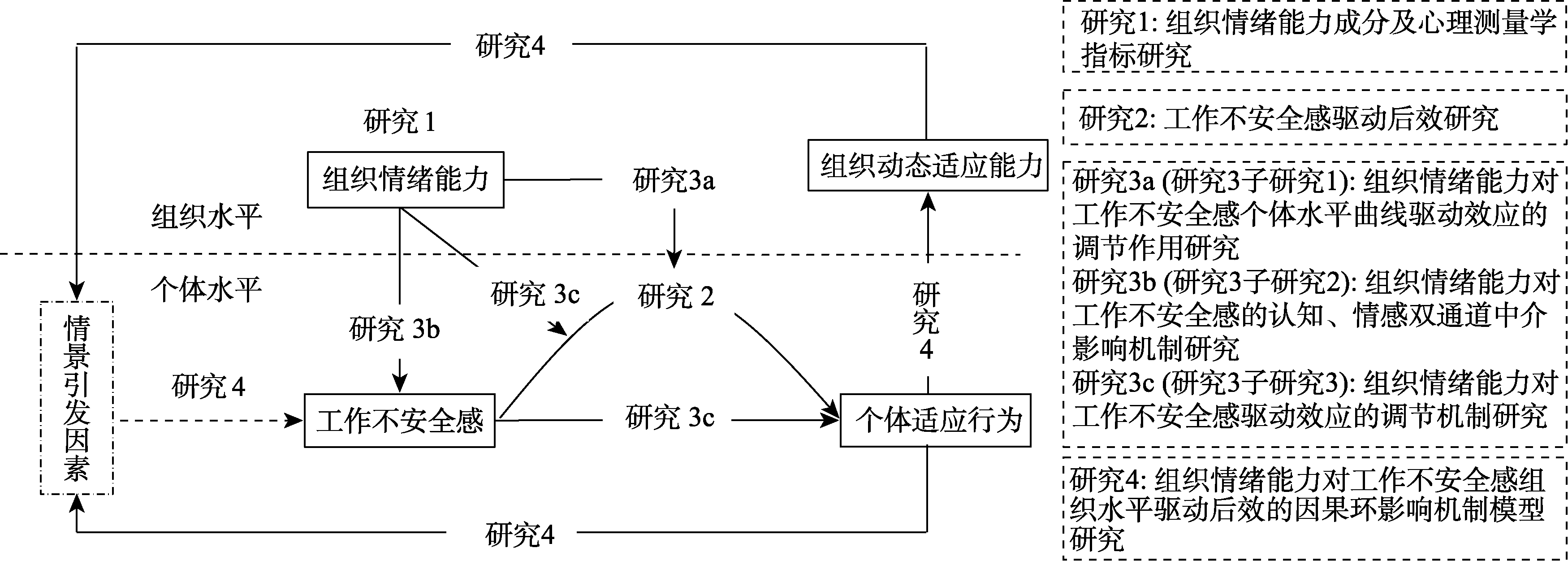
图1 整体研究关系图
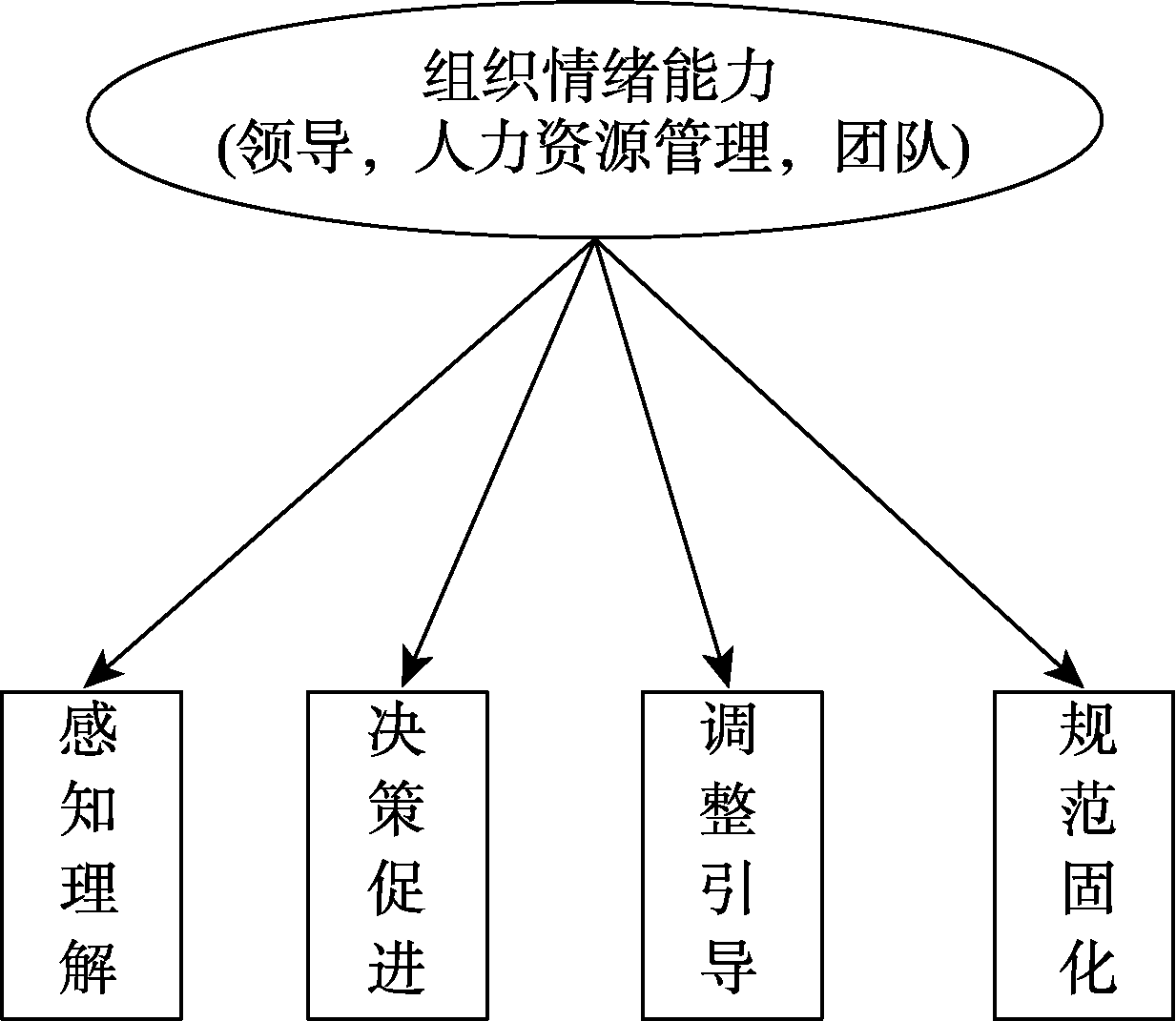
图2 组织情绪能力成分模型假设
| 维度名称 | 内涵 | 条目举例 |
|---|---|---|
| 感知理解 | 主要包括组织对员工情绪进行接收、分辨、评价与理解的能力。 | • 领导善于倾听, 能与员工产生情感共鸣; • 人力资源部特别关注大家对绩效考评的情绪反应; • 团队关系融洽, 成员能够自由表露情绪。 |
| 决策促进 | 主要包括利用情绪能量促进认知决策活动的能力。 | • 高管团队总能在各抒己见后快速达成一致; • 因为害怕受到惩罚, 员工们总是不愿意去创新(反向题); • 相互鼓励的气氛使我们团队成员迸发出很多创新想法。 |
| 调整引导 | 主要包括组织采用情绪性管理实践活动, 调整员工情绪状态以符合组织需要的能力。 | • 领导总是喜欢描绘愿景, 为我们带来希望; • 在推行新政策之前公司会通过培训活动引导员工的情绪反应; • 团队成员总是发生冲突, 让人产生远离是非的想法(反向题)。 |
| 规范固化 | 主要包括在组织结构、惯例与文化等规范中体现出组织对情绪知识的掌握与应用技能, 据此能够对组织情绪的未来走向予以预期。 | • 领导在遇到问题时隐瞒真相的做法总是让员工们很不满(反向题); • 人力资源部门具有丰富的应对情绪性突发事件的经历; • 团队的任务完成需要形成相互支持、互相依赖的情感氛围。 |
表1 组织情绪能力各维度内容及条目示例
| 维度名称 | 内涵 | 条目举例 |
|---|---|---|
| 感知理解 | 主要包括组织对员工情绪进行接收、分辨、评价与理解的能力。 | • 领导善于倾听, 能与员工产生情感共鸣; • 人力资源部特别关注大家对绩效考评的情绪反应; • 团队关系融洽, 成员能够自由表露情绪。 |
| 决策促进 | 主要包括利用情绪能量促进认知决策活动的能力。 | • 高管团队总能在各抒己见后快速达成一致; • 因为害怕受到惩罚, 员工们总是不愿意去创新(反向题); • 相互鼓励的气氛使我们团队成员迸发出很多创新想法。 |
| 调整引导 | 主要包括组织采用情绪性管理实践活动, 调整员工情绪状态以符合组织需要的能力。 | • 领导总是喜欢描绘愿景, 为我们带来希望; • 在推行新政策之前公司会通过培训活动引导员工的情绪反应; • 团队成员总是发生冲突, 让人产生远离是非的想法(反向题)。 |
| 规范固化 | 主要包括在组织结构、惯例与文化等规范中体现出组织对情绪知识的掌握与应用技能, 据此能够对组织情绪的未来走向予以预期。 | • 领导在遇到问题时隐瞒真相的做法总是让员工们很不满(反向题); • 人力资源部门具有丰富的应对情绪性突发事件的经历; • 团队的任务完成需要形成相互支持、互相依赖的情感氛围。 |
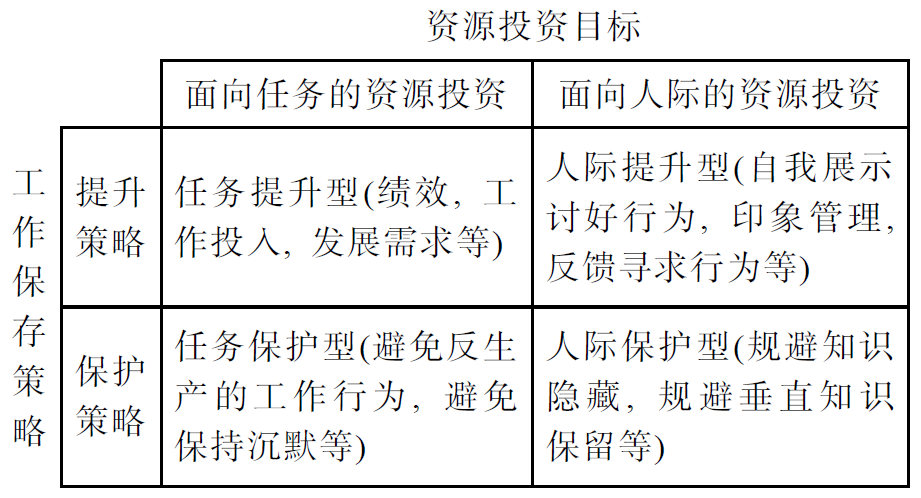
图3 工作保存行为分类框架
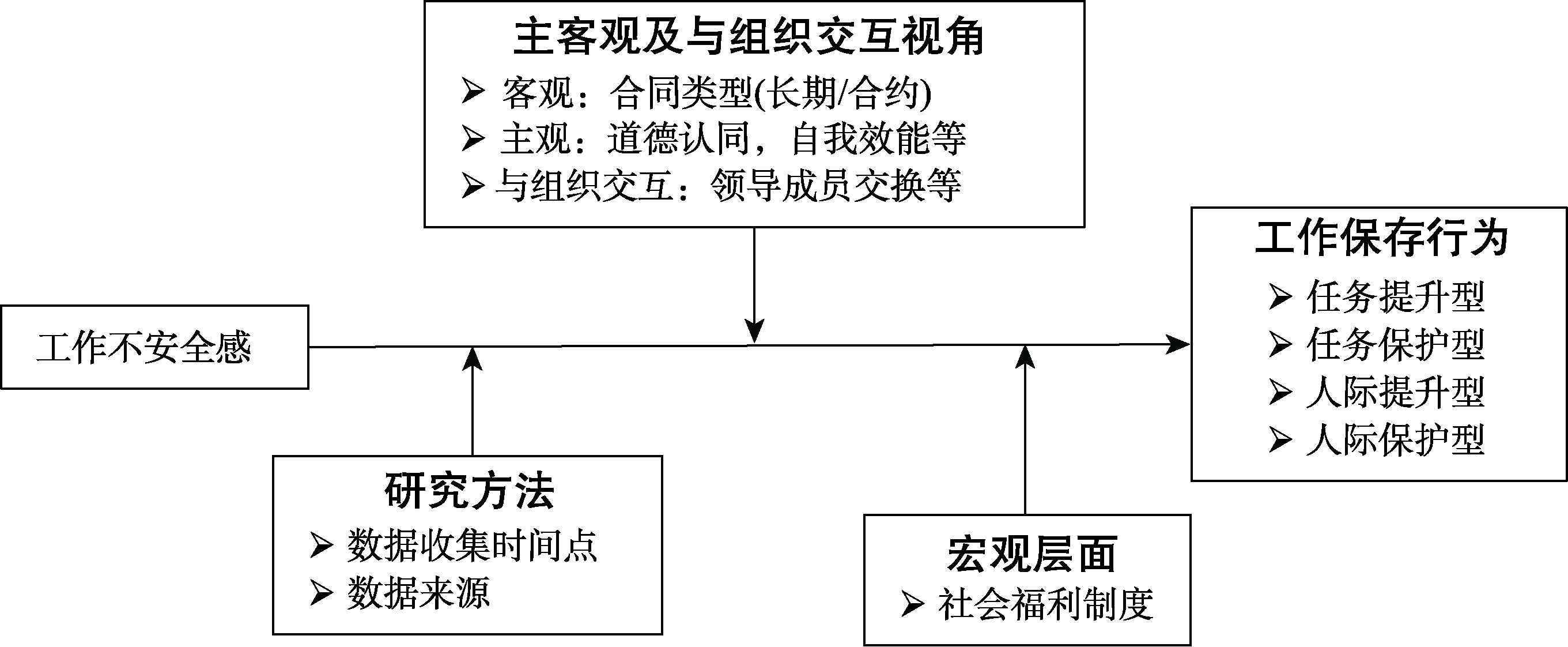
图4 工作不安全感驱动效应元分析研究概念模型
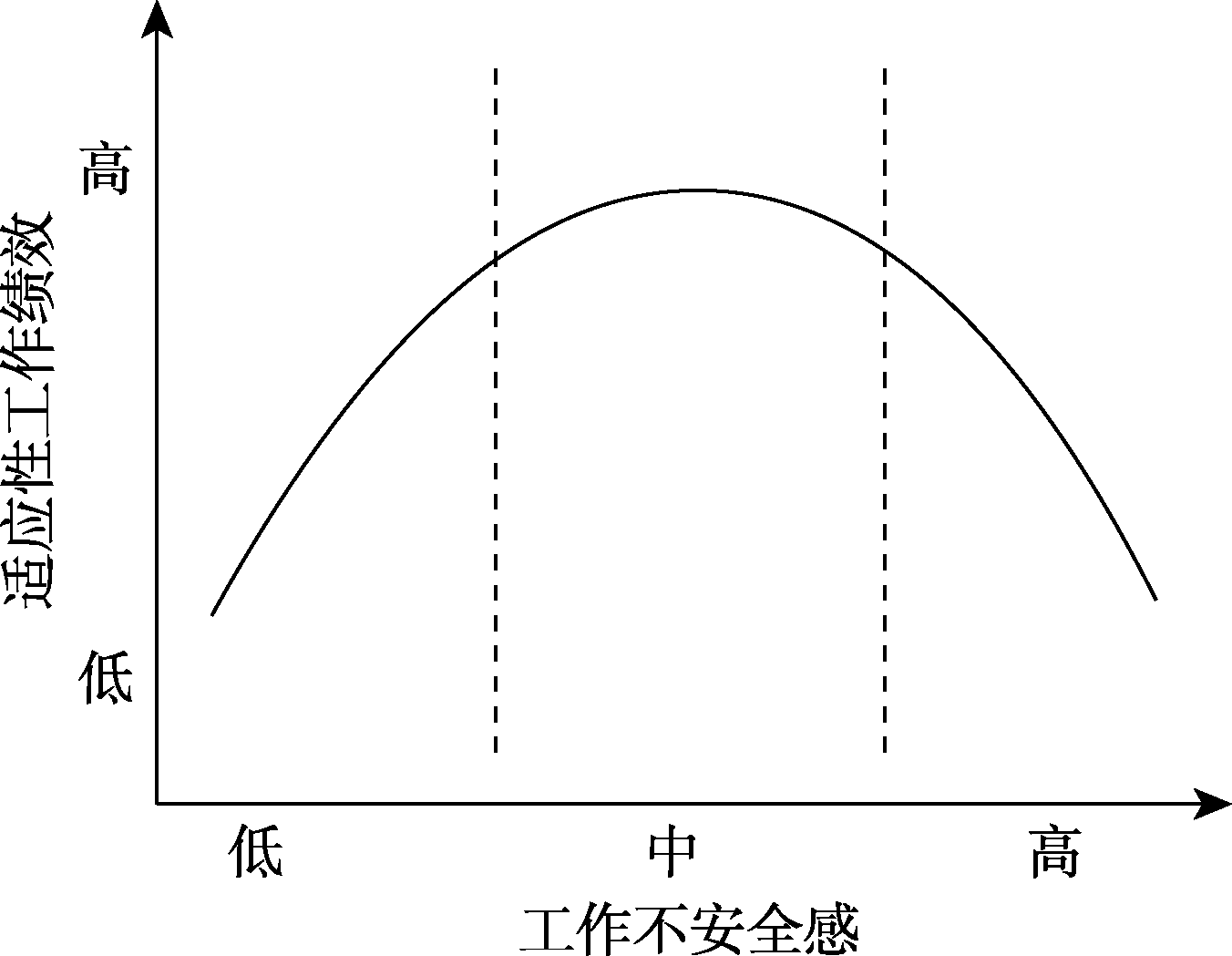
图5 工作不安全感与适应性绩效的倒U型关系示意图
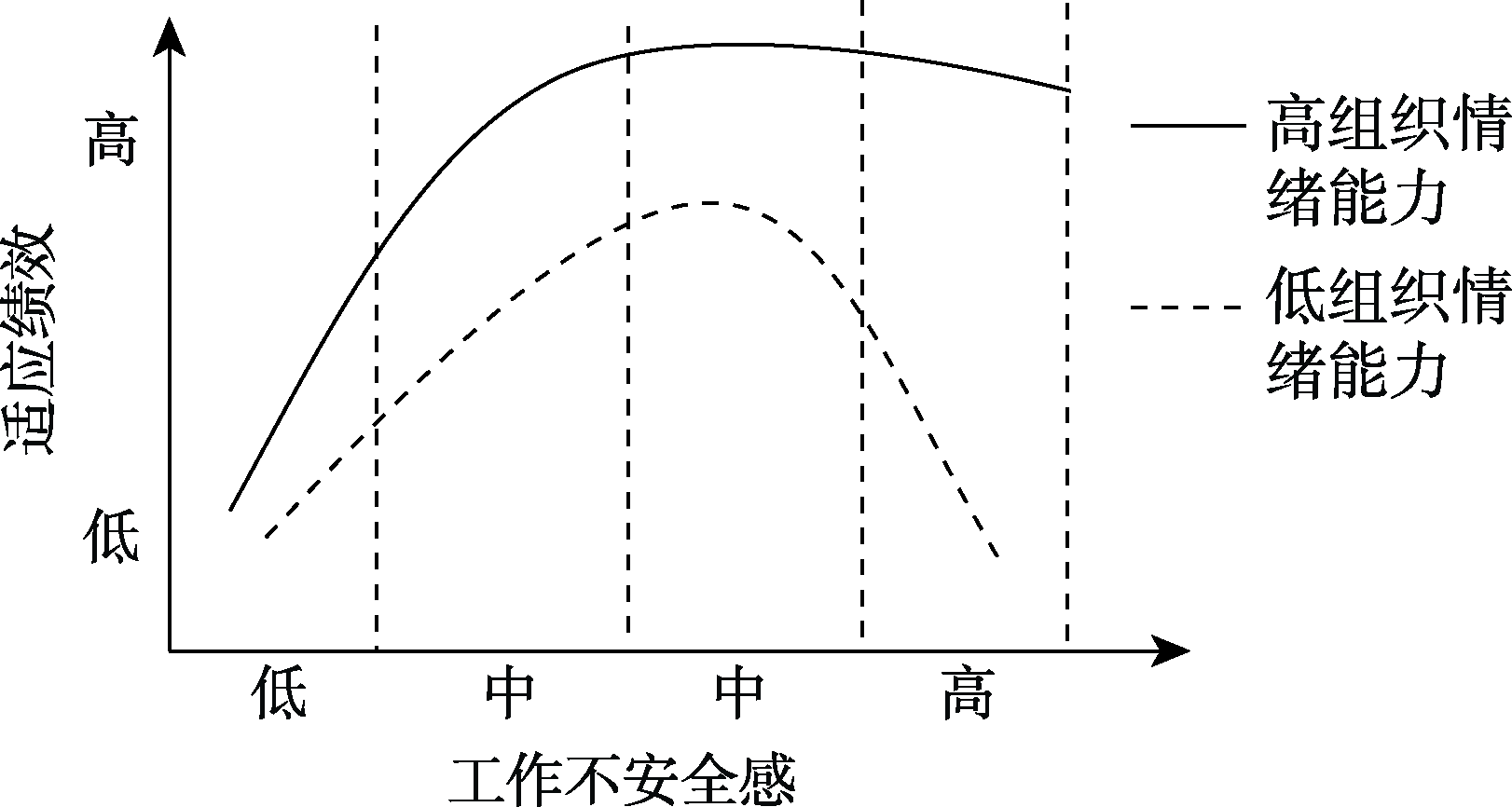
图6 组织情绪能力对工作不安全感驱动效应的曲线调节影响示意图
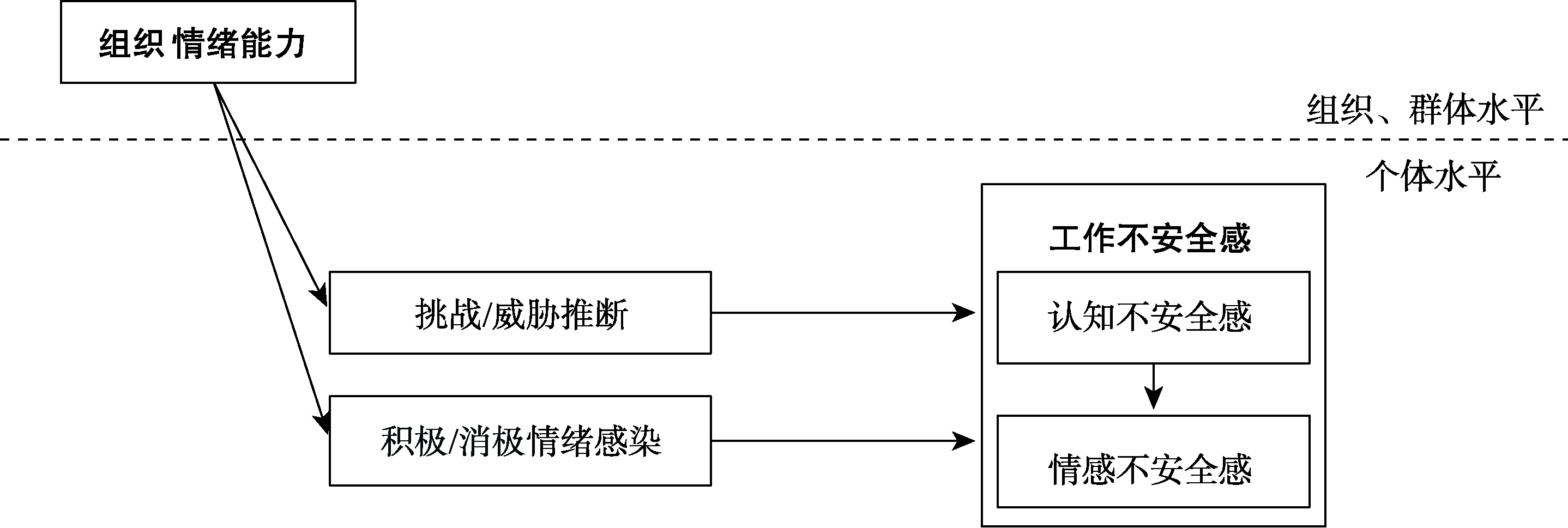
图7 组织情绪能力对工作不安全感的影响机制
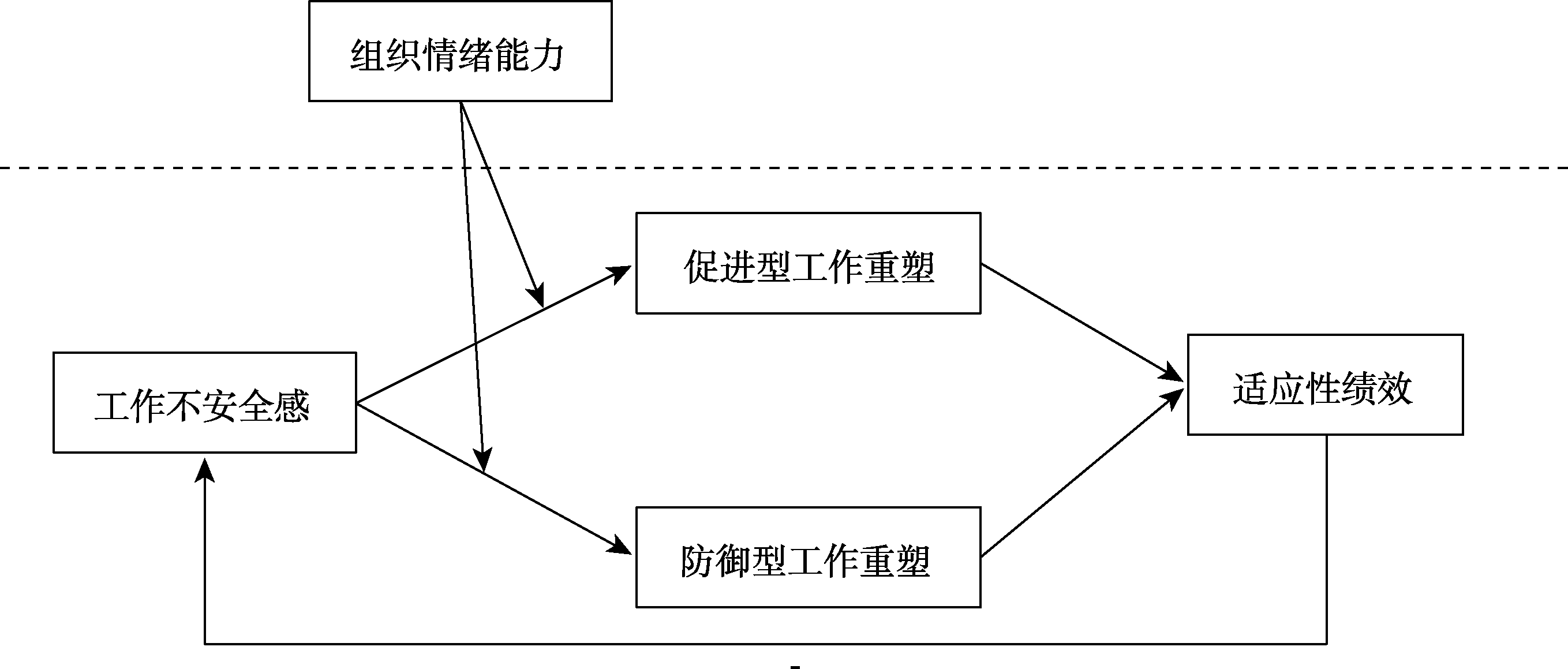
图8 组织情绪能力对工作不安全感双刃剑驱动效应的调节机制
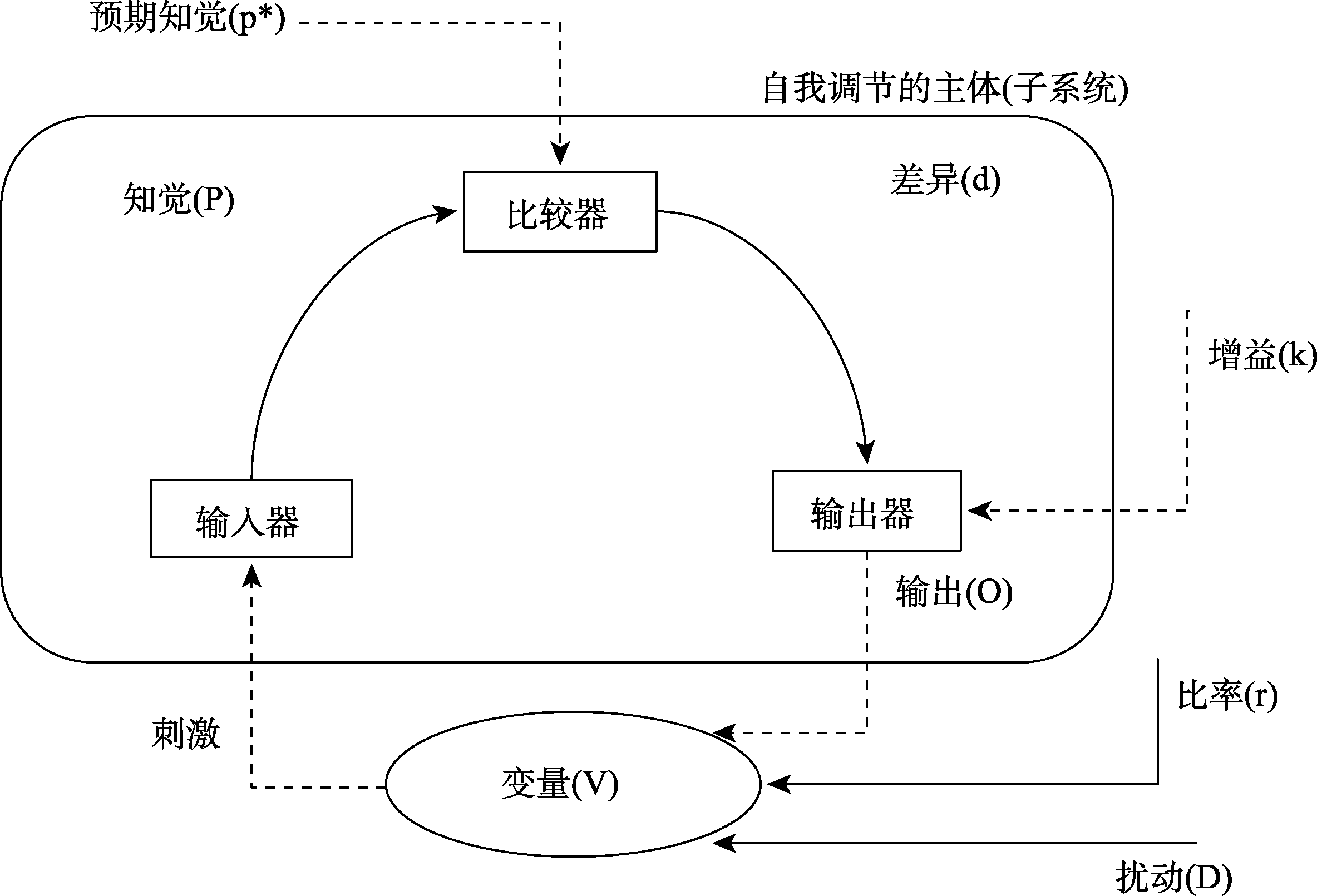
图9 主体自我调节反馈环
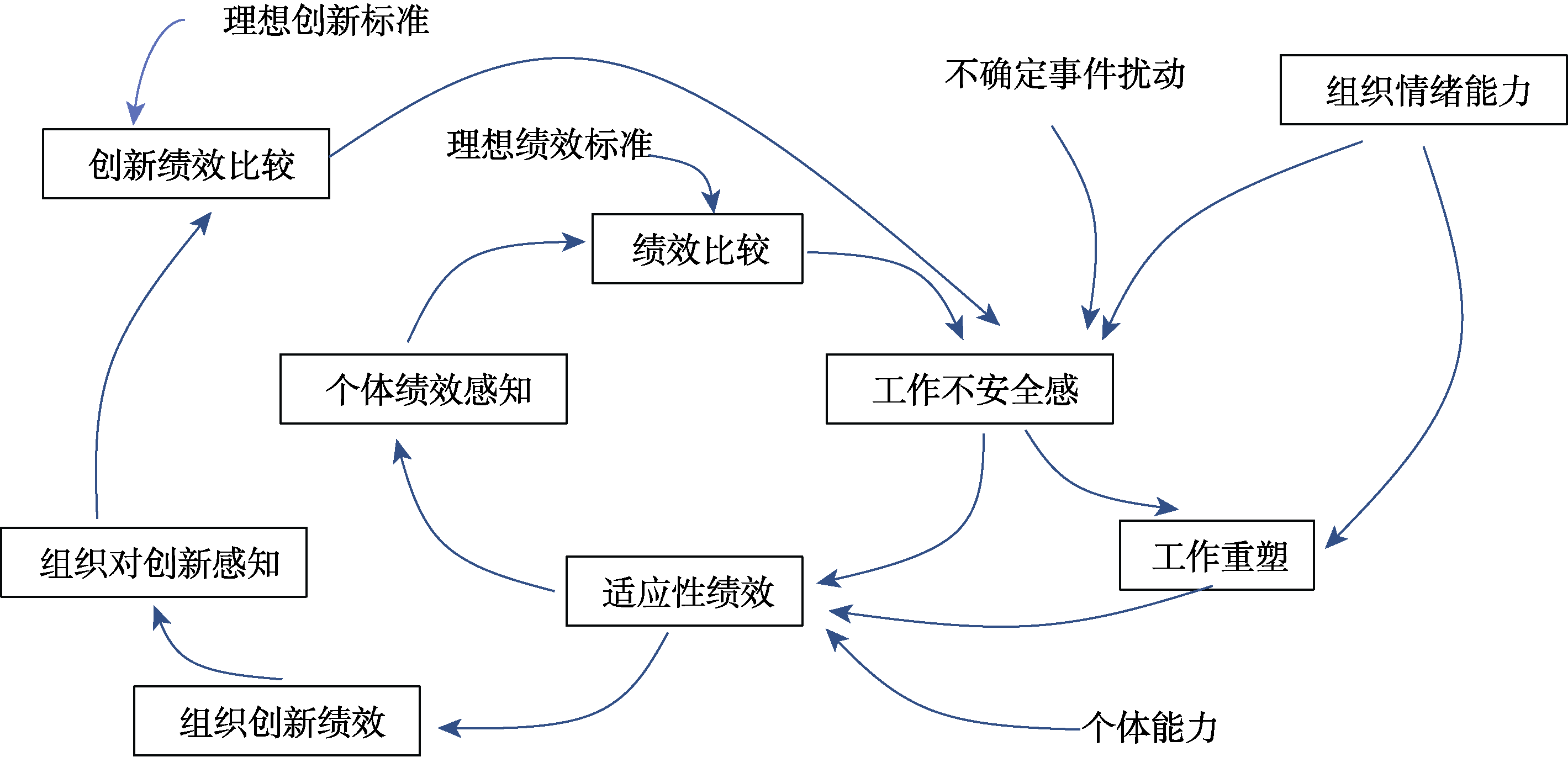
图10 组织情绪能力对工作不安全感驱动效应影响的因果逻辑环模型
| [1] |
常洁, 唐朝永, 牛冲槐. (2020). 组织情绪能力与组织创新关系:心理安全及失败学习的链式中介模型. 科技进步与对策, 37(18), 10-17.
doi: 10.6049/kjjbydc.2019090637 |
| [2] | 邓少军, 芮明杰. (2010). 组织动态能力演化微观认知机制研究前沿探析与未来展望. 外国经济与管理, 32(11), 26-34. |
| [3] | 杜小民, 高洋, 刘国亮, 葛宝山. (2015). 战略与创业融合新视角下的动态能力研究. 外国经济与管理, 37(2), 18-28. |
| [4] | 胡倩, 李旭. (2008). 现代信息技术对“牛鞭效应”影响的系统动力学研究. 物流技术, 27(12), 78-81. |
| [5] | 胡三嫚, 梁晓燕, 申传刚. (2024). 工作不安全感如何影响工作-生活平衡?——一个被调节的链式中介模型. 心理科学, 47(1), 132-141. |
| [6] | 焦豪, 杨季枫, 应瑛. (2021). 动态能力研究述评及开展中国情境化研究的建议. 管理世界, 37(5), 191-210. |
| [7] | 李树文, 罗瑾琏. (2020). 组织能力与外部环境如何促进产品创新?基于生命周期的组态分析. 科学学与科学技术管理, 41(10), 105-118. |
| [8] | 李树文, 罗瑾琏. (2022). 内外部学习平衡的形成及其对绩效的动态影响研究. 财经论丛, 38(4), 81-93. |
| [9] | 李树文, 罗瑾琏, 郭利敏, 王靖宇. (2021). 科创企业能力型、动机型与机会型战略人力资源管理对产品创新影响的周期演进. 南开管理评论, 25(2), 90-102. |
| [10] | 李树文, 罗瑾琏, 梁阜, 胡文安. (2021). 竞争环境下研发企业组织情绪能力与组织绩效:双路径模型检验. 南开管理评论, 24(2), 118-125. |
| [11] | 李树文, 罗瑾琏, 孙锐. (2019). 组织情绪能力:概念、测量、前因与后果. 外国经济与管理, 41(6), 59-70. |
| [12] | 李树文, 罗瑾琏, 张志菲. (2023). 技术型管理者认知对数字化生产力工具创新突破的影响. 科研管理, 44(11), 173-183. |
| [13] | 李树文, 孙锐, 梁阜. (2020). 动态环境下科技企业组织情绪能力对产品创新绩效的影响:一个链式有调节的中介模型. 管理工程学报, 34(2), 50-59. |
| [14] | 李树文, 孙锐, 罗瑾琏. (2020). 新创科技企业战略人力资源与组织创新. 科学学研究, 38(3), 566-576. |
| [15] |
李树文, 姚柱, 张显春. (2019). 员工越轨创新实现路径与边界:游戏动态性的触发作用. 科技进步与对策, 36(23), 147-152.
doi: 10.6049/kjjbydc.2019020424 |
| [16] | 梁阜, 李艳娟. (2022). 组织容错能力如何助推数字企业实现技术突破性创新? 财经论丛, (2), 79-88. |
| [17] |
刘平青, 刘园园, 刘东旭, 刘淑桢. (2022). 助推力还是绊脚石?工作不安全感对个体创新行为的“双刃剑”影响. 科技进步与对策, 39(6), 130-140.
doi: 10.6049/kjjbydc.2021090233 |
| [18] |
马冰, 杨蓉, 杜旌, 马贵梅. (2022). 居危思变?工作不安全感对创新行为的差异化影响. 心理科学进展, 30(11), 2381-2394.
doi: 10.3724/SP.J.1042.2022.02381 |
| [19] | 马鸿佳, 肖彬. (2025). 叙事需要平衡吗?平台企业叙事独特性与动态能力倒U型关系探究. 南开管理评论, 28 (11), 198-208. |
| [20] |
梅强, 童金根, 孙锐. (2017). 企业转换型领导、组织情绪能力与组织创造力——一个有调节的中介模型. 科技进步与对策, 34(18), 131-138.
doi: 10.6049/kjjbydc.2017020405 |
| [21] | 孟韬, 姚晨. (2023). 环境突变背景下数字平台能力如何影响组织创新绩效?——基于组织即兴能力的中介作用. 科学学与科学技术管理, 44(5), 95-114. |
| [22] |
彭灿, 曹冬勤, 李瑞雪. (2021). 环境动态性与竞争性对双元创新协同性的影响:资源拼凑的中介作用与组织情绪能力的调节作用. 科技进步与对策, 38(20), 11-19.
doi: 10.6049/kjjbydc.2020090813 |
| [23] | 乔朋华, 薛睿, 韩先锋. (2024). 数字营销何以激发中小企业创新——基于信息动态能力的中介作用. 南开管理评论, 27(5), 40-50+77. |
| [24] | 任迎伟, 张露, 毛竹. (2021). 工作不安全感与员工创新行为:抑制还是促进? 财经科学, (8), 93-105. |
| [25] | 孙锐. (2017). 科技企业组织情绪能力结构测量及对创新的影响. 科研管理, 38(9), 43-51. |
| [26] | 孙锐, 李树文. (2017). 科技企业组织情绪能力影响研发员工创新的中介机制研究. 中国人力资源开发, (6), 14-22. |
| [27] | 孙锐, 赵晨. (2016). 战略人力资源管理、组织情绪能力与组织创新——高新技术企业部门心理安全的作用. 科学学研究, 34(12), 1905-1915. |
| [28] | 孙锐, 赵晨. (2017). 高新技术企业组织情绪能力、组织学习与创新绩效. 科研管理, 38(2), 93-100. |
| [29] | 童金根, 梅强, 孙锐. (2017). 企业转换型领导、组织情绪能力与研发人员创新行为——集体主义导向的调节作用. 科技管理研究, 37(18), 15-22. |
| [30] | 王超发, 李雨露, 王林雪, 杜跃平, 杨德林. (2023). 动态能力对智能制造企业数字创新质量的影响研究. 管理学报, 20(12), 1818-1826. |
| [31] | 王象路, 罗瑾琏, 耿新. (2024). 企业数字化能否促进创新“提质增量”?——基于动态能力视角. 科学学与科学技术管理, 45(11), 104-117. |
| [32] | 温志毅. (2005). 工作绩效的四因素结构模型. 首都师范大学学报(社会科学版), (5), 105-111. |
| [33] | 吴欢伟, 潘紫晨, 雷宣. (2024). 员工危机经历对适应性绩效的影响:工作不安全感和防御性悲观的作用. 中国人力资源开发, 41(2), 61-75. |
| [34] | 许晖, 杨金东, 王泽鹏. (2024). 逐绿前行, 绿浪迭起:制造业企业绿色动态能力的构建机制研究——基于德龙钢铁的纵向单案例研究. 南开管理评论, 27(2), 60-74. |
| [35] | 杨光, 卢娜. (2023). 保住工作?工作不安全感对亲组织不道德行为的影响研究. 中国人力资源开发, 40(12), 71-83. |
| [36] | 张莉, 陈龙, 赵宁, 刘轩. (2016). 工作不安全感对组织承诺的影响:主动化行为的中介作用. 工业工程与管理, 12(4), 159-165. |
| [37] | 周浩, 龙立荣. (2011). 工作不安全感、创造力自我效能对员工创造力的影响. 心理学报, 43(8), 929-940. |
| [38] | 周浩, 龙立荣. (2013). 基于自我效能感调节作用的工作不安全感对建言行为的影响研究. 管理学报, 10(11), 1604-1610. |
| [39] | 朱良杰, 何佳讯, 黄海洋. (2018). 互联网平台形成的演化机制——基于韩都衣舍的案例研究. 管理案例研究与评论, 11(2), 163-180. |
| [40] |
Adner, R., Pólos, L., Ryall, M., & Sorenson, O. (2009). The case for formal theory. Academy of Management Review, 34(2), 201-208.
doi: 10.5465/amr.2009.36982613 URL |
| [41] |
Akgün, A. E., Keskin, H., & Byrne, J. C. (2009). Organizational emotional capability, product and process innovation, and firm performance: An empirical analysis. Journal of Engineering and Technology Management, 26(3), 103-130.
doi: 10.1016/j.jengtecman.2009.06.008 URL |
| [42] |
Akgün, A. E., Keskin, H., Byrne, J. C., & Aren, S. (2007). Emotional and learning capability and their impact on product innovativeness and firm performance. Technovation, 27(9), 501-513.
doi: 10.1016/j.technovation.2007.03.001 URL |
| [43] |
Akgün, A. E., Keskin, H., Byrne, J. C., & Günsel, A. (2011). Antecedents and results of emotional capability in software development project teams. Journal of Product Innovation Management, 28(6), 957-973.
doi: 10.1111/jpim.2011.28.issue-6 URL |
| [44] |
Ashforth, B. E., & Humphrey, R. H. (1995). Emotion in the workplace: A reappraisal. Human Relations, 48(2), 97-125.
doi: 10.1177/001872679504800201 URL |
| [45] |
Ashkanasy, N. M., Humphrey, R. H., & Huy, Q. N. (2017). Integrating emotions and affect in theories of management. Academy of Management Review, 42(2), 175-189.
doi: 10.5465/amr.2016.0474 URL |
| [46] |
Bachrach, D. G., Powell, B. C., Collins, B. J., & Richey, R. G. (2006). Effects of task interdependence on the relationship between helping behavior and group performance. Journal of Applied Psychology, 91(6), 1396-1405.
pmid: 17100493 |
| [47] |
Baer, M., & Frese, M. (2003). Innovation is not enough: Climates for initiative and psychological safety, process innovations, and firm performance. Journal of Organizational Behavior, 24(1), 45-68.
doi: 10.1002/job.v24:1 URL |
| [48] |
Barney, J. (1991). Firm resources and sustained competitive advantage. Journal of Management, 17(1), 99-120.
doi: 10.1177/014920639101700108 URL |
| [49] |
Barreto, I. (2010). Dynamic capabilities: A review of past research and an agenda for the future. Journal of Management, 36(1), 256-280.
doi: 10.1177/0149206309350776 URL |
| [50] |
Barsade, S. G., & Gibson, D. E. (2007). Why does affect matter in organizations? Academy of Management Perspectives, 21(1), 36-59.
doi: 10.5465/amp.2007.24286163 URL |
| [51] |
Bartol, K. M., Liu, W., Zeng, X. Q., & Wu, K. L. (2009). Social exchange and knowledge sharing among knowledge workers: The moderating role of perceived job security. Management and Organization Review, 5(2), 223-240.
doi: 10.1111/j.1740-8784.2009.00146.x URL |
| [52] |
Benach, J., Vives, A., Amable, M., Vanroelen, C., Tarafa, G., & Muntaner, C. (2014). Precarious employment: Understanding an emerging social determinant of health. Annual Review of Public Health, 35(1), 229-253.
doi: 10.1146/publhealth.2014.35.issue-1 URL |
| [53] |
Bindl, U. K., Unsworth, K. L., Gibson, C. B., & Stride, C. B. (2018). Job crafting revisited: Implications of an extended framework for active changes at work. Journal of Applied Psychology, 104(5), 605-628.
doi: 10.1037/apl0000362 URL |
| [54] |
Blau, G., Tatum, D. S., McCoy, K., Dobria, L., & Ward-Cook, K. (2004). Job loss, human capital job feature, and work condition job feature as distinct job insecurity constructs. Journal of Allied Health, 33(1), 31-41.
pmid: 15053218 |
| [55] |
Brockner, J., Grover, S., Reed, T. F., & Dewitt, R. L. (1992). Layoffs, job insecurity, and survivors' work effort: Evidence of an inverted-u relationship. Academy of Management Journal, 35(2), 413-425.
doi: 10.2307/256380 URL |
| [56] |
Brown, S. L., & Eisenhardt, K. M. (1997). The art of continuous change: Linking complexity theory and time-paced evolution in relentlessly shifting organizations. Administrative Science Quarterly, 42(1), 1-34.
doi: 10.2307/2393807 URL |
| [57] |
Burgard, S. A., Brand, J. E., & House, J. S. (2009). Perceived job insecurity and worker health in the United States. Social Science & Medicine, 69(5), 777-785.
doi: 10.1016/j.socscimed.2009.06.029 URL |
| [58] |
Cheng, G. H. L., & Chan, D. K. S. (2008). Who suffers more from job insecurity? A meta-analytic review. Applied Psychology, 57(2), 272-303.
doi: 10.1111/apps.2008.57.issue-2 URL |
| [59] |
Chirumbolo, A., Urbini, F., Callea, A., Lo Presti, A., & Talamo, A. (2017). Occupations at risk and organizational well-being: An empirical test of a job insecurity integrated model. Frontiers in Psychology, 8, 2084.
doi: 10.3389/fpsyg.2017.02084 pmid: 29250013 |
| [60] | Collins, R. (1990). Stratification, emotional energy, and the transient emotions. In T. D. Kemper (Ed.), Research agendas in the sociology of emotions (pp. 27-57). State University of New York Press. |
| [61] |
Colquitt, J. A., Lepine, J. A., Piccolo, R. F., Zapata, C. P., & Rich, B. L. (2012). Explaining the justice-performance relationship: Trust as exchange deepener or trust as uncertainty reducer? Journal of Applied Psychology, 97(1), 1-15.
doi: 10.1037/a0025208 pmid: 21910516 |
| [62] |
Curran, T., Hill, A. P., Appleton, P. R., Vallerand, R. J. & Standage, M. (2015). The psychology of passion: A meta- analytical review of a decade of research on intrapersonal outcomes. Motivation and Emotion, 39(5), 631-655.
doi: 10.1007/s11031-015-9503-0 URL |
| [63] |
De Cuyper, N., & De Witte, H. (2006). The impact of job insecurity and contract type on attitudes, well-being and behavioural reports: A psychological contract perspective. Journal of Occupational and Organizational Psychology, 79(3), 395-409.
doi: 10.1348/096317905X53660 URL |
| [64] |
De Cuyper, N., & De Witte, H. (2007). Job insecurity in temporary versus permanent workers: Associations with attitudes, well-being, and behaviour. Work and Stress, 21(1), 65-84.
doi: 10.1080/02678370701229050 URL |
| [65] | De Cuyper, N., De Witte, H., Kinnunen, U., & Nätti, J. (2010). The relationship between job insecurity and employability and well-being among Finnish temporary and permanent employees. International Studies of Management & Organization, 40(1), 57-73. |
| [66] |
De Cuyper, N., Schreurs, B., Vander Elst, T., Baillien, E., & De Witte, H. (2014). Exemplification and perceived job insecurity: Associations with self-rated performance and emotional exhaustion. Journal of Personnel Psychology, 13(1), 1-10.
doi: 10.1027/1866-5888/a000099 URL |
| [67] | De Witte, H., De Cuyper, N., Handaja, Y., Sverke, M., Näswall, K., & Hellgren, J. (2010). Associations between quantitative and qualitative job insecurity and well-being: A test in Belgian banks. International Studies of Management & Organization, 40(1), 40-56. |
| [68] |
De Witte, H., Pienaar, J., & De Cuyper, N. (2016). Review of 30 years of longitudinal studies on the association between job insecurity and health and well-being: Is there causal evidence? Australian Psychologist, 51(1), 18-31.
doi: 10.1111/ap.12176 URL |
| [69] | De Witte, H., Vander Elst, T., & De Cuyper, N. (2015). Job insecurity, health and well-being. In: VuoriJ., BlonkR., PriceR. (Eds.), Sustainable working lives. Aligning perspectives on health, safety and well-being. Springer, Dordrecht. |
| [70] |
Edmondson, A. (1999). Psychological safety and learning behavior in work teams. Administrative Science Quarterly, 44(2), 350-383.
doi: 10.2307/2666999 URL |
| [71] |
Eisenhardt, K. M., & Martin, J. A. (2000). Dynamic capabilities: What are they? Strategic Management Journal, 21(10/11), 1105-1121.
doi: 10.1002/(ISSN)1097-0266 URL |
| [72] |
Elliot, A. J. (2006). The hierarchical model of approach- avoidance motivation. Motivation and Emotion, 30(2), 111-116.
doi: 10.1007/s11031-006-9028-7 URL |
| [73] |
Ferrie, J., Shipley, M., Marmot, M., Martikainen, P., Stansfeld, S., & Smith, G. (2001). Job insecurity in white- collar workers: Toward an explanation of associations with health. Journal of Occupational Health Psychology, 6(1), 26-42.
doi: 10.1037//1076-8998.6.1.26 pmid: 11199254 |
| [74] |
Fiol, C. M., & O'Connor, E. J. (2003). Waking up! Mindfulness in the face of bandwagons. Academy of Management Review, 28(1), 54-70.
doi: 10.5465/amr.2003.8925227 URL |
| [75] |
Frijda, N. (1988). The laws of emotion. The American Psychologist, 43(5), 349-358.
doi: 10.1037/0003-066X.43.5.349 URL |
| [76] |
Gailliot, M. T., Stillman, T. F., Schmeichel, B. J., Maner, J. K., & Plant, E. A. (2008). Mortality salience increases adherence to salient norms and values. Personality and Social Psychology Bulletin, 34(7), 993-1003.
doi: 10.1177/0146167208316791 pmid: 18550864 |
| [77] |
Gakovic, A., & Tetrick, L. E. (2003). Psychological contract breach as a source of strain for employees. Journal of Business and Psychology, 18(2), 235-246.
doi: 10.1023/A:1027301232116 |
| [78] |
George, J. M. (2000). Emotions and leadership: The role of emotional intelligence. Human Relations, 53(8), 1027-1055.
doi: 10.1177/0018726700538001 URL |
| [79] |
Gilbert, C. G. (2006). Change in the presence of residual fit: Can competing frames coexist? Organization Science, 17(1), 150-167.
doi: 10.1287/orsc.1050.0160 URL |
| [80] | Goleman, D. (1996). Emotional intelligence. Why it can matter more than IQ. Learning, 24(6), 49-50. |
| [81] |
Graen, G. B., & Uhl-Bien, M. (1995). Relationship-based approach to leadership: Development of leader-member exchange (LMX) theory of leadership over 25 years: Applying a multi-level multi-domain perspective. The Leadership Quarterly, 6(2), 219-247.
doi: 10.1016/1048-9843(95)90036-5 URL |
| [82] |
Greenhalgh, L., & Rosenblatt, Z. (1984). Job insecurity: Toward conceptual clarity. Academy of Management Review, 9(3), 438-448.
doi: 10.2307/258284 URL |
| [83] | Greenhalgh, L., & Rosenblatt, Z. (2010). Evolution of research on job insecurity. International Studies of Management and Organization, 40(1), 6-19. |
| [84] |
Helfat, C. E. (1997). Know-how and asset complementarity and dynamic capability accumulation: The case of R&D. Strategic Management Journal, 18(5), 339-360.
doi: 10.1002/(ISSN)1097-0266 URL |
| [85] |
Hellgren, J., Sverke, M., & Isaksson, K. (1999). A two- dimensional approach to job insecurity: Consequences for employee attitudes and well-being. European Journal of Work and Organizational Psychology, 8(2), 179-195.
doi: 10.1080/135943299398311 URL |
| [86] |
Hodgkinson, G. P., & Healey, M. P. (2011). Psychological foundations of dynamic capabilities: Reflexion and reflection in strategic management. Strategic Management Journal, 32(13), 1500-1516.
doi: 10.1002/smj.v32.13 URL |
| [87] | Huang, G.-H., Lee, C., Ashford, S., Chen, Z., & Ren, X. (2010). Affective job insecurity: A mediator of cognitive job insecurity and employee outcomes relationships. International Studies of Management & Organization, 40(1), 20-39. |
| [88] |
Huang, G. H., Wellman, N., Ashford, S. J., Lee, C., & Wang, L. (2017). Deviance and exit: The organizational costs of job insecurity and moral disengagement. Journal of Applied Psychology, 102(1), 26-42.
doi: 10.1037/apl0000158 URL |
| [89] | Huckfeldt, R. R., Kohfeld, C. W., & Likens, T. W. (1982). Dynamic modeling: An introduction (Sage University Paper Series on Quantitative Applications in the Social Sciences, series no. 07-027). Sage Publications. |
| [90] |
Huy, Q. N. (1999). Emotional capability, emotional intelligence, and radical change. The Academy of Management Review, 24(2), 325-345.
doi: 10.2307/259085 URL |
| [91] |
Huy, Q. N. (2002). Emotional balancing of organizational continuity and radical change: The contribution of middle managers. Administrative Science Quarterly, 47(1), 31-69.
doi: 10.2307/3094890 URL |
| [92] | Huy, Q. N. (2005). An emotion-based view of strategic renewal. Advances in Strategic Management, 22(1), 3-37. |
| [93] | Ilgen, D. R., & Hulin, C. L. (2000). Computational modeling of behavior in organizations: The third scientific discipline. American Psychological Association. |
| [94] |
Jiang, L., & Lavaysse, L. M. (2018). Cognitive and affective job insecurity: A meta-analysis and a primary study. Journal of Management, 44(6), 2307-2342.
doi: 10.1177/0149206318773853 URL |
| [95] |
Jiang, L., Lawrence, A., & Xu, X. (2022). Does a stick work? A meta-analytic examination of curvilinear relationships between job insecurity and employee workplace behaviors. Journal of Organizational Behavior, 43(8), 1410-1445.
doi: 10.1002/job.v43.8 URL |
| [96] |
Jiang, L., & Probst, T. M. (2016). A multilevel examination of affective job insecurity climate on safety outcomes. Journal of Occupational Health Psychology, 21(3), 366-377.
doi: 10.1037/ocp0000014 pmid: 26594845 |
| [97] | Jundt, D. K., & Shoss, M. K. (2023). A process perspective on adaptive performance: Research insights and new directions. Group & Organization Management, 48(2), 405-435. |
| [98] |
Jundt, D. K., Shoss, M. K., & Huang, J. L. (2015). Individual adaptive performance in organizations: A review. Journal of Organizational Behavior, 36(S1), S53-S71.
doi: 10.1002/job.1955 URL |
| [99] |
Kang, D. S., Gold, J., & Kim, D. (2012). Responses to job insecurity: The impact on discretionary extra-role and impression management behaviors and the moderating role of employability. Career Development International, 17(4), 314-332.
doi: 10.1108/13620431211255815 URL |
| [100] |
Kelly, J. R., & Barsade, S. G. (2001). Mood and emotions in small groups and work teams. Organizational Behavior and Human Decision Processes, 86(1), 99-130.
doi: 10.1006/obhd.2001.2974 URL |
| [101] |
Kinnunen, U., Feldt, T., & Mauno, S. (2003). Job insecurity and self-esteem: Evidence from cross-lagged relations in a 1-year longitudinal sample. Personality and Individual Differences, 35(3), 617-632.
doi: 10.1016/S0191-8869(02)00223-4 URL |
| [102] |
Koc, T. (2007). Organizational determinants of innovation capacity in software companies. Computers & Industrial Engineering, 53(3), 373-385.
doi: 10.1016/j.cie.2007.05.003 URL |
| [103] | Kundu, S. C., & Kumar, S. (2017). Effects of psychological empowerment on firms’ performance: Mediation of affective commitment. Journal of Organisation & Human Behaviour, 6(1), 41-53. |
| [104] |
Lam, C. F., Liang, J., Ashford, S. J., & Lee, C. (2015). Job insecurity and organizational citizenship behavior: Exploring curvilinear and moderated relationships. Journal of Applied Psychology, 100(2), 499-510.
doi: 10.1037/a0038659 pmid: 25602119 |
| [105] | Laureiro-Martínez, D., Brusoni, S., & Zollo, M. (2009). Cognitive flexibility in decision-making: A neurological model of learning and change. CROMA-Center for Research in Organization and Management-Bocconi University, 1, 1-43. |
| [106] | Lazarus, R. S., & Folkman, S. (1984). Stress, appraisal, and coping. Springer Publishing Company. |
| [107] |
Lee, C., Huang, G. H., & Ashford, S. J. (2018). Job insecurity and the changing workplace: Recent developments and the future trends in job insecurity research. Annual Review of Organizational Psychology and Organizational Behavior, 5(1), 335-359.
doi: 10.1146/orgpsych.2018.5.issue-1 URL |
| [108] |
Levinthal, D. A. (2011). A behavioral approach to strategy- What's the alternative? Strategic Management Journal, 32(13), 1517-1523.
doi: 10.1002/smj.v32.13 URL |
| [109] |
Li, S., Jia, R., Seufert, J. H., Hu, W., & Luo, J. (2022). The impact of ability-, motivation-and opportunity-enhancing strategic human resource management on performance: The mediating roles of emotional capability and intellectual capital. Asia Pacific Journal of Human Resources, 60(3), 453-478.
doi: 10.1111/aphr.v60.3 URL |
| [110] |
Lim, V. K. G., & Sng, Q. S. (2006). Does parental job insecurity matter? Money anxiety, money motives, and work motivation. Journal of Applied Psychology, 91(5), 1078-1087.
pmid: 16953769 |
| [111] |
Makadok, R. (2001). Toward a synthesis of the resource- based and dynamic-capability views of rent creation. Strategic Management Journal, 22(5), 387-401.
doi: 10.1002/smj.v22:5 URL |
| [112] |
Mauno, S., Kinnunen, U., & Ruokolainen, M. (2007). Job demands and resources as antecedents of work engagement: A longitudinal study. Journal of Vocational Behavior, 70(1), 149-171.
doi: 10.1016/j.jvb.2006.09.002 URL |
| [113] | Mayer, J. D. (1986). How mood influences cognition. Advances in Cognitive Science, 290-314. |
| [114] | Mayer, J.D., & Salovey, P. (1997). What is emotional intelligence? In P. Salovey & D. J. Sluyter (Eds.), Emotional development and emotional intelligence: Educational implications (pp. 3-34). Basic Books. |
| [115] |
McKnight, D. H., Phillips, B., & Hardgrave, B. C. (2009). Which reduces IT turnover intention the most: Workplace characteristics or job characteristics? Information & Management, 46(3), 167-174.
doi: 10.1016/j.im.2009.01.002 URL |
| [116] | Motowidlo, S.J., & Kell, H. J. (2003). Job performance. In W. C. Borman, D. R. Ilgen, & R. J. Klimoski (Eds.), Handbook of psychology: Vol. 12. Industrial and organizational psychology (pp. 39-53). Wiley. |
| [117] |
Niessen, C., & Jimmieson, N. L. (2016). Threat of resource loss: The role of self-regulation in adaptive task performance. Journal of Applied Psychology, 101(3), 450-462.
doi: 10.1037/apl0000049 pmid: 26348477 |
| [118] |
Nutt, P. C. (2004). Averting decision debacles. Technological Forecasting and Social Change, 71(3), 239-265.
doi: 10.1016/S0040-1625(02)00352-9 URL |
| [119] |
Pavlou, P. A., & Sawy, O. (2006). From IT leveraging competence to competitive advantage in turbulent environments: The case of new product development. Information Systems Research, 17(3), 198-227.
doi: 10.1287/isre.1060.0094 URL |
| [120] |
Pescosolido, A. T. (2002). Emergent leaders as managers of group emotion. The Leadership Quarterly, 13(5), 583-599.
doi: 10.1016/S1048-9843(02)00145-5 URL |
| [121] |
Petrou, P., & Bakker, A. (2016). Crafting one's leisure time in response to high job strain. Human Relations, 69(2), 507-529.
doi: 10.1177/0018726715590453 URL |
| [122] |
Piccoli, B., & De Witte, H. (2015). Job insecurity and emotional exhaustion: Testing psychological contract breach versus distributive injustice as indicators of lack of reciprocity. Work and Stress, 29(3), 246-263.
doi: 10.1080/02678373.2015.1075624 URL |
| [123] | Prahalad, C. K., & Hamel, G. (1990). The core competence of the corporation. Harvard Business Review, 68(3), 79-91. |
| [124] |
Probst, T. M., Gailey, N. J., Jiang, L. X., & Bohle, S. L. (2017). Psychological capital: Buffering the longitudinal curvilinear effects of job insecurity on performance. Safety Science, 100(Part A), 74-82.
doi: 10.1016/j.ssci.2017.02.002 URL |
| [125] |
Probst, T. M., Stewart, S. M., Gruys, M. L., & Tierney, B. W. (2007). Productivity, counterproductivity and creativity: The ups and downs of job insecurity. Journal of Occupational and Organizational Psychology, 80(3), 479-497.
doi: 10.1348/096317906X159103 URL |
| [126] | Reisel, W. D., Probst, T. M., Chia, S.-L., Maloles, C. M., & König, C. J. (2010). The effects of job insecurity on job satisfaction, organizational citizenship behavior, deviant behavior, and negative emotions of employees. International Studies of Management & Organization, 40(1), 74-91. |
| [127] |
Roseman, I. J. (1991). Appraisal determinants of discrete emotions. Cognition and Emotion, 5(3), 161-200.
doi: 10.1080/02699939108411034 URL |
| [128] |
Rothaermel, F. T., & Hess, A. M. (2007). Building dynamic capabilities: Innovation driven by individual-, firm-, and network-level effects. Organization Science, 18(6), 898-921.
doi: 10.1287/orsc.1070.0291 URL |
| [129] |
Rudolph, C. W., Shoss, M. K., & Zacher, H. (2025). Dynamic and reciprocal relations between job insecurity and physical and mental health. Journal of Applied Psychology, 110(7), 948-962.
doi: 10.1037/apl0001259 URL |
| [130] |
Salovey, P., & Mayer, J. D. (1990). Emotional intelligence. Imagination, Cognition and Personality, 9(3), 185-211.
doi: 10.2190/DUGG-P24E-52WK-6CDG URL |
| [131] |
Schreurs, B., van Emmerik, H., Notelaers, G., & De Witte, H. (2010). Job insecurity and employee health: The buffering potential of job control and job self-efficacy. Work and Stress, 24(1), 56-72.
doi: 10.1080/02678371003718733 URL |
| [132] |
Selenko, E., Mäkikangas, A., Mauno, S., & Kinnunen, U. (2013). How does job insecurity relate to self-reported job performance? Analysing curvilinear associations in a longitudinal sample. Journal of Occupational and Organizational Psychology, 86(4), 522-542.
doi: 10.1111/joop.2013.86.issue-4 URL |
| [133] |
Serenko, A., & Bontis, N. (2016). Understanding counterproductive knowledge behavior: Antecedents and consequences of intra-organizational knowledge hiding. Journal of Knowledge Management, 20(6), 1199-1224.
doi: 10.1108/JKM-05-2016-0203 URL |
| [134] |
Shoss, M. K. (2017). Job insecurity: An integrative review and agenda for future research. Journal of Management, 43(6), 1911-1939.
doi: 10.1177/0149206317691574 URL |
| [135] |
Shoss, M. K., Brummel, B. J., Probst, T. M., & Jiang, L. X. (2020). The joint importance of secure and satisfying work: Insights from three studies. Journal of Business and Psychology, 35(3), 297-316.
doi: 10.1007/s10869-019-09627-w |
| [136] |
Shoss, M. K., Su, S. Y., Schlotzhauer, A. E., & Carusone, N. (2022). Working hard or hardly working? An examination of job preservation responses to job insecurity. Journal of Management, 49(7), 2387-2414.
doi: 10.1177/01492063221107877 URL |
| [137] |
Shoss, M. K., & Vancouver, J. B. (2024). A dynamic, computational model of job insecurity and job performance. Journal of Applied Psychology, 109(2), 222-237.
doi: 10.1037/apl0001142 URL |
| [138] |
Siegrist, J. (1996). Adverse health effects of high-effort/low- reward conditions. Journal of Occupational Health Psychology, 1(1), 27-41.
doi: 10.1037//1076-8998.1.1.27 pmid: 9547031 |
| [139] |
Staufenbiel, T. & König, C. J. (2010). A model for the effects of job insecurity on performance, turnover intention, and absenteeism. Journal of Occupational and Organizational Psychology, 83(1), 101-117.
doi: 10.1348/096317908X401912 URL |
| [140] | Staufenbiel, T., & König, C. J. (2011). An evaluation of Borg's cognitive and affective job insecurity scales. International Journal of Business and Social Science, 2(20), 1-7. |
| [141] |
Stynen, D., Forrier, A., Sels, L., & De Witte, H. (2015). The relationship between qualitative job insecurity and OCB: Differences across age groups. Economic and Industrial Democracy, 36(3), 383-405.
doi: 10.1177/0143831X13510326 URL |
| [142] |
Sun, R., Li, S. W., & Liu, W. (2022). Linking organizational emotional capability to innovation performance in high-tech innovating firms. Asia Pacific Journal of Human Resources, 60(3), 532-561.
doi: 10.1111/aphr.v60.3 URL |
| [143] |
Sverke, M., & Hellgren, J. (2002). The nature of job insecurity: Understanding employment uncertainty on the brink of a new millennium. Applied Psychology: An International Review, 51(1), 23-42.
doi: 10.1111/apps.2002.51.issue-1 URL |
| [144] | Sverke, M., Låstad, L., Hellgren, J., Richter, A., & Näswall, K. (2019). A meta-analysis of job insecurity and employee performance: Testing temporal aspects, rating source, welfare regime, and union density as moderators. International Journal of Environmental Research and Public Health, 16(14), 2536. |
| [145] |
Taber, C. S., & Timpone, R. J. (1996). Beyond simplicity: Focused realism and computational modeling in international relations. Mershon International Studies Review, 40(1), 41-79.
doi: 10.2307/222641 URL |
| [146] |
Teece, D. J. (2007). Explicating dynamic capabilities: The nature and microfoundations of (sustainable) enterprise performance. Strategic Management Journal, 28(13), 1319-1350.
doi: 10.1002/smj.v28:13 URL |
| [147] |
Teece, D. J., Pisano, G., & Shuen, A. (1997). Dynamic capabilities and strategic management. Strategic Management Journal, 18(7), 509-533.
doi: 10.1002/(ISSN)1097-0266 URL |
| [148] |
Thaker, V., Jiang, L. X., & Xu, X. H. (2021). A test of competing theoretical models of meaningful work as a moderator in the curvilinear relationship between job insecurity and employee voice. International Journal of Stress Management, 28(3), 165-175.
doi: 10.1037/str0000229 |
| [149] |
Van Kleef, G. A. (2009). How emotions regulate social life: The emotions as social information (EASI) model. Current Directions in Psychological Science, 18(3), 184-188.
doi: 10.1111/j.1467-8721.2009.01633.x URL |
| [150] |
Vancouver, J. B., Tamanini, K. B., & Yoder, R. J. (2010). Using dynamic computational models to reconnect theory and research: Socialization by the proactive newcomer as example. Journal of Management, 36(3), 764-793.
doi: 10.1177/0149206308321550 URL |
| [151] |
Vancouver, J. B., Weinhardt, J. M., & Schmidt, A. M. (2010). A formal, computational theory of multiple-goal pursuit: Integrating goal-choice and goal-striving processes. Journal of Applied Psychology, 95(6), 985-1008.
doi: 10.1037/a0020628 pmid: 20804232 |
| [152] |
Vander Elst, T., Richter, A., Sverke, M., Näswall, K., De Cuyper, N., & De Witte, H. (2014). Threat of losing valued job features: The role of perceived control in mediating the effect of qualitative job insecurity on job strain and psychological withdrawal. Work and Stress, 28(2), 143-164.
doi: 10.1080/02678373.2014.899651 URL |
| [153] |
Wang, H.-J., Lu, C.-Q., & Siu, O.-L. (2015). Job insecurity and job performance: The moderating role of organizational justice and the mediating role of work engagement. Journal of Applied Psychology, 100(4), 1249-1258.
doi: 10.1037/a0038330 URL |
| [154] | Warr, P. (1987). Work, unemployment, and mental health. Oxford University Press. |
| [155] | Weiss, H. M., & Cropanzano, R. (1996). Affective events theory. Research in Organizational Behavior, 18(1), 1-74. |
| [156] |
Wernerfelt, B. (1995). The resource-based view of the firm: Ten years after. Strategic Management Journal, 16(3), 171-174.
doi: 10.1002/smj.v16:3 URL |
| [157] |
Wong, Y.-T., Wong, C.-S., Ngo, H.-Y., & Lui, H.-K. (2005). Different responses to job insecurity of Chinese workers in joint ventures and state-owned enterprises. Human Relations, 58(11), 1391-1418.
doi: 10.1177/0018726705060243 URL |
| [158] |
Wrzesniewski, A., & Dutton, J. E. (2001). Crafting a job: Revisioning employees as active crafters of their work. Academy of Management Review, 26(2), 179-201.
doi: 10.2307/259118 URL |
| [159] |
Yukl, G. (2012). Effective leadership behavior: What we know and what questions need more attention. Academy of Management Perspectives, 26(4), 66-85.
doi: 10.5465/amp.2012.0088 URL |
| [160] |
Zhao, X., Lim, V. K. G., & Teo, T. S. H. (2012). The long arm of job insecurity: Its impact on career-specific parenting behaviors and youths' career self-efficacy. Journal of Vocational Behavior, 80(3), 619-628.
doi: 10.1016/j.jvb.2012.01.018 URL |
| [161] |
Zollo, M., & Winter, S. G. (2002). Deliberate learning and the evolution of dynamic capabilities. Organization Science, 13(3), 339-351.
doi: 10.1287/orsc.13.3.339.2780 URL |
| [162] |
Zott, C. (2003). Dynamic capabilities and the emergence of intraindustry differential firm performance: Insights from a simulation study. Strategic Management Journal, 24(2), 97-125.
doi: 10.1002/smj.v24:2 URL |
| [1] | 宋一晓, 曾铭灼, 苏涛. 机会抑或威胁? 人与AI协作系统对员工工作效能影响的元分析[J]. 心理科学进展, 2026, 34(3): 461-486. |
| [2] | 侯楠, 高中华, 杨皎平, 李豪. 年长员工数字技术工作不安全感的来源与影响后效[J]. 心理科学进展, 2025, 33(9): 1514-1525. |
| [3] | 王涛, 占小军, 余薇. AI感知对员工心理和行为的影响及理论解释[J]. 心理科学进展, 2024, 32(7): 1195-1208. |
| [4] | 涂艳, 蒿坡, 龙立荣. 工作替代还是工作转型?技术型工作不安全感的内涵、影响后果及来源[J]. 心理科学进展, 2023, 31(8): 1359-1373. |
| [5] | 马冰, 杨蓉, 杜旌, 马贵梅. 居危思变?工作不安全感对创新行为的差异化影响?[J]. 心理科学进展, 2022, 30(11): 2381-2394. |
| [6] | 胡三嫚. 工作不安全感的研究现状与展望[J]. 心理科学进展, 2007, 15(6): 938-947. |
| 阅读次数 | ||||||
|
全文 |
|
|||||
|
摘要 |
|
|||||
