

ISSN 1671-3710
CN 11-4766/R
主办:中国科学院心理研究所
出版:科学出版社
CN 11-4766/R
主办:中国科学院心理研究所
出版:科学出版社
心理科学进展 ›› 2025, Vol. 33 ›› Issue (8): 1367-1378.doi: 10.3724/SP.J.1042.2025.1367 cstr: 32111.14.2025.1367
杨童舒, 黄艳利( ), 谢久书()
收稿日期:2024-09-30
出版日期:2025-08-15
发布日期:2025-05-15
基金资助:
YANG Tongshu, HUANG Yanli(), XIE Jiushu()
Received:2024-09-30
Online:2025-08-15
Published:2025-05-15
摘要:
孤独症谱系障碍(Autism Spectrum Disorder, ASD)儿童存在跨情境词汇学习障碍, 严重阻碍了其语言习得。以往研究虽尝试从一般认知能力受损的角度探究该障碍的成因, 却忽视了ASD儿童学习机制的特异性。为此, 本文特尝试从学习机制入手, 揭示ASD儿童内隐学习较为完整而外显学习可能受损的分离, 发现ASD儿童的跨情境词汇学习主要依赖联结学习, 而非假设检验。基于此, 本文提出混合式协同作用模型, 并认为操纵指代物多样性和词频分布或可分别影响联结学习和假设检验, 进而促进ASD儿童的跨情境词汇学习。该模型对理解ASD儿童跨情境词汇学习障碍的认知机制及探索潜在的干预手段具有重要的理论意义和实践价值。
中图分类号:
杨童舒, 黄艳利, 谢久书. (2025). 孤独症儿童跨情境词汇学习障碍的认知机制. 心理科学进展 , 33(8), 1367-1378.
YANG Tongshu, HUANG Yanli, XIE Jiushu. (2025). The cognitive mechanisms of cross-situational word learning deficits in children with autism spectrum disorder. Advances in Psychological Science, 33(8), 1367-1378.
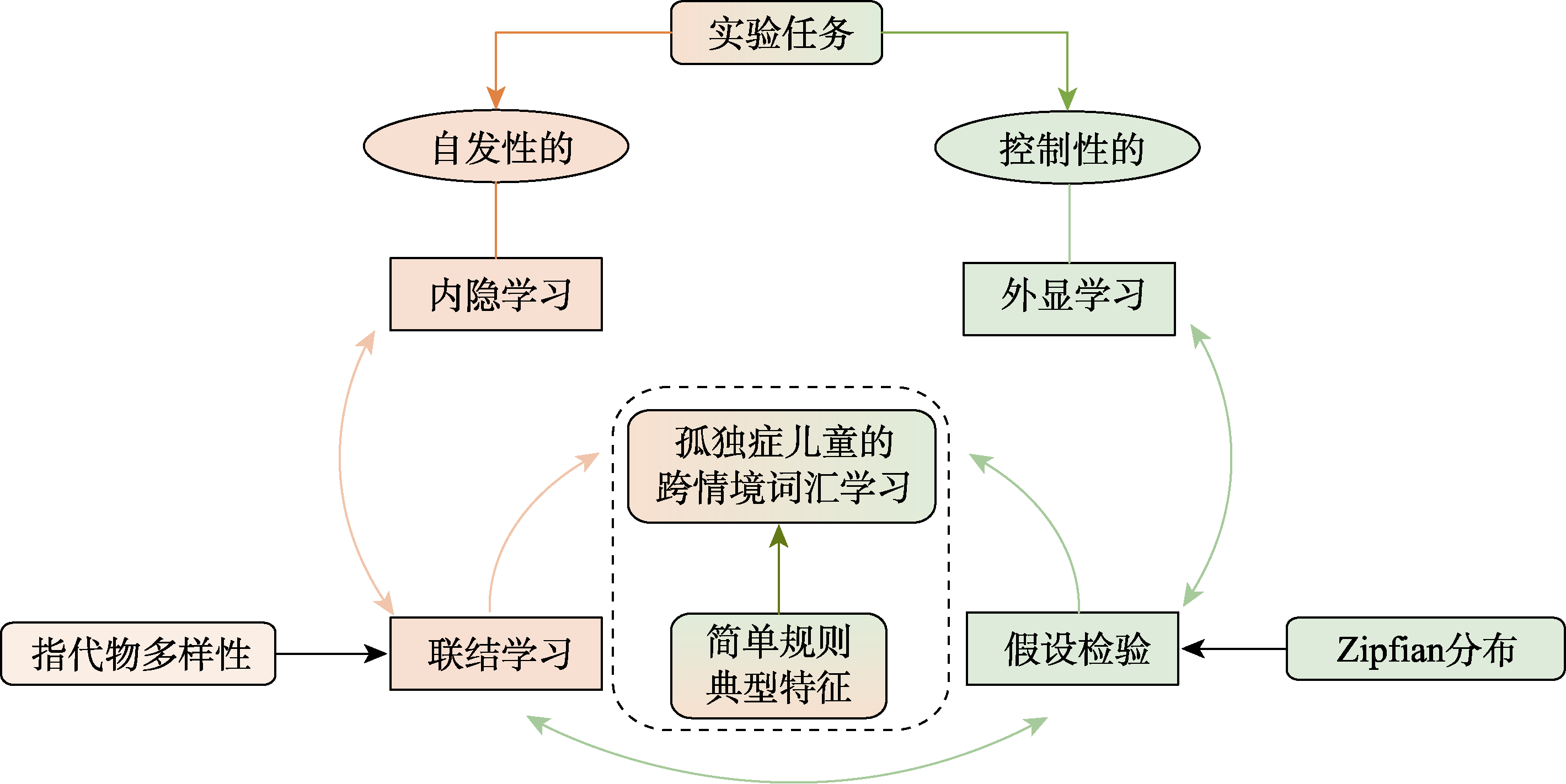
图1 ASD儿童跨情境词汇学习的混合式协同作用模型
| [1] |
陈雁, 李晶. (2024). 人际同步对孤独症儿童合作行为的影响及干预促进. 心理科学进展, 32(4), 639-653. https://journal.psych.ac.cn/xlkxjz/CN/10.3724/SP.J.1042.2024.00639
doi: 10.3724/SP.J.1042.2024.00639 URL |
| [2] |
侯文文, 苏怡. (2022). 注意和记忆对孤独症儿童词汇发展滞后的影响. 心理科学进展, 30(11), 2558-2569. https://journal.psych.ac.cn/xlkxjz/CN/10.3724/SP.J.1042.2022.02558
doi: 10.3724/SP.J.1042.2022.02558 URL |
| [3] | 刘书云, 黄艳利, 石宇婧, 谢久书, 邓铸. (2024). 跨情境词汇学习的联结学习与假设检验之争. 心理发展与教育, 40(3), 431-441. https://doi.org/10.16187/j.cnki.issn1001-4918.2024.03.14 |
| [4] | 石宇婧, 黄艳利, 谢久书, 刘书云. (2024). 跨情境词汇学习的偏态学习优势效应. 心理科学, 47(3), 538-545. https://doi.org/10.16719/j.cnki.1671-6981.20240304 |
| [5] |
张琳琳, 魏坤琳, 李晶. (2022). 儿童的人际运动同步. 心理科学进展, 30(3), 623-634. https://journal.psych.ac.cn/xlkxjz/CN/10.3724/SP.J.1042.2022.00623
doi: 10.3724/SP.J.1042.2022.00623 URL |
| [6] | Ackermann, L., Hepach, R., & Mani, N. (2020). Children learn words easier when they are interested in the category to which the word belongs. Developmental Science, 23(3), e12915. https://doi.org/10.1111/desc.12915 |
| [7] |
Alispahic, S., Pellicano, E., Cutler, A., & Antoniou, M. (2024). Multiple talker processing in autistic adult listeners. Scientific Reports, 14(1), Article 14698. https://doi.org/10.1038/s41598-024-62429-w
doi: 10.1038/s41598-024-62429-w URL pmid: 38926416 |
| [8] | American Psychiatric Association, DSM-5 Task Force. (2013). Diagnostic and statistical manual of mental disorders: DSM-5™ (5th ed.). American Psychiatric Publishing, Inc.. https://doi.org/10.1176/appi.books.9780890425596 |
| [9] | Aussems, S., & Vogt, P. (2020). Adults use cross-situational statistics for word learning in a conservative way. IEEE Transactions on Cognitive and Developmental Systems, 12(2), 232-242. https://doi.org/10.1109/TCDS.2018.2870161 |
| [10] |
Bacon, E. C., Moore, A., Lee, Q., Carter Barnes, C., Courchesne, E., & Pierce, K. (2020). Identifying prognostic markers in autism spectrum disorder using eye tracking. Autism, 24(3), 658-669. https://doi.org/10.1177/1362361319878578
doi: 10.1177/1362361319878578 URL pmid: 31647314 |
| [11] |
Baronchelli, A., Ferrer-i-Cancho, R., Pastor-Satorras, R., Chater, N., & Christiansen, M. H. (2013). Networks in cognitive science. Trends in Cognitive Sciences, 17(7), 348-360. https://doi.org/10.1016/j.tics.2013.04.010
doi: 10.1016/j.tics.2013.04.010 URL pmid: 23726319 |
| [12] |
Batterink, L. J., & Paller, K. A. (2019). Statistical learning of speech regularities can occur outside the focus of attention. Cortex, 115, 56-71. https://doi.org/10.1016/j.cortex.2019.01.013
doi: S0010-9452(19)30032-2 URL pmid: 30771622 |
| [13] |
Batterink, L. J., Reber, P. J., Neville, H. J., & Paller, K. A. (2015). Implicit and explicit contributions to statistical learning. Journal of Memory and Language, 83, 62-78. https://doi.org/10.1016/j.jml.2015.04.004
URL pmid: 26034344 |
| [14] |
Bedford, R., Gliga, T., Frame, K., Hudry, K., Chandler, S., Johnson, M. H., Charman, T., & BASIS, TEAM. (2013). Failure to learn from feedback underlies word learning difficulties in toddlers at risk for autism. Journal of Child Language, 40(1), 29-46. https://doi.org/10.1017/S0305000912000086
doi: 10.1017/S0305000912000086 URL pmid: 23217290 |
| [15] | Benitez, V. L., Zettersten, M., & Wojcik, E. (2020). The temporal structure of naming events differentially affects children’s and adults’ cross-situational word learning. Journal of Experimental Child Psychology, 200, 104961. https://doi.org/10.1016/j.jecp.2020.104961 |
| [16] |
Berens, S. C., Horst, J. S., & Bird, C. M. (2018). Cross- situational learning is supported by Propose-but-Verify Hypothesis Testing. Current Biology, 28(7), 1132-1136.e5. https://doi.org/10.1016/j.cub.2018.02.042
doi: S0960-9822(18)30227-6 URL pmid: 29551416 |
| [17] | Berry, D. C., & Broadbent, D. E. (1995). Implicit learning in the control of complex systems. In P. A. Frensch & J. Funke (Eds.), Complex problem solving: The European perspective (pp. 131-150). Lawrence Erlbaum Associates, Inc. |
| [18] | Berry, D. C., & Dienes, Z. (1993). Implicit learning: theoretical and empirical issues. Psychological Bulletin, 115(2), 13-18. |
| [19] | Bo, J., Lee, C.-M., Colbert, A., & Shen, B. (2016). Do children with autism spectrum disorders have motor learning difficulties? Autism Spectrum Disorders, 23, 50-62. https://doi.org/10.1016/j.rasd.2015.12.001 |
| [20] | Brown, J., Aczel, B., Jimenez, L., Kaufman, S. B., & Grant, K. P. (2010). Intact implicit learning in autism spectrum conditions. The Quarterly Journal of Experimental Psychology Section A, 63(9), 1789-1812. https://doi.org/10.1080/17470210903536910 |
| [21] | Bulgarelli, F., Weiss, D. J., & Dennis, N. A. (2021). Cross- situational statistical learning in younger and older adults. Aging, Neuropsychology, and Cognition, 28(3), 346-366. https://doi.org/10.1080/13825585.2020.1759502 |
| [22] |
Camero, R., Gallego, C., & Martínez, V. (2023). Gaze following as an early diagnostic marker of autism in a new word learning task in toddlers. Journal of Autism and Developmental Disorders, 54(9), 3211-3224. https://doi.org/10.1007/s10803-023-06043-1
doi: 10.1007/s10803-023-06043-1 URL pmid: 37410255 |
| [23] |
Carter, C. K., & Hartley, C. (2021). Are children with autism more likely to retain object names when learning from colour photographs or black-and-white cartoons? Journal of Autism and Developmental Disorders, 51(9), 3050-3062. https://doi.org/10.1007/s10803-020-04771-2
doi: 10.1007/s10803-020-04771-2 URL pmid: 33156474 |
| [24] | Clark, G. T., & Reuterskiold, C. (2023). Word learning with orthographic support in nonspeaking and minimally speaking school-age autistic children. Journal of Speech, Language, and Hearing Research, 66(6), 2047-2063. https://doi.org/10.1044/2023_JSLHR-22-00549 |
| [25] | Crespo, K., & Kaushanskaya, M. (2021). Is 10 better than 1? The effect of speaker variability on children’s cross- situational word learning. Language Learning and Development, 17(4), 397-410. https://doi.org/10.1080/15475441.2021.1906680 |
| [26] | Crespo, K., Vlach, H., & Kaushanskaya, M. (2023). The effects of bilingualism on children’s cross-situational word learning under different variability conditions. Journal of Experimental Child Psychology, 229, 105621. https://doi.org/10.1016/j.jecp.2022.105621 |
| [27] | Cuneo, N., Floyd, S., & Goldberg, A. E. (2024). Word meaning is complex: Language-related generalization differences in autistic adults. Cognition, 244, 105691. https://doi.org/10.1016/j.cognition.2023.105691 |
| [28] |
Degonda, N., Mondadori, C. R. A., Bosshardt, S., Schmidt, C. F., Boesiger, P., Nitsch, R. M., Hock, C., & Henke, K. (2005). Implicit associative learning engages the hippocampus and interacts with explicit associative learning. Neuron, 46(3), 505-520. https://doi.org/10.1016/j.neuron.2005.02.030
URL pmid: 15882649 |
| [29] |
Ferdinand, N. K., Mecklinger, A., & Kray, J. (2008). Error and deviance processing in implicit and explicit sequence learning. Journal of Cognitive Neuroscience, 20(4), 629-642. https://doi.org/10.1162/jocn.2008.20046
URL pmid: 18052785 |
| [30] | Fitch, A., Lieberman, A. M., Luyster, R. J., & Arunachalam, S. (2020). Toddlers’ word learning through overhearing: Others’ attention matters. Journal of Experimental Child Psychology, 193, 104793. https://doi.org/10.1016/j.jecp.2019.104793 |
| [31] |
Foti, F., De Crescenzo, F., Vivanti, G., Menghini, D., & Vicari, S. (2015). Implicit learning in individuals with autism spectrum disorders: A meta-analysis. Psychological Medicine, 45(5), 897-910. https://doi.org/10.1017/S0033291714001950
doi: 10.1017/S0033291714001950 URL pmid: 25126858 |
| [32] |
Fu, Q., Bin, G., Dienes, Z., Fu, X., & Gao, X. (2013). Learning without consciously knowing: Evidence from event-related potentials in sequence learning. Consciousness and Cognition, 22(1), 22-34. https://doi.org/10.1016/j.concog.2012.10.008
doi: 10.1016/j.concog.2012.10.008 URL pmid: 23247079 |
| [33] | Gray, S., Lancaster, H., Alt, M., Hogan, T. P., Green, S., Levy, R., & Cowan, N. (2020). The structure of word learning in young school-age children. Journal of Speech, Language, and Hearing Research: JSLHR, 63(5), 1446-1466. https://doi.org/10.1044/2020_JSLHR-19-00186 |
| [34] |
Haebig, E., Jiménez, E., Cox, C. R., & Hills, T. T. (2021). Characterizing the early vocabulary profiles of preverbal and minimally verbal children with autism spectrum disorder. Autism, 25(4), 958-970. https://doi.org/10.1177/1362361320973799
doi: 10.1177/1362361320973799 URL pmid: 33246365 |
| [35] | Haebig, E., Saffran, J. R., & Ellis Weismer, S. (2017). Statistical word learning in children with autism spectrum disorder and specific language impairment. Journal of Child Psychology and Psychiatry, 58(11), 1251-1263. https://doi.org/10.1111/jcpp.12734 |
| [36] | Hart, B., & Risley, T. R. (1995). Meaningful differences in the everyday experience of young American children. Paul H Brookes Publishing. |
| [37] | Hartley, C., Bird, L.-A., & Monaghan, P. (2020). Comparing cross-situational word learning, retention, and generalisation in children with autism and typical development. Cognition, 200, 104265. https://doi.org/10.1016/j.cognition.2020.104265 |
| [38] | Hartley, C., & Whiteley, H. A. (2024). Do multiple exemplars promote preschool children’s retention and generalisation of words learned from pictures? Cognitive Development, 70, 101459. https://doi.org/10.1016/j.cogdev.2024.101459 |
| [39] | Hayman, G., & Tulving, E. (1989). Contingent dissociation between recognition and fragment completion: The method of triangulation. Journal of Experimental Psychology: Learning, Memory, and Cognition, 15(2), 228-240. https://doi.org/10.1037/0278-7393.15.2.228 |
| [40] |
Hendrickson, A. T., & Perfors, A. (2019). Cross-situational learning in a Zipfian environment. Cognition, 189, 11-22. https://doi.org/10.1016/j.cognition.2019.03.005
doi: S0010-0277(19)30060-5 URL pmid: 30903853 |
| [41] |
Howlin, P. (2003). Outcome in high-functioning adults with autism with and without early language delays: implications for the differentiation between autism and Asperger syndrome. Journal of Autism and Developmental Disorders, 33(1), 3-13. https://doi.org/10.1023/a:1022270118899
doi: 10.1023/a:1022270118899 URL pmid: 12708575 |
| [42] |
Izadi-Najafabadi, S., Mirzakhani-Araghi, N., Miri-Lavasani, N., Nejati, V., & Pashazadeh-Azari, Z. (2015). Implicit and explicit motor learning: Application to children with Autism Spectrum Disorder (ASD). Research in Developmental Disabilities, 47, 284-296. https://doi.org/10.1016/j.ridd.2015.09.020
doi: 10.1016/j.ridd.2015.09.020 URL pmid: 26458260 |
| [43] |
Jiménez, E., Haebig, E., & Hills, T. T. (2021). Identifying areas of overlap and distinction in early lexical profiles of children with autism spectrum disorder, late talkers, and typical talkers. Journal of Autism and Developmental Disorders, 51(9), 3109-3125. https://doi.org/10.1007/s10803-020-04772-1
doi: 10.1007/s10803-020-04772-1 URL pmid: 33156473 |
| [44] | Kligler, N., Yu, C., & Gabay, Y. (2023). Reduced implicit but not explicit knowledge of cross‐situational statistical learning in developmental dyslexia. Cognitive Science, 47(9), e13325. https://doi.org/10.1111/cogs.13325 |
| [45] | Lavi-Rotbain, O., & Arnon, I. (2021). Visual statistical learning is facilitated in Zipfian distributions. Cognition, 206, 104492. https://doi.org/10.1016/j.cognition.2020.104492 |
| [46] | Lenhart, J., Lenhard, W., Vaahtoranta, E., & Suggate, S. (2020). More than words: Narrator engagement during storytelling increases children’s word learning, story comprehension, and on-task behavior. Early Childhood Research Quarterly, 51, 338-351. https://doi.org/10.1016/j.ecresq.2019.12.009 |
| [47] | Long, H. L., Ramsay, G., Bene, E. R., Su, P. L., Yoo, H., Klaiman, C., … Oller, D. K. (2024). Canonical babbling trajectories across the first year of life in autism and typical development. Autism, 28(12), 3078-3091. https://doi.org/10.1177/13623613241253908 |
| [48] | Maresch, J., Werner, S., & Donchin, O. (2021). Methods matter: Your measures of explicit and implicit processes in visuomotor adaptation affect your results. European Journal of Neuroscience, 53(2), 504-518. https://doi.org/10.1111/ejn.14945 |
| [49] |
Markman, E. M., & Wachtel, G. F. (1988). Children’s use of mutual exclusivity to constrain the meaning of words. Cognitive Psychology, 20(2), 121-157. https://doi.org/10.1016/0010-0285(88)90017-5
URL pmid: 3365937 |
| [50] | Mathée-Scott, J., Larson, C., Venker, C., Pomper, R., Edwards, J., Saffran, J., & Ellis Weismer, S. (2022). Use of mutual exclusivity and its relationship to language ability in toddlers with autism spectrum disorder. Journal of Autism and Developmental Disorders, 52(10), 4528-4539. https://doi.org/10.1007/s10803-021-05321-0 |
| [51] | McGregor, K. K., Rost, G., Arenas, R., Farris‐Trimble, A., & Stiles, D. (2013). Children with ASD can use gaze in support of word recognition and learning. Journal of Child Psychology and Psychiatry, 54(7), 745-753. https://doi.org/10.1111/jcpp.12073 |
| [52] |
Medina, T. N., Snedeker, J., Trueswell, J. C., & Gleitman, L. R. (2011). How words can and cannot be learned by observation. Proceedings of the National Academy of Sciences of the United States of America, 108(22), 9014-9019. https://doi.org/10.1073/pnas.1105040108
doi: 10.1073/pnas.1105040108 URL pmid: 21576483 |
| [53] |
Miyamoto, Y. R., Wang, S., & Smith, M. A. (2020). Implicit adaptation compensates for erratic explicit strategy in human motor learning. Nature Neuroscience, 23(3), 443-455. https://doi.org/10.1038/s41593-020-0600-3
doi: 10.1038/s41593-020-0600-3 URL pmid: 32112061 |
| [54] |
Mormann, M., & Russo, J. E. (2021). Does attention increase the value of choice alternatives? Trends in Cognitive Sciences, 25(4), 305-315. https://doi.org/10.1016/j.tics.2021.01.004
doi: 10.1016/j.tics.2021.01.004 URL pmid: 33549495 |
| [55] |
Murphy, C. M., Christakou, A., Daly, E. M., Ecker, C., Giampietro, V., Brammer, M., … Rubia, K. (2014). Abnormal functional activation and maturation of fronto-striato-temporal and cerebellar regions during sustained attention in autism spectrum disorder. American Journal of Psychiatry, 171(10), 1107-1116. https://doi.org/10.1176/appi.ajp.2014.12030352.
pmid: 24873905 |
| [56] |
Pesthy, O., Farkas, K., Sapey-Triomphe, L.-A., Guttengéber, A., Komoróczy, E., Janacsek, K., Réthelyi, J. M., & Németh, D. (2023). Intact predictive processing in autistic adults: Evidence from statistical learning. Scientific Reports, 13(1), 11873. https://doi.org/10.1038/s41598-023-38708-3
doi: 10.1038/s41598-023-38708-3 URL pmid: 37481676 |
| [57] | Reber, A. S. (1967). Implicit learning of artificial grammars. Journal of Verbal Learning and Verbal Behavior, 6(6), 855-863. https://doi.org/10.1016/S0022-5371(67)80149-X |
| [58] | Rivera-Vera, N. A., Andringa, S., Kronmüller, E., Monaghan, P., & Rispens, J. E. (2022). The effect of speaker reliability on adult cross-situational word learning. Glossa Psycholinguistics, 1(1). https://doi.org/10.5070/G601113 |
| [59] | Roembke, T. C., & McMurray, B. (2021). Multiple components of statistical word learning are resource dependent: Evidence from a dual-task learning paradigm. Memory & Cognition, 49(5), 984-997. https://doi.org/10.3758/s13421-021-01141-w |
| [60] | Rogers, L. L., Park, S. H., & Vickery, T. J. (2021). Visual statistical learning is modulated by arbitrary and natural categories. Psychonomic Bulletin & Review, 28(4), 1281-1288. https://doi.org/10.3758/s13423-021-01917-w |
| [61] | Roux, A. M., Shattuck, P. T., Cooper, B. P., Anderson, K. A., Wagner, M., & Narendorf, S. C. (2013). Postsecondary employment experiences among young adults with an autism spectrum disorder. Journal of the American Academy of Child & Adolescent Psychiatry, 52(9), 931-939. https://doi.org/10.1016/j.jaac.2013.05.019 |
| [62] | Saldana, D. (2023). Atypical vocabulary acquisition in autism: Where is it coming from? Journal of Cultural Cognitive Science, 7(1), 1-7. https://doi.org/10.1007/s41809-022-00116-w |
| [63] | Sobczak, J. M., & Gaskell, M. G. (2019). Implicit versus explicit mechanisms of vocabulary learning and consolidation. Journal of Memory and Language, 106, 1-17. https://doi.org/10.1016/j.jml.2019.01.003 |
| [64] | Studdert-Kennedy, M. (1986). Some developments in research on language behavior. In N. J. Smelser & D. R. Gerstein (Eds.), Behavioral and social science: Fifty years of discovery: In commemoration of the fiftieth anniversary of the “Ogburn Report: Recent Social Trends in the United States.” (pp. 208-248). National Academy Press. |
| [65] |
Suanda, S. H., Mugwanya, N., & Namy, L. L. (2014). Cross-situational statistical word learning in young children. Journal of Experimental Child Psychology, 126, 395-411. https://doi.org/10.1016/j.jecp.2014.06.003
doi: 10.1016/j.jecp.2014.06.003 URL pmid: 25015421 |
| [66] |
Sun, R., Zhang, X., Slusarz, P., & Mathews, R. (2007). The interaction of implicit learning, explicit hypothesis testing learning and implicit-to-explicit knowledge extraction. Neural Networks, 20(1), 34-47. https://doi.org/10.1016/j.neunet.2006.07.002
URL pmid: 17010570 |
| [67] |
Tek, S., Jaffery, G., Fein, D., & Naigles, L. R. (2008). Do children with autism spectrum disorders show a shape bias in word learning? Autism Research, 1(4), 208-222. https://doi.org/10.1002/aur.38
doi: 10.1002/aur.38 URL pmid: 19360671 |
| [68] | Tola, G., Talu, V., Congiu, T., Bain, P., & Lindert, J. (2021). Built environment design and people with Autism Spectrum Disorder (ASD): A scoping review. International Journal of Environmental Research and Public Health, 18(6), 3203. https://doi.org/10.3390/ijerph18063203 |
| [69] | Tomasello, M. (2003). Constructing a language: A usage-based theory of language acquisition. Harvard University Press. https://doi.org/10.2307/j.ctv26070v8 |
| [70] | Tovar, Á. E., Rodríguez-Granados, A., & Arias-Trejo, N. (2020). Atypical shape bias and categorization in autism: Evidence from children and computational simulations. Developmental Science, 23(2), e12885. https://doi.org/10.1111/desc.12885 |
| [71] |
Trueswell, J. C., Lin, Y., Armstrong, B., Cartmill, E. A., Goldin-Meadow, S., & Gleitman, L. R. (2016). Perceiving referential intent: Dynamics of reference in natural parent-child interactions. Cognition, 148, 117-135. https://doi.org/10.1016/j.cognition.2015.11.002
doi: 10.1016/j.cognition.2015.11.002 URL pmid: 26775159 |
| [72] |
Trueswell, J. C., Medina, T. N., Hafri, A., & Gleitman, L. R. (2013). Propose but verify: Fast mapping meets cross- situational word learning. Cognitive Psychology, 66(1), 126-156. https://doi.org/10.1016/j.cogpsych.2012.10.001
doi: 10.1016/j.cogpsych.2012.10.001 URL pmid: 23142693 |
| [73] | Van Rooijen, R., Ward, E. K., De Jonge, M., Kemner, C., & Junge, C. (2022). Two-year-olds at elevated risk for ASD can learn novel words from their parents. Journal of Child Language, 49(5), 1052-1063. https://doi.org/10.1017/S0305000921000428 |
| [74] |
Venker, C. E. (2019). Cross-situational and ostensive word learning in children with and without autism spectrum disorder. Cognition, 183, 181-191. https://doi.org/10.1016/j.cognition.2018.10.025
doi: S0010-0277(18)30283-X URL pmid: 30468980 |
| [75] | Venker, C. E., Neumann, D., & Aladé, F. (2022). Visual perceptual salience and novel referent selection in children with and without autism spectrum disorder. Autism & Developmental Language Impairments, 7, 239694152210854. https://doi.org/10.1177/23969415221085476 |
| [76] | Vulchanova, M., Vulchanov, V., & Allen, M. (2023). Word learning in ASD: the sensorimotor, the perceptual and the symbolic. Journal of Cultural Cognitive Science, 7(1), 9-22. https://doi.org/10.1007/s41809-022-00117-9 |
| [77] |
Watanabe, K., Ikeda, H., & Miyao, M. (2010). Learning efficacy of explicit visuomotor sequences in children with attention-deficit/hyperactivity disorder and Asperger syndrome. Experimental Brain Research, 203(1), 233-239. https://doi.org/10.1007/s00221-010-2217-3
doi: 10.1007/s00221-010-2217-3 URL pmid: 20339839 |
| [78] | West, M. J., Angwin, A. J., Copland, D. A., Arnott, W. L., & Nelson, N. L. (2022). Effects of emotional cues on novel word learning in typically developing children in relation to broader autism traits. Journal of Child Language, 49(3), 503-521. https://doi.org/10.1017/S0305000921000192 |
| [79] |
Woodard, K., Gleitman, L. R., & Trueswell, J. C. (2016). Two- and three-year-olds track a single meaning during word learning: Evidence for propose-but-verify. Language Learning and Development, 12(3), 252-261. https://doi.org/10.1080/15475441.2016.1140581
doi: 10.1080/15475441.2016.1140581 URL pmid: 27672354 |
| [80] | Xiong, H., Liu, X., Yang, F., Yang, T., Chen, J., Chen, J., & Li, T. (2024). Developmental language differences in children with autism spectrum disorders and possible sex difference. Journal of Autism and Developmental Disorders, 54(3), 841-851. https://doi.org/10.1007/s10803-022-05806-6 |
| [81] | Yang, F., Tian, J., Yuan, P., Liu, C., Zhang, X., Yang, L., & Jiang, Y. (2024). Unconscious and conscious gaze- triggered attentional orienting: Distinguishing innate and acquired components of social attention in children and adults with autistic traits and autism spectrum disorders. Research, 7, 0417. https://doi.org/10.34133/research.0417 |
| [82] |
Yirmiya, N., Gamliel, I., Shaked, M., & Sigman, M. (2007). Cognitive and verbal abilities of 24- to 36-month-old siblings of children with autism. Journal of Autism and Developmental Disorders, 37(2), 218-229. https://doi.org/10.1007/s10803-006-0163-5
URL pmid: 16897384 |
| [83] |
Yu, C., & Smith, L. B. (2007). Rapid word learning under uncertainty via cross-situational statistics. Psychological Science, 18(5), 414-420. https://doi.org/10.1111/j.1467-9280.2007.01915.x
URL pmid: 17576281 |
| [84] |
Yurovsky, D., & Frank, M. C. (2015). An integrative account of constraints on cross-situational learning. Cognition, 145, 53-62. https://doi.org/10.1016/j.cognition.2015.07.013
doi: 10.1016/j.cognition.2015.07.013 URL pmid: 26302052 |
| [85] | Zhao, W., Li, Q., Zhang, X., Song, X., Zhu, S., Shou, X., … Kendrick, K. M. (2024). Language skill differences further distinguish social sub-types in children with autism. Journal of Autism and Developmental Disorders, 54(1), 143-154. https://doi.org/10.1007/s10803-022-05759-w |
| [86] | Zhou, X., Wang, L., Hong, X., & Wong, P. C. M. (2023). Infant-directed speech facilitates word learning through attentional mechanisms: An fNIRS study of toddlers. Developmental Science, 27(1), e13424. https://doi.org/10.1111/desc.13424 |
| [87] |
Zwart, F. S., Vissers, C. Th. W. M., Kessels, R. P. C., & Maes, J. H. R. (2018). Implicit learning seems to come naturally for children with autism, but not for children with specific language impairment: Evidence from behavioral and ERP data. Autism Research, 11(7), 1050-1061. https://doi.org/10.1002/aur.1954
doi: 10.1002/aur.1954 URL pmid: 29676529 |
| [1] | 王慧, 韩卓. 孤独症儿童社交沟通障碍的神经生理机制:基于亲子同步性的视角[J]. 心理科学进展, 2025, 33(9): 1483-1497. |
| [2] | 谢婷婷, 王丽娟. 动作编码促进孤独症谱系障碍学龄儿童记忆的影响因素及机制[J]. 心理科学进展, 2025, 33(6): 1067-1076. |
| [3] | 曹守静, 王馨. 以全新视角看待孤独症的社交沟通:双重共情问题[J]. 心理科学进展, 2025, 33(4): 539-547. |
| [4] | 单晓龙, 陈华富, 段旭君. 孤独症谱系障碍多模态磁共振脑影像模式识别[J]. 心理科学进展, 2025, 33(4): 548-564. |
| [5] | 涂海霞, 翁旭初, 徐波. 小脑异常发育与孤独症谱系障碍的关系[J]. 心理科学进展, 2025, 33(4): 565-573. |
| [6] | 翁玉悦, 翁旭初, 耿红岩. 孤独症中不同大脑活动相关的基因表达变化[J]. 心理科学进展, 2025, 33(4): 574-587. |
| [7] | 杨平, 方润秋, 翁旭初. 孤独症谱系障碍儿童非典型面部表情特征及其在早期筛查中的应用[J]. 心理科学进展, 2025, 33(4): 588-597. |
| [8] | 田仁霞, 杨平, 郭园园, 吴瑕. 治疗孤独症谱系障碍:重复经颅磁刺激的潜在作用[J]. 心理科学进展, 2025, 33(4): 598-610. |
| [9] | 范桂容, 翁旭初, 耿红岩. 炎症性肠病与儿童孤独症谱系障碍的关系[J]. 心理科学进展, 2025, 33(4): 611-619. |
| [10] | 周爱保, 袁月. 高功能孤独症自我加工的机制与干预[J]. 心理科学进展, 2025, 33(2): 212-222. |
| [11] | 付春野, 李艾馨, 吕小康, 王崇颖. 孤独症谱系障碍者的视觉感知:基于贝叶斯和预测编码视角[J]. 心理科学进展, 2024, 32(7): 1164-1178. |
| [12] | 荆伟, 陈琦, 薛云卿, 杨苗, 张婕. 孤独症者的预测编码缺陷:前馈联结异常还是反馈联结异常?[J]. 心理科学进展, 2024, 32(5): 813-833. |
| [13] | 高丽梅, 汪凯, 李丹丹. 社交机器人在孤独症谱系障碍儿童中的应用[J]. 心理科学进展, 2024, 32(5): 834-844. |
| [14] | 陈雁, 李晶. 人际同步对孤独症儿童合作行为的影响及干预促进[J]. 心理科学进展, 2024, 32(4): 639-653. |
| [15] | 肖石花, 李晶. 自然发展行为干预在孤独症早期干预中的应用[J]. 心理科学进展, 2023, 31(12): 2350-2367. |
| 阅读次数 | ||||||
|
全文 |
|
|||||
|
摘要 |
|
|||||
