



1 Introduction
Fear memory has played a crucial role in species evolution, being a key factor in human survival. However, excessive and rigid fear can disrupt daily life and impact both mental and physical health, necessitating the attenuation and elimination of maladaptive memories. The formation of fear memory is based on Pavlovian classical conditioning, which is considered a typical experimental model for studying negative emotional memory (Kim & Richardson, 2010). When a neutral stimulus (conditioned stimulus, CS) is repeatedly paired with an aversive stimulus (unconditioned stimulus, US), the individual develops a conditioned fear response to the CS alone, similar to the response elicited by the US. This indicates the acquisition of a CS-US conditioned fear memory connection. After acquiring conditioned fear, if the CS is repeatedly presented without the US, the fear response to the CS will gradually diminish. This process is known as conditioned fear extinction, also referred to as the traditional extinction paradigm (Davis et al., 2003). However, both research and practice have shown that the original CS-US associative memory is not eliminated by extinction training. Traditional extinction training leads to the formation of new extinction memory that competes with the original fear memory. The outcome of this competition determines whether the fear response is expressed, with the dominant memory influencing the individual's behavior (Bouton, 2004). Despite significant progress in understanding the behavioral and neurobiological mechanisms of conditioned fear extinction, substantial evidence indicates that fear relapse occurs under various conditions, manifesting as spontaneous recovery, reinstatement, renewal, and rapid reacquisition (Myers & Davis, 2007). This presents a major challenge for clinical exposure therapy based on extinction training, which aims to reduce maladaptive responses caused by conditioned fear. Patients often experience fear relapse after undergoing exposure therapy.
In recent years, researchers have actively explored intervention methods targeting the original fear memory CS-US connection to avoid the problem of fear relapse observed with traditional extinction training. This led to the emergence of the memory reconsolidation intervention paradigm. Memory reconsolidation refers to the process by which previously consolidated long-term memory becomes temporarily destabilized under certain retrieval conditions and then restabilizes (Phelps & Hofmann, 2019). When fear memory becomes unstable, behavioral or pharmacological interventions during the restabilization process can modify or update the original fear memory (Lee et al., 2017; Nader et al., 2000). Numerous studies have shown that after an individual acquires conditioned fear, exposure to a conditioned stimulus (CS) related to the original context (retrieval cue) reactivates the original memory, making it unstable and entering the reconsolidation phase. During this time window (currently recognized as 6 hours), conducting traditional extinction training can effectively prevent fear relapse. This approach is known as the retrieval-extinction paradigm (Kredlow et al., 2016; Monfils et al., 2009; Schiller et al., 2010). As a non-invasive behavioral intervention, the retrieval- extinction paradigm is safer and more applicable to human subjects compared to other pharmacological and behavioral interventions based on the principle of memory reconsolidation. Its extinction effects are more enduring and less prone to relapse compared to the traditional extinction paradigm. Moreover, it closely aligns with the procedures used in current clinical exposure therapies, facilitating easier clinical translation.
Although the traditional extinction paradigm and the retrieval-extinction paradigm share significant operational similarities (both involve a certain amount of CS exposure without the US), their mechanisms and neurobiological foundations are different. The traditional extinction paradigm generates CS-noUS extinction memory that competes with the original fear memory, based on memory extinction. In contrast, the retrieval-extinction paradigm destabilizes the original memory through the retrieval operation, and the subsequent extinction training updates the unstable original CS-US connection to a safe CS-US connection, based on memory reconsolidation (Chen et al., 2021). Evidence from animal studies suggests that the effectiveness of the retrieval-extinction paradigm depends on changes in calcium-permeable AMPA (α-amino-3-hydroxy- 5-methyl-4-isoxazole) receptors in the basolateral amygdala (BLA), whereas traditional extinction is not dependent on these changes (Clem & Huganir, 2010). Human functional magnetic resonance imaging (fMRI) data indicate that, compared to the traditional extinction group, the retrieval-extinction group shows reduced involvement of the ventromedial prefrontal cortex during the extinction training phase, weakened functional connectivity between the prefrontal cortex and the amygdala, and decreased amygdala activation (Schiller et al., 2013). This suggests that minor operational differences can lead to either memory reconsolidation or extinction. Numerous studies have shown that a key distinction between the two is that reconsolidation typically involves limited or brief exposure to the CS, while extinction involves prolonged exposure to the CS (Ferrara et al., 2023). In studies of contextual fear conditioning in mice, it was found that 3 minutes of exposure to a threatening environment induces a reconsolidation process, whereas 30 minutes of exposure induces extinction learning (Suzuki et al., 2004). On a neurochemical level, it was observed that, several days after acquiring conditioned fear to a tone, presenting four CSs induced a memory reconsolidation process marked by the internalization of AMPA receptors containing the GluA2 subunit, while presenting 40 CSs led to extinction learning and a reduction in the phosphorylation of CREB (a protein that regulates gene transcription) (Ferrara et al., 2021). However, human studies have rarely examined the regulation of memory reconsolidation and extinction by exposure duration.
Despite both memory reconsolidation and extinction being induced by CS exposure during the retrieval phase, their relationship is non-linear and controlled by “boundary conditions,” which determine whether memory is activated into different processes. The boundary condition most studied is prediction error (PE) (Vaverkova et al., 2020). Cross-species studies on conditioned fear (crabs, rats, humans) have shown that both reconsolidation and extinction require prediction error during retrieval, meaning a discrepancy between previously acquired information and current information (Diaz-Mataix et al., 2013; Gershman et al., 2017; Pedreira et al., 2004). Research evidence from both foreign and our laboratories suggests that prediction error is a necessary but not sufficient condition for memory destabilization (Chen et al., 2018; Junjiao et al., 2019; Sevenster et al., 2013). Studies have found that reconsolidation demands a specific range of prediction errors: the extent of the prediction error must be significant enough to necessitate updating (appropriate PE triggers reconsolidation), but not so different as to warrant forming a new memory (excessive PE triggers extinction) (Chen et al., 2020; Exton-McGuinness et al., 2015). Therefore, quantifying the prediction error generated by the original memory during CS exposure can help elucidate how exposure duration regulates memory reconsolidation and extinction, supported by evidence from human and animal studies. For example, in human studies, researchers have demonstrated through increasing retrieval trials to alter prediction error amounts that different levels of prediction error can activate memory into different stages, defining the transition from retrieval to reconsolidation to extinction (Sevenster et al., 2014). Additionally, in rodent studies, altering the timing of shocks during retrieval exposure induced temporal prediction errors, and different exposure durations created trace dominance, showing that prediction error and trace dominance jointly mediate the transition from retrieval to reconsolidation to extinction (Alfei et al., 2015).
Most studies have found that the retrieval-extinction paradigm can inhibit fear relapse 24 hours later, with some studies even showing effects lasting over a year (Schiller et al., 2010). However, there is a small portion of negative evidence indicating no difference in fear elimination effects between the retrieval-extinction and traditional extinction paradigms (Chalkia et al., 2020; Zimmermann & Bach, 2020). In the conditioned fear model, the operational difference between the traditional extinction and retrieval-extinction paradigms is simply whether stimuli are presented continuously or in two stages: traditional extinction involves continuous CS presentation without the US, while retrieval-extinction involves presenting some trials, waiting a period (typically 10 minutes in human studies), and then presenting the remaining trials. Therefore, some scholars suggest that the reason for the negative findings in retrieval-extinction studies may be that the retrieval operation fails to destabilize the original memory, making retrieval- extinction equivalent to traditional extinction, both leading to new safety memory that coexists with the original fear memory, ultimately resulting in fear relapse after extinction (Zuccolo & Hunziker, 2019). According to reconsolidation theory, the key to the success of the retrieval-extinction paradigm is whether the retrieval phase can destabilize the memory, involving whether the CS exposure duration and the resulting prediction error meet the boundary conditions for destabilizing the original memory. In human conditioned fear models, exposure duration is expressed as the time or number of CS presentations. Research on CS presentation time has shown that when the retrieval phase involves 1-second or 4-second CS exposures, the retrieval-extinction paradigm shows superior fear response elimination compared to traditional extinction. When the retrieval phase involves 30-second or 3-minute CS exposures, the retrieval-extinction effect is the same as traditional extinction, indicating the memory did not enter the reconsolidation process (Hu et al., 2018). However, the regulation of fear memory towards reconsolidation or extinction by the number of CS presentations, and thus whether the retrieval-extinction effect surpasses traditional extinction, has not been clearly explored in human conditioned fear models.
In summary, the great clinical application potential of the retrieval-extinction paradigm lies in its ability to be directly transformed from the traditional extinction paradigm by dividing it into a retrieval phase and an extinction phase with a certain interval in between. However, studies have found that if the retrieval phase does not destabilize the original memory but only involves retrieval (memory expression) or directly triggers extinction learning, the effects of retrieval-extinction and traditional extinction will be identical, making the entire retrieval-extinction process equivalent to traditional extinction. Therefore, from the perspective of clinical application of the retrieval-extinction paradigm, it is necessary to explore in the laboratory how to allocate retrieval trials (i.e., control retrieval exposure duration) to successfully transform the traditional extinction paradigm into the retrieval-extinction paradigm. Only by clarifying the effect of retrieval exposure duration on the fate of memory (reconsolidation or extinction) after retrieval can the traditional extinction paradigm be effectively transformed into the retrieval-extinction paradigm, leveraging the reconsolidation effect to inhibit fear relapse. To this end, this study modifies the retrieval-extinction paradigm based on the traditional extinction paradigm by controlling the number of retrieval trials to change the retrieval exposure duration. It aims to explore the regulatory role of retrieval exposure duration on memory reconsolidation and extinction and attempts to elucidate its mechanism by quantifying prediction error.
2 Methods
2.1 Participants
Participants were recruited from university students through volunteer sign-ups and recruitment posters, with the requirement that participants attend the experiment at the same time for four consecutive days. All participants were right-handed, had no history of physical or mental disorders, had normal or corrected-to-normal vision, normal hearing, and had no symptoms of nasal congestion or coughing recently. Additionally, they had not participated in similar emotional experiments within the past six months. The study was approved by the Ethics Committee of the School of Psychology at South China Normal University (Approval Number: SCNU-PSY-2022-131). All participants presented their ID cards before the experiment to ensure they were at least 18 years old and signed an informed consent form. The consent form informed participants of the test content (including skin conductance, questionnaire completion, and subjective assessment), explained the nature of the skin conductance experiment and the individualized evaluation of electric shocks, ensuring the voltage range was strictly controlled and would not harm the body. Participants were also informed that they could lower the shock value or terminate the experiment at any time if they felt uncomfortable. Confidentiality principles were explained, ensuring all data and information related to the participants would be strictly confidential. Participants were also asked to keep the experiment's content confidential and signed their names upon confirmation. Those who completed the four-day experiment received a certain amount of compensation, with additional rewards given based on their diligence.
The sample size was calculated using G*Power 3.1 software, setting the probability of Type I error α = 0.05, test power 1 − β = 0.8, and effect size f = 0.25, resulting in a required sample size of 80 participants. A total of 90 participants were recruited, with 87 valid participants, including 24 males (3 participants did not complete the experiment for personal reasons). The age range was 18 to 28 years (M = 20.85, SD = 2.31). Participants were randomly divided into four groups according to the experimental design: Group 1 was the traditional extinction group (Group E), Group 2 was the single-retrieval extinction group (Group R1), Group 3 was the double-retrieval extinction group (Group R2), and Group 4 was the quadruple-retrieval extinction group (Group R4). There were no significant differences among the four groups in terms of age, gender, trait anxiety level, depression level, or the intensity of the electric shocks, as shown in Table 1.
Table 1 Group information and questionnaire data of the participants
| variables | Group | F or χ2 | p | |||
|---|---|---|---|---|---|---|
| E (n = 23) | R1 (n = 23) | R2 (n = 21) | R4 (n = 20) | |||
| Number of male (proportion) | 6 (26.09%) | 9 (39.13%) | 5 (23.81%) | 4 (20.00%) | 2.29 | 0.515 |
| Age | 20.35 ± 4.24 | 21.43 ± 3.98 | 19.95 ± 4.16 | 21.70 ± 4.85 | 0.04 | 0.990 |
| STAI-T | 43.04 ± 8.98 | 42.87 ± 7.96 | 39.76 ± 8.29 | 43.00 ± 9.62 | 0.03 | 0.992 |
| BDI | 4.30 ± 0.90 | 5.52 ± 1.03 | 6.81 ± 1.42 | 6.95 ± 1.55 | 1.03 | 0.382 |
| Shock intensity | 54.96 ± 11.46 | 50.30 ± 9.34 | 55.38 ± 11.55 | 44.25 ± 9.89 | 0.23 | 0.877 |
Note. E: Traditional extinction group, R1: Single-retrieval extinction group, R2: Double-retrieval extinction group, R4: Quadruple-retrieval extinction group. STAI-T: State-Trait Anxiety Inventory, BDI: Beck Depression Inventory. M ± SD.
2.2 Experimental materials
Following previous studies (Chen et al., 2020, 2021), the conditioned stimuli in the experiment consisted of two images of single-colored, three-dimensional geometric shapes. One image depicted an orange cylinder, and the other depicted a purple cube, as shown in Figure 1. Both images had the same brightness, with a white background, and were presented in slideshow format (resolution 960×540) on a 16-inch LCD computer screen. Each image was displayed for 8 seconds. One of the conditioned stimuli was followed by an unconditioned stimulus (US, i.e., an electric shock) on 50% of the trials, termed CS+, while the other conditioned stimulus was not followed by the unconditioned stimulus, termed CS−. The assignment of the images to CS+ or CS− was counterbalanced across participants. The unconditioned stimulus was a constant voltage electric shock delivered to the participant's right wrist, intended to induce a fear response. The intensity of the electric shock was predetermined based on each participant's tolerance level, with each shock lasting 200 ms. Prior to the formal experiment, participants were exposed to the electric shock and asked to rate their discomfort on a scale of 0 to 9 (with 0 being “comfortable with no sensation” and 8 being “extremely uncomfortable but bearable,” and 9 being “unbearable pain”). The intensity corresponding to a rating of 8 was selected as the electric shock intensity for that participant for the entire experiment and remained constant throughout the study.
Figure 1.

Figure 1.
Experimental material.
2.3 Measurement Indicators
2.3.1 Skin Conductance Response
Skin conductance response (SCR) was measured using the Biopac MP36 physiological data acquisition system at a sampling rate of 1000 Hz. Two electrodes were attached to the index and ring fingers of the left hand, and data were analyzed using the Biopac Student Lab 4.1 software.
For processing the SCR data during stimulus presentation: First, the skin conductance data were filtered using a low-pass filter (1 Hz) to eliminate noise interference. Second, the SCRs for all CS+ and CS− trials were analyzed by subtracting the average skin conductance level 1 s before the CS presentation from the maximum SCR within 7.8 s of the CS presentation (excluding the impact of the electric shock). This difference was used as the raw skin conductance response to the CS (Sevenster et al., 2013). All SCR data were then range-corrected, setting skin conductance values less than 0.02 μs to zero. Finally, all data were standardized using a square root transformation to reduce distribution skewness (Schiller et al., 2010).
2.3.2 Subjective Expectation Ratings and Prediction Error Quantification
This study adopted Thiele et al. (2021) method to collect participants' subjective expectation ratings of shock occurrence during the acquisition and retrieval-extinction phases. The size of the prediction error for each trial during the retrieval-extinction phase was calculated using a simplified Rescorla-Wagner model, which represents prediction error. The model is expressed in Equation (1).
Subjective expectation ratings were collected by presenting a rating slider below the conditioned stimulus image during the first 6 s of the image presentation. The slider ranged from 0 to 100 (0 indicating “no chance of shock,” 100 indicating “certain shock”), with an initial default value of 50. Higher scores indicated a higher likelihood of expecting a shock in that trial. Participants used a mouse to adjust the slider to the desired rating. The raw subjective expectation ratings were standardized to reduce individual differences and facilitate subsequent analysis and group comparison. Specifically, all participants' data were standardized as a whole, using the mean of the first CS+ and CS− ratings for each participant and the difference between the maximum and minimum values of all participants' ratings during the acquisition and retrieval-extinction phases (Thiele et al., 2021). The standardization and range correction steps are detailed in Equations (2) to (5).
The actual fear response value R for each participant was calculated using standardized subjective ratings. There were two types of R values: for non-shock CS trials (CS− and non-shock CS+), the R value was the standardized expectation value corresponding to the last CS− trial during the acquisition phase; for shock CS+ trials, the R value was the standardized expectation value corresponding to the last CS+ trial during the acquisition phase divided by the reinforcement rate of 50%, as shown in Equation (6).
The mean standardized subjective ratings for the first CS+ and CS− trials during the acquisition phase were used as the initial expectation value
2.4 Experimental Procedure
The experimental procedure was programmed and executed using E-Prime 3.0 software. The experiment was conducted over four days, comprising the following phases: Day 1 - Acquisition, Day 2 - Reactivation and Extinction, Day 3 - Spontaneous Recovery, and Day 4 - Reinstatement Test. Each day’s session lasted approximately 30 minutes, with 24 h intervals between sessions. The types of stimuli, presentation times, and inter- stimulus intervals on Days 2, 3, and 4 were the same as on Day 1.
Day 1: Fear Acquisition Phase. Participants entered the laboratory, presented their ID cards to confirm their identity and age (at least 18 years old), and the experimenter explained the details of the experiment. After understanding the experiment, participants signed a joint informed consent form and completed the State Anxiety Inventory and Beck Depression Inventory. Following questionnaire completion, participants were fitted with the experimental apparatus, including skin conductance and shock devices. Before the formal experiment, participants' electric shock intensity was evaluated, with adjustable ranges from 10 to 60 V. Participants first practiced four trials to ensure they understood the experimental rules before starting the formal experiment. In the formal experiment, a red fixation point “+” was presented centrally for 2000 ms, followed by the CS+ and CS− stimulus images and the US subjective expectation rating slider in a pseudo-random sequence. Each CS stimulus image was presented for 8000 ms, with the rating slider appearing simultaneously but for 6000 ms. The electric shock for CS+ trials occurred 200 ms before the image disappeared and lasted for 200 ms. The acquisition phase included 12 CS+ and 12 CS− stimuli, with 6 CS+ stimuli paired with shocks (reinforcement rate 50%), and the 1st, 4th, 5th, 8th, 10th, and 11th CS+ stimuli unpaired with shocks (pseudo-random sequence). The first stimulus was always CS−, and the second was always a non-shocked CS+ to collect the initial expectation values for the CS. The intertrial interval (ITI) ranged from 8 to 10 s, with the screen displaying “please relax” to ensure participants' skin conductance levels returned to normal. After the experiment, participants were asked to report the association between the images and the shocks. The presentation flow of the experimental stimuli and shocks is shown in Figure 2.
Figure 2.
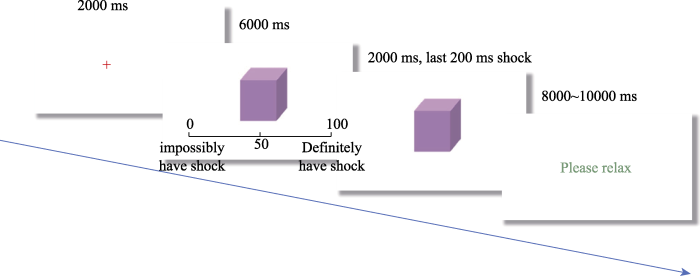
Figure 2.
Flow chart of stimulation and electric shock presentation.
Day 2: Reactivation and Extinction Phase. Before starting, participants were asked if they remembered the information from the first day and were informed that the same stimuli would be presented. Participants were re-fitted with the shock and Biopac MP36 devices, and the shock intensity was adjusted to the level rated as “8” on the first day. Participants in the experimental group with 0 retrieval trials (Group E) directly entered the extinction phase, where 12 CS+ and 12 CS− were randomly presented without shocks. Participants in the experimental group with 1 retrieval trial (Group R1) had one non-shocked CS+ trial, then rested for 10 min, during which they watched a 9 min neutral video, before entering the extinction phase. Participants in the experimental groups with 2 or 4 retrieval trials (Groups R2 and R4) had 2 or 4 non-shocked CS+ trials, respectively, then rested for 10 min before entering the extinction phase. During both the acquisition and retrieval-extinction phases, a subjective expectation rating slider was displayed at the bottom of the computer screen, allowing participants to rate their current level of fear at any time without receiving a shock.
Day 3: Spontaneous Recovery Test Phase. Participants entered the laboratory and were fitted with the equipment and connected to the devices. After the experiment started, a red fixation point “+” was presented on the screen for 2000 ms to capture participants' attention, followed by the random presentation of 12 CS+ and 12 CS− stimuli without shocks, measuring the recovery of fear memory. Participants were required to maintain full attention on the computer screen and rate the likelihood of shock association using the subjective expectation rating slider.
Day 4: Fear Memory Reinstatement Test Phase. Participants entered the laboratory and were fitted with the equipment and connected to the devices. After the experiment started, participants were presented with four consecutive unexpected shocks, each lasting 200 ms with a 1000 ms interval between shocks. Participants then rested for 5 min before the random presentation of 12 CS+ and 12 CS− stimuli without shocks, measuring the reinstatement of fear memory. Participants were again required to rate the likelihood of shock association. After the experiment, participants received compensation. The schedule and order of spontaneous recovery and reinstatement tests were based on previous studies (Sartor & Aston-Jones, 2014; Shumake & Monfils, 2015). The overall experimental procedure is shown in Figure 3.
Figure 3.
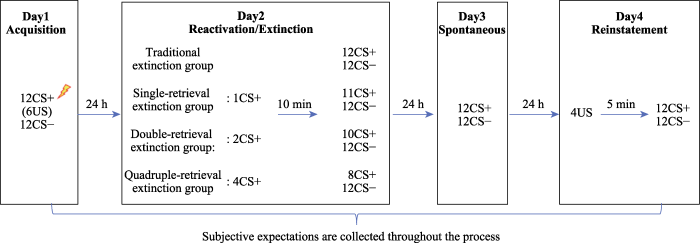
Figure 3.
Overall experimental flow chart.
3 Experimental Results
3.1 Skin Conductance Response Analysis
The SCR data for the four groups during the fear acquisition, reactivation and extinction, spontaneous recovery test, and reinstatement test phases are shown in Figure 4.
Figure 4.
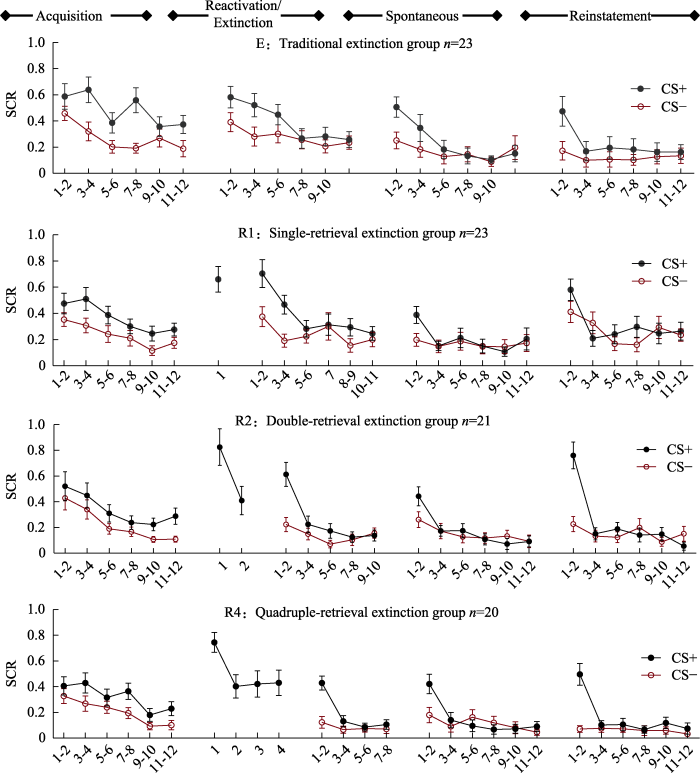
Figure 4.
Four groups of participants in the fear memory acquisition, reactivation, extinction, spontaneous and reinstatement phase of the skin conductance response.
Note. E: The x axis represents the trials; Error bar stands for standard error.
Day 1: Acquisition Phase. A 2 (stimulus type: CS+, CS−) × 2 (phase: first half of acquisition trials, second half of acquisition trials) × 4 (group) multifactor repeated measures ANOVA was conducted on the acquisition phase of the four groups. The results showed a significant main effect of stimulus type, F(1, 83) = 37.89, p < 0.001, η2p = 0.31; a significant main effect of phase, F(1, 83) = 67.36, p < 0.001, η2p = 0.45; non-significant interaction effect between stimulus type and group, F(3, 83) = 0.92, p = 0.435; non-significant interaction effect between phase and group, F(3, 83) = 0.43, p = 0.732; non-significant interaction effect between stimulus type and phase, F(1, 83) = 0.18, p = 0.675; non-significant interaction effect between stimulus type, phase, and group, F(3, 83) = 0.31, p = 0.817; and non-significant between-group differences, F(3, 83) = 1.10, p = 0.353. These results indicate that there were no significant overall differences in fear responses to CS+ and CS− across the four groups. Paired-sample t-tests on the SCR of CS+ and CS− in the second half of the acquisition trials (trials 7-12) for each group revealed significant differences for Group E, t(22) = 3.18, p = 0.004, d = 0.66; Group R1, t(22) = 2.04, p = 0.027, d = 0.42; Group R2, t(20) = 1.92, p = 0.035, d = 0.42; and Group R4, t(19) = 3.99, p < 0.001, d = 0.89. These results indicate that all four groups successfully acquired the conditioned fear response to CS+.
Day 2: Extinction Phase. A 2 (stimulus type: CS+, CS−) × 2 (phase: first half of extinction trials, second half of extinction trials) × 4 (group) multifactor repeated measures ANOVA was conducted on the extinction phase of the four groups. The results showed a significant main effect of stimulus type, F(1, 83) = 27.64, p < 0.001, η2p = 0.25; a significant main effect of phase, F(1, 83) = 89.26, p < 0.001, η2p = 0.52; non-significant interaction effect between stimulus type and group, F(3, 83) = 1.02, p = 0.390; non-significant interaction effect between phase and group, F(3, 83) = 0.30, p = 0.824 F(3, 83) = 0.30, p = 0.824; significant interaction effect between stimulus type and phase, F(1, 83) = 15.02, p < 0.001, η2p = 0.15; non-significant interaction effect between stimulus type, phase, and group, F(3, 83) = 0.26, p = 0.853; and significant between-group differences, F(3, 83) = 3.32, p = 0.024, η2p = 0.11. These results indicate significant changes in responses from the first to the second half of the extinction phase across the four groups. Because the extinction trials used for the ANOVA in each group were different (Groups R1, R2, and R4's extinction trials excluded the retrieval trials of CS− in order to use an equal number of CS+ and CS− for analysis, as shown in Figure 5), this can explain the between-group differences in overall SCR. Since the results of spontaneous recovery and the preceding extinction phase are related, paired-sample t-tests were conducted on the SCR of the last trial of CS+ and CS− in the extinction phase for each group to verify successful extinction. The results showed no significant differences for Group E, t(22) = 0.97, p = 0.345; Group R1, t(22) = 1.71, p = 0.101; Group R2, t(20) = 0.39, p = 0.699; and Group R4, t(19) = 0.89, p = 0.387, indicating that all four groups successfully completed fear extinction.
Figure 5.
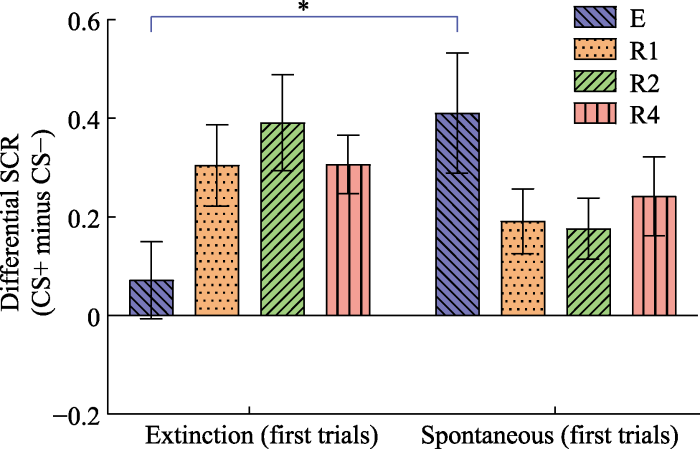
Figure 5.
Comparison of extinction after retrieval in each group
Note. E: Traditional extinction group, R1: Single-retrieval extinction group, R2: Double-retrieval extinction group, R4: Quadruple-retrieval extinction group. *p < 0.05.
Post-retrieval Effect Analysis. Following previous studies, the mean differential skin conductance response (mdSCR) was used, calculated as the difference in SCR between CS+ and CS− (Chen et al., 2020; Schiller et al., 2010). To further explore the extinction effect brought by brief retrieval, a 4 (group) × 2 (first extinction trial, first spontaneous recovery trial) two-factor repeated measures ANOVA was conducted. The results showed no significant main effect of trial, F(1, 83) = 0.05, p = 0.830; no significant main effect of group, F(3, 83) = 0.12, p = 0.95; but a significant interaction effect between trial and group, F(3, 83) = 4.85, p = 0.004, η2p = 0.15. These results indicate significant differences in subsequent extinction effects due to different retrieval exposure durations. Simple effect analysis revealed significant differences for Group E, t(22) = −2.47, p = 0.022, d = 0.30; non-significant differences for Group R1, t(22) = 1.08, p = 0.290; Group R2, t(20) = 2.03, p = 0.056; and Group R4, t(19) = 0.74, p = 0.471. These results indicate that brief retrieval can affect subsequent extinction effects, as Group E, which had no retrieval process and proceeded directly to extinction, showed significant differences compared to the other three groups.
Spontaneous Recovery Effect Analysis. Following previous studies, the change in mdSCR from the last extinction trial on Day 2 to the first spontaneous recovery trial on Day 3 was used as the index for spontaneous recovery (Chen et al., 2020; Schiller et al., 2010). A 4 (group) × 2 (trial) two-factor repeated measures ANOVA was conducted on the two key trials of the four groups. The results showed a significant main effect of trial, F(1, 83) = 18.31, p < 0.001, η2p = 0.18; no significant main effect of group, F(3, 83) = 0.63, p = 0.596; and no significant interaction effect between trial and group, F(3, 83) = 0.37, p = 0.778, indicating a significant increase in the differential SCR from Day 2 to Day 3, suggesting a spontaneous recovery effect. To better detect the size of the spontaneous recovery effect in each group, key trial mdSCR changes were compared within groups. Paired-sample t-tests on the mdSCR of the last extinction trial and the first spontaneous recovery trial revealed significant differences for Group E, t(22) = −2.70, p = 0.013, d = −0.56; non-significant differences for Group R1, t(22) = −1.47, p = 0.155; significant differences for Group R2, t(20) = −3.01, p = 0.007, d = −0.66; and non-significant differences for Group R4, t(19) = −2.09, p = 0.050. These results indicate significant spontaneous recovery effects for Groups E and R2, reflected in a significant increase in mdSCR from the last extinction trial to the first spontaneous recovery trial, while Groups R1 and R4 did not show significant increases, indicating no significant spontaneous recovery effect. Additionally, comparisons of the mdSCR of the first spontaneous recovery trial among the four groups showed no significant differences between any two groups. Overall, these results suggest that compared to Groups E and R2, Groups R1 and R4 can weaken the degree of spontaneous recovery of the original fear memory. The spontaneous recovery results for the four groups are shown in Figure 6.
Figure 6.
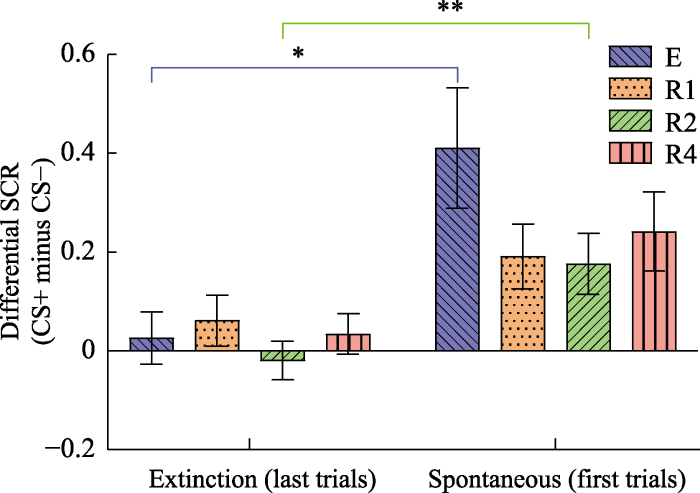
Figure 6.
Comparison of spontaneous recovery of fear memory in each group.
Note. E: Traditional extinction group, R1: Single-retrieval extinction group, R2: Double-retrieval extinction group, R4: Quadruple-retrieval extinction group. Spontaneous recovery index = spontaneous recovery of the first trial of SCR value - extinction of the last trial of SCR value (Schiller et al., 2010). *p < 0.05, **p < 0.01
Fear Reinstatement Effect Analysis. Following previous studies, the change in mdSCR from the last spontaneous recovery trial on Day 3 to the first reinstatement trial on Day 4 was used as the index for fear reinstatement (Chen et al., 2020; Schiller et al., 2010). A 4 (group) × 2 (trial) two-factor repeated measures ANOVA was conducted on the two key trials of the four groups. The results showed a significant main effect of trial, F(1, 83) = 34.87, p < 0.001, η2p = 0.30; non-significant main effect of group, F(3, 83) = 1.72, p = 0.169; and non-significant interaction effect between trial and group, F(3, 83) = 2.03, p = 0.116, indicating a significant increase in the differential SCR from Day 3 to Day 4, suggesting a fear reinstatement effect. To better detect the size of the fear reinstatement effect in each group, key trial mdSCR changes were compared within groups. Paired-sample t-tests on the mdSCR of the last spontaneous recovery trial and the first reinstatement trial revealed significant differences for Group E, t(22) = −2.48, p = 0.021, d = −0.52; non-significant differences for Group R1, t(22) = −1.07, p = 0.296; significant differences for Group R2, t(20) = −4.95, p < 0.001, d = −1.08; and significant differences for Group R4, t(19) = −4.46, p < 0.001, d = −0.99. These results indicate significant fear reinstatement effects for Groups E, R2, and R4, reflected in a significant increase in mdSCR from the last spontaneous recovery trial to the first reinstatement trial, while Group R1 did not show a significant increase, indicating no significant reinstatement effect. Additionally, comparisons of the mdSCR of the first reinstatement trial among the four groups showed that Group R1 was significantly lower than Group R2, t(20) = −2.74, p = 0.013, d = −0.60, and significantly lower than Group R4, t(19) = −2.14, p = 0.046, d = −0.48. No other significant differences were found between any other pairs of groups. Overall, these results suggest that compared to Group R1, Groups E, R2, and R4 do not weaken the degree of fear response after US reinstatement, as shown in Figure 7.
Figure 7.
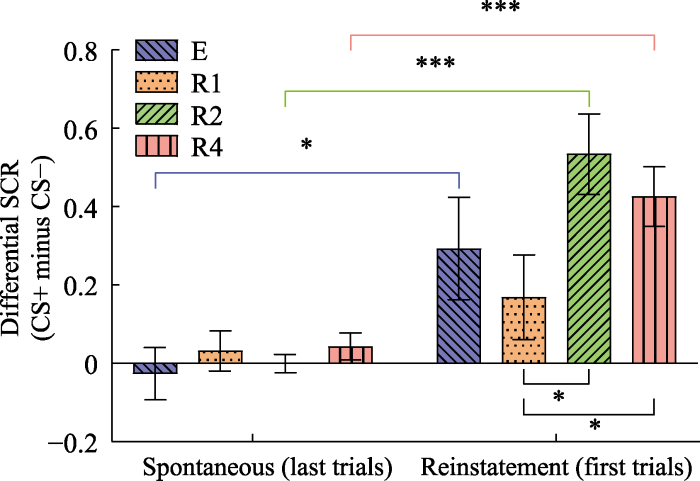
Figure 7.
Comparison of reinstatement test of fear memory in each group.
Note. E: Traditional extinction group, R1: Single-retrieval extinction group, R2: Double-retrieval extinction group, R4: Quadruple-retrieval extinction group. Fear reinstatement index = reinstatement of the first trial of SCR value - spontaneous recovery of the first trial of SCR value (Schiller et al., 2010). *p < 0.05, ***p < 0.001
3.2 Analysis of US Subjective Expectation Ratings and Prediction Error Quantification
The subjective expectation rating data for the US were imported into MATLAB 2022a, and the expected value V for each trial was calculated using the model. This allowed for the determination of the prediction error for each trial during the acquisition and retrieval-extinction phases (i.e.,
Figure 8.
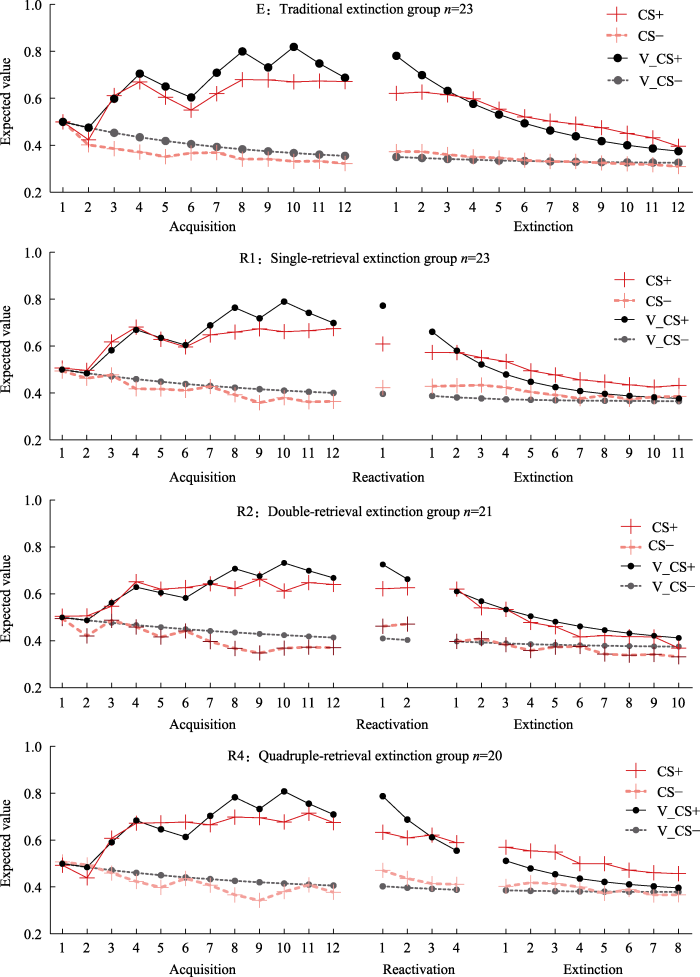
Figure 8.
The subjective expected value and the fitting expected value of the acquisition and retrieval-extinction phase in each group.
Note. The red dotted line is the expected value of the subject's subjective assessment, and the black solid line is the expected value of the reinforcement learning model fit. The color map is available in electronic version
Since this study focuses on the differences in US expected values and prediction errors for CS+ trials among the four groups during the retrieval-extinction phase on the second day, only CS+ trials from the second day were statistically analyzed. A 12 (trials on the second day) × 4 (groups) two-factor repeated measures ANOVA was conducted on the US subjective expectation values for CS+ during the retrieval-extinction phase. The results showed a significant main effect of trials, F(11, 869) = 56.65, p < 0.001, η2p = 0.42; no significant between-group differences, F(3, 79) = 0.49, p = 0.690; and no significant interaction effect between trials and groups, F(33, 869) = 0.87, p = 0.674. These results indicate significant changes in responses throughout the extinction phase for all four groups, but no significant differences between the groups.
Table 2. The model fits the main parameters
| Group | α | model error | average PE |
|---|---|---|---|
| E | 0.18 | 0.14 | 0.19 |
| R1 | 0.27 | 0.12 | 0.12 |
| R2 | 0.18 | 0.09 | 0.15 |
| R4 | 0.24 | 0.14 | 0.14 |
Note. E: Traditional extinction group, R1: Single-retrieval extinction group, R2: Double-retrieval extinction group, R4: Quadruple-retrieval extinction group. α is the learning rate in day2, model error is the model fitting error, and average PE is the mean of the absolute values of prediction error in day2 calculated by the model.
Figure 9.
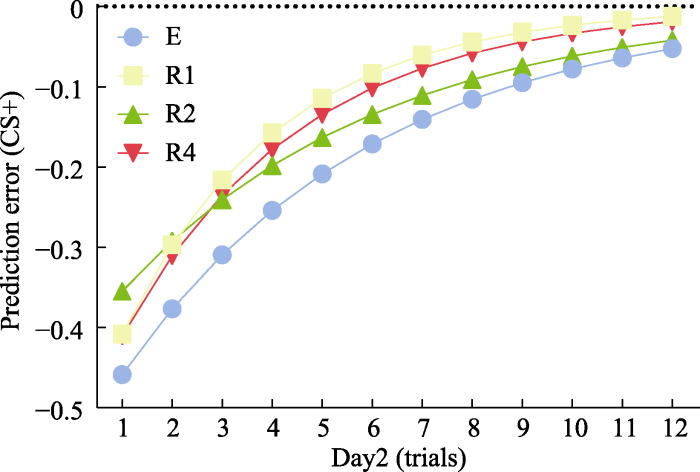
Figure 9.
The prediction error value generated by 12 trials on the second day of the four groups of participants.
Note. E: Traditional extinction group, R1: Single-retrieval extinction group, R2: Double-retrieval extinction group, R4: Quadruple-retrieval extinction group.
A 12 (trials on the second day) × 4 (groups) two-factor repeated measures ANOVA was conducted on the PE values for CS+ on the second day. The results showed a significant main effect of trials, F(11, 869) = 1176.79, p < 0.001, η2p = 0.94; significant between-group differences, F(3, 79) = 15.49, p < 0.001, η2p = 0.37; and a significant interaction effect between trials and groups, F(33, 869) = 5.10, p < 0.001, η2p = 0.16. These results indicate significant changes in responses over time on the second day and significant differences between the groups. Further analysis revealed that the change in PE values for Group R1 on the second day was significantly greater than that for the other three groups. The order of the PE values on the second day from smallest to largest was R1 < R4 < R2 < E. Combining the SCR results, Groups R1 and R4 showed better inhibition of spontaneous recovery in the spontaneous recovery test, while only Group R1 showed better inhibition of fear reinstatement in the reinstatement test. This follows a certain order of PE values for the four groups. Overall, the combined results of SCR and prediction error quantification suggest that the smaller the average PE value for the trials on the second day (see Table 2), the better the extinction effects on the third and fourth days.
4 Discussion
This study collected skin conductance response and subjective expectation ratings, combined with the simplified Rescorla-Wagner reinforcement learning model to fit the prediction error quantification curve. Based on the experimental design that transitions from the traditional extinction paradigm to the retrieval-extinction paradigm, extinction training was divided into retrieval and extinction phases according to the number of retrieval trials, resulting in four different retrieval exposure durations: traditional extinction, single-retrieval extinction, double-retrieval extinction, and quadruple-retrieval extinction. This study compared the effectiveness of conditioned fear memory extinction under these four conditions. The results showed that under the premise of equal levels of acquisition and extinction of fear memory among the four groups, the spontaneous recovery test revealed that the single-retrieval extinction group and the quadruple-retrieval extinction group did not exhibit significant spontaneous recovery effects, indicating a certain inhibitory effect on fear spontaneous recovery. In contrast, the traditional extinction group and the double-retrieval extinction group exhibited significant spontaneous recovery effects. In the fear reinstatement test, only the single-retrieval extinction group showed some inhibition of fear reinstatement, whereas the other three groups exhibited significant fear reinstatement effects. Furthermore, the subjective expectation and PE quantification results for CS+ trials on the second day for the four groups indicated that there were no significant between-group differences in the subjective expectation of whether CS+ was accompanied by a shock. However, the PE quantification revealed that the single-retrieval extinction group exhibited the greatest change in PE for CS+ trials on the second day, with the overall smallest PE value.
4.1 The Impact of Retrieval Trial Quantity on the Transformation from Traditional Extinction Paradigm to Retrieval-Extinction Paradigm
In this study, although the number of CS presentations on the second day was the same for all four groups (12 CS+ and 12 CS−), the different allocation of trials to the retrieval phase resulted in varying effects on conditioned fear memory extinction. This indicates that, in the process of transforming the traditional extinction paradigm into the retrieval-extinction paradigm, the number of retrieval trials is crucial for successful transformation (i.e., preventing fear relapse), in addition to requiring a time interval between retrieval and extinction trials. In this experiment, the successful transformation from the traditional extinction paradigm to the retrieval-extinction paradigm was observed in the single-retrieval extinction group, which inhibited fear relapse on the third and fourth days. In contrast, the double-retrieval extinction group and the quadruple-retrieval extinction group failed to inhibit fear relapse, showing no superior effect in fear extinction compared to the traditional extinction group. Presently studies demonstrating that the retrieval-extinction effect is superior to traditional extinction generally include the following exposure duration parameters: 1-3 CS retrieval trials in cued fear conditioning and 2-4 minutes of contextual exposure in contextual fear conditioning. Exposure durations shorter or longer than these parameters may lead to the loss of the fear extinction advantage of the retrieval-extinction paradigm (Raskin & Monfils, 2023). However, most of these studies are based on rodent models of conditioned fear, and research in human conditioned fear models is still relatively scarce. This study obtained results similar to those from rodent research in human, indicating that simply dividing phases is not sufficient to transform the traditional extinction paradigm into the retrieval-extinction paradigm. The retrieval exposure duration affects the effectiveness of the retrieval-extinction paradigm, with appropriate retrieval exposure duration (one CS retrieval trial in this experiment) being necessary for successful transformation.
The reason for this phenomenon is that the retrieval-extinction paradigm, which effectively inhibits fear relapse, is based on reconsolidation theory, whereas the traditional extinction paradigm is based on extinction learning. The mechanisms involved are different. Research has found that initial CS presentations in both traditional extinction and retrieval-extinction processes activate the prefrontal cortex and amygdala. However, as CS presentations continue, their neural activation patterns diverge. The traditional extinction paradigm continues to engage the prefrontal cortex, whereas the retrieval-extinction paradigm does not (Cahill & Milton, 2019). While both paradigms continue to activate the amygdala, the retrieval-extinction paradigm activates the same neuronal cell clusters that were active during fear acquisition (Khalaf et al., 2018). Additionally, studies have found that in the lateral amygdala (LA), AMPA receptors containing the GluR1 subunit are phosphorylated after a single CS presentation in the retrieval-extinction group, but are dephosphorylated during the second CS presentation one hour later, leading to a reduction in AMPA receptor-mediated transmission in the LA, weakening the CS-US connection. This change is not observed in the traditional extinction group (Clem & Huganir, 2010; Monfils et al., 2009). Many animal studies using immunohistochemistry to compare the differences in the location, type, and number of active neurons during retrieval-extinction and traditional extinction indicate that the two paradigms initially exhibit similar activation patterns but diverge as the process progresses (Khalaf & Graff, 2019; Lee et al., 2015; Tedesco et al., 2014). Therefore, the process of transforming the traditional extinction paradigm into the retrieval-extinction paradigm involves a mechanism shift, with retrieval exposure duration playing a critical regulatory role as a behavioral variable in this series of complex cellular and molecular mechanism changes.
4.2 Reconsolidation Update and Extinction Learning Enhancement as Two Mechanisms for Fear Memory Elimination
Previous studies using the classic three-day paradigm (with various fear relapse tests on the third day) have not been able to effectively compare the intervention effects of different fear elimination paradigms on conditioned fear responses. This is because the close proximity of the second and third days may result in inconsistent outcomes between spontaneous recovery and fear reinstatement tests, making it difficult to interpret and qualitatively determine the occurrence of fear relapse (Haaker et al., 2014; Lonsdorf et al., 2017). To evaluate the impact of different exposure durations on the fear elimination effect of the retrieval-extinction paradigm, this study adopted a four-day experimental paradigm. Tests were conducted over two days: the spontaneous recovery test was performed 24 hours after the retrieval-extinction phase, followed by the fear reinstatement test another 24 hours later. SCR analysis results indicated that in the single-retrieval extinction group, there were no significant spontaneous recovery or fear reinstatement effects in the key trials on both the third and fourth days, indicating a strong inhibitory effect on fear relapse. In contrast, the quadruple-retrieval extinction group exhibited a fear reinstatement effect only in the key trials on the fourth day, with no significant spontaneous recovery effect on the third day, indicating a weaker inhibitory effect on fear relapse. Combining previous research with our experimental results, we propose two main pathways for eliminating conditioned fear responses in conditioned fear models: reconsolidation update and extinction learning enhancement (Vaverkova et al., 2020).
Clinical exposure therapy based on the traditional extinction paradigm is prone to relapse. Therefore, researchers have explored many variations of the traditional extinction paradigm (including the retrieval-extinction paradigm) to improve and inhibit fear relapse phenomena (such as spontaneous recovery, reinstatement, and renewal). Besides the retrieval-extinction paradigm, which is based on a fundamentally different fear elimination mechanism from the traditional extinction paradigm, there are other variations that enhance the extinction learning-based extinction memory strength, increasing its competitive advantage over the original memory and effectively inhibiting short-term fear relapse. Examples include gradual extinction, vicarious extinction, and deepened extinction (Golkar et al., 2013; Leung et al., 2012; Shiban et al., 2015). Some scholars believe that only retrieval-extinction paradigms that meet specific boundary conditions are based on reconsolidation update, while other retrieval-extinction studies may also be based on extinction learning enhancement. If fear relapse tests are limited, misjudgments may occur (Monfils & Holmes, 2018). Researchers in rodent conditioned fear models have formed two experimental groups by swapping the number of retrieval and extinction trials. They found that both groups successfully eliminated fear responses in long-term memory tests (24 hours after intervention), but showed differences in short-term memory tests (3.25 hours after intervention). If based on reconsolidation update, fear responses would appear in short-term memory tests; if based on extinction learning enhancement, they would not, as the inhibitory effect of forming extinction memory manifests immediately. Similar results have been found in human conditioned fear models (Chen et al., 2021; Ponnusamy et al., 2016). Therefore, although both the single-retrieval extinction group and the quadruple-retrieval extinction group could inhibit spontaneous recovery, they may involve different mechanisms. Based on the test results on the last two days, it can be inferred that the single-retrieval extinction group is based on reconsolidation update, affecting the original memory trace. The absence of spontaneous recovery on the third day indicates that the original memory has been updated to a safe memory, hence no fear reinstatement effect on the fourth day. The quadruple-retrieval extinction group is based on extinction learning enhancement, forming a competitive extinction memory trace that competes with the original fear memory. On the third day, the extinction memory is dominant, but over time, the original fear memory outcompetes the extinction memory on the fourth day, leading to fear relapse. Due to the use of only SCR indicators, this study can only speculate on the mechanisms of fear elimination, and further verification with cognitive neuroscience indicators is needed.
4.3 Prediction Error Mediated Transition of Memory from Reconsolidation to Extinction Due to Exposure Duration
After acquiring Pavlovian associative memory, re-exposure to the CS will sequentially undergo several retrieval-dependent memory processes: solo retrieval (memory expression), reconsolidation, “limbo” (a state between reconsolidation and extinction), and extinction. The fate of the memory will shift with increased exposure duration (de Oliveira Alvares & Do-Monte, 2021; Kida, 2023). Rodent studies on conditioned fear have shown that brief CS exposure leads to memory reconsolidation, while longer CS exposure triggers extinction, indicating that the fate of the memory post-retrieval depends on the exposure duration. Fear memory interrupts the reconsolidation process and triggers extinction learning as the retrieval duration increases (Bustos et al., 2009; Suzuki et al., 2004). Research has found that extracellular signal-regulated kinase (ERK) phosphorylation in the hippocampus, amygdala, and medial prefrontal cortex increases transiently during the transition from reconsolidation to extinction. In this transitional process, ERK acts as a molecular switch to abolish reconsolidation and initiate extinction learning (Fukushima et al., 2021; Merlo et al., 2018). However, the exposure duration that determines whether memory enters reconsolidation or triggers extinction learning can vary with different experimental settings. We can only ascertain that longer retrieval exposure durations are more likely to result in extinction learning, making it challenging to define specific exposure duration parameters suitable for memory reconsolidation. To clarify the regulatory role of retrieval exposure duration on memory reconsolidation and extinction, further exploration of the changes induced by CS exposure is needed.
The consolidation, reconsolidation, and extinction of Pavlovian associative memory are all based on error-driven learning theory. Prediction error, the difference between the predicted and actual occurrence of the CS-US association, is essential for all retrieval-dependent memory processes (Vaverkova et al., 2020). Therefore, the amount of prediction error induced during the retrieval phase may be the underlying mechanism through which exposure duration regulates memory reconsolidation and extinction. The quantification results of PE induced by CS+ trials on the second day for each group in this study revealed that although the number of trials was the same, the PE induced by fixed-order trials varied between groups. Additionally, the overall change in PE across 12 trials differed between groups. The single-retrieval extinction group showed a significantly greater change in PE on the second day compared to the other three groups. Overall, the PE values from smallest to largest were R1 < R4 < R2 < E, corresponding to the ranking of fear elimination effectiveness across the four groups. This indicates that triggering memory reconsolidation during the retrieval phase is reflected by the accelerated reduction in PE values. The overall PE values induced by the intervention trials can predict the effectiveness of fear elimination, with lower PE values indicating better outcomes. Furthermore, additional analysis of the PE differences induced by retrieval trials among the three retrieval-extinction groups showed that the PE value induced by one retrieval trial in Group R1 was 0.41, the total PE value induced by two retrieval trials in Group R2 was 0.65 (mean 0.32), and the total PE value induced by four retrieval trials in Group R4 was 1.13 (mean 0.28). This demonstrates that we cannot simply rely on the total PE value of all retrieval trials or the PE value of the last retrieval trial to determine the fate of the memory. The determination of whether memory enters reconsolidation or extinction based on the size of the prediction error during the retrieval phase cannot be achieved through simple summation. Given the different exposure durations, it is likely that the prediction errors of all retrieval trials are integrated in a certain functional relationship. More complex computational models will be required for fitting and verification in the future.
4.4 Summary and Prospects
This study set up four different quantities of retrieval trials (0, 1, 2, 4) to represent different CS exposure durations. Combined with previous research and the results of this study, it can be confirmed that the quantity of retrieval trials is most directly related to the fate of the memory after retrieval. The underlying mechanism is related to the pattern of PE changes induced by the trials. It is worth noting that the relationship between the prediction error induced by retrieval exposure duration and the retrieval-extinction effect in this study is only speculative. In future studies, appropriate statistical methods could be used to directly correlate the two, thereby obtaining a predictive role of retrieval-induced prediction error on the retrieval-extinction effect. Additionally, due to the relatively simple data measurement and PE quantification methods used in this study, the exact exposure duration and the prediction error parameters generated from the transition of memory from reconsolidation to extinction after retrieval cannot yet be fully parameterized. Although different cellular and molecular markers represent reconsolidation and extinction in animal studies, they only provide insight into the mechanisms of retrieval-dependent memory reconsolidation and extinction. These markers cannot be used in human studies and are even more challenging to translate clinically (Raskin & Monfils, 2023). Future research needs to delve deeper into identifying observable, real-time, non-invasive specific neural markers in human studies that determine the reconsolidation and extinction processes of memory. This will help explore the reasons for many negative results in reconsolidation intervention studies (whether the retrieval operation failed to destabilize the memory) and assist in designing new, more reliable clinical treatment methods for maladaptive emotional memories (such as post-traumatic stress disorder, phobias, and drug addiction).
Reference
Prediction error and trace dominance determine the fate of fear memories after post-training manipulations
Context and behavioral processes in extinction
Disruptive effect of midazolam on fear memory reconsolidation: Decisive influence of reactivation time span and memory age.
DOI:10.1038/npp.2008.75
URL
PMID:18509330
[Cited within: 1]

Benzodiazepine (BDZ) administered shortly after retrieval disrupts the reconsolidation of fear memory. In this research, we explored the way in which different factors that limit the emergence of such process may affect BDZ's disruptive effect on fear memory reconsolidation. Animals were conditioned in a contextual fear paradigm; the consolidated memory was reactivated by exposure to the associated context for different periods of time that were followed by midazolam (MDZ) administration. We also studied MDZ amnesic effect after reactivating fear memories of several ages. We finally analyzed the effectiveness of different MDZ doses in preventing the reconsolidation of different age fear memories. The memory trace was disrupted following MDZ when the reactivation session lasted 3-5 min but it was not after a briefer 1-min reactivation period. Over a 10-min reactivation session, all animals gradually reduced their fear response, which indicates the emergence of the extinction process. When tested, MDZ rats exhibited a robust fear, suggesting that MDZ impaired the consolidation of extinction. In a 3-min reactivation session, MDZ (1-1.5 mg/kg) prevented the reconsolidation of recently acquired memories. A 21-day-old fear memory was only vulnerable to MDZ at a 1.5 mg/kg dose with a reactivation session of 5 and not 3 min, whereas a 36-day-old memory was only disrupted with a higher MDZ dose (3 mg/kg) regardless of the reactivation trial's duration. This study demonstrated MDZ's interference on fear-memory reconsolidation within a relatively short reactivation period in recently acquired memories. Over longer reexposure, MDZ disrupts the consolidation of extinction. A longer duration of the reexposure session, as well as higher MDZ doses, is required to prevent the reconsolidation process of remote fear memories.
Neurochemical and molecular mechanisms underlying the retrieval-extinction effect
No persistent attenuation of fear memories in humans: A registered replication of the reactivation-extinction effect
DOI:S0010-9452(20)30170-2
URL
PMID:32580869
[Cited within: 1]
It has been proposed that memory retrieval can destabilize consolidated memories, after which they need to be reconsolidated in order to be retained. The presentation of relevant information during memory reconsolidation could then result in the modification of a destabilized memory trace, by allowing the memory trace to be updated before being reconsolidated. In line with this idea, Schiller et al. (2010) have demonstrated that memory retrieval shortly before extinction training can prevent the later recovery of conditioned fear responding that is observed after regular extinction training. Those findings have been the subject of considerable controversy, due in part to theoretical reasons but also due to a number of failures to obtain similar results in conceptual replication attempts. Here, we report the results of a highly powered, direct, independent replication of the critical conditions of Schiller et al. (2010, Experiment 1). Due to misrepresentation of the exclusion criteria in the original Schiller et al. (2010) report, data collection was considerably delayed. When we eventually managed to attain our pre-registered sample size, we found that we could not observe any benefit of reactivation-extinction over regular extinction training in preventing recovery of conditioned fear. The results of the present study, along with the mixed findings in the literature and the misreporting in Schiller et al. (2010), give cause to question whether there is robust evidence that reactivation-extinction prevents the return of fear in humans.Copyright © 2020 Elsevier Ltd. All rights reserved.
Effects of prediction error on post-retrieval extinction of fear to compound stimuli
DOI:10.3724/SP.J.1041.2018.00739
URL
[Cited within: 1]
<p id="C2">Memories with a strong fear emotional connotation play a pathogenic role in a variety of emotional disorders, including post-traumatic stress disorder (PTSD), anxiety disorder and phobia. So how to fundamentally eliminate the acquired fear memory and prevent relapse has been the difficulties of clinical treatment. The retrieval extinction paradigm, which is based on the memory reconsolidation theory, was demonstrated an effective and promising way in eliminating undesired memories. The key of this paradigm is how to retrieve fear memory to undergo reconsolidation, which makes the memory fragile and labile. Research has shown that when a mismatch between what is expected based on previous experiences and the actual state of events at retrieval, the prediction error will occur so that the memory will undergo reconsolidation. In the present study, we change CS-US (conditioned stimulus-unconditioned stimulus) matching rules during the retrieval to manipulate the conditions of PE to explore whether the amount of PE is a crucial factor to open reconsolidation window. </p><p id="C100">In the current study, two tones and four colored figures were used, one of the tones and two of the figures (CS+) were paired with a mild shock to the wrist (US) on 50% of the trails, while the other figures and tones were never paired with shock (CS-). the skin conductance response (SCR) was the measure of fear. Four groups of participants were fear conditioned on day1 using a 50% reinforcement schedule, in such a way that they could expect the CS to be followed by shock every other trial. During memory reactivation on day2, participants received one unreinforced CS+ (No PE group), two unreinforced CS+ (Negative PE group), two reinforced CS+ (Positive PE group) and four unreinforced CS+ (Multiple PE group) respectively, following extinction training. On day3, participants took part in tests of spontaneous recovery and reinstatement of fear through re-extinction and regaining. </p><p id="C100">The results showed that the SCR was not significantly different among the four groups in the fear conditioning of the first day and extinction of the second day. However, on the third day, No PE group and Multiple PE group showed increased SCR in spontaneous fear recovery and reinstatement test, whereas Negative PE group and Positive PE group did not show any significant increased SCR in spontaneous fear recovery or reinstatement. </p><p id="C100">Our study provided further evidence that the behavioral interference during reconsolidation (retrieval- extinction) can effectively eliminate fear and block fear relapse under certain circumstances. According to the results, we demonstrate that the prediction error is a necessary condition of initiating reconsolidation and a lack of prediction error during retrieval will leave the memory trace in an inactive state. Additionally, the amount of PE is a crucial factor and too much prediction error will cause failure. It is inferred that a limited degree of mismatch between the memory and events at the time of retrieval will induce memory destabilization.</p>
Destabilizing different strengths of fear memories requires different degrees of prediction error during retrieval
Retrieval-extinction as a reconsolidation-based treatment for emotional disorders:Evidence from an extinction retention test shortly after intervention
Calcium-permeable AMPA receptor dynamics mediate fear memory erasure
DOI:10.1126/science.1195298
URL
PMID:21030604
[Cited within: 2]
Traumatic fear memories can be inhibited by behavioral therapy for humans, or by extinction training in rodent models, but are prone to recur. Under some conditions, however, these treatments generate a permanent effect on behavior, which suggests that emotional memory erasure has occurred. The neural basis for such disparate outcomes is unknown. We found that a central component of extinction-induced erasure is the synaptic removal of calcium-permeable α-amino-3-hydroxyl-5-methyl-4-isoxazole-propionate receptors (AMPARs) in the lateral amygdala. A transient up-regulation of this form of plasticity, which involves phosphorylation of the glutamate receptor 1 subunit of the AMPA receptor, defines a temporal window in which fear memory can be degraded by behavioral experience. These results reveal a molecular mechanism for fear erasure and the relative instability of recent memory.
Role of the amygdala in fear extinction measured with potentiated startle
Understanding the dynamic and destiny of memories
DOI:10.1016/j.neubiorev.2021.03.009
URL
PMID:33722616
[Cited within: 1]
Memory formation enables the retention of life experiences overtime. Based on previously acquired information, organisms can anticipate future events and adjust their behaviors to maximize survival. However, in an ever-changing environment, a memory needs to be malleable to maintain its relevance. In fact, substantial evidence suggests that a consolidated memory can become labile and susceptible to modifications after being reactivated, a process termed reconsolidation. When an extinction process takes place, a memory can also be temporarily inhibited by a second memory that carries information with opposite meaning. In addition, a memory can fade and lose its significance in a process known as forgetting. Thus, following retrieval, new life experiences can be integrated with the original memory trace to maintain its predictive value. In this review, we explore the determining factors that regulate the fate of a memory after its reactivation. We focus on three post-retrieval memory destinies (reconsolidation, extinction, and forgetting) and discuss recent rodent studies investigating the biological functions and neural mechanisms underlying each of these processes.Copyright © 2021. Published by Elsevier Ltd.
Detection of a temporal error triggers reconsolidation of amygdala-dependent memories
Updating memories—The role of prediction errors in memory reconsolidation
DOI:10.1016/j.bbr.2014.10.011
URL
PMID:25453746
[Cited within: 1]
Memories are not static imprints of past experience, but rather are dynamic entities which enable us to predict outcomes of future situations and inform appropriate behaviours. In order to maintain the relevance of existing memories to our daily lives, memories can be updated with new information via a process of reconsolidation. In this review we describe recent experimental advances in the reconsolidation of both appetitive and aversive memory, and explore the neuronal mechanisms that underpin the conditions under which reconsolidation will occur. We propose that a prediction error signal, originating from dopaminergic midbrain neurons, is necessary for destabilisation and subsequent reconsolidation of a memory. Copyright © 2014 Elsevier B.V. All rights reserved.
Memory retrieval, reconsolidation, and extinction: Exploring the boundary conditions of post-conditioning cue exposure
Regulation of learned fear expression through the MgN-amygdala pathway
Active transition of fear memory phase from reconsolidation to extinction through ERK-mediated prevention of reconsolidation
The computational nature of memory modification
Other people as means to a safe end: Vicarious extinction blocks the return of learned fear
DOI:10.1177/0956797613489890
URL
PMID:24022651
[Cited within: 1]
Information about what is dangerous and safe in the environment is often transferred from other individuals through social forms of learning, such as observation. Past research has focused on the observational, or vicarious, acquisition of fears, but little is known about how social information can promote safety learning. To address this issue, we studied the effects of vicarious-extinction learning on the recovery of conditioned fear. Compared with a standard extinction procedure, vicarious extinction promoted better extinction and effectively blocked the return of previously learned fear. We confirmed that these effects could not be attributed to the presence of a learning model per se but were specifically driven by the model's experience of safety. Our results confirm that vicarious and direct emotional learning share important characteristics but that social-safety information promotes superior down-regulation of learned fear. These findings have implications for emotional learning, social-affective processes, and clinical practice.
A review on human reinstatement studies: An overview and methodological challenges
Reminder duration determines threat memory modification in humans
DOI:10.1038/s41598-018-27252-0
URL
PMID:29891856
[Cited within: 1]
Memory reminders can return a memory into an unstable state such that it will decay unless actively restabilized into long-term memory through reconsolidation. Exposure to a memory reminder, however, does not always lead to destabilization. The 'trace dominance' principle posits that the extent of exposure to memory reminders governs memory susceptibility to disruption. Here, we provide a first systematic investigation of reminder duration effects on threat memory modification in humans. Reminder duration was parametrically varied across 155 participants in a three-day protocol. We found that short reminders (1 s and 4 s) made the memory prone to interference from post-retrieval extinction, suggesting that the memory had been updated. In contrast, no reminder or long reminders (30 s and 3 min) made the memory resistant to such interference, and robustly return. Reminder duration therefore influences memory stability and may be a critical determinant of therapeutic efficacy.
Role of prediction error in destabilizing fear memories in retrieval extinction and its neural mechanisms
DOI:S0010-9452(19)30321-1
URL
PMID:31669978
[Cited within: 1]
Memory reconsolidation interference has been shown to be an effective way to neutralize conditioned fear memory and prevent relapse. The critical factor to utilize this paradigm is inducing a labile state of the long-term memory. Novel information is viewed as a driving factor to update memory; however, it is unknown whether different forms of novelty play the same role. In addition, although pharmacological intervention studies have confirmed that prediction error (PE) during reactivation is a necessary condition in memory destabilization, the role of PE in retrieval extinction has remained under debate; furthermore, the neural mechanisms underlying the process are largely unknown. In this study, we isolated two forms of novelty: PE and stimulus novelty without PE during reactivation to compare their role in memory lability. Skin conductance responses (SCR) and functional magnetic resonance imaging (fMRI) were used to clarify their role at the behavioural and neural mechanism levels. A total of 54 healthy adults were tested in a three-day retrieval extinction protocol. The results showed that PE, the novelty of CS-US combinations, was a critical condition to destabilize memory. The novelty of the stimulus itself with the absence of PE was insufficient for retrieving the memory. The neural mechanisms that distinguished standard extinction from retrieval extinction were that the latter was associated with a diminished recruitment of the inferior temporal cortex (IT) and dorsolateral prefrontal cortex (dlPFC) and decreased functional connectivity of the dlPFC-anterior cingulate cortex (ACC) and IT-dlPFC. Possible interpretations were discussed.Copyright © 2019 Elsevier Ltd. All rights reserved.
Reactivation of recall-induced neurons in the infralimbic cortex and the basolateral amygdala after remote fear memory attenuation
DOI:10.3389/fnmol.2019.00070
URL
PMID:31057365
[Cited within: 1]
Whether the attenuation of traumatic memories is mediated through the suppression of the original memory trace of fear by a new memory trace of safety, or through an updating of the original fear trace towards safety has been a long-standing question at the interface of neuroscience and psychology. This matter is of particular importance for remote fear memories as they lie at the core of stress- and anxiety-related disorders. Recently, we have found that in the dentate gyrus, the effective attenuation of remote fear memories is accompanied by a reactivation of memory recall-induced neurons and that the continued activity of these neurons is critical for fear reduction. However, whether this also applies to other brain areas implicated in the storage of remote fear memories remains to be determined. Here, we show-by cellular compartment analysis of temporal activity using fluorescence hybridization-that such reactivation also occurs in the basolateral amygdala and the infralimbic cortex, two brain areas known to be involved in fear memory attenuation. These results provide further experimental support for effective traumatic memory attenuation likely being mediated by an updating of the original fear trace towards safety.
Reactivation of recall-induced neurons contributes to remote fear memory attenuation
DOI:10.1126/science.aas9875
URL
PMID:29903974
[Cited within: 1]
Whether fear attenuation is mediated by inhibition of the original memory trace of fear with a new memory trace of safety or by updating of the original fear trace toward safety has been a long-standing question in neuroscience and psychology alike. In particular, which of the two scenarios underlies the attenuation of remote (month-old) fear memories is completely unknown, despite the impetus to better understand this process against the backdrop of enduring traumata. We found-chemogenetically and in an engram-specific manner-that effective remote fear attenuation is accompanied by the reactivation of memory recall-induced neurons in the dentate gyrus and that the continued activity of these neurons is critical for fear reduction. This suggests that the original memory trace of fear actively contributes to remote fear attenuation.Copyright © 2018 The Authors, some rights reserved; exclusive licensee American Association for the Advancement of Science. No claim to original U.S. Government Works.
Interaction between reconsolidation and extinction of fear memory
DOI:10.1016/j.brainresbull.2023.02.009
URL
PMID:36801360
[Cited within: 1]
Memory retrieval is not a passive process. When a memory is retrieved, it returns to a labile state and undergoes reconsolidation to be re-stored. The discovery of this memory reconsolidation has had a major impact on memory consolidation theory. In other words, it suggested that memory is more dynamic than expected and can be modified through reconsolidation. Conversely, a conditioned fear memory undergoes memory extinction after retrieval, and it is thought that extinction does not reflect its erasure, but rather new inhibitory learning of the original conditioned memory. We have investigated the relationship between memory reconsolidation and extinction by comparing their behavioral, cellular, and molecular mechanisms. Memory reconsolidation and extinction have opposite functions on contextual fear and inhibitory avoidance memories; reconsolidation maintains or strengthens fear memory, whereas extinction weakens it. Importantly, reconsolidation and extinction are contrasting memory processes not only at the behavioral level but also at cellular and molecular levels. Furthermore, our analysis revealed that reconsolidation and extinction are not independent processes, but interact with each other. Interestingly, we also found a "memory transition process" that switches the fear memory process from reconsolidation to extinction after retrieval. Investigating the mechanisms of reconsolidation and extinction will contribute to our understanding of the dynamic nature of memory.Copyright © 2023 The Authors. Published by Elsevier Inc. All rights reserved.
New findings on extinction of conditioned fear early in development: Theoretical and clinical implications
DOI:10.1016/j.biopsych.2009.09.003
URL
PMID:19846065
[Cited within: 1]
Research with adult animals suggests that extinction depends, at least partly, on new inhibitory learning that is specific to the context in which it is learned. However, several recent studies show that extinction processes are dissociated across development. The present article reviews research on the behavioral and neurobiological mechanisms underlying extinction in developing rats. To summarize, postweanling aged rats (i.e., 24-day-olds) display adult-like extinction in that they show renewal, reinstatement, spontaneous recovery, and compound summation of extinguished stimuli. However, preweanling aged rats (i.e., 17-day-olds) do not show any of those behavioral phenomena. Pharmacological studies also show that reducing N-methyl-D-aspartate, gamma-aminobutryic acid, and opioid neurotransmission impairs extinction in 24-day-old rats, but extinction in P17 rats is only affected by the blocking of opioid neurotransmission. Lastly, extinction in 24-day-old rats involves the amygdala and the ventromedial prefrontal cortex (vmPFC), which are critical brain areas in the neural circuitry of extinction in adult rats. Interestingly, extinction in 17-day-old rats involves the amygdala but not the vmPFC. The existing models of extinction cannot account for these developmental differences. These findings showing that distinct processes mediate extinction at different stages of development may have significant clinical implications, which are discussed in this review.2010 Society of Biological Psychiatry. Published by Elsevier Inc. All rights reserved.
Harnessing reconsolidation to weaken fear and appetitive memories: A meta-analysis of post-retrieval extinction effects
DOI:10.1037/bul0000034
URL
PMID:26689086
[Cited within: 1]
A new understanding of the mechanisms of memory retrieval and reconsolidation holds the potential for improving exposure-based treatments. Basic research indicates that following fear extinction, safety and fear memories may compete, raising the possibility of return of fear. One possible solution is to modify original fear memories through reconsolidation interference, reducing the likelihood of return of fear. Postretrieval extinction is a behavioral method of reconsolidation interference that has been explored in the context of conditioned fear and appetitive memory paradigms. This meta-analysis examines the magnitude of postretrieval extinction effects and potential moderators of these effects. A PubMed and PsycINFO search was conducted through June 2014. Sixty-three comparisons examining postretrieval extinction for preventing the return of fear or appetitive responses in animals or humans met inclusion criteria. Postretrieval extinction demonstrated a significant, small-to-moderate effect (g =.40) for further reducing the return of fear in humans and a significant, large effect (g = 0.89) for preventing the return of appetitive responses in animals relative to standard extinction. For fear outcomes in animals, effects were small (g = 0.21) and nonsignificant, but moderated by the number of animals housed together and the duration of time between postretrieval extinction/extinction and test. Across paradigms, these findings support the efficacy of this preclinical strategy for preventing the return of conditioned fear and appetitive responses. Overall, findings to date support the continued translation of postretrieval extinction research to human and clinical applications, with particular application to the treatment of anxiety, traumatic stress, and substance use disorders.(c) 2016 APA, all rights reserved).
Extinction and retrieval + extinction of conditioned fear differentially activate medial prefrontal cortex and amygdala in rats
DOI:10.3389/fnbeh.2015.00369
URL
PMID:26834596
[Cited within: 1]
Pairing a previously neutral conditioned stimulus (CS; e.g., a tone) to an aversive unconditioned stimulus (US; e.g., a footshock) leads to associative learning such that the tone alone comes to elicit a conditioned response (e.g., freezing). We have previously shown that an extinction session that occurs within the reconsolidation window (termed retrieval + extinction) attenuates fear responding and prevents the return of fear in Pavlovian fear conditioning (Months et al., 2009). To date, the mechanisms that explain the different behavioral outcomes between standard extinction and retrieval + extinction remain poorly understood. Here we sought to examine the differential temporal engagement of specific neural systems by these two approaches using Arc catFISH (cellular compartment analysis of temporal activity using fluorescence in situ hybridization (FISH)). Our results demonstrate that extinction and retrieval + extinction lead to differential patterns of expression, suggesting that they engage different networks. These findings provide insight into the neural mechanisms that allow extinction during reconsolidation to prevent the return of fear in rodents.
An update on memory reconsolidation updating
DOI:S1364-6613(17)30078-5
URL
PMID:28495311
[Cited within: 1]
The reactivation of a stored memory in the brain can make the memory transiently labile. During the time it takes for the memory to restabilize (reconsolidate) the memory can either be reduced by an amnesic agent or enhanced by memory enhancers. The change in memory expression is related to changes in the brain correlates of long-term memory. Many have suggested that such retrieval-induced plasticity is ideally placed to enable memories to be updated with new information. This hypothesis has been tested experimentally, with a translational perspective, by attempts to update maladaptive memories to reduce their problematic impact. We review here progress on reconsolidation updating studies, highlighting their translational exploitation and addressing recent challenges to the reconsolidation field.Copyright © 2017 Elsevier Ltd. All rights reserved.
Two ways to deepen extinction and the difference between them
Don't fear 'fear conditioning': Methodological considerations for the design and analysis of studies on human fear acquisition, extinction, and return of fear
DOI:S0149-7634(16)30846-6
URL
PMID:28263758
[Cited within: 1]
The so-called 'replicability crisis' has sparked methodological discussions in many areas of science in general, and in psychology in particular. This has led to recent endeavours to promote the transparency, rigour, and ultimately, replicability of research. Originating from this zeitgeist, the challenge to discuss critical issues on terminology, design, methods, and analysis considerations in fear conditioning research is taken up by this work, which involved representatives from fourteen of the major human fear conditioning laboratories in Europe. This compendium is intended to provide a basis for the development of a common procedural and terminology framework for the field of human fear conditioning. Whenever possible, we give general recommendations. When this is not feasible, we provide evidence-based guidance for methodological decisions on study design, outcome measures, and analyses. Importantly, this work is also intended to raise awareness and initiate discussions on crucial questions with respect to data collection, processing, statistical analyses, the impact of subtle procedural changes, and data reporting specifically tailored to the research on fear conditioning.Copyright © 2017 The Authors. Published by Elsevier Ltd.. All rights reserved.
A novel retrieval-dependent memory process revealed by the arrest of ERK1/2 activation in the basolateral amygdala
Extinction-reconsolidation boundaries: Key to persistent attenuation of fear memories
Memory boundaries: Opening a window inspired by reconsolidation to treat anxiety, trauma- related, and addiction disorders
DOI:S2215-0366(18)30270-0
URL
PMID:30385214
[Cited within: 1]
Pioneering research over the past two decades has shown that memories are far more malleable than we once thought, thereby highlighting the potential for new clinical avenues for treatment of psychopathology. We first briefly review the historical foundation of memory reconsolidation-a concept that refers to hypothetical processes that occur when a memory is retrieved and restored. Then, we provide an overview of the basic research on memory reconsolidation that has been done with humans and other animals, focusing on models of fear, anxiety-related disorders, and addiction, from the perspective that they all involve disorders of memory. This basic research has fuelled early stage developments of novel treatment techniques. More specifically, we consider behavioural interventions inspired by reconsolidation updating, namely retrieval-extinction techniques. We discuss the set of principles that would be needed for memory modifications within a putative reconsolidation time window, and review research that employs reconsolidation-based strategies with clinical populations. We conclude by highlighting current pitfalls and controversies surrounding the use of reconsolidation-based approaches, but end on an optimistic note for clinical research going forward. Despite the challenges, we believe that drawing on ideas from psychological science can help open up treatment innovation.Copyright © 2018 Elsevier Ltd. All rights reserved.
Mechanisms of fear extinction
DOI:10.1038/sj.mp.4001939
URL
PMID:17160066
[Cited within: 1]
Excessive fear and anxiety are hallmarks of a variety of disabling anxiety disorders that affect millions of people throughout the world. Hence, a greater understanding of the brain mechanisms involved in the inhibition of fear and anxiety is attracting increasing interest in the research community. In the laboratory, fear inhibition most often is studied through a procedure in which a previously fear conditioned organism is exposed to a fear-eliciting cue in the absence of any aversive event. This procedure results in a decline in conditioned fear responses that is attributed to a process called fear extinction. Extensive empirical work by behavioral psychologists has revealed basic behavioral characteristics of extinction, and theoretical accounts have emphasized extinction as a form of inhibitory learning as opposed to an erasure of acquired fear. Guided by this work, neuroscientists have begun to dissect the neural mechanisms involved, including the regions in which extinction-related plasticity occurs and the cellular and molecular processes that are engaged. The present paper will cover behavioral, theoretical and neurobiological work, and will conclude with a discussion of clinical implications.
Fear memories require protein synthesis in the amygdala for reconsolidation after retrieval
Mismatch between what is expected and what actually occurs triggers memory reconsolidation or extinction
Memory editing from science fiction to clinical practice
Retrieval and reconsolidation accounts of fear extinction
DOI:10.3389/fnbeh.2016.00089
URL
PMID:27242459
[Cited within: 1]
Extinction is the primary mode for the treatment of anxiety disorders. However, extinction memories are prone to relapse. For example, fear is likely to return when a prolonged time period intervenes between extinction and a subsequent encounter with the fear provoking stimulus (spontaneous recovery). Therefore there is considerable interest in the development of procedures that strengthen extinction and to prevent such recovery of fear. We contrasted two procedures in rats that have been reported to cause such deepened extinction. One where extinction begins before the initial consolidation of fear memory begins (immediate extinction) and another where extinction begins after a brief exposure to the consolidated fear stimulus. The latter is thought to open a period of memory vulnerability similar to that which occurs during initial consolidation (reconsolidation update). We also included a standard extinction treatment and a control procedure that reversed the brief exposure and extinction phases. Spontaneous recovery was only found with the standard extinction treatment. In a separate experiment we tested fear shortly after extinction (i.e., within 6 h). All extinction procedures, except reconsolidation update reduced fear at this short-term test. The findings suggest that strengthened extinction can result from alteration in both retrieval and consolidation processes.
Reconsolidation and fear extinction: An update
Post-retrieval extinction attenuates cocaine memories
DOI:10.1038/npp.2013.323
URL
PMID:24257156
[Cited within: 1]
Recent studies have shown that post-retrieval extinction training attenuates fear and reward-related memories in both humans and rodents. This noninvasive, behavioral approach has the potential to be used in clinical settings to treat maladaptive memories that underlie several psychiatric disorders, including drug addiction. However, few studies to date have used a post-retrieval extinction approach to attenuate addiction-related memories. In the current study, we attempted to disrupt cocaine-related memories by using the post-retrieval extinction paradigm in male Sprague Dawley rats. Results revealed that starting extinction training 1 h after cocaine contextual memory was retrieved significantly attenuated cocaine-primed reinstatement of conditioned place preference (CPP) and relapse of cocaine CPP (drug-free and cocaine-primed) following 30 days of abstinence. However, animals that did not retrieve the contextual cocaine memory before extinction training, or animals that began extinction training 24 h after retrieval (outside of the reconsolidation window), demonstrated normal cocaine CPP. Conversely, animals that received additional CPP conditioning, rather than extinction training, 1 h after reactivation of cocaine memory showed enhanced cocaine CPP compared with animals that did not reactivate the cocaine memory before conditioning. These results reveal that a behavioral manipulation that takes advantage of reconsolidation and extinction of drug memories may be useful in decreasing preference for, and abuse of, cocaine.
Extinction during reconsolidation of threat memory diminishes prefrontal cortex involvement
DOI:10.1073/pnas.1320322110
URL
PMID:24277809
[Cited within: 1]
Controlling learned defensive responses through extinction does not alter the threat memory itself, but rather regulates its expression via inhibitory influence of the prefrontal cortex (PFC) over amygdala. Individual differences in amygdala-PFC circuitry function have been linked to trait anxiety and posttraumatic stress disorder. This finding suggests that exposure-based techniques may actually be least effective in those who suffer from anxiety disorders. A theoretical advantage of techniques influencing reconsolidation of threat memories is that the threat representation is altered, potentially diminishing reliance on this PFC circuitry, resulting in a more persistent reduction of defensive reactions. We hypothesized that timing extinction to coincide with threat memory reconsolidation would prevent the return of defensive reactions and diminish PFC involvement. Two conditioned stimuli (CS) were paired with shock and the third was not. A day later, one stimulus (reminded CS+) but not the other (nonreminded CS+) was presented 10 min before extinction to reactivate the threat memory, followed by extinction training for all CSs. The recovery of the threat memory was tested 24 h later. Extinction of the nonreminded CS+ (i.e., standard extinction) engaged the PFC, as previously shown, but extinction of the reminded CS+ (i.e., extinction during reconsolidation) did not. Moreover, only the nonreminded CS+ memory recovered on day 3. These results suggest that extinction during reconsolidation prevents the return of defensive reactions and diminishes PFC involvement. Reducing the necessity of the PFC-amygdala circuitry to control defensive reactions may help overcome a primary obstacle in the long-term efficacy of current treatments for anxiety disorders.
Preventing the return of fear in humans using reconsolidation update mechanisms
Prediction error governs pharmacologically induced amnesia for learned fear
DOI:10.1126/science.1231357
URL
PMID:23413355
[Cited within: 2]
Although reconsolidation opens up new avenues to erase excessive fear memory, subtle boundary conditions put constraints on retrieval-induced plasticity. Reconsolidation may only take place when memory reactivation involves an experience that engages new learning (prediction error). Thus far, it has not been possible to determine the optimal degree of novelty required for destabilizing the memory. The occurrence of prediction error could only be inferred from the observation of a reconsolidation process itself. Here, we provide a noninvasive index of memory destabilization that is independent from the occurrence of reconsolidation. Using this index, we show in humans that prediction error is (i) a necessary condition for reconsolidation of associative fear memory and (ii) determined by the interaction between original learning and retrieval. Insight into the process of memory updating is crucial for understanding the optimal and boundary conditions on reconsolidation and provides a clear guide for the development of reconsolidation-based treatments.
Prediction error demarcates the transition from retrieval, to reconsolidation, to new learning
Gradual extinction reduces reinstatement
DOI:10.3389/fnbeh.2015.00254
URL
PMID:26441581
[Cited within: 1]
The current study investigated whether gradually reducing the frequency of aversive stimuli during extinction can prevent the return of fear. Thirty-one participants of a three-stage procedure (acquisition, extinction and a reinstatement test on day 2) were randomly assigned to a standard extinction (SE) and gradual extinction (GE) procedure. The two groups differed only in the extinction procedure. While the SE group ran through a regular extinction process without any negative events, the frequency of the aversive stimuli during the extinction phase was gradually reduced for the GE group. The unconditioned stimulus (US) was an air blast (5 bar, 10 ms). A spider and a scorpion were used as conditioned stimuli (CS). The outcome variables were contingency ratings and physiological measures (skin conductance response, SCR and startle response). There were no differences found between the two groups for the acquisition and extinction phases concerning contingency ratings. SCR, or startle response. GE compared to SE significantly reduced the return of fear in the reinstatement test for the startle response but not for SCR or contingency ratings. This study was successful in translating the findings in rodent to humans. The results suggest that the GE process is suitable for increasing the efficacy of fear extinction.
Assessing fear following retrieval + extinction through suppression of baseline reward seeking vs. freezing
DOI:10.3389/fnbeh.2015.00355
URL
PMID:26778985
[Cited within: 1]
Freezing has become the predominant measure used in rodent studies of conditioned fear, but conditioned suppression of reward-seeking behavior may provide a measure that is more relevant to human anxiety disorders; that is, a measure of how fear interferes with the enjoyment of pleasurable activities. Previous work has found that an isolated presentation of a fear conditioned stimulus (CS) prior to extinction training (retrieval extinction) results in a more robust and longer-lasting reduction in fear. The objective of this study was to assess whether the retrieval + extinction effect is evident using conditioned suppression of reward seeking, operationalized as a reduction in baseline licking (without prior water deprivation) for a 10% sucrose solution. We found that, compared to freezing, conditioned suppression of reward seeking was much more sensitive to fear conditioning and far less responsive to extinction training. As in previous work, we found that retrieval + extinction reduced post-extinction fear reinstatement when measured as freezing, but it did not reduce fear reinstatement when measured as conditioned suppression. This suggests that there is still residual fear following retrieval + extinction, or that this procedure only modifies memory traces in neural circuits relevant to the expression of freezing, but not to the suppression of reward seeking.
Memory reconsolidation and extinction have distinct temporal and biochemical signatures
Extinction, applied after retrieval of auditory fear memory, selectively increases zinc-finger protein 268 and phosphorylated ribosomal protein S6 expression in prefrontal cortex and lateral amygdala
DOI:10.1016/j.nlm.2014.08.015
URL
PMID:25196703
[Cited within: 1]
Retrieval of consolidated memories induces a labile phase during which memory can be disrupted or updated through a reconsolidation process. A central component of behavioral updating during reconsolidation using a retrieval-extinction manipulation (Ret+Ext) is the synaptic removal of a calcium-permeable-α-amino-3-hydroxyl-5-methyl-4-isoxazole-propionate receptor (CP-AMPARs) in the lateral amygdala-a metabotropic GluR1 receptor (mGluR1) dependent mechanism. In the present study, we investigate the effect of Ret+Ext on the expression of molecular markers that could play a role in the reconsolidation process. Specifically, we tested the effects of Ret+Ext on the global expression of zinc-finger 268 protein (Zif268), a marker previously found to be implicated in memory reconsolidation, to confirm its occurrence after retrieval (Ret) and Ret+Ext. We also evaluated the global expression of phosphorylated ribosomal protein S6 (rpS6P), here proposed as a marker of the mGluR1-mediated memory process induced by Ret+Ext. The expression of both markers (zif268, rpS6P) was assessed by immunolocalization in prelimbic cortex (PRL), infralimbic cortex (IL), ventral subdivision of the lateral amygdala (LA) and hippocampus CA1 (CA1) in fear-conditioned rats. Our results showed that retrieval and Ret+Ext, but not extinction alone, increased Zif268 expression in prefrontal cortex and lateral amygdala. Ret+Ext, but not retrieval, retrieval followed by context exposure or extinction alone, increased the expression of rpS6P in prefrontal cortex and LA. In summary, (i) Zif268 increased after retrieval confirming that reconsolidation is engaged in our conditions, (ii) Zif268 increased after Ret+Ext confirming that it does not simply reflect an extinction or reconsolidation disruption (Zif268 level of expression should be lower in both cases) and (iii) rpS6P increased after Ret+Ext, but not after extinction, suggesting, as expected, a potential mGluR1 mediated molecular mechanism specific for Ret+Ext. Together with the Zif268 increase, our results suggest that the Ret+Ext induced memory process is more similar to reconsolidation updating than extinction facilitation.Copyright © 2014 The Authors. Published by Elsevier Inc. All rights reserved.
A ventral striatal prediction error signal in human fear extinction learning
Retrieval-dependent mechanisms affecting emotional memory persistence: Reconsolidation, extinction, and the space in between
Impact of a reminder/extinction procedure on threat-conditioned pupil size and skin conductance responses
A review of boundary conditions and variables involved in the prevention of return of fear after post-retrieval extinction
DOI:S0376-6357(18)30403-0
URL
PMID:30708059
[Cited within: 1]
Experimental evidence suggests that the return of fear may be prevented by post-retrieval extinction (PRE), a procedure consisting of extinction training after the presentation of a retrieval cue. However, attempts to replicate these findings have yielded mixed results, with some studies showing diminished fear responses after PRE, whereas others show no effect on the return of fear following this procedure. The discrepancies across studies have been interpreted as evidence that there might be conditions under which PRE is not effective (boundary conditions), but these variables have yet to be fully described. We aimed to provide an overview of PRE in humans. We briefly present the theory and research that originated post-retrieval procedures with a focus on the experimental setup used in human studies. We continue with a compilation of possible experimental boundary conditions along with some questions for future research.Copyright © 2019 Elsevier B.V. All rights reserved.


