

ISSN 0439-755X
CN 11-1911/B
CN 11-1911/B
Acta Psychologica Sinica ›› 2026, Vol. 58 ›› Issue (10): 1919-1930.doi: 10.3724/SP.J.1041.2026.1919
• Reports of Empirical Studies • Next Articles
WU Zeyu1,2, ZHAO Jingjing1( ), WANG Luyao1, ZHANG Yi1, ZHANG Yang1
Published:2026-10-25
Online:2026-08-04
Contact:
ZHAO Jingjing
E-mail:zhaojingjing_31@126.com
WU Zeyu, ZHAO Jingjing, WANG Luyao, ZHANG Yi, ZHANG Yang. (2026). The impact of time pressure on selective attention: The role of attentional scope. Acta Psychologica Sinica, 58(10), 1919-1930.
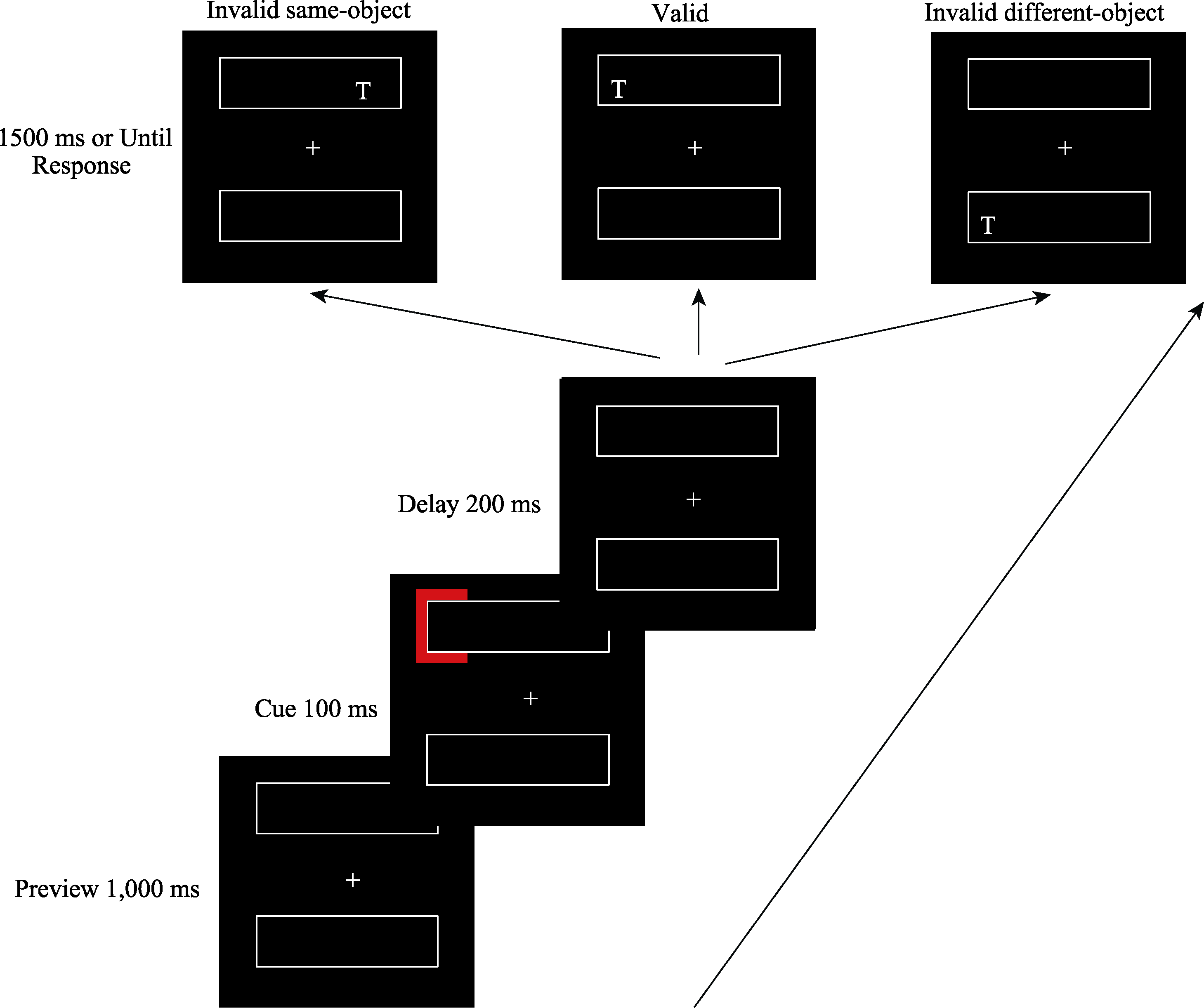
Figure 1. Trial sequences of Experiment 1a.
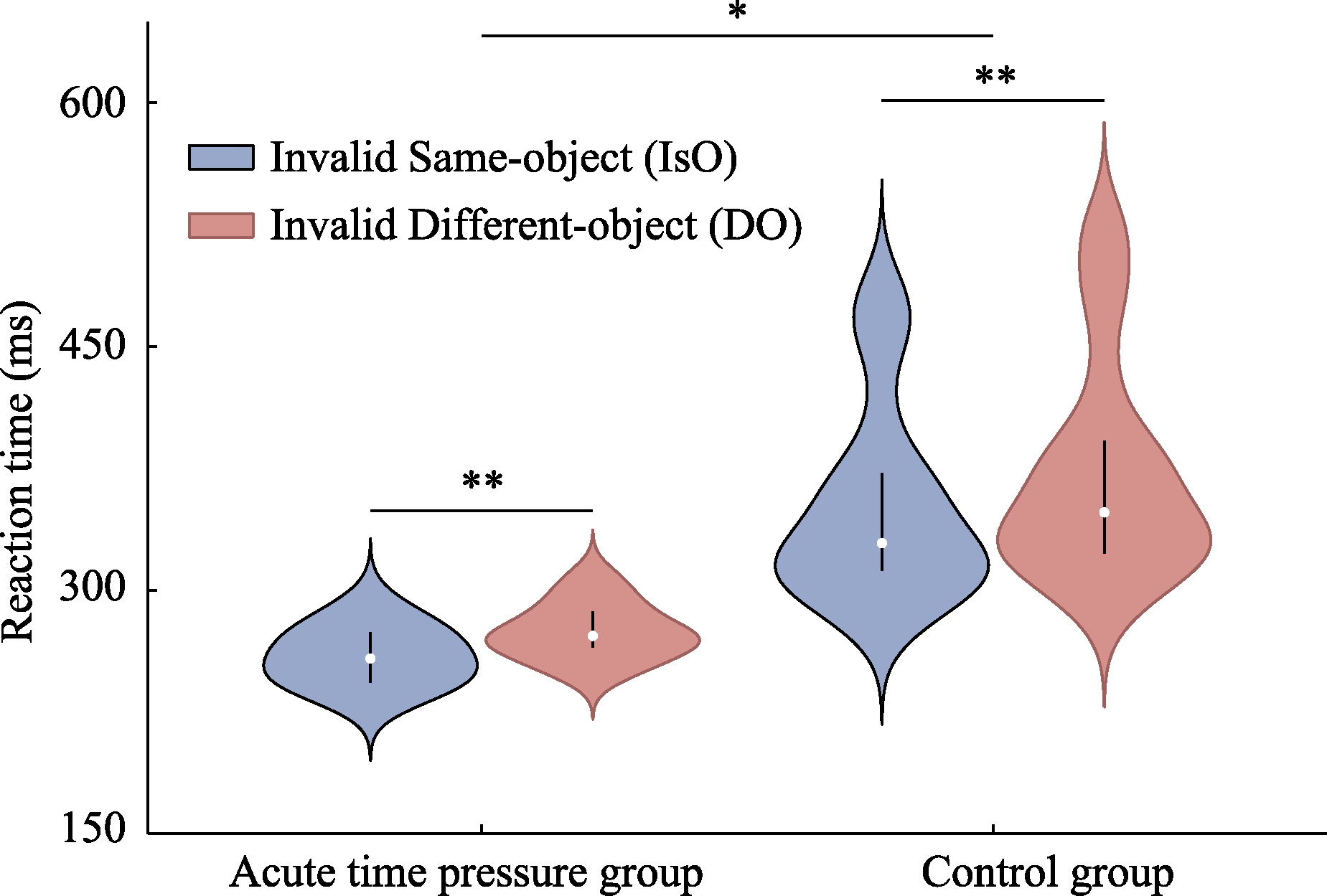
Figure 2. Reaction time differences between the acute time pressure group and the control group in the OBA task when using different cues. Note. * indicates p <.05, ** indicates p <.01. See the online version for the color figure. The same below.
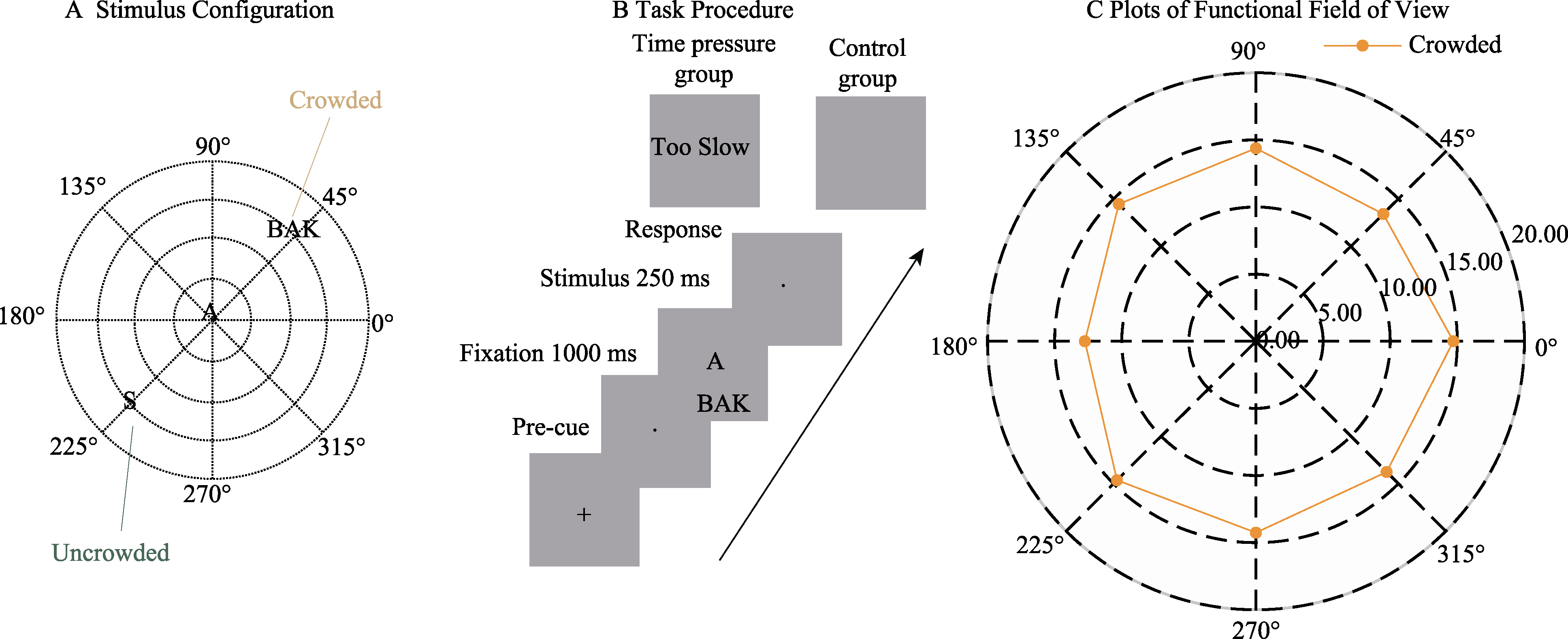
Figure 3. Schematic of stimuli, task flowchart, and FFV plot. Note. (A) Schematic of stimuli. A letter is presented in the central fixation area. In the uncrowded condition, a single target appears in the peripheral visual field, whereas in the crowded condition, the target letter is presented between two distractor letters. (B) Task flowchart. Prior to the onset of the target stimulus, a visual cue (three white dots) is presented to indicate the location of the peripheral letters. Participants are required to identify the middle of the three peripheral letters and report whether it is identical to the letter simultaneously presented in the central fixation area. (C) FFV plot. The spatial extent of the FFV under the crowded condition is plotted on polar coordinates (solid orange line).
| Variable | M | SD | 1 | 2 | 3 | 4 |
|---|---|---|---|---|---|---|
| 1 Acute time pressure | - | 0.50 | ||||
| 2 Attentional scope | 2.45 | 0.30 | -0.515** | |||
| 3 OBA | 18.15 | 14.57 | -0.180* | 0.269** | ||
| 4 SBA | 5.21 | 14.24 | -0.123 | 0.178* | 0.348** |
Table 1 Descriptive statistics and correlation analysis of variables in Experiment 2
| Variable | M | SD | 1 | 2 | 3 | 4 |
|---|---|---|---|---|---|---|
| 1 Acute time pressure | - | 0.50 | ||||
| 2 Attentional scope | 2.45 | 0.30 | -0.515** | |||
| 3 OBA | 18.15 | 14.57 | -0.180* | 0.269** | ||
| 4 SBA | 5.21 | 14.24 | -0.123 | 0.178* | 0.348** |
| Model path | Effect | SE | S.E. | p | 95% CI | |
|---|---|---|---|---|---|---|
| LLCI | ULCI | |||||
| Acute time pressure → Attentional scope → OBA | Total effect | -0.18 | 0.08 | 0.02 | -0.29 | -0.18 |
| Direct effect | -0.06 | 0.09 | 0.52 | -0.12 | 0.56 | |
| Indirect effect | -0.12 | 0.04 | - | -0.22 | -0.05 | |
Table 2 Mediation effect test.
| Model path | Effect | SE | S.E. | p | 95% CI | |
|---|---|---|---|---|---|---|
| LLCI | ULCI | |||||
| Acute time pressure → Attentional scope → OBA | Total effect | -0.18 | 0.08 | 0.02 | -0.29 | -0.18 |
| Direct effect | -0.06 | 0.09 | 0.52 | -0.12 | 0.56 | |
| Indirect effect | -0.12 | 0.04 | - | -0.22 | -0.05 | |

Figure 4. Path coefficient diagram of acute time pressure, attentional scope, and object-based attention. Note. *p <.05, ***p <.001.
| [1] |
Arnsten, A. F. T. (2009). Stress signalling pathways that impair prefrontal cortex structure and function. Nature Reviews Neuroscience, 10(6), 410-422. https://doi.org/10.1038/nrn2648
doi: 10.1038/nrn2648 URL |
| [2] |
Baumeister, R. F., & Heatherton, T. F. (1996). Self-Regulation Failure: An Overview. Psychological Inquiry, 7(1), 1-15. https://doi.org/10.1207/s15327965pli0701_1
doi: 10.1207/s15327965pli0701_1 URL |
| [3] |
Belopolsky, A., Zwaan, L., Theeuwes, J., & Kramer, A. (2007). The size of an attentional window modulates attentional capture by color singletons. Psychonomic Bulletin & Review, 14, 934-938. https://doi.org/10.3758/BF03194124
doi: 10.3758/BF03194124 URL |
| [4] |
Beste, C., Yildiz, A., Meissner, T., & Wolf, O. (2013). Stress improves task processing efficiency in dual-tasks. Behavioural Brain Research, 252, 260-265. https://doi.org/10.1016/j.bbr.2013.06.013
doi: 10.1016/j.bbr.2013.06.013 URL pmid: 23769959 |
| [5] |
Biggs, A., & Gibson, B. (2018). Opening the window: Size of the attentional window dominates perceptual load and familiarity in visual selection. Journal of Experimental Psychology: Human Perception and Performance, 44(11), 1780-1798. https://doi.org/10.1037/xhp0000565
doi: 10.1037/xhp0000565 URL pmid: 30247049 |
| [6] |
Booth, R., & Sharma, D. (2009). Stress reduces attention to irrelevant information: Evidence from the Stroop task. Motivation and Emotion, 33(4), 412-418. https://doi.org/10.1007/s11031-009-9141-5
doi: 10.1007/s11031-009-9141-5 URL |
| [7] | Broadbent, D. E. (1958). Perception and communication. Pergamon Press. https://doi.org/10.1037/10037-000 |
| [8] | Burke, R. J., Astakhova, M., & Singh, P. (2014). Time affluence, material affluence and work experiences of professional women in Russia. Employee Relations, 36(6), 642-653. https://doi.org/10.1108/ER-11-2013-0166 |
| [9] |
Buschman, T., & Miller, E. (2007). Top-down versus bottom-up control of attention in the prefrontal and posterior parietal cortices. Science, 315, 1860-1862. https://doi.org/10.1126/science.1138071
doi: 10.1126/science.1138071 URL pmid: 17395832 |
| [10] |
Chajut, E., & Algom, D. (2003). Selective attention improves under stress: Implications for theories of social cognition. Journal of Personality and Social Psychology, 85(2), 231-248. https://doi.org/10.1037/0022-3514.85.2.231
URL pmid: 12916567 |
| [11] |
Christianson, S., Loftus, E., Hoffman, H., & Loftus, G. (1991). Eye fixations and memory for emotional events. Journal of Experimental Psychology: Learning, Memory, and Cognition, 17(4), 693-701. https://doi.org/10.1037/0278-7393.17.4.693
doi: 10.1037/0278-7393.17.4.693 URL |
| [12] |
Denovan, A., Dagnall, N., Drinkwater, K., & Escolà-Gascón, Á. (2023). Evaluating the psychometric properties of the Chronic Time Pressure Inventory using Rasch analysis. PeerJ, 11, e15218. https://doi.org/10.7717/peerj.15218
doi: 10.7717/peerj.15218 URL |
| [13] |
Dror, I. E., Basola, B., & Busemeyer, J. R. (1999). Decision making under time pressure: An independent test of sequential sampling models. Memory & Cognition, 27(4), 713-725. https://doi.org/10.3758/BF03211564
doi: 10.3758/BF03211564 URL |
| [14] |
Duncan, J. (1984). Selective attention and the organization of visual information. Journal of Experimental Psychology: General, 113(4), 501-517. https://doi.org/10.1037/0096-3445.113.4.501
doi: 10.1037/0096-3445.113.4.501 URL |
| [15] |
Fried, Y., & Slowik, L. (2004). Enriching goal-setting theory with time: An integrated approach. The Academy of Management Review, 29(3), 404-422. https://doi.org/10.2307/20159051
doi: 10.2307/20159051 URL |
| [16] |
Goldsmith, M., & Yeari, M. (2003). Modulation of object-based attention by spatial focus under endogenous and exogenous orienting. Journal of Experimental Psychology: Human Perception and Performance, 29(5), 897-918. https://doi.org/10.1037/0096-1523.29.5.897
doi: 10.1037/0096-1523.29.5.897 URL |
| [17] |
Hermans, E. J., Henckens, M. J. A. G., Joëls, M., & Fernández, G. (2014). Dynamic adaptation of large-scale brain networks in response to acute stressors. Trends in Neurosciences, 37(6), 304-314. https://doi.org/10.1016/j.tins.2014.03.006
doi: 10.1016/j.tins.2014.03.006 URL pmid: 24766931 |
| [18] |
Hu, S., Gao, Y., Zou, M., Zhang, H., Cheng, Z., Zhao, J., & Wang, Y. (2022). People attend to the world differently: The modulation of personality traits on the modes of attentional selection. Personality and Individual Differences, 192, 111584. https://doi.org/10.1016/j.paid.2022.111584
doi: 10.1016/j.paid.2022.111584 URL |
| [19] | Hu, S., Liu, M., Wang, Y., & Zhao, J. (2020). Wholist-analytic cognitive styles modulate object-based attentional selection. Quarterly Journal of Experimental Psychology, 73(10), 174702182092134. https://doi.org/10.1177/1747021820921345 |
| [20] |
Huang, L., Li, M.-S., Wang, L.-J., & Zhang, X.-L. (2019). Neural mechanisms of visual selective attention. Acta Physiologica Sinica, 71(1), 11-21. https://doi.org/10.13294/j.aps.2019.0005
URL pmid: 30778500 |
| [21] |
Karau, S. J., & Kelly, J. R. (1992). The effects of time scarcity and time abundance on group performance quality and interaction process. Journal of Experimental Social Psychology, 28(6), 542-571. https://doi.org/10.1016/0022-1031(92)90045-L
doi: 10.1016/0022-1031(92)90045-L URL |
| [22] |
Kasser, T., & Sheldon, K. M. (2009). Time affluence as a path toward personal happiness and ethical business practice: Empirical evidence from four studies. Journal of Business Ethics, 84, 243-255. https://doi.org/10.1007/s10551-008-9696-1
doi: 10.1007/s10551-008-9696-1 URL |
| [23] |
Kelly, J. R., & Karau, S. J. (1999). Group decision making: The effects of initial preferences and time pressure. Personality and Social Psychology Bulletin, 25(11), 1342-1354. https://doi.org/10.1177/0146167299259002
doi: 10.1177/0146167299259002 URL |
| [24] |
Kelly, J. R., & Loving, T. J. (2004). Time pressure and group performance: Exploring underlying processes in the Attentional Focus Model. Journal of Experimental Social Psychology, 40(2), 185-198. https://doi.org/10.1016/S0022-1031(03)00094-5
doi: 10.1016/S0022-1031(03)00094-5 URL |
| [25] |
Kofman, O., Meiran, N., Greenberg, E., Balas, M., & Cohen, H. (2006). Enhanced performance on executive functions associated with examination stress: Evidence from task-switching and Stroop paradigms. Cognition and Emotion, 20(5), 577-595. https://doi.org/10.1080/02699930500270913
doi: 10.1080/02699930500270913 URL |
| [26] | Lallement, J. (2010). The effects of time pressure on information processing. Recherche et Applications En Marketing (English Edition), 25(4), 45-69. https://doi.org/10.1177/205157071002500403 |
| [27] |
Li, A., Yan, L., Wang, X., Ma, X., & Li, F. (2015). The double-edged effect and mechanism of time pressure. Advances in Psychological Science, 23(9), 1627-1636. https://doi.org/10.3724/sp.j.1042.2015.01627
doi: 10.3724/SP.J.1042.2015.01627 URL |
| [28] |
Li, Y., Wang, S., Shan, Q., & Xia, X. (2023). Singleton effect decreases under time pressure: An fNIRS study. Brain and Cognition, 171, 106074. https://doi.org/10.1016/j.bandc.2023.106074
doi: 10.1016/j.bandc.2023.106074 URL |
| [29] |
Lin, B., Chen, Y., & Zhou, T. (2023). Effect of time pressure and cue salience on event-based prospective memory. Current Psychology, 43(1), 369-379. https://doi.org/10.1007/s12144-023-04240-w
doi: 10.1007/s12144-023-04240-w URL |
| [30] |
Liston, C., Miller, M. M., Goldwater, D. S., Radley, J. J., Rocher, A. B., Hof, P. R., Morrison, J. H., & McEwen, B. S. (2006). Stress-induced alterations in prefrontal cortical dendritic morphology predict selective impairments in perceptual attentional set-shifting. The Journal of Neuroscience, 26(30), 7870-7874. https://doi.org/10.1523/JNEUROSCI.1184-06.2006
doi: 10.1523/JNEUROSCI.1184-06.2006 URL |
| [31] |
Liu, C., Liu, Y. H., Gedeon, T., Zhao, Y., Wei, Y., & Yang, F. (2019). The effects of perceived chronic pressure and time constraint on information search behaviors and experience. Information Processing & Management, 56(5), 1667-1679. https://doi.org/10.1016/j.ipm.2019.04.004
doi: 10.1016/j.ipm.2019.04.004 URL |
| [32] |
Liu, Y., Xie, T., & Fu, S. (2022). The role of object representation strength in the object-based attention of dynamic object. Advances in Psychological Science, 30(3), 591-600. https://doi.org/10.3724/sp.j.1042.2022.00591
doi: 10.3724/SP.J.1042.2022.00591 URL |
| [33] |
Momin, A., Bhattacharya, S., Sanyal, S., & Chakraborty, P. (2020). Visual attention, mental stress and gender: A study using physiological signals. IEEE Access, 8, 165973-165988. https://doi.org/10.1109/ACCESS.2020.3022727
doi: 10.1109/Access.6287639 URL |
| [34] |
Neves, R. M., Keulen, S., van, Yang, M., Logothetis, N. K., & Eschenko, O. (2018). Locus coeruleus phasic discharge is essential for stimulus-induced gamma oscillations in the prefrontal cortex. Journal of Neurophysiology, 119(3), 904-920. https://doi.org/10.1152/jn.00552.2017
doi: 10.1152/jn.00552.2017 URL pmid: 29093170 |
| [35] |
Niiya, Y. (2019). My time, your time, or our time? Time perception and its associations with interpersonal goals and life outcomes. Journal of Happiness Studies, 20(5), 1439-1455. https://doi.org/10.1007/s10902-018-0007-y
doi: 10.1007/s10902-018-0007-y URL |
| [36] | Notebaert, L., Crombez, G., Van Damme, S., Durnez, W., & Theeuwes, J. (2012). Attentional prioritisation of threatening information: Examining the role of the size of the attentional window. Cognition & Emotion, 27(4), 621-631. https://doi.org/10.1080/02699931.2012.730036 |
| [37] |
Petrac-Robinson, D., Bedwell, J., Renk, K., Orem, D., & Sims, V. (2008). Differential relationship of recent self-reported stress and acute anxiety with divided attention performance. Stress, 12, 313-319. https://doi.org/10.1080/10253890802380714
doi: 10.1080/10253890802380714 URL |
| [38] |
Plessow, F., Kiesel, A., & Kirschbaum, C. (2012). The stressed prefrontal cortex and goal-directed behaviour: Acute psychosocial stress impairs the flexible implementation of task goals. Experimental Brain Research, 216(3), 397-408. https://doi.org/10.1007/s00221-011-2943-1
doi: 10.1007/s00221-011-2943-1 URL pmid: 22101494 |
| [39] |
Posner, M. (1980). Orienting of attention. The Quarterly Journal of Experimental Psychology, 32, 3-25. https://doi.org/10.1080/00335558008248231
doi: 10.1080/00335558008248231 URL |
| [40] |
Posner, M. I., & Petersen, S. E. (1990). The attention system of the human brain. Annual Review of Neuroscience, 13, 25-42. https://doi.org/10.1146/annurev.ne.13.030190.000325
URL pmid: 2183676 |
| [41] |
Rice, S., & Trafimow, D. (2012). Time pressure heuristics can improve performance due to increased consistency. The Journal of General Psychology, 139(4), 273-288. https://doi.org/10.1080/00221309.2012.705187
doi: 10.1080/00221309.2012.705187 URL |
| [42] |
Roxburgh, S. (2004). "There just aren’t enough hours in the day": The mental health consequences of time pressure. Journal of Health and Social Behavior, 45(2), 115-131. https://doi.org/10.1177/002214650404500201
URL pmid: 15305755 |
| [43] | Sänger, J., Bechtold, L., Schoofs, D., Blaszkewicz, M., & Wascher, E. (2014). The influence of acute stress on attention mechanisms and its electrophysiological correlates. Frontiers in Behavioral Neuroscience, 8, Article 353. https://doi.org/10.3389/fnbeh.2014.00353 |
| [44] |
Schoemann, A. M., Boulton, A. J., & Short, S. D. (2017). Determining power and sample size for simple and complex mediation models. Social Psychological and Personality Science, 8(4), 379-386. https://doi.org/10.1177/1948550617715068
doi: 10.1177/1948550617715068 URL |
| [45] | Shamsi, F., Chen, V., Liu, R., Pergher, V., & Kwon, M. (2021). Functional field of view determined by crowding, aging, or glaucoma under divided attention. Translational Vision Science & Technology, 10(14), 14. https://doi.org/10.1167/tvst.10.14.14 |
| [46] |
Sheng, X., Wang, Y., Hong, W., Zhu, Z., & Zhang, X. (2017). The curvilinear relationship between daily time pressure and work engagement: The role of psychological capital and sleep. International Journal of Stress Management, 26(1), 25-35. https://doi.org/10.1037/str0000085
doi: 10.1037/str0000085 URL |
| [47] |
Shurchkov, O. (2012). Under pressure: Gender differences in output quality and quantity under competition and time constraints. Journal of the European Economic Association, 10(5), 1189-1213. https://doi.org/10.1111/j.1542-4774.2012.01084.x
doi: 10.1111/jeea.2012.10.issue-5 URL |
| [48] |
Steinhauser, M., Maier, M., & Hübner, R. (2007). Cognitive control under stress: How stress affects strategies of task-set reconfiguration. Psychological Science, 18(6), 540-545. https://doi.org/10.1111/j.1467-9280.2007.01935.x
URL pmid: 17576268 |
| [49] |
Sussman, R. F., & Sekuler, R. (2022). Feeling rushed? Perceived time pressure impacts executive function and stress. Acta Psychologica, 229, 103702. https://doi.org/10.1016/j.actpsy.2022.103702
doi: 10.1016/j.actpsy.2022.103702 URL |
| [50] | Szollos, A. (2009). Toward a psychology of chronic time pressure: Conceptual and methodological review. Time & Society, 18(2-3), 332-350. https://doi.org/10.1177/0961463X09337847 |
| [51] |
Voyer, D. (2011). Time limits and gender differences on paper-and-pencil tests of mental rotation: A meta-analysis. Psychonomic Bulletin & Review, 18(2), 267-277. https://doi.org/10.3758/s13423-010-0042-0
doi: 10.3758/s13423-010-0042-0 URL |
| [52] |
Wegner, D. M. (1994). Ironic processes of mental control. Psychological Review, 101, 34-52. https://doi.org/10.1037/0033-295X.101.1.34
doi: 10.1037/0033-295x.101.1.34 URL pmid: 8121959 |
| [53] | Wells, A., & Matthews, G. (2014). Attention and emotion (Classic edition): A clinical perspective. Psychology Press. https://doi.org/10.4324/9781315747187 |
| [54] |
Widmer, P., Semmer, N., Kälin, W., Jacobshagen, N., & Meier, L. (2012). The ambivalence of challenge stressors: Time pressure associated with both negative and positive well-being. Journal of Vocational Behavior, 80, 422-433. https://doi.org/10.1016/j.jvb.2011.09.006
doi: 10.1016/j.jvb.2011.09.006 URL |
| [55] |
Wu, J.-Y., & Xie, C. (2018). Using time pressure and note-taking to prevent digital distraction behavior and enhance online search performance: Perspectives from the load theory of attention and cognitive control. Computers in Human Behavior, 88, 244-254. https://doi.org/10.1016/j.chb.2018.07.008
doi: 10.1016/j.chb.2018.07.008 URL |
| [56] |
Zhong, Y., Zhang, W., Li, Y., & Fan, W. (2018). Influence of time stress on mood-congruent false memories. Acta Psychologica Sinica, 50(9), 929-939.
doi: 10.3724/SP.J.1041.2018.00929 |
| [57] |
Zhou, Y.-B., Ruan, S.-J., Zhang, K., Bao, Q., & Liu, H.-Z. (2024). Time pressure effects on decision-making in intertemporal loss scenarios: An eye-tracking study. Frontiers in Psychology, 15, 1451674. https://doi.org/10.3389/fpsyg.2024.1451674
doi: 10.3389/fpsyg.2024.1451674 URL |
| [1] | PANG Chao, CHEN Yanzhang, WANG Li, YANG Xiduan, HE Ya, LI Zhiying, OUYANG Xiaoyu, FU Shimin, NAN Weizhi. Different attentional selection modes of object information in the encoding and maintenance stages of visual working memory [J]. Acta Psychologica Sinica, 2023, 55(9): 1397-1410. |
| [2] | YAN Chi, GAO Yunfei, HU Saisai, SONG Fangxing, WANG Yonghui, ZHAO Jingjing. The impact and mechanism of gaze cues on object-based attention [J]. Acta Psychologica Sinica, 2022, 54(7): 748-760. |
| [3] | WANG Ming, SUN Qiwu, LIU Jing, REN Zhihong, JIANG Guangrong. Effects of vulnerable personality traits of PTSD, working memory abilities and peritraumatic cognitive processing on analogue traumatic flashbacks [J]. Acta Psychologica Sinica, 2022, 54(2): 168-181. |
| [4] | Xiaoyu TANG, Jiaying SUN, Xing PENG. The effect of bimodal divided attention on inhibition of return with audiovisual targets [J]. Acta Psychologica Sinica, 2020, 52(3): 257-268. |
| [5] | LI Shouxin, CHE Xiaowei, LI Yanjiao, WANG Li, CHEN Kaisheng. The effects of capacity load and resolution load on visual selective attention during visual working memory [J]. Acta Psychologica Sinica, 2019, 51(5): 527-542. |
| [6] | Yiping ZHONG, Wenjie ZHANG, Yalei LI, Wei FAN. Influence of time stress on mood-congruent false memories [J]. Acta Psychologica Sinica, 2018, 50(9): 929-939. |
| [7] | Xuejun BAI, Haijuan YAO. Differences in cognitive inhibition between persons with high and low creativity: Evidences from behavioral and physiological studies [J]. Acta Psychologica Sinica, 2018, 50(11): 1197-1211. |
| [8] | GU Honglei, LIU Jun, XIA Tiansheng. Effect of family socioeconomic status on reading autonomy among elementary school students: The mediating effects of parents' encouragement and reading motivation [J]. Acta Psychologica Sinica, 2017, 49(8): 1063-1071. |
| [9] | WANG Yan, LIN Zhenchao, HOU Bowen, SUN Shijin. The intrinsic mechanism of life history trade-offs: The mediating role of control striving [J]. Acta Psychologica Sinica, 2017, 49(6): 783-793. |
| [10] | HU Cenlou, ZHANG Bao, HUANG Sai. Does irrelevant long-term memory representation guide the deployment of visual attention? [J]. Acta Psychologica Sinica, 2017, 49(5): 590-601. |
| [11] | ZHOU Yuanyuan, HU Yangli, ZHAO Yancheng. What do you listen to under the pressure of time? The moderator effects of reference group on impulsive buying [J]. Acta Psychologica Sinica, 2017, 49(11): 1439-1448. |
| [12] | LIU Zhiying, KU Yixuan. Perceiving better, inhibiting better: Effects of perceptual precision on distractor-inhibition processes during working memory [J]. Acta Psychologica Sinica, 2017, 49(10): 1247-1255. |
| [13] | WEN Hongbo; LIANG Kaili; LIU Xianwei. Effect of family environment on reading ability: The mediating effects of reading engagement and reading interest among junior high school students [J]. Acta Psychologica Sinica, 2016, 48(3): 248-257. |
| [14] | LI Xiujun, SHI Wendian. Influence of selective attention on implicit learning with auditory stimuli [J]. Acta Psychologica Sinica, 2016, 48(3): 221-229. |
| [15] | LI Liping; WU Xinchun; ZHOU Ningning; CHENG Yahua; NGUYEN Thi Phuong. The cognitive characteristics and influential factors of Chinese word callers in primary school [J]. Acta Psychologica Sinica, 2016, 48(10): 1270-1281. |
| Viewed | ||||||
|
Full text |
|
|||||
|
Abstract |
|
|||||
