

ISSN 0439-755X
CN 11-1911/B
CN 11-1911/B
Acta Psychologica Sinica ›› 2025, Vol. 57 ›› Issue (9): 1553-1571.doi: 10.3724/SP.J.1041.2025.1553
• Reports of Empirical Studies • Previous Articles Next Articles
CHEN Zilong, JI Luyan( )
)
Published:2025-09-25
Online:2025-06-26
Contact:
JI Luyan
E-mail:luyanji@gzhu.edu.cn
CHEN Zilong, JI Luyan. (2025). Automatic processing of variability in multiple facial expressions: Evidence from visual mismatch responses. Acta Psychologica Sinica, 57(9), 1553-1571.
Add to citation manager EndNote|Ris|BibTeX
URL: https://journal.psych.ac.cn/acps/EN/10.3724/SP.J.1041.2025.1553
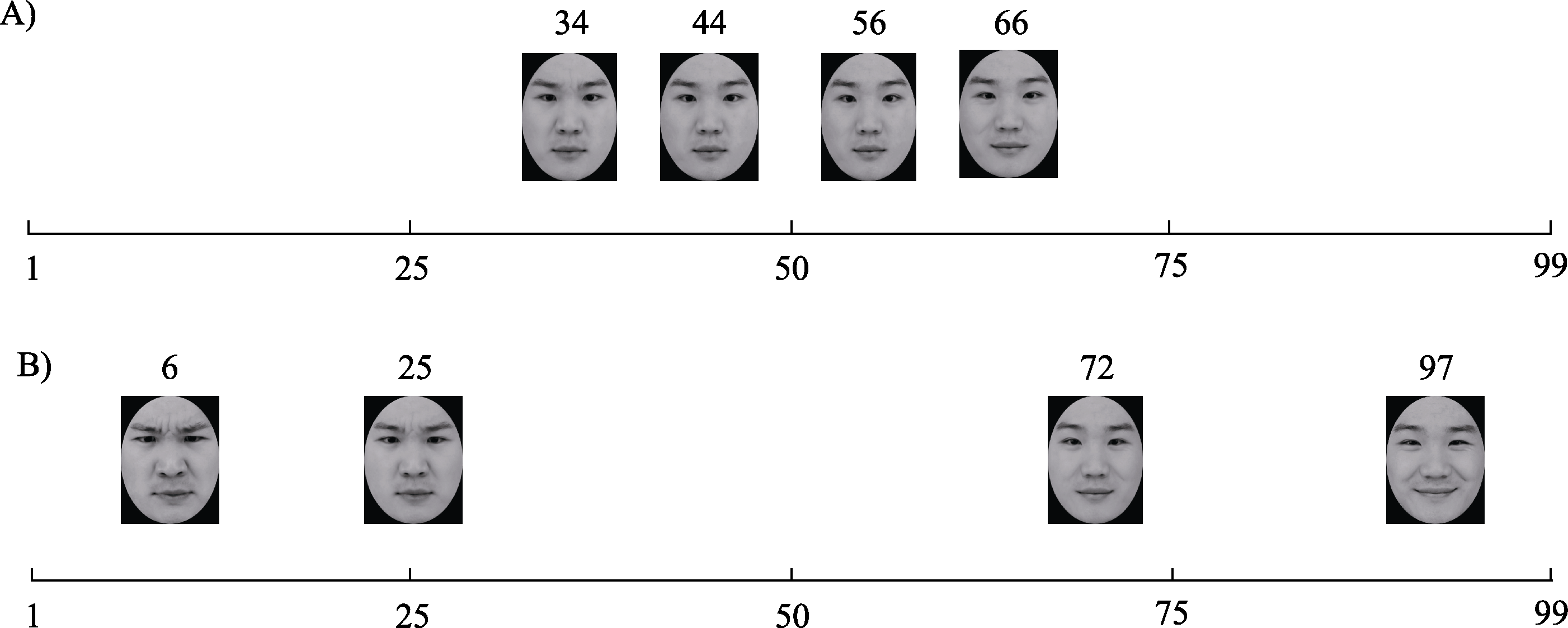
Figure 1. An example of face materials for Experiment 1. A) is a set of faces with low emotional variability, and B) is a set of faces with high emotional variability. Numbers represent emotional units, with closer to 1 indicating a more negative emotion and closer to 99 indicating a more positive emotion. In both the high and low emotional variability conditions, the mean emotion was neutral (50).
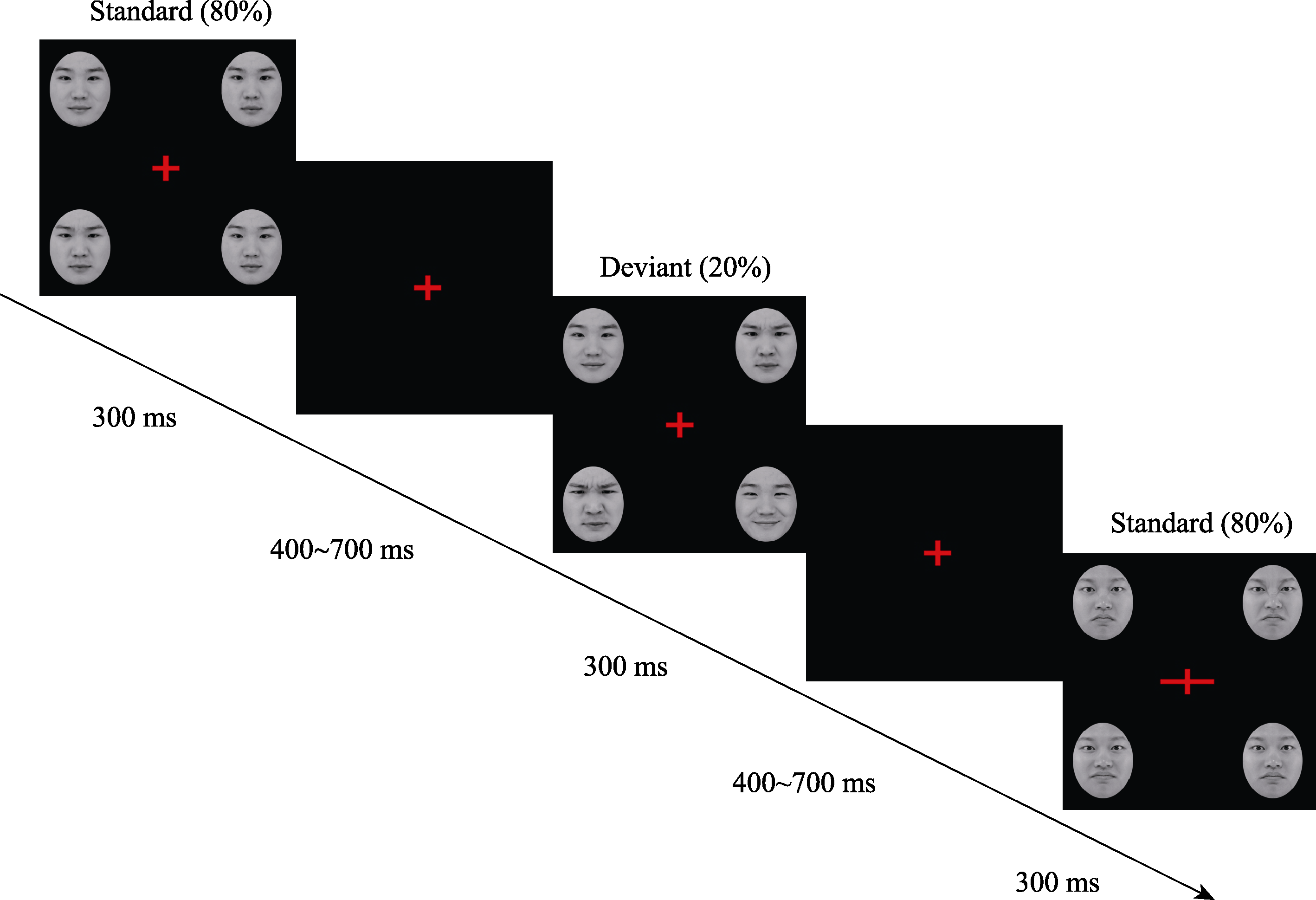
Figure 2. In each trial, four faces were presented simultaneously for 300?ms, followed by a 400−700?ms inter-stimulus interval (ISI). Participants were instructed to detect changes in the central fixation cross: if the horizontal bar became longer, they pressed the “J” key; if the vertical bar became longer, they pressed the “F” key. No response was required when the fixation cross did not change.
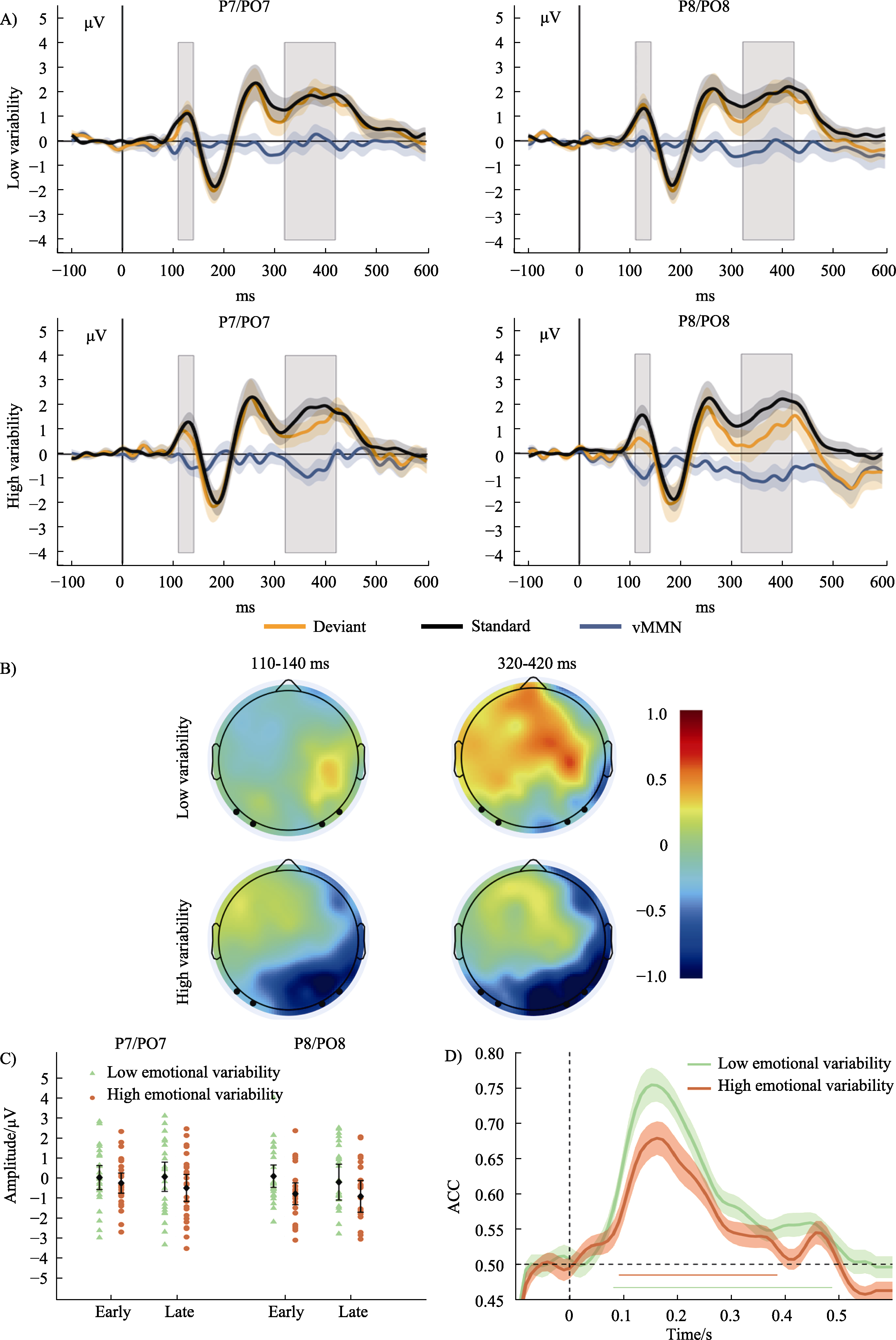
Figure 3. A) ERP waveforms in Experiment 1. The difference wave represents the ERP elicited by deviant stimuli minus that elicited by standard stimuli. The shaded areas indicate the time windows of interest (early: 110−140?ms; late: 320−420?ms). B) Scalp topographies of the difference waves in Experiment 1. The electrodes highlighted on the topographic maps indicate the sites used for ERP waveform plotting and statistical analysis. C) Mean vMMN amplitudes (deviant minus standard) at lateral electrodes for high and low emotional variability conditions in early and late time windows. Each dot represents a participant’s average amplitude for that condition; black diamonds and error bars indicate the mean and 95% confidence intervals. D) Decoding results of ERPs in Experiment 1. Horizontal lines near the x-axis indicate time windows where decoding accuracy exceeded chance level (p < 0.05).

Figure 4. Examples of face materials from Experiment 2. A) is the faces with low emotional variability face set, and B) is the faces with high emotional variability. In both the high and low emotional variability conditions for the anger faces, the mean emotion was medium anger (25); in both the high and low emotional variability conditions for the happy faces, the mean emotion was medium happiness (75).

Figure 5. A) ERP waveforms from Experiment 2. Difference wave refers to the ERP evoked by the deviant stimulus minus the ERP elicited by the standard stimulus, and the shaded area is the time window of interest (110−140 ms and 320−420 ms).B) Topographic map of the difference wave in Experiment 2. The average amplitude of the electrodes labelled on the topographic map was used to map the ERP waveforms in this brain region, as well as for statistical analysis.

Figure 6. A) Mean vMMN (ERP induced by deviant stimulus minus ERP induced by standard stimulus) amplitudes of electrodes analysed laterally around 320−420 ms for each emotion and emotional variability condition in Experiment 2. Each point represents the mean amplitude of the participant in that condition, and the black diamonds and the error bars represent the mean and the 95% confidence interval for each condition. B) Decoding results of ERPs in Experiment 2. The horizontal line near the x-axis is the time window in which decoding accuracy was greater than chance level (p < 0.05).
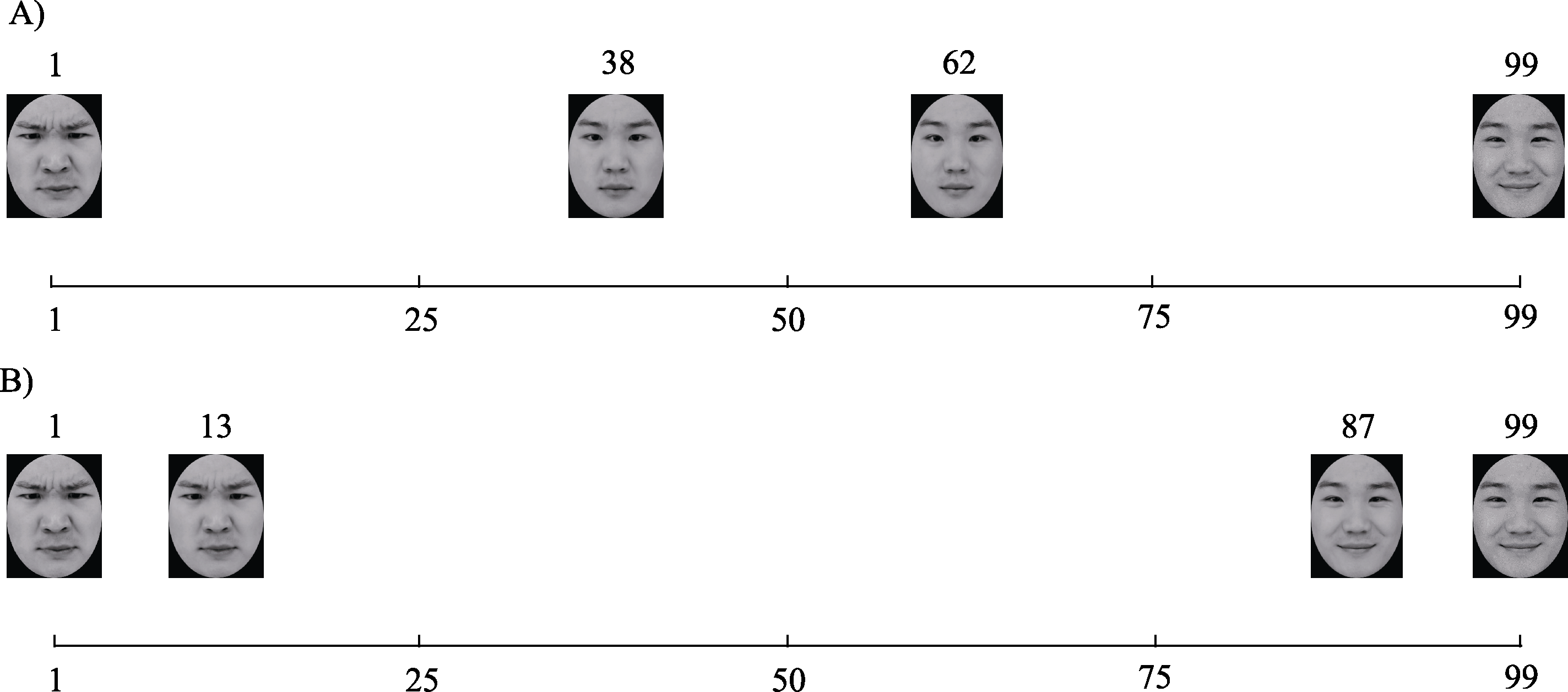
Figure 7. An example of the face materials in Experiment 3. A) is the set of faces with low emotional variability, and B) is the set of faces with high emotional variability. In both the high and low emotional variability conditions, the mean emotional was neutral (50).

Figure 8. A) ERP waveforms in Experiment 3. Difference wave refers to the ERP evoked by the deviant stimulus minus the ERP evoked by the standard stimulus, and the shaded area is the time window of interest (110−140 ms and 320−420 ms). B) Topographic map of the difference wave in Experiment 3. The mean amplitude of the electrodes marked on the topographic map was used to map the ERP waveforms in this brain region, as well as for statistical analyses. C) Mean vMMN (ERP induced by deviant stimulus minus ERP induced by standard stimulus) amplitude of the electrodes analysed around 320−420 ms for the high and low emotional variability conditions in Experiment 3. Each point represents the mean amplitude of one participant in that condition, and the black diamonds and the error bars represent the mean and 95% confidence intervals for each condition. D) Decoding results of ERPs in Experiment 3. Horizontal lines near the x-axis are the time windows in which decoding accuracy was greater than chance level (p < 0.05).
| [1] | Allard, R., Ramanoël, S., Silvestre, D., & Arleo, A. (2021). Variance-dependent neural activity in an unvoluntary averaging task. Attention, Perception, & Psychophysics, 83(3), 1094-1105. https://doi.org/10.3758/s13414-020-02223-8 |
| [2] |
Alvarez, G. A. (2011). Representing multiple objects as an ensemble enhances visual cognition. Trends in Cognitive Sciences, 15(3), 122-131. https://doi.org/10.1016/j.tics.2011.01.003
doi: 10.1016/j.tics.2011.01.003 URL pmid: 21292539 |
| [3] |
Alvarez, G. A., & Oliva, A. (2008). The representation of simple ensemble visual features outside the focus of attention. Psychological Science, 19(4), 392-398. https://doi.org/10.1111/j.1467-9280.2008.02098.x
doi: 10.1111/j.1467-9280.2008.02098.x URL pmid: 18399893 |
| [4] | Alvarez, G. A., & Oliva, A. (2009). Spatial ensemble statistics are efficient codes that can be represented with reduced attention. Proceedings of the National Academy of Sciences, 106(18), 7345-7350. https://doi.org/10.1073/pnas.0808981106 |
| [5] |
Ariely, D. (2001). Seeing sets: Representation by statistical properties. Psychological Science, 12(2), 157-162. https://doi.org/10.1111/1467-9280.00327
URL pmid: 11340926 |
| [6] | Astikainen, P., Cong, F., Ristaniemi, T., & Hietanen, J. K. (2013). Event-related potentials to unattended changes in facial expressions: Detection of regularity violations or encoding of emotions? Frontiers in Human Neuroscience, 7. https://doi.org/10.3389/fnhum.2013.00557 |
| [7] | Bex, P. J., & Makous, W. (2002). Spatial frequency, phase, and the contrast of natural images. Journal of the Optical Society of America A, 19(6), 1096-1106. https://doi.org/10.1364/JOSAA.19.001096 |
| [8] | Brand, J., Oriet, C., & Sykes Tottenham, L. (2012). Size and emotion averaging: Costs of dividing attention after all. Canadian Journal of Experimental Psychology / Revue Canadienne de Psychologie Expérimentale, 66(1), 63-69. https://doi.org/10.1037/a0026950 |
| [9] |
Campbell, J. I. D., & Thompson, V. A. (2012). MorePower 6.0 for ANOVA with relational confidence intervals and Bayesian analysis. Behavior Research Methods, 44(4), 1255-1265. https://doi.org/10.3758/s13428-012-0186-0
doi: 10.3758/s13428-012-0186-0 URL pmid: 22437511 |
| [10] | Cant, J. S., & Xu, Y. (2020). One bad apple spoils the whole bushel: The neural basis of outlier processing. NeuroImage, 211, 116629. https://doi.org/10.1016/j.neuroimage.2020.116629 |
| [11] | Carlson, T. A., Grootswagers, T., & Robinson, A. K. (2020). An introduction to time-resolved decoding analysis for M/EEG. In D. Poeppel, G. R. Mangun, & M. S. Gazzaniga (Eds.), The cognitive neurosciences (6th ed., pp. 679-690). The MIT Press. https://doi.org/10.7551/mitpress/11442.003.0075 |
| [12] | Chen, B., Sun, P., & Fu, S. (2020). Consciousness modulates the automatic change detection of masked emotional faces: Evidence from visual mismatch negativity. Neuropsychologia, 144, 107459. https://doi.org/10.1016/j.neuropsychologia.2020.107459 |
| [13] |
Chetverikov, A., Campana, G., & Kristjánsson, Á. (2017). Representing color ensembles. Psychological Science, 28(10), 1510-1517. https://doi.org/10.1177/0956797617713787
doi: 10.1177/0956797617713787 URL pmid: 28862923 |
| [14] |
Chong, S. C., & Treisman, A. (2003). Representation of statistical properties. Vision research, 43(4), 393-404. https://doi.org/10.1016/s0042-6989(02)00596-5
URL pmid: 12535996 |
| [15] |
Csikós, N., Petro, B., Kojouharova, P., Gaál, Z. A., & Czigler, I. (2024). Automatic change detection in Interwoven sequences: A visual mismatch negativity study. Journal of Cognitive Neuroscience, 36(3), 534-550. https://doi.org/10.1162/jocn_a_02099
doi: 10.1162/jocn_a_02099 URL pmid: 38165736 |
| [16] | Csizmadia, P., Petro, B., Kojouharova, P., Gaál, Z. A., Scheiling, K., Nagy, B., & Czigler, I. (2021). Older adults automatically detect age of older adults’ photographs: A visual mismatch negativity study. Frontiers in Human Neuroscience, 15, 707702. https://doi.org/10.3389/fnhum.2021.707702 |
| [17] | Czigler, I. (2007). Visual Mismatch Negativity: Violation of nonattended environmental regularities. Journal of Psychophysiology, 21(3-4), 224-230. https://doi.org/10.1027/0269-8803.21.34.224 |
| [18] |
Czigler, I., & Sulykos, I. (2010). Visual mismatch negativity to irrelevant changes is sensitive to task-relevant changes. Neuropsychologia, 48(5), 1277-1282. https://doi.org/10.1016/j.neuropsychologia.2009.12.029
doi: 10.1016/j.neuropsychologia.2009.12.029 URL pmid: 20036268 |
| [19] | de Gardelle, V., & Summerfield, C. (2011). Robust averaging during perceptual judgment. Proceedings of the National Academy of Sciences, 108(32), 13341-13346. https://doi.org/10.1073/pnas.1104517108 |
| [20] | Ding, X., Chen, Y., Liu, Y., Zhao, J., & Liu, J. (2022). The automatic detection of unexpected emotion and neutral body postures: A visual mismatch negativity study. Neuropsychologia, 164, 108108. https://doi.org/10.1016/j.neuropsychologia.2021.108108 |
| [21] |
Durant, S., Sulykos, I., & Czigler, I. (2017). Automatic detection of orientation variance. Neuroscience Letters, 658, 43-47. https://doi.org/10.1016/j.neulet.2017.08.027
doi: S0304-3940(17)30671-7 URL pmid: 28822834 |
| [22] |
Elias, E., Padama, L., & Sweeny, T. D. (2018). Perceptual averaging of facial expressions requires visual awareness and attention. Consciousness and Cognition, 62, 110-126. https://doi.org/10.1016/j.concog.2018.03.005
doi: S1053-8100(17)30471-3 URL pmid: 29573970 |
| [23] |
Epstein, M. L., & Emmanouil, T. A. (2021). Ensemble statistics can be available before individual item properties: Electroencephalography evidence using the oddball paradigm. Journal of Cognitive Neuroscience, 33(6), 1056-1068. https://doi.org/10.1162/jocn_a_01704
doi: 10.1162/jocn_a_01704 URL pmid: 34428790 |
| [24] | Fahrenfort, J. J., van Leeuwen, J., Olivers, C. N. L., & Hogendoorn, H. (2017). Perceptual integration without conscious access. Proceedings of the National Academy of Sciences, 114(14), 3744-3749. https://doi.org/10.1073/pnas.1617268114 |
| [25] |
File, D., & Czigler, I. (2019). Automatic detection of violations of statistical regularities in the periphery is affected by the focus of spatial attention: A visual mismatch negativity study. European Journal of Neuroscience, 49(10), 1348-1356. https://doi.org/10.1111/ejn.14306
doi: 10.1111/ejn.14306 URL pmid: 30554438 |
| [26] | Gayle, L. C., Gal, D. E., & Kieffaber, P. D. (2012). Measuring affective reactivity in individuals with autism spectrum personality traits using the visual mismatch negativity event-related brain potential. Frontiers in Human Neuroscience, 6. https://doi.org/10.3389/fnhum.2012.00334 |
| [27] |
Grootswagers, T., Wardle, S. G., & Carlson, T. A. (2017). Decoding dynamic brain patterns from evoked responses: A tutorial on multivariate pattern analysis applied to time series neuroimaging data. Journal of Cognitive Neuroscience, 29(4), 677-697. https://doi.org/10.1162/jocn_a_01068
doi: 10.1162/jocn_a_01068 URL pmid: 27779910 |
| [28] |
Haberman, J., Lee, P., & Whitney, D. (2015). Mixed emotions: Sensitivity to facial variance in a crowd of faces. Journal of Vision, 15(4), 16. https://doi.org/10.1167/15.4.16
doi: 10.1167/15.4.16 URL pmid: 26676106 |
| [29] |
He, W., Li, S., & Zhao, D. (2021). Neural mechanism underlying the perception of crowd facial emotions. Advances in Psychological Science, 29(5), 761-772. https://doi.org/10.3724/SP.J.1042.2021.00761
doi: 10.3724/SP.J.1042.2021.00761 URL |
| [30] | Huang, L. (2015). Statistical properties demand as much attention as object features. PLOS ONE, 10(8), e0131191. https://doi.org/10.1371/journal.pone.0131191 |
| [31] |
Jeong, J., & Chong, S. C. (2021). Perceived variability reflects the reliability of individual items. Vision Research, 183, 91-105. https://doi.org/10.1016/j.visres.2021.02.008
doi: 10.1016/j.visres.2021.02.008 URL pmid: 33744826 |
| [32] | Ji, L., Chen, Z., Zeng, X., Sun, B., & Fu, S. (2024). Automatic processing of unattended mean emotion: Evidence from visual mismatch responses. Neuropsychologia, 202, 108963. https://doi.org/10.1016/j.neuropsychologia.2024.108963 |
| [33] |
Ji, L., Rossi, V., & Pourtois, G. (2018). Mean emotion from multiple facial expressions can be extracted with limited attention: Evidence from visual ERPs. Neuropsychologia, 111, 92-102. https://doi.org/10.1016/j.neuropsychologia.2018.01.022
doi: S0028-3932(18)30022-8 URL pmid: 29371095 |
| [34] |
Jiang, Y., Wu, X., Saab, R., Xiao, Y., & Gao, X. (2018). Time course of influence on the allocation of attentional resources caused by unconscious fearful faces. Neuropsychologia, 113, 104-110. https://doi.org/10.1016/j.neuropsychologia.2018.04.001
doi: S0028-3932(18)30142-8 URL pmid: 29626497 |
| [35] | Kecskés-Kovács, K., Sulykos, I., & Czigler, I. (2013). Is it a face of a woman or a man? Visual mismatch negativity is sensitive to gender category. Frontiers in Human Neuroscience, 7. https://doi.org/10.3389/fnhum.2013.00532 |
| [36] |
Khvostov, V. A., & Utochkin, I. S. (2019). Independent and parallel visual processing of ensemble statistics: Evidence from dual tasks. Journal of Vision, 19(9), 3. https://doi.org/10.1167/19.9.3
doi: 10.1167/19.9.3 URL pmid: 31390466 |
| [37] |
Kim, M., & Chong, S. C. (2020). The visual system does not compute a single mean but summarizes a distribution. Journal of Experimental Psychology: Human Perception and Performance, 46(9), 1013-1028. https://doi.org/10.1037/xhp0000804
doi: 10.1037/xhp0000804 URL pmid: 32496089 |
| [38] | Kovarski, K., Latinus, M., Charpentier, J., Cléry, H., Roux, S., Houy-Durand, E., … Gomot, M. (2017). Facial expression related vMMN: Disentangling emotional from neutral change detection. Frontiers in Human Neuroscience, 11. https://doi.org/10.3389/fnhum.2017.00018 |
| [39] | Lacroix, A., Harquel, S., Mermillod, M., Vercueil, L., Alleysson, D., Dutheil, F., Kovarski, K., & Gomot, M. (2022). The predictive role of low spatial frequencies in automatic face processing: A visual mismatch negativity investigation. Frontiers in Human Neuroscience, 16, 838454. https://doi.org/10.3389/fnhum.2022.838454 |
| [40] | Lau, J. S.-H., & Brady, T. F. (2018). Ensemble statistics accessed through proxies: Range heuristic and dependence on low-level properties in variability discrimination. Journal of Vision, 18(9), 3. https://doi.org/10.1167/18.9.3 |
| [41] | Li, Q., & Chen, W. (2022). Differences in ensemble representation dependent on various stimulus types and attributes. Chinese Science Bulletin, 67(21), 2463-2472. https://doi.org/10.1360/TB-2021-1068 |
| [42] | Li, Y., Zhang, M., Liu, S., & Luo, W. (2022). EEG decoding of multidimensional information from emotional faces. NeuroImage, 258, 119374. https://doi.org/10.1016/j.neuroimage.2022.119374 |
| [43] | Liu, J., Liu, Y., Jiang, H., Zhao, J., & Ding, X. (2024). Facial feedback manipulation influences the automatic detection of unexpected emotional body expressions. Neuropsychologia, 195, 108802. https://doi.org/10.1016/j.neuropsychologia.2024.108802 |
| [44] | Liu, T., Xiao, T., Li, X., & Shi, J. (2015). Fluid intelligence and automatic neural processes in facial expression perception: An event-related potential study. PLOS ONE, 10(9), e0138199. https://doi.org/10.1371/journal.pone.0138199 |
| [45] |
Liu, T., Xiao, T., & Shi, J. (2016). Automatic change detection to facial expressions in adolescents: Evidence from visual mismatch negativity responses. Frontiers in Psychology, 7, 462. https://doi.org/10.3389/fpsyg.2016.00462
doi: 10.3389/fpsyg.2016.00462 URL pmid: 27065927 |
| [46] |
Liu, Y., & Ji, L. (2024). Ensemble coding of multiple facial expressions is not affected by attentional load. BMC Psychology, 12(1), 102. https://doi.org/10.1186/s40359-024-01598-9
doi: 10.1186/s40359-024-01598-9 URL pmid: 38414021 |
| [47] |
Maris, E., & Oostenveld, R. (2007). Nonparametric statistical testing of EEG- and MEG-data. Journal of Neuroscience Methods, 164(1), 177-190. https://doi.org/10.1016/j.jneumeth.2007.03.024
doi: 10.1016/j.jneumeth.2007.03.024 URL pmid: 17517438 |
| [48] | McNair, N. A., Goodbourn, P. T., Shone, L. T., & Harris, I. M. (2017). Summary statistics in the attentional blink. Attention, Perception, & Psychophysics, 79(1), 100-116. https://doi.org/10.3758/s13414-016-1216-2 |
| [49] |
Menzel, C., Kovács, G., Amado, C., Hayn-Leichsenring, G. U., & Redies, C. (2018). Visual mismatch negativity indicates automatic, task-independent detection of artistic image composition in abstract artworks. Biological Psychology, 136, 76-86. https://doi.org/10.1016/j.biopsycho.2018.05.005
doi: S0301-0511(18)30364-8 URL pmid: 29742461 |
| [50] | Mihalache, D., Lamer, S. A., Allen, J., Maher, M., & Sweeny, T. D. (2021). Anger bias in the evaluation of crowds. Journal of Experimental Psychology: General, 150(9), 1870-1889. https://doi.org/10.1037/xge0001025 |
| [51] | Morgan, M., Chubb, C., & Solomon, J. A. (2008). A ‘dipper’ function for texture discrimination based on orientation variance. Journal of Vision, 8(11), 9-9. https://doi.org/10.1167/8.11.9 |
| [52] |
Norman, L. J., Heywood, C. A., & Kentridge, R. W. (2015). Direct encoding of orientation variance in the visual system. Journal of Vision, 15(4), 3. https://doi.org/10.1167/15.4.3
doi: 10.1167/15.4.3 URL pmid: 26067349 |
| [53] | Oosterhof, N. N., Connolly, A. C., & Haxby, J. V. (2016). CoSMoMVPA: Multi-modal multivariate pattern analysis of neuroimaging data in Matlab/GNU Octave. Frontiers in Neuroinformatics, 10. https://doi.org/10.3389/fninf.2016.00027 |
| [54] |
Pazo-Alvarez, P., Cadaveira, F., & Amenedo, E. (2003). MMN in the visual modality: A review. Biological Psychology, 63(3), 199-236. https://doi.org/10.1016/S0301-0511(03)00049-8
URL pmid: 12853168 |
| [55] |
Proklova, D., Kaiser, D., & Peelen, M. V. (2019). MEG sensor patterns reflect perceptual but not categorical similarity of animate and inanimate objects. NeuroImage, 193, 167-177. https://doi.org/10.1016/j.neuroimage.2019.03.028
doi: S1053-8119(19)30205-8 URL pmid: 30885785 |
| [56] | Roberts, T., Cant, J. S., & Nestor, A. (2019). Elucidating the neural representation and the processing dynamics of face ensembles. The Journal of Neuroscience, 39(39), 7737-7747. https://doi.org/10.1523/JNEUROSCI.0471-19.2019 |
| [57] |
Sel, A., Harding, R., & Tsakiris, M. (2016). Electrophysiological correlates of self-specific prediction errors in the human brain. NeuroImage, 125, 13-24. https://doi.org/10.1016/j.neuroimage.2015.09.064
doi: S1053-8119(15)00886-1 URL pmid: 26455899 |
| [58] |
Solomon, J. A., Morgan, M., & Chubb, C. (2011). Efficiencies for the statistics of size discrimination. Journal of Vision, 11(12), 13-13. https://doi.org/10.1167/11.12.13
doi: 10.1167/11.12.13 URL pmid: 22011381 |
| [59] |
Stefanics, G., Csukly, G., Komlósi, S., Czobor, P., & Czigler, I. (2012). Processing of unattended facial emotions: A visual mismatch negativity study. NeuroImage, 59(3), 3042-3049. https://doi.org/10.1016/j.neuroimage.2011.10.041
doi: 10.1016/j.neuroimage.2011.10.041 URL pmid: 22037000 |
| [60] | Stefanics, G., Kremláček, J., & Czigler, I. (2014). Visual mismatch negativity: A predictive coding view. Frontiers in Human Neuroscience, 8. https://doi.org/10.3389/fnhum.2014.00666 |
| [61] |
Stefanics, G., Stephan, K. E., & Heinzle, J. (2019). Feature-specific prediction errors for visual mismatch. NeuroImage, 196, 142-151. https://doi.org/10.1016/j.neuroimage.2019.04.020
doi: S1053-8119(19)30306-4 URL pmid: 30978499 |
| [62] |
Sulykos, I., & Czigler, I. (2011). One plus one is less than two: Visual features elicit non-additive mismatch-related brain activity. Brain Research, 1398, 64-71. https://doi.org/10.1016/j.brainres.2011.05.009
doi: 10.1016/j.brainres.2011.05.009 URL pmid: 21636075 |
| [63] |
Tokita, M., Ueda, S., & Ishiguchi, A. (2016). Evidence for a global sampling process in extraction of summary statistics of item sizes in a set. Frontiers in Psychology, 7, 711. https://doi.org/10.3389/fpsyg.2016.00711
doi: 10.3389/fpsyg.2016.00711 URL pmid: 27242622 |
| [64] |
Tong, K., Tang, W., Chen, W., & Fu, X. (2015). Statistical summary representation: Contents and mechanisms. Advances in Psychological Science, 23(10), 1723-1731. https://doi.org/10.3724/SP.J.1042.2015.01723
doi: 10.3724/SP.J.1042.2015.01723 URL |
| [65] | Tse, C.-Y., Shum, Y.-H., Xiao, X.-Z., & Wang, Y. (2021). Fronto-occipital mismatch responses in pre-attentive detection of visual changes: Implication on a generic brain network underlying Mismatch Negativity (MMN). NeuroImage, 244, 118633. https://doi.org/10.1016/j.neuroimage.2021.118633 |
| [66] |
Wang, H., Chen, E., Lian, Y., Li, J., & Wang, L. (2023). Automatic processing of facial width-to-height ratio. Acta Psychologica Sinica, 55(11), 1745-1761. https://doi.org/10.3724/SP.J.1041. 2023.01745
doi: 10.3724/SP.J.1041.2023.01745 URL |
| [67] | Whitney, D., & Yamanashi Leib, A. (2018). Ensemble perception. Annual Review of Psychology, 69(1), 105-129. https://doi.org/10.1146/annurev-psych-010416-044232 |
| [68] |
Winkler, I., & Czigler, I. (2012). Evidence from auditory and visual event-related potential (ERP) studies of deviance detection (MMN and vMMN) linking predictive coding theories and perceptual object representations. International Journal of Psychophysiology, 83(2), 132-143. https://doi.org/10.1016/j.ijpsycho. 2011.10.001
doi: 10.1016/j.ijpsycho.2011.10.001 URL pmid: 22047947 |
| [69] |
Winkler, I., Czigler, I., Sussman, E., Horváth, J., & Balázs, L. (2005). Preattentive binding of auditory and visual stimulus features. Journal of Cognitive Neuroscience, 17(2), 320-339. https://doi.org/10.1162/0898929053124866
URL pmid: 15811243 |
| [70] | Xiong, M., Ding, X., Kang, T., Zhao, X., Zhao, J., & Liu, J. (2022). Automatic change detection of multiple facial expressions: A visual mismatch negativity study. Neuropsychologia, 170, 108234. https://doi.org/10.1016/j.neuropsychologia.2022.108234 |
| [71] | Yang, T., Yang, Z., Xu, G., Gao, D., Zhang, Z., Wang, H., … Sun, P. (2020). Tsinghua facial expression database - A database of facial expressions in Chinese young and older women and men: Development and validation. PLOS ONE, 15(4), e0231304. https://doi.org/10.1371/journal.pone.0231304 |
| [72] | Yang, Y., Tokita, M., & Ishiguchi, A. (2018). Is there a common summary statistical process for representing the mean and variance? A study using illustrations of familiar items. I-Perception, 9(1), 204166951774729. https://doi.org/10.1177/2041669517747297 |
| [73] | Zeng, X., Ji, L., Liu, Y., Zhang, Y., & Fu, S. (2022). Visual mismatch negativity reflects enhanced response to the deviant: Evidence from event-related potentials and electroencephalogram time- frequency analysis. Frontiers in Human Neuroscience, 16, 800855. https://doi.org/10.3389/fnhum.2022.800855 |
| [74] |
Zhao, L., & Li, J. (2006). Visual mismatch negativity elicited by facial expressions under non-attentional condition. Neuroscience Letters, 410(2), 126-131. https://doi.org/10.1016/j.neulet.2006.09.081
URL pmid: 17081690 |
| [1] | SONG Ru, WU Jun, LIU Caixia, LIU Jie, CUI Fang. Is the Bystander Truly Objective? The Moderation of Third-Party Moral Judgment by Perspective Taking in Moral Scenarios [J]. Acta Psychologica Sinica, 2025, 57(6): 1070-1082. |
| [2] | FANG Xia, GE Youxun. The impact of spontaneity and presentation mode on the ingroup advantage in recognizing angry and disgusted facial expressions [J]. Acta Psychologica Sinica, 2024, 56(6): 701-713. |
| [3] | LI Mei, LI Jin, ZHANG Guanfei, ZHONG Yiping, LI Hong. Influence of social distance and promise levels on trust decisions: An ERPs study [J]. Acta Psychologica Sinica, 2023, 55(11): 1859-1871. |
| [4] | ZHAN Youlong, XIAO Xiao, TAN Qianbao, LI Jin, ZHONG Yiping. Influence of reputational concern and social distance on moral decision-making under the harmful dilemma: Evidence from behavioral and ERPs study [J]. Acta Psychologica Sinica, 2022, 54(6): 613-627. |
| [5] | LI Wanyue, LIU Shen, HAN Shangfeng, ZHANG Lin, XU Qiang. Emotional bias of trait anxiety on pre-attentive processing of facial expressions: ERP investigation [J]. Acta Psychologica Sinica, 2022, 54(1): 1-11. |
| [6] | XIONG Chengqing, XU Jiaying, MA Danyang, LIU Yongfang. The effect of opponent’s emotional facial expressions on individuals’ cooperation and underlying mechanism in prisoner’s dilemma game [J]. Acta Psychologica Sinica, 2021, 53(8): 919-932. |
| [7] | LI Wanyue, HAN Shangfeng, LIU Shen, YANG Yaping, ZHANG Lin, XU Qiang. Scene effects on facial expression detection: The moderating effects of trait anxiety [J]. Acta Psychologica Sinica, 2019, 51(8): 869-878. |
| [8] | YANG Yaping, XU Qiang, ZHANG Lin, DENG Peizhuang, LIANG Ningjian. Scenes Differing in Spatial Frequencies Affect Facial Expression Processing: Evidence from ERP [J]. Acta Psychologica Sinica, 2015, 47(12): 1433-1444. |
| [9] | JIANG Jun;XIANG Ling;ZHANG Qinglin;CHEN Antao. Conflict Adaptation Is Independent of Consciousness: Behavioral and ERP Evidence [J]. Acta Psychologica Sinica, 2014, 46(5): 581-592. |
| [10] | SI Jiwei; XU Yanli; FENG Hongmin; XU Xiaohua; ZHOU Chao. Differences of Arithmetic Strategy Use in Adults with Different Math Anxieties: An ERP Study [J]. Acta Psychologica Sinica, 2014, 46(12): 1835-1849. |
| [11] | Ding Ni,Ding Jinhong,Guo Dejun. An Event-Related Potential Study of Neuroticism Influences on Emotional Processing [J]. , 2007, 39(04): 629-637. |
| [12] | Wang-Yiwenm,--Lin-Chongde. Frontal Involvement to Executive Control: Load Effects Reflected by [J]. , 2005, 37(06): 723-728. |
| [13] | Wang Yiwen,Lin Chongde,Wei Jinghan, Luo Yuejia. EVIDENCE FROM ERP OF DYNAMIC DISSOCIATION OF SHORT-TERM STORAGE AND REHEARSAL [J]. , 2004, 36(06): 697-703. |
| [14] | Wang Yiwen, Lin Chongde, Wei Jinghan, Luo Yuejia, Wei Xing. ERP Effects of Dynamic Maintenance of Chinese Characters and Spatial Information in Working Memory [J]. , 2004, 36(03): 253-259. |
| [15] | Gao Wenbin, Wei Jinghan, Peng Xiaohu, Luo Yuejia. THE ADJUST MECHANISM OF VISUAL SPATIAL ATTENTION SCALE ON P2 [J]. , 2004, 36(02): 139-144. |
| Viewed | ||||||
|
Full text |
|
|||||
|
Abstract |
|
|||||
